INTRODUCTION
The hydrozoan fauna of the remote oceanic islands of the South Atlantic is poorly known, and this is particularly true of the British Overseas Territory of St Helena, Ascension and Tristan da Cunha. Although recent data on the hydroids of Tristan da Cunha became available with the study of Galea (Reference Galea2010a), very little is known about the species composition of St. Helena, an island situated about 2430 km north of Tristan between the Equator and the Tropic of Capricorn.
Although about 23 hydroids were previously known from the Tristan da Cunha group of islands (Galea, Reference Galea2010a), only four species from St. Helena are mentioned in the relevant literature, namely Eudendrium carneum Clarke, Reference Clarke1882 (Cunningham, Reference Cunningham1910, as Eudendrium cunninghami Kirkpatrick, Reference Kirkpatrick and Cunningham1910), Halecium macrocephalum Allman, 1877 (Ritchie, Reference Ritchie1907, as Halecium robustum Allman, Reference Allman1888), Halecium tenellum Hincks, 1861 (Ritchie, Reference Ritchie1907) and Sertularella gayi (Lamouroux, Reference Lamouroux1821) (Ritchie, Reference Ritchie1909).
A number of hydroid samples from shallow water stations around St. Helena and Gough Island were gathered in 2014 by scuba diving. Additional material from deep-water stations around Tristan da Cunha group of islands was secured during a recent cruise of the British Antarctic Survey.
The present account aims at summarizing the hydroid species composition of these localities by complementing earlier faunal lists and discusses taxonomic, morphological and distributional aspects of the species involved.
MATERIAL AND METHODS
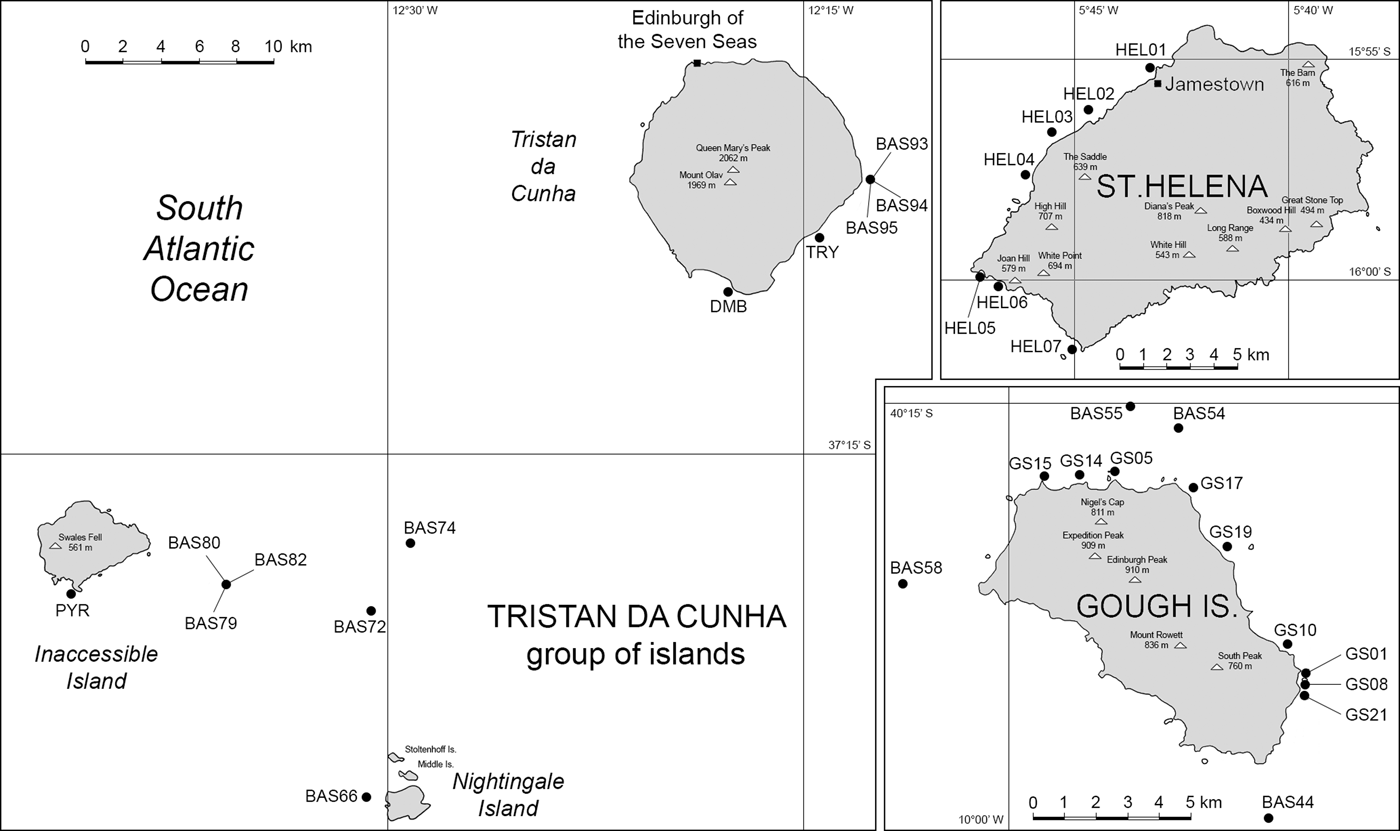
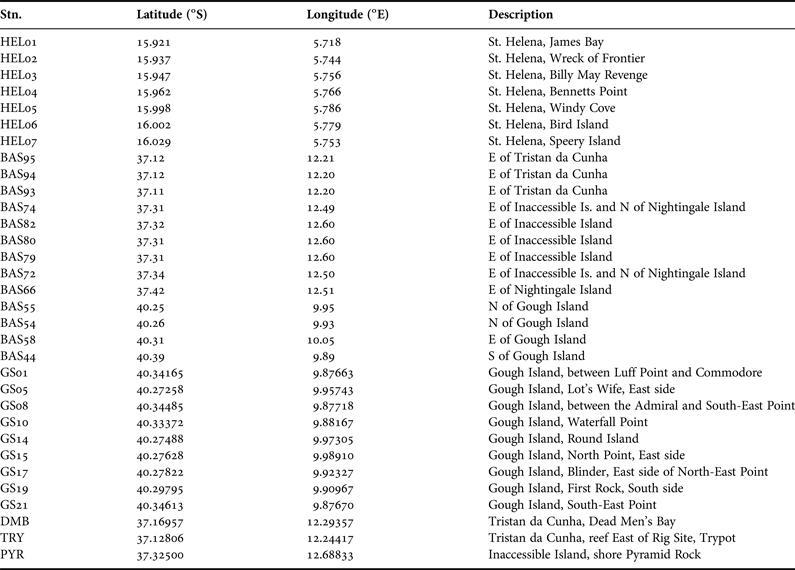
Sampling at Tristan da Cunha was done by scuba diving from the Tristan Fisheries Department RIB Janus tristani, which was based on the mother crayfish fishing ship MV Edinburgh. Deep-water sampling was undertaken during the Cruise JR287 of the British Antarctic Survey (May 2013) on board the James Clark Ross using an Agassiz trawl. Sampling at St. Helena was done by scuba diving, either from shore (Station HEL01) or from the hard boat Gannet III. The coordinates of stations are given in Table 1, and a map showing their position is illustrated in Figure 1. Close-up photographs were taken of several hydroids in their natural habitat. The collected specimens were fixed in either 4% formalin in seawater or 70% ethanol. Observations were done on preserved material using the methods described in Galea (Reference Galea2007, Reference Galea2010b). Most samples were deposited in collections of Muséum d'Histoire Naturelle in Geneva, Switzerland, and catalogue numbers are indicated by MHNG-INVE- followed by a five-digit number.
Map of the study area with the location of stations yielding hydroid material.

List of stations and their coordinates.
RESULTS
A total of 34 species, belonging to five families of Anthoathecata and eight families of Thecata, were sampled.
Taxonomic account
SYSTEMATICS
Subclass HYDROIDOLINA
Order ANTHOATHECATA Cornelius, Reference Cornelius1992
Family HYDRACTINIIDAE Agassiz, Reference Agassiz1862
Genus Fiordlandia
Fiordlandia protecta Schuchert, Reference Schuchert1996
(Figures 2A–E & 5A )
Fiordlandia protecta Schuchert, Reference Schuchert1996, Figures 31 & 32.
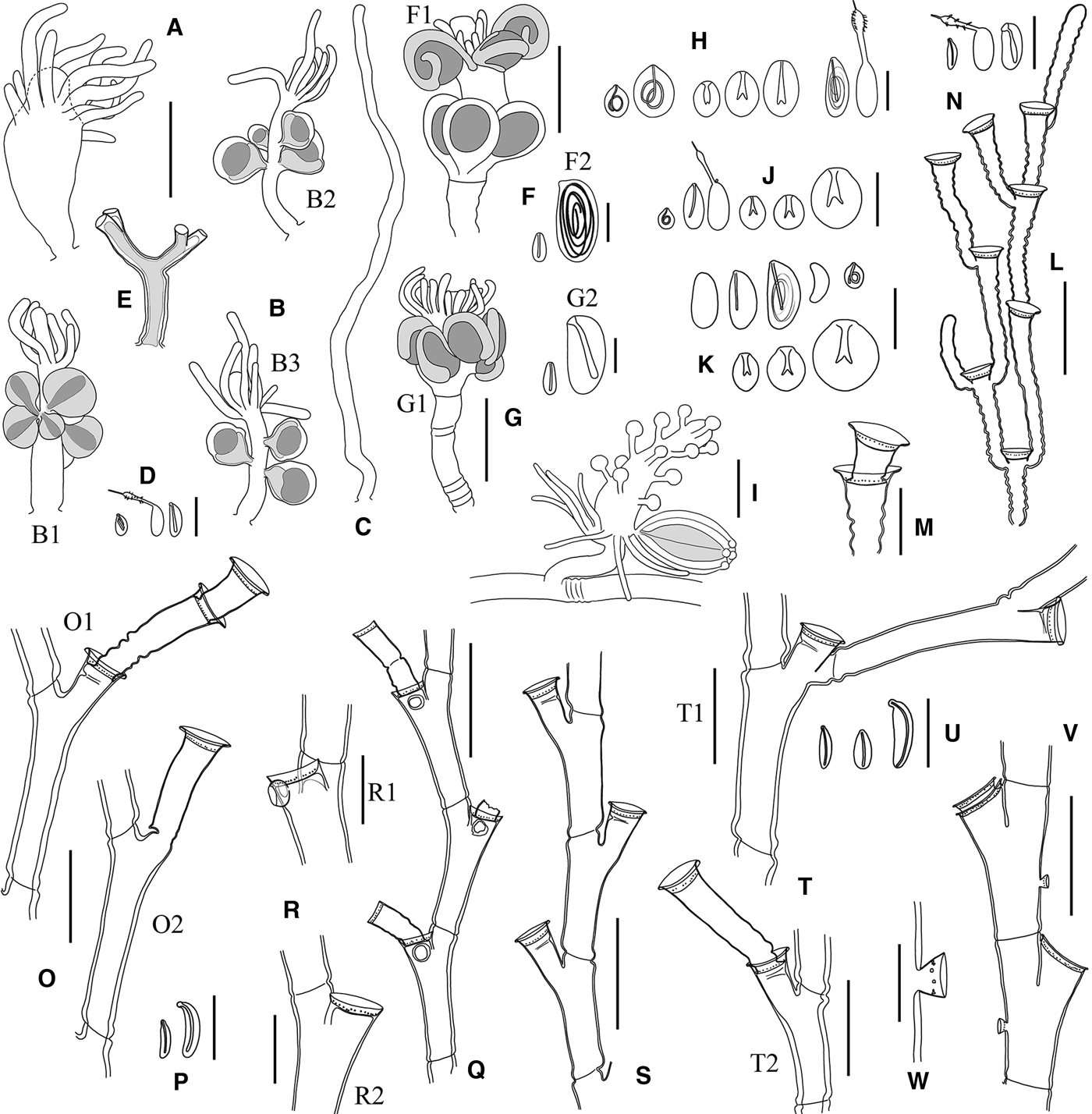
Fiordlandia protecta: gastrozooid (A), male (B1) and female (B2–3) gonozooids, tentaculozooid (C), cnidome (D), protective stolons (E). Eudendrium carneum: female gonozooid (F1), cnidome (F2). Eudendrium ramosum: female gonozooid (G1), cnidome (G2). Candelabrum sp.: cnidome (H). Ectopleura mayeri: cnidome (J). Zyzzyzus warreni: cnidome (K). Halecium cf. pusillum: erect stem (L), renovated hydrotheca (M), cnidome (N). Halecium sp. 1: internodes (O), cnidome (P). Halecium sp. 2: internodes (Q), hydrothecae (R). Halecium sp. 3: internodes (S, T), cnidome (U). Hydrodendron arboreum: internodes (V), nematotheca (W). Scale bars: 10 µm (D, F2, G2, H, J, K, N, P, U), 100 µm (W), 200 µm (M, R), 300 µm (O, T), 500 µm (A–C, E, F1, G1, I, L, Q, S, V).
MATERIAL EXAMINED
Three male and two female colonies on stems of Aglaophenia parvula Bale, Reference Bale1882 and unidentifiable hydroid; Station DMB, 14–20 m, MHNG-INVE-91726, coll. by S. Scott, 20 November 2007.
DIAGNOSIS
The so-far monotypic genus Fiordlandia Schuchert, Reference Schuchert1996 is immediately recognizable due the presence of characteristic perisarc-covered, branched, tubular structures (Figure 2E) arising from the hydrorhiza, and arching over the gonozooids, presumably acting as protective stolons. In addition, unlike other hydractiniid hydroids, the gonozooids produce gonophores in several rows around their bodies (Figure 2B). The cnidome, composed of desmonemes and microbasic euryteles (Figure 2D), is in perfect agreement with the diagnosis of the type of Fiordlandia protecta, as originally described by Schuchert (Reference Schuchert1996). However, the present material shows the presence of a few, scattered tentaculozooids (Figure 2C), unreported so far. Their occurrence and, when present, their number are most probably variable features that are consistent with the variability met with in other members of the family Hydractiniidae (Schuchert, Reference Schuchert2008a). It is not excluded that they were overlooked in the type material (P. Schuchert, personal communication).
DISTRIBUTION
Previously only know from New Zealand (Schuchert, Reference Schuchert1996). This is not only the second record of the species, but its finding in Tristan da Cunha, a very remote locality, suggests that we are most probably dealing with a species whose geographical distribution is underestimated due to the absence of recent taxonomical studies in the sub-Antarctic.
Subclass HYDROIDOLINA
Order ANTHOATHECATA
Family EUDENDRIIDAE Agassiz, Reference Agassiz1862
Genus Eudendrium
Eudendrium carneum Clarke, Reference Clarke1882
(Figure 2F)
Eudendrium carneum – Schuchert, Reference Schuchert2008b, Figure 11.
Eudendrium cunninghami Kirkpatrick, Reference Kirkpatrick and Cunningham1910, pl. 7, Figures 1–3.
MATERIAL EXAMINED
Three fragments (1.5–3 cm high) from female colony; Station HEL07, 20.4 m, MHNG-INVE-87686, coll. by J. Brown, 16 January 2014.
DIAGNOSIS
The female gonophores with bifid spadices given off around the bodies of atrophied hydranths, the basal embryos protected by filmy periderm (Figure 2F1), as well as the large haplonemes (Figure 2F2), are diagnostic of Eudendrium carneum.
DISTRIBUTION
Western Atlantic (from New England to Brazil), Mediterranean, tropical eastern Atlantic, South Africa, California to tropical eastern Pacific (Schuchert, Reference Schuchert2008b). First recorded in St. Helena by Kirkpatrick (Reference Kirkpatrick and Cunningham1910) as a supposedly new species, Eudendrium cunninghami.
Subclass HYDROIDOLINA
Order ANTHOATHECATA
Family EUDENDRIIDAE
Genus Eudendrium
Eudendrium ramosum (Linnaeus, Reference Linnaeus1758)
(Figure 2G)
Eudendrium ramosum – Schuchert, Reference Schuchert2008b, Figures 12–14.
MATERIAL EXAMINED
Female colony with up to 4.5 cm high stems; Station HEL02, 25.6 m, MHNG-INVE-87685, coll. by J. Brown, 13 January 2014.
DIAGNOSIS
The lightly fascicled stems, the non-reduced gonozooids, the female gonophores with simple spadices (Figure 2G1), as well as the large microbasic euryteles (Figure 2G2) scattered on the hydranths’ bodies, are diagnostic features of Eudendrium ramosum.
DISTRIBUTION
Reportedly circumglobal in warm or temperate waters, but also present in the Arctic, although a number of records are doubtful (Schuchert, Reference Schuchert2008b). This is the first record for St. Helena.
Subclass HYDROIDOLINA
Order ANTHOATHECATA
Family CANDELABRIDAE Stechow, Reference Stechow1921
Genus Candelabrum sp.
(Figures 2H & 5B )
MATERIAL EXAMINED
A 2.75 mm high, fertile specimen in kelp holdfast; Station GS14, 26–28 m, MHNG-INVE-91727, coll. by S. Scott, 3 February 2014.
DIAGNOSIS
The available specimen is small (~2.5 mm high), although it already bears a few gonophores whose sex could not be ascertained in fixed material. The blastostyles seem unbranched and devoid of tentacles. The distal part of the body is covered with numerous short, densely packed, capitate tentacles. The cnidome comprises small [(8.3–8.9) × (5.9–6.4) μm] and large [~12.9 × (9.9–10.2) μm] desmonemes, microbasic euryteles [(14.0–14.8) × (5.6–5.9) μm], as well as stenoteles [(10.0–12.4) × (7.2–9.7) μm]. In addition to the commonest, medium-sized capsules, both smaller [(7.0–8.3) × (5.1–6.2) μm] and larger stenoteles [~14.0 × (8.6–8.9) μm] occur rarely, and these may represent nothing more than the extremes of a normal size range.
REMARKS
A reliable identification based on a single, small specimen is impossible, even in the presence of gonophores and data on the cnidome composition. Blastostyles devoid of tentacles are characteristic of Candelabrum meridianum Briggs, 1939 (Millard, Reference Millard, van Zinderen Bakker, Winterbottom and Dyer1971), but the present individual is very young and its blastostyles may be insufficiently developed. In addition, other species of the genus have similar cnidomes, e.g. Candelabrum capensis (Manton, 1940) (Millard, Reference Millard1975), Candelabrum cocksii (Cocks, 1854) (Schuchert, Reference Schuchert2006), Candelabrum meridianum (Millard, Reference Millard, van Zinderen Bakker, Winterbottom and Dyer1971) and Candelabrum valdiviensis Galea & Schories, 2014 (Galea et al., Reference Galea, Schories, Försterra and Häussermann2014).
DISTRIBUTION
The present material originated from Gough Island.
Subclass HYDROIDOLINA
Order ANTHOATHECATA
Family PENNARIIDAE McCrady, Reference McCrady1859
Genus Pennaria
Pennaria disticha Goldfuss, Reference Goldfuss1820
(Figure 2I)
Pennaria disticha – Calder, Reference Calder2010, Figure 43.
MATERIAL EXAMINED
A few fragmented colonies with gonophores of both sexes; Station HEL02, 25.6 m, coll. by J. Brown, 13 January 2014.
REMARKS
For a recent redescription of this well-known species, refer to Calder (Reference Calder2010).
DISTRIBUTION
Circumglobal in tropical and warm-temperate waters (Calder, Reference Calder2010). This is the first record for St. Helena.
Subclass HYDROIDOLINA
Order ANTHOATHECATA
Family TUBULARIIDAE Allman, Reference Allman1864
Genus Ectopleura
Ectopleura mayeri Petersen, Reference Petersen1990
(Figures 2J & 5C)
Ectopleura mayeri Petersen, Reference Petersen1990, Figure 22. Galea, Reference Galea2013, pl. 1J, K, Figure 2N–Q.
MATERIAL EXAMINED
Five polyps, one of which bears recognizable gonophores; Station HEL03, 23.5 m, MHNG-INVE-91728, coll. by J. Brown, 18 January 2014.
DIAGNOSIS
The characteristic fluorescent yellow-greenish tinge of living hydranths (Figure 5C), combined with the presence of medusa buds with two marginal tentacles, leaves little doubt that the present material is conspecific with the specimens described earlier from Martinique (Galea, Reference Galea2013). In addition, the cnidome of the polyp, comprising three size classes of stenoteles, a desmoneme, as well as a heteroneme (Figure 2J), is indistinguishable from that of the Caribbean population. A few heteronemes, assigned earlier to the microbasic mastigophores (Galea, Reference Galea2013), were observed discharged, proving that they belong instead to the microbasic euryteles.
DISTRIBUTION
Bermuda, eastern coast of Panama, Cuba, Guadeloupe, Martinique (Galea, Reference Galea2013). This is the first record for St. Helena.
Subclass HYDROIDOLINA
Order ANTHOATHECATA
Family TUBULARIIDAE
Genus Zyzzyzus
Zyzzyzus warreni Calder, Reference Calder1988
(Figure 2K)
Zyzzyzus warreni – Campos et al., Reference Campos, Marques and Migotto2007, Figure 1.
MATERIAL EXAMINED
A few, badly preserved polyps with incipient gonophores on a piece of sponge; Station HEL06, 16.2 m, coll. by J. Brown, 16 January 2014.
DIAGNOSIS
Due to the poor state of preservation of the polyps, a proper identification based on morphological criteria could not be provided, but their cnidome composition (Figure 2K) is in perfect agreement with the illustrations provided by both Calder (Reference Calder1988, Figure 40) and Galea (Reference Galea2008, Figure 3I) based on specimens from Bermuda and Guadeloupe, respectively. For a thorough description of this species, refer to Campos et al. (Reference Campos, Marques and Migotto2007).
DISTRIBUTION
Western and south-eastern Atlantic, western Indian Ocean, and north-western Pacific (Campos et al., Reference Campos, Marques and Migotto2007). This is the first record for St. Helena.
Subclass HYDROIDOLINA
Order LEPTOTHECATA Cornelius, Reference Cornelius1992
Family HALECIIDAE Hincks, Reference Hincks1868
Halecium cf. pusillum Sars, 1856
(Figure 2L–N)
Halecium pusillum – Bouillon et al., Reference Bouillon, Medel, Pagès, Gili, Boero and Gravili2004, Figure 76D–G.
Halecium sp. – Galea, Reference Galea2010a, Figure 3C.
MATERIAL EXAMINED
Colony composed of a few sterile stems, up to 3.5 mm high, growing on ascidian-covered barnacles; Station PYR, 4–31.5 m, MHNG-INVE-91729, coll. by S. Scott, 28 November 2007.
DIAGNOSIS
Beside their infertile condition, these small, monosiphonic, dark-brown stems with annulated perisarc, with side branches given off singly or in pairs (Figure 2L) and flaring hydrothecae with everted rim (Figure 2M), suggests that we are probably dealing with M. Sars's (1856) species. Its cnidome composition (Figure 2N) was compared with that of Mediterranean specimens and proved identical. The very scarce material assigned earlier to Halecium sp. by Galea (Reference Galea2010a) likely belongs to the present species. For a recent redescription of Halecium pusillum, refer to Bouillon et al. (Reference Bouillon, Medel, Pagès, Gili, Boero and Gravili2004).
DISTRIBUTION
Although Halecium pusillum is mainly known from the Mediterranean and both sides of the Atlantic, several records from the Indo–Pacific also exist (Peña Cantero & García Carrascosa, Reference Peña Cantero and García Carrascosa2002).
Subclass HYDROIDOLINA
Order LEPTOTHECATA
Family HALECIIDAE
Genus Halecium sp. 1
(Figure 2O, P)
Halecium cf. delicatulum – Galea, Reference Galea2010a, Figure 3E, F (not Halecium delicatulum Coughtrey, 1876).
MATERIAL EXAMINED
Several sterile stems up to 3 cm high, on axis of dead gorgonian (sample DB12-0017); Station BAS44, 170 m, coll. by British Antarctic Survey, 19 May 2013.
DESCRIPTION
Halecium of flabby appearance. Stems monosiphonic, up to 3 cm high, divided into 590–805 µm long, slender, geniculate internodes by means of oblique nodes, 90–135 µm wide, slanting in alternate directions; distal ends of internodes swollen. Hydrophores well-developed, 50–150 µm (occasionally up to 345 µm) long, surpassing level of distal node, with pseudodiaphragm on adaxial side (Figure 2O1). Hydrothecae moderately deep (40–45 µm high), 110–120 µm wide at base and 160–175 µm wide at aperture; the latter with strongly everted rim. Side branches irregular and coplanar, borne on short apophyses given off from the stem hydrophores. Gonothecae absent. Cnidome: small, fusiform [(5.6–6.2) × ~1.6 µm] and large, banana-shaped [(8.9–9.7) × (2.4–2.7) μm] microbasic mastigophores.
REMARKS
This is evidently the same species as that assigned earlier to Halecium cf. delicatulum Coughtrey, 1876 (morphotype 1) by Galea (Reference Galea2010a). However, Galea et al. (Reference Galea, Schories, Försterra and Häussermann2014) indicated that Coughtrey's taxon is possibly restricted to New Zealand. The present material is unidentifiable in the absence of (female) gonothecae.
DISTRIBUTION
Secured from off South Gough Island.
Subclass HYDROIDOLINA
Order LEPTOTHECATA
Family HALECIIDAE
Genus Halecium sp. 2
(Figure 2Q, R)
MATERIAL EXAMINED
Several sterile stems up to 1.7 high, on axis of dead gorgonian (sample DB12-0369); Station BAS82, 160 m, coll. by British Antarctic Survey, 24 May 2013. Three sterile, polysiphonic stems 4.2–5.7 cm high with no hydrorhizae, as well as a few small, lightly fascicled stems growing on axis of dead gorgonian (sample DB12-0397b); Station BAS93, 100 m, coll. by British Antarctic Survey, 25 May 2013. A badly preserved, sterile colony 6.5 cm high (sample DB12-0440); Station BAS95, 90 m, MHNG-INVE-00000, coll. by British Antarctic Survey, 25 May 2013.
DESCRIPTION
Halecium of rigid appearance. Stems and basal part of side branches polysiphonic. Internodes thick, slightly geniculate to almost collinear (Figure 2Q), 525–650 µm long and 135–190 µm wide at nodes. Hydrophores inconspicuous, hydrothecae almost sessile, rather shallow (30–35 µm high), walls slightly diverging from a 125–140 µm wide base towards the 150–170 µm wide margin, the latter with no everted rim (Figure 2R). Side branches given off irregularly in all directions; main tube (in fascicled parts) borne on moderately long apophysis given off from below a stem hydrotheca. Gonothecae absent.
REMARKS
This species is unidentifiable in the absence of (female) gonothecae.
DISTRIBUTION
Specimens of this species were secured off Tristan da Cunha and Inaccessible Island.
Subclass HYDROIDOLINA
Order LEPTOTHECATA
Family HALECIIDAE
Genus Halecium sp. 3
(Figure 2S–U)
MATERIAL EXAMINED
Several infertile stems up to 1.5 cm high growing on serpulid tubes (sample H12); Station GS21, 25–30 m, coll. by S. Scott, 10 February 2014.
DIAGNOSIS
Halecium with monosiphonic stems, up to 1.5 cm high, divided into 475–600 µm long, almost collinear internodes by means of oblique nodes (90–130 µm wide) slanting in alternate directions; a bulge at each end of internode (Figure 2S). Hydrophores well-developed, 140–200 µm long, surpassing level of distal node, with conspicuous pseudodiaphragm on adaxial side (Figure 2T); each bears terminally a relatively shallow (35–40 µm high) hydrotheca, 115–135 µm wide at base and 160–185 µm wide at aperture; the latter with strongly everted margin (Figure 2T2). Side branches scarce and short, borne on reduced apophyses given off laterally from the stem hydrophores (Figure 2T1). Gonothecae absent. Cnidome (Figure 2U): small, fusiform [(5.6–6.4) × ~1.6 µm], medium, seed-shaped [(6.2–6.5) × (2.9–3.2) μm], and large, banana-shaped [(9.4–10.5) × (2.7–2.9) μm] microbasic mastigophores.
REMARKS
This species is unidentifiable in the absence of (female) gonothecae.
DISTRIBUTION
This species occurred at Gough Island.
Subclass HYDROIDOLINA
Order LEPTOTHECATA
Family HALECIIDAE
Genus Hydrodendron
Hydrodendron arboreum (Allman, Reference Allman1888)
(Figure 2V, W)
Halecium robustum Allman, Reference Allman1888, pl. 4, Figures 1–3.
Halecium arboreum Allman, Reference Allman1888: legend of pl. 4. Jäderholm, Reference Jäderholm1905, pl. 5, Figure 4. Hickson & Gravely, Reference Hickson and Gravely1907, pl. 4, Figures 27–29.
Ophiodes arboreus – Billard, Reference Billard1910; 1914. Ritchie, Reference Ritchie1913, Figures 2 & 3. Stepanjants, Reference Stepanjants1979, pl. 21, Figure 1A–V.
Ophiodissa arborea – Totton, Reference Totton1930, Figure 2A. Briggs, Reference Briggs1938. Blanco, Reference Blanco1978, Figures 1 & 2.
Hydrodendron arborea – Rees & Thursfield, Reference Rees and Thursfield1965. Millard, Reference Millard1977, Figure 2E–G.
Hydrodendron arboreum – Branch & Williams, Reference Branch and Williams1993, Peña Cantero & Gili, Reference Peña Cantero and Gili2006. Peña Cantero & Ramil, Reference Peña Cantero and Ramil2006, Figure 2C. Peña Cantero, Reference Peña Cantero2008; Reference Peña Cantero2009. Peña Cantero et al., Reference Peña Cantero, Boreo and Piraino2013, Figure 9A–C.
? Ophiodissa armata Totton, Reference Totton1930, Figure 2B.
? Hydrodendron armata – Ralph, Reference Ralph1958, Figures 13D–I & 14B–D.
? Ophyodes armatus – Stepanjants, Reference Stepanjants1979, pl. 21, Figure 2A, B.
? Hydrodendron tottoni Rees & Vervoort, Reference Rees and Vervoort1987. Vervoort & Watson, Reference Vervoort and Watson2003, Figure 19G–I.
MATERIAL EXAMINED
A sterile colony 3.8 cm high detached from its substrate (sample DB12-0265); Station BAS72, 180 m, MHNG-INVE-91730, coll. by British Antarctic Survey, 23 May 2013.
REMARKS
The present material, with short primary hydrophores (Figure 2V) and small nematothecae on opposite sides of the internodes (Figure 2V, W), is assigned to the synonymy of Allman's species.
The concept of Hydrodendron arboreum, especially with respect to the previously mentioned features, is variously accepted among taxonomists. Short hydrophores were reported by Billard (Reference Billard1910; re-examination of the type), Jäderholm (Reference Jäderholm1905), Blanco (Reference Blanco1978), Millard (Reference Millard1977) and Peña Cantero & Ramil (Reference Peña Cantero and Ramil2006). In contrast long hydrophores are mentioned by Totton (Reference Totton1930) and Peña Cantero et al. (Reference Peña Cantero, Boreo and Piraino2013). Discrepancies between the description and illustration given by Hickson & Gravely (Reference Hickson and Gravely1907) were pointed out by Billard (Reference Billard1910). Ritchie (Reference Ritchie1913) recognized that ‘there is some variation in the condition exhibited by the hydrothecae. While, in the majority of cases, a hydrotheca is closely apposed to the internode, at least the margin is free, although it does not, or scarcely does, reach beyond the node’.
The taxonomic status of Hydrodendron tottoni Ress & Vervoort, Reference Rees and Vervoort1987 (replacement name for Ophiodissa armata Totton, Reference Totton1930) is presently unclear with respect to Hydrodendron arboreum. In this nominal species, Ralph (Reference Ralph1958) identified features that Totton (Reference Totton1930) ascribed to Allman's taxon (‘larger nematothecae restricted to the proximal part of the internode opposite the hydrotheca, a deeper hydrotheca, and with a greater part of hydrothecal wall free from the stem’), but pointed out similarities between their respective gonosomes, admitting that ‘H. armata is a closely allied if not a varietal form of the latter species’.
Vervoort & Watson (Reference Vervoort and Watson2003) kept separate Hydrodendron tottoni from Hydrodendron arboreum on the account of its almost sessile hydrothecae; however, their material had scarce nematothecae, which, when present, were found on the internodes opposite the corresponding hydrophores, thus resembling Hydrodendron arboreum as defined by Totton (Reference Totton1930).
DISTRIBUTION
Kerguelen (Allman, Reference Allman1888; Millard, Reference Millard1977; Stepanjants, Reference Stepanjants1979), Crozet (Millard, Reference Millard1977; Stepanjants, Reference Stepanjants1979), Falkland Islands (Jäderholm, Reference Jäderholm1905), South Georgia (Jäderholm, Reference Jäderholm1905), Patagonia (Stepanjants, Reference Stepanjants1979), Prince Edward Island (Totton, Reference Totton1930; Branch & Williams, Reference Branch and Williams1993), Marion Island (Branch & Williams, Reference Branch and Williams1993), Antarctica (Peña Cantero et al., Reference Peña Cantero, Boreo and Piraino2013).
Subclass HYDROIDOLINA
Order LEPTOTHECATA
Family HEBELLIDAE Fraser, Reference Fraser1912
Genus Hebella
Hebella furax Millard, Reference Millard1957
(Figure 3A)
Hebella furax – Millard, Reference Millard1975, Figure 60A–C.
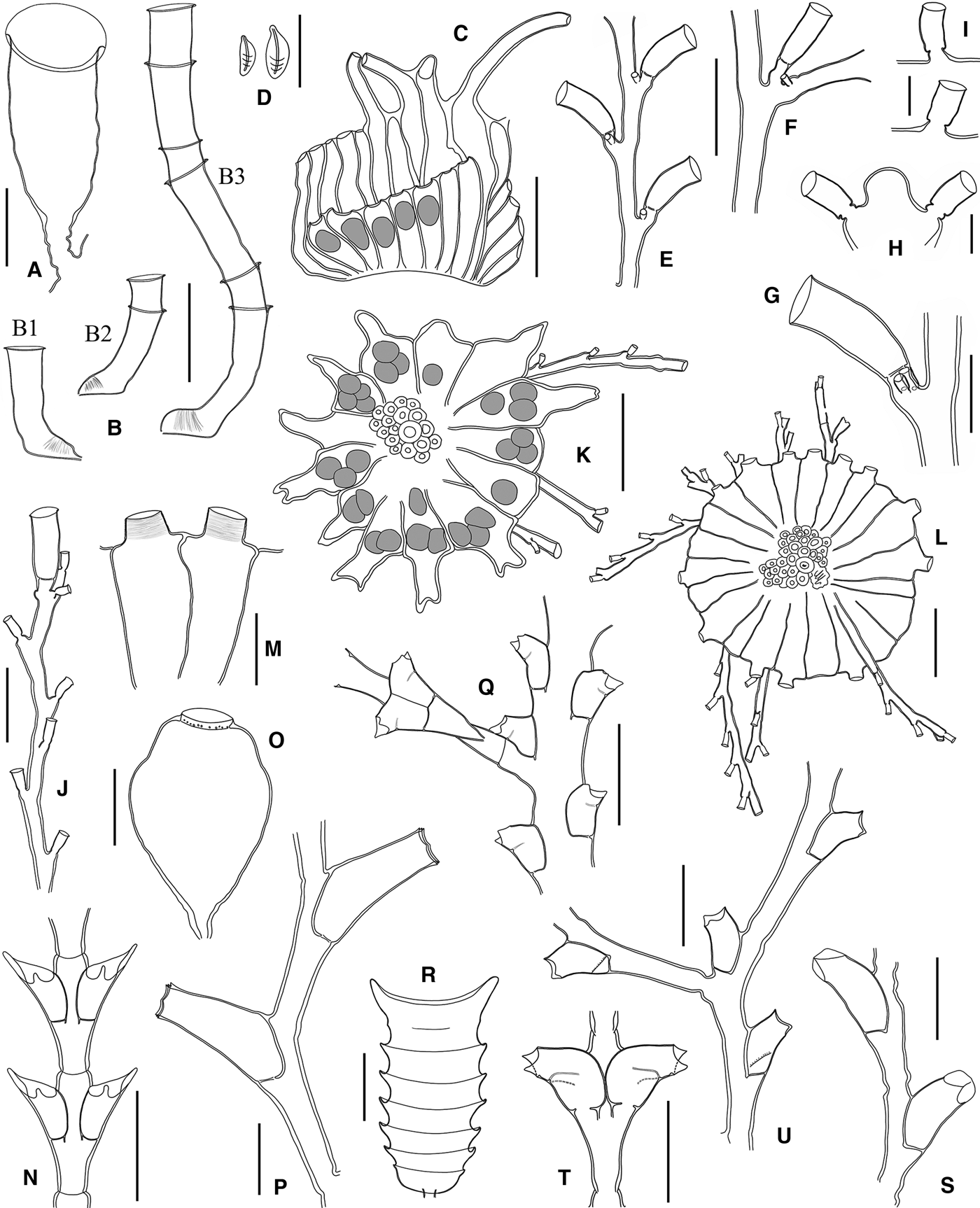
Hebella furax: hydrotheca (A). Filellum bouvetensis: hydrothecae (B), coppinia (C), cnidome (D). Zygophylax armata: internodes (E), axillar hydrotheca (F), detail of a hydrotheca (G), axillar nematothecae (H), detail of two nematothecae (I), nematophorous ramulus (J), cross section through a female coppinia (K) and a second coppinia (L), detail of two gonothecae (M). Amphisbetia operculata: internodes (N), gonotheca (O). Sertularella leiocarpa: internodes (P). Sertularia marginata: fragment of stem with beginning of cladium (Q), gonotheca (R). Sertularia tongensis: internodes (S). Sertularia turbinata: internode (T). Symplectoscyphus cf. filiformis: fragment of stem and proximal part of a side branch (U). Scale bars: 10 µm (D), 50 µm (H, I), 200 µm (G, M), 300 µm (J, S), 500 µm (A–C, E, F, K, L, N–R, T, U).
MATERIAL EXAMINED
Several hydrothecae arising from a stolon creeping on stems of Macrorhynchia filamentosa (Lamarck, 1816); Station HEL07, 20.4 m, MHNG-INVE-91731, coll. by J. Brown, 16 January 2014.
DIAGNOSIS
The large size of the hydrothecae (1185–1250 µm long and 475–565 µm wide in middle), their strongly everted margin (diameter 550–645 µm), the presence of a pronounced basal, annular thickening (Figure 3A), combined to their occurrence on Macrorhynchia filamentosa, are typical features of Hebella furax as stated by Millard (Reference Millard1975).
DISTRIBUTION
South Africa, Seychelles (Millard, Reference Millard1975), Brazil (Migotto & de Andrade, Reference Migotto and de Andrade2000). This is the first record for St Helena (present study).
Subclass HYDROIDOLINA
Order LEPTOTHECATA
Family LAFOEIDAE Hincks, Reference Hincks1868
Genus Filellum
Filellum bouvetensis Marques et al., Reference Marques, Peña Cantero, Miranda and Migotto2011
(Figures 3B–D & 5D )
Filellum bouvetensis Marques et al., Reference Marques, Peña Cantero, Miranda and Migotto2011, Figure 2.
MATERIAL EXAMINED
Fertile colony (two coppiniae present) growing on surface of dead, unrecognizable hydroid with polysiphonic, ramified stem (sample DB12-0018); Station BAS44, 170 m, MHNG-INVE-91732, coll. by British Antarctic Survey, 19 May 2013.
DIAGNOSIS
The hydrothecae are provided with short, adnate parts bearing numerous, closely set striae on their abaxial surface (Figure 3B1–3); the free parts, most often carrying several renovations (Figure 3B2–3), are 520–2220 µm long, and 215–260 µm wide at aperture. These dimensions match the measurements given by Marques et al. (Reference Marques, Peña Cantero, Miranda and Migotto2011) for Filellum bouvetensis and distinguish this nominal species from its congeners with similar coppiniae, namely Filellum antarcticum (Hartlaub, Reference Hartlaub1904), Filellum conopeum Watson, Reference Watson2003 and Filellum magnificum Peña Cantero et al., Reference Peña Cantero, Svoboda and Vervoort2004.
Two coppinia, both enclosing female gonothecae, occur in the present material. The larger one is 2.5 long (Figure 5D ), and the smaller one (~1 mm long) was dissected in order to observe its internal structure (Figure 3C), the latter corresponding to the description of the type.
The cnidome comprises two size classes of heteronemes (Figure 3D): one with more fusiform (~5.7 × 2.3 µm) and the other with more swollen (~7.8 × 3.2 µm) capsules, the former not reported so far.
DISTRIBUTION
The sole, earlier record is from Bouvet Island (Marques et al., Reference Marques, Peña Cantero, Miranda and Migotto2011). The present material off Gough Island represents not only the second record of the species, but also extends northward its area of occurrence.
Subclass HYDROIDOLINA
Order LEPTOTHECATA
Family LAFOEIDAE
Genus Zygophylax
Zygophylax armata (Ritchie, Reference Ritchie1907)
(Figure 3E–L)
Brucella armata Ritchie, Reference Ritchie1907, pl. 2, Figure 2A–C.
MATERIAL EXAMINED
Seven pinnate colonies 1.8–5.0 cm high and three coppinia, on axis of dead gorgonian (sample DB12-0071); Station BAS54, 120 m, MHNG-INVE-91733, coll. by British Antarctic Survey, 20 May 2013. Four sterile, pinnate stems 2.0–4.4 cm high detached from their substrate (sample DB12-0177); Station BAS58, 166 m, MHNG-INVE-91734, coll. by British Antarctic Survey, 20 May 2013. A fan-shaped colony composed of several stems up to 5.8 cm high, some with female coppinia, on axis of dead gorgonian (sample DB12-0195b); Station BAS66, 120 m, MHNG-INVE-91735, coll. by British Antarctic Survey, 22 May 2013. Sterile colony composed of several pinnate stems, up to 1.4 cm high, on axis of dead gorgonian (sample DB12-0369); Station BAS82, 160 m, MHNG-INVE-91736, coll. by British Antarctic Survey, 24 May 2013.
REMARKS
The trophosomes of the present specimens are in perfect agreement with the description of the type by Ritchie (Reference Ritchie1907). Four coppinia masses (2–9 mm long) occur on two of the stems in sample DB12-0195b. The largest one comprises flask-shaped gonothecae, adnate to each other for two-thirds of their length, tapering basally, attaining their maximum width at the top of contiguous part, their distal end being produced as a simple or bifid horn (Figure 3K). Three or four large oocytes are present in each gonotheca, but no distinct aperture could be seen at this stage.
Besides two coppinia (both ~4 mm long) with gonothecae exhibiting the same shape as those from sample DB12-0195b, a third coppinia (~3 mm long) with morphologically different gonothecae (Figure 3L) also occurs in sample DB12-0071. The distal end of the gonothecae is neck-shaped, finely and transversely striated and bears a large, circular aperture on top (Figure 3M). Since no morphological differences between the trophosomes of the colonies bearing the two types of coppinia could be noted, it is difficult to explain the dissimilarities displayed in their respective gonosomes in the absence of more abundant, fertile material.
Nematophorous ramuli, bearing both nemato- and hydrothecae (Figure 3J), spring irregularly from between either type of gonothecae.
DISTRIBUTION
Off Gough Island (Ritchie, Reference Ritchie1907, present study), off Inaccessible Island and Nightingale Island (present study), South Africa (Millard, Reference Millard1975), Kerguelen and Crozet (Stepanjants, Reference Stepanjants1979).
Subclass HYDROIDOLINA
Order LEPTOTHECATA
Family SERTULARIIDAE Lamouroux, Reference Lamouroux1812
Genus Amphisbetia
Amphisbetia operculata (Linnaeus, Reference Linnaeus1758)
(Figure 3N, O)
Amphisbetia operculata – Cornelius, Reference Cornelius1979, Figure 6.
MATERIAL EXAMINED
A fertile colony ~11 cm high growing on bottom of barge; Station HEL01, 1–2 m, MHNG-INVE-91737, coll. by J. Brown, 19 December 2013.
REMARKS
This well-known species needs no additional comments on morphology. For a redescription, refer to Cornelius (Reference Cornelius1979).
DISTRIBUTION
Circumglobal in temperate waters (Watson, Reference Watson, Wells, Walker and Kendrick2005). This is the first record for St. Helena.
Subclass HYDROIDOLINA
Order LEPTOTHECATA
Family SERTULARIIDAE
Genus Amphisbetia
Amphisbetia minima (Thompson, Reference Thompson1879)
Amphisbetia minima – Millard, Reference Millard1975, Figure 82H–K.
MATERIAL EXAMINED
A male and two female colonies on red algae (sample H3); Station GS10, 9–12 m, MHNG-INVE-91738, coll. by S. Scott, 31 January 2014.
REMARKS
For a redescription of this well-known species, refer to Millard (Reference Millard1975). Galea (Reference Galea2010a) provides illustrations of material from Tristan da Cunha.
DISTRIBUTION
Temperate and sub-Antarctic waters of the southern hemisphere (Vervoort & Watson, Reference Vervoort and Watson2003). Recorded earlier from Tristan da Cunha (Galea, Reference Galea2010a).
Subclass HYDROIDOLINA
Order LEPTOTHECATA
Family SERTULARIIDAE
Genus Sertularella
Sertularella gayi (Lamouroux, Reference Lamouroux1821)
Sertularella gayi Ramil et al., Reference Ramil, Parapar and Vervoort1992, Figures 1A, 2 & 3.
MATERIAL EXAMINED
A 1.5 cm high, sterile, unbranched stem (sample DB12-0209); Station BAS66, 120 m, MHNG-INVE-91739, coll. by British Antarctic Survey, 22 May 2013. Four sterile colonies 2–4 cm high (sample DB12-0308); Station BAS79, 160 m, MHNG-INVE-91740, coll. by British Antarctic Survey, 24 May 2013. Eight young, sterile stems, 1.0–1.3 cm high, some with a short lateral branch (sample DB12-0312); Station BAS79, 160 m, MHNG-INVE-91741, coll. by British Antarctic Survey, 24 May 2013. Two sterile fragments forming a colony originally 4 cm high (sample DB12-0340); Station BAS80, 160 m, MHNG-INVE-91742, coll. by British Antarctic Survey, 24 May 2013. Three sterile fragments from a colony originally 5.7 cm high (sample DB12-0421); Station BAS94, 90 m, MHNG-INVE-91743, coll. by British Antarctic Survey, 25 May 2013. A sterile colony 7 cm high (sample DB12-0427); Station BAS94, 90 m, MHNG-INVE-91744, coll. by British Antarctic Survey, 25 May 2013.
REMARKS
Specimens from Tristan da Cunha assigned to this species were reported in an earlier account (Galea, Reference Galea2010a). As previously, the present material is sterile, but the identification is likely reliable on the account of the polysiphonic structure of the stem and morphological similarity of the hydrothecae when compared with European material.
DISTRIBUTION
Widely distributed in the Atlantic, also occurring in the northern Pacific (Vervoort & Watson, Reference Vervoort and Watson2003). In the study area, it was recorded from off Gough Island (Ritchie, Reference Ritchie1907) and the Tristan da Cunha group of islands (Galea, Reference Galea2010a, present report), as well as off St. Helena (Ritchie, Reference Ritchie1909).
Subclass HYDROIDOLINA
Order LEPTOTHECATA
Family SERTULARIIDAE
Genus Sertularella
Sertularella leiocarpa (Allman, Reference Allman1888)
(Figure 3P )
Sertularella leiocarpa – Millard, Reference Millard1975, Figure 95D–F.
MATERIAL EXAMINED
Colony composed of five sterile stems up to 3 cm high (sample DB12-0340); Station BAS80, 160 m, MHNG-INVE-91745, coll. by British Antarctic Survey, 24 May 2013.
DIAGNOSIS
The monosiphonic condition of these infertile stems, their mode of branching, the large, deep and almost cylindrical hydrothecae with small marginal cusps separated by shallow embayments (Figure 3P), as well as the occurrence of this material in the same location as the type of Allman's species, leave little doubt about its specific identity.
DISTRIBUTION
Off Inaccessible Island (present report), off Nightingale Island, off Namibia, scattered records in the south and south-east Indian Ocean, New Caledonia and New Zealand (Vervoort & Watson, Reference Vervoort and Watson2003).
Subclass HYDROIDOLINA
Order LEPTOTHECATA
Family SERTULARIIDAE
Genus Sertularia
Sertularia marginata (Kirchenpauer, Reference Kirchenpauer1864)
(Figure 3Q, R)
Sertularia marginata – Calder, Reference Calder1983, Figures 6 & 7.
MATERIAL EXAMINED
Several stems and fragments 1.0–2.2 cm high, one of which bears five gonothecae; Station HEL07, 20.4 m, MHNG-INVE-91746, coll. by J. Brown, 16 January 2014. Three infertile stems 0.9–1.6 cm high; Station HEL05, 20.5 m, MHNG-INVE-91747, coll. by J. Brown, 29 January 2014.
REMARKS
This very characteristic species requires no additional comments on morphology. For a redescription, refer to Calder (Reference Calder1983).
DISTRIBUTION
Circumglobal in tropical and subtropical seas (Medel & Vervoort, Reference Medel and Vervoort1998). This is the first record for St. Helena.
Subclass HYDROIDOLINA
Order LEPTOTHECATA
Family SERTULARIIDAE
Genus Sertularia
Sertularia tongensis (Stechow, Reference Stechow1919)
(Figure 3S)
Sertularia tongensis – Galea, Reference Galea2010b, Figure 5H–M.
MATERIAL EXAMINED
Four infertile stems up to 5 mm high epizoic on stolon of Aglaophenia parvula Bale, Reference Bale1882; Station HEL07, 20.4 m, MHNG-INVE-91748, coll. by J. Brown, 16 January 2014.
DIAGNOSIS
Even in the absence of fertile specimens, these stems with alternate hydrothecae (Figure 3S), whose apertures are closed by two opercular flaps (one adaxial, the other abaxial), both pleated along a median line (giving the impression of a four-flapped operculum), could be assigned with no doubt to the present species.
DISTRIBUTION
Caribbean, western Mediterranean, Seychelles, Chagos Archipelago, southern India, Indonesia, Japan, Australia, Kingdom of Tonga, Marshall islands, French Polynesia, Fiji (Galea, Reference Galea2010b). This is the first record for St. Helena and the mid-Atlantic.
Subclass HYDROIDOLINA
Order LEPTOTHECATA
Family SERTULARIIDAE
Genus Sertularia
Sertularia turbinata (Lamouroux, Reference Lamouroux1816)
(Figure 3T)
Sertularia turbinata – Millard, Reference Millard1975, Figure 100B, C, E.
MATERIAL EXAMINED
Several infertile stems 8–15 mm high; Station HEL04, 22.3 m, MHNG-INVE-91749, coll. by J. Brown, 24 January 2014.
DIAGNOSIS
Even in the absence of gonothecae, these unbranched stems with moderately long internodes, carrying distally a pair of partly contiguous, tumid hydrothecae, exhibiting an internal horseshoe-shaped perisarc ridge (Figure 3T), leave little doubt about their specific identity.
DISTRIBUTION
Circumglobal in tropical and subtropical waters (Millard, Reference Millard1975). This is the first record for St. Helena.
Subclass HYDROIDOLINA
Order LEPTOTHECATA
Family SERTULARIIDAE
Genus Symplectoscyphus
Symplectoscyphus cf. filiformis (Allman, Reference Allman1888)
(Figure 3U)
Symplectoscyphus filiformis Galea, Reference Galea2007, Figure 16A–I. Galea & Schories, Reference Galea and Schories2012, Figure 5Q, R.
MATERIAL EXAMINED
Three sterile stems 7–12 mm high detached from their substrate (sample DB12-0107); Station BAS55, 166 m, MHNG-INVE-91750, coll. by British Antarctic Survey, 20 May 2013.
REMARKS
A comparison of this sterile material with fertile specimens of Symplectoscyphus filiformis from southern Chile, extensively studied by both Galea (Reference Galea2007) and Galea & Schories (Reference Galea and Schories2012), leave little doubt about its specific identity.
DISTRIBUTION
Atlantic and Pacific coasts of South America, Falkland Islands, Burdwood Bank, Kerguelen, Crozet, Marion and Prince Edward Islands and Weddel Sea (Galea & Schories, Reference Galea and Schories2012). This is the first record for Gough Island.
Subclass HYDROIDOLINA
Order LEPTOTHECATA
Family THYROSCYPHIDAE Stechow, Reference Stechow1920
Genus Parascyphus
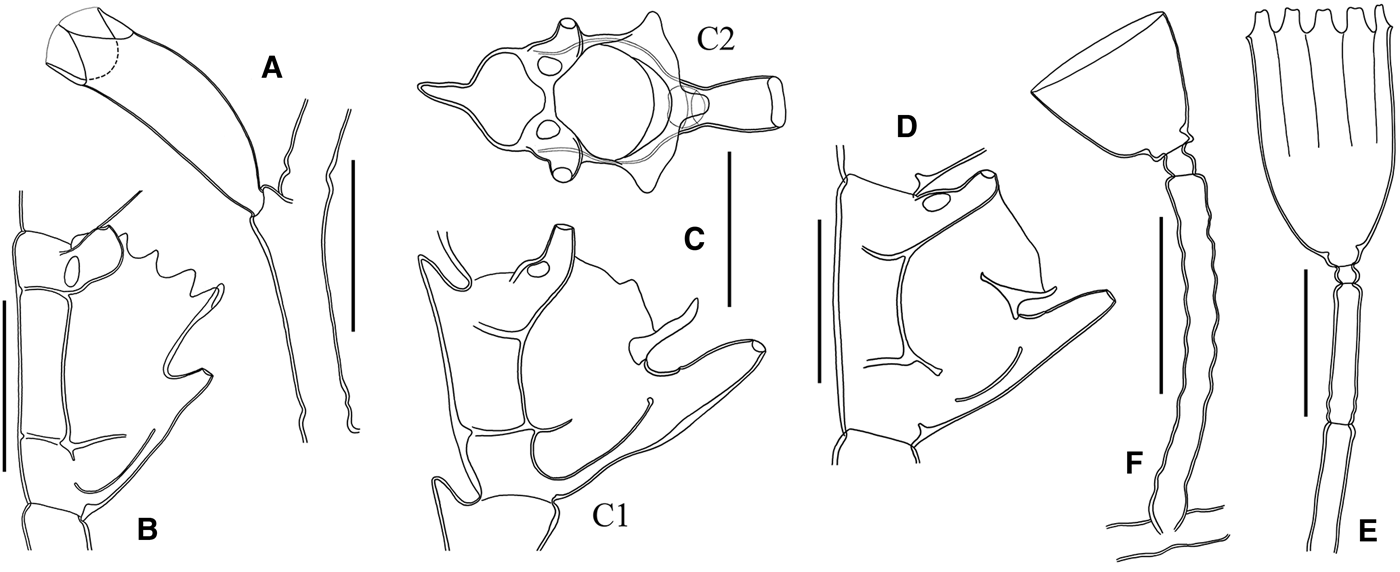
Parascyphus simplex (Lamouroux, Reference Lamouroux1816)
(Figure 4A)
Parascyphus simplex Vervoort & Watson, Reference Vervoort and Watson2003, Figure 57I & J.
Parascyphus simplex: internode with hydrotheca (A). Aglaophenia picardi: cormidium (B). Macrorhynchia filamentosa: cormidium in lateral (C1) and apical (C2) views. Macrorhynchia philippina: cormidium (D). Campanularia hincksii: hydrotheca atop its pedicel (E). Orhopyxis cf. caliculata: hydrotheca atop its pedicel (F). Scale bars: 200 µm (B–D), 500 µm (A, E, F).
MATERIAL EXAMINED
Several sterile stems up to 1.5 cm high, on bryozoan and unidentified substrate (sample DB12-0107); Station BAS55, 166 m, MHNG-INVE-91751, coll. by British Antarctic Survey, 20 May 2013. A colony composed of seven sterile, badly preserved stems, 3–15 mm high, detached from substrate (sample DB12-0190); Station BAS58, 166 m, MHNG-INVE-91752, coll. by British Antarctic Survey, 20 May 2013.
DIAGNOSIS
The tricuspidate hydrothecae make this species immediately distinguishable from the second member of the genus, Parascyphus repens (Jäderholm, 1904), which possesses four marginal cusps (Galea, Reference Galea2007). For a redescription of the trophosome of this species, refer to Vervoort & Watson (Reference Vervoort and Watson2003). Its gonothecae were observed only in rare instances (see Galea et al., Reference Galea, Schories, Försterra and Häussermann2014).
DISTRIBUTION
Australia, Bass Strait, Tasmania, Vema Seamount, South Africa, southern Chile (Galea et al., Reference Galea, Schories, Försterra and Häussermann2014). Previously recorded off Gough Island (Ritchie, Reference Ritchie1909), it was secured again from the same area (present study).
Subclass HYDROIDOLINA
Order LEPTOTHECATA
Family PLUMULARIIDAE Hincks, Reference Hincks1868
Genus Plumularia
Plumularia setacea (Linneaus, 1758)
Plumularia setacea Schuchert, Reference Schuchert2013, Figures 2A, B & 4–6.
MATERIAL EXAMINED
Several female stems up to 4 cm high growing on two small sponges (sample H1); Station GS01, 17–18 m, MHNG-INVE-91753, coll. by S. Scott, 26 January 2014. A cluster of 3 cm high plumes on serpulid tubes (sample H13); Station GS10, 9–12 m, MHNG-INVE-91754, coll. by S. Scott, 31 January 2014. Male and female stems, up to 5.5 cm high, on serpulid tubes (sample H9); Station GS15, 0–30 m, MHNG-INVE-91755, coll. by S. Scott, 4 February 2014.
REMARKS
Specimens of this species from Tristan da Cunha were identified and illustrated earlier by Galea (Reference Galea2010a). The size and general outline of the plumes is typical of specimens from exposed environments. Microscopically, their features match the present concept of the species as described by Schuchert (Reference Schuchert2013). Notable is the presence of two axillar nematothecae, a character apparently most often met with in populations from the southern hemisphere (Totton, Reference Totton1930; Galea, Reference Galea2007).
DISTRIBUTION
Schuchert (Reference Schuchert2014), based on molecular analyses, pointed out that the actual concept of Plumularia setacea comprises a multitude of geographically delimited lineages corresponding to cryptic species. However, according to traditional taxonomy, P. setacea could be considered as a highly variable, nearly cosmopolitan species.
Subclass HYDROIDOLINA
Order LEPTOTHECATA
Family HALOPTERIDIDAE Millard, Reference Millard1962
Genus Antennella
Antennella quadriaurita Ritchie, Reference Ritchie1909
Antennella quadriaurita Schuchert, Reference Schuchert1997, Figure 9. Galea & Ferry, Reference Galea and Ferry2015 (Figure 7H–N).
MATERIAL EXAMINED
Male colony with stems up to 5 cm high growing on cluster of serpulid tubes (sample H5); Station GS08, 10–17 m, MHNG-INVE-91125, coll. by S. Scott, 29 January 2014. Sterile colony with stems up to 2.5 cm high (sample H6); Station GS17, 3–27 m, MHNG-INVE-91756, coll. by Rohan Holt, 6 February 2014. Sterile colony with stems up to 1.8 mm high (most broken off) arising from massive rhizoidal stolon growing among bryozoans and serpulid tubes (sample H4); Station GS10, 9–12 m, MHNG-INVE-91757, coll. by S. Scott, 31 January 2014. Colony composed of up to 7–8 cm high stems, some with female gonothecae (sample DB12-0073); Station BAS54, 120 m, MHNG-INVE-91758, coll. by British Antarctic Survey, 20 May 2013. Colony composed of up to 6.0 cm high stems, some with female gonothecae (sample DB12-0260); Station BAS72, 180 m, MHNG-INVE-91126, coll. by British Antarctic Survey, 23 May 2013. Colony composed of up to 5.5 cm high stems, some with either male or female gonothecae (sample DB12-0293); Station BAS74, 200 m, MHNG-INVE-91760, coll. by British Antarctic Survey, 23 May 2013. Colony composed of up to 3.5 cm high stems, some with female gonothecae (sample DB12-0420); Station BAS94, 90 m, MHNG-INVE-91127, coll. by British Antarctic Survey, 25 May 2013. Colony composed of up to 3 cm high stems, some with female gonothecae (sample DB12-0439); Station BAS95, 90 m, MHNG-INVE-91762, coll. by British Antarctic Survey, 25 May 2013.
REMARKS
The morphological variation observed in the present material, as well as illustrations of the specimens involved are provided by Galea & Ferry (Reference Galea and Ferry2015). Earlier, Galea (Reference Galea2013) gave reasons to believe that several world records may not belong to Antennella quadriaurita, owing to dissimilar morphological characters reported by several authors.
DISTRIBUTION
Unresolved at present, although a summary of world records is given by Schuchert (Reference Schuchert1997). According to Galea & Ferry (Reference Galea and Ferry2015), reliable records are from the Tristan da Cunha area (Galea, Reference Galea2010a, present study), Congo (Broch, Reference Broch and Michaelsen1914), Vema Seamount (Millard, Reference Millard1966), South Africa (Millard, Reference Millard1975) and Brazil (Grohmann et al., Reference Grohmann, Nogueira and Da Silva2003).
Subclass HYDROIDOLINA
Order LEPTOTHECATA
Family AGLAOPHENIIDAE Marktanner-Turneretscher, Reference Marktanner-Turneretscher1890
Genus Aglaophenia
Aglaophenia parvula Bale, Reference Bale1882
Aglaophenia parvula Svoboda & Cornelius, Reference Svoboda and Cornelius1991, Figures 7–9, 10A–E, 13H, 18, 22 & 23.
MATERIAL EXAMINED
Several fully fertile cormoids, up to 6 cm, some exhibiting the characteristic dichotomous branching pattern, on sponge (sample H2); Station GS01, 17–18 m, MHNG-INVE-91763, coll. by Rohan Holt, 26 January 2014. Several unbranched cormoids up to 3 cm high, mostly fertile; Station HEL07, 20.4 m, MHNG-INVE-91764, coll. by J. Brown, 16 January 2014.
REMARKS
The samples examined are consistent with the other accounts of the morphology of this well-known species (Svoboda & Cornelius, Reference Svoboda and Cornelius1991).
DISTRIBUTION
Widespread in warm and temperate waters around the world (Svoboda & Cornelius, Reference Svoboda and Cornelius1991). Earlier records from Tristan da Cunha, Inaccessible Island and Nightingale Island are given in Galea (Reference Galea2010a). This is the first record for St. Helena.
Subclass HYDROIDOLINA
Order LEPTOTHECATA
Family AGLAOPHENIIDAE
Genus Aglaophenia
Aglaophenia picardi Svoboda, Reference Svoboda1979
(Figure 4B)
Aglaophenia picardi Svoboda & Cornelius, Reference Svoboda and Cornelius1991, Figure 11.
MATERIAL EXAMINED
Several cormoids up to 3.5 cm high, two of which being fertile; Station HEL05, 20.5 m, MHNG-INVE-91765, coll. by J. Brown, 29 January 2014.
DIAGNOSIS
These cormoids with apparently no prosegments (basal parts heavily invested by filamentous algae) and the deep, slender hydrothecae provided with short mesial nematothecae arising from the middle of their abaxial wall conform to the description of the species given by Svoboda & Cornelius (Reference Svoboda and Cornelius1991). Ansín Agís et al. (Reference Ansín Agís, Ramil and Vervoort2001) reported that prosegments may occur among ‘typical’ cormoids belonging to the same colony.
DISTRIBUTION
North Spain, all Mediterranean (including the Black Sea), Canaries, Cape Verdes (Svoboda & Cornelius, Reference Svoboda and Cornelius1991). This is the first record for St. Helena.
Subclass HYDROIDOLINA
Order LEPTOTHECATA
Family AGLAOPHENIIDAE
Genus Macrorhynchia
Macrorhynchia filamentosa (Lamarck, 1816)
(Figure 4C)
Lytocarpus filamentosus Millard, Reference Millard1975, Figure 137E–G.
Fiordlandia protecta: colony in situ (A). Candelabrum sp.: preserved polyp (B), and individual in situ (insert). Ectopleura mayeri: colony in situ (C). Filellum bouvetensis: coppinia (D). Macrorhynchia filamentosa: detail of a living colony (E). Photo courtesy: Sue Scott (A), Holly Latham (insert B) and Judith Brown (C, E).
MATERIAL EXAMINED
A sterile colony broken in two parts, the lower one ~3.5 cm high, the upper one ~4.5 cm high; Station HEL07, 20.4 m, MHNG-INVE-91766, coll. by J. Brown, 16 January 2014.
DIAGNOSIS
The cormidia, sharply demarcated by almost transverse nodes, with their distal, posterior side produced as a spine, as well as the well-developed, abcauline hydrothecal cusp in the form of a solid keel (Figure 4C), are diagnostic (Millard, Reference Millard1975).
DISTRIBUTION
Scattered records are from the Vema Seamount, South Africa, Madagascar, Australia (Millard, Reference Millard1975) and Guam (Kirkendale & Calder, Reference Kirkendale and Calder2003). This is not only the first record for St. Helena, but also the northern-most locality on the eastern side of the south Atlantic.
Subclass HYDROIDOLINA
Order LEPTOTHECATA
Family AGLAOPHENIIDAE
Genus Macrorhynchia
Macrorhynchia philippina Kirchenpauer, Reference Kirchenpauer1872
(Figure 4D)
Macrorhynchia philippina – Schuchert, Reference Schuchert2003, Figure 67.
MATERIAL EXAMINED
An infertile, fragmentary colony, growing on a shipwreck; Station HEL02, 25.6 m, MHNG-INVE-91767, coll. by J. Brown, 13 January 2014.
DIAGNOSIS
The contrast between the dark-brown to black stems and hydrocladia glowing white in living specimens, combined with a prominent V-shaped intrathecal septum between mesial nematotheca and anterior margin, as well as the two opposite low lobes on the lateral hydrothecal walls (Figure 4D) are diagnostic.
DISTRIBUTION
Circumglobal in warm waters (Ansín Agís et al., Reference Ansín Agís, Ramil and Vervoort2001). This is the first record for St. Helena.
Subclass HYDROIDOLINA
Order LEPTOTHECATA
Family CAMPANULARIIDAE Hincks, Reference Hincks1868
Genus Campanularia
Campanularia hincksii Alder, 1856
(Figure 4E)
Campanularia hincksii Cornelius, Reference Cornelius1995, Figure 52.
MATERIAL EXAMINED
Sterile colony epizoic on Zygophylax armata (Ritchie, Reference Ritchie1907) (sample DB12-0195b); Station BAS66, 120 m, MHNG-INVE-91768, coll. by British Antarctic Survey, 22 May 2013.
DIAGNOSIS
These large, campanulate hydrothecae with castellate rim with apically notched, linguiform cusps separated by deep embayments, each of which giving rise to a trailing down fold (Figure 4E), are consistent with the characters of Alder's (1856) species.
DISTRIBUTION
Nearly cosmopolitan (Cornelius, Reference Cornelius1995). This is the first record for the Tristan da Cunha group of islands.
Subclass HYDROIDOLINA
Order LEPTOTHECATA
Family CAMPANULARIIDAE
Genus Orthopyxis
Orthopyxis cf. caliculata (Hincks, Reference Hincks1853)
(Figure 4F)
Orthopyxis caliculata Hincks, Reference Hincks1868, pl. 31 Figures 2A–D.
MATERIAL EXAMINED
A small colony composed of a few, badly preserved hydrothecae; Station GS19, 0–5 m, MHNG-INVE-91769, coll. by S. Scott, 8 February 2014.
REMARKS
The poor state of preservation and the sterile condition of the present material do not allow an unambiguous identification. Its wrinkled pedicels, thin-walled hydrothecae with smooth rim and the presence of a subhydrothecal spherule (Figure 4F) indicate that we are most probably dealing with a member of the genus Orthopyxis Agassiz, Reference Agassiz1862. Based on biogeographical grounds, it is here assigned to Orthopyxis caliculata, instead than to Orthopyxis integra (MacGillivray, 1842). Indeed, the latter appears to occur exclusively in the northern hemisphere whereas, for example, all South African material assigned to it (Millard, Reference Millard1975) exhibits ovoid instead of elongate gonothecae, with smooth instead of characteristically spirally grooved walls (Hincks, Reference Hincks1868; Calder, Reference Calder1970; Schuchert, Reference Schuchert2001).
DISTRIBUTION
Ralph (Reference Ralph1957) indicates a cosmopolitan occurrence for this species, but its real distribution could not be ascertained properly, insofar as its relationships with other nominal species of the genus are yet unsettled (Arai & Brinckmann-Voss, Reference Arai and Brinckmann-Voss1980). This is the first record for Gough Island.
Subclass HYDROIDOLINA
Order LEPTOTHECATA
Family CAMPANULARIIDAE
Genus Obelia
Obelia dichotoma (Linnaeus, Reference Linnaeus1758)
Obelia dichotoma – Cornelius, Reference Cornelius1995, Figure 70.
MATERIAL EXAMINED
Several stems up to 6 cm high, some with rare gonothecae (sample H7); Station GS05, 0–30 m, MHNG-INVE-91770, coll. by Holly Latham, 28 January 2014. Sterile colony ~2.5 cm high, epizoic on Zygophylax armata (Ritchie, Reference Ritchie1907) (sample DB12-0195b); Station BAS66, 120 m, MHNG-INVE-91771, coll. by British Antarctic Survey, 22 May 2013.
REMARKS
A description of this well-known species is given by Cornelius (Reference Cornelius1995).
DISTRIBUTION
Nearly cosmopolitan in coastal waters (Cornelius, Reference Cornelius1995).
Subclass HYDROIDOLINA
Order LEPTOTHECATA
Family CAMPANULARIIDAE
Genus Silicularia
Silicularia hemisphaerica (Allman, Reference Allman1888)
Silicularia hemisphaerica Ritchie, Reference Ritchie1907. Galea et al., Reference Galea, Schories, Försterra and Häussermann2014, Figure 1P–R.
Silicularia rosea Galea, Reference Galea2010a, Figure 5D.
MATERIAL EXAMINED
Colony with both male and female gonothecae on kelp frond; Station TRY, 13–16 m, MHNG-INVE-91772, coll. by S. Scott, 31 October 2007.
REMARKS
Specimens of this species from Tristan da Cunha were already recorded by Galea (Reference Galea2010a, as Silicularia rosea Meyen, 1834). Later, Galea et al. (Reference Galea, Schories, Försterra and Häussermann2014) showed that considerable size differences exist between this material and congeners from southern Chile. The phenotype of the latter, with hydro- and gonothecae of comparatively larger proportions, corresponds in every respect to the type of Silicularia rosea, as described and illustrated by Hartlaub (Reference Hartlaub1905).
DISTRIBUTION
Distribution unclear, but reliable records are from the Falkland Islands (Allman, Reference Allman1888), western South Atlantic (Marktanner-Turneretscher, Reference Marktanner-Turneretscher1890, as Hypanthea atlantica), Gough Island (Ritchie, Reference Ritchie1907) and Tristan da Cunha (Galea, Reference Galea2010a, present study).
DISCUSSION
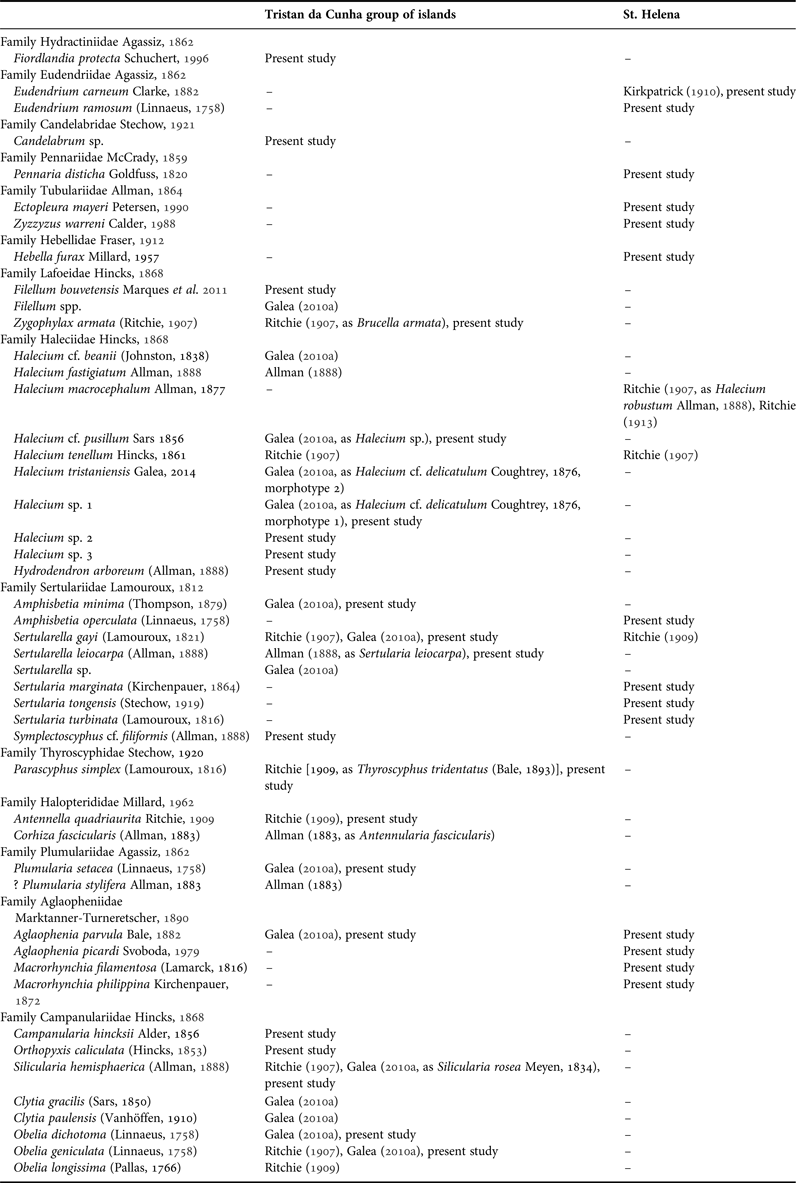
The present report supplements an earlier account dealing with the hydroid fauna of the Tristan da Cunha group of islands (Galea, Reference Galea2010a) and adds nine unrecorded species to the faunal list, raising their number to 34. Among these, 13 species existing in the present collection were already mentioned in the relevant literature. The remaining part of the collection, based on hydroid material secured from St. Helena, adds 13 unrecorded species to a faunal list comprising only four species (see Table 2).
Checklists of the hydroid species from St. Helena and Tristan da Cunha, with references for their records.
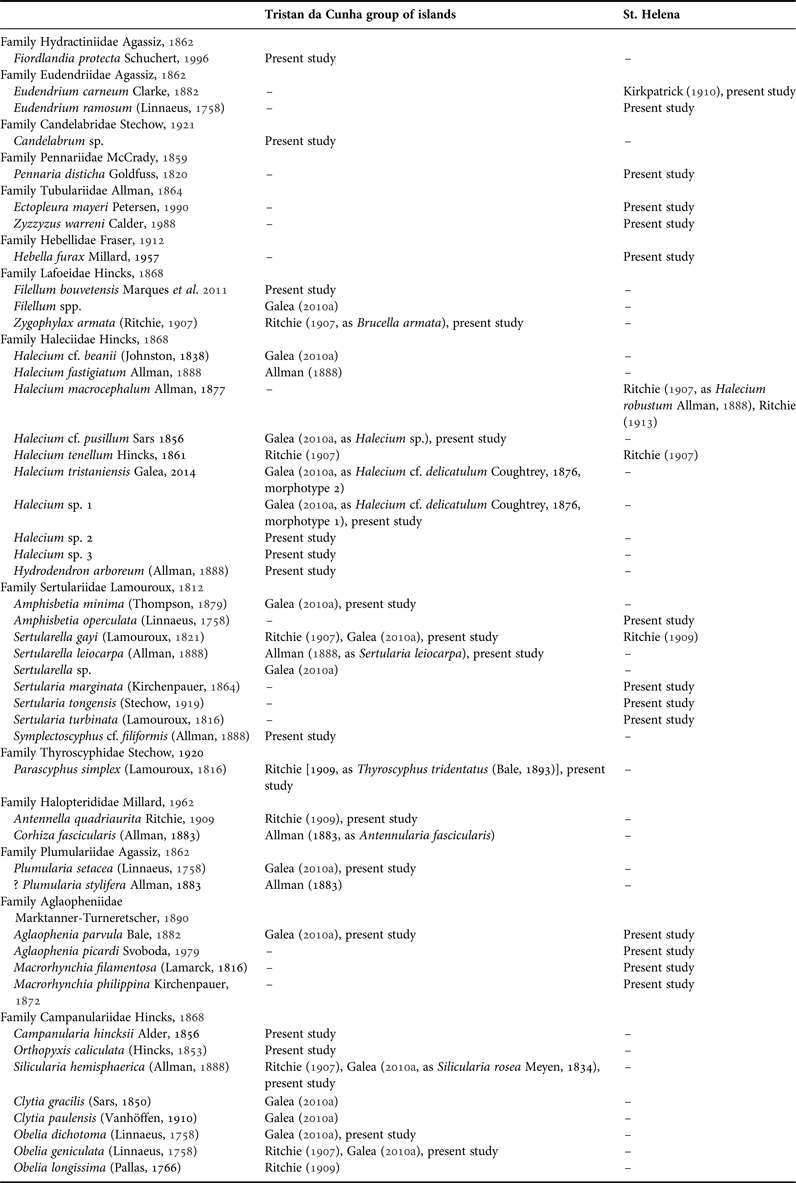
The Tristan da Cunha hydroid fauna shows obvious affinities with the sub-Antarctic, with characteristic species such as Fiordlandia protecta Schuchert, Reference Schuchert1996, Filellum bouvetensis Marques et al., Reference Marques, Peña Cantero, Miranda and Migotto2001, Hydrodendron arboreum (Allman, Reference Allman1888), Amphisbetia minima (Thompson, Reference Thompson1879), Symplectoscyphus filiformis (Allman, Reference Allman1888), Parascyphus simplex (Lamouroux, Reference Lamouroux1816) or Silicularia hemisphaerica (Allman, Reference Allman1888). In contrast, the hydroid assemblage of St. Helena is characteristic of the warm-water fauna, comprising typical species such as Pennaria disticha Goldfuss, Reference Goldfuss1820, Ectopleura mayeri Petersen, Reference Petersen1990, Zyzzyzus warreni Calder, Reference Calder1988, Sertularia marginata (Kirchenpauer, Reference Kirchenpauer1864), Sertularia tongensis (Stechow, Reference Stechow1919), Sertularia turbinata (Lamouroux, Reference Lamouroux1816) or Macrorhynchia philippina Kirchenpauer, Reference Kirchenpauer1872.
Table 2 comprises checklists of hydroids from both St. Helena and Tristan da Cunha group of islands, either occurring in the present collections or mentioned in the literature.
Last but not least, it is worth discussing the taxonomic status of the hydroid material from St. Helena assigned by Ritchie (Reference Ritchie1907) to Halecium robustum Allman, Reference Allman1888 [now regarded as Hydrodendron arboreum (Allman, Reference Allman1888)]. His specimens were secured from two remote localities, namely off Coats Land (Antarctica) and St. Helena. In a later paper, Ritchie (Reference Ritchie1913) included both of them in the synonymy of Halecium macrocephalum Allman, 1877, but Vervoort (Reference Vervoort1972) regarded them as belonging to an undescribed species, which he named Halecium jaederholmi. In a recent redescription of Allman's species, Vervoort et al. (Reference Vervoort, Henry and Nizinski2011) acknowledged that ‘Morphological differences between Halecium macrocephalum and H. jaederholmi are slight, and have led to taxonomic confusion between these two species’. Since Halecium jaederholmi is widely recognized as a sub-Antarctic species (Peña Cantero, Reference Peña Cantero2014) and Halecium macrocephalum as a ‘subtropical western Atlantic species’ (Vervoort et al., Reference Vervoort, Henry and Nizinski2011), I believe that Ritchie's material from Coats Land belongs undoubtedly to the former, whilst the record from St. Helena belongs to the latter.
ACKNOWLEDGEMENTS
I am indebted to marine biologist and photographer Sue Scott (Lochcarron, United Kingdom), Dr Rohan Holt (Royal Society for the Protection of Birds, RSPB), Holly Latham (RSPB) and Dr Judith Brown (Director of Fisheries, Ascension Island Government), who secured the shallow-water hydroid material and entrusted it to me for examination. Dr David Barnes (British Antarctic Survey) kindly provided me with the deep-water collection from Tristan da Cunha. The taxonomic study was made possible through the grant DPLUS 005 from the Darwin Initiative Project. Shallow sampling at Tristan da Cunha was equally part of the DPLUS 005 Project, with support from the fishing company Ovenstone Agenices (Pty) Ltd. and the Tristan Fisheries Department. Collection at St. Helena was supported by a grant from the Darwin Initiative Project (19-031) and the assistance of the St. Helena Government Marine Section, in particular Elizabeth Clingham, Leeann Henry and Annalea Beard, and volunteer diver Steve Brown. The author acknowledges Henry H.C. Choong (Fairbanks Museum & Planetarium, USA), as well as an anonymous referee, for their thorough review of the manuscript.