


1. Introduction
Collisional sutures mark the zones along which oceanic lithosphere has been totally subducted and along which two previously separated landmasses have joined (Engi & Berger, Reference Engi and Berger2006; Raharimahefa & Kusky, Reference Raharimahefa and Kusky2006). Research on the evolution of collisional suture zones can help to reconstruct the convergent plate framework prior to, and during, collision (Chang et al. Reference Chang, Angelier, Huang and Liu2001). As a collision area, the Zagros Mountain Belt offers an excellent opportunity to study the kinematics of a continent–continent collisional suture zone. During recent years, it has become accepted that the Zagros Suture Zone represents the remains of the Neo-Tethys Ocean. The Neo-Tethyan ophiolites in the eastern Mediterranean are situated in two lineaments including the Bitlis–Zagros Suture Zone and the Tauride belt (Parlak & Delaloye, Reference Parlak and Delaloye1999). The major features of the Zagros Suture Zone, including the presence of ophiolites such as Neyriz, Kermanshah and Kohy, are well established (Fig. 1). Obducted Tethyan ophiolites are generally associated with tectonic mélange. Deformation leading to the formation of mélange is focused in a tectonic accretionary setting, which evolves along the subduction plate boundary (Engi & Berger, Reference Engi and Berger2006). Investigation of the deformation processes of tectonic mélanges incorporating oceanic material is particularly important in order to understand the kinematics and mechanics of plate convergence (Fukui & Kano, Reference Fukui and Kano2007; Robertson & Ustaomer, Reference Robertson and Ustaomer2011).
Distribution map of obducted ophiolites (Neyriz, Kermanshah and Khoy) along the Zagros Suture Zone and other ophiolitic assemblages in Iran (modified after Shafaii Moghadam, Stern & Rahgoshay, Reference Shafaii Moghadam, Stern and Rahgoshay2010).

This study is aimed at understanding the structural geometry and evolution of mélange rock units in the Zagros Suture Zone, and the tectonics of continental collision events along the structural boundary between the Afro-Arabian continent to the south and the Central Iranian microcontinents to the north. However, the structural characteristics of subduction, accretion and collision and the polarity of these processes in the study area are still poorly understood. We present here the results of detailed observations of mélange fabrics in a typical tectonic mélange along the Zagros Suture Zone. We discuss the formation process of mélange fabrics, and stress the importance of the kinematic analysis of mélange, which yields information about the kinematics of past plate interactions and convergence directions.
2. Plate tectonic setting
The Zagros orogenic belt is part of the Alpine–Himalayan Mountain Range and extends for more than 1500 km in a NW–SE direction from eastern Turkey to the Minab Fault System in southern Iran (Haynes & McQuillan, Reference Haynes and McQuillan1974; Stöcklin, Reference Stöcklin, Burk and Drake1974). Iran is an assemblage of marginal Gondwana fragments that detached from the Gondwanan–Arabian plate during Permian or Early Triassic times (Stöcklin, Reference Stöcklin1968; Saki, Reference Saki2010; Nance et al. Reference Nance, Gutierrez-Alonso, Keppie, Linnemann, Murphy, Quesada, Strachan and Woodcock2010). The Zagros orogenic belt is considered to be a complex product of an Early Mesozoic separation of the Iranian continental block from the rest of the Gondwana landmass followed by a NE-dipping subduction of the newly generated Neo-Tethyan oceanic crust below the Central Iranian microcontinents and subsequent collision between the Afro-Arabian and Central Iranian microcontinents (Berberian & King, Reference Berberian and King1981; Alavi, Reference Alavi1994, Reference Alavi2004). The Late Cretaceous to Tertiary convergence between the Afro-Arabian continent and Central Iranian microcontinents accounts for thrusting and large-scale strike-slip faulting associated with crustal shortening in the Zagros Orogen (Alavi, Reference Alavi1994; Mohajjel & Fergusson, Reference Mohajjel and Fergusson2000; Sepehr & Cosgrove, Reference Sepehr and Cosgrove2005; Lacombe et al. Reference Lacombe, Mouthereau, Kargar and Meyer2006, Faghih & Sarkarinejad, Reference Faghih and Sarkarinejad2011). Collision is still an ongoing orogenic process (Talebian & Jackson, Reference Talebian and Jackson2002; Tatar, Hatzfeld & Ghafory-Ashtiyani, Reference Tatar, Hatzfeld and Ghafory-Ashtiyani2004; Allen, Jackson & Walker, Reference Allen, Jackson and Walker2004; Regard et al. Reference Regard, Bollier, Thomas, Abbasi, Mercier, Shabanian, Feghhi and Soleymani2004; Vernant et al. Reference Vernant, Nilforoushan, Hatzfeld, Abbasi, Vigny, Masson, Nankali, Martinod, Ashtiani, Bayer, Tavakoli and Chery2004; Authemayou et al. Reference Authemayou, Bellier, Chardon, Malekzade and Abassi2005; Kusky, Robinson & El-Bas, Reference Kusky, Robinson and El-Baz2005) with a convergence rate of approximately 20 ± 2 mm yr−1 (Vernant et al. Reference Vernant, Nilforoushan, Hatzfeld, Abbasi, Vigny, Masson, Nankali, Martinod, Ashtiani, Bayer, Tavakoli and Chery2004).
The study area is located in the Neyriz area, 250 km southeast of Shiraz city (Figs 1, 2), southwestern Iran. The metamorphic grade of the mélange constituents is low, typically at prehnite-pumpyllite to greenschist facies (Arvin, Reference Arvin1982). The Neyriz area is a key area, the understanding of which may resolve enigmatic features of the Zagros Orogen such as its complex tectonic history, essential for the reconstruction of Neo-Tethyan continental margin.
Geological map of the Neyriz ophiolite and studied tectonic mélange. The location of the study area is shown in Figure 1.

3. Tectonic mélange
Stratal disruption, block-in-matrix fabric and tectonic layering, caused by the preferred orientation of competent blocks, are the typical characters of chaotic rocks commonly known as mélange (Byrne, Reference Byrne and Raymond1984; Cowan, Reference Cowan1985; Chester & Logan, Reference Chester and Logan1987; Fisher & Byrne, Reference Fisher and Byrne1987; Moore & Silver, Reference Moore and Silver1987). While a diapiric mélange has a typical isotropic disaggregation texture, the block-in-matrix fabric characterizing sedimentary and tectonic mélanges can be the result either of the intimate mixing of blocks and mud due to mud-flow and debris-flow processes, or of layer-parallel extension and/or shearing due to gravitational sliding or tectonic deformation (Kusky, Bradley & Haeussler, Reference Kusky, Bradley, Haeussler and Karl1997; Kusky et al. Reference Kusky, Bradley and Haeussler1997; Bettelli & Vannucchi, Reference Bettelli and Vannucchi2003).
Tectonic mélanges are one of the hallmarks of convergent margins, yet understanding their genesis and relationships of specific structures to plate kinematic parameters has proven elusive because of the complex and seemingly chaotic nature of these units (Kusky & Bradley, Reference Kusky and Bradley1999). Despite their apparently chaotic nature, mélanges often exhibit a high degree of internal organization and display a consistent suite of structures, which are indicative of the processes that formed the mélange (Needham, Reference Needham1995). Analysis of deformational fabrics in tectonic mélange may also yield information about the kinematics of past plate interactions (Kusky & Bradley, Reference Kusky and Bradley1999; Fukui & Kano, Reference Fukui and Kano2007).
Mesoscopic occurrences of mélange typically appear in two principal outcrops approximately 2.5–5 km ENE of the Neyriz ophiolite, along the NW-trending Zagros Suture Zone. Excellent mesoscopic exposures of this mélange are preserved in road-cuts along the Hassan Abad and Naghare-Khane passes (Fig. 2). Chaotic mixtures of sandstone and mudstone as clast and matrix, respectively, characterize the rocks of the tectonic mélange in the study area. The mélange unit includes lenses, blocks and ribbons of radiolarian chert, limestone, sandstone, pillow lava, tuff, serpentinite, shale and marl in a matrix of greywacke and mudstone. These lenses and blocks range in size from a few millimetres to several metres (Sarkarinejad, Reference Sarkarinejad, Dilek and Robinson2003), supporting the idea that mélange fabrics exhibit a fractal geometry (Kusky & Bradley, Reference Kusky and Bradley1999). The mélange and the Neyriz ophiolite occur together in thrust fault contact. The mélange is thrust over the Neyriz ophiolite (Ricou, Reference Ricou1968a , Reference Ricou b ). Outcrop-scale occurrences of mélange indicate disruption of original bedding and block-in-matrix structure, which includes small blocks of sandstone, basalt and chert, typically with an asymmetric geometry. Shear-related deformation of the mélange is well documented by asymmetric fabrics such as P–Y structures (Rutter et al. Reference Rutter, Maddock, Hall and White1986), which form the dominant asymmetric fabric in the mélange. Radiolarian-bearing chert is an abundant component of the mélange. At several places, radiolarian chert depositionally overlies pillow basalt. Mafic volcanic rocks including altered pillow basalt and massive basalt are also common in the mélange.
4. Mélange fabrics
The mélange exhibits deformation phases characterized by a suite of generally ductile structures that form the typical ‘block-in-matrix’ and disrupted aspect of the mélange (Bradley & Kusky, Reference Bradley, Kusky, Bradley and Ford1992; Kusky & Bradley, Reference Kusky and Bradley1999). Analysis of asymmetric fabrics in mélange to determine local and regional kinematics has proven successful in a number of cases (Moore & Wheeler, Reference Moore and Wheeler1978; Fisher & Byrne, Reference Fisher and Byrne1987; Needham & Mackenzie, Reference Needham and Mackenzie1988; Cowan, Reference Cowan1990; Byrne & Fisher, Reference Byrne and Fisher1990; Kano, Nakaji & Takeuchi, Reference Kano, Nakaji and Takeuchi1991; Onishi & Kimura, Reference Onishi and Kimura1995; Ujiie, Reference Ujiie1997, Reference Ujiie2002; Kusky & Bradley, Reference Kusky and Bradley1999; Ikesawa et al. Reference Ikesawa, Kimura, Sato, Ikehara-Ohmori, Kitamura, Yamaguchi, Ujiie and Hashimoto2005; Fukui & Kano, Reference Fukui and Kano2007). As in the structural analysis of shear zones, asymmetric fabrics with monoclinic symmetry are regarded as yielding the most reliable indication of sense of shear (Kano, Nakaji & Takeuchi, Reference Kano, Nakaji and Takeuchi1991).
In many places, the tectonic mélange exhibits composite planar fabrics, which are geometrically very similar to those in mylonitic rocks within shear zones (e.g. Passchier & Trouw, Reference Passchier and Trouw2005). On the basis of geometrical similarities (Kano, Nakaji & Takeuchi, Reference Kano, Nakaji and Takeuchi1991; Kusky & Bradley, Reference Kusky and Bradley1999; Fukui & Kano, Reference Fukui and Kano2007), we use terminology applied to mylonitic rocks, in the following descriptions of mélange fabrics. One of the characteristic fabrics of the mudstone matrix is a scaly foliation (Fig. 3). This foliation (Y-surfaces) is developed parallel to sandstone layers and the overall alignment of sandstone clasts. Another foliation is defined by the alignment of long axes of inequant sandstone clasts (P-surfaces), which bend into parallelism with the Y-surfaces near their juncture, forming sigmoidal fabrics. A P–Y type (Rutter et al. Reference Rutter, Maddock, Hall and White1986) of composite planar fabric is present, which may be interpreted in a manner similar to structures in quartzo-feldspathic mylonite zones (Lister & Snoke, Reference Lister and Snoke1984). Elongate fragments of chert, basalt and greywacke characterize these mesoscale mélanges. Disaggregated sandstone, basalt and chert fragments surrounded by a scaly mudstone matrix typically characterize the Y-surfaces. The P-surfaces are defined principally by the shape-elongation of the fragments that comprise the mélange.
Field photograph of the foliated tectonic mélange in the study area. Coin is approximately 27 mm diameter.

Although the deformation mechanisms that produced the ‘mesoscale P–Y mélanges’ are obviously different from the crystal-plastic mechanisms that produce C–S mylonites, the kinematic interpretation is similar. According to the geometry of the Y- and P-surfaces, many outcrops of mélange in the study area can be interpreted in terms of sense of shear in a manner analogous to interpreting asymmetric fabrics in quartzo-feldspathic mylonite (Cowan & Brandon, Reference Cowan and Brandon1994; Kusky & Bradley, Reference Kusky and Bradley1999). The composite planar fabric is exactly analogous to the argillite-matrix mélange described by Kusky & Bradley (Reference Kusky and Bradley1999) in the accretionary complex of southern Alaska. At the outcrop scale, the P–Y fabrics developed as a structure showing obliquity between cleavages. Foliations of P-surfaces, which are flattening surfaces, composed of scaly cleavages, are oblique to the shear surfaces (Y-surfaces). The P-surfaces are developed both in the mudstone and greywacke matrix and in the sandstone layers.
The most prominent extensional structures within tectonic mélange are boudinage structures in sandstone layers. Pinch-and-swell and boudinage are common in all the different types of mélange. Pinch-and-swell and boudinage are common mechanisms of layer-parallel extension in the tectonic mélange (Needham, Reference Needham1987) of the study area (Fig. 4). Sandstone beds form boudins in mudstone-matrix mélange. In places where boudins are present along with P–Y mélange, the boudin necks are typically parallel to the P–Y intersection lineation. Asymmetric tails around blocks, as well as the shapes of blocks and boudins, suggest a sense of shear. The long axes of all boudins lie within a plane defined by scaly cleavage and argue for layer-parallel extension, similar to the strain in the southern Alaska accretionary mélanges (Kusky & Bradley, Reference Kusky and Bradley1999). Blocks of sandstone float ubiquitously in the matrix of tectonic mélange at outcrop scale. These blocks form pressure shadows analogous to those found around porphyroclasts in higher-grade metamorphic rocks. Asymmetric flow of matrix around the sandstone blocks provides information about the sense of shear during deformation (Onishi & Kimura, Reference Onishi and Kimura1995). The extreme necking of boudins suggests that the sand deformed in a ductile manner prior to separation into isolated blocks. The isolated clasts are mostly lenticular in shape. Asymmetric shapes of the lenticular clasts with tails show σ and δ shapes (Passchier & Trouw, Reference Passchier and Trouw2005) and are used for kinematic analysis of the mélange (Fig. 5).
Extensional structure in the tectonic mélange. Occurrence of boudins and pinch-and-swell structures on the foliation surface is shown. The outcrop is perpendicular to the foliation. Coin is approximately 27 mm diameter.

Shear fabrics of foliated tectonic mélange in the study area showing the P–Y fabrics and sigma structures. Coin is approximately 27 mm diameter.

5. Slip direction
The characteristics of the mélange reveal that the asymmetric composite planar fabrics have been formed by layer-parallel non-coaxial shear with extensional components. Such asymmetric fabrics have proven to be good indicators of shear sense in ancient accretionary complexes. There have been numerous attempts to correlate mélange kinematics with plate convergence vectors (e.g. Kano, Nakaji & Takeuchi, Reference Kano, Nakaji and Takeuchi1991; Onishi & Kimura, Reference Onishi and Kimura1995; Kusky & Bradley, Reference Kusky and Bradley1999; Onishi et al. Reference Onishi, Kimura, Hashimoto, Ikehara-Ohmori and Watanabe2001; Ujiie, Reference Ujiie2002; Fukui & Kano, Reference Fukui and Kano2007). We have deduced the shear sense in each outcrop from the direction perpendicular to the intersection lineation of the P- and Y-surfaces on the Y-surface according to the methods of Kano, Nakaji & Takeuchi (Reference Kano, Nakaji and Takeuchi1991) and Cowan & Brandon (Reference Cowan and Brandon1994). Overall shear sense obtained from a systematic analysis of the composite planar fabrics of the mélange with monoclinic symmetry may provide the direction of convergence of plates (Kano, Nakaji & Takeuchi, Reference Kano, Nakaji and Takeuchi1991). Magnetic anomaly lineations in a fixed hot spot reference frame and deformation fabrics in a preserved accretionary complex may be good indicators of relative plate motions along convergent plate boundaries younger than 250 Ma (Onishi & Kimura, Reference Onishi and Kimura1995; Kusky & Bradley, Reference Kusky and Bradley1999).
Slip vectors can be derived from many of the structural elements present in mélange, and analysed in a manner similar to kinematic data from higher-grade mylonitic rocks (Passchier & Trouw, Reference Passchier and Trouw2005). The slip vector data were collected from the outcrops where asymmetrical features were clearly visible and the slip sense easily determinable. The slip vector data were collected from the asymmetrical structures of the mélange. Following Kano, Nakaji & Takeuchi (Reference Kano, Nakaji and Takeuchi1991), we first measured the attitude of Y-surfaces. Then the attitude of slickenline trends on the foliation surfaces, the elongation axis of monoclinic symmetry of clasts and the intersection lineation of two foliation surfaces were recorded. The slip direction is perpendicular to the direction of the intersection lineations of the P–Y surfaces (Kano, Nakaji & Takeuchi, Reference Kano, Nakaji and Takeuchi1991; Cowan & Brandon, Reference Cowan and Brandon1994; Kusky & Bradley, Reference Kusky and Bradley1999). According to Kusky & Bradley (Reference Kusky and Bradley1999), after measurement of these fabric elements in mélange, the most reliable data are plotted as a series of lower hemisphere, equal-angle projections and placed in the geographic framework of the regional map. In each station, slip vector directions in present coordinates are plotted as a solid dot with an arrow through it pointing in the direction of slip of the hanging wall (Fig. 6).
Lower hemisphere equal-angle projections of the P–Y fabrics and shear directions determined from those surfaces. The lower right inset shows the method of measurement of shear direction from P–Y fabrics in the mélange after Onishi & Kimura (Reference Onishi and Kimura1995). See text for details.

6. Degree of non-coaxiality
The foliated mélange exhibits conspicuous monoclinic symmetry which is strikingly similar in its geometry to that found in foliated, fault-related rocks in the shear zones. This clearly indicates that non-coaxial deformation is a primary mode of deformation during the formation of mélange fabrics (Kano, Nakaji & Takeuchi, Reference Kano, Nakaji and Takeuchi1991). Vorticity is an important measure of the rotational character of the flow and the non-coaxiality of shear zones and, if it can be measured, places at least reasonable limits on the deformation paths in these zones (Bobyarchick, Reference Bobyarchick1986; Tikoff & Fossen, Reference Tikoff and Fossen1995; Holcombe & Little, Reference Holcombe and Little2001; Bailey & Eyster, Reference Bailey and Eyster2003, Merschat, Hatcher & Davis, Reference Merschat, Hatcher and Davis2005; Passchier & Trouw, Reference Passchier and Trouw2005). Over the last two decades a number of methods have been established to quantify shear-induced vorticity in naturally deformed rocks. Most of the vorticity methods utilize data collected on the XZ-plane of the finite strain ellipsoid (i.e. parallel to lineation and normal to foliation) and commonly assume steady-state monoclinic flow with the vorticity vector approximately parallel to the Y-axis of the strain ellipsoid (Xypolias, Reference Xypolias2009 and references cited therein). We utilize the kinematic vorticity number Wk to characterize the non-coaxiality of deformation in this deformation zone. The kinematic vorticity number, Wk , is a dimensionless number that describes the quality of flow, which records a ratio of pure- to simple-shear components of deformation (Means et al. Reference Means, Hobbs, Lister and Williams1980). Pure shear is described by Wk = 0, and simple shear is described by Wk = 1. General shear is the term used for flows intermediate between the pure and simple shear end-members, in which 1 > Wk > 0 (Means, Reference Means1994; Tikoff & Fossen, Reference Tikoff and Fossen1995). Bobyarchick (Reference Bobyarchick1986) suggested that the kinematic vorticity, Wk , depends on the angle α between two eigenvectors and varies as: Wk = cos α
In such studies, deformation zone boundaries are considered as eigenvectors which provide a reference frame to determine vorticity (Simpson & DePaor, Reference Simpson and De Paor1993). If so, the angle between the deformation zone boundary and other eigenvectors, expressed as deformed markers, can be measured and the kinematic vorticity calculated using Bobyarchick's equation. As mentioned above, the P–Y fabrics developed as a structure showing obliquity between cleavages in the tectonic mélange in which the Y-foliation is considered to be parallel to the deformation zone boundary (i.e. the trend of the Zagros Suture Zone). The average angle between P- and Y-surfaces in deformed rocks of the area under investigation is 33 (i.e. θ = 33). So, according to the Tikoff & Fossen (Reference Tikoff and Fossen1995) using the relationship α = 90 − 2θ, Wk was determined as 0.91.
7. Discussion
The data presented herein concerning the kinematic evolution of the Zagros Suture Zone suggest a new perspective for the deformation of an accretionary prism that has experienced oblique subduction. Mélanges are well known to encode important information concerning tectonic settings and processes. Since the acceptance of the plate tectonics paradigm, it has been widely accepted that many mélanges record processes of subduction in active margin settings. More recently, it has become clear that mélanges can form by a wide range of processes in different tectonic settings, including active margins, rifts and unstable passive margins, and that they may form by tectonic or sedimentary processes, or a combination of both (Robertson & Ustaömer, Reference Robertson and Ustaomer2011 and references therein). The characteristics of the foliated mélange suggest that the stratal disruption and fragmentation resulted from layer-parallel extension. Stratal disruptions by layer-parallel extension are one of the characteristic features of block-in-matrix type mélange from which such features have been described in several regions (e.g. Byrne, Reference Byrne and Raymond1984; Cowan, Reference Cowan1985; Fisher & Byrne, Reference Fisher and Byrne1987; Needham, Reference Needham1987; Needham & Mckenzie, Reference Needham and Mackenzie1988; Waldron, Turner & Stevens, Reference Waldron, Turner and Stevens1988; Kimura & Mukai, Reference Kimura and Mukai1989; Kano, Nakaji & Takeuchi, Reference Kano, Nakaji and Takeuchi1991). Generally, subhorizontal layer-parallel extension in mélanges has been explained in two ways: one is gravity slumping or sliding of surficial slope sediments that cover the prisms; the other is associated with layer-parallel shear during the vertical loading due to wedge geometry of the overriding accretionary prism (Ujiie, Reference Ujiie2002 and references cited therein). Layer-parallel extensional fabrics and the associated kinematics suggest that they resulted from a tectonic process. Subsequently, boudinaged layers were reoriented by shearing, resulting in the development of P–Y fabrics. These features suggest that asymmetric fabrics result from heterogeneous bulk shear in the mélange.
Most kinematic indicators from the mélange show oblique slip with the hanging wall moving up with respect to the footwall, consistent with an accretionary wedge setting. The shear direction deduced is dextral strike-slip and reverse dip-slip (i.e. top-to-the-SW for shear planes with a NW-strike and northeasterly dip). Furthermore, the accretionary mélange consists of tectonic slices derived from oceanic and/or arc terranes that have been juxtaposed along the Zagros Suture Zone. According to the shearing in the mélange, it seems that the constituent rocks of the mélange were obliquely subducted adjacent to the Iranian microcontinents. When the oceanic plate is subducted oblique to the trench axis, shear on the oceanic plate initially reflects the direction of the offshore plate motion. As the plate is subducted, the deformation is subsequently partitioned into displacement components orthogonal and parallel to the trench axis (Fitch, Reference Fitch1972).
Based on the well-accepted hypothesis that mélange-type rocks are formed during accretionary processes, the overall shear sense developed during generation of mélange fabrics may directly indicate the relative convergence direction of the downgoing and overriding plates. Several workers have suggested that shear direction deduced from accretion-related structures is parallel to plate motion (Kano, Nakaji & Takeuchi, Reference Kano, Nakaji and Takeuchi1991; Kimura & Mukai, Reference Kimura and Mukai1991; Kimura, Reference Kimura1999; Kusky & Bradley, Reference Kusky and Bradley1999; Niwa, Reference Niwa2006). Asymmetric fabrics geometrically analogous to shear zones have been found in the tectonic mélange of the study area as well as other active margins in the world (Kano, Nakaji & Takeuchi, Reference Kano, Nakaji and Takeuchi1991; Kusky & Bradley, Reference Kusky and Bradley1999). Using structural data of the tectonic mélange, the convergence direction (Fossen & Tikoff, Reference Fossen, Tikoff, Holdsworth, Strachan and Dewey1998) between the Afro-Arabian continent and Central Iranian microcontinents was determined according to Kano, Nakaji & Takeuchi (Reference Kano, Nakaji and Takeuchi1991), which varies from N9°E to N14°E in the study area. The most reliable values for the Afro-Arabian continent and Central Iranian microcontinents convergence vector are provided by recent GPS studies at the Arabian plate scale and are about 25 mm yr−1 in a direction N10°E (Kargaranbafghi, Neubauer & Genser, Reference Kargaranbafghi, Neubauer and Genser2011). Similar conformable relationships between on-land kinematic data and regional plate reconstructions have already been done for the other tectonic mélanges in the world (Kano, Nakaji & Takeuchi, Reference Kano, Nakaji and Takeuchi1991; Onishi & Kimura, Reference Onishi and Kimura1995; Kusky & Bradley, Reference Kusky and Bradley1999; Ujiie, Reference Ujiie2002; Fukui & Kano, Reference Fukui and Kano2007).
Given the presence of several shear sense indicators such as P–Y fabrics and asymmetric boudinage, we interpret the Zagros Suture Zone as an ancient transpressional boundary. The combination of strike-slip and oblique-slip deformation along this zone plus a strong component of simple shear deformation Wk = 0.91 is consistent with a transpressional flow regime (Sanderson & Marchini, Reference Sanderson and Marchini1984; Tikoff & Teyssier, Reference Tikoff and Teyssier1994). Transpressional shearing is predominantly localized within the mélange type rocks. The composite planar fabrics of the foliated mélange in the study area reveal that the non-coaxial deformation occurred during mélange formation. The development of scaly foliation with varying degrees in the tectonic mélange suggests that the distribution of shear strain within the mélange is heterogeneous. Transpressional deformation and strain partitioning have been further studied in several terms (Jones et al. Reference Jones, Holdsworth, Clegg, McCaffrey and Tavarnelli2004 and references cited therein). These models consider either oblique subduction or continent–continent convergence. The corresponding geometry of the partitioned systems is that of a wedge bounded at the base by a horizontal or inclined surface accommodating slip at a high angle to the plate boundary, and at the back by a vertical strike-slip fault.
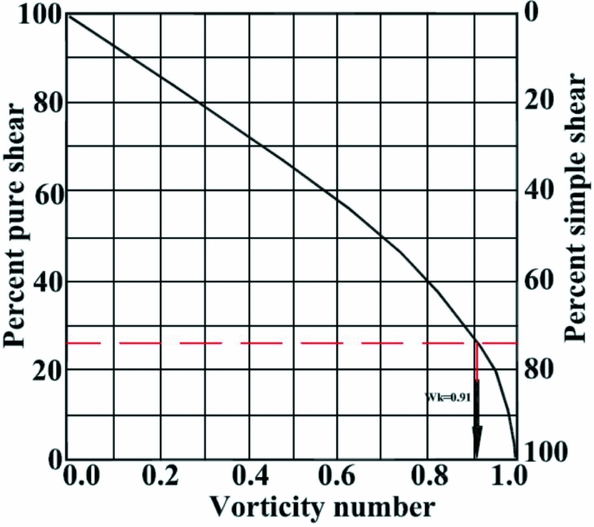
The obtained kinematic vorticity number (0.91) reflects spatial partitioning of the flow path between domains that underwent coaxial flow and those that underwent non-coaxial flow. This value indicates that the deformation zone has suffered transpressional deformation with 27% pure shear and 73% simple shear (Fig. 7). Most natural examples of transpression, based on regional studies of both ancient and modern examples indicate a partitioning of the regional deformation into faults and ductile shear zones and contraction or oblique-slip dominated domains (Iacopini et al. Reference Iacopini, Passchier, Koehn and Carosi2007). Although some workers have categorized deformations as either pure- or simple-shear dominated, in reality there is a continuum from pure shear to simple shear. Fort & Bailey (Reference Fort and Bailey2007) proposed three separate fields for pure-, general- and simple-shear dominated deformations. Pure-shear dominated deformations have Wk values of 0–0.3, corresponding to less than 20% simple shear. In contrast, simple-shear dominated deformations have Wk values of greater than 0.95, corresponding to greater than 80% simple shear. General shear occupies the range between 0.3 and 0.95. The measured kinematic vorticity number indicates that the accretion-related deformation in the study area occurred in a general shear realm. During transpression, there is a marked tendency for pure-shear and simple-shear strain components to spatially partition into separate deformational domains (Tikoff & Teyssier, Reference Tikoff and Teyssier1994; Teyssier, Tikoff & Markley, Reference Teyssier, Tikoff and Markley1995; Jones et al. Reference Jones, Holdsworth, Clegg, McCaffrey and Tavarnelli2004). The structural evolution of the mélange has been affected by a NE-dipping subduction zone of Neo-Tethyan oceanic lithosphere below the Central Iranian microcontinents. The leading edge of the NE-moving Afro-Arabian continent is marked by the Late Cretaceous ophiolite complexes such as Neyriz and Kermanshah in western Iran and the Semail ophiolite in Oman along a belt known as the ‘Croissant ophiolitique’ (Ricou, Reference Ricou1971). The Neyriz ophiolite occurs along the NW–SE trend and represents the Zagros Suture Zone between the colliding Afro-Arabian continent and Central Iranian microcontinents. Dewey (Reference Dewey and McElhinny1977) defined sutures to mark the sites of subducted oceanic lithosphere and the consequent welding of continental masses, and noted that rock suites such as ophiolites are common in sutures. The arrangement of the Mesozoic ophiolitic complex, tectonic mélange and the distribution of Mesozoic arc-related calc-alkaline granitoid rocks in the Sanandaj–Sirjan metamorphic belt confirm the presence of an ancient subduction zone southwest of the Sanandaj–Sirjan metamorphic belt during Mesozoic time (Shahabpour, Reference Shahabpour2005, Reference Shahabpour2007). Consumption and closure of the oceanic basin was accomplished during Maastrichtian time and culminated with emplacement of Neyriz ophiolite and pelagic sediments onto the African–Arabian continental margin. The oldest sediments resting unconformably on the Neyriz ophiolite are the Upper Cretaceous Tarbur limestones, indicating that the Neyriz ophiolite was obducted by Late Cretaceous time (Ricou, Reference Ricou1971). Furthermore, 40Ar–39Ar heating plateau ages from hornblende ranging from 92–97 Ma (Haynes & Reynolds, Reference Haynes and Reynolds1980; Babaie et al. Reference Babaie, Babaie, Ghazi and Arvin2006) suggest that the tectonic emplacement of the Neyriz ophiolite occurred in Late Cretaceous time.
Diagram showing the non-linear relationship between kinematic vorticity numbers of pure and simple shear for instantaneous 2D flow. Wk is defined as a nonlinear ratio of the pure-shear (Wk = 0) and simple-shear (Wk = 1) components of deformation, assuming a steady-state deformation (Means, Reference Means1994).
8. Conclusion
The Neyriz area of the Iranian plateau as a part of the Alpine–Himalaya Mountain Range is one key area with components that record various tectonic environments, including oceanic subduction, accretion, continental collision, strike-slip fault displacement and thrust movement. Structural and kinematic investigations of a tectonic mélange in this area along the Zagros Suture Zone record the interrelation of thrusting and wrenching in an oblique subduction-accretion tectonic setting, demonstrating strain partitioning during a single prolonged event in a transpressional orogen. Kinematic vorticity number measurements suggest strain partitioning between simple-shear and pure-shear components, which shows a general shearing behaviour for the deformation zone in the study area. The primary deformation phase in the mélange occurred in clastic sequences in response to fragmentation of sandstone layers. Thrusting and wrenching have caused the rearrangement of tectonic units in the study area along the Zagros Suture Zone during Miocene times during the collision of the Afro-Arabian and Central Iranian continental blocks. The slip directions deduced from the P–Y fabrics indicate bulk top-to-the-SW shearing. The mode of deformation and kinematic data suggest that the mélange unit formed at shallow levels of an accretionary prism in an oblique subduction tectonic setting.
Acknowledgements
We keenly appreciate critical comments and careful reviewing by an anonymous reviewer which improved the manuscript. We thank journal editor Dr Mark Allen for both his constructive comments and editorial authority. The Research Council of Shiraz University has supported the project, which is gratefully acknowledged. Addition funds were provided by the National Natural Science Foundation of China (Grant 40821061) and the Ministry of Education of China (B07039).



