Introduction
Cover crop usage has increased from 4.2 to 6.2 million hectares in the United States between 2012 and 2017 (USDA-NASS 2012, 2017). Growers in southeastern states have adopted planting annual cover crops such as cereal rye (Secale cereale L.), oats (Avena sativa L.), wheat (Triticum aestivum L.), crimson clover (Trifolium incarnatum L.), Austrian winter pea (Pisum sativum L.), and hairy vetch (Vicia villosa L.) as a way to attain soil health benefits (Han et al. Reference Han, Smith and Pitman2018). Cover crops improve soil stabilization (Hartwig and Ammon Reference Hartwig and Ammon2002; Sanders et al. Reference Sanders, Andres and Hill2018), water infiltration (Hartwig and Ammon Reference Hartwig and Ammon2002), soil water holding capacity (Echtenkamp and Moomaw Reference Echtenkamp and Moomaw1989), soil organic matter (Cherr et al. Reference Cherr, Scholberg and McSorley2006), and soil nitrogen when legumes are used (Andrews et al. Reference Andrews, Sanders, Cabrera, Saha and Hill2018; Cherr et al. Reference Cherr, Scholberg and McSorley2006; Sanders et al. Reference Sanders, Andrews, Saha, Vencill, Lee and Hill2017), and lead to the diversification of soil microbial communities (Vukicevich et al. Reference Vukicevich, Lowery, Bowen, Urbez-Torres and Hart2016). In addition to these soil health benefits, cover crops also reduce weed emergence and growth, providing an additional benefit for managing herbicide-resistant weeds and mitigate further development of resistance (Bunchek et al. Reference Bunchek, Wallace, Curran, Mortensen, VanGessel and Scott2020; Hand et al. Reference Hand, Nichols, Webster and Culpepper2019; Teasdale et al. Reference Teasdale, Brandsæter, Calegari and Skora Neto2007). Although annual cover crops are typically planted, other researchers have proposed intercropping or use of a living mulch (Affeldt et al. Reference Affeldt, Albrecht, Boerboom and Bures2004; Andrews et al. Reference Andrews, Sanders, Cabrera, Saha and Hill2018; Hiltbrunner et al. Reference Hiltbrunner, Jeanneret, Liedgens, Stamp and Streit2007; Pedersen et al. Reference Pedersen, Bures and Albrecht2009; Sanders et al. Reference Sanders, Andrews, Saha, Vencill, Lee and Hill2017, Reference Sanders, Andres and Hill2018).
A living mulch is a cropping system in which a cover crop is established and maintained in conjunction with a cash crop; this practice has become common in cropping systems such as orchards and vineyards (Freyman Reference Freyman1989; Guerra and Steenwerth Reference Guerra and Steenwerth2012). However, other researchers have suggested that living mulch systems may be a viable option for summer annual row crops such as corn (Affeldt et al. Reference Affeldt, Albrecht, Boerboom and Bures2004; Alexander et al. Reference Alexander, Baker, Venterea and Coulter2019; Andrews et al. Reference Andrews, Sanders, Cabrera, Saha and Hill2018; Sanders et al. Reference Sanders, Andrews, Saha, Vencill, Lee and Hill2017, Reference Sanders, Andres and Hill2018). Furthermore, an international meta-analysis determined that intercropping (living mulch, relay cropping, or synchronous planting of cover crops) was able to reduce weed populations by 82% compared with nonweeded control plots (Verret et al. Reference Verret, Gardarin, Pelzer, Médiène, Makowski and Valantin-Morison2017). Other researchers have suggested that living mulches can provide additional benefits such as increased land productivity and reduction of selection pressure on weeds, slowing the development of herbicide resistance (Hiltbrunner et al. Reference Hiltbrunner, Jeanneret, Liedgens, Stamp and Streit2007; Liebman and Dyck Reference Liebman and Dyck1993; Teasdale Reference Teasdale1996; Yenish et al. Reference Yenish, Worsham and York1996).
Of the living mulch systems, clover is frequently selected as an ideal plant because of its low growth habit, ability to fix nitrogen, perennial and long-lived growth, and weed suppression potential (Affeldt et al. Reference Affeldt, Albrecht, Boerboom and Bures2004; Pearson et al. Reference Pearson, Brummer, Beahm and Hansen2014; Sanders et al. Reference Sanders, Andrews, Saha, Vencill, Lee and Hill2017). Living mulch systems have been used in corn production where clover is established before a cash crop is planted. In this system, a vegetation-free strip is created using banded herbicide or strip tillage (Pearson et al. Reference Pearson, Brummer, Beahm and Hansen2014; Sanders et al Reference Sanders, Andrews, Saha, Vencill, Lee and Hill2017; Wiggins et al. Reference Wiggins, Singer, Moore and Lamkey2012). Clover-based living mulches have also been used with broccoli, bell pepper, and snap beans, with mixed results (Chase and Mbuya, Reference Chase and Mbuya2008; Pfeiffer et al. Reference Pfeiffer, Silva and Colquhoun2015). Several species of clover have been used including crimson clover (Trifolium incarnatum), red clover (T. pretense), Kura clover (T. ambiguum M. Bieb.), subterranean clover (T. subterraneum L.), and white clover. Tolerance to cold temperatures and water stress varies between species, which allows for selected species to perform well as a living mulch in various regions of the United States (Brooker et al. Reference Brooker, Sprague and Renner2020; Ilnicki and Enache Reference Ilnicki and Enache1992; Pearson et al. Reference Pearson, Brummer, Beahm and Hansen2014; Pfeiffer et al. Reference Pfeiffer, Silva and Colquhoun2015; Sanders et al. Reference Sanders, Andrews, Saha, Vencill, Lee and Hill2017; Ziyomo et al. Reference Ziyomo, Albrecht, Baker and Bernardo2013).
A perennial clover living mulch system proposed by Sanders et al. (Reference Sanders, Andrews, Saha, Vencill, Lee and Hill2017, Reference Sanders, Andres and Hill2018) and Andrews et al. (Reference Andrews, Sanders, Cabrera, Saha and Hill2018) provides a potentially viable system for the southeastern United States using ‘Durana’ white clover in a corn production system. ‘Durana’ is a naturalized ecotype release by the University of Georgia and is an “intermediate” clover with a height of 8 to 20 cm compared with small clover (<8 cm), or tall ladino types (20–30 cm), with dense spreading stolons and prolific flower/seed production (Bouton et al. Reference Bouton, Woodfield, Caradus and Wood2005). These characteristics make this variety a potentially ideal fit for use as a perennial living mulch. Once ‘Durana’ has been established, it may be used for several production seasons (Sanders et al. Reference Sanders, Andrews, Saha, Vencill, Lee and Hill2017, Reference Sanders, Andres and Hill2018). However, weeds must be managed simultaneously within the clover stand during the establishment year to ensure successful establishment. When used for a living mulch, white clover is planted in late fall but is slow to establish during the fall and winter months. The relatively slow growth of white clover does not allow it to compete well with common winter weeds (Figure 1). In the United States, winter weeds such as wild radish and cutleaf evening primrose can drive winter weed management programs (Culpepper et al. Reference Culpepper, Carlson and York2005; Schroeder Reference Schroeder1989). Due to the slow establishment of white clover and the prevalence of wild radish, cutleaf evening primrose, and common vetch in production fields in the southeastern United States, control of these weeds is critical during clover establishment. Without control, these weeds outcompete the clover and create gaps in the stand that could be exploited by summer annual weeds. Agronomic practices to optimize this system for southeastern corn production have been investigated (Andrews et al. Reference Andrews, Sanders, Cabrera, Saha and Hill2018; Sanders et al. Reference Sanders, Andrews, Saha, Vencill, Lee and Hill2017, Reference Sanders, Andres and Hill2018), but efficacious weed management strategies during the initial establishment of white clover are lacking for this system. This experiment aims to determine the impact of herbicide application and timing on weed control and clover response during ‘Durana’ white clover establishment as a living mulch.
A) First-year established living white clover ‘Durana’ mulch with corn. B) Biomass of white clover weeks after early POST applications. C) Wild radish competition with 2- to 3-trifoliate white clover seedlings. D) Wild radish nontreated plots at 16 wk after early POST applications.

Materials and Methods
Experiment Locations
Field experiments were conducted during the winter of 2018 to 2019 and 2019 to 2020 growing seasons at the Southeast Georgia Research and Education Center (SEGREC) near Midville, GA (32.87°N, 82.21°W). The soil was a Dothan loamy sand (fine-loamy, kaolinitic, thermic Plinthic Kandiudults), pH 5.77. A second location at the J. Phil Campbell Research and Education Center (JPCREC), near Watkinsville, GA (33.86°N, 83.45°W) was established on a Cecil sandy loam (fine, kaolinitic, thermic Typic Kanhapludults), pH 6.07. Both sites were equipped with weather stations as part of the Georgia Weather Network (http://www.georgiaweather.net/) and recorded average temperature, rainfall, soil temperature, and soil moisture for the duration of the experiments.
Experiment Establishment and Design
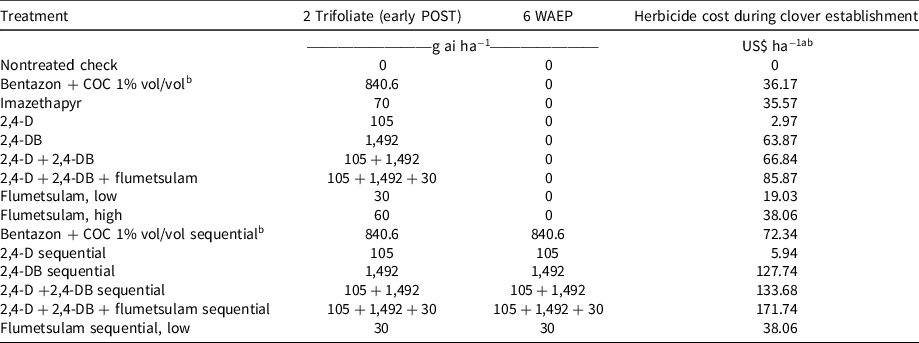
The soil seedbed was prepared with a one-pass tillage operation using an offset disc. White clover (T. repens ‘Durana’; Pennington Seed Inc., Madison, GA) was seeded using a Brillion True Stand Seeder (Landoll Corp., Marysville, KS) that drops seed between two sets of cultipackers calibrated to 13.4 kg ha−1. The first cultipacker firms the seedbed, while the second presses the small clover seed into the soil to ensure good seed/soil contact. Plots were planted in mid-October in 2018 and 2019 at JPCREC, and late October in 2018 and 2019 at the SEGREC. In research conducted by Andrews et al. (Reference Andrews, Sanders, Cabrera, Saha and Hill2018) and Sanders et al. (Reference Sanders, Andrews, Saha, Vencill, Lee and Hill2017, Reference Sanders, Andres and Hill2018) living mulch similar to that used in the current experiments would be followed by a corn cash crop, and the clover stand would be retained for multiple seasons. However, these studies focused on the establishment of the clover, and no cash crop was used. Plots were 1.8 m by 4.6 m and were established and arranged in a randomized complete block design with four replications for each herbicide treatment. The experiment was replicated at each location over 2 yr. This experiment focused on the use of herbicide treatments in single and sequential applications for the control of problematic weeds during clover establishment. Early POST herbicide applications containing bentazon (840.6 g ai ha−1), 2,4-D (105 g ai ha−1), 2,4-DB (1,492 g ai ha−1), imazethapyr (70 g ai ha−1), and flumetsulam at a low and high dose (30 or 60 g ai ha−1, respectively; Table 1; Table 2) were applied when the clover reached the 2- to 3-trifoliate phenological growth stage. All treatments were applied using a four-nozzle CO2-powered backpack sprayer affixed with 8003 VS nozzles calibrated to deliver 187 L ha−1. Six weeks after the early postemergence (WAEP), sequential applications of bentazon (840.6 g ai ha−1), flumetsulam alone (30 g ai ha−1), and combinations with 2,4-D (105 g ai ha−1), 2,4-DB (1,492 g ai ha−1), and flumetsulam (30 g ai ha−1), were applied over designated plots, following the same procedure as the early POST applications. A nontreated check was included for comparison for a total of 15 treatments. These herbicides were chosen because they provide control of common winter weeds known to be present in agricultural production fields in the region, have active ingredients registered for row-crop use, and are safe on clover in other agricultural systems (Anonymous 2013, 2014, 2016a, 2016b, 2017a, 2017b, 2018; Ghanizadeh and Harrington Reference Ghanizadeh and Harrington2019). The 2-trifoliate leaf stage was chosen because it is the earliest application timing when all herbicides could be applied according to herbicide labels (Anonymous 2013, 2016a, 2016b, 2017a, 2017b, 2018). The study was terminated at 16 WAEP, which coincided with 2 wk before when corn would typically be planted at our experiment locations.
Common name, trade name, and manufacturer of herbicides assessed for clover tolerance and weed control in 2018 to 2019 and 2019 to 2020 on white clover ‘Durana’ living mulch.

Herbicide treatment rate at two timings in weeks after early POST, and estimated herbicide cost during the establishment of white clover ‘Durana’ as a living mulch. c

a Cost of application based on data presented by Lancaster et al. (Reference Lancaster, Peterson, Fick, Currie and Kumar2021).
b Cost of COC calculated to include 1% vol/vol for an application at 187 L ha−1.
c Abbreviations: COC, crop oil concentrate; WAEP, weeks after early POST.
Clover Injury and Weed Control
Plots were visually rated at each site at 1, 2, 4, 7, 8, and 10 WAEP applications, which correspond to 1, 2, and 4 wk after the early POST and the sequential 6 WAEP herbicide application, respectively. At each rating timing, plots were rated visually for percent of clover ground cover, chlorosis, necrosis, and stunting, as well as percent weed control. All visual assessments were performed using a 0% (no clover injury/no weed control) to 100% (clover death/complete weed control) scale, compared with the nontreated plots.
Clover and Weed Biomass
At 16 WAEP, clover and weed aboveground biomass were assessed. Clover biomass was determined in each plot by harvesting aboveground biomass from five 30-cm by 30-cm quadrats. Wild radish was present only at the SEGREC location but was present in both years at this site. There was an abundance of large wild radish plants of uniform size in each plot. The biomass of these plants was determined by harvesting, drying, and weighing three randomly selected plants in each plot. To estimate wild radish biomass for each treatment, plants in each plot were counted and multiplied by the average biomass of the three harvested plants for each plot. All aboveground biomass for cutleaf evening primrose at SEGREC and common vetch at JPCREC in each plot were collected by species. All clover and weed biomass were separated by species, placed in paper bags, and dried in a forced-air dryer at 80 C for 96 h. Dry herbage was weighed to determine total weed and clover aboveground biomass.
Statistical Analysis
Data were analyzed using JMP 14.0.1 software (SAS, Cary, NC) with repeated-measures ANOVA, and homogeneity of variance was checked using Levene’s test. Location was treated as a fixed effect for weed responses due to differences in weed composition across sites. If the data for the parameters did not meet normal homogeneity of variance, data were log-transformed, and ANOVA was performed on the transformed data. Homogeneity of variance according to Levene’s test for weed biomass and visual assessment of clover stunting was not normal and data were log-transformed and analyzed by year and rating date. Presented data are nontransformed, but mean separations are based upon the log-transformed ANOVA. If interactions between treatment, year, rating date, or location were significant then response variables were analyzed separately by year, location, or rating date. Differences between treatments were determined by using Tukey’s honestly significant difference test at P ≤ 0.05.
Results and Discussion
Environmental Conditions
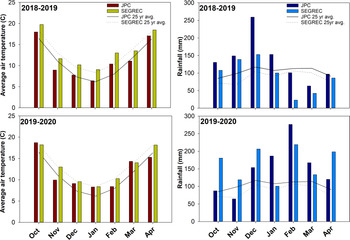
Average monthly temperatures followed similar trends in both years, but for JPCREC, in December 2019 and January, February, and March 2020, temperatures were all above the 25-yr average. This is higher than what was observed in 2019 (Figure 2). However, rainfall in the 2018 to 2019 season was greater than the 25-yr average earlier in the clover growing season (October through December). However, rainfall was greater than the 25-yr average in the latter portion of the 2019 to 2020 growing season (January through April). These greater rainfall amounts occurred after the initial treatment applications in the 2018 to 2019 season, and after the sequential POST applications in the 2019 to 2020 growing season.
Average monthly temperature (C) and rainfall (mm) for J. Phil Campbell Research and Education Center (JPCREC) near Watkinsville, GA, and Southeast Georgia Research and Education Center (SEGREC) near Midville, GA. for 2018–2019 and 2019–2020. Twenty-five-year averages for each location are included for reference.

Weed Control and Biomass
Weed control from each site varied due to differences in the field weed species complex. At SEGREC, weeds consisted of wild radish and cutleaf evening primrose. At the JPCREC location, common vetch was the only weed present. Interactions for year and date of rating were significant at P ≤ 0.05. Therefore, weed control is reported by year and rating date within each location (Table 3).
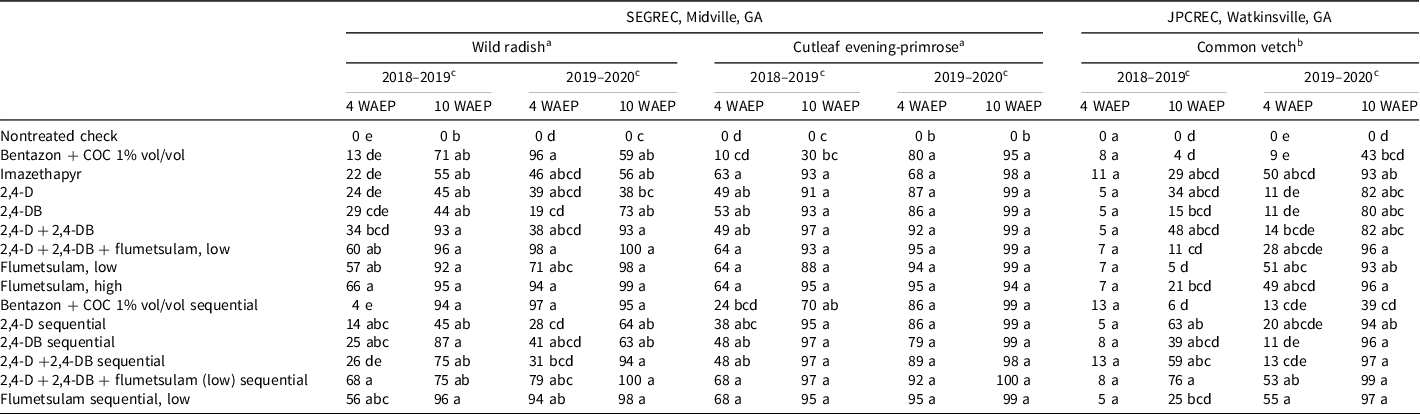
Weed control of wild radish, cutleaf evening-primrose, and common vetch in establishing white clover ‘Durana’ living mulch over the 2018–2019 and 2019–2020 winter field seasons at 4 wk after each herbicide application.e

a R. raphanistrum and O. laciniata were rated at the Southeast Georgia Research and Education Center located near Midville, GA.
b V. sativa was rated at the J. Phil Campbell Research and Education Center located near Watkinsville, GA.
c Sequential applications were made at 6 WAEP. Therefore, 10 WAEP is equivalent to 4 wk after sequential herbicide applications.
d Means separation was performed using Tukey’s honestly significant difference test and means followed by the same letter in a column do not differ significantly (P ≤ 0.05).
e Abbreviations: COC, crop oil concentrate; WAEP weeks after early POST.
Weed Control
Weed control for wild radish was greatest when treatments contained flumetsulam for both 4 WAEP and 10 WAEP in both years (Table 3). These dates (4 WAEP and 10 WAEP) were chosen because they represent 4 wk after both the single and sequential applications, at which time any weeds not controlled by the application would either have regrown or new weeds germinated after the application. By 10 WAEP single and sequential applications of 2,4-D + 2,4-DB had greater wild radish control in both years than treatments containing a single application of 2,4-D or 2,4-DB. In the 2018 to 2019 season single applications of bentazon provided comparable control to treatments containing flumetsulam, or single applications of 2,4-D + 2,4-DB by 10 WAEP in the same year. However, in the 2019 to 2020 season, bentazon treatments did not provide control during clover establishment due to the continued germination of wild radish throughout the season. This difference can be attributed to the lack of rain in the latter part of the 2018 to 2019 season, which may have prevented additional wild radish seed germination (Clewis et al. Reference Clewis, Jordan, Spears and Wilcut2007). Results with 2,4-D applications for control of wild radish were similar to those previously reported for auxin herbicides in other cropping systems (Culpepper et al. Reference Culpepper, Carlson and York2005; Madafiglio et al. Reference Madafiglio, Medd, Cornish and Van De Ven2006; Schroeder Reference Schroeder1989), with sequential applications providing only 45% and 65% control in 2018 to 2019 and 2019 to 2020, respectively. Previous trials using flumetsulam showed significant reductions in wild radish seed production (>75%) across nine locations when applied at the flowering stage of growth (Madafigilio et al. Reference Madafiglio, Medd, Cornish and Van De Ven2006). Other studies found significant reductions in biomass of related oilseed radish (Raphanus sativus L.) planted after flumetsulam and imazethapyr use in corn or soybean (Brooker et al. Reference Brooker, Sprague and Renner2020; Cholette et al. Reference Cholette, Soltani, Hooker, Robinson and Sikkema2017; Cornelius and Bradley Reference Cornelius and Bradley2017) due to herbicide persistence in the soil. Our experiment evaluated 2,4-D, flumetsulam, and imazethapyr at lower use rates than would be applied in corn and soybean in the aforementioned studies. Herbicides in the present experiment were applied POST and to actively growing weeds instead of relying on the residual activity of an herbicide applied in a previous crop.
The visual ratings at 10 WAEP for treatments containing 2,4-D, 2,4-DB, imazethapyr, or flumetsulam indicated consistent control (>93%) of cutleaf evening primrose compared to other treatments (Table 3). Single applications of these herbicides provided equal control by 10 WAEP as sequential applications, indicating that sequential applications are not needed for control of cutleaf evening primrose in establishing living mulch. Culpepper et al. (Reference Culpepper, Carlson and York2005) found that addition of 2,4-D to glyphosate resulted in improved control of cutleaf evening primrose, compared to glyphosate alone. However, this would not be a viable option during clover establishment, because glyphosate applications would likely kill or damage young clover.
Weed control for common vetch was inconsistent between years. In 2018 to 2019 sequential application treatments of 2,4-D, 2,4-D + 2,4-DB, and 2,4-D + 2,4-DB + flumetsulam gave best control (Table 3). However, in the 2019 to 2020 season, the average control of common vetch for single and sequential applications not containing bentazon was >80% and >94% control, respectively. Common vetch can be competitive with crops at populations of 5 to 10 plants per square meter as reported in winter wheat (Zanin et al. Reference Zanin, Berti and Toniolo1993). Densities of common vetch were low (<3 plants m−2) in the present study and did not compete significantly with clover. If higher populations of common vetch are present, sequential applications of 2,4-D + 2,4-DB or 2,4-D + 2,4-DB + flumetsulam may be required to allow for the adequate control of common vetch during the establishment of a clover living mulch.
Weed Biomass
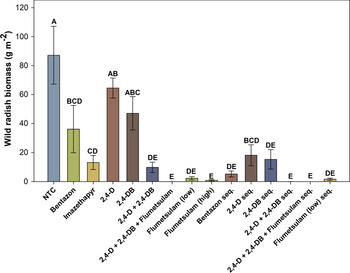
There was no year-by-treatment interaction on wild radish biomass; therefore, data were averaged over years. Little to no biomass of wild radish was harvested from treatments containing flumetsulam or from sequential applications of 2,4-D + 2,4-DB, due to complete control (Figure 3). By 16 WAEP, no wild radish was present in these plots, and clover biomass prevented additional emergence of wild radish plants. Single applications of 2,4-D, 2,4-DB, and bentazon reduced wild radish biomass by 26%, 47%, and 58%, respectively, whereas the remainder of the treatments reduced biomass by >80%. These reductions are greater than those reported for fall-planted R. sativus following PRE-applied flumetsulam in corn, showing the susceptibility of this genus to flumetsulam (Brooker et al. Reference Brooker, Sprague and Renner2020). This indicates that early POST applications of flumetsulam in an establishing living mulch cover crop may provide increased control of wild radish in establishing living mulch.
Wild radish biomass (grams per square meter) response to single and sequential herbicide applications in ‘Durana’ white clover at the Southeast Georgia Research and Education Center near Midville, GA, averaged over 2018–2019 and 2019–2020. Early POST applications were made on 2- to 3-trifoliate clover, and sequential (seq.) applications were made 6 wk after early POST applications. Weed biomass was harvested approximately 16 wk after early POST applications. Homogeneity of variance for weed biomass data for all species was not normal and data were log-transformed. Data presented are nontransformed, but mean separations are based on the log-transformed ANOVA. Bars show means and standard errors with different letters indicating differences between treatments according to Tukey’s honestly significant difference test (P ≤ 0.05).

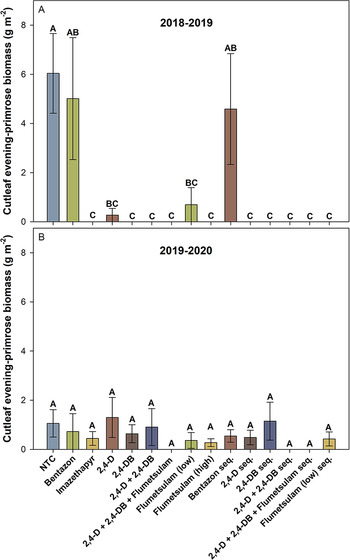
There was a treatment-by-year interaction for cutleaf evening primrose biomass; therefore, data are presented by year. In the 2018 to 2019 season, all treatments except those containing bentazon reduced cutleaf evening primrose biomass by >88% (Figure 4A), whereas there were no differences in cutleaf evening primrose biomass between treatments in 2019 to 2020 (Figure 4B). Differences between seasons in the biomass of the nontreated control treatments are attributed to a prolonged period of germination during the 2018–2019 season. Cutleaf evening primrose germination is sensitive to variations in moisture and temperature (Clewis et al. Reference Clewis, Jordan, Spears and Wilcut2007), conditions that were experienced in the 2019–2020 season. The increased number of cutleaf evening primrose plants in this season is indicated by the higher biomass production in the nontreated control treatment in this season compared to the previous year (Figure 4).
Cutleaf evening-primrose biomass (in grams per square meter) response to single and sequential herbicide applications in ‘Durana’ white clover at the East Georgia Research and Education Center near Midville, GA, in A) 2018–2019 and B) 2019–2020. Early POST applications were made on 2- to 3-trifoliate clover, and sequential (seq.) applications were made 6 wk after early POST applications. Weed biomass was harvested approximately16 wk after early POST applications or 2 wk before corn planting. Bars show means and standard errors with different letters indicating differences between treatments according to Tukey’s honestly significant difference test (P ≤ 0.05).

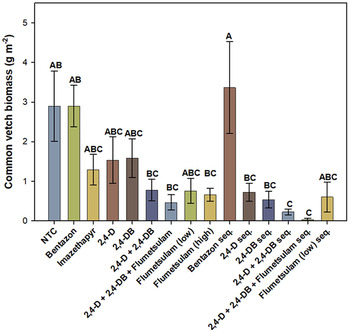
No interaction of treatment with year for biomass was significant for common vetch (measured in grams per square meter) and therefore, data are combined over years. At JPCREC, common vetch biomass was reduced by >47% with all herbicide applications except those containing bentazon (Figure 5). The greatest reduction in common vetch was with sequential applications of 2,4-D + 2,4-DB and 2,4-D + 2,4-DB + flumetsulam when compared to the nontreated check and treatments containing bentazon.
Common vetch biomass (in grams per square meter) response to single and sequential herbicide applications in ‘Durana’ white clover at the J. Phil Campbell Research and Education Center near Watkinsville, GA, in 2018–2020. Early POST applications were made on 2- to 3-trifoliate clover, and sequential (seq.) applications were made 6 wk after early POST applications. Weed biomass was harvested approximately 16 wk after early POST applications or 2 wk before corn planting.

Clover Injury and Biomass
Interactions between year, treatment, and rating date were significant and are reported over location, by year, and rating date. Herbicide treatments did not negatively impact the overall percent clover cover in each plot, and clover injury (chlorosis and necrosis) was minimal (<5%) across rating dates (data not shown).
Clover Stunting
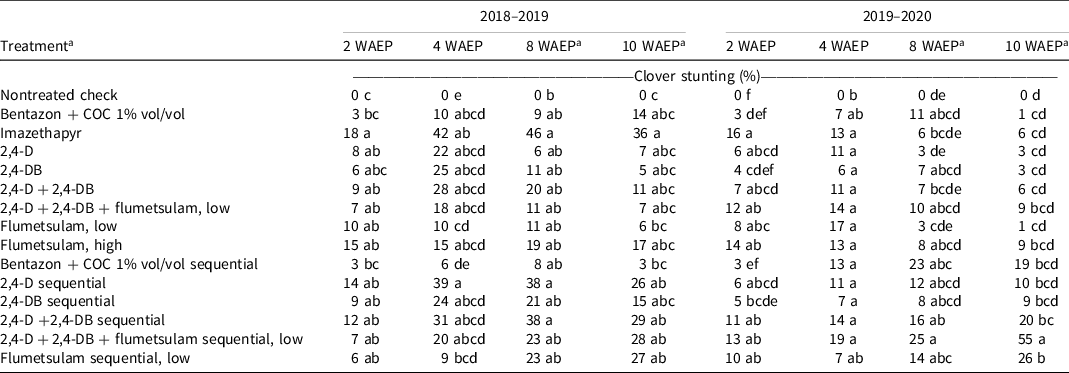
Clover growth was affected by some herbicide treatments that resulted in stunting (Table 4). Overall, by 10 WAEP in both years, most treatments did not have clover stunting greater than that of the nontreated check, indicating that most of the herbicides included in this experiment are safe to use on clover during establishment. Most early-season injury was transient, and clover tended to recover by 10 WAEP. However, during the 2018 to 2019 season, the greatest level of stunting was observed with a single application of imazethapyr, which showed consistent stunting across all rating dates when compared to the nontreated check. Single and sequential applications of 2,4-D and sequential applications of 2,4-D + 2,4-DB also showed greater rates of stunting in the first 8 WAEP in 2018. However, in the 2019 to 2020 season, sequential applications of flumetsulam (low), and 2,4-D +2,4-DB + flumetsulam showed the greatest stunting by 10 WAEP. Greater injury was noted for all sequential applications of bentazon and tank-mix treatments in the 2019 to 2020 season and may be due to greater rainfall following sequential applications.
Clover stunting in white clover ‘Durana’ establishing living mulch over the 2018 and 2019 winter field seasons at Southeast Georgia Research and Education Center (SEGREC) near Midville, GA, and J. Phil Campbell Research and Education Center (JPCREC) near Watkinsville, GA, at 2, 4, 8, and 10 WAEP. c

a Sequential applications were made at 6 WAEP. Therefore, 8WAEP and 10 WAEP is equivalent to 2 and 4 wk after sequential herbicide applications, respectively.
b Means separation was performed using Tukey’s honestly significant difference test and means followed by the same letter in a column do not differ significantly (P ≤ 0.05).
c Abbreviations: COC, crop oil concentrate; WAEP, weeks after early POST.
Clover Biomass
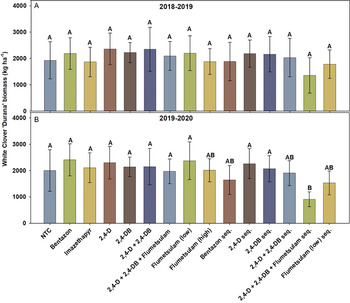
Interactions between year and treatment were noted for clover biomass and are reported by year averaged over location (Figure 6). In the 2018 to 2019 season clover biomass was similar across all treatments (Figure 6A). However, in the 2019 to 2020 season the sequential application of 2,4-D + 2,4-DB + flumetsulam resulted in a reduction in clover biomass (Figure 6B). The effect of herbicide applications on clover biomass at 16 WAEP was not different from that of the nontreated check for most herbicide treatments. This was attributed to the mobility of herbicides in the environment and differences in rainfall patterns among years. Of the treatments applied, this treatment included the greatest number of herbicides capable of moving into the root zone (Shaner Reference Shaner2014), which may have affected the establishing clover. Above-normal rainfall throughout the establishment period of the 2019 to 2020 season at both locations (Figure 2) likely resulted in herbicide movement into the rooting zone of the clover resulting in plant uptake and injury. Differences in stunting and biomass between years can be explained by the timing of rainfall events (Figure 2). In the 2018 to 2019 season at both locations, the rainfall was greatest during October through December, which coincides with the period after the initial application but before sequential applications. Furthermore, rainfall after the sequential application (January through April) was less than after the first application. However, in the 2019 to 2020 season, rainfall patterns were different from that in the previous season, with more rainfall occurring after the sequential application (January through April). This difference in rainfall patterns is a possible explanation for why treatments such as imazethapyr were more injurious in the 2018 to 2019 season than in the 2019 to 2020 season. This may also explain why sequential applications of 2,4-D + 2,4-DB + flumetsulam (low) were more injurious in 2019 to 2020 than in the season previous.
‘Durana’ white clover biomass (in kilograms per hectare) response to single and sequential herbicide applications A) 2018–2019 and B) 2019–2020 combined over location (J. Phil Campbell Research and Education Center near Watkinsville, GA, and East Georgia Research and Education Center near Midville, GA). Early POST applications were made on 2- to 3-trifoliate clover, and sequential (seq.) applications were made 6 wk after early POST applications. Clover biomass was harvested at 16 wk after early POST applications. Treatments with different letters indicate differences between treatments according to Tukey’s honestly significant difference test (P ≤ 0.05).

Other researchers have noted the importance of cover crop biomass for the suppression of weeds (Liebman and Dyck Reference Liebman and Dyck1993, Teasdale Reference Teasdale1996; Verret et al. Reference Verret, Gardarin, Pelzer, Médiène, Makowski and Valantin-Morison2017). However, because living mulches continue to produce biomass throughout the season, the biomass needed for weed suppression may be different than that of desiccated cover crop residues (Teasdale et al. Reference Teasdale, Brandsæter, Calegari and Skora Neto2007). Furthermore, a living mulch alters the light quality (red:far-red ratio) reaching soil surface compared to a desiccated residue, which can affect weed seed germination (Teasdale and Daughtry Reference Teasdale and Daughtry1993). Therefore, negative impacts on clover biomass could decrease the ability of the living mulch to suppress weeds when planted to a cash crop, an obvious concern for treatments that caused significant clover injury. Mean biomass for clover across both locations and treatments was 2,046 kg ha−1 and 1,993 kg ha−1 in the 2018 to 2019 and 2019 to 2020 seasons, respectively. Herbicide treatments other than sequential applications of 2,4-D + 2,4-DB + flumetsulam showed safety on the white clover and should be considered for use in establishing living mulch systems.
When establishing living mulch, time, labor, and herbicide cost should be considered when evaluating the optimal weed management plan. Of the treatments in this study that were efficacious and had minimal damage to the clover, sequential applications of 2,4-D provided the least expensive option (US$5.94 ha−1; Table 2) and in both years visual control ratings averaged 45% and 64% for 2018 to 2019 and 2019 to 2020, respectively (Table 3; Lancaster et al. Reference Lancaster, Peterson, Fick, Currie and Kumar2021). However, this level of control is not acceptable for controlling wild radish because control >90% is required to greatly reduce wild radish biomass and gaps in the clover canopy resulting from noncontrolled radish. Flumetsulam alone at the low rate (30 g ai ha−1) was the second least expensive application (US$19.03 ha−1); it required only one trip across the field and resulted in >90% control of weeds assessed at both sites in both years (Table 2; Table 3). Most treatments containing flumetsulam provided >90% control of the weeds assessed in the present study. However, rotation restrictions for flumetsulam may limit the planting of other crops in living mulch (Anonymous 2018), especially cotton, sunflower, or sweetcorn with a rotation restriction of 18 mo. If cotton is to be planted in a living mulch system, a single 2,4-D + 2,4-DB application or sequential applications of bentazon or 2,4-D + 2,4-DB could provide effective alternatives and be used in conjunction with crops with resistance to 2,4-D. Note that wild radish has developed resistance to auxin-, phytoene desaturase–, photosystem II–, and acetolactate synthase–inhibiting herbicides outside of the United States (Walsh et al. Reference Walsh, Powles, Beard, Parkin and Porter2004; Yu et al. Reference Yu, Zhang, Hashem, Walsh and Powles2003). No resistance for wild radish has been reported to date in the United States (Heap Reference Heap2021). Given that resistance has been known to develop to all of the modes of action evaluated in this study, decisions on how to best manage wild radish must include considerations for resistance management (Beckie and Harker Reference Beckie and Harker2017).
Most herbicide treatments neither increased nor decreased clover biomass from the nontreated check. However, these treatments were selected on the basis of their safety to clover in other production systems such as pastures, with active ingredients that are registered for use in agronomic production systems. It is likely that other viable herbicides exist that can be used during clover establishment, and more research will be needed to identify other herbicides for use during clover establishment. Furthermore, herbicide treatments may not be the only options for growers adopting white clover as a living mulch. If control of wild radish, cutleaf evening primrose, common vetch, or other winter weeds is not successful in a living mulch system, gaps in the clover stand due to competition could be exploited by summer weeds. Evaluation of other means of optimizing clover growth through species/cultivar selection and seeding rate optimization may allow clover living mulch that effectively suppresses winter weeds without the need for herbicides or that require only a single herbicide application. Additional research is still needed to promote the adoption of this cropping system. Future research focusing on suppression and control of weeds in established living mulch, the effect of in-season herbicide use on clover regrowth, the impact of living mulch on weed seed bank dynamics, and the use of living mulch for other cropping systems such as cotton, sorghum, peanuts, and soybeans will expand the adoption of living mulch utility in large-scale crop production.
Acknowledgments
We thank Anthony Black, superintendent of the SEGREC; Eric Elsner, superintendent; and Brooke Powell, senior agriculture specialist of the JPCREC, for their assistance with planting and maintenance. We also thank graduate students Logan Dyer, Tayler Denman, and David Weisberger for their help with the harvest. We also thank Pennington Seed for providing ‘Durana’ clover seed for use in this study. Furthermore, we thank Pam Knox and the Georgia Weather Network for providing environmental weather data. This research received no specific grant from any funding agency, commercial or not-for-profit sectors. No conflicts of interest have been declared.