INTRODUCTION
The presence the black-pygmy mussel Limnoperna securis (Lamarck, 1818) (Bivalvia: Mytilidae) was first reported in the Ria of Vigo, in an intense Galician shellfish farming (north-eastern Atlantic, Spain), five years ago (Garci et al., Reference Garci, Trigo, Pascual, Gonzalez, Rocha and Guerra2007). The mode of introduction of this species, which has been recorded in recent literature with its synonym Xenostrobus securis (Gofas et al., Reference Gofas, Le Renard, Bouchet, Costello, Emblow and White2001) was discussed in relation to human management activities (Garci et al., Reference Garci, Trigo, Pascual, Gonzalez, Rocha and Guerra2007; Santaclara et al., Reference Santaclara, Espiñeira and Vieites2007) and several hypotheses that can account for the colonization history of the species of Australian/New Zealand/Southern Asia origin (Huber, Reference Huber2010) in Galician waters were described by Pascual et al. (Reference Pascual, Villalba, Abollo, Garci, González, Nombela, Posada and Guerra2010). Recently, L. securis has been recorded in brackish water biotopes of Northern Catalonia in the Spanish Mediterranean Sea (Barbieri et al., Reference Barbieri, Maltagliati, di Giuseppe, Cossu, Lardicci and Castelli2011) and in intertidal and shallow waters in the Nervión estuary (south-eastern Bay of Biscay, Spain) by Adarraga & Martínez (Reference Adarraga and Martínez2012).
The pygmy mussel was included in the list of exotic species with invading potential for the Spanish Ministry of Environment. This Ministry also prescribed the need for follow-up of this exotic species with invading potential, recommending their control and management (BOE, 2011). Today, the information available on the distribution in Spain of this mytilid places it in brackish waters near the mouth of fluvial courses. However, L. securis constitutes a potential threat in the Galician Rias especially for the blue mussel Mytilus galloprovincialis raft culture, whose annual production is around 270,000 metric tons (Figueras, Reference Figueras2007). The report by Bañón (Reference Bañón2012) for the Regional Government of Galicia, considers that L. securis may have a negative impact on fluvial and estuarine ecosystems when it becomes an invader. This report places more importance on the economic impact that could be caused due to the fact that the species may contribute to increasing the prevalence of marteiliosis in Galician waters, since L. securis is a carrier of the parasitic protozoan Marteilia refringens (Pascual et al., Reference Pascual, Villalba, Abollo, Garci, González, Nombela, Posada and Guerra2010).
The notable differences found in the bissus threads of both the alien and the indigenous species of mytilids, and the better adaptation of L. securis than M. galloprovincialis to live on soft bottoms and under a wide range of environmental conditions, seem to be the key factors in the successful invasion of L. securis in inner zones of estuarine areas (Babarro & Lassudrie, Reference Babarro and Lassudrie2011). Settling process and larval dispersal of L. securis are two important issues needed to confirm the true potential of this alien species to hypothetically colonize areas where bivalve culture is being conducted.
This work sets out to describe the current invasion extent of this species in Galician waters. Nevertheless, an occasional finding realized in a research project designed to identify the prey of the common octopus (Octopus vulgaris) larvae using molecular techniques (Roura et al., 2012) has allowed us to draw some conclusions on the invasive potential and ecological relationships of L. securis.
MATERIALS AND METHODS
Sampling sites
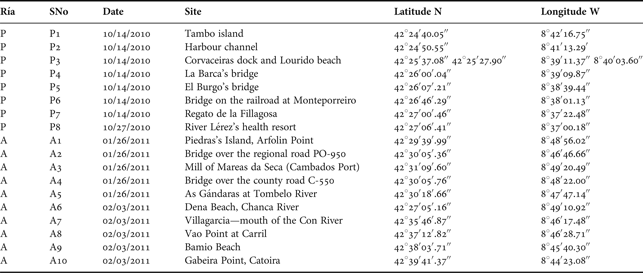
Figure 1 and Table 1 show the sampling dates and location of the sampled stations. A total of 10.8 km from the Tambo Island (P1) towards River Lérez's health resort (P8) in the Ria of Pontevedra was surveyed. The first transect in the south margin of the Ria of Arousa extended from Piedras's Island in the mouth of the Umia River (A1) to As Gándaras at Tombelo River (A5), which covered 5.9 km. The second transect in Arousa extended from Dena Beach (A6) to the mouth of the Con River at Catoira (A10), which covered 6.65 km. These areas were selected and visited due to the fact they are the most likely ones for the species, based on their habitat preferences (Wilson, Reference Wilson1968).
Limnoperca securis: location of sampled stations.

Limnoperna securis: location, and dates of the stations sampled. P, Pontevedra; A, Arousa; SNo, station number; date: month/days/year.

Sampling procedure
The geographical distribution, type of substrata and population density were recorded at each sampling station either by SCUBA diving (0–6 m depth) or by walking along the coast in intertidal areas, where the tide main width is around 3 m. When L. securis was visually detected, wild colonies were sampled in each station using one 20 × 20 cm square frame. The collected specimens were transported to the laboratory and counted. The data obtained were extrapolated to the number of individuals per square metre. Fifteen black-pygmy mussels randomly selected from each station were measured.
Species identification
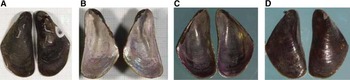
The detailed study of the mussels based on their shell morphology (i.e. shell equivalve; subcylindrical; ventral margin straight or slightly arcuate; umbones nearly terminal; shell dark brown; internally, the shell is usually pearly, purple above and white below the umbonal keel; periostracum shining and hairy in younger specimens; size of adults between 20 and 30 mm), allowed us to identify them as Limnoperca securis (Figure 2) following the methods of Rolán et al. (Reference Rolán, Trigo, Otero-Schmitt and Rolán-Álvarez1985).
Shell morphology of Limnoperna securis from the Ria of Vigo (A, B) and the Ria of Pontevedra (C, D).

DNA purification, polymerase chain reaction amplification and sequencing
Ten mussels collected in different sampled stations were employed for molecular identification. DNA was isolated from 10 mg of tissues using Qiagen DNeasyTM Tissue Kit according to manufacturer's instructions. DNA quality and quantity were checked in a Nanodrop® ND-1000 spectrophotometer and in 1% agarose gel. Primers LCO1490 and HCO2198 (Folmer et al., Reference Folmer, Black, Hoeh, Lutz and Vrijenhoek1994) and primers 16S-A and 16S-B (Medlin et al., Reference Medlin, Elwood, Stickel and Sogin1988) were employed to amplify a fragment of the cytochrome oxidase c subunit I (COI) gene and the small subunit (18S) ribosomal RNA gene, respectively.
Polymerase chain reactions (PCRs) were performed in a total volume of 25 ml containing 100 ng of genomic DNA, PCR buffer at 1 × concentration, 1.5 mM MgCl2, 0.2 mM nucleotides (Roche Applied Science), 0.3 µM primers and 0.625 U Taq DNA polymerase (Roche Applied Science). The cycling protocol for the 18S rRNA gene was 2 minutes at 94°C, 35 cycles of 30 seconds at 94°C, 1 minute at 55°C and 2 minutes at 72°C, followed by 7 minutes at 72°C. The cycling protocol for the COI gene was 2 minutes at 94°C, 35 cycles of 30 seconds at 94°C, 30 seconds at 50°C and 1 minute at 72°C, followed by 7 minutes at 72°C. All PCRs were carried out in a TGradient thermocycler (Biometra) and a negative control (without DNA) was included for each set of PCRs. PCR products were separated on a 2% agarose (in 1 × Tris-acetic EDTA buffer) gel, stained with ethidium bromide and scanned in a GelDoc XR documentation system (Bio-Rad Laboratories).
Polymerase chain reaction products were cleaned for sequencing, using ExoSAP-IT© (USB corporation) as supplied by the manufacturer. Sequencing was performed by Secugen Company (Madrid, Spain). All amplified fragments were sequenced with forward primers and the chromatograms were analysed using ChromasPro v.1.41 Technelysium Pty LtdA. Sequences were subjected to BLASTn analyses against available sequences from GenBank, through web servers of the National Center for Biotechnology Information (USA). Nucleotide sequence data reported in this paper are available in GenBank under accession numbers JF430145–JF430154.
Identification of Limnoperna securis as prey: DNA cloning and sequencing
Within the frame of a study carried out to identify prey of the common octopus (Octopus vulgaris) larvae using molecular techniques (Roura et al., Reference Roura, Guerra, Redd and González2012), the group-specific primers designed therein made it possible to identify metazoan prey of copepods. One individual of eighteen copepod species collected in July 2010, from the outer part of the Ria of Vigo (transect 2 in Roura et al., 2012) was analysed for prey detection using a two step semi-nested PCR-based approach. The DNA obtained from the digestive tract of copepods was amplified using the universal primer 16Sar (Palumbi et al., Reference Palumbi, Martin, Kessing, McMillan and Hoelzel1991) and the reverse group-specific primer 16Scrur (Roura et al., 2012) in the first PCR. Then, one microlitre of that reaction was used as a template in the second prey-specific PCR with the group-specific primers 16Scruf and 16Scrur (Roura et al., Reference Roura, Guerra, Redd and González2012). PCR products obtained were subsequently cloned and sequenced.
Statistics
The analysis of variance Student's t-test was used for size and density differences between mussel populations in respect to depth (Zar, Reference Zar1974).
RESULTS
The genetic analysis confirmed that the examined mussels belonged to L. securis. In fact, blast of the obtained sequences showed that the most similar sequences in GenBank were the 18S rDNA and COI of L. securis with identity values of 100%.
Distribution and abundance
Table 2 shows measurement and abundances of L. securis in the sampled stations of the Ria of Pontevedra. Field sampling revealed a gradient in the invasion pattern of the black-pygmy mussel, which is currently restricted to the upper reaches of estuaries in the inner part of that ria. The invader was absent from station P1 in Tambo Island (Figure 1) to Corvaceiras dock at a distance of 5.25 km. However, from that point onwards numerous colonies were found at the six sampling stations (Stations P3–P8) located in the Lérez River. These mussels had spread from 5.6 km up-river in a zone of brackish waters.
Mean ± standard deviation of the specimens of Limnoperna securis from the Ría de Pontevedra. Sta, station number; TNXs, total number of specimens of L. securis in 400 cm2; SN, number in the random subsample; TL, shell total length; MW, maximum width of the shell; MH, maximum height of the shell; W, total weight. TNMg, total number of specimens of Mytilus galloprovincialis in 400 cm2.

Population densities of L. securis were 225 individuals/m2 at Station P3 and 375 at Station P4. From P4 onwards the abundance of that mussel increased abruptly and considerably: 11,975 at Station P5 and 18,425 at P6, and afterwards decreasing again: 7600 at Station P7 and 1700 at P8 (Table 2). The species completely disappeared up to the course of the river, where salinity and concentration of organic matter decreased. In the four first stations, individuals of L. securis within the 20 × 20 cm square were together with colonies of the blue mussel Mytilus galloprovincialis (Table 2), although L. securis was present at shallower levels.
Except for Station P3, population densities were inversely related to the size of the mussel (Table 2). Mussels from Station 3, with low density, had significantly larger mussels in size (P < 0.01) than the other stations. Mussels from Stations 4 to 8 did not show significant differences (P > 0.05) between them, being the smallest ones present at Stations 7 and 8. These differences in the length of the shell agree with differences in maximum width and height of the shell, and also with total weight. Average ratios ranging from 0.43 to 0.50 (height/length), between 0.37 and 0.49 (width/length), and from 0.037 to 0.075 (weight/length) were found. Mussels from Stations 6, 7 and 8 showed the lower weight to length ratios.
Large concentrations of black-pygmy mussels were found to have settled on a variety of hard substrates, both natural (rocks) and artificial (free trunks, tree branches, pipes, walls, etc.). Nevertheless, small groups of L. securis were observed colonizing stones, shells and other hard substrata standing out of a totally muddy bottom at Station 3 of the Ria of Pontevedra. Our observations also showed that size and population density changed significantly (P > 0.01) with water depth. The black-pygmy mussel was far more abundant and larger in size in deeper colonies of the infralittoral waters than in shallow intertidal waters. The abundance of blue mussel (Mytilus galloprovincialis) mixed with L. securis diminished progressively further up the river and the influence of the salty water declined. We also observed that the distribution of L. securis was patchy.
To date, none of the 14 sampled stations in the Ria of Arousa showed the presence of L. securis.
Limnoperna securis as prey
Only in one of the eighteen species of copepods analysed, the calanoid Centropages typicus Kröyer, 1848, was L. securis detected. From the five clones of C. typicus sequenced two of them showed 98% similarity with L. securis and one clone showed an 88% similarity with this species. The specimen of C. typicus was captured in surface waters in the outer part of the Ria of Vigo. At that time, the coastal upwelling event was in the relaxation–sinking phase (Á Roura, unpublished data).
DISCUSSION
The significant size differences observed among individuals from different sampling sites in the Ria of Pontevedra may be due to phenotypical responses to different environmental conditions existing in the sampling sites, suggesting mussels' settlement inter-population preferences, typical of invertebrate organisms with planktonic larvae (Snelgrove et al., Reference Snelgrove, Butman and Grassle1993; Eckman et al., Reference Eckman, Werner and Gross1994; Turner et al., Reference Turner, Zimmer-Faust, Palmer, Lukenbach and Pentcheff1994).
Previous observations on substrata type colonized by L. securis in the Vigo showed that the species can inhabit very different estuarine bottoms with broadly differing granulometry values in terms of proportions of gravel, sand and mud in the inner areas of the Ria of Vigo (Garci et al., Reference Garci, Trigo, Pascual, Gonzalez, Rocha and Guerra2007; Pascual et al., 2010), which also occurred in the Nervión estuary (Adarraga & Martinez, 2012). The alien species was also able to colonize soft and muddy bottoms in the Ria of Pontevedra. In these cases some hard substrata (small rocks, shells, nylon ropes, etc.) making it possible to adhere to a byssate species. Some of the hard bottoms in the Rias of Vigo and Pontevedra were covered by both L. securis and M. galloprovincialis, but the latter species was never present in soft and/or muddy bottoms (Garci et al., 2007 and Table 2 in this paper). Although both bivalves are filter feeders, in contrast to M. galloprovincialis, L. securis was usually found on muddy sediments in eutrophic bays and estuaries of Japan (Kimura et al., Reference Kimura, Kakuta and Kurokura1995). Byssus thickness secreted by each of these mytilid species might represent the basis of these attachment strength differences. Secretion of an extremely thin but vast number of byssus filaments by the alien L. securis is extraordinary (not previously recorded in other Mytilidae) and highlights a great advantage that could allow this species to become invasive (Babarro & Lassudrie, Reference Babarro and Lassudrie2011). The byssus features of L. securis would make it better adapted to inhabit soft bottoms (with a profuse network established with its abundant byssus threads), but less capable of much plasticity on other substrates due to the fact that the alien species secreted a weaker byssus than M. galloprovicialis and presented a limited ability to modify byssus characteristics and attachment strength on nylon ropes (Babarro & Lassudrie, Reference Babarro and Lassudrie2011). To this L. securis characteristic it is needed to couple its species-specific euryhaline response, which enables its capacity to inhabit heterogeneous (i.e. wide salinity fluctuations) environments (Wilson & Hodgkin, Reference Wilson and Hodgkin1967; Kimura et al., 1995; Babarro & Lassudrie, Reference Babarro and Lassudrie2011). Since attachment strength of M. galloprovincialis was higher than in L. securis in all abiotic conditions tested by Babarro & Lassudrie (Reference Babarro and Lassudrie2011), this indigenous species would not suffer extreme competition by the alien on natural rocks unless salinity values were to vary abruptly. In the latter case, L. securis would be the better performer (Babarro & Lassudrie, 2012). Nevertheless, both the bissus characteristic and the tolerance to environmental fluctuations showed by L. securis could mean it represents a threat for the ecosystem of the Rias of Vigo and Pontevedra as a whole. In that sense, L. securis can be considered as an autogenic engineer sensu Jones et al. (Reference Jones, Lawton and Shachak1994), given that the species is able to significantly change the environment via their living or dead shell clumps. The role of the elements included in this category of ecosystem engineering is important due to their cascading effect on resident biota (Crooks, Reference Crooks2002).
Population densities found in the Ria of Pontevedra were similar to those in the Ria of Vigo (Garci et al., Reference Garci, Trigo, Pascual, Gonzalez, Rocha and Guerra2007), except for Station 1 in the latter Ria where the density was 67,000 individuals/m2, a figure never reached in the Ria of Pontevedra, where the highest density was 18,425 individuals/m2 at Station P6. That density was lower than the maximum found by Adarraga & Martínez (Reference Adarraga and Martínez2012) in rocky substrata at 1.5 m above the sea level in the Nervión estuary (39,450 ind./m2), but higher than the 4090 ind./m2 found by these authors in muddy bottoms of 1.4 m depth. Shell length of the mussels ranged from 28.0 to 46.4 mm in the Ria of Vigo while it was between 21.6 and 28.3 mm in the Ria of Pontevedra.
Differences in colonized substrata as well as in population abundance and distribution patterns in diverse estuarine ecosystems could be explained not only by differences in the sediment characteristics but also by time of colonization, as well as the advection and passive processes of larvae deposition, which have a profound impact on settlement (Eckman, Reference Eckman1983; Snelgrove, 1994). However, these differences could be also related to the different settlement age of the colonies in the two estuaries.
The absence of L. securis in the Ria of Arousa, where sampling was undertaken in ecologically similar places to those of the Rias of Pontevedra and Vigo, is a favourable, new and surprising result. The Ria of Arousa is the most extensive of the southern Galician Rias and also the one that has major extensions of bivalve cultures. Although absence is always impossible to demonstrate (see Figure 1), with the set of sampling stations it is convincing because it shows a thorough sampling effort indicating a high probability for absence. Nevertheless, more sampling effort is needed to confirm that L. securis has still not invaded that Ria.
The copepod Centropages typicus is mainly a neritic and epiplanktonic subsuperficial species, but also it inhabits deep-sea. The more adequate habitats for the development of the species are brackish waters with salinity levels up to 28 (Vives & Shmeleva, Reference Vives, Shmeleva, Ramos, Alba, Bellés, Gosálvez, Guerra, Macpherson, Martin, Serrano and Templado2007). It is an omnivorous copepod that feeds on a wide spectrum of prey, from small algae (3–4 µm equivalent spherical diameter) to yolk-sac fish larvae (3.2–3.6 mm length), which uses both suspensivorous and ambush feeding strategies, depending on the characteristics of the prey (Calbet et al., Reference Calbet, Carlotti and Gaudy2007). Moreover, C. typicus exhibits selection for large motile prey, such as ciliates or dinoflagelates, both in the wild and in the laboratory, and this selective pattern is enhanced under moderate intensities of turbulence (Calbet et al., 2007). Molecular evidences described in this paper show that the copepod preyed upon some larval stage of L. securis during summer time at the outer part of the Ría de Vigo. We ignore where the copepod captured the L. securis larva, but its presence in the stomach of C. typicus indicates that the pygmy mussel larva had left the brackish waters. Considering that the black pigmy mussel is physiologically well adapted for persistence in an estuarine environment characterized by variable and unstable salinity conditions (Wilson, Reference Wilson1969), that its larvae have a high tolerance to low salinity (Wilson, Reference Wilson1968), and that spawning occurs in summer months (Wilson & Hodgkin, Reference Wilson and Hodgkin1967), the most likely hypothesis is that it might prey upon the larval motile stage transported by the current of fresh water that, proceeding from the Verdugo River, is transported by surface on the right side of the Ria of Vigo from its inner part up to the ocean (Rosón et al., Reference Rosón, Cabanas, Pérez, González-Garcés, Vilas and Álvarez Salgado2008). Lenses of low salinity water, with their source in river runoff into the coastal ocean, can result in buoyant plumes that develop into inshore currents transported by the poleward flow to the north under downwelling conditions (Relvas et al., Reference Relvas, Barton, Dubert, Oliveira, Peliz, da Silva and Santos2007). These lenses of low salinity waters are highly dependent on wind stress since their buoyancy usually confines them near the surface layer (Alvárez et al., 2006). As indicated by Alvarez et al. (Reference Alvarez, de Castro, Gomez-Gesteira and Prego2006), when the wind blows from the southern direction the freshwater intrusion from the Miño River (located around 35 km south off ria de Vigo) flows northward close to the coast in the along axis direction in the Rias de Vigo and Pontevedra, but not in their neighbour Ria de Arousa. In consequence, that hydrographical regime could account for the transport of L. securis from one Ria to the other and its absence in the Ria de Arousa. Nevertheless, routine transport form one bay to the other could provide an alternative route of dispersion.
Despite that the presence of L. securis larvae is based on an isolated case, the above hypothesis seems to indicate that the capacity of dispersion of L. securis larval forms is high and that the circulation of the Ria and the continental shelf of Galicia favour its dispersion. An increased population density of this mytilid in recent years and its appearance in new estuarine habitats in Galicia (this paper) and the Basque Country (Adarraga & Martínez, Reference Adarraga and Martínez2012) as well as brackish-water localities of Catalonia (Barbieri et al., 2011) indicate a successful invasive role. Conversely, laboratory experiments have confirmed that the native crab Carcinus maenas is a more efficient predator on native mussel M. galloprovincialis than on the exotic L. securis, and that the number of L. securis ingested by C. maenas tended to decrease with increasing temperature, whereas the number of M. galloprovincialis consumed increased at the highest temperature. These results suggest that global warming could enhance invasion of L. securis due to its lower profitability and greater handling and breaking time (Veiga et al., Reference Veiga, Rubal, Arenas, Incera, Olabarria and Sousa-Pinto2011).
Further research is needed to understand adult competition for food and space as well as larval dispersal and recruitment patterns in the inner and outer Ria. Such investigation would confirm the true potential of this alien species to hypothetically colonize areas where raft mussel culture is carried out (Babarro & Lassudrie, Reference Babarro and Lassudrie2011). Likewise, it is still important to promote studies that help clarify the invasion corridors by defining the pathways, timing and sources of invasion, and to carry out continuous monitoring on the expansion into areas not yet colonized or where data are still absent.
ACKNOWLEDGEMENTS
We thank Roberto Gómez and Enrique Poza (ECIMAT, University of Vigo at Toralla Island) for their help in sampling. Thanks are also due to the personnel of the Pontevedra's Delegation of the Regional Department of the Environment (Regional Government of Galicia) for their helpful information. The authors are indebted to Marcos Regueira for Figure 1.