Juvenile justice practitioners are tasked with evaluating cases of suspected juvenile offending and determining which youth to channel into the justice system and which to divert from formal processing. Although the juvenile justice system's ability to utilize discretion was intended to benefit youth and society, little is known about the actual consequences of various paths through which the system can process and sanction youth (Lau, Rosenman, Wiehe, Tu, & Aalsma, Reference Lau, Rosenman, Wiehe, Tu and Aalsma2018; Petitclerc, Gatti, Vitaro, & Tremblay, Reference Petitclerc, Gatti, Vitaro and Tremblay2013). For instance, youth can be processed either formally (i.e., sentenced before a judge) or informally (i.e., diverted to community service), leading to very different juvenile justice system experiences and, possibly, divergent long-term outcomes.
In spite of the potential long-term impacts and outcomes (Liberman, Kirk, & Kim, Reference Liberman, Kirk and Kim2014; Radice, Reference Radice2017; Verbruggen, van der Geest, & Blokland, Reference Verbruggen, van der Geest and Blokland2016), there is little research examining the extent to which justice system decision making positively or negatively influence youths’ subsequent behavior and development. Instead, most studies in the area of juvenile justice have examined the risk factors for recidivism (i.e., repeat offending), particularly among adolescents who have committed serious offenses (Loughran, Piquero, Fagan, & Mulvey, Reference Loughran, Piquero, Fagan, Mulvey and Dowd2011; Monahan, Steinberg, Cauffman, & Mulvey, Reference Monahan, Steinberg, Cauffman and Mulvey2009, Reference Monahan, Steinberg, Cauffman and Mulvey2013; Mulvey et al., Reference Mulvey, Steinberg, Fagan, Cauffman, Piquero, Chassin and Losoya2004, Reference Mulvey, Steinberg, Piquero, Besana, Fagan, Schubert and Cauffman2010), and the impact of specific interventions, particularly whether programs that aggregate young offenders (which are common in the juvenile justice system) lead to desistance (Dishion, McCord, & Poulin, Reference Dishion, McCord and Poulin1999; Dishion, Poulin, & Burraston, Reference Dishion, Poulin and Burraston2001; Lipsey, Reference Lipsey2006). However, there is very little research examining how system processing in and of itself is related to desistance (i.e., offending abstinence) and other positive outcomes. Considering that the juvenile justice system handles over a million cases each year, it is important to examine whether the way in which an adolescent's first contact with the system was handled impacts his life in a variety of domains, whether the effects are sustained long-term, and whether the nature of the impact varies based on critical demographic factors, such as age of first arrest, race, or ethnicity.
What is known about formal processing and diversion during adolescence?
One of the juvenile justice system's key goals is to promote desistance from crime (Farrington, Reference Farrington2019; Robertson et al., Reference Robertson, Frick, Walker, Kemp, Ray, Thornton and Cauffman2020). Given the enormous impact of crime on society, victims, and offenders, most available research on formal processing (and diversion) has focused on recidivism and subsequent court involvement. One of the most comprehensive existing tests of whether formal processing during adolescence (compared to diversion) is related to recidivism or desistance was a meta-analysis of 29 experimental studies, in which youth in the juvenile justice system were either formally processed or diverted (Petrosino, Turpin-Petrosino, & Guckenburg, Reference Petrosino, Turpin-Petrosino and Guckenburg2010). In this meta-analysis, the researchers found no evidence that formal processing produced lower recidivism rates than diversion. In fact, the direction of the overall effect sizes generally suggested that formal processing might be related to more (not less) crime. Consistent with the general theme from the experimental work, a 20-year observational study of low-income Montreal youth who were followed into young adulthood found that juvenile justice intervention actually increased the likelihood of adult crime seven-fold over diversion from the justice system, even when self-reported delinquent behavior was statistically controlled (Gatti, Tremblay, & Vitaro, Reference Gatti, Tremblay and Vitaro2009).
In line with this work, research using the Pathways to Desistance study (Mulvey et al., Reference Mulvey, Steinberg, Fagan, Cauffman, Piquero, Chassin and Losoya2004; Schubert et al., Reference Schubert, Mulvey, Cauffman, Steiberg, Hecker, Losoya and Knight2004), a justice-system-involved sample of adolescents convicted of serious offenses, also reported that components of justice system decision making were related to recidivism (Monahan et al., Reference Monahan, Steinberg, Cauffman and Mulvey2009, Reference Monahan, Steinberg, Cauffman and Mulvey2013). In particular, the researchers have found that harsher sanctions for formally processed youth, such as time in secure residential facilities, does not lead to desistance (Loughran et al., Reference Loughran, Mulvey, Schubert, Fagan, Piquero and Losoya2009). However, adolescents in the Pathways study have been convicted of serious crimes with extensive criminal histories and it is unknown whether youth being processed for the first time for offenses of moderate severity would show similar responses to such sanctions. Nonetheless, both experimental work and observational studies suggest that the more punitive the sanction, the more likely adolescents are at risk for continued offending and sustained court involvement.
Looking beyond recidivism
Although the majority of prior work has focused on the associations between contact with the justice system and later offending or subsequent court involvement, a small body of work has examined nonoffending outcomes such as education and employment (Kang, Reference Kang2019). For example, prior work has found that being arrested or having to make a court appearance during adolescence significantly increases the odds of dropping out of high school (Bernburg & Krohn, Reference Bernburg and Krohn2003; Kirk & Sampson, Reference Kirk and Sampson2013; Sweeten, Reference Sweeten2006), increases later unemployment (Bernburg & Krohn, Reference Bernburg and Krohn2003; Lopes et al., Reference Lopes, Krohn, Lizotte, Schmidt, Vasquez and Bernburg2012), increases later reliance on government assistance such as welfare (Lopes et al., Reference Lopes, Krohn, Lizotte, Schmidt, Vasquez and Bernburg2012), and decreases the odds of college or university enrollment (Kirk & Sampson, Reference Kirk and Sampson2013). Furthermore, one study found that men and women who were arrested during adolescence earned a lower income 18 years later in adulthood, but this effect was reduced to nonsignificance when education was statistically controlled (Hyla, Reference Hyla2016). However, the extent to which the results from the Hyla (Reference Hyla2016) study can be generalized to other samples is limited, as this study had substantial attrition (only 58% of the initial sample completed the adult follow-up survey).
In addition to employment and education outcomes, prior work has examined how specific justice system interventions, particularly incarceration, are related to nonoffending outcomes such as health and psychosocial development (Dmitrieva, Monahan, Cauffman, & Steinberg, Reference Dmitrieva, Monahan, Cauffman and Steinberg2012; Johnson & Raphael, Reference Johnson and Raphael2009; Massoglia & Pridemore, Reference Massoglia and Pridemore2015; Porter, Reference Porter2014; Schnittker, Massoglia, & Uggen, Reference Schnittker, Massoglia and Uggen2012; Turney, Wildeman, & Schnittker, Reference Turney, Wildeman and Schnittker2012). However, none of these studies to our knowledge examined the long-term outcomes associated with justice system processing – specifically whether an adolescent is formally or informally processed. Nonetheless, the research in this area clearly suggests that the cost of justice system involvement can extend well beyond its effects on later criminal behavior.
Limitations and gaps in prior work
Although prior work has produced several convergent insights regarding the potential impact of justice system processing, there are several limitations that should be considered. For example, about 75% of the diversion studies in the experimental meta-analysis were published prior to 1990 (Petrosino et al., Reference Petrosino, Turpin-Petrosino and Guckenburg2010), and it is possible that the nature of the juvenile justice system has changed over the past three decades. In addition, the majority of existing studies in this area have only examined criminal behavior outcomes. This is a limitation because a focused analysis may overlook some critical ways that contact with the justice system impacts development and behavior during adolescence and early young adulthood.
Another limitation in prior work is that there are likely many between-youth differences (i.e., charge severity; type and number of prior offenses; prior “failed” justice system interventions) that might be related to the way in which a cases is handled, (informal vs. formal), the sanctions that are issued (community service vs. secure confinement), in addition to later antisocial behavior and other outcomes. This means that differences in later antisocial behavior or other outcomes might be due to preexisting differences between youth and not a direct result of the justice system factors themselves. In addition, most prior work does not take into account the possibility that the same justice system interventions may affect different youth in unique ways. Youth who are involved in the justice system are a diverse group, and it may be imprudent to draw broad generalizations about justice system involvement without taking this heterogeneity into account. There was some evidence in Petrosino et al.'s (Reference Petrosino, Turpin-Petrosino and Guckenburg2010) meta-analysis suggesting that the impact of formal processing might vary based on whether the youth had prior offenses or not. It is possible that other moderating factors explain why some youth experience positive outcomes as a result of involvement with the justice system while others do not. Thus, even for youth with similar records of offending, the effect of court involvement may not be universal. In particular, demographic factors such as age, race, and ethnicity may influence the extent to which formal processing is related to positive (or negative) long-term outcomes.
For example, because younger adolescents are more developmentally immature and have less life experience, they may have fewer cognitive resources and thus may be less able to tolerate the stress and pressure of justice system processing. Younger adolescents also may be more impressionable and more susceptible to negative influences. Consequently, younger adolescents may have worse outcomes than adolescents who enter the system at older ages. Conversely, younger adolescents’ developmental immaturity may render them more amenable to treatment and more rehabilitative than older adolescents. Thus, youth who are arrested for the first time at younger ages may have better long-term outcomes than older youth. Youth who enter the system at younger ages also may fare better because they have greater time until reaching adulthood. In addition, it is well documented that youth of color receive differential treatment at all stages in the juvenile justice system (Hawkins & Kempf-Leonard, Reference Hawkins and Kempf-Leonard2010) and are disproportionately exposed to community disadvantage and other risk factors. Given these racial disparities, it is possible that the negative consequences of justice system involvement are more pronounced for youth of color, because minority youth may already face institutionalized barriers to education, employment, community resources, and other protective factors that may compound the negative effects of justice system involvement (Kurlychek & Johnson, Reference Kurlychek and Johnson2019). As a result, it is critical to examine how the impact of the justice system varies by age, race, and ethnicity.
Finally, although prior studies have had vastly different follow-up windows, ranging from 2 months to almost a decade, no prior study has been able to comprehensively examine the extent to which the associations between formal processing and later behavior are sustained long-term. On the one hand, it is possible that formal processing has relatively strong associations with outcomes in the near future (1 year after processing), but the magnitudes of the effects may gradually wane with time (“equifinality;” see Cicchetti & Rogosch, Reference Cicchetti and Rogosch1996). On the other hand, it is possible that the differences between formally processed youth and informally processed youth are actually amplified over time, given that formal processing may set in motion a variety of unique life experiences that may cascade in their influence on the developing adolescent.
Present study
The present study, the Crossroads study, builds on past work by specifically recruiting demographically similar youth who committed the same crimes but differ in whether they were formally processed or informally processed after their first arrest. Importantly, all youth in the present study were recruited into the study after they were arrested for the first time and interviewed regularly for 5 years. We chose to focus on youths’ first encounter with the justice system to naturally constrain differences that predated justice system processing and because first-time offenders make up the majority of juveniles who come into contact with the system. In addition to the sampling methodology, we also reduced the influence of preexisting differences among youth and potential selection effects with a specialized statistical technique – augmented inverse probability weighting (see plan of analysis section). Finally, like the majority of prior work, we examined whether formally and informally processed youth differed in their rate of subsequent illegal behavior and justice system contact, but we also examined whether processing style was related to a host of other developmental outcomes, as well.
The overall goal of the proposed study was to test the extent to which juvenile justice processing decisions – particularly whether an adolescent's first arrest was formally or informally processed – is related to subsequent justice system contact and illegal/antisocial behavior, as well as economic, educational, social, and health outcomes in the near (i.e., 1 year later) or distant (i.e., 5 years) future. We also examined whether the nature of the associations varied based on age at first arrest, race, or ethnicity.
Method
Data for the present study were collected as part of the Crossroads Study (see http://sites.uci.edu/crossroadsinfo/). The Crossroads study is a multisite research project that has followed 1,216 youth who were recently arrested for the first time in three locales: Orange County, California; Jefferson Parish, Louisiana; and Philadelphia, Pennsylvania. Recruitment for the study began on July 18, 2011. The combined sample was racially and ethnically diverse: 46% Latinx/Hispanic, 37% Black/African American, 15% White, and 2% self-identified as multiracial, multiethnic, or another race or ethnicity.
Youth were recruited through a collaborative process with the probation department, district attorney office, and County Court in each site. After dispositions were imposed, adolescents who were male, between 13 and 17 years of age, spoke English, had at least one eligible charge (discussed later; see Supplementary Table 1), and were being charged with their first offense (i.e., no prior arrests) were approached about study involvement.
We exclusively recruited youth with no prior offenses and youth with specific charges because we wanted to maximize the similarities between formally and informally processed youth. We determined which charges were appropriate for the Crossroads study by examining court records over a 5-year period prior to study commencement. Using these historical records, we selected the charges at each site for which youth with no prior offenses were formally processed in about 50% of the cases (charges that had a 0.35–0.65 probability of being formally processed). Restricting the eligible charges in this way not only enhanced our ability to interpret differences between youth who experienced different decisions, it also increased the practical utility of the study findings by focusing on the charges where processing decisions are both variable and relatively unconstrained (i.e., lack of mandatory sentencing statutes). Supplementary Table 1 lists the eligible offenses by site. Although there are some site variations in eligible charges, there is also a lot of overlap (e.g., simple assault/battery, theft, criminal damage/mischief).
After eligible youth were identified, informed consent was obtained from a parent/guardian and assent was obtained from the youth. About 80% of the eligible boys and their parents who were approached agreed to participate in the study. All participants were interviewed initially after their first arrest (“baseline interview”) and again at 6-month intervals for 3 years, followed by two annual assessments. In total, youth were interviewed regularly for about 5 years after their first arrest. The baseline interviews were conducted from July 2011 to June 2013 and the 5-year follow-up interviews were conducted from July 2016 to July 2018. Youth were between 13 and 17 years of age (M age = 15.29) at baseline and between 17 and 23 years of age (M age = 20.29) at the 5-year follow-up interview. During each interview, participants were asked a variety of question about their attitudes, thoughts, behaviors, family, friends, and other experiences. In addition to interviewing youth, we also obtained official arrest records. Interviews were conducted on laptop computers in participants’ homes or other public locations that could offer privacy. When necessary, youth were interviewed in secure facilities. Anonymous keypad data entry was available to the participants, which was particularly helpful for sensitive questions (e.g., criminal behavior). We encouraged retention by financially compensating youth for their time according to an escalating payment, by utilizing a specialized tracking database, and by building rapport with participants. Based on our efforts, over 85% of the original sample completed each interview (see Missing Data section below). To be consistent with the annual assessments, the 6-month interviews were combined in annual chunks. For example, Time 1 in the present analysis represented “year 1” after the first arrest (i.e., combination of 6- and 12-month assessments) and Time 2 represented “year 2” after the first arrest (i.e., combination of 18- and 24-month assessments). Baseline values were used in the matching analysis as well as in the main analysis as control variables. All procedures were approved by the institutional review boards at the three participating sites.
Measures
Formal versus informal processing
We used official court and probation records to determine whether youth were informally processed or formally processed. Informally processed cases were diverted from the court and handled and supervised by the probation department and/or the district attorney's office. In general, informally processed youth were on probation for about 1 to 6 months and had terms such as writing an apology letter, attending legal awareness/anger management classes, and serving community service hours. In contrast, formally processed youth were petitioned and processed through the formal court system. Youth who were formally processed had to stand before a judge and participate in a court hearing. Formally processed youth were typically supervised by both the court and probation for about 6 to 12 months. The final formal processing variable was a binary variable with formal processing coded as 1 (N = 547; 45%) and informal processing coded as 0 (N = 669; 55%). Recruitment was designed to slightly oversample informally processed cases.
Outcome variables
Justice system contact
Re-arrests
Official court and probation records were used to determine whether youth were re-arrested during each year after the first arrest. “Re-arrests” in the present study only included new charges. Probation or technical violations (e.g., failure to attend school or services; violations of conditions of probation) were excluded. We created a binary variable indexing whether participants were arrested at least once during each year (1 = yes, re-arrested; 0 = no, not re-arrested). We used official arrest records, in addition to self-reported offending (described below), because these data sources tend to provide separate, but complementary information. Although self-reported illegal behavior has the ability to measure undetected and unreported criminal behavior, official re-arrest data have the ability to objectively measure justice system contact.
Incarceration
Using a monthly life calendar approach, youth reported the number of days they had been in “a secure institution, locked facility, jail, or detention” since the previous interview. With these data, we created a binary variable that indexed whether youth were incarcerated for any period during each year after their first arrest (1 = yes, incarcerated in this year; 0 = no, not incarcerated this year).
Illegal/aggressive behavior
Total offending
Total offending was measured with a revised version of the Self-Report of Offending scale (SRO; Huizinga, Esbensen, & Weiher, Reference Huizinga, Esbensen and Weiher1991). At all interviews, youth reported whether they had engaged in 24 different illegal behaviors during the recall period. Sample items include “During the past X months, have you taken something from another person by force, without a weapon?” and “During the past X months, have you beaten up or physically attacked someone so badly they probably needed a doctor?” Youth responded to each item with a “yes” (=1) or “no” (=0). The final offending variety variable was created by counting the total number of “yes” responses (maximum = 24). We chose to use offending variety because variety scores are highly correlated with other measures of offending (e.g., frequency, severity), but less vulnerable to recall bias and less influenced by high-frequency minor offences (Monahan & Piquero, Reference Monahan and Piquero2009; Osgood, McMorris, & Potenza, Reference Osgood, McMorris and Potenza2002).
Violence
Violence was measured with 10 items from the SRO at all interviews (Huizinga et al., Reference Huizinga, Esbensen and Weiher1991). Violent offenses included behaviors such as carjacking, rape, robbery/armed robbery, fighting, assault, and gang violence. The 10 items were combined to create a binary variable indicating whether the participant engaged in any violent behaviors during each year after the first arrest (1 = yes, participant engaged in at least one violent behavior during this year; 0 = no, participant did not engage in any of the 10 items during this year).
Physical aggression
Physical aggression was measured with the total overt subscale from The Peer Conflict Scale (Marsee et al., Reference Marsee, Barry, Childs, Frick, Kimonis, Munoz and Lau2011). The subscale consisted of 20 items that measured the extent to which the participant generally behaved aggressively in everyday situations. Sample items include “I start fights to get what I want” and “When someone hurts me, I end up getting into a fight.” Youth reported how well each item matched their typical behavioral style by using a 4-point response scale that ranged from 0 (not at all true) to 3 (definitely true). The final physical aggression variable was created by calculating the sum of the 20 items, with higher scores indicative of a greater behavioral preference for physical aggression (mean α = .881, range = .852 to .896).
School/employment
Enrolled in school
We determined whether the young men were currently enrolled in school at each interview by using a single item from The School Calendar. At each interview, youth answered the question “Are you currently enrolled in school?” and they responded with a “yes” (=1) or “no” (=0). This item was used to determine whether the participant was enrolled in school during each year after the first arrest (1 = currently enrolled in school; 0 = not currently enrolled in school).
Employed
We determined whether the participants were currently employed at each interview with a single item from The Job Calendar. At each interview, youth answered the question “Do you currently have a paying job?” Illegal and other “under the table” jobs were excluded. Current employment was coded into a binary variable with the response options of “yes” (=1) or “no” (=0). This variable was used to determine whether the participants were employed during each year after the first arrest (1 = currently employed; 0 = not currently employed).
Employed or enrolled in school
The previously described current school enrollment and current employment variables were combined to create a single measure of productive time usage. This combined variable was created given that school enrollment and employment are likely inversely related (at least to some extent), although they are both positive and productive activities. To combine the two variables, the maximum score of the two items was used, producing a binary variable with a value of 1 representing that the participant was currently enrolled in school or employed and a value of 0 representing that the participant was not currently enrolled in school or employed.
High school graduation or equivalent
At all interviews, participants were asked to state the highest degree that they had previously attained and the highest grade in school that they had completed. These data were combined to create a single variable indicating whether the participant had received a high school diploma or GED at any point prior to the 5-year follow-up interview.
Mental health/cognitive
Internalizing problems
A measure of internalizing problems was assessed with 16 items from the Revised Child Anxiety and Depression Scale (Chorpita, Yim, Moffitt, Umemoto, & Francis, Reference Chorpita, Yim, Moffitt, Umemoto and Francis2000). For each item, youth reported the frequency with which they experienced different symptoms of depression and anxiety using a 4-point scale that ranged from 0 (never) to 3 (always). Sample items include “I worry that bad things will happen to me” and “Nothing is much fun anymore.” The 16 items were summed together, with higher scores indicating that the participant reported more internalizing problems (mean α = .900; range = .869 to .921).
Interpersonal callousness
Twenty-four items from the Inventory of Callous-Unemotional traits scale were used to measure callous-unemotional traits (Kimonis et al., Reference Kimonis, Frick, Skeem, Marsee, Cruise, Munoz and Morris2008). Sample items include “I do not care who I hurt to get what I want” and “The feelings of others are unimportant to me.” Youth rated the degree to which each statement represented how they generally felt using a 4-point Likert scale that ranged from 0 (not at all true) to 3 (definitely true). The sum of the 24 items was used as the interpersonal callousness score, with higher scores indicating more callous–unemotional traits (mean α = .784, range α = .765–.795).
Psychosocial development/expectations
Impulse control
The eight-item impulse control subscale from the Weinberger Adjustment Inventory was used as our measure of impulse control (WAI; Weinberger & Schwartz, Reference Weinberger and Schwartz1990). Sample items include behaviors such as, “I do things without giving them enough thought” and “I say the first thing that comes into my mind without thinking enough about it.” Youth reported the extent to which each statement represented their general behavior by using a 5-point Likert scale that ranged from 1 (false) to 5 (true). A total impulse control score was created by calculating the mean of the eight items, with higher scores indicating that the participant reported a greater ability to inhibit impulsive behavior (mean α = .770, range α = .741–.790).
Suppression of aggression
Youths’ ability to suppress aggression was measured at each time point with the seven-item suppression of aggression subscale from the WAI (Weinberger & Schwartz, Reference Weinberger and Schwartz1990). For this scale, youth read a series of statements and rated how true each statement was for them using a 5-point response scale that ranged from 1 (false) to 5 (true). Sample items include “When someone tries to start a fight with me, I fight back” and “People who get me angry better watch out.” The seven items were combined by calculating the mean, with higher scores indicative of a greater ability to suppress aggression (mean α = .815, range α = .791–.830).
Consideration of others
Youths’ tendency to think about the perspective of other people in everyday situations was measured at each time point with the seven-item consideration of others subscale from the WAI (Weinberger & Schwartz, Reference Weinberger and Schwartz1990). Like the two other WAI subscales, the consideration of others subscale was measured by reading a series of statements to the participants and asking them to rate the extent to which the statement represented how they usually felt. Sample items include “I think about other people's feelings before I do something they might not like” and “Doing things to help other people is more important to me than almost anything else.” Youth responded to each statement using a 5-point response scale that ranged from 1 (false) to 5 (true). The seven items were combined by calculating the mean, with higher scores indicating that the participant reported a greater tendency to think about the needs and wants of other people (mean α = .735, range α = .687–.782).
Sensation seeking
At each time point, preference for sensation-seeking activities was measured with the six-item Sensation Seeking Scale (Steinberg et al., Reference Steinberg, Albert, Cauffman, Banich, Graham and Woolard2008; Zuckerman, Eysenck, & Eysenck, Reference Zuckerman, Eysenck and Eysenck1978). Participants read a series of statements and determined whether the statement was true for them or not. Sample items include “I like new and exciting experiences and sensations even if they are a little frightening” and “I like doing things just for the thrill of it.” Participants rated each statement as either “true” or “false.” A total sensations seeking score was created by counting the number of “true” responses for each participant at each time point (maximum score = 6), with higher scores indicative of a greater preference for sensation-seeking activities (mean α = .761, range α = .698–.795).
Future orientation
Fifteen items from the Future Outlook Inventory were used to measure the extent to which the participant thought about and planned for the future (Cauffman & Woolard, Reference Cauffman and Woolard1999). Sample items include “I will keep working at difficult, boring tasks if I know they will help me get ahead later” and “I will give up my happiness now so that I can get what I want in the future.” Youth rated how true each statement was for them by using a 4-point response scale that ranged from 1 (never true) to 4 (always true). The 15 items were combined by calculating the mean. Higher scores on the future orientation variable represented a greater degree of future consideration and planning (mean α = .712, range α = .657–.743).
Perception of opportunities
Perception of opportunities was measured at all time points with the six-item Motivation to Succeed Scale from Eccles and colleagues (Eccles, Wigfield, & Schiefele, Reference Eccles, Wigfield, Schiefele, Damon and Eisenberg1998). The scale included a series of statements that asked youth to rate the extent to which they perceived opportunities for school success and work success in their neighborhoods. Sample items include “In my neighborhood, it's pretty easy for a young person to get a good-paying, honest job” and “I'll never have as much opportunity to succeed as people from other neighborhoods” (reverse scored). Youth rated the extent to which they agreed with each statement by choosing a value on a 5-point response scale that ranged from 1 (strongly disagree) to 5 (strongly agree). When necessary, reverse-scored items were inverse-converted such that higher scores were always indicative of greater perceived opportunities for work and school success. A total perception of opportunities scale was created by calculating the mean of the six items (mean α = .688, range = .605–.741), with higher scores indicating that the participant reported greater perceived opportunities to succeed.
Contextual factors
Peer delinquency
At each time point, the 13-item antisocial peer behavior subscale from the Association with Deviant Peers scale was used to measure peer delinquency (Thornberry, Lizotte, Krohn, Farnworth, & Jang, Reference Thornberry, Lizotte, Krohn, Farnworth and Jang1994). Each item asked youth to state the proportion of friends who had engaged in different illegal behaviors in the past X months (e.g., vandalism, theft, fighting). Sample items include “What proportion of your friends have purposely damaged or destroyed property that did not belong to them?” and “What proportion of your friends have gotten into a physical fight?” Youth estimated the proportion of friends who had engaged in each behavior by choosing a value on a 5-point scale that ranged from 1 (none of them) to 5 (all of them). A mean of the 13 items at each time point was used as the final peer delinquency variable, with higher scores indicating a greater tendency to affiliate with peers who engaged in antisocial and/or illegal behaviors (mean α = .907, range = .895–.921).
Exposure to violence
Eighteen items from the Exposure to Violence Inventory were used to measure the extent to which youth were exposed to violence during each recall period (Selner-O'Hagan, Kindlon, Buka, Raudenbush, & Earls, Reference Selner-O'Hagan, Kindlon, Buka, Raudenbush and Earls1998). Each of the 18 items measured whether the participant was the victim or witness of a specific violent event (1 = yes, victim/witness of violent event; 0 = no, did not experience or witness violent event). Sample items include “During the past X months, have you been chased where you thought you might be seriously hurt?” and “During the past X months, have you been beaten up, mugged, or seriously threatened by another person?” Youth responded to each item with a “yes” (=1) or “no” (=0). A total measure of exposure to violence was created by counting the total number of “yes” responses (maximum score = 18).
Demographics
Youth reported their race/ethnicity at the baseline interview and this information was used to create a four categorical nominal race variable (Black, Hispanic, White, Other). Participants’ date of birth was also obtained during recruitment and used to determine their age at each interview. Race/ethnicity and age at baseline were used as critical control variables and moderators.
Matching variables
Thirty-three background variables measured at the baseline interview were used to create inverse probability matching weights. See Supplementary Table 2 for more information about the matching variables.
Plan of analysis
The overall goal of the present study was to examine whether formal processing during adolescence was related to a variety of outcomes in the short (about 1 year) and long-term (about 5 years) future. In the first step of the analysis, we created inverse probability weights (Austin & Stuart, Reference Austin and Stuart2015) with over 30 variables measured at baseline to reduce preexisting differences between formally and informally processed youth. Because these models used maximum likelihood estimation, we imputed 50 datasets to ensure that all cases were included in the weight-generating analysis. This step was necessary because cases with missing data on the independent variables are typically dropped from models estimated with maximum likelihood (model default). Of the people with missing data on any of the matching variables (N = 105), most participants (75%) were missing data on only one variable (M = 1.43 missing variables; SD = 0.83; range: 1–5). The imputed data sets ensured that all participants were included in the weight-generating analysis. Consistent with the recommendation from others, the weighting variable was truncated at the 99th percentile (13 cases truncated).
After matching weights were established, the associations between the matching variables and formal processing were examined in two logistic regression models. One model included the matching weights and the second model did not. These parallel models were examined to determine whether the weights successfully reduced the presence of baseline differences between formally and informally processed youth. Provided the matching weights successfully reduced baseline differences, all subsequent analyses proceeded with the inclusion of the weights.
For the primary analysis, generalized estimating equations (GEE) population-averaged models with robust standard errors were used with formal processing (vs. informal processing) as the primary predictor variable, controlling for baseline values of each outcome variable. There were three exceptions to the baseline control specification. First, because the corresponding baseline value was not as relevant for the high school graduation outcome, we instead controlled for whether the participant was enrolled in school at baseline for this outcome. Second (and third), we did not include baseline values when examining the re-arrest and incarceration outcomes because all participants were “first time” offenders at baseline.
Each outcome was tested in its own model. GEE models are ideal for the present study because they can accommodate the repeated measurement design and they tend to be fairly flexible. The specific family and link functions were modified for each GEE to accommodate the distributional properties of the outcome variables (e.g., logit was used for binary outcomes; negative binomial for count). Outcome variables were measured at all time points, and the GEE models were conducted with all available data. Because of the nature of the high school graduation item, we only examined whether a high school diploma or equivalent was obtained by the last interview (i.e., at any point during the 5-year follow-up study period).
In all models, we also controlled for age at baseline (i.e., age at first arrest) and race and ethnicity because we had a secondary interest in both the main effects and the potentially moderating effect of these demographic variables. In the second part of the primary analysis, we examined interactions between formal processing and age, formal processing and race/ethnicity, and formal processing and time. The interactions were conducted to examine whether the strength of the association between formal processing and any of the outcome variables varied by youths’ age at baseline, race and ethnicity, or time since processing.
Finally, we also examined supplemental models that repeated the primary analysis but excluded the demographic control variables (e.g., age; race, and ethnicity) and the matching weights. These results are presented with the Supplementary material. As stated earlier in the Method section, the 6-month interviews during the first 3 years of the study were combined in annual intervals to be consistent with the recall period of the later interviews. All analyses were conducted in Stata version 15 (StataCorp, Reference StataCorp2016).
Missing data
Sample retention in the present study was high and ranged from 85% to 95% at each follow-up interview (average 91%). Over 70% of participants had complete data (i.e., 70% of participants missed none of the interviews). Approximately 15% only missed one interview, 5% missed two interviews, 3% missed three interviews, and 6% missed four or more interviews. Formal processing was not related to having any missing data (OR = 1.26, p = .072) or the number of missing interviews (IRR = 1.05, p = .495). In addition, having any missing data was not associated with age at baseline (OR = 0.91, p = .061) but missing data was associated with race and ethnicity (χ2 = 19.71, p < .001). The significant association between race and missing data indicated that Black youth had slightly higher odds of having missing data than White youth (OR = 1.55, p = .024).
Results
Preliminary analysis
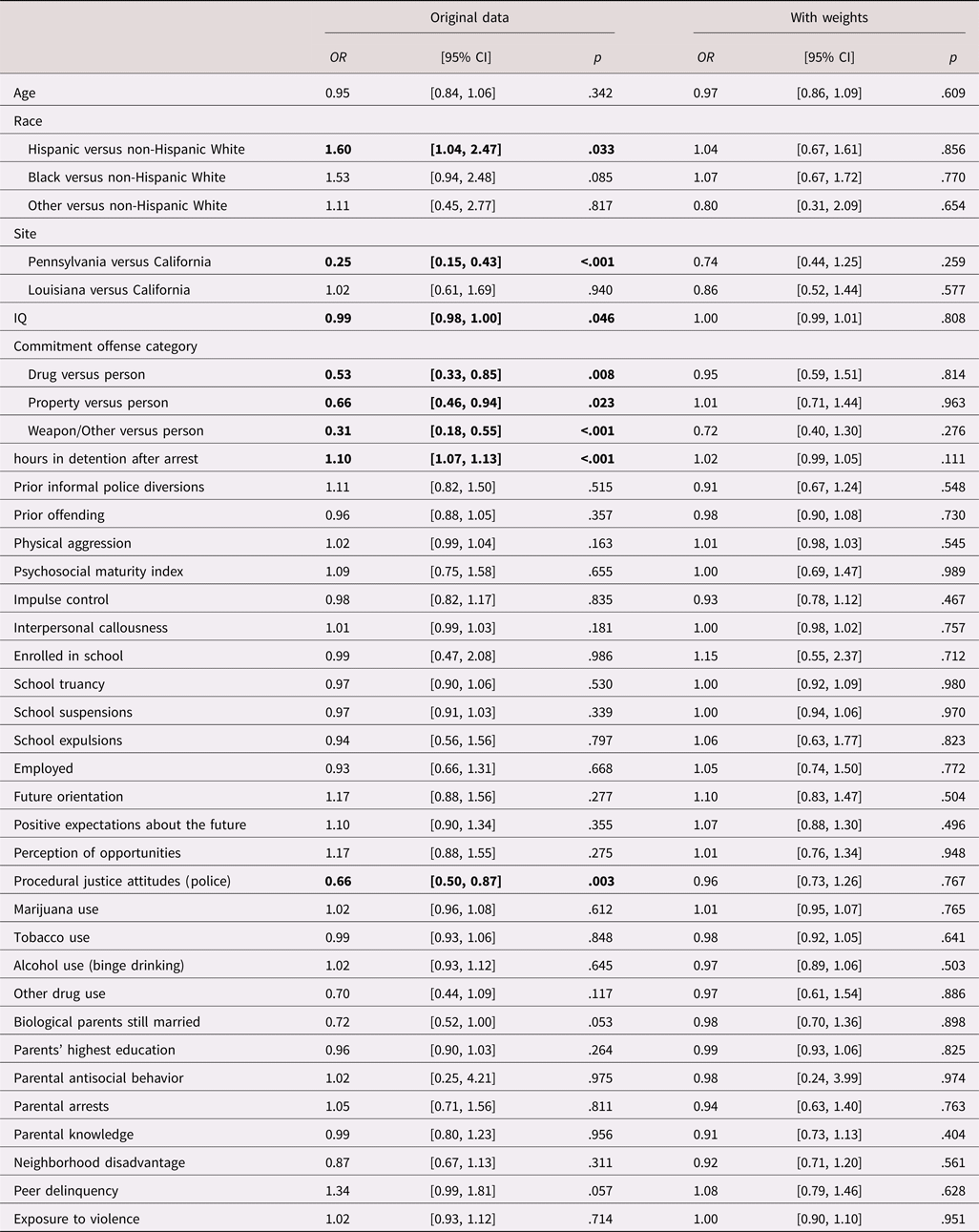
As shown in Table 1, formally processed and informally processed youth differed on numerous variables prior to the creation of the matching weights. For example, formally processed youth were more likely to be Hispanic than White, more likely to come from California than Pennsylvania, had lower IQs, were more likely to have a person offense than a drug, property, or weapon/other offense, were held in detention for more hours after their first arrest, and had less positive attitudes toward the police. After the matching weights were included, none of the matching variables were significantly related to formal processing (see Table 1).
Associations between matching variables and formal processing before and after adjusting for inverse probability weights

Notes. Regression estimates derived from two binary logistic regressions (one without weights and one with weights). Values in bold print represent coefficients that were significant based on a threshold of p < .05.
The impact of formal processing
Justice system contact
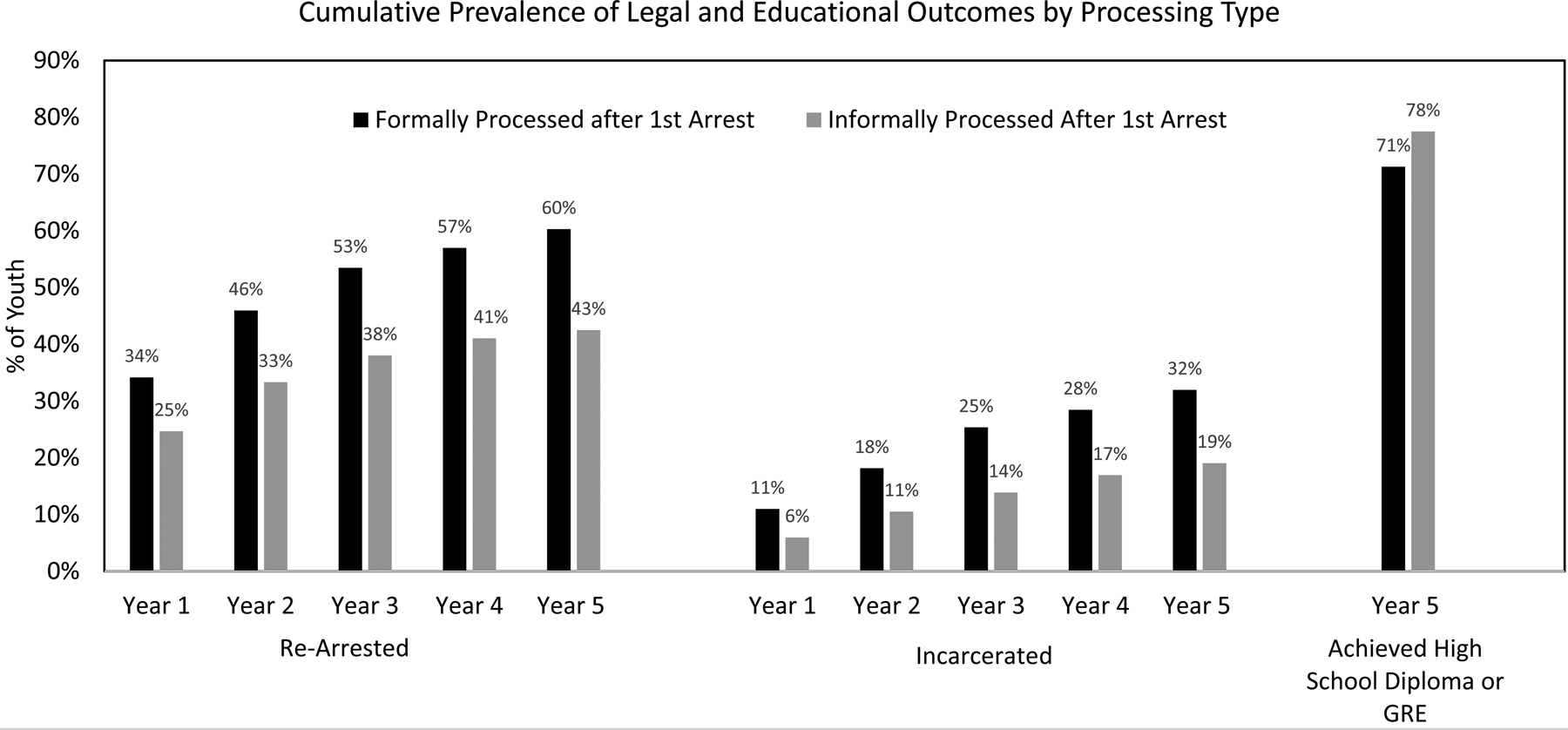
Throughout the study period, formally processed youth had significantly higher odds of being re-arrested and incarcerated than informally processed youth (see Table 2 and Figure 1). Of the youth who were formally processed after their first arrest, approximately 60% were re-arrested and approximately 28% were incarcerated at least once during the 5 years after their first arrest (see Figure 2). Of the youth who were informally processed during adolescence, approximately 43% were re-arrested, and approximately 17% were incarcerated during the 5-year study period (see Figure 2). Surprisingly, more than half (57%) of the formally and informally processed youth who were re-arrested during the 5-year study period were re-arrested during the first year and about 77% were arrested during the first 2 years of the study (see Figure 2).
Illustration of the significant main effects of formal processing (with 95% confidence intervals).

Cumulative prevalence of legal and educational outcomes by processing type.

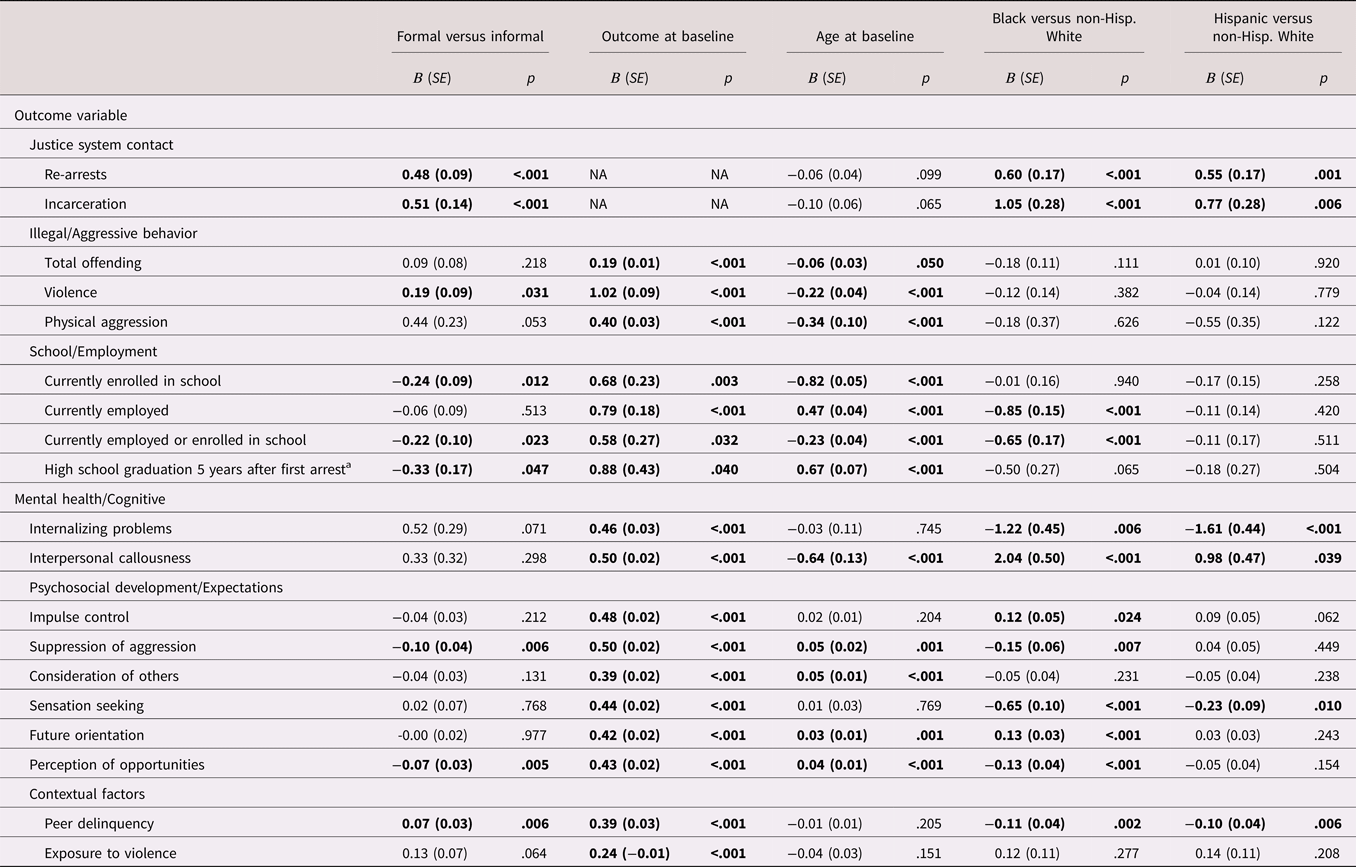
The impact of formal processing on legal factors, illegal/aggressive behavior, school/employment, mental health/cognitive, psychosocial development/expectations, and contextual factors with matching weights and control variables

Note. Generalized estimating equation population-averaged models with inverse probability matching weights. All models also included the main effect of time. SE = robust standard error. Values in bold print represent coefficients that are significant based on p < .05.
a When “high school graduation 5 years after first arrest” was examined, the baseline control variable was whether the participant was currently enrolled in school.
Illegal/aggressive behavior
Formally processed youth were more likely to self-report engaging in violence than informally processed youth (see Table 2 and Figure 1). Formally and informally processed youth did not differ on total offending or physical aggression. See Table 2 for more information.
School/employment
Formally processed youth were less likely to be enrolled in school throughout the study than informally processed youth (see Table 2 and Figure 1). In addition, when school and work were examined together, results showed that formally processed youth were less likely to be enrolled in school or work at each time point. Formally processed youth were also slightly less likely to have graduated high school (or equivalent) within 5 years than informally processed youth (71% of formally processed youth had a high school diploma or equivalent within 5 years while 78% of informally processed youth reached this milestone during the time period; see Figure 2). Formally processed and informally processed youth did not differ in likelihood of being gainfully employed at each year during the study.
Mental health
Formally processed and informally processed youth did not differ on internalizing problems or interpersonal callousness (see Table 2).
Psychosocial development
Formally processed youth had significantly lower suppression of aggression and lower expectations for future opportunities than informally processed youth (see Table 2 and Figure 1). Formally processed and informally processed youth did not differ on impulse control, consideration of others, sensation seeking, and future orientation (see Table 2).
Contextual factors
Formally processed youth reported significantly more affiliation with delinquent peers than informally processed youth (see Table 2 and Figure 1). However, formally processed and informally processed youth reported similar exposure to violence throughout the study period (see Table 2).
Summary of findings
To summarize the primary findings, results showed that youth who were formally processed during adolescence were more likely to be re-arrested, more likely to be incarcerated, engaged in more violence, reported a greater affiliation with delinquent peers, reported lower school enrollment, were less likely to graduate high school within 5 years, reported less ability to suppress aggression, and had lower perceptions of opportunities than informally processed youth (see Figure 1 and Figure 2 for illustrations of the significant associations between formal processing and the outcome variables). Formal processing was not related to general offending, physical aggression, employment, internalizing problems, interpersonal callousness, impulse control, consideration of others, sensation seeking, future orientation, and exposure to violence.
Impact of age, race, and ethnicity
A secondary interest in the present study was to examine whether age at first arrest and race/ethnicity were related to any of the outcome variables. The main effects of age at baseline are presented in Table 2. Youth who were younger at the time of their first arrest engaged in more offending, more violence, more aggression, and reported higher interpersonal callousness scores than youth who were older at baseline. Youth who were younger at the time of their first arrest were also more likely to be enrolled in school during the study period, but less likely to be employed and less likely to have graduated high school in 5 years. Youth who were younger at baseline had lower psychosocial maturity (i.e., lower suppression of aggression, lower consideration of others, lower future orientations) and more pessimistic perceptions of opportunities for future success. Finally, age was not significantly associated with internalizing problems, peer delinquency, or exposure to violence.
The main effects of race and ethnicity are presented in Table 2. These results showed that Black and Hispanic youth were more likely to be re-arrested and incarcerated than White youth during the study period, but there were no racial or ethnic differences in self-reported offending, self-reported violence, or physical aggression. Only 36% of White youth were re-arrested within 5 years of their first arrest, but 53% of Black youth and 53% of Hispanic youth were re-arrested during this period. In addition, only 11% of White youth were incarcerated during the study period, while 31% of Black youth and 24% of Hispanic youth were incarcerated within 5 years of their first arrest.
Black youth were less likely to be employed during the study period than White youth, but there were no racial/ethnic differences in school enrollment. In addition, Black and Hispanic youth had lower internalizing problems, lower sensation seeking, lower peer delinquency, and higher interpersonal callousness than White youth. Moreover, Black youth had higher impulse control, lower suppression of aggression, higher future orientation, and lower perceptions of future opportunities than White youth. In addition, there were no racial/ethnic differences in exposure to violence.
Finally, the main analysis was repeated and interactions between formal processing and time, formal processing and race/ethnicity, and formal processing and age were tested. These interactions were examined to determine whether the impact of formal processing varied by time (i.e., whether the magnitude of the impact of formal processing was strongest in the immediate future and waned across time), by race and ethnicity (i.e., whether formal processing was related to worse outcomes for Black or Hispanic youth than White youth), and/or by age (i.e., whether the impact of formal processing was worse for youth who were younger at the time of their first arrest). Results from the interaction models are not presented in the manuscript but are available from the authors by request. None of the interactions were significant using p < .05 as the threshold for significance, suggesting that the main effects presented in the previous section largely did not vary by time, race and ethnicity, or age at baseline.
Sensitivity analysis
A supplemental analysis was conducted to evaluate the associations between formal processing and change in the outcome variables without adjustment for other variables or the matching weights. In these models, GEE models were conducted with formal processing as the main predictor variable and baseline values of the outcome variables included as the only control variables. None of the demographic controls were included in these models. We also did not include the matching weights in this analysis. Results from these models are shown in Supplementary Table 3. In general, the results from these models were similar to the results from the primary models (see Supplementary Table 3).
Discussion
In the United States, the juvenile justice system was created on the belief that youth are fundamentally different from adults in ways that require different treatment under the law (Cauffman, Fine, Mahler, & Simmons, Reference Cauffman, Fine, Mahler and Simmons2018). In fact, the official rationale was, “not so much to punish as to reform, not to degrade but to uplift, not to crush but to develop” (Mack, Reference Mack1909, p. 107). In the current era, the juvenile justice system is directing its efforts towards meeting two goals simultaneously: preventing future problems in youths while also ensuring public safety (Grisso, Reference Grisso2017; Nemoyer, Gale-Bentz, Durham, Wagage, & Goldstein, Reference Nemoyer, Gale-Bentz, Durham, Wagage and Goldstein2020). As recommended by numerous researchers (e.g., Drawbridge, Todorovic, Winters, & Vincent, Reference Drawbridge, Todorovic, Winters and Vincent2019; Nelson & Vincent, Reference Nelson and Vincent2018), and as an extension as the state perceiving itself to be the ultimate parent for juvenile offenders (Goldman & Rodriguez, Reference Goldman and Rodriguez2020), the juvenile justice system abides by a principle of “individualistic application of justice” which inherently means that there is variability in how the system processes youth – even those have been charged with the same crime (Fine, Fountain, & Vidal, Reference Fine, Fountain and Vidal2019; Kurlychek & Johnson, Reference Kurlychek and Johnson2019).
Although the juvenile justice system's ability to utilize discretionary processes was intended to benefit youth and society, little is known about the actual consequences of various paths through which the system can process and sanction youth (Lau et al., Reference Lau, Rosenman, Wiehe, Tu and Aalsma2018; Petitclerc et al., Reference Petitclerc, Gatti, Vitaro and Tremblay2013). A few studies have examined how these decisions are made (Beaudry-Cyr, Leiber, Brubaker, & Jaynes, Reference Beaudry-Cyr, Leiber, Brubaker and Jaynes2020; Fine et al., Reference Fine, Donley, Cavanagh, Miltimore, Steinberg, Frick and Cauffman2017) and how much youth understand their conditions (Schwalbe & Koetzle, Reference Schwalbe and Koetzle2020), yet they do not focus on the long-term consequences of these decisions. In fact, despite juvenile justice system contact being viewed to be a critical point in youths’ lives that likely has long-term implications for both sustained justice system contact and opportunities for a successful future (Beardslee et al., Reference Beardslee, Miltimore, Fine, Frick, Steinberg and Cauffman2019; Verbruggen et al., Reference Verbruggen, van der Geest and Blokland2016), few longitudinal studies have examined the effects of present-day juvenile justice system processing in multiple justice systems within the United States across a wide range of outcomes over an extended follow-up period.
One of the critical questions that the Crossroads study was designed to answer is whether formal processing is related to worse outcomes than informal processing, which is simultaneously less expensive and less punitive. The results of the present study indicate that formal processing for an adolescent charged for the first time with a relatively moderate offense does more harm than good. Although there were some instances in which there were no differences between formal and informal processing (e.g., mental health problems; sensation seeking; future orientation), formal processing was never related to better outcomes in any of the domains tested. Conversely, in no instance was informal processing related to worse outcomes. Specifically, youth who were formally processed during adolescence were more likely to be re-arrested, more likely to be incarcerated, and reported more violence. Thus, formal processing of youth led to less safe communities. Further, formal processing was related to a greater affiliation with delinquent peers, lower school enrollment, less ability to suppress aggression, lower perceptions of opportunities, and slightly lower odds of graduating high school within 5 years than informally processed youth. These findings held regardless of age and race/ethnicity, although youth who entered the justice system at younger ages and youth of color generally had worse outcomes than older youth and white youth. In fact, although Black and Hispanic youth were more likely to be re-arrested and incarcerated than White youth during the study period, there were no racial or ethnic differences in self-reported offending, self-reported violence, or physical aggression.
Our confidence in the general finding that formal processing was related to worse outcomes was enhanced by the use of a statistical weighting technique to reduce the potential influence of preexisting differences between formally and informally processed youth. This approach allowed us to statistically account for preexisting differences between formally and informally processed youth that may have influenced processing decisions (e.g., offense severity, attitudes toward police, race, age, socioeconomic status, family characteristics, etc.) and also may be related to the outcome variables (i.e., confounding variables that may cause spurious associations). For example, our findings indicated that youth with low IQ, youth who committed person offenses, youth who spent more time in detention, and youth who had worse perceptions of the justice system were more likely to be formally processed. Although we found that Hispanic boys were more likely to be formally processed, it is important to note that race and ethnicity were confounded with site. In addition, recruitment was loosely stratified based on site, race and ethnicity, age at first arrest, and processing style. Nonetheless, the key take-away is that once the weights were taken into account, we were able to minimize the potential impact of preexisting differences – regardless of mechanism – on the outcomes under investigation.
While this study adds to our understanding of justice system processing, there are some limitations that are important to note. First, the study focused solely on males. As such, we do not know whether these findings extend to females. For instance, there is evidence that justice system personnel may treat females differently than males (Leiber & Beaudry-Cyr, Reference Leiber and Beaudry-Cyr2017; Leiber, Beaudry-Cyr, Peck, & Mack, Reference Leiber, Beaudry-Cyr, Peck and Mack2018) and their experiences may be fundamentally different (Cauffman, Reference Cauffman2008; Espinosa, Sorensen, & Walfield, Reference Espinosa, Sorensen and Walfield2020; Morash, Reference Morash2016; Parrish, Reference Parrish2020). Second, we were not able to randomly assign youth to formal or informal processing. While randomized control trials are the gold standard for assessing treatment outcomes, assigning youth to justice system experience was not ethically viable, given our predictions that formal processing could lead to poorer outcomes. Thus, we relied on our statistical weighting technique to minimize the potential differences between the two processing groups. On the one hand, our approach enhances external validity, yet on the other, it precludes establishing causality. Finally, this study only followed youth for the first 5 years after their justice system experience. While this afforded us an opportunity to see how youths change from approximately 13–17 years to 17–23 years, we are not able to fully assess the transition to adulthood. Further study of this population as they make their transition through the adult years is key to understanding what impact the juvenile justice system has on adult outcomes.
Despite these limitations, this study affords us new and important insight into the impact of juvenile justice system experience. Our multimethod approach with rich measurement design allows us to move beyond focusing only on criminal recidivism to determine the impact of juvenile justice experience on a host of other developmental outcomes. For example, while formal processing did not impact employment in particular, youth who are formally processed were less likely to graduate from high school in 5 years and less likely to be engaged in a productive activity (i.e., school or work). The lack of findings on employment, in particular, may be due to the fact that, developmentally, being employed is not the major developmental task of this age group and that we need to follow these young men longer in order to determine the true effect on adult outcomes. In addition, it is also possible that a more nuanced analysis of employment (e.g., occupational prestige; hourly wage; full-time versus part-time) could have produced group differences. Our employment variable represented whether the young man was currently employed at the time of the 5-year follow-up interview. Nonetheless, as youth were less likely to graduate from high school within the first 5 years after the first arrest, it suggests that long term employment options may be limited, based on research showing a robust connection between school completion to gainful employment and wage rates (Bridgeland, DiIulio, & Morison, Reference Bridgeland, DiIulio and Morison2006; Donovan & Watts, Reference Donovan and Watts1990; Hyla, Reference Hyla2016; Kienzl & Kena, Reference Kienzl and Kena2006).
In addition, the study examined whether any of the associations between processing and the various developmental outcomes were stronger (or weaker) for certain subgroups of youth or by time. As such, we created product terms between formal processing and age, formal processing and race/ethnicity, and formal processing and time. None of these interactions were significant, suggesting that the negative outcomes associated with formal processing were apparent regardless of youths’ age at first arrest, race, and ethnicity. In addition, the nonsignificant interactions with time indicated that the outcomes associated with formal processing were apparent in the immediate future (within the first year after) and maintained for at least 5 years. These findings are consistent with research showing that a juvenile record and juvenile justice system contact can have an immediate labelling effect on the youth (Liberman et al., Reference Liberman, Kirk and Kim2014) that can last into the transition to adulthood (Petersilia, Reference Petersilia1981; Radice, Reference Radice2017).
Conclusion
In support of the call from Edward Zigler to bring research from the laboratory to the streets (Zigler, Reference Zigler1998; Zigler & Finn-Stevenson, Reference Zigler, Finn-Stevenson, Bornstein and Lamb1992), the Crossroads study was designed by developmental scientists as a vehicle by which to study a critical public health issue. Millions of youth are arrested and processed by the justice system each year, and it is incumbent upon decision-makers to ensure public safety while also steering former adolescent offenders toward desistance and other positive life outcomes.
Although jurisdictions across the United States are reforming their juvenile justice systems to become more developmentally appropriate (Esthappan, Lacoe, Zweig, & Young, Reference Esthappan, Lacoe, Zweig and Young2020; Miller & Palmer, Reference Miller and Palmer2020; Schwartz, Reference Schwartz2018) particularly in light of the fact that juvenile justice system programs and procedures are enormously expensive (Labrecque, Schweitzer, & Mattick, Reference Labrecque, Schweitzer and Mattick2018; Petteruti, Walsh, Velazquez, & Walsh, Reference Petteruti, Walsh, Velazquez and Walsh2009; Steinberg, Reference Steinberg2017), there is still much work to do. Findings from the multisite and multiyear Crossroads study are important for guiding decisions surrounding future policies and practices. The observed variations in the processing of youthful offenders, even within the same locale, can be perceived as a feature of a system that is intended to use its flexibility in order to better serve youth and society. However, the results of this study indicate quite clearly that such flexibility can be symptomatic of the need for empirical guidance to enhance youth outcomes and ensure public safety. Responding to Zigler's (Reference Zigler1998) legacy of actively conducting, supporting, and encouraging applied scholarly work, the present study provides important guidance for juvenile justice professionals when making decisions about how to handle youth who have committed their first, low-level offense. We found that diversion not only promotes public safety through reducing violence, it also promotes positive life outcomes for the adolescents who are processed through the system. This gives youth an opportunity to desist from crime and make positive contributions to society throughout their life-course. As such, by diverting youth from formal justice system processing after their first arrest, we find that both of the critical goals of the justice system – public safety and rehabilitation – can be achieved. All things considered, our findings suggest that diversion for former first-time adolescent offenders charged with moderately severe offenses may serve the best interest of the community, the taxpayers, and the youths themselves.
Supplementary Material
The supplementary material for this article can be found at https://doi.org/10.1017/S095457942000200X.
Acknowledgments
The authors would like to thank the undergraduate, graduate and postdoctoral scholars for their invaluable contributions to this research project as well as the participants themselves.
Funding Statement
The Crossroads Study is supported by funding from the John D. and Catherine T. MacArthur Foundation, the County of Orange, the Fudge Family Foundation, the Office of Juvenile Justice and Delinquency Prevention, and the National Institute of Justice.
Conflicts of Interest
None.