Introduction
Chickpea, a legume of the family Fabaceae, is a popular crop in the low-input agriculture practiced in western Asia and northern Africa, where it is grown in more than 50 countries (Gupta et al. Reference Gupta, Verma, Sheikh, Prasad and Yadav2015; Jukanti et al. Reference Jukanti, Gaur, Gowda and Chibbar2012; Toker et al. Reference Toker, Lluch, Tejera and Siddique2007). Chickpea is the third most important grain legume, after dry bean (Phaseolus vulgaris L.), and pea (Pisum sativum L.) (FAOSTAT 2017). It is an important source of energy, protein, and fiber––both soluble and insoluble. Mature chickpea grains contain 60% to 65% carbohydrates, 6% fat, and between 12% and 31% protein––higher than any other pulse crop (Mukesh et al. Reference Mukesh, Navneet, Sunil, Arvind and Vipin2015). Chickpea is also a good source of vitamins and minerals such as B vitamins, potassium, and phosphorus (Singh et al. Reference Singh, Saini and Singh2004). It plays an essential role in improving soil fertility by fixing the atmospheric nitrogen. Chickpea can supply 80 to 120 kg N ha−1 to the soil (Herridge et al. Reference Herridge, Marcellos, Felton, Turner and Peoples1995). After harvest, chickpea leaves a substantial amount of residual nitrogen for subsequent crops, as well as a certain amount of organic matter to maintain and improve soil health and fertility (Kantar et al. Reference Kantar, Hafeez, Shivkumar, Sundaram, Tejera, Aslam and Raja2007). As such, chickpea can reduce the fertilizer input costs of subsequent crops. India, Turkey, Pakistan, Iran, Australia, New Zealand, Myanmar, Ethiopia, and Canada are the world’s main producers and consumers of chickpea. Recent years have seen an increase in land use for chickpea production, up to 12.7 million ha in 2014, resulting in 12.1 million tons harvested (FAOSTAT 2017). In 2016 the total harvested area of chickpea in Iran was 433,356 ha, with an average yield of 4,096 kg ha‒1, which is lower than the global average yield of 967.6 kg ha‒1 (FAOSTAT 2017).
Weed problems have become a major constraint on successful chickpea production. Chickpea is a poor competitor with weeds at all stages of growth because of its short stature, slow establishment, and limited vegetative growth. Toker et al. (Reference Toker, Canci, Inci and Ceylan2012) reported up to 90% reductions in chickpea yield due to competition with weeds for light, moisture, and nutrients. Weeds can also act as pathogen hosts and thus contribute to problems with chickpea disease and pest predation (Yenish Reference Yenish2007). Several studies have documented that chickpea is a poor weed competitor (Datta et al. Reference Datta, Sindle, Kristiansen, Jessop and Felton2009; Knights Reference Knights1991; Lyon and Wilson Reference Lyon and Wilson2005; Mousavi et al. Reference Mousavi, Pezeshkpour and Shahverdi2007). Chickpea generally has an open growth habit and a slow growth rate in the early stages of the crop cycle, characteristics that favor the emergence and growth of weeds (Yenish Reference Yenish2007). Thus, controlling weeds, particularly during the critical period of weed control, is important to avoid yield losses. The critical period of weed control in chickpea was found to be 50 to 69 d after emergence in Mediterranean areas (Frenda et al. Reference Frenda, Ruisi, Saia, Frangipane, Di Miceli, Amato and Giambalvo2013). In Iran, chickpea is planted in fall, early winter, and spring. Most chickpea growers tend to plant chickpea in the fall or early winter. Winter plantings have higher yields compared to spring ones, as the growing season is longer. However, weed density is expected to be higher in fall plantings.
A large amount of chickpea production in Iran occurs in Lorestan province, and hand weeding is the most common form of weed control in Iran. There is room for improvement in weed control strategies in chickpea production in Iran, as hand weeding is costly and time consuming, particularly in large-scale production systems. Therefore, there is a need to introduce effective herbicides that provide adequate control of weeds and reduce weed management costs and yield loss. Previous studies have indicated that weed interference reduces chickpea yield by 90% (Knights Reference Knights1991; Mousavi et al. Reference Mousavi, Pezeshkpour and Shahverdi2007). Previous work has shown that effective weed control increased chickpea yield by 17% to 105% (ICARDA 1986).
Although various herbicides are used for weed control in chickpea in other countries including trifluralin, ethalfluralin, and simazine in the United States and Australia (Lees Reference Lees2004) and imazethapyr in Turkey (Kantar and Elkoca Reference Kantar and Elkoca1999), only linuron and pyridate have been registered for weed control in chickpea in Iran (Zand et al. Reference Zand, Shimi, Baghestani and Bitarafan2009). However, anecdotal evidence suggests that these options do not provide adequate control of some weed species. Previous researchers have reported variable levels of weed control with pyridate (Ahmadi et al. Reference Ahmadi, Shahbazi and Diyanat2016; Karimmojeni et al. Reference Karimmojeni, Yousefi, Kudsk and Bazrafshan2015; Mousavi et al. Reference Mousavi, Pezeshkpour and Shahverdi2007). Broadleaf weeds such as wild mustard, wild safflower, threehorn bedstraw, field bindweed (Convolvulus arvensis L.), hoary cress, and haresear mustard [Conringia orientalis (L.) Dumort] are a serious challenge to chickpea production in this region (Mousavi et al. Reference Mousavi, Pezeshkpour and Shahverdi2007; Ahmadi Reference Ahmadi2011). Although most chickpea production in Iran is under rain-fed conditions, little information has been documented on weed control with herbicides in rain-fed chickpea. Therefore, the present study was designed to evaluate weed control efficacy and crop injury with PRE and POST herbicides in rain-fed chickpea.
Materials and Methods
Field Studies
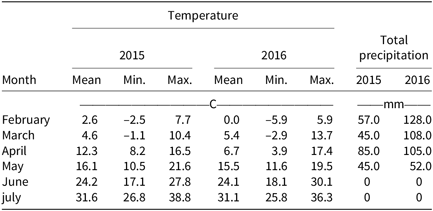
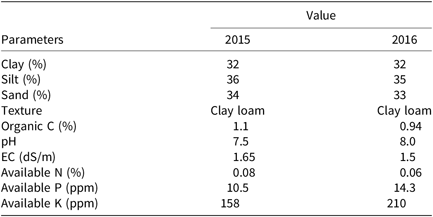
Studies were conducted in the 2015 and 2016 growing seasons in Lorestan, Aleshtar, Iran (35.49°N, 36.15°E), altitude 1,660 m above sea level. The climate of the region is arid to semiarid with average annual air temperature and rainfall of 17.2 C and 504 mm, respectively (References). Monthly average air temperatures and precipitation at the experimental site during the chickpea growing seasons in 2015 and 2016 are presented in Table 1. The soil type was a clay loam with pH of 7.5 in 2015 and 8.0 in 2016; soil organic matter was 1.1% in 2015 and 0.94% in 2016. Physical and chemical properties of the soil of the experimental site (depth of 0–30 cm) are shown in Table 2. Each study environment was preceded by wheat production and had a natural population of broadleaf weed species.
Monthly air temperatures and precipitation at experimental sites at Aleshtar, Lorestan, Iran, during the chickpea growth period in 2015 and 2016.

Physical and chemical properties of the soil of the experimental site (depth of 0–30 cm).Footnote a

a Abbreviations: CEC, cation exchange capacity [cmol (+)/kg]; EC, electrical conductivity (dS/m).
In both years the soil preparation in the experimental site was done by a moldboard plow in the fall, followed by disking before chickpea sowing. The chickpea variety ‘Hashem’ (FLIP 84-48 C) was sown at a density of 50 seed m‒2 by hand on February 10, 2015 and February 15, 2016. The experimental design in both experimental years was a randomized complete block with four replications of each treatment. Each experimental plot consisted of 11 rows 30 cm apart and 6 m long.
The herbicide treatments were linuron (Afhalen®, SC 45%, Bazargan Kala Corp., Tehran, Iran), imazethapyr (Pursuit®, SL 10%, BASF Corp., Tehran, Iran), pendimethalin (Stomp®, EC 33%, BASF Corp., Tehran, Iran), oxadiazon (Ronestar®, SL 12%, Ariashimi Corp., Tehran, Iran), pyridate (Lentagran®, EC 60%, Golsam Corp., Tehran, Iran), and bentazon (Basagran®, SL 48%, Ariashimi, Tehran, Iran). Treatment timings occurred as PPI immediately before planting, PRE 2 to 3 d after planting, and POST at the two- to four-leaf weed stage and three- to four-leaf chickpea stage. Herbicides applied PPI included linuron at 900 g ai ha‒1, imazethapyr at 100 g ai ha‒1, or pendimethalin at 825 g ai ha‒1. Herbicides applied PRE included imazethapyr at 100 g ai ha‒1 and pendimethalin at 825 g ai ha‒1. Herbicides applied POST included pendimethalin at 825 g ai ha‒1, imazethapyr at 70 g ai ha‒1, pyridate at 1,500 g ai ha‒1, bentazon at 960 g ai ha‒1, and oxadiazon at 240 g ai ha‒1. Treatments of one and two hand weedings, nontreated weedy controls, and hand-weeded, season-long weed-free plots were also included both years. In plots that were hand-weeded once or twice, weeds were removed at the time of POST herbicide application and 2 wk later, respectively. In the weed-free plots, weeds were removed weekly by hand during the growing season. Herbicide treatments were applied with a Matabi electric knapsack sprayer (Goizeper S. Cooperative Co., Guipuzcoa, Spain) fitted with 8002 VS flat-fan nozzles, calibrated to deliver 300 L ha‒1 of spray solution at a pressure of 250 kPa.
The percent weed density reduction of each weed species (wild safflower, threehorn bedstraw, wild mustard, hoary cress, low cornflower (Centaurea depressa M. Bieb), haresear mustard, and cowcockle (Vaccaria pyramidata Medik.) was measured at 3 wk after POST herbicide application (May 5, 2015 and May 12, 2016) by counting the number of plants within two permanent 0.25-m2 quadrats in each plot. Weeds were harvested at ground level, separated by species, counted, and oven dried at 75 C for 72 h. The density and biomass reduction of treatments was assessed using Equation 1 (Zand et al. Reference Zand, Baghestani, Soufizadeh, Eskandari, PourAzar, Veysi, Mousavi and Barjasteh2007; Karimmojeni et al. Reference Karimmojeni, Yousefi, Kudsk and Bazrafshan2015; Ahmadi et al. Reference Ahmadi, Shahbazi and Diyanat2016):
 $$WR\left( \,\%\, \right)=\left[ {1-\left( {WT/WC} \right)} \right]{\times}100$$
where WR is density and biomass reduction (%), WT is the weed biomass (gm‒2) in a specific treatment, and WC is the weed biomass (gm‒2) in the weedy plot.
The chickpea yield and yield components in each treatment were assessed by harvesting chickpea plants from a 2-m2 area in the center of each plot at crop physiological maturity (Karimmojeni et al. Reference Karimmojeni, Yousefi, Kudsk and Bazrafshan2015). Plant height, number of pods per plant, number of seeds per pod, and 1,000-seed weight were estimated by measuring the corresponding traits in 20 randomly chosen chickpea plants. Plots were visually evaluated for chickpea injury 40 d after sowing for PPI and PRE herbicides and 15 and 30d following POST treatments. Chickpea injury was evaluated on a scale of 1 to 9, with 1 indicating no observable injury and 9 indicating chickpea death (Sandral et al. Reference Sandral, Dear, Pratley and Cullis1997).
Data were subjected to an analysis of variance (ANOVA) using a General Linear Model procedure (Proc GLM) in SAS Software (Version 9.1, SAS Institute Inc., Cary, NC). Before analyzing the data, the assumption of a homogeneous variance was tested using a normality test. Treatment means were compared using a Fisher’s protected LSD test at the 0.05 level of significance.
Results and Discussion
Weed Density and Biomass
The composition of weed species in chickpea fields in both years was similar. Wild safflower, threehorn bedstraw, wild mustard, and hoary cress were the predominant weed species in both experimental years. Low cornflower, haresear mustard, and cowcockle were other species present. Weed density was evaluated based on the weedy check plots. The average densities in 2015 and 2016 for wild safflower were 9 and 17 plants m‒2, 10 and 8 plants m‒2 for threehorn bedstraw, 6 and 11 plants m‒2 for wild mustard, and 4 and 9 plants m‒2 for hoary cress, respectively.
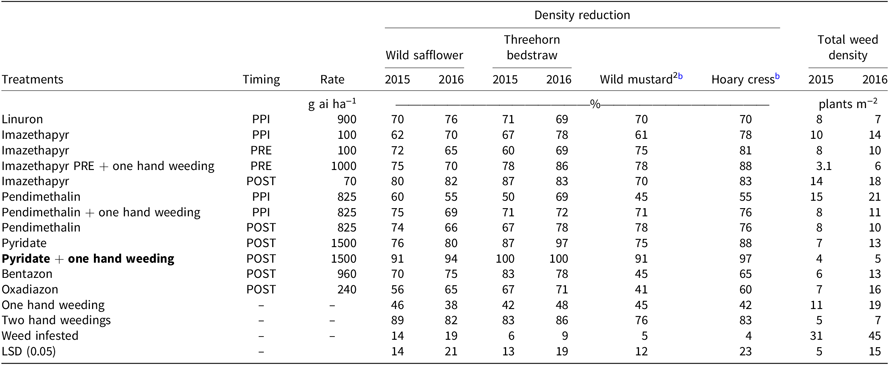
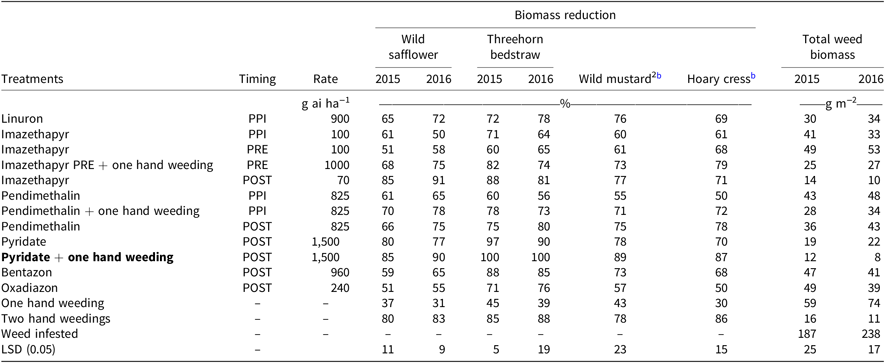
The percent reductions of weed density and biomass for different treatments are given in Tables 3 and 4. As ANOVA indicated significant differences between the year and treatment for density and biomass reductions of wild safflower and threehorn bedstraw, data from density and biomass reductions of wild safflower and threehorn bedstraw were analyzed separately for both years (Tables 3 and 4).
Effect of experimental treatments on percent density reductions 21 d after herbicide application at Aleshtar, Lorestan, Iran in 2015 and 2016.Footnote a

a Abbreviations: PPI, preplant incorporated application of herbicide applied immediately before planting; PRE, pre-emergence application of herbicide at 2–3 d after planting; POST, postemergence application of herbicide at the two- to four-leaf stage of the weeds.
b Data were pooled for 2015 and 2016.
Effect of experimental treatments on percent biomass reductions 21 d after herbicide application at Aleshtar, Lorestan, Iran in 2015 and 2016.Footnote a

a Abbreviations: PPI, preplant incorporated application of herbicide applied immediately before planting; PRE, pre-emergence application of herbicide at 2–3 d after planting; POST, postemergence application of herbicide at the two- to four-leaf stage of the weeds.
b Data were pooled for 2015 and 2016.
In 2015 and 2016, none of the herbicide treatments provided >80% control of wild safflower except imazethapyr POST and pyridate POST followed by (fb) hand weeding once. Although they have been registered for weed control in chickpea, pyridate or linuron alone did not control wild safflower. In both 2015 and 2016, no herbicide treatments achieved superior wild safflower control relative to two hand weedings (Tables 3 and 4).
In 2015 and 2016, the reduction of threehorn bedstraw density and biomass ranged from 50% to 100% over the experimental treatments. Averaged over 2 yr, application of imazethapyr POST, pyridate POST, pyridate fb one hand weeding, bentazon and two hand weedings provided control of threehorn bedstraw. Among the herbicide treatments, the poorest threehorn bedstraw control was observed in plots treated with pendimethalin PPI or imazethapyr PRE or imazethapyr PPI (Tables 3 and 4).
The highest percent wild mustard density and biomass reduction was achieved in plots treated with pyridate fb one hand weeding, whereas <80% reduction in wild mustard biomass was observed in other treatments (Table 3).
No treatments provided satisfactory control of hoary cress. The highest reduction in hoary cress biomass was achieved with pyridate fb one hand weeding and two hand weedings (Tables 3 and 4). Hand weeding once or twice reduced weed density and biomass in the range of 30% to 45% and 75% to 88%, respectively (Tables 3 and 4). Several studies have also reported that hand weeding can improve weed control in chickpea (Lyon and Wilson Reference Lyon and Wilson2005) and lentil (Ahmadi et al. Reference Ahmadi, Shahbazi and Diyanat2016; Karimmojeni et al. Reference Karimmojeni, Yousefi, Kudsk and Bazrafshan2015). In Plew et al. (Reference Plew, Hill and Dastgheib1994), better weed control was obtained in the plots with hoeing more than once. Bhan and Kukula (Reference Bhan and Kukula1987) also found that chickpea fields should be weeded two or three times during the early stages of crop growth.
Total weed dry biomass in the weedy control plots averaged 187 and 238 g m‒2 in 2015 and 2016, respectively. All treatments reduced weed biomass in both years compared to the weedy check. Pyridate POST fb one hand weeding resulted in the lowest total weed biomass in both 2015 and 2016 (11.6 and 7.8 g m‒2, respectively). In both years, weed biomass was higher in plots with one hand weeding. Among the herbicide treatments, the poorest performance was observed in plots treated with oxadiazon POST (49 g m‒2) in 2015 and imazethapyr PRE (52.6 g m‒2) in 2016. Further differences were observed in weed densities following various treatments. Total weed densities in the weedy control were 31 and 45 plants m‒2 in 2015 and 2016, respectively. The lowest total weed densities (3.1 and 5 plants m‒2 in 2015 and 2016, respectively) were related to plots treated with imazethapyr PRE fb one hand weeding in 2015 and pyridate POST fb one hand weeding in 2016, whereas the highest weed densities (14.8 and 21.2) were observed in plots treated with pendimethalin PPI in 2015 and 2016 (Table 3).
Crop Injury
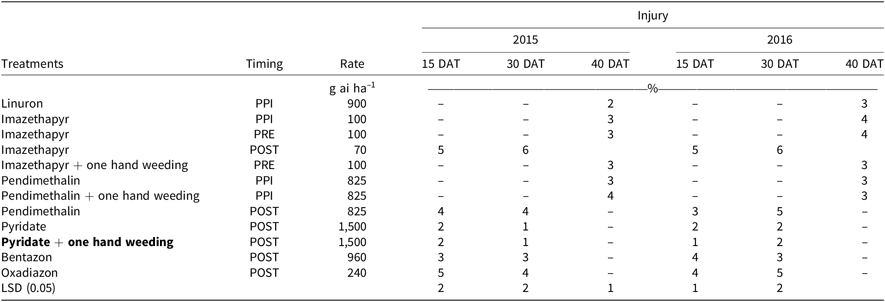
All herbicide treatments applied in this study resulted in crop injury on chickpea (Table 5). In both years, the least and most crop injury were found in plots with pyridate (10%) and imazethapyr POST (40% to 50%), respectively. Oxadiazon and pendimethalin POST also caused significant crop injury (Table 5). Taran et al. (Reference Taran, Holm and Banniza2013) reported that POST applications of imazethapyr, imazamox, and metribuzin caused major levels of injury to the chickpea plants. They found that weed control in chickpea is restricted to PRE herbicide applications to avoid crop injury. Lyon and Wilson (Reference Lyon and Wilson2005) was also found that PPI ethalfluralin caused significant crop injury in chickpea.
Visual chickpea injury following herbicide treatments at Aleshtar, Lorestan, Iran in 2015 and 2016.Footnote a–Footnote c

a Injury was rated on a scale of 1 to 9, with 1 equal to no plant response and 9 equal to plant death.
b Abbreviations: DAT, day after treatment; PPI, preplant incorporated application of herbicide applied immediately before planting; PRE, pre-emergence application of herbicide at 2–3 d after planting; POST, postemergence application of herbicide at the two- to four-leaf stage of the weeds.
c Data were pooled for 2015 and 2016.
Yield and Yield Components
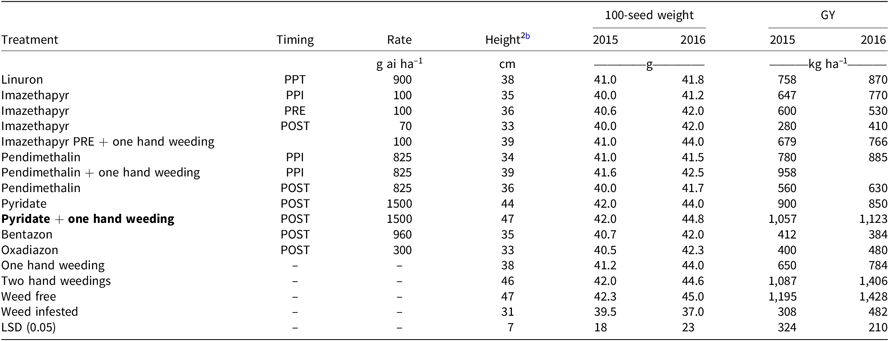
The year-by-treatment interaction was not significant for plant height. Chickpea plant height was affected by various treatments (Table 6). Plant height was reduced in weedy check plots relative to all other treatments. The greatest heights were observed in plots with weed-free treatments (47 cm), two hand weedings (46 cm), and pyridate fb one hand weeding (47 cm) and pyridate (44 cm). Reduced plant heights in some treatments may have resulted from a combination of poor weed control and herbicide injury. Weight of 100 seeds and grain yield of chickpea were affected by the year-by-treatment interaction (Table 6). Weight of 100 seeds of chickpea varied from 37 g in weedy check plots to 45 g in weed free plots in 2015 and 2016. Among the herbicide treatments, 100-seed weight in plots treated with pyridate POST fb one hand weeding, imazethapyr PRE fb one hand weeding, and pyridate POST were lower than those of other herbicide treatments (Table 6).
Height, 100-seed weight, and grain yield (GY) of chickpea under different treatments during the 2015 and 2016 growing seasons at Aleshtar, Lorestan, Iran.Footnote a

a Abbreviations: PPI, preplant incorporated application of herbicide applied immediately before planting; PRE, pre-emergence application of herbicide at 2–3 d after planting; POST, postemergence application of herbicide at the two- to four-leaf stage of the weeds.
b Data were pooled for 2015 and 2016.
Most treatments improved chickpea yields relative to the weedy control. The presence of weeds reduced yield by 74% and 66% in the weedy check plots compared to the weed-free control plots in 2015 and 2016, respectively. Chickpea yields in plots treated with oxadiazon, bentazon, or imazethapyr (PPI, PRE, or POST) were similar to the weedy check treatment in 2015 and 2016. In treatments with one hand weeding, 52% and 38% yield increases were recorded for 2015 and 2016 relative to the weedy checks, which led to chickpea yields of 650 and 784 kg ha‒1, respectively (Table 6). In both years, none of the herbicide treatments resulted in superior grain yields, as compared to two hand weedings. Chickpea yield in weed-free treatments in 2016 was higher than 2015: 1,195 kg ha‒1 vs. 1,428 kg ha‒1, respectively. A greater amount of precipitation during the major growth period of rain-fed chickpea (from February through June) in 2016 (393 mm) compared with 2015 (232 mm) might have resulted in enhanced vegetative and reproductive growth in 2016 (Table 1).
The results of 2 yr of trials highlight the need for weed control so as to obtain the maximum yield in chickpea. Overall, herbicide application significantly increased chickpea yields compared with the weedy check. Of the herbicides tested, pyridate was the most effective, with minimal injury to the chickpea plants. Other herbicides used did not provide effective weed control and resulted in serious phytotoxicity to chickpea plants. Application of PRE herbicides did not provide good control of weeds. Generally, POST applications of herbicides resulted in greater chickpea injury than PPI or PRE treatments. Although hand weeding (especially twice during the chickpea growing season) was a very effective treatment, it can be considered economically unjustifiable because of the labor requirement and costs. Although not tested in the present study, a combination of POST herbicide following the PRE herbicide may result in efficient and economical weed control in rain-fed chickpea.
Acknowledgments
No conflicts of interest have been declared. This research received no specific grant from any funding agency, commercial, or not-for-profit sectors.