INTRODUCTION
Members of the family Molidae, commonly known as ocean sunfishes, have deep compressed bodies which end abruptly behind short, high dorsal and anal fins. They are grouped into three genera and four valid species: Masturus lanceolatus (Liénard, 1840), Mola mola (Linnaeus, Reference Linnaeus1758), Mola ramsayi (Giglioli, 1883) and Ranzania laevis (Pennant, 1776) (Parenti, Reference Parenti2003).
Mola mola is the world's heaviest bony fish weighing up to 2.3 t (Roach, Reference Roach2003). This pelagic species has solitary habits and occurs in tropical and temperate ocean basins, occupying a broad range of depths, from a few metres to more than 800 m, and exhibiting diel vertical migration throughout the water column (Potter & Huntting, Reference Potter and Huntting2011).
In Uruguay, the presence of ocean sunfishes (Mola sp.) have been recorded on the continental slope (Domingo et al., Reference Domingo, Pons, Jiménez, Miller, Barceló and Swimmer2012) as well as in coastal areas, ranging from the shore to depths of no more than 50 m (Tremoleras, Reference Tremoleras1917; Devincenzi, Reference Devincenzi1924). Records have always been reported as Mola mola; however, no meticulous morphological description has been described in order to accept the appropriate recognition of the species. It appears that identifications were made on basic external observations of whole specimens only.
The aim of this work is to confirm the presence of Mola mola in the coastal area of Uruguay, based on the morphological diagnostic characters of a specimen collected in April 2013. Additionally, historical records of ocean sunfishes in the Uruguayan coast are discussed.
MATERIALS AND METHODS
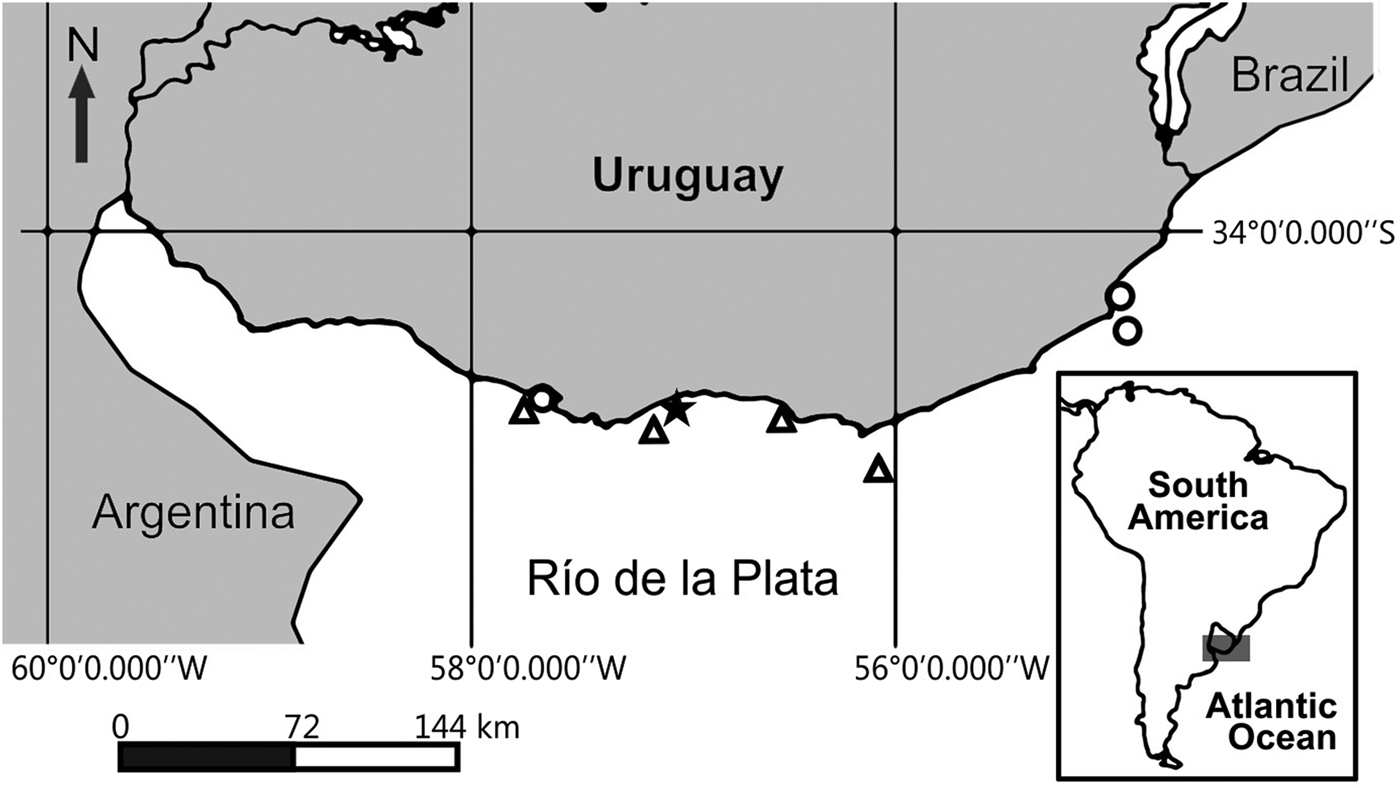
A Mola mola specimen was captured 100 m (5 m deep) off the Uruguayan coast in the Río de la Plata estuary on 24 April 2013 (autumn), as bycatch by an artisanal fisherman (34°47′15″S 55°49′54″W; Figure 1). The fish was found dead in a gill net with a stretched mesh size of 22 cm; however, its external appearance, as well as the necropsy, revealed no symptoms of decomposition. Also, the specimen exhibited some fishing net marks, probably resulting from attempting to escape.
Referenced ocean sunfish occurrences in the Uruguayan coast: filled star indicates present record, confirmed as Mola mola; open triangles indicate historical records (Mola sp.) during 20 July 1912, 26 April 1909, 14 May 1916 and 3 May 1909 (from left to right); open circles indicate records made by fishermen and local people in April 2013, February 2013 (unknown date) and 10 April 2013 (from left to right).

The individual was transported to Facultad de Ciencias, Universidad de la República (Uruguay), to be measured and dissected. Identification was based on the work of Fraser-Brunner (Reference Fraser-Brunner1951). In addition, muscular and fat tissue samples were collected and preserved both in 95% alcohol and frozen at −20°C for future genetic and isotopic analysis, respectively. The head, pectoral, dorsal, anal and caudal fins were fixed in 10% formalin. All samples were housed in the Ichthyological collection of Museo Nacional de Historia Natural de Montevideo (Montevideo, Uruguay; Collection No. MHNM 3472). Historical records of ocean sunfishes in the coastal area of Uruguay were compiled through a bibliographic revision.
Satellite images were obtained in order to show the oceanographic conditions in which the species occurred. The distribution of Sea Surface Temperature (SST) (Geostationary Operational Environmental Satellite/GOES – Polar Operational Environmental Satellite/POES) and chlorophyll-a concentration of the region (MODIS Aqua Ocean Color) (Figure 4A, B) (OceanWatch, 2013; CoastWatch, 2014), as well as the estuarine front location of the Río de la Plata estuary (Moderate-Resolution Imaging Spectroradiometer/MODIS Aqua satellite) (Figure 4C) (Earth Data, 2013) were analysed. The reason for the chosen date of the estuarine front location image – 21 April 2013 – and of the chlorophyll-a image – corresponding to the weekly image of 15 April 2013 – was related to the high abundance of clouds in the area during previous days of the record. Despite this, the estuarine front prevailed at the same position between 21 and 24 April 2013, and the chlorophyll-a concentration and distribution remained practically the same.
RESULTS
SYSTEMATICS
Order TETRAODONTIFORMES Berg, 1940
Family MOLIDAE Bonaparte, 1835
Genus Mola Kölreuter, 1766
Mola mola (Linnaeus, Reference Linnaeus1758)
(Figure 2)
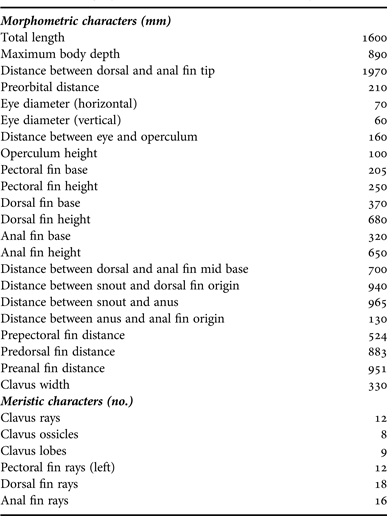
The recorded specimen (Figure 2) presented all the diagnostic characters of Mola mola: region of the clavus supported by 12 rays, eight of which bore widely separated ossicles, those born on paraxial rays united to form a single ossicle larger than the others; as well as a band of reduced skin denticles between dorsal and anal fins, smaller than the rest of the body skin (Figure 3). The specimen measured a total body length of 160 cm. Other body measurements and meristic characters are summarized in Table 1.
Mola mola specimen captured on 24 April 2013 in the Uruguayan coast of the Río de la Plata estuary.
Details of the skin of a Mola mola specimen captured on 24 April 2013 in the Uruguayan coast of the Río de la Plata estuary. A: upper view of the body skin appearance; B: transversal view of the body skin appearance; C: upper view of the band of reduced denticles between dorsal and anal fins; D: transversal view of the band of reduced denticles between dorsal and anal fins.
Body characters of Mola mola captured on 24 April 2013 in the Uruguayan coast of the Río de la Plata estuary.
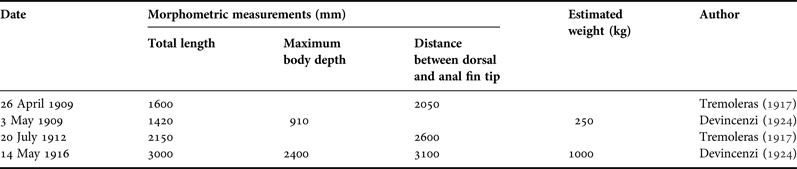
Based on the bibliographic revision, four ocean sunfishes (Mola sp.) have been recorded in the Uruguayan coast of the Río de la Plata estuary in the last 105 years (Figure 1), dating from the early twentieth century. Table 2 summarizes dates and authors of these historical records as well as morphological characteristics; other specimens, which according to the presented characteristics could be defined as Mola sp., were sighted along the Uruguayan coast by fishermen and local people in February and April 2013 as shown in Figure 1. While two of these sightings occurred at the shore, one of them in the Río de la Plata estuary (April 2013) and the other one in the Atlantic Ocean (February 2013), a third record occurred away from the shore (10 April 2014) in the Atlantic Ocean, where fishermen captured a specimen and released it alive.
Historical records of ocean sunfishes (Mola sp.) in Uruguay.
The satellite images analysed showed SST values between 19 and 19.5°C for the area of the present record throughout the day (Figure 4A). A southward intrusion of subtropical waters was recorded at approximately 36°S converging with subantartic waters and leaving an intrusion of relatively warm waters enclosed along the Uruguayan coast; the presence of some warmer water cores were detected in the Río de la Plata estuary and close to the M. mola record zone (Figure 4A). Analysis of SST revealed that the water temperature on 24 April was slightly higher than in previous months, since a positive temperature anomaly of approximately 1.5°C and less than 1°C was detected for the zone of the record and adjacent Atlantic Uruguayan coast, respectively (CoastWatch, 2014).
Satellite images (A: GOES/POES image; B: Aqua MODIS image [ocean color]; C: Aqua MODIS image of the region of the Uruguayan coast where a Mola mola specimen was captured on 24 April 2013). A: distribution of SST; B: chlorophyll-a concentration; C: estuarine front location of the Río de la Plata estuary. Stars indicate record position.
Satellite chlorophyll-a concentration images based on weekly average values previous to the day of the record revealed a concentration between 5 and 20 mg m−3 in the estuarine record region, as well as in the Atlantic Uruguayan coast (Figure 4B). These values were high in comparison with adjacent regions of Brazil and Argentina (Figure 4B) (OceanWatch, 2013) and higher than those recorded by Nagy et al. (Reference Nagy, Gómez-Erache, López and Perdomo2002) for the Río de la Plata, with typical values below 10 mg m−3 and a mode within the range 2–4 mg m−3, and by Calliari et al. (Reference Calliari, Brugnoli, Ferrari and Vizziano2009) from the Río de la Plata to the shelf slope, with a range 18.7– < 0.1 mg m−3 and average values of 2 mg m−3.
The estuarine front of the Río de la Plata estuary was found west of the record zone (Figure 4C). Furthermore, during the historical records of Mola sp. the estuarine front was located in the inner zone of the Río de la Plata estuary according to river flow data from the Instituto Nacional de Agua y Ambiente (INAA), Argentina, and salinity values from the Servicio de Oceanografía, Hidrografía y Meteorología de la Armada (SOHMA), Uruguay. According to the above mentioned, the area where M. mola has occurred has resulted in salinities where diluted ocean water prevails (Nagy et al., Reference Nagy, Severov, Pshennikov, De los Santos, Lagomarsino, Sans and Morozov2008) (Figure 4C).
DISCUSSION
Historically, ocean sunfishes in the Uruguayan coast have been recorded as Mola mola (Lema et al., Reference Lema, Lucena, Saenger and Oliveira1979); however, none of the authors specified the specific morphological characteristics required to determine the true identity of the species; moreover, there are no voucher specimens available from these records for re-examination. Hence, we referred to the historical records as Mola sp. Following Fraser-Brunner (Reference Fraser-Brunner1951), the specimen captured here could be identified as M. mola, constituting the first confirmed record of the species in the coastal area of Uruguay.
After the revision of historical occurrences in Uruguay and the record of the presented species, it has been concluded that ocean sunfishes could reach coastal areas of this region, at least occasionally. The offshore occurrence of Mola species in the continental slope of Uruguayan waters, where the species is commonly sighted, was cited by Domingo et al. (Reference Domingo, Pons, Jiménez, Miller, Barceló and Swimmer2012), which described that the Uruguayan pelagic longline fleets using American-type longline gear captured a total of 105 individuals between August 2008 and December 2010. As suggested by Fraser-Brunner (Reference Fraser-Brunner1951) and Lee (Reference Lee1986), this species spends most part of its life in oceanic waters, although they are thought to undertake unpredictable inshore migrations at least seasonally. Mola mola is most frequently detected in inshore zones of the western Atlantic off North Carolina in spring (mid-April to mid-May) and occasionally in autumn and summer (Lee, Reference Lee1986). Similarly, M. mola sightings are common in summer months at temperate latitudes in the Irish and Celtic Seas (Houghton et al., Reference Houghton, Doyle, Davenport and Hays2006) and in the western English Channel (Sims & Southall, Reference Sims and Southall2002).
The specimen recorded here occurred in an area affected by a coastal intrusion of oceanic subtropical water. Also, some of the records reported in this article were sighted together with the presence of jellyfish, according to fishermen. The distribution of M. mola has been previously associated with gelatinous plankton dynamics, suggesting movement of this species as a result of prey searching behaviour, highlighting the importance of monitoring jellyfish occurrence in order to link these events with the ocean sunfish (Molidae) presence in coastal areas (Sims et al., Reference Sims, Queiroz, Doyle, Houghton and Hays2009; Potter & Huntting, Reference Potter and Huntting2011). A study undertaken by Cartamil & Lowe (Reference Cartamil and Lowe2004) described M. mola as a seasonally common inhabitant of southern Californian waters, citing Santa Catalina Island as a probably temporary ‘stopping-over’ location for the species, due to abundant prey and warm water. Dewar et al. (Reference Dewar, Thys, Teo, Farwell, O'Sullivan, Tobayama, Soichi, Nakatsubo, Kondo, Okada, Lindsay, Hays, Walli, Weng, Streelman and Karl2010) described the important role that SST plays in the abundance and distribution of M. mola. Moreover, Sims & Southall (Reference Sims and Southall2002) found active M. mola in warmer inshore waters, mostly associated with productive fronts and stratified water masses (between 14 and 17°C), presumably for foraging. In this sense, the record zone of M. mola in the Río de la Plata estuary occurred near fronts of the system, which have been described by Nagy et al. (Reference Nagy, Gómez-Erache, López and Perdomo2002) and Nagy et al. (Reference Nagy, Severov, Pshennikov, De los Santos, Lagomarsino, Sans and Morozov2008). Moreover, a chlorophyll maximum into the estuary and in adjacent coastal waters was found to coincide with the record zone. Chlorophyll maximum (high phytoplankton concentrations) zones are often associated with high zooplankton concentrations (Harris, Reference Harris1988), which might have increased prey density. According to Dewar et al. (Reference Dewar, Thys, Teo, Farwell, O'Sullivan, Tobayama, Soichi, Nakatsubo, Kondo, Okada, Lindsay, Hays, Walli, Weng, Streelman and Karl2010), M. mola individuals tagged off the coast of Kamogawa, Japan, moved to the more productive waters in the Kuroshio–Oyashio transition zone and to the southern reaches of the Oyashio current after a reduction in chlorophyll-a concentration in the Kuroshio current (along the track chlorophyll-a ranged from 0.2 to 3.1 mg m−3 and SST varied from 11.3 to 27.8°C). Warm core rings and meso-scale eddies enhanced regional productivity, resulting in a large forage base for a range of species including anchovy, salmon, mackerel and skipjack tuna (Minoda, Reference Minoda, Sherman and Alexander1989; Yasuda & Kitagawa, Reference Yasuda and Kitagawa1996).
To conclude, water temperature distribution, as well as food availability, have been suggested as environmental drivers in the distribution of M. mola species; in this sense, such factors could have favoured the movement of M. mola reaching the Uruguayan coast of the Río de la Plata. Future records of the species, as well as more details on the distribution patterns of jellyfishes and environmental characteristics, would enhance the links between M. mola, prey and regional oceanography.
ACKNOWLEDGEMENTS
We would like to thank Juan Carlos Pallas (artisanal fisherman), and the fishermen and local people of the coastal zone for alerting us to the presence of ocean sunfishes there. Also, we are grateful to Dr Henrique Cabral, Dr Carlos Assis and Fabrizio Scarabino for their suggestions about this work, and to Ana Röhrdanz, Andrés Ligrone and Héctor Banchero for helping us with the fish dissection and transportation. This research received no specific grant from any funding agency, commercial or not-for-profit sectors.