




No CrossRef data available.
Real Shock, Monetary Aftershock: The 1906 San Francisco Earthquake and the Panic of 1907
Published online by Cambridge University Press: 31 January 2005
Abstract
In April 1906 the San Francisco earthquake and fire caused damage equal to more than 1 percent of GNP. Although the real effect of this shock was localized, it had an international financial impact: large amounts of gold flowed into the country in autumn 1906 as foreign insurers paid claims on their San Francisco policies out of home funds. This outflow prompted the Bank of England to discriminate against American finance bills and, along with other European central banks, to raise interest rates. These policies pushed the United States into recession and set the stage for the Panic of 1907.
San Francisco's $200,000,000 “ash heap” involves complications which will be felt on all financial markets for many months to come [and] the payment of losses sustained … represents a financial undertaking of far-reaching magnitude….The Financial Times [London], 6 July 1906
Information
- Type
- ARTICLES
- Information
- Copyright
- © 2004 The Economic History Association
Can localized disasters have international economic effects? This question is attracting more attention from economists as the magnitude and frequency of these events—or simply the media attention paid to them—has risen noticeably in the past decades. Earthquakes such as those that hit Northridge, California in 1994 and Kobe, Japan in 1995 may indicate that increases in population and economic activity in areas like the Pacific Rim will be accompanied by a greater risk of exposure to natural disaster.1
Other large cities in geologically unstable areas, such as Mexico City and Istanbul, have also experienced devastating earthquakes in the past 20 years.
History tells us that, indeed, events far removed from one's own country can have devastating effects. In April 1906 an earthquake and fire destroyed much of the city of San Francisco. Although the World Trade Center attacks and recent natural disasters resulted in significant destruction, the damage from each totaled less than 1 percent of GNP. On the other hand, the cost of the April 1906 disaster was substantially higher, at somewhere between $350 and $500 million, or 1.3 to 1.8 percent of nominal U.S. GNP in 1906.2
The GNP data are taken from Balke and Gordon, “Historical Data,” p. 802; and Romer, “Business Cycle,” p. 22. Early estimates of the damage were reported in The Commercial and Financial Chronicle on 28 April 1906 (p. 959) and in The Economist on 19 October 1907 (p. 1771). For later damage estimates see Douty, Localized Disasters, p. 194; Thomas and Witts, San Francisco Earthquake, p.271; and Haas et al., Reconstruction, p. 6.
For extensive recent discussion of natural disasters and insurance, see Froot, The Financing of Catastrophe Risk.
After the claims were adjudicated in July 1906, the magnitude of the resulting gold outflows in late summer and early autumn 1906 forced the Bank of England to undertake defensive measures to maintain its desired level of reserves and a fixed sterling-dollar exchange rate. The Bank's response was to raise its discount rate 250 basis points between September and November 1906; central banks in France and Germany followed suit. In addition, the Bank of England attempted to stem the gold outflow by pressuring British joint-stock companies to stop discounting American finance bills for the next year.4
The Economist, 20 October 1906, p. 1694.
The actions of the Bank of England and other European central banks attracted gold imports and sharply reduced the flow of gold to the United States. By May 1907 the United States had fallen into one of the shortest, but most severe recessions in American history. Thus primed for a financial crisis, already-weakened world markets crashed in October 1907 with the collapse of the Knickerbocker Trust Company in New York. The panic led to one of the most important changes in American financial architecture: the creation of the Federal Reserve System. Using information from contemporary sources, our article traces out the links between the disaster localized in San Francisco and the onset of the nationwide Panic of 1907.
THE GOLD STANDARD AND INTERNATIONAL SPECIE FLOWS
Between 1870 and 1914 many countries adhered to a gold standard, strictly tying national money supplies to gold stocks and standing ready to redeem currency for gold at a fixed exchange rate. The operation of the gold standard had a number of implications for economic activity in open economies, as summarized in the classical adjustment mechanism. Consider the effects of a sudden outflow of gold from a country caused, for example, by the payment of insurance claims. Through the price-specie-flow mechanism (most famously described by David Hume in 1752), the gold outflow amounts to a reduction in the nation's money supply, and so reduces the domestic price level. As the price of domestic goods falls relative to the price of foreign goods, exports will increase, imports will decline, and the resulting trade surplus will return gold to the nation. This gold flow will reduce the foreign price level and raise the domestic price level until trade imbalances and international price differentials are eliminated.5
For further discussion of this mechanism, see Bloomfield, Monetary Policy; Barro, “Money,” and Bordo, “Gold Standard.”
With integrated financial markets, this trade adjustment mechanism can be augmented by capital flows, whereby the reduction in the money supply from a gold outflow raises domestic interest rates. This will attract loanable funds from abroad, reversing the initial gold outflow. Central banks may also use policy tools to affect the speed with which equilibrium is reached. Under what came to be known as “the rules of the game,” central banks were supposed to respond to a sudden gold outflow by contracting the domestic money supply and raising interest rates.6
Bloomfield, Monetary Policy.
Prior to 1913 the United States lacked a central bank to provide liquidity during periods of monetary stringency and so the economic effects of abnormal gold flows were often magnified. Fabio Canova, and Ellis Tallman and Jon Moen, building on work by O. M. Sprague in 1910, argue that unusual gold flows were the cause of most financial crises and business cycles in the United States before the founding of the Federal Reserve.7
Canova, “Sources”; Tallman and Moen, “Gold Shocks”;Sprague, History of Crises.
There is, however, far less research on the sources of exogenous gold shocks. Take, for example, the many studies that have examined the causes of the Panic of 1907. Most of this literature explains the Panic as the ultimate outcome of a liquidity crisis in London in the wake of an unusually large amount ($70 million) of gold exports from England to the United States during 1906. Under the gold standard, such a sudden gold outflow represented a massive shock to the British money stock. In response, the Bank of England not only nearly doubled its discount rate between September and October 1906, but it also instituted a discriminatory policy against capital flows (in the form of finance bills) to the United States. These actions practically cut off gold exports to the United States, and England reversed its position from a net gold exporter to a net gold importer. The actions pushed the United States into a recession and made New York markets susceptible to a financial panic.
Scholars disagree about what caused the gold outflows that ultimately led the Bank of England to take such drastic measures. Charles Kindleberger cites various international events ranging from an Italian banking failure to the Boer War and the Russo-Japanese War as possible sources of the British gold outflow; R. S. Sayers adds the fact of a bumper crop of cotton produced in Egypt in autumn 1906.8
See Kindleberger, Manias; and Sayers, Bank of England. A search of The Economist uncovered another potentially important event in precipitating the 1907 panic: In late December 1905 concern over the Moscow uprising and the likely impact on Russia's foreign debt caused a spike in American call loan rates. This spike, however, was not accompanied by the gold outflows from Britain that we see in the aftermath of the San Francisco earthquake.

What events particular to the United States could have precipitated such unusual imports of specie from England? Milton Friedman and Anna Schwartz, and Charles Goodhart note that Secretary of the Treasury L. M. Shaw had, throughout 1906, subsidized gold imports, but they discount the impact these actions may have had in changing the usual direction of specie movements.9
Friedman and Schwartz, Monetary History; and Goodhart, Money Market.
See, for example, Sprague, History of Crises; Sayers, Bank of England; Clapham, Bank of England; Goodhart, Money Market; Kindleberger, Manias; and Bordo and Murshid, “Financial Crises.”

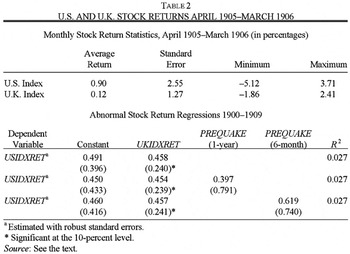
As an additional check, we test whether U.S. equity returns were significantly greater than U.K. returns in the year and six months before the earthquake. We first regress American stock returns on a constant and on the return on the U.K. All Shares Index for the period 1900–1909. The return on the U.K. index is significant at the 10-percent level. We then estimate two more regressions that incorporate dummy variables to test if there were abnormal returns in U.S. equities prior to the earthquake. The dummy variable, PREQUAKE, is set equal to one in the year leading up to the earthquake in the first specification, and set equal to one in the six months before the natural disaster in the second model. As Table 2 shows, U.K. stock returns continue to be significant at the 10-percent level while the PREQUAKE dummy is not significant at even the 40-percent level in both regressions. The results suggest that it is difficult to support the claim that British speculation in an American stock boom created the sizeable gold flows that forced the Bank of England to nearly double its discount rate in September and October 1906.
In contrast, our evidence shows that the magnitude and timing of earthquake-loss-related funds do fit the pattern of gold flows we see in autumn 1906. British insurers (and others, including a significant number of German firms) stalled on paying claims immediately after the April disaster. It was not until late summer 1906 that an agreement was reached among the firms to accept liability for claims. In their comprehensive monetary history of the United States, Friedman and Schwartz offer no definitive statement on the basis for the Bank's rate increases, saying only that “During September and October 1906, when the New York money market was relieved by gold imports from Great Britain and Germany, the London money market was in turmoil.”11
Friedman and Schwartz, Monetary History, p. 156.
At the request of the San Francisco Chamber of Commerce in Autumn 1906, U.C. Berkeley mathematics professor (and insurance consultant) Albert W. Whitney prepared a detailed accounting of insurance settlements resulting from the earthquake and fire. (This scarce report was reissued in 1972 by Caltech's Disaster Research Center.) Using Whitney's data, we find that English companies accounted for 62 percent and German companies accounted for 23 percent of total fire insurance premiums collected by foreign insurance companies in San Francisco in 1905. In addition, the average size of English and German insurance firms doing business in San Francisco was significantly larger than the average American firm (Whitney, Insurance Settlements, pp. 12–16). In fact, a list in The New York Times on 20 April 1906 (p. 4) shows that the two largest insurers in San Francisco were London Assurance and Royal of Liverpool. Transatlantic of Hamburg was ranked fourth.
Contemporary observers certainly noted this connection, as seen in the epigraph. But while Sayers and Kindleberger make brief reference to the observation that the San Francisco earthquake resulted in gold exports from England to the United States (echoing a suggestion first made by a banker in 1908 and repeated by Sprague in his 1910 volume on bank crises), they appear to be referring mainly to the gold flows that occurred immediately after the earthquake in Spring 1906.13
Frank Vanderlip, “Panic,” p. 303.
THE SETTING AND THE DISASTER
By the time the transcontinental railroad was completed in 1869, San Francisco had already established itself as the center for export trade from the Pacific Coast region. Endowed with an excellent natural harbor and easy coastal and river access to the agricultural and natural resource riches of the west, San Francisco had developed strong economic ties to other countries, particularly to Britain. Most of the wheat exported from the west coast and bound for England was financed through San Francisco, and a sizeable number of London banks had offices in that city.
At the same time, other British financial institutions sought to expand their business in the area.14
One example is the British firm of Balfour, Guthrie, and Co. which started as wheat exporters and became the San Francisco-based agents for British fire insurance firms in the nineteenth century. See Rothstein, “British Firm.”
Kirschner, Fire Insurance, p. 7.
Calculated from figures on Class 1 fire insurance companies listed in the U.S. Bureau of the Census, Insurance Business.
Twenty-five years later, these patterns persisted. At the end of 1905 slightly more than half of insured risks in California were underwritten by American firms, with almost 40 percent of business still carried by foreign firms, most of whom were based in Britain. On the other hand, California-based firms were writing only 7 percent of fire insurance business in the state.17
Kirschner, Fire Insurance, p. 21.
The Economist, 5 May 1906, p. 767. This is nearly double the average for the nation as a whole; in 1900, British fire houses issued roughly 25 percent of all fire insurance policies in the United States (Cockerell and Green, British Insurance, p. 25).
The Economist, 28 April 1906, p. 713.
In fact, The Economist, ibid., noted that some critics were chiding the British companies (which had underwritten very profitable San Francisco policies) for their “tendency to strain after big figures without devoting adequate consideration to the risks involved.” James Castillo Kennedy even suggests that insurers saw little fire risk in San Francisco because “with the winter rains and the summer fogs, buildings never really dried out enough to be dangerous” (Great Earthquake, p. 49). On 20 April 1906 (p. 4) The New York Times commented that “San Francisco had been so thoroughly free from fire for years that nearly all the large companies carried unusually extensive amounts of insurance there.”
On Wednesday, 18 April 1906 an earthquake of Richter magnitude 8.3 hit San Francisco. Most of the damage was not done by the tremor itself (which was especially severe in areas of landfill where liquefaction occurred) but by the fires that followed. Many of the city's buildings had been made of wood; this material was far more plentiful and inexpensive than brick as a result of the city's central place in the coastal lumber trade. The combination of close quarters, highly flammable building materials, and earthquake-damaged water mains hampered the efforts of firefighters. Ultimately more than four square miles—about half of the city—were destroyed. Although fewer than 1,000 of the city's 375,000 residents were killed, damage to the city was estimated at between $350 million and $500 million, on which approximately $235 million in insurance policies were held.21
Whitney, Insurance Settlements, p. 11.
Word of the disaster in San Francisco spread throughout the United States within hours and the impact was felt almost immediately in financial markets. In particular, news of the earthquake led to a sell-off and a significant drop in the price of shares in the New York and London stock exchanges. On 26 April The New York Times reported that the San Francisco disaster led directly or indirectly to about a $1 billion (or nearly 12.5 percent) decline in the market value of NYSE stocks; railway stocks alone fell more than 15 percent.22
The New York Times, 26 April 1906, p. 15. The 12.5 percent figure was computed by dividing $1 billion by the NYSE market capitalization at the end of 1905. The authors thank Peter Rousseau for providing the data on NYSE market capitalization.
The Economist, 12 May 1906, p. 804.
Funds for relief and rebuilding flowed into the city quite quickly. Given the preference of Californians for specie over banknotes, these funds came largely in the form of gold; in fact, San Francisco's bankers formed a clearinghouse to coordinate the distribution of gold money to their depositors shortly after the earthquake.24
Californians had developed this preference during the gold rush of the late 1840s. Parker Willis notes that this preference persisted until World War I and the government's impounding of gold. Only then did paper currency replace gold coin as the common medium of exchange for California. See Willis, Reserve Bank, pp. 34 and 65–67; and Armstrong and Denny, Financial California. On the clearinghouse, see Phillips, “Financial Catastrophe,” p. 98.
The New York Times, 7 May 1906, p. 12.

U.S. NET GOLD IMPORTS, 1900–1913.
THE INSURERS
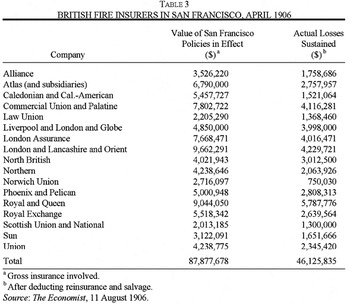
Because San Francisco was a major market for British fire insurance companies, much of the brunt of financing San Francisco's recovery was borne abroad.26
This was anticipated by the editor of the Los Angeles Times who wrote, on 1 May that “It is going to tax the ability, not only of the United States, but of the civilized world under existing circumstances, to finance the enormous project of rebuilding the city of San Francisco…” (p. 4).
The Economist, 11 August 1906, p. 1342. This figure excludes reinsurance. What little reinsurance existed (and one author [Kennedy, Great Earthquake, p. 249] suggests that the reinsurance market was not very developed in 1906) was often issued by the same companies that had primary policies in San Francisco.

Of course, the amount of policies underwritten could not precisely predict the size of insurance payments to be made; some properties survived the earthquake undamaged. At the same time, the insurers (in a particularly bad public relations move) indicated early on that no payments would be made on damage that resulted from the earthquake itself. This was a sticky point: If the fires that followed the earthquake produced the damage but the fires themselves were caused by the earthquake, insurers claimed that they were not liable.28
The San Francisco newspapers reacted quickly and vociferously to such a suggestion. In the 7 May 1906 edition of the San Francisco Examiner, the editor wrote “To say that [insurers] will not recognize as an obligation the destruction of a building by fire, which fire was the result of an earthquake, is to take a position hardly more reputable than that of an ordinary pickpocket.”
Los Angeles Times, 8 May 1906, p. 3.
In contrast to relief payments, most insurance claims took months to settle.30
Under normal circumstances, most insurance contracts of the time included a clause allowing firms 60 days to pay the adjusted claims. This “grace period” was extended even further-to the benefit of the policyholders in San Francisco-after the Insurance Commissioner of California requested that firms extend the time period for the insured to file proof of loss until 17 August. Most companies acceded to his request (Whitney, Insurance Settlements, p. 27).
Whitney, ibid., traces the development of these joint decisions, beginning with the first meetings of the insurance firms in Oakland on 21 April 1906. Kennedy (Great Earthquake, p. 253) notes that by the end of November, 1,149 claims, totaling more than $88 million had been adjusted.
Douty, Localized Disasters, p. 198.
Cockerell and Green, British Insurance, p. 25.
What made these British liabilities all the more significant for international financial markets was the fact that most foreign insurers decided to pay the claims out of their “home funds” rather than out of the reserves they held in the United States.34
Within a few days of the disaster, The New York Times reported “the announcement by some of the foreign insurance companies which carried heavy risks in San Francisco that all their losses would be paid from the home offices, and that their American resources would not be drawn on at all to meet the losses incurred in the San Francisco conflagration” and that “gold exports from London, and probably from Germany, are looked for …” (21 April 1906, p. 18). There are a number of reasons why foreign insurers may have chosen to liquidate home, rather than American, securities to pay claims, including the perceived thinness of American security markets. (On 3 May 1906, The New York Times referred to foreign firms finding some “less drastic means” of raising funds other than selling their American securities [p. 11].) Moreover, in the wake of the 1905 Armstrong Committee hearings (which had severely criticized insurance companies for draining premiums from the areas in which they were collected and investing them elsewhere) foreign firms may have been concerned about the appearance of depleting what (little) stock of American securities they did own.
See the 6 July 1906 issue of The Financial Times [London].
The pattern and timing of insurance payments can be seen in the experience of one British company, the Norwich Union Fire Insurance Society, which had over $15 million in San Francisco policies in effect.36
Business Minutes of the CGNU Archives. The Norwich Union Fire Society consisted of four insurance firms: Norwich Union, Commercial Union, Palatine, and Alliance.
Because the refusal of some British firehouses to assume liability produced a large public outcry in San Francisco, members of the Norwich Union reconsidered their liability in the earthquake. Legal counsel in the United States advised these British firehouses to pay claims in order to avoid possible litigation. Lawyers for the firehouses noted that British companies were likely to lose in court given that a San Francisco jury would be influenced by the “extraordinary conditions” surrounding the quake.37
Business Minutes of the CGNU Archives, 28 May 1906.
Some British firehouses met early claims by selling assets held by New York trust companies. Norwich Union, for example, liquidated its portfolio in July 1906.38
Business Minutes of the CGNU Archives, March-November 1906.
San Francisco drafts advised 523 thousand total drafts paid 447 thousand—Balance in banks 42 thousand—May I draw? (17 September 1906)
Since this morning's cablegram have additional notice of drafts so draw sight for £17,571.1.2 time money 6 per cent, financial advice here is to borrow in London and transfer by cable—such transfer being saleable here at higher rate than sight bills. (17 September 1906)
Total San Francisco drafts advised six [sic] fifty one thousand draw sight tomorrow's steamer £20,682.10.6. (19 September 1906)
Total San Francisco drafts advised 800 thousand—draw sight tomorrow steamer £8,274.14.5. (3 October 1906)
While the summer of 1906 saw British insurance firms shipping gold to San Francisco, New York financial institutions also faced reduced gold reserves resulting from their own specie transfers to San Francisco in the immediate aftermath of the earthquake.39
The Financial Times [London], 6 July 1906.
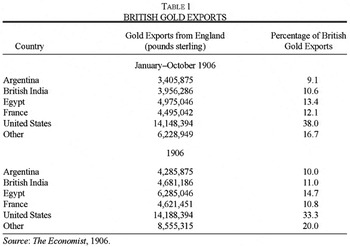
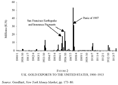
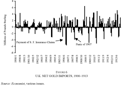
In sum, then, the disaster gave rise to a massive flow of gold to San Francisco and New York, immediately after the earthquake and again in the autumn of 1906. As shown in Figure 2, England exported $30 million in gold to the United States in April and May; this was followed in September and October by a further $35 million in specie. In total, quake-related payments to the United States represented 40 percent of seasonally adjusted British gold exports for all of 190640
In contrast, exports to France, Egypt, India, and Argentina each amount to only 10 to 15 percent of total or seasonally adjusted British gold outflows. If we include British gold exports to France in the spring—funds intended to shore up French reserves lost as a result of that country's relief and aid payments to the United States—we can say that more than 42 percent of seasonally adjusted British gold exports were quake related, and such payments to the United States would account for more than 2.5 times the British gold exports to any other country in 1906. (British gold exports were deseasonalized using the Holt-Winters exponential smoothing algorithm).
If insurance payments by all foreign companies are totaled, the London Times estimated that over $55 million in claims were paid out in later summer and early fall, with non-British firms accounting for 10 percent of foreign insurance payments made. Although Britain was by far the largest foreign insurer in San Francisco, there were also substantial amounts insured by France and, especially, Germany. (A few German firms were forced into bankruptcy by the disaster.) The Times can also be used to pinpoint when insurance companies paid out most of their claims. It reported on 9 August 1906 that “[insurance] losses will be paid out of home funds” (p. 11; emphasis added). Nearly three weeks later, on 29 August, it noted that “thirty-five companies of the 120 involved in the San Francisco disaster have paid an aggregate of $55,000,000 in claims” (p. 3). Finally, on 18 October, the Times wrote that “all claims have now been paid expect those arising under policies with ‘earthquake clauses’” (p. 14).

U.K. GOLD EXPORTS TO THE UNITED STATES, 1900–1913
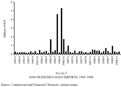
Confirmation of the importance of insurance payments comes from figures on gold imports into the port of San Francisco. Typically, the city accounted for a negligible amount of American gold imports in any given month. This was not the case, however, in autumn 1906. As shown in Figure 3, the city of San Francisco alone received through its port approximately $11 million in the late summer and early fall of 1906. This accounts for approximately 9 percent of all seasonally adjusted U.S. gold imports in 1906. In addition, the records of the National Monetary Commission indicate that New York transferred $10 million of gold to San Francisco in the fall of 1906. One periodical noted that “with money pouring in at the rate of $1,000,000 a day from insurance alone, the banks of San Francisco are more crowded with deposits than ever in their history.”42
The American Banker, 26 August 1906.
The New York Times, 21 September 1906, p. 8.

SAN FRANCISCO GOLD IMPORTS, 1905–1908
THE CENTRAL BANKS
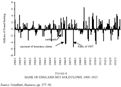
The magnitude of the British funds flows can be put into stark perspective by noting that they represented a 14-percent loss in the gold money stock of England.44
Data for the U.K. gold money stock are taken from Capie and Webber, Monetary History.
Individually, September 1906 ranks third and October 1906 ranks fourth in terms of the size of England's monthly net gold outflows between 1900 and 1913. The largest single month outflow during that period was in October 1907, at the height of the Panic.
Market watchers had speculated about a rise in the discount rate months earlier: On 22 April 1906 The New York Times commented that “As a result of the transfers of capital which must be made from London to this country in connection with [the insurance claims], discussion was rift in London financial circles yesterday of the chances of an increase in the English bank rate ….”
The Economist, 15 September 1906, p. 1497.
We searched the recorded minutes in the Bank of England's archives but located no specific statement on the reasons for raising the discount rate. The Archivist at the Bank of England, Mr. Henry Gillett, noted that the Bank did not record discussions of discount rate changes during this particular period in British economic history. However, in a lengthy letter to the Editor of The Economist, a correspondent signing himself “Economist” takes issue with an earlier letter in which the increase in the discount rate was blamed on the Bank's “injudicious finance.” “Economist” writes that “… the causes underlying this present crisis are deeper. There are many subsidiary causes. The sudden liabilities of the British insurance companies to America in connection with the San Francisco fire is one cause …” (15 December 1906, p. 2053).
The Economist, 20 October 1906, p. 1694.

BANK OF ENGLAND NET GOLD FLOWS, 1900–1913
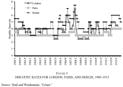
As shown in Fig. 5, the bank held the discount rate constant for the remainder of 1906 and then subsequently lowered it in early 1907. This would seem to indicate an easing of credit conditions in England. On the contrary, the bank threatened joint stock companies with a 7-percent rate on money if they did not stop discounting U.S. finance bills, credit instruments used to import gold and to profit from exchange rate fluctuations.49
Typically, American banks and trust companies drew finance bills payable in pounds sterling on their correspondent banks in London during the summer. They would then sell sterling bills for dollars; this would result in a gold shipment to New York. The finance bills would be covered in the autumn when the demand for dollars was high following the export of U.S. agricultural goods to Europe.
Sprague, History of Crises. The Economist of 22 September 1906 saw this as a reflection of the Bank's “evident desire … to avoid, if possible, a further advance of the rate” (p. 1533). By 22 December the editor of The Economist actually came out in favor of outright discrimination against American bills despite one correspondent's contention that such an anti-free market policy could “imperil ‘our pre-eminence in the international position’” (p. 2089). Clearly, the editor was more concerned about domestic economic conditions than international economic reputation.

DISCOUNT RATES FOR LONDON, PARIS, AND BERLIN, 1900–1913

U.K. NET GOLD IMPORTS, 1900–1913
The gold drain was not confined to the London money market. Insurance companies from other parts of Europe, particularly France and Germany, had also issued policies in San Francisco, accounting for about 10 percent of the payments owed by foreign firms. Like their British counterparts, these firms paid their claims in accordance with the New York report (see The Times reports for foreign insurance companies, September-December 1906). As seen in Figure 5, the German central bank raised its discount rate to 7 percent in the fall of 1906 to counter gold losses of nearly 10 million pounds sterling, or more than 10 percent of its specie reserve, between 7 August and 31 October 1906. With a bank rate higher than that of the Bank of England—6 percent—gold poured into the Reichsbank in early 1907. The specie reserve of the Reichsbank increased from 36 million pounds sterling on 7 January 1907 to nearly 45 million pounds by the end of February.51
Investor's Monthly Manual, Tabular Money Market History, January 1908.
See Eichengreen, Golden Fetters; and Goodhart, Business of Banking.
Sprague, History of Crises, p. 241.
Cross, Domestic and Foreign Exchange, pp. 215–17.
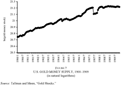
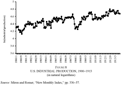
As finance bills came due (without the possibility for the usual rolling-over of extant bills) there was a scramble for liquidity and a sell-off of railroad securities by American firms in early 1907. The decline in stock values led to a short but sharp “Rich Man's Panic” in March, helping to push the United States into a recession. The repatriation of finance bills led to the net export of more than $30 million in gold during the summer of 1907.55
Moen and Tallman, “Lessons,” p. 4.
Balke and Gordon, “Historical Data,” pp. 789–808.

U.S. GOLD MONEY SUPPLY, 1900–1909 (in natural logarithms)

U.S. INDUSTRIAL PRODUCTION, 1900–1913 (in natural logarithms)
The New York money market entered the fall of 1907 low on gold reserves and vulnerable to shocks that might otherwise have been temporary in nature. Some scholars attribute the proximate cause of the Panic to the failed attempt by Auguste Heinz and his associates to corner the copper market. Others blame the collapse of New York's second largest trust company, Knickerbocker. Both events probably contributed to the panic that erupted in late October 1907, leading to a series of bank runs in New York. Within a few weeks, the crisis spread to other regions of the United States.
Several measures were taken to contain the crisis. The New York Clearinghouse Association issued loan certificates, a money substitute used to clear accounts between banks. Clearinghouse loan certificates artificially increased the money supply and freed up currency for depositors who demanded cash. Federal aid came in the form of public funds deposited by the U.S. Treasury at key New York City banks, and J. P. Morgan formed a money pool with bankers to provide liquidity assistance to trust companies and the stock market.57
For extended discussions of these events, see DeLong, “Morgan's Men”; Donaldson, “Banking Crises”; and Ramirez, “Morgan's Men.”
Moen and Tallman, “Clearinghouse Membership,” p. 151.
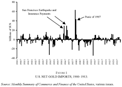
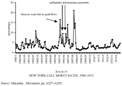
As short-term interest rates rose to over 10 percent as seen in Figure 9, gold poured into the United States from England and the rest of Europe. Figure 1 shows that the United States imported over $100 million in gold during November and December. Although the specie arrived too late to prevent a panic, gold shipments probably shortened the period of suspension and reduced the duration of the recession. On the other hand, specie exports drained European money centers of gold, helping to transmit the “localized” New York panic to international financial markets.59
See Goodhart, Money Market, pp. 120–21.
Jeanne, “Monetary Policy,” p. 321.

NEW YORK CALL MONEY RATES, 1900–1913
To summarize, the historical narrative provides evidence that the San Francisco earthquake was the catalyst for a liquidity crisis in the New York and European money markets through its effect on gold flows. The Bank of England, in conjunction with other European central banks, responded by raising their discount rates and discriminating against U.S. bills for the next year. These actions set off a chain of events—the interest rate increases that led to a recession and stock market decline—that ultimately ended in the panic of 1907.61
Extensive econometric analysis of the connection between these gold shocks and the American economy are available from the authors on request.
CONCLUSION
Empirical evidence on the links between real and monetary shocks is often difficult to uncover given the endogenous interaction of the two factors. The San Francisco earthquake, on the other hand, is an identifiable exogenous real shock with a traceable impact. In our article, we follow the impact of this disaster and estimate its effects on financial markets and the American economy. This chain of events also led to a permanent change in the institutional structure of the United States. Responding to the panic, Congress passed the Aldrich-Vreeland Act in 1908; this created the National Monetary Commission and authorized banks to issue emergency currency backed by commercial paper in times of crisis. The National Monetary Commission's recommendations eventually formed the basis of the Federal Reserve System that was established in 1913.
The authors would like to thank Michael Bordo, Richard Burdekin, Charles Calomiris, Forrest Capie, Michael Edelstein, Claudia Goldin, Charles Goodhart, Anne Hanley, Larry Katz, Charles Kindleberger, Jon Moen, Harold Mulherin, Larry Neal, Ronnie Phillips, Peter Rousseau, Richard Sylla, John Wallis, Tom Weiss, Gavin Wright, two anonymous referees, and seminar participants at the 2001 Economic History Association, 2001 Business History Conference, the University of Wisconsin at LaCrosse, and the Claremont Colleges for comments. We would also like to thank the archivists at the Bank of England and Ellis Tallman for supplying data for the study. A special thanks to Sheree Leeds, the archivist at CGNU, for locating and transcribing the Business Minutes of Norwich Union for 1906 and 1907. The authors acknowledge financial support from Claremont McKenna College.
References
1906.
American Banker.
New York,
26 August
Andrew A. Piatt.
1983.
Statistics for the United States 1867–1909.
Washington, DC:
Garland Publishing,
Armstrong Leroy, and J. O. Denny.
1916.
Financial California: An Historical Review of the Beginnings and Progress of Banking in the State.
San Francisco:
Banker Publishing Co.,
Balke Nathan S., and Robert J. Gordon.
1986.
“Historical Data.” In The American Business Cycle: Continuity and Change,
edited by Robert J. Gordon,
781–850.
Chicago:
University of Chicago Press,
Barro Robert J.
1979
“Money and the Price Level under the Gold Standard.”
Economic Journal
89, no. 353
13–33Google Scholar
Bloomfield Arthur.
1959.
Monetary Policy under the International Gold Standard.
New York:
Federal Reserve Bank of New York,
Bordo Michael D.
1984.
“The Gold Standard: The Traditional Approach.” In A Retrospective on the Classical Gold Standard, 1821–1931,
edited by Michael D. Bordo and Anna J.
Schwartz,
23–113.
Chicago:
University of Chicago Press,
Bordo Michael D., and Antu Murshid.
2001.
“Are Financial Crises Becoming More Contagious? What is the Historical Evidence on Contagion?” In International Financial Contagion,
edited by Stijn Claessens and Kristin J. Forbes,
367–403.
London:
Kluwer,
Bureau of Domestic and Foreign Commerce.
Monthly Summary of Commerce and Finance of the United States.
Washington, DC:
GPO,
1905–1908
CGNU Archives,
London.
Calomiris Charles, and Gary Gorton.
1991.
“The Origins of Banking Panics: Models, Facts, and Bank Regulation.” In Financial Markets and Financial Crises,
edited by R. G. Hubbard.,
109–173.
Chicago:
University of Chicago Press,
Calomiris Charles, and R. Glenn Hubbard.
1989
“Price Flexibility, Credit Availability, and Economic Fluctuations: Evidence from the United States, 1894–1909.”
Quarterly Journal of Economics
104, no. 3
429–52Google Scholar
Capie Forrest, and Alan Webber.
1985.
A Monetary History of the United Kingdom, 1870–1982.
London:
George Allen and Unwin,
Canova Fabio.
1991:
“The Sources of Financial Crisis: Pre- and Post- Fed Evidence.”
International Economic Review
32, no. 3
689–713.Google Scholar
Clapham John.
1944.
The Bank of England.
Vol. 2.
Cambridge:
Cambridge University Press,
Clapham John.
1952.
An Economic History of Modern Britain: Free Trade and Steel.
Cambridge:
Cambridge University Press,
Cockerell H. A. L., and Edwin Green.
1976.
The British Insurance Business 1547–1970.
London:
Heinemann Educational Books,
The Commercial and Financial Chronicle
New York,
various dates.
Cross Ira.
1923.
Domestic and Foreign Exchange: Theory and Practice.
New York:
The Macmillan Co.,
De Long J. Bradford.
1991.
“Did Morgan's Men Add Value? An Economist's Perspective on Financial Capitalism.” In Inside the Business Enterprise: Historical Perspectives on the Use of Information,
edited by Peter Temin,
205–36.
Chicago:
University of Chicago Press,
Donaldson R Glenn.
1993:
“Financing Banking Crises: Lessons from the Panic of 1907.”
Journal of
Monetary Economics
31, no. 1
69–95.Google Scholar
Douty Christopher.
1977.
The Economics of Localized Disasters: The 1906 San Francisco Catastrophe.
New York:
Arno Press,
Eichengreen Barry.
1992.
Golden Fetters.
Oxford:
Oxford University Press,
The Economist
London,
various dates.
1906
The Financial Times
[London],
Friedman Milton and Anna Schwartz.
1963.
A Monetary History of the United States 1867–1960.
Princeton, NJ:
Princeton University Press,
Froot Kenneth A., ed.
1999.
The Financing of Catastrophe Risk.
Chicago:
The University of Chicago Press,
Goodhart Charles E.
1969.
The New York Money Market and the Finance of Trade.
Cambridge, MA:
Harvard University Press,
Goodhart Charles E.
1972.
The Business of Banking, 1891–1914.
London:
Weidenfield and Nicolson,
Haas J Eugene, Robert W. Kates, and Martyn Bowden, eds.
1977.
Reconstruction Following Disaster.
Cambridge, MA:
The MIT Press,
Investor's Monthly Manual
1908.
London,
Jeanne Olivier.
1995:
“Monetary Policy in England 1893–1914: A Structural VAR Analysis.”
Explorations in Economic History
32, no. 3
302–26.Google Scholar
Kennedy John Castillo.
1963.
The Great Earthquake and Fire, San Francisco, 1906.
New York:
William Morrow and Company,
Kindleberger Charles.
1978.
Manias, Panics, and Crashes: A History of Financial Crises.
New York:
Basic Books,
Kirschner Herbert A.
1922.
Fire Insurance Development on the Pacific Coast.
San Francisco:
Underwriters' Report,
Los Angeles Times,
various dates.
Macaulay F. R.
1938.
The Movement of Interest Rates, Bond Yields, and Stock Prices in the United States since 1856.
New York:
National Bureau of Economic Research,
Miron Jeffrey A., and Christina D. Romer.
1990:
“A New Monthly Index of Industrial Production, 1884–1940.“
This Journal
50, no. 2
321–37.Google Scholar
Moen Jon, and Ellis Tallman.
1990:
“Lessons from the Panic of 1907.”
Federal Reserve Bank of Atlanta Economic Review
75
2–13.Google Scholar
Moen Jon, and Ellis Tallman.
2000:
“Clearinghouse Membership and Deposit Contraction during the Panic of 1907.”
This Journal
60, no. 1
145–63.Google Scholar
Myers Margaret.
The New York Money Market.
New York:
Columbia University Press,
1931–1932
Neal Larry D.
2000:
“A Shocking View of Economic History (Presidential Address to the Economic History Association).”
This Journal
60 no. 2
317–34.Google Scholar
Neal Larry D., and Marc D. Weidenmier.
2003.
“Crises in the Global Economy from Tulips to Today: Contagion and Consequences” In Globalization in Historical Perspective,
edited by Michael D. Bordo, Alan M. Taylor, and Jeffrey G. Williamson,
473–510.
Chicago:
University of Chicago Press,
The New York Times,
various dates.
Phillips Ronnie J.
2003:
“Coping with Financial Catastrophe: The San Francisco Clearinghouse during the Earthquake of 1906.”
Research in Economic History
21
79–104.Google Scholar
Ramirez Carlos.
1995
“Did J. P. Morgan's Men Add Value? Corporate Investment, Cash Flow, and Financial Structure at the Turn of the Century.”
Journal of Finance
50, no. 2
661–78Google Scholar
Romer Christina D.
1989
“The Prewar Business Cycle Reconsidered: New Estimates of Gross National Product, 1869–1908.”
Journal of Political Economy
97, no. 1
1–37Google Scholar
Rothstein Morton.
1963
“A British Firm on the American West Coast, 1869–1914.”
Business History Review
37, no. 4
392–415Google Scholar
San Francisco Examiner,
various dates.
Sayers R. S.
1976.
The Bank of England 1891–1944.
Cambridge:
Cambridge University Press,
Sprague O.M.
1910.
History of Crises under the National Banking System.
Washington, DC:
National Monetary Commission,
Tallman Ellis, and Jon Moen.
1998
“Gold Shocks, Liquidity, and the United States Economy during the National Banking Era.”
Explorations in Economic History
35, no. 4
381–404Google Scholar
Thomas Gordon, and Max Morgan Witts.
1971.
The San Francisco Earthquake.
New York:
Stein and Day,
The Times
London,
1905–1908
United States Bureau of the Census.
1891.
Report on Insurance Business in the United States.
Eleventh Census, Extra Census Bulletin no. 6,
United States Comptroller of the Currency.
Annual Reports,
various years.
United States Secretary of the Treasury.
1906.
Annual Report on the State of the Finances for the Fiscal Year Ended June 30, 1906.
Washington, DC:
GPO,
Vanderlip Frank A.
1908:
“The Panic as a World Phenomenon.”
Annals of the American Academy of Political and Social Science
31, no. 2
pp.
302–07.Google Scholar
Whitney Albert W.
1972.
On Insurance Settlements Incident to the 1906 San Francisco Fire.
Pasadena:
California Institute of Technology,
Willis Parker B.
1937.
The Federal Reserve Bank of San Francisco.
New York:
Columbia University Press,
BRITISH GOLD EXPORTS
U.S. AND U.K. STOCK RETURNS APRIL 1905-MARCH 1906
U.S. NET GOLD IMPORTS, 1900–1913.
BRITISH FIRE INSURERS IN SAN FRANCISCO, APRIL 1906
U.K. GOLD EXPORTS TO THE UNITED STATES, 1900–1913
SAN FRANCISCO GOLD IMPORTS, 1905–1908
BANK OF ENGLAND NET GOLD FLOWS, 1900–1913
DISCOUNT RATES FOR LONDON, PARIS, AND BERLIN, 1900–1913
U.K. NET GOLD IMPORTS, 1900–1913
U.S. GOLD MONEY SUPPLY, 1900–1909 (in natural logarithms)
U.S. INDUSTRIAL PRODUCTION, 1900–1913 (in natural logarithms)
NEW YORK CALL MONEY RATES, 1900–1913
 You have
Access
- 72
- Cited by