Introduction
Behaviour therapy (BT) and later cognitive behaviour therapy (CBT) have been in use in Ireland among mental health professionals since the 1970s. While learning theories have been taught to undergraduates in psychology, training courses in Clinical and Counselling Psychology have had different emphases. The first BT course for psychiatric nurses in Ireland was in 1975. Since then, there have been several courses in BT or CBT, which were recognised by the Nursing and Midwifery Board of Ireland [NMBI, previously known as An Bord Altranais (ABA)], and more recently, university-based courses.
As CBT increasingly becomes the treatment of choice for a range of conditions and is recommended as such by UK National Institute for Clinical Excellence, the demand for training courses is likely to rise. Consequently, CBT is in demand by both mental health professionals seeking training in CBT and clients seeking therapy. In Ireland, there are a number of short introductory courses as well as longer ones lasting a year or more. At present, however, few Irish courses are structured to fit the kind of training necessary for accreditation with the Irish Council for Psychotherapy/National Association for Cognitive Behaviour Therapy (NACBT) or the British Association for Behavioural and Cognitive Psychotherapies (BABCP). Historically, courses (e.g. those aimed at mental health nurses) tended to be occasional rather than regular and were accredited by professional bodies (e.g. NMBI) rather than universities. A certificate course in BT for nurses did, however, run for 13 consecutive years at University College Cork (UCC; Ryan et al. Reference Ryan, Cullinan and Quayle2005). Other courses were often run and undertaken by nurses with little support, financial or otherwise. Though interprofessional post-graduate CBT courses are common place in the United Kingdom, this has not always been the case in Ireland and the present course at Trinity College Dublin (TCD) was the first in Ireland, starting in 1996.
Previous follow-up studies
Ashworth et al. (Reference Ashworth, Williams and Blackburn1999) found in their follow-up of CBT graduates from the Newcastle, England, course that past trainees continued to use their CBT skills, although the ways in which the skills were used seemed to be determined by the professional background. Their graduates comprised psychiatrists, GPs, psychologists, nurses as well as other professions. Few of their graduates were employed as predominantly CBT specialists.
Nurses qualifying in BT/CBT have been extensively studied – more than any other profession (Marks et al. Reference Marks, Connolly and Hallam1973; Ginsberg & Marks, Reference Ginsberg and Marks1977; Marks, Reference Marks1985; Newell & Gournay, Reference Newell and Gournay1994; Gournay et al. Reference Gournay, Denford, Parr and Neewell2000; Gournay, Reference Gournay2000). Gournay (Reference Gournay2000) reviewed 132 UK nurses who had undergone BT/CBT training, and found that the majority were employed as dedicated nurse therapists. In contrast, Ryan et al (Reference Ryan, Cullinan and Quayle2005) review of 257 Irish nurses who had undertaken a BT course between 1986 and 1999 found that only 17% reported that BT was the main focus of their work.
A number of studies followed up psychiatrists who had undertaken CBT training (Lefevre & Lefevre, Reference Lefevre and Goldbeck2001; Hull & Swan, Reference Hull and Swan2003; Swift et al. Reference Swift, Durkin and Beuster2004; Whitfield et al. Reference Whitfield, Connolly, Davidson and Williams2006). The main finding was that insufficient time affected psychiatrists’ ability to continue to provide CBT after qualifying. However, many CBT-qualified psychiatrists stated that the training had impacted on their clinical work or on their occupational activities.
Specialised CBT courses previously seemed to have been aimed at nurses, first by the Maudsley course and later ENB 650 (accredited by the English National Board for Nurses) in the United Kingdom and through various courses in Ireland run by UCC or in hospital nurse education settings. As CBT courses moved to universities, becoming recognised post-graduate courses, the intakes comprised a mix of professions. However, professions other than nurses and psychiatrists do not seem to have been studied, although training courses regularly mention that their intakes also consist of psychiatric social workers, occupational therapists (OTs), GPs, psychologists and others.
Why do a follow–up survey?
There are a number of reasons for following up graduates. Mavis (Reference Mavis2005) enumerates some reasons including (1) to justify funding for the course, (2) to find out to what extent the course is providing graduates with its expressed goals, and (3) to compare courses – ‘to monitor program outcomes and enhance program quality’.
Like other CBT courses (Ashworth et al. Reference Ashworth, Williams and Blackburn1999), the TCD course is expensive both financially for the funders and in terms of time committment. Most students attend through a day release agreement with their employers, and thus are absent from their posts on study days. The aims of this study are multiple but in line with Mavis’s (Reference Mavis2005) reasons, we aim to evaluate whether learning on the course is carried over into the working life of the graduates, that is, (1) whether the graduates continue to use CBT, if at all, (2) how they manage to integrate the CBT with their professional role, (3) whether they have become dedicated CBT therapists in the health service, (4) whether they have retained their interest in CBT by undertaking CPD, and (5) if the course had a positive impact on the students themselves.
Method
An internet-based voluntary and anonymous questionnaire survey was conducted between May and June 2010. The survey took ∼15 minutes to complete.
Participants
All participants were graduates from the TCD CBT course, which has been running since 1996. Except for a 3-year gap when the course did not run and 2 years when an MSc was run, the course has been run at post-graduate diploma level. The last cohort of graduates surveyed was the 2008–2009 group. Of 82 available records of trainees, 77 were contacted by email and invited to participate. They were graduates of both the MSc (n=27, 37.7%) and the post-graduate diploma (n=53, 68.8%). Of the five missing graduates, one was deceased, two had retired and two were untraceable.
Data collection
The data were collected through an internet-based survey. This method was chosen because nowadays, most professional people use the internet on a regular basis, either at work or in their personal lives, or both. Response rates to internet-based surveys of health professionals range from 9% to 94% (Braithwaite et al. Reference Braithwaite, Emery, De Lusignan and Sutton2003). Studies by Cook et al. (2000) and Couper (2000), quoted in Dillman et al. (Reference Dillman, Phelps, Torora, Swift, Kohrell, Berck and Messer2009), found that response rates to internet-based surveys tended to be lower than to other modes. However, given that internet usage has increased exponentially in the last 10 years or so (from 8% in 1998 to 62.7% in 2008 according to the World Bank, 2014), and that there was a prior relationship with our graduates, we hoped for a response rate that would be larger than the usual low rate obtainable in postal surveys. Most surveys require the use of reminders and the sending out of second batches is usual. Thus, emails were sent to 77 graduates giving them a link to a survey on Surveymonkey. A number of responses were obtained and the process was repeated 2 weeks later, sending the emails with the link again, thanking those who had already responded. Four emails were sent in total to all graduates. Responses were 14 to the first email, 4 to the second email and so on until a total of 43 (56%) responses were obtained through repeated reminders.
Survey questions covered a number of different areas, mostly based on Ashworth et al. (Reference Ashworth, Williams and Blackburn1999) with some based on Townend et al. (Reference Townend, Ianetta and Freeston2002). The areas covered included
1. Demographic information: age, gender, profession, year course completed, current work setting, etc.
2. Past and present work information: whether CBT had become a dominant therapeutic approach, whether the respondent had changed jobs, whether completion of the course had enhanced career prospects.
3. Experience of CBT course: a brief seven-point rating scale to summarise their experience, from ‘very poor’ to ‘excellent’.
4. Clinical CBT Supervision: this covered whether the respondent received or provided formal or informal CBT supervision.
5. Continuous professional development (CPD): whether the respondent continued to read CBT journal articles or books, attended CBT workshops or conferences, and membership of a CBT association.
6. General: usefulness of the CBT course personally, professionally, and clinically.
Results
The average current age of respondents was 38, with a range from 30 to 59. As regards gender, 62% (n=23) were female and 38% (n=14) were male – six respondents did not specify their gender.
Respondents came from each year the course had run. Cohorts with the highest numer of responses were from years 2007 (n=6) and 2008 (n=11), with year 2009 having the lowest (n=4). Most respondents had completed the course in the post-graduate diploma format (n=35) and the remainder in the MSc format (n=8). Forty-three questionnaires were returned, giving a response rate of 56%. However, not all respondents answered each question and so percentages below are calculated from the numbers of responses received. A total of 81% of respondents completed the questionnaire fully. Two respondents provided their responses in paper form.
Thirty-seven respondents answered the question regarding the current area of employment. Twenty-six were working in General Adult Mental Health; three in Child and Adolescent Mental Health; three in Primary Care; two in Addictions; one in Rehabilitation; one in Psycho-Oncology; and one in Cardiology.
Of 41 respondents who responded to the question regarding their work setting, 25 worked in the public health service; 5 in Voluntary Hospitals; 3 in a private hospital; 5 in private practice; 1 in a university counselling service; and 2 respondents gave the responses ‘hospital’ and ‘private’.
Of 39 respondents answering the question regarding their core profession (Fig. 1), mental health nurses were the most highly represented group (n=18; 46%), whereas dieticians and speech and language therapists (SALTs) were the least represented (n=1 of each; 3%).
Professions of respondents.

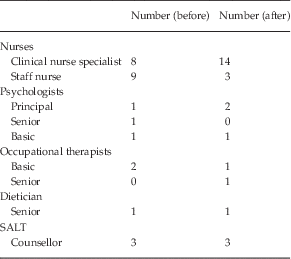
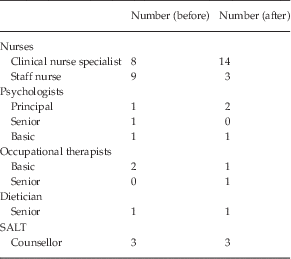
Participants were asked to state their grade at the commencement of their CBT training as well as after undertaking the course. Table 2 lists the responses to this question. Staff nurse (n=9) and Clinical Nurse Specialist (n=8) were the most frequently cited grades at the start of CBT training. Post training, clinical nurse specialist was the most frequently cited grade (n=14; (Table 1).
Occupational grade before and after course completion
SALT, Speech and Language Therapist.
Psychiatrists omitted as Registrar is a training grade.
Almost half (47%) of the respondents had changed their job since completing the course. Five Registrars had become Consultant Psychiatrists, and six nurses had become Clinical Nurse Specialists in CBT, one with an approved position as an Advanced Nurse Specialist but still awaiting funding. Other job changes were from the mental health domain to a university setting; from working with one particular population to another; or progression in the original profession (e.g. OTs). Dieticians, SALTs, Counsellors had remained at the same grade.
Completion of the CBT course was regarded as enhancing one’s career by 70% of the respondents. However, 9% disagreed and 20% were uncertain that completion of the CBT course enhanced one’s career.
Brefore attending the course, the dominant therapeutic approach used by the 33 respondents to this question varied widely. A quarter of respondents (25%, n=8) said their approach was person-centred (including the descriptions of ‘Humanistic’ and ‘Rogerian’), 16% (five) gave their orientation as medical or biological, 6% (two) as systemic, and 6% (two) as biopsychosocial. Other descriptions given included interpersonal, integrative, eclectic, directive, didactic, supportive, strengths-based, solution-focussed, collaborative, reality therapy, and motivational interviewing.
Thirty-four (79%) respondents answered the question about the main current therapeutic approach. As expected 16 (47%) endorsed CBT as their main approach. Other approaches were CBT-based or CBT plus medication or systems theory or biopsychosocial approach (n=7, 21%), collaborative (n=4, 12%), and integrative, biopsychosocial, psychosocial, psychotherapeutic, and structured (each with two or fewer endorsements).
Seventeen (51%) of respondents reported that CBT was the main focus of their present job. Reasons given when CBT was not the main focus included lack of resources/funding (two), lack of time (three), other duties taking precedence (eight), and a role that did not have a psychotherapeutic component (three) (Fig. 2).
Percentage of working time by activity.
The majority of participants had high levels of clinical involvement, with 30 respondents (91%) spending between 30% and 100% of their time in clinical work. Supervision of others comprised <10% of work time for 15 (45%) respondents, but between 10% and 40% for 10 (23.3%) respondents. For two respondents, supervision comprised 40% to 60% of their work time. In total, 12 (39%) spent more than 10% of their worktime supervising others. Ten (23.3%) respondents taught (formally and informally) for 10–20% of their time, whereas 17 (51%) taught <10% of their work time. Other activities mentioned included journalism. Seven (37%) were spending more than 10% of their time participating in research activity. However, this question was only answered by 19 respondents. Interestingly, those with least client contact were more involved in supervision, teaching and research.
Current CBT supervision
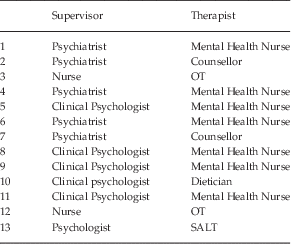
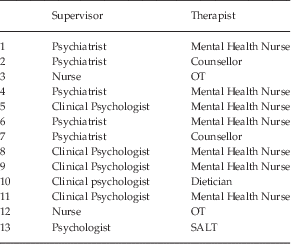
Out of 32 respondents, 22 (69%) currently receive formal CBT supervision. Twenty-one answered more detailed questions on the kind of supervision. Thirteen (59%) receive supervision on a one-to-one basis with an expert CBT therapist; nine (41%) engage in peer group supervision; one has telephone supervision; and four (18%) have group supervision with an expert therapist. Five respondents (23%) have access to more than one form of supervision. None of the psychiatrists receive CBT supervision, nor do two of the three psychologists, nor either of the two social workers, nor one each of the nurses and counsellors (Table 2).
Profession of supervisor if different to your own
OT, Occupational Therapist; SALT, Speech and Language Therapist.
As regards the profession of the supervisor, 10 (48%) of respondents have supervision from the same profession, and 11 (52%) from a different profession. Five of the supervising ‘different profession’ are psychiatrists and six are psychologists; two are nurses. In both cases where a nurse is supervisor, the supervisee was an OT. Conversely, those supervised by a different profession are mostly nurses being supervised by psychiatrists or psychologists. These professions are also chosen by the counsellors, dieticians, and SALTs who are unlikely to find same-profession CBT supervisors. Six (42%) nurses were supervised by nurses; four (28%) by psychologists; and three (21%) by psychiatrists.
Although 75% of supervisors are endorsed as having formal CBT training, the CBT qualifications of their supervisors are either unknown or lacking in the other quarter. Again, three-quarters of the supervisors are reported to have formal supervision training.
Seven (23%) of those who answered both questions, provide supervision but do not receive it. The majority (n=5, 71%) of these, however, state that the supervision they provide is informal and to their own profession. One, however, provides formal CBT supervision but does not receive it.
Frequency of supervision is generally monthly (n=15, 63%), whereas seven (30%) have weekly supervision. Almost 17% (four) report having supervision ‘as necessary’.
The method most often used (n=22, 92%) in supervision is case discussion, followed by ‘Formulation’ (n=18, 75%), audio/video recordings (n=11, 46%), role play (n=7, 29%), and Functional Analysis (n=6, 25%). Topics discussed (in order of frequency) are: interventions (n=23, 100%); therapeutic relationship (n=20, 87%); homework (n=18, 78%); ethical issues (n=16, 25%); risk assessment (n=13, 56%); and measurement (n=12, 52%). Other topics mentioned by individual respondents were process issues in therapy, literature, clinical, and corporate governance issues.
Over half of respondents (n=11, 52%) had access to informal supervision, whereas 24% (n=5) had no access and 29% (n=6) had only occasional access to this. Most of the informal supervision (n=11, 85%) was accessed from a present colleague.
We asked whether graduates had difficulty in accessing CBT supervision: 48% (n=10) had no difficulty, 48% (n=10) had difficulty, one (5%) of who had problems with having time for supervision. One respondent did not try to access supervision. The majority of those having difficulty worked in the public health sectors: seven (70%) in the Heath Services Executive (HSE), one (10%) in Rehabilitation and one (10%) in a Voluntary Hospital. On the other hand, half of those reporting no difficulty worked in the HSE. Several respondents suggested that the course provide support or supervision for graduates (Fig. 3).
Provision of clinical supervision.
A large proportion of the respondents provided informal CBT supervision to their own profession (n=14, 44%) and almost a quarter (n=7, 22%) provided formal supervision to their own and other professions. However, one-third (n=11, 34%) provided no supervision at all. Approximately two-thirds (n=20, 64%) had no training in providing supervision and the rest had, although one stated that this training was not CBT-focussed. Eight respondents provided supervision, but did not recieve supervision: many of these stated that they provided informal CBT supervision to their own profession. The majority of those providing supervision (n=20, 87%) did so on a one-to-one basis; 43% (n=10) engaged in peer dyad or group supervision; and 13% (n=3) provided supervision as expert to a group. (As some respondents engage in more than one form of supervision, totals are more than 100 %.)
CPD
The majority of respondents have attended CBT workshops (n=25, 75%), courses (n=9, 28%), conferences (n=15, 47%) and lectures (n=16, 47%), but four (15%) attended no CPD events at all. All respondents reported continued reading of CBT material, with 22 (69%) reading ‘a lot’ and 10 (31%) reading ‘a little’.
Membership of CBT associations
There are two main CBT associations in Ireland: one is the BABCP of which the Irish Association for Behavioural and Cognitive Psychotherapies (IABCP) is a branch; and the NACBT, a member of the Irish Council for Psychotherapy.
Twelve (36%) respondents are members of BABCP, and two (6%) are members of the NACBT. However, almost two-thirds (n=20, 61%) are not members of either association. Twenty-two (79%) have not pursued accreditation with either association, while the other fifth has done so. Asked whether they were aware of the BABCP Jiscmail discussion forum, six (42%) of those who were BABCP members were aware of it and two (10%) (A third of these) had made use of it.
It seems that membership of one of the CBT organisations is correlated with attendence at CPD events. Five respondents who were not members of either organisation did not attend any CBT CPD events. On average, those who were members of either or both organisation/s attended an average of 2.8 CPD events annually (workshops, conference, lecture, course) while those who were not members of either organisation averaged 1.3 attendences. Four respondents who were not members of either CBT association had not attended any CPD events (one of these was on extended leave) but said they read CBT material.
Experience of the CBT course
The majority (n=18, 55%) described their experience of the course as ‘Excellent’; 33% (11) rated it as ‘very good’, 9% (3) as ‘slightly good’ and 3% (1) as ‘average’. No ratings were received for the negative options of ‘slightly poor’, ‘poor’, or ‘very poor’. Comments on the course were in general complimentary of the teaching and organisation of the course, and of the value of the CBT approach. The reflective practice aspect of the course was favourably commented on by several respondents. However, two respondents gave generally negative views of the course: one felt it to be overly academic, and the other found it too focussed on diagnoses and individual pathology. Several mentioned the dearth of suitable supervision after the end of the course. Only one respondent mentioned the expense of the course.
Responses to the questions whether the course had been personally and professionally useful were unanimous at 100% each (n=32 and 33, respectively). In terms of clinical utility, 97% (32) felt the course had definitely been useful, and 3% (1) that it was a little useful. There were no negative responses.
Comments included:
‘Self practice/self reflection made me look at life very differently. I became more conscious of what made me tick. It was scary but brilliant’.
‘The reflective practice approach and the skills learned from the course I feel has increased my confidence and helped me immensely in providing therapeutic interventions for my clients’.
‘In a general hospital CBT (is) very useful… Many of my patients have benefited from CBT and many more could if there was only more time and personnel’.
‘The current Psychiatric nurse training does not have enough emphasis on talk therapy which should be a given’.
‘I have a different approach to my patients which is definitely more collaborative … I do a lot of snippets of CBT on the wards and in outpatients and direct all my patients to explore self-help material’.
Discussion
The response rate was low compared with other university-based CBT course follow-up surveys, most of which have taken place in the United Kingdom. There was generally a high response rate (c 80%) in UK surveys of CBT graduates (Newell & Gournay, Reference Newell and Gournay1994; Hull & Swan, Reference Hull and Swan2003; Swift et al. Reference Swift, Durkin and Beuster2004; Davidson, Reference Davidson2004). Response rates varied from 79% to 94% (Whitfield et al. Reference Whitfield, Connolly, Davidson and Williams2006) and generally involved an initial survey plus one reminder.
Ryan et al. (Reference Ryan, Cullinan and Quayle2005) in Ireland had a response rate of 53%, having sent out just one batch of questionnaires. An unpublished survey of MSc CBT graduates from UCC (Crowe, Reference Crowe2008) had a response rate of 43% from participants who had completed the course and graduated. In the current study, the initial response rate of 34% was boosted to the present 56% after three reminders. This may have been partly due to its format – electronic rather than postal. Kaplowitz et al. (Reference Kaplowitz, Hadlock and Levine2004) found that younger people (⩽24 years) are much more likely to respond to a web survey than a postal survey. It is, however, interesting that the three Irish surveys had much lower response rates than the British ones. This raises the question of cultural attitudes to surveys affecting response rates.
The proportion of the various professions is in contrast to Ashworth et al. (Reference Ashworth, Williams and Blackburn1999) study of CBT graduates in Newcastle in the United Kingdom, in which 33% were medical professionals, 27% were nurses, and 25% were psychologists. We had many more nurses, fewer medical professionals, and far fewer psychologists. Their survey had an almost close to 50–50 gender balance, close to our 60–50 female–male sample, and their mean age of 37 was also similar to ours.
The course was highly rated by all and was percieved as enhancing one’s career by 70% of the respondents. It is, however, interesting that promotions and career development seemed to have occured almost exclusively among the psychiatrists and the nurses. It is unclear if these were due to undertaking the course, or for other reasons. It is likely that the psychiatrists were taking consultant posts in the normal progression of their careers. In nursing, the number of CNSs had increased from 8 to 15 after graduating from the course, with one in the process of becoming an Advanced Nurse Practitioner (ANP). It would thus seem that undertaking the course is associated with career advancement for nurses. However, the study would have benefitted from knowing whether the promotions/specialism were in CBT. In spite of the existance of a register of CNSs and ANPs in CBT (National Council for Nursing and Midwifery), which should make tracking in easier, other studies too have failed to identify the use of CBT by CBT trained nurses. Ryan et al. (Reference Ryan, Cullinan and Quayle2005) found that only 17% of their respondents indicated that BT was the main focus of their work. However, while nurses believe that the course enhances their career; this might not be in actually specialising in CBT. Crowe’s (Reference Crowe2008) study showed that 45% of participants believed that CBT training would enhance their promotion prospects. Ryan et al. (Reference Ryan, Cullinan and Quayle2005) found that 70% believed that completion of the course altered their career prospects.
Many of the repondents found that they did not have CBT as their main focus due to lack of time, resources or due to other duties. This again supports the findings of other studies (LeFevre & Lefevre, Reference Lefevre and Goldbeck2001; Hull & Swan, Reference Hull and Swan2003; Swift et al. Reference Swift, Durkin and Beuster2004; Whitfield et al. Reference Whitfield, Connolly, Davidson and Williams2006). This is interesting in light of the funding of courses by employers. Employers may support and fund CBT training but somehow not support its application post-qualification. This possible lack of employer support might also explain the low use of supervision and CPD. This would seem a waste of resources if indeed employers do not facilitate to optimum use of acquired skills. It is interesting that the respondents, who’s other duties took precedence, did try to incorporate CBT as much as possible into their work where appropriate. However, this reduced use of CBT skills post-qualification warrants further investigation.
The responses to the question regarding CBT supervision support those of other studies. Townend et al. (Reference Townend, Ianetta and Freeston2002) in the United Kingdom found that 57% of therapists made use of individual supervision (59% in the present study); group/expert 15% (18%); peer group 42% (41%) as well as using more than one form of supervision.
Difficulties in accessing supervison seemed related to the workplace, in that no private hospital employees reported problems in this area. This may well be due to the sizes of the relative institutions, as the public health service covers the entire country and so CBT graduates may be quite isolated from other CBT practitioners. However, we did not ask graduates about their geographical location. The problem with lack of access to supervision does not bode well for the practice of CBT as lack of supervison results in therapist drift, a decline of skills and use of idiosyncratic practice (Mannix et al. Reference Mannix, Blackburn, Garland, Gracie, Moorey, Reid, Standart and Scott2006; Waller, Reference Waller2009), which may reduce the effectiveness of the therapy being provided. Waller (Reference Waller2009) states that supervision is essential to ensure that clinicians implement evidence-based treatments. In future, it may be interesting to review the outcomes of high versus low supervision therapists in Ireland.
We did not ask whether those who provided supervision to others, received supervision for their supervision. It is perhaps perturbing that 23% of those who answered both questions, provide supervision but do not receive it. The majority of these, however, provide informal supervision to their own profession. Of the psychiatrists, none received CBT supervision, although one provided formal CBT supervision. In contrast, Whitfield et al. (Reference Whitfield, Connolly, Davidson and Williams2006) found that half of the CBT-qualified psychiatrists they surveyed received supervision for their own CBT practice. The paucity of CBT supervison for psychiatrists may reflect the amount of time they are able to devote to it, or the availability of supervision, and may deserve further study.
It is interesting how few of the ‘different professions’ providing supervision are nurses. Only two nurse respondents (14%) provide formal supervision to other professions, and only three (21%) provide formal supervision to other nurses. It is possible that nurses are percieved and percieve each other as lower status supervisors resulting in seeking supervisors from other professional backgrounds. There may, however, be a number of other reasons for this, for example geographical convenience, but this is beyond the present study.
Of course, the more graduates complete the course each year, the more supervisors should be available, for both formal and informal. However, as only a one-third are members of the two CBT associations, supervisors may be difficult to find when more recent graduates seek supervision. As the graduates are spread widely in the public health service, apart from the Dublin area, it may be useful to emphasise that students need to maintain membership of the associations, and attend CPD events in order to network with their peers.
The breakdown of how worktime was spent would have benefited from a 0% option; unfortunately the lowest posible answer was 0–10%, making it impossible to know whether the activity was not carried out at all. Clinical work rated the highest, with the majority of the respondents spending most of their worktime in clinical work. Supervision and teaching was undertaken by a considerable number, although whether this was CBT teaching was not clarified.
We asked only yes/no questions about CPD, and so gained only basic information. More useful enquiries could have been made into the amount of CPD, and where the workshops were attended – whether in Ireland or abroad. Although it appears that association members attend more types of CPD events, it may not in fact be the case that they actually have more CPD as we did not ask for CPD to be enumerated. It might also have been useful to enquire into what graduates read as CPD.
A postal survey may have been more useful with this cohort of graduates, and may have led to a better response rate. It seems that further study of graduates of CBT courses in Ireland would merit examination, particularly as there seem to be notable differences to graduate surveys done in the United Kingdom. There has been little research with Irish CBT practitioners, and given the immediate differences between these findings and findings in the United Kingdom, it would appear that UK studies may not be generalisable to Ireland.
Of course, there are broader service implications of these findings. The main finding of relevance is of course whether people trained in CBT, whose training is often funded by the employer, are using their skills in clinical practice post-qualification. This is relevant not only to the employer but for the planning and provision of health care, and may also be relevant socially and economically to Irish society in general.
Layard, an economist, was the driver of the Increasing Access to Psychological Therapies programme in the United Kingdom, and has a barrage of frightening statistics to justify investment in mental health (Layard & Clark, Reference Layard and Clark2014). Poor mental health or mental illness is responsible for a loss of 4% of GDP. It accounts for half of absenteeism from work. One in six people is affected by depression or anxiety but only one-third of these get treated, whereas 90% of those afflicted with physical illnesses recieve treatment. Crimes committed by people suffering from mental illness accounts for another 2% of GDP. One in three families contains someone suffering from mental ill-health. Mental illness accounts for 38% of all illnesses.
The evidence base for CBT is strong (Hoffmann et al. Reference Hoffmann, Asnaani, Vonk Imke, Sawyer and Fang2012) and it is clear that there is a demand from the public for talking therapies. A Vision for Change (Department of Health and Children, 2006), which was adopted as Irish govenment policy on mental health, recommended the establishment of a National Mental Health Directorate to implement ‘a multi-professional manpower plan… linked to projected service plans. This plan should look at the skill mix of teams and geographically, taking into account the service models recommended by this policy’. Unfortunately this Directorate has not yet been established, and CBT training seems to proceed in an ad hoc manner. The levels of training needed in CBT are not set out and so whether staff attend one- or two-day courses or workshops, gain an extra-mural Foundation Certificate in CBT, or a more advanced post-graduate diploma or Masters is up to the individual themselves. In order to foster expertise, training needs need to be analysed, and support given to skills implementation and development through supervision and CPD.
Acknowledgement
The authors thank Katie Armstrong, Course Administrator, for helping track down so many graduates.