Introduction
In 1902, Discovery Hut was erected at Hut Point, Ross Island, Antarctica, by the National Antarctic Expedition led by Robert F. Scott. This wooden building was the first structure to be built on Ross Island and was to serve as a shelter, a workshop and to store supplies. Due to the design of the hut it was too cold to house the men. When the expedition members left the continent, the hut and supplies were abandoned. The hut was also used extensively by four other expeditions in the Heroic Age, both as a key stepping stone to the southern latitudes and as shelter for those returning from the south. After use by Shackleton's 1914–1917 Imperial Trans-Antarctic expedition, the hut was abandoned until the late 1940s and visited only periodically until 1957 when restoration work began. In the past 20 years, the hut and the surrounding area has attracted increasing numbers of tourists from cruise ships and scientists from the nearby research facilities, Scott Base and McMurdo Station. Of the three historic huts, on Ross Island, Discovery Hut has been the most affected by human impact due both to being close to the research facilities and to the increasing numbers of visitors.
There are many reports of fungi isolated from Antarctic soils, some described as endemic or indigenous to the continent while many were reported to be introduced (Vishniac Reference Vishniac1996). Onofri et al. (Reference Onofri, Selbmann, Zucconi and Pagano2004) reported that in Antarctica 0.6% of the known fungal species are water moulds (kingdom Chromista) and 99.4% are composed of true fungi including yeasts and filamentous fungi from the phyla Chytidiomycota, Zygomycota, Ascomycota and Basidiomycota. Onofri et al. stated that most Antarctic filamentous fungi are cold tolerant mesophiles or psychrotrophs rather than psychrophiles. Psychrotrophic fungi (organisms capable of growth at around 0°C as well as grow above 20°C (Cavicchioli et al. Reference Cavicchioli, Siddiqui, Andrews and Sowers2002)) have been previously isolated from Antarctica and have been defined as strains of filamentous mesophilic fungi adapted to grow at temperatures of 1°C (Kerry Reference Kerry1990a, Abyzoz Reference Abyzoz and Friedman1993, Azmi & Seppelt Reference Azmi and Seppelt1997).
Much of the previous work on fungi found in association with the Ross Island historic huts focused on the long-term survival of organisms in the food supplies and horse-associated materials (Meyer et al. Reference Meyer, Morrow and Wyss1962, Reference Meyer, Morrow and Wyss1963, Nedwell et al. Reference Nedwell, Russell and Cresswell-Maynard1994). Recently Held et al. (Reference Held, Jurgens, Arenz, Duncan, Farrell and Blanchette2005) reported on the presence of large fungal blooms within Scott's Terra Nova Hut at Cape Evans. Investigations of biological and non-biological causes of deterioration in the historic huts of Antarctica produced evidence of decay fungi associated with exterior wood in contact with the ground, including several previously undescribed Cadophora species, (based on the recent taxonomic revision of some of the Phialophora-like fungi (Harrington & McNew Reference Harrington and McNew2003)). Blanchette et al. (Reference Blanchette, Held, Jurgens, McNew, Harrington, Duncan and Farrell2004) suggested, on the basis of their molecular evidence, that some of these fungi are indigenous species to Antarctica. Along with providing a nutrient source for the fungi, the hut creates a microenvironment with conditions suitable for fungal growth during the summer. Fungi found in Discovery Hut appeared well adapted to cold temperatures, and environmental monitoring within the hut indicated temperatures ranging from a maximum of 6.6°C to a minimum of -39°C (Held et al. Reference Held, Jurgens, Arenz, Duncan, Farrell and Blanchette2005).
Many micro-organisms are known to degrade cellulose, a linear polymer of β-linked glucosyl units. The enzymes responsible for hydrolysis of cellulose are extracellular and collectively known as cellulases. Endo-1, 4-β-glucanase (EC 3.2.1.4), one of the components of the cellulase enzyme complex catalyses randomly the hydrolysis of the β 1,4-glucosidic linkage.
Cellulose decomposition in the Antarctic region has been studied by Smith (Reference Smith1981) and Walton (Reference Walton, Siegfried, Condy and Laws1985) at South Georgia, Pugh & Allsopp (Reference Pugh and Allsopp1982) at Signy Island and Yamamoto et al. (Reference Yamamoto, Ohtani, Tatsuyama and Akiyama1991) at Syowa station and Langhovde hut, Antarctica. All concluded that cellulolytic fungi were present in the Antarctic region and that cellulose decomposition was occurring but at a slower rate when compared with more temperate environments. Antarctic fungi have been evaluated for extracellular enzyme activity including cellulases by Hurst et al. (Reference Hurst, Pugh and Walton1983), seven of eight fungi isolated from this study (Acremonium terricola, Botrytis cinerea, 2 Chaetophoma sp., Chrysosporium pannorum, Cladosporium sphaerospermum, and Fusarium lateritium) were grown on and were able to cause clearing of cellulose agar plates at 20°C. In addition they reported cellulase activity at 1°C for B. cinerea, C. pannorum, Chaetophoma, and C. sphaerospermum. Fenice et al. (Reference Fenice, Selbmann, Zucconi and Onofri1997) reported rather low cellulase activity in 12 of 33 fungal strains tested and Bradner et al. (Reference Bradner, Gillings and Nevalainen1999) reported testing for cellulase activity along with other hemicellulolytic activity but did not present results for cellulolytic activity.
This investigation focused on fungi isolated from cellulose containing samples (wood, straw and food stuffs) from Discovery Hut. It was proposed that isolated fungi would be able to grow at temperatures typical of the summer months and that they would be able to degrade cellulose. The isolated fungi were screened for the ability to degrade carboxymethyl cellulose, production of the related enzyme endo-1, 4-β-glucanase (EC 3.2.1.4), and their ability to use a variety of synthetic celluloses as a nutrient source to determine their ability to degrade cellulose.
Materials and methods
Sample collection
In January 1999, December 1999 and December 2000 samples of wood, artefacts and organic material were collected from Discovery Hut, Hut Point, Ross Island, Antarctica (77°50′50″S, 166°38′30″E). Minute segments of structural wood, foodstuffs (straw, meat, molasses, biscuits and oats) and organic materials were aseptically collected using tweezers and scalpels from inconspicuous locations throughout the hut. Swab samples were taken, using a sterile cotton swab saturated with sterile distilled water from the more conspicuous areas. Scrapings were taken from surfaces with visible fungal growth or an accumulation of organic material was seen. All samples were taken under the New Zealand Ministry of Agriculture and Fishery permit numbers 1999006429 and 2000010576. Samples were placed in sterile vials and kept between 0–5°C while in Antarctica and during transit to New Zealand. Samples were then stored under sterile conditions at 4°C until isolations were made.
Isolation of fungi
Fungi from the samples taken in January 1999 and December 1999 were isolated on the following media:
YM agar (yeast extract 0.2%, malt extract 1.5%, agar 1.8%),
Medium 4 (yeast extract 0.2%, malt extract 1.5%, agar 1.8%, chloramphenicol 0.2 g l-1, streptomycin sulphate 0.1 g l-1) for isolation of streptomycin resistant fungi (Harrington Reference Harrington1981),
Medium 6 (yeast extract 0.2%, malt extract 1.5%, agar 1.8%, chloramphenicol 0.2 g l-1, streptomycin sulphate 0.1 g l-1, cycloheximide 0.4 g l-1) for isolation of cycloheximide resistant fungi (Harrington Reference Harrington1981),
Medium 7 (yeast extract 0.2%, malt extract 1.5%, agar 1.8%, chloramphenicol 0.2 g l-1, benlate 0.06 g l-1, streptomycin sulphate 0.1 g l-1, lactic acid 2 ml) for selection of Basidiomycetes, and
Vogel Bonner minimal medium (-25% glucose, 2.0% agar, 20 ml VB concentrate/litre (50% K2HPO4 (anhydrous), 17.5% NaNH4PO4 · 4H2O, 10% citric acid · H2O, 1% MgSO4 · 7H2O in 670 mls distilled water) for the selection of slow growing fungi (Vogel & Bonner Reference Vogel and Bonner1956).
For fungal isolations wood samples were surface sterilized by soaking for one minute in a 5% hypochlorite solution, followed by two rinses in sterile, distilled water, sliced and cultured on a variety of enriched and semi-selective media prepared as agar plates. Organic material samples were cut with a sterile scalpel and placed onto culture media; swab samples were wiped over the surface of the media; wood scraping samples were aseptically placed onto the media. The agar plates were then incubated at 4°C, 15°C or 25°C for up to six weeks. Organisms growing on the agar plates were transferred by subculturing from hyphal tips, colonies or spores to fresh YM agar plates.
Fungi from the samples taken in December 2000 were isolated by the following method: a small amount of each sample (~1 g) was transferred into YM broth (yeast extract 0.2%, malt extract 1.5%). These were incubated with horizontal shaking movement at three temperatures; 4°C, 15°C, and 25°C for one week before being plated out onto YM agar, Medium 7, and Medium 4. For four weeks, all plates were observed daily to sub-culture filamentous fungi. Sub-cultures were isolated on the same media as their parental plates. All isolates were sub-cultured until colonies of uniform physical appearance were obtained.
Identification of fungi
Fungi were identified into putative species using classical taxonomy based on morphology (Barrnett & Hunter Reference Barnett and Hunter1972, Sun et al. Reference Sun, Huppert and Cameron1978).
Molecular characterizations, particularly DNA sequence analyses of the two internal transcribed spacer regions of ribosomal DNA, ITS1 and ITS2, were used to confirm identity of the two species used for the radial hyphal extension rate on various media and selected cellulose carbon sources experiments. Fungal material was scraped from pure cultures and DNA extracted using Qiagen DNeasy plant mini-kits, following manufacturer's instructions (Qiagen Sciences Inc, Germantown, MA). The rDNA internal transcribed spacer (ITS) regions 1, 5.8S, and ITS region 2 were amplified using primers ITS1 and ITS4 (Gardes & Bruns Reference Gardes and Bruns1993). PCR amplification was done in a MJ Research PTC Mini-cycler (Watertown, MA), with the following protocol: 94°C for 5 min; 35 cycles of 94°C for 1 min, 50°C for 1 min, 72°C for 1 min followed by a final extension step of 72°C for 5 min.
Sequencing reactions were performed at the Advanced Genetic Analysis Centre (AGAC) at the University of Minnesota. Separate sequences were run with both the ITS1 and ITS4 primers, and combined to form a consensus sequence. This sequence was compared to those in GenBank using BLASTn to find the best match.
Detection of carboxymethyl cellulose activity and analysis of endoglucanase activity
Fungi were screened for cellulase activity using a congo red agarose plate technique (Duncan et al. Reference Duncan, Farrell, Thwaites, Held, Arenz, Jurgens and Blanchette2006), using plates consisting of Trichoderma viride medium A (Mandels et al. Reference Mandels, Parrish and Reese1962) (14 ml (NH4)2 SO4 10%, 15 ml KH2PO4 1 M, 6 ml urea 35%, 3 ml CaCl2 10%, 3 ml MgSO4 · 7 H2O 10%, 1 ml trace elements solution (10 ml concentrated HCl, FeSO4 0.51%, MnSO4 · 4H2O 0.186%, ZnCl2 0.166%, CoCl2 0.2%), 2 ml Tween 80, carboxymethyl cellulose 0.2%, agarose 1.5%). The Index of Relative Enzyme Activity (RA) (which compares the width of the clearing zone with the width of fungal growth) determined which fungi were producing cellulase (Bradner et al. Reference Bradner, Gillings and Nevalainen1999). For the screening it was determined that a RA value 1 or greater was significant carboxymethyl cellulase activity.
Endoglucanase activity was determined using methods described by Duncan et al. Reference Duncan, Farrell, Thwaites, Held, Arenz, Jurgens and Blanchette2006. Fungi were grown on YM agar for one week at 15°C or four weeks at 4°C, then harvested and rinsed with 2 ml of saline solution (0.9% NaCl, 0.01% Tween 80). The cells were added to 50 ml of cellulose broth (Avicel 1%, soya bean flour 1.5%, K2HPO4 1.5%, (NH4)2SO4 0.5%, CaCl2 2H2O 0.006%, MgSO4 7H2O 0.006%, Tween 80 0.02% (v/v)) in a 250 ml flask. Flasks were shaken at 150 rpm and after 10 days for fungi grown at 15°C and 28 days for fungi grown at 4°C, the fungal cells were separated from the culture supernatant by centrifugation. Endo-1, 4-β-glucanase enzyme activity was determined from the culture supernatant (Bailey et al. Reference Bailey, Biely and Poutanen1992). The enzyme supernatants (320 µl) were mixed with 480 µl of substrate solution containing 1% hydroxyethyl cellulose in 0.05 M citrate buffer pH 4.8 (0.05 M citric acid, 0.05 M sodium citrate). After 10 min incubation at 50°C (demonstrated to be the temperature for optimal enzyme activity under these conditions (data not shown)), the reaction was stopped with the addition of 1.2 ml dinitrosalicylic acid (2-hydroxy-3,5,-dinitrobenzoic acid 1%, NaOH 1.6% (added slowly), Rochelle salts 30% (added in small portions with continuous stirring and filter to remove particulate material) and subsequent boiling in a water bath for 5 min. The absorbance was measured spectrophotometrically at 540 nm against a blank which was the same volume as the sample but the enzyme supernatant was added at the boiling stage. All assays were performed in triplicate. Activity was expressed as micromoles glucose released per minute and converted to specific activity by dividing by the total protein in the supernatant. The total protein measurements of the supernatant were carried out by the Bradford method using a protein assay kit (Bio-Rad Laboratories, Richmond, CA, USA) using bovine serum albumin as the standard.
Radial hyphal extension rate on various media and selected cellulose carbon sources
Fungi were tested for their ability to grow on selected cellulose carbon sources using an agarose plate technique. All the cellulose sources were synthetic; Avicel is non-soluble and relatively crystalline while both carboxymethyl cellulose and hydroxyethyl cellulose are both soluble. Plates consisted of Trichoderma viride medium A (Mandels et al. Reference Mandels, Parrish and Reese1962). Trichoderma viride medium A plates with no cellulose carbon source and YM agar plates were also used as controls. Single isolates of fungi were first grown on the appropriate test medium and incubated at test temperatures prior to establishment of the experiment. For this a 6 mm plug of actively growing colony margins were placed at the centre of a 90 mm plastic Petri dish of the test medium. Plates were incubated at 4°C, 15°C or 25°C until the stationary phase of growth was reached. Two diameter measurements were made daily of the fungal colony at right angles to each other until the diameter measurement failed to increase. The intrinsic growth rate was determined by calculating the change in colony diameter per day during the log phase of growth.
Results
Isolation of fungi
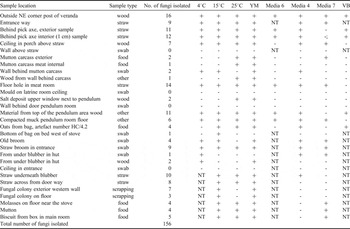
The 30 sites within Discovery Hut provided 156 filamentous fungi from swabs, wall scrapings, organic material or wood (Table I). Of these, 44 isolates were from agar plates incubated at 4°C, 73 from plates incubated at 15°C and 39 from plates incubated at 25°C. The number of fungi isolated on each selective medium was as follows: 76 isolates on YM agar; 40 isolates on Medium 4; 18 isolates on Medium 6; 14 isolates on VB agar; and eight isolates on Medium 7. Fungi were isolated from all physical samples and swabs of artefacts except for four swab samples of wood surfaces.
Fungi isolated from samples taken from Discovery Hut and cultured at 4°C, 15°C and 25° on YM agar, Media 6, Media 4, Media 7, and Vogel Bonner medium.

Note + = fungi isolated from the sample, - = no fungi isolated from the sample, NT means not tested.
Footnote: YM agar (YM), general purpose agar; Media 4, for isolation of streptomycin resistant fungi; Media 6, for isolation of cycloheximide resistant fungi; Media 7 for selection of Basidiomycetes; and Vogel Bonner (VB) minimal medium for the selection of slow growing fungi.
Identification of fungi
Using classical taxonomy based on morphology six of the seven fungi used for further experiments were identified. Isolate numbers 226, 227, 228 and 824 were identified as Geomyces sp. Isolate 805 was identified as Cladosporium sp. Isolate 129 was identified as as Gliocladium sp. Isolate 816 could not be identified due to a lack of identifiable structures. Two fungal isolates, 805 and 824, were identified by morphological and molecular characterization as Cladosporium oxysporum (99% similarity, 500/502 overlap and Genbank accession number AJ300332) and a Geomyces sp. C239/10G (94% similarity, 467/492 overlap and Genbank accession number AY345347), respectively.
Screening for cellulolytic activity
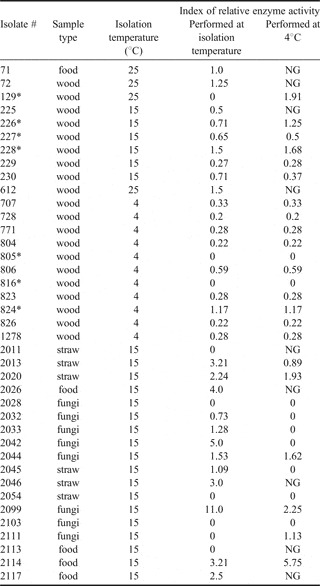
Of the 108 Antarctic isolates screened for cellulolytic activity on carboxymethyl cellulose (CMC) 29 isolates, including six initially isolated at 4°C, 20 isolated at 15°C and four isolated at 25°C, demonstrated clearing of CMC with an Index of Relative Enzyme Activity of 1 or greater. To screen Antarctic fungi isolated at temperate temperatures for CMC activity at cold temperatures (4°C), 28 fungi initially isolated at 15°C or 25°C (15 isolates were CMC positive, 13 were CMC negative) were also screened for cellulase activity at 4°C. Of the 15 fungi that showed CMCase activity at their isolation temperature, five also showed CMCase activity at 4°C, six did not grow at 4°C and four showed no CMCase activity at 4°C. Of the 13 fungi that showed no CMCase activity at their isolation temperature, three showed CMCase activity at 4°C, three did not grow at 4°C and seven showed no CMCase activty at 4°C. Data is shown in Table II of activity at isolation temperature, and if the isolate was isolated at 15°C or 25°C, also activity when the isolate was cultured at 4°C.
Screening fungi from the Discovery Hut for carboxymethyl cellulase activity: Index of Relative Enzyme activity at isolation temperature and at 4°C.

* Isolates used in further studies. NG = No growth
Of the 156 original Antarctic fungi, seven isolates were chosen for further study, and identified by morphological characteristics to belong to three genera, Cladosporium, Geomyces, and Gliocladium and one isolate remained unidentified as no sexual structures could be seen. The isolation temperatures of the seven selected isolates chosen were 4°C (three isolates), 15°C (three isolates) and 25°C (one isolate). Three isolates came from YM agar, two from Media 4, and two from Medium 6.
The seven isolates had the following characteristics: one showed clearing of carboxymethyl cellulose at isolation temperature, three showed clearing of carboxymethyl cellulose at 4°C but not at their isolation temperature and three isolates showed no clearing of carboxymethyl cellulose at isolation temperature or at 4°C (Table II).
Quantifying amounts of accumulated endo-1, 4-β-glucanase at different temperatures
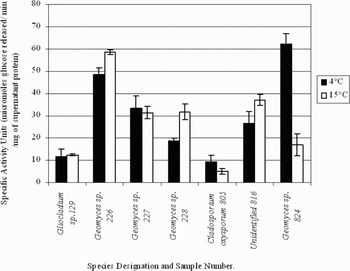
All of the fungi selected for this experiment showed endo-1, 4-β-glucanase activity. Figure 1 shows the levels of accumulated endoglucanase activity, expressed as specific activity units (micromoles glucose released per minute per mg of protein in the extracellular supernatant) in the extracellular supernatant when fungal isolates were cultured at either 4°C or 15°C (initial growth experiments showed that maximal endoglucanase activity occurred for the isolates cultured at 4°C after 28 days and cultured at 15°C after 10 days (data not shown)). Of the seven fungi tested, two produced more endoglucanase activity at 4°C than at 15°C, two produced similar endoglucanase activity at 4°C and 15°C, and three produced more endoglucanase activity at 15°C than at 4°C (Fig. 1). Geomyces sp. strains 226 and 228 produced more endoglucanase activity at 15°C than 4°C (58.6 and 31.8 specific activity units at 15°C compared with 48.8 and 18.6 specific activity units at 4°C respectively), but Geomyces sp. strains 227 and 824 produced more endoglucanase activity at 4°C than 15°C (33.5 and 63.7 specific activity units at 4°C compared with 31.5 and 17.1 specific activity units at 15°C respectively). Cladosporium oxysporum 805 produced more endoglucanase activity at 4°C than 15°C (9.4 specific activity units at 4°C compared with 5 specific activity units at 15°C). Gliocladium sp. strain 129 produced slightly more endoglucanase activity at 15°C than 4°C (12.5 specific activity units at 15°C compared with 11.7 specific activity units at 4°C). An unidentified strain 816 produced more endoglucanase activity at 15°C than 4°C (37.1 specific activity units at 15°C compared with 26.6 specific activity units at 4°C).
Comparison of specific activity units of endoglucanase (micromoles of glucose min-1 ml-1/milligram of soluble protein in the supernatant) for the selected seven fungi at 4°C and 15°C

Radial hyphal extension rate
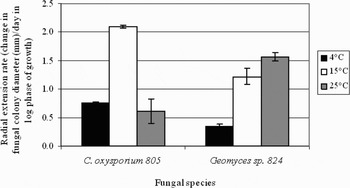
The two fungi selected for this experiment demonstrated the ability to grow on YM medium at the three temperatures tested. The Geomyces sp. 824 grew fastest on YM medium at 25°C but could still grow at 4°C (radial extension rate at 25°C was 1.57 mm per day compared with 1.22 mm per hour at 15°C and 0.35 mm per day at 4°C) while the C. oxysporum 805 isolate showed fastest growth at 15°C compared with 25°C or 4°C on YM medium (radial extension rate at 25°C was 0.61 mm per day compared with 2.1 mm per day at 15°C and 0.76 mm per day at 4°C) (Fig. 2).
Growth rates of Cladosporium oxysporum strain 805 and Geomyces sp. strain 824 on YM agar at 4°C, 15°C and 25°C.

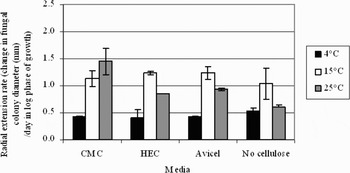
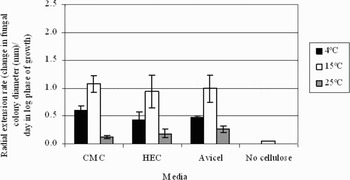
The two fungi were able to grow on all three carbon sources. The Geomyces sp. grew on all sources of cellulose tested and also grew on the agar plates containing no cellulose at 4°C, 15°C and 25°C (Fig. 3). The growth rate at 4°C was the same on all three sources of cellulose. The growth rate was the same at 15°C on all three sources of cellulose but was slower when Geomyces sp. was grown on medium containing no cellulose as a carbon source. The growth rate at 25°C was less on hydroxyethyl cellulose and Avicell and less on the medium containing no cellulose as a carbon source (Fig. 3). In contrast C. oxysporum grew on all three cellulose sources at 4°C, 15°C and 25°C, with a similar growth rate at each of the temperatures, but no growth on the medium containing no cellulose (Fig. 4).
Growth rates of Geomyces sp. strain 824 on three cellulose sources and media containing no cellulose as a carbon source.

Growth rates of the Cladosporium oxysporum strain 805 on three cellulose sources and media containing no cellulose as a carbon source.

Discussion
The historic huts of Ross Island provide a unique environment and metabolic substrates for fungi in this relatively pristine region. Although we cannot be sure of their origin, it is apparent that the fungal isolates described in this study are well adapted to the environmental conditions of Antarctica. Vincent (Reference Vincent2000) hypothesized that increased invasion from micro-organisms from elsewhere in the world into Antarctica leads to larger microbial speciation. Human impacts in Antarctica have led to selection of fungal species which were either native, and able to utilize the new nutrient sources introduced by humans, or were new non-native species brought in with the humans and materials. This has resulted in a diversity profile that is different to the adjacent unimpacted environment. This research, in addition to the research reported by Duncan et al. (Reference Duncan, Farrell, Thwaites, Held, Arenz, Jurgens and Blanchette2006) and Held et al. (Reference Held, Jurgens, Arenz, Duncan, Farrell and Blanchette2005), suggests that other factors, including environmental influences, are impacting on fungal numbers and diversity. Fungal material is being introduced by the human visits but it is the ability to adapt to the environment that ultimately leads to an increase in fungal biomass and species diversity within the historic huts. It seems likely that both indigenous and introduced fungi were isolated from Discovery Hut when the fungi isolated from this study were compared with fungi identified in a more in-depth study on fungal diversity (Arenz et al. Reference Arenz, Held, Jurgens, Farrell and Blanchette2006) and their growth optima demonstrated that the fungi are not only surviving in the Antarctica environment but are capable of proliferating. Therefore, we feel these findings support Vincent's (Vincent Reference Vincent2000) hypothesis that larger microbial speciation caused by adaptation has been demonstrated in this research focused on the interior of the historic hut.
Of the two fungi identified by molecular techniques, Geomyces spp. have been isolated from pristine areas (Kerry Reference Kerry1990b) and areas with both little biotic influence and seal-influenced soil samples such as Peterson Island, off the Windmill Islands (Azmi & Seppelt Reference Azmi and Seppelt1997). There are no references to Cladosporium oxysporum being isolated in Antarctica but Mercantini et al. (Reference Mercantini, Marsella, Moretto and Finotti1993) have reported isolation of Cladosporium sp. from areas of high biotic influence along the Newfoundland Coast, Ross Sea Region. Neither of the fungi used in this study could be defined as psychrophilic. Both species grew at 4°C but also at 25°C. Cladosporium oxysporum strain 805 showed higher growth rates at 15°C than at 25°C, and should be classified as a psychrotroph. Geomyces sp. strain 824 showed higher growth rates at 25°C than at 15°C and 4°C and should be classified as a cold tolerant mesophile. During summer temperatures averaging 2°C, and as high as 8.2°C, were reported by Held et al. (Reference Held, Jurgens, Arenz, Duncan, Farrell and Blanchette2005) in Discovery Hut. Compared with the other two historic huts on Ross Island, the number of hours that provided adequate conditions for fungal growth (> 0°C and > 80% RH) at Discovery Hut was substantially lower than found at the Cape Royds and Cape Evans huts (Held et al. Reference Held, Jurgens, Arenz, Duncan, Farrell and Blanchette2005). This may explain the low amount of visible fungal growth and the presence of relatively small inactive colonies on the wood structure and artifacts compared to the other huts.
Many researchers have screened Antarctic fungi for extracellular enzyme activity. Of 33 fungal strains isolated from Victoria Land, by Fenice et al. (Reference Fenice, Selbmann, Zucconi and Onofri1997), (isolates screened at 25°C, and at their optimal growth temperature if 25°C was not optimal), 36.4% of the isolates demonstrated cellulase activity with halo diameters ≤10 mm. When the results of this study of Discovery Hut fungi are expressed by the methods used by Fenice et al., (which did not take into account the fungal colony size) the percentage of cellulase producing organisms is 61% with 18 isolates producing halos of diameters ≤ 10 mm, 39 isolates producing halos measuring 11–25 mm and 20 isolates producing halos > 25 mm. When comparing cellulase production it is important to consider the substrate and habitat that the fungi were isolated from. The substrates in this research are structural wood, foodstuffs and organic material and the temperature inside the hut ranged from maximum of 6.6°C to a minimum of -39°C (Held et al. Reference Held, Jurgens, Arenz, Duncan, Farrell and Blanchette2005) while the fungal isolates from Fenice et al. (Reference Fenice, Selbmann, Zucconi and Onofri1997) came from a habitat consisting of soil, moss, soil under moss, or moss and soil/sand under the moss. The air temperatures at time of collection were 0°C to -9°C, while the temperature of the substrata were always above 0°C and as high as 27°C. Fenice et al. did not describe the species of moss that the fungi were isolated from, but Walton (Reference Walton, Siegfried, Condy and Laws1985) noted that decomposition rates in Polytrichum alpestre as “low decomposition of plants due to high holocellulose and crude fibre, very low nutrient content and low microbial populations”. Hurst et al. (Reference Hurst, Pugh and Walton1983) cultured fungi from leaf discs from three sub-Antarctic phanerogams and airspora beneath a grass canopy on the sub-Antarctic island of South Georgia. Eight fungi isolated from this study (Acremonium terricola, Botrytis cinerea, 2 Chaetophoma sp., Chrysosporium pannorum, Cladosporium sphaerospermum, Fusarium lateritium and Mucor hiemalis) were screened for their ability to degrade cellulose (by growth rate and clearing zones around fungal colonies) along with other substrates at 20°C. All except M. hiemalis grew on and were able to cause clearing of cellulose agar plates. They reported cellulase activity at 1°C for Botrytis at 70% of its maximum, C. pannorum at 60%, Chaetophoma at 50%, and C. sphaerospermum at 40%.
Cellulose is a secondary nutrient source for fungi. Cellulose is a mixture of crystalline cellulose, which is more resistant to microbial degradation, and amorphous cellulose, which is readily broken down to glucose (Eriksson et al. Reference Eriksson, Blanchette and Ander1990). All cellulose substrates used in this study were synthetic. Cladosporium oxysporum strain 805 and Geomyces sp. strain 824 grew on all three cellulose carbon sources indicating these fungi can use many different types of cellulose as nutrient sources. The presence of these fungi within the historic huts, and their ability to degrade cellulose demonstrates that it is important to create conditions in the hut which are not conducive to fungal growth so that continued degradation of the historic textiles, paper, wood and other cellulosic substrates in the hut is reduced.
Quantitative cellulase activity at psychrophilic temperatures has been reported by the authors, (Duncan et al. Reference Duncan, Farrell, Thwaites, Held, Arenz, Jurgens and Blanchette2006) in Antarctic fungi isolated from the Cape Evans historic hut. This previous study reported on 18 fungi identified from an Antarctic historic hut, all producing detectable levels of endoglucanase activity, at either 4°C or 15°C. The findings of the Discovery Hut work adds that fungi isolated from a variety of substrates within Discovery Hut were capable of cellulose breakdown activity at 4°C and 15°C and produce carboxymethyl cellulase and endo-1, 4-β-glucanase activity in culture. Thus, these enzymes are likely to be functional in the Antarctic ecosystem and the organisms may have significant impact on the wood of the hut structure and cellulosic artefacts.
Acknowledgements
We thank David Harrowfield for helpful comments and insights, Nigel Watson and conservators of the Antarctic Heritage Trust for their support and cooperation during this study, support personnel of Scott Base for their assistance in conducting this research in Antarctica and Antarctica New Zealand for logistic support. This research was supported by the Vice-Chancellor Bryan Gould's Fund of The University of Waikato and by the National Science Foundation Grants 0229570 and 0537143 to R.A. Blanchette. We also sincerely thank Margaret E. DiMenna from AgResearch, Ruakura, Hamilton, for assistance with identifying the fungi and mycological references.