In cognitive-behavioural models of anxiety disorders, avoidance plays a key role in the manifestation of clinical levels of fear and anxiety (e.g., Barlow, Reference Barlow2001). In these models, anxiety disorders develop in part as a result of active avoidance of situations, stimuli, and events that are fear-producing (i.e., behavioural avoidance). A central problem, and a theoretical mechanism by which clinical anxiety develops and maintains, is that failure to approach anxiety-producing situations inhibits new learning, interferes with habituation and extinction, and blocks emotional processing (e.g., Foa & Kozak, Reference Foa and Kozak1986; Mowrer, Reference Mowrer and Mowrer1960).
Behavioural avoidance appears in the diagnostic criteria for a number of the anxiety disorders (e.g., specific phobia, posttraumatic stress disorder, agoraphobia, social phobia; American Psychiatric Association, 2001), and may result not only in anxiety symptoms but also in functional impairment (e.g., Michelson, Lee, Orsillo, & Roemer, Reference Michelson, Lee, Orsillo and Roemer2011) and other downstream consequences (e.g., substance use; Buckner, Heimberg, & Schmidt, Reference Buckner, Heimberg and Schmidt2011). Anecdotally, individuals with anxiety disorders often choose to avoid or delay exposure to fear-producing stimuli, despite the fact that delaying this exposure will likely lead to objectively worse outcomes. For example, individuals with dental phobia may avoid dental care for long periods of time (Thom, Sartory, & Jöhren, Reference Thom, Sartory and Jöhren2000), resulting in substantively more pain (and a more invasive dentist visit) in the future.
Paradigms that examine delay discounting, or the decrease in the value of an outcome as the temporal delay to that outcome increases (e.g., Mazur, Reference Mazur, Commons, Mazur, Nevin and Rachlin1987), may further explicate avoidance behaviour in individuals with anxiety. This phenomenon has been studied extensively as it relates to rewards (see Green & Myerson, Reference Green and Myerson2004, for a review). In these paradigms, participants are typically presented with a choice between two reinforcers; one is relatively small and delivered immediately, the other is larger and delivered after a delay. Choice of the smaller, immediate reward reflects behavioural impulsivity (Ainslie, Reference Ainslie1974). Research using this paradigm has demonstrated that delay discounting of rewards may have relevance in disorders associated with impulsive behaviours, including drug dependence (e.g., Coffey, Gudleski, Saladin, & Brady, Reference Coffey, Gudleski, Saladin and Brady2003).
Delay discounting of rewards may also have relevance to anxiety disorders. In one study, Rounds, Beck, and Grant (Reference Rounds, Beck and Grant2007) applied the delay discounting of rewards paradigm to individuals high and low in social anxiety, demonstrating that individuals more prone to social phobia were more likely to engage in delay discounting of rewards than those low in social anxiety during a non-threat condition. While this is interesting preliminary evidence of a role of delay discounting in anxiety, Round and colleagues (Reference Rounds, Beck and Grant2007) suggested that the delay discounting paradigm could be modified to serve as a more direct analogue of anxiety related processes. Given the role of avoidance in anxiety, it may be that choices related to aversive consequences are as relevant as choices about rewards.
However, very few researchers have examined delay discounting as it applies to aversive outcomes (i.e., choice between immediate, less aversive outcomes and delayed, more aversive outcomes). One exception is Deluty (Reference Deluty1978), who extended the self-control and impulsivity choice paradigm to an aversive stimulus (electric shock). In a choice between an immediate shock and a longer, delayed shock of the same intensity, Deluty operationally defined the selection of a smaller, more immediate shock as the ‘self-controlled’ choice and the choice for the larger, delayed shock as the ‘impulsive’ choice. He manipulated both the duration of shock and the delay to its introduction. The results of this experiment were presented in terms of choice allocation to each alternative. When delays were short (e.g., 2 vs. 12 s and 5 vs. 15 s), more impulsive choices were made (i.e., a 2-s shock) than self-controlled choices (i.e., a 1-s shock). When delays increased (greater than a 10-s delay to the 1-s shock) choice reversed, favouring the self-controlled alternative. Deluty's findings suggest that there is an interaction between the magnitude and delay of aversive events, supporting the application of an analogue to the delay discounting paradigm with aversive events.
Despite the paucity of research in this area, discounting of delayed aversive outcomes has broad applicability to our understanding of avoidance in anxiety. It may be that individuals who are more likely to discount aversive outcomes that follow a delay may be more likely to engage in behavioural avoidance of aversive, fear-producing events. Further, the choice to delay aversive events may be influenced by a number of psychological variables. For example, evidence from the extant literature supports the idea that delay discounting may be affected by internal states such as mood. Hirsh and colleagues (Hirsh, Guindon, Morisano, & Peterson, Reference Hirsh, Guindon, Morisano and Peterson2010) found that positive mood increased delay discounting of rewards in extraverted individuals, perhaps because positive mood primes the behavioural activation system. Conversely, it is possible that negative emotions, including anxiety, might heighten defensive responding and increase delay discounting of aversives.
In addition, the tendency to discount delayed consequences may be affected by personality variables. For example, Hirsch, Morisano, and Peterson (Reference Hirsh, Morisano and Peterson2008) demonstrated that individuals higher in extraversion exhibited greater delay discounting of rewards than those low in extraversion. While personality has not been examined as a factor in delay discounting of aversives, it is possible that certain personality characteristics may increase an individual's likelihood of choosing to delay aversive consequences. For example, in addition to behavioural avoidance (i.e., the ‘action’ of avoidance), contemporary CBT models acknowledge the importance of experiential avoidance, or attempts to mentally avoid, control, or suppress internal experiences associated with anxiety, including negative emotions and thoughts, in the development of clinical anxiety (e.g., Hayes, Wilson, Gifford, Follette, & Strosahl, Reference Hayes, Wilson, Gifford, Follette and Strosahl1996). The tendency to engage in experiential avoidance may be one trait that leads to choices to delay aversive events; if an individual is prone to avoid internal experiences of negative emotion, they may tend to engage in choices that delay their need to face and process fear-producing events.
In the current study, we used survey measures and a laboratory-based delay discounting task to examine the role of anxiety, negative affect, and trait experiential avoidance in choices between immediate and delayed aversive outcomes (electrical stimulation). In this study, the choice to delay an aversive outcome was associated with an objectively worse aversive event (three electric shocks) than the choice to approach the aversive outcome immediately (one electric shock). We hypothesised that higher levels of anxiety, greater negative affectivity, and greater tendency to engage in experiential avoidance would predict choice of an objectively worse delayed aversive stimulus over an immediate (but less severe) aversive stimulus.
Method
Participants
Participants were 34 undergraduate students from the psychology subject pool at a small Northeastern university. One participant was missing data from a number of key study variables and was therefore excluded from the analyses. The remaining 33 participants (8 males), ranged in age from 18 to 37 (M = 20.87, SD = 3.75). Self-reported racial identity of the sample was 84.8% white, 15.2% non-white; ethnicity was 12.1% Hispanic, 81.8% non-Hispanic. Participants were recruited using an online research-pool management website and via fliers posted on campus.
Measures
Anxiety
The Depression Anxiety and Stress Scales, 21-item version (DASS-21; Antony, Bieling, Cox, Enns, & Swinson, Reference Antony, Bieling, Cox, Enns and Swinson1998) is a briefer form of the DASS-42 (Lovibond & Lovibond, Reference Lovibond and Lovibond1995). The DASS-21 has separate subscales for anxiety, depression, and stress symptoms; the subscales are supported by factor analyses in clinical and non-clinical samples, demonstrate adequate to excellent internal consistency, and have good convergent validity with other established measures of these constructs (Antony et al., Reference Antony, Bieling, Cox, Enns and Swinson1998). Internal consistency estimates for the three subscales in the current sample were good to excellent (all Cronbach's αs > .83).
Negative Affect
The Positive and Negative Affect Scale (PANAS; Watson, Clark, & Tellegen, Reference Watson, Clark and Tellegen1988) is a 20-item self-report measure that assesses positive and negative affectivity. Because we predicted that negative emotionality would be associated with choices to delay aversive events, analysis of the positive affect scale is not included in the current study. The negative and positive affect scales are not highly correlated (rs range from −.12 to −.23; Watson et al., Reference Watson, Clark and Tellegen1998), suggesting that these two subscales measure distinct constructs and can be used separately. In the current study, the PANAS was delivered with instructions to rate affectivity ‘generally, that is, on average’ in order to assess general negative emotionality. Internal consistency for the PANAS negative affectivity scale using all time frame instructs has been shown to be good to excellent (Cronbach's αs from .84 to .87; Watson et al., Reference Watson, Clark and Tellegen1998); internal consistency in the current sample was excellent (Cronbach's α = .90).
Experiential Avoidance
The Acceptance and Action Questionnaire-II (AAQ-II; Bond et al., Reference Bond, Hayes, Baer, Carpenter, Guenole, Orcutt and Zettle2011) is a seven-item measure of experiential avoidance, or the tendency to be afraid of and to attempt to control or avoid internal experiences such as negative emotions and thoughts. The AAQ-II is a revised version of the AAQ-I (Hayes, Luoma, Bond, Masuda, & Lillis, Reference Hayes, Luoma, Bond, Masuda and Lillis2006) that has demonstrated internal consistency superior to that of the original (Cronbach's α > .81; Bond et al., Reference Bond, Hayes, Baer, Carpenter, Guenole, Orcutt and Zettle2011). Internal consistency in the current sample was excellent (Cronbach's α = .92).
Delay of Aversive Events
The procedure used to examine choices to delay aversive events was based on the work of Evenden and Ryan (Reference Evenden and Ryan1996). In the original procedure, rats were presented with a series of choices between a smaller, more immediate amount of food, and a larger, delayed amount of food. The delay to the larger amount of food increased across blocks of trials. In the present procedure, participants were asked to choose (by pressing a button on the response pad) between a single, half-second shock delivered after a 1-s delay and three half-second shocks (separated with half-second pauses) delivered after some larger delay. The larger delay increased from 1 s to 120 s across blocks of trials.
Each block of trials began with a ‘forced-choice’ trial, in which participants were required to select the three-shock alternative at the programmed delay. After that, they were presented with six ‘free-choice’ trials, in which they could press one button to receive the single shock and another button to receive the (delayed) three shocks. There were six blocks of seven (one forced choice, six free choices) trials, yielding a total of 42 choices made by the participants. The primary dependent measure was the percentage of free-choice trials in which the three shocks were chosen.
Procedure
All procedures were approved by Eastern Connecticut State University's Committee for the Use of Human Subjects in Research. Participants accessed online surveys via a research participant management website. After providing consent to participate, participants completed the surveys, including a demographic questionnaire, the DASS-21 (Antony et al., Reference Antony, Bieling, Cox, Enns and Swinson1998), the PANAS (Watson et al., Reference Watson, Clark and Tellegen1988), the AAQ-II (Bond et al., Reference Bond, Hayes, Baer, Carpenter, Guenole, Orcutt and Zettle2011), and other measures not used in the current study. At the end of the surveys, participants were instructed to sign up for a laboratory session to complete the study.
The second component of the study took place in a small laboratory space in an academic building on our university's campus. For this component of the study, participants were presented with stimuli on a 19” LCD monitor and made responses on a 7-key response pad (RB-730, Cedrus, San Pedro, CA). Electric shocks were delivered using a bar electrode and the STMISOC module (BioPac Systems, Inc). SuperLab software (Cedrus Corporation) was used to coordinate stimulus presentation and choice data acquisition.
When participants arrived in the laboratory, they were welcomed by the experimenter and given a second consent document. After completing that document, they were shown the equipment they would be using and were instructed to wash their hands. The electrodes for shock delivery and psychophysiological data were attached; psychophysiological data were recorded during a 5-minute resting baseline period. Psychophysiological data (which were also recorded throughout the choice procedure) are not included in the present analyses.
After the baseline period, the intensity of the shock was titrated following methods described by Orr and colleagues (2002). The experimenter presented a series of shocks to the participant with increasing intensity. The participant was instructed to indicate when the intensity was ‘highly annoying, but not painful’. The intensity selected by the participant was subsequently used for the choice procedure. Following the choice procedure, participants were debriefed.
Results
The distribution of scores on the key study variables was examined. The per cent choice outcome from the choice task was found to be highly positively skewed; this skew could not be corrected through transformation because a large number of participants (N = 11) never selected the three-shock alternative in the free-choice trials (the remaining 22 participants did select the three-shock alternative (range: 8 to 67% of trials). Thus, participants were categorised into two groups: those who had no trials in which the three shocks were chosen (‘no delay’, n = 11), and those who chose the more aversive three-shock outcome on at least one trial (‘delay’, n = 22), and a non-parametric (Mann-Whitney U) test was utilised to examine predictors of group membership. Mann-Whitney U tests indicated no difference in the titrated shock intensity (U = 116.00, z = −0.19, p = .85) or age (U = 118.00, z = −0.52, p = .61) between the groups.
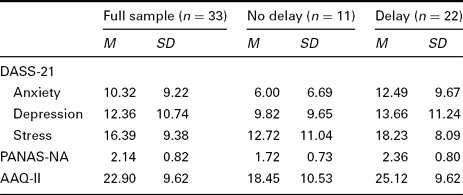
Means and standard deviations of key study variables for the full sample and as a function of group membership are displayed in Table 1. Mann-Whitney U tests revealed significant relations between group membership and DASS-21 anxiety (U = 69.50, z = 1.98, p = .048), PANAS negative affectivity (U = 55.50, z = 2.51, p = .01), and AAQ-II experiential avoidance (U = 64.50, z = 2.16, p = .03), with higher scores on all three measures predicting membership in the delay group. There was no relation between DASS-21 stress (U = 80.50, z = 1.55, p = .12), or depression (U = 95.00, z = 0.99, p = .32), and group membership.
Means and Standard Deviations of Key Study Variables for Full Sample and By Group Membership (N = 33)

Note: DASS-21 = Depression Anxiety and Stress Scales — 21 item version, PANAS-NA = Positive and Negative Affect Scale — Negative Affectivity, AAQ-II = Acceptance and Action Questionnaire – II.
Discussion
Our hypotheses that anxiety, negative affectivity, and trait experiential avoidance would be associated with choice of a delayed aversive consequence over an immediate aversive consequence were supported. Higher self-reported levels of anxiety, negative affect, and tendency to avoid internal experiences significantly predicted membership in the ‘delay group’, indicating choices consistent with delaying aversive consequences even when those consequences are objectively worse after the delay.
These findings should be interpreted in the context of a number of limitations of the current study. Due to a small sample size, we are unable to examine a number of relevant questions about the nature of the relations between the key study variables. For example, future studies with larger samples could examine whether anxiety and experiential avoidance predict choices to delay aversive events beyond the association between delaying and negative affect (i.e., is it that negative emotionality in general predicts delaying, or do anxiety and experiential avoidance make unique contributions to this relationship?). A larger sample would also be needed to determine whether the relation between group membership and anxiety was significantly more powerful than the relations between group membership and depression or stress (i.e., is the relationship specific to anxiety or could this be an underlying mechanism in many forms of psychopathology?).
Interpretations of the current findings are also limited by the use of a correlational design and a non-clinical sample. Experimental and longitudinal studies are needed to help elucidate the nature and direction of the relationships demonstrated (e.g., it may be that higher levels of anxiety lead to choices to delay aversive consequences or that delaying aversive consequences results in anxiety). These questions should also be addressed in a population of individuals with clinical levels of anxiety.
If these findings are extended and replicated, there could be a host of implications for cognitive behavioural treatments for anxiety disorders. First, if it is the case that choices to delay aversive stimuli are related to avoidance of internal experiences, it could be that by treatments that directly target experiential avoidance (e.g., acceptance and commitment therapy; Hayes, Strosahl, & Wilson, Reference Hayes, Strosahl and Wilson2011; acceptance-based behavioural therapy, Roemer & Orsillo, Reference Roemer and Orsillo2009) may also indirectly reduce behavioural avoidance (or, conversely, that traditional exposure-based therapies that directly target behavioural avoidance may reduce experiential avoidance).
Further, our findings suggest that patients’ understanding of the relation between avoidance and the worsening of long-term negative outcomes may not necessarily increase choices to approach aversive stimuli. In our study, participants were instructed that the choice to delay the electric shock would result in a clearly worse outcome, yet those with higher levels of anxiety were still more likely to make the choice to delay. Thus, perhaps psychoeducational and cognitive techniques designed to make explicit the relationship between avoidance and worse outcomes are either not necessary or not sufficient to create behavioural change.
Our results, while preliminary, suggest that choices to delay aversive events may relate both to mood state and to personality variables. These findings also suggest that a modified delay discounting paradigm using aversive stimuli may be a useful tool to better understand behavioural avoidance in anxiety. Based on our results, future studies using clinical populations and examining mood and personality variables that affect choices to delay aversive events are warranted.