Dissemination of dementia-specific education among informal and formal caregivers is a pressing need. Aging of the US population is predicted to triple the prevalence of Alzheimer's disease cases from 5.2 million to 13.8 million by 2050 (Alzheimer's Association, 2014). International prevalence rates of dementia are expected to grow to 131.5 million by 2050 (Prince et al., Reference Prince, Wimo, Guerchet, Ali, Wu and Prina2015). Estimates suggest the demand for dementia care will exhaust the present-day workforce in the USA (Stone, Reference Stone2007) and will require countries worldwide to plan and grow long-term care services in preparation (Prince et al., Reference Prince, Prina and Guerchet2013). Coupled with an inadequate number of geriatric-based professional healthcare providers (LaMascus et al., Reference LaMascus, Bernard, Barry, Salerno and Wesss2005; IOM, 2008), the deficit of para-professionals to meet the growing demand for care is problematic (HRSA, 2004; Harahan and Stone, Reference Harahan and Stone2007). In the USA, the National Alzheimer's Project Act and the Health Brain Initiative were established to create and implement plans to overcome Alzheimer's disease and 33 states, including Oregon, developed plans to address Alzheimer's disease and support caregivers (NAPA, 2012; CDC, 2013; Hoffman, Reference Hoffman2014). As part of Oregon's 2014 State Plan, free educational programs were offered to all caregivers as part of a multi-component strategy to deliver high-quality and safe dementia-care (SPADO Task Force, 2012).
Daily dementia care differs significantly compared to other chronic conditions for informal or formal caregivers because of worries about decision-making capacity, living arrangements, and ongoing safety concerns. As symptoms of dementia progress, verbal communication skills deteriorate and caregivers must try to understand or interpret the needs of people with dementia by their behavior. The “behavior” associated with dementia is one of the most challenging aspects of care because of their frequency (Selbaek et al., Reference Selbaek, Engedal and Bergh2013) in the caregiving experience. Furthermore, behavioral symptoms of dementia are often triggered by miscommunication between the caregiving dyad, heightening frustration, and stress. Knowledge of the disease process and person-centered care techniques can enhance a caregiver's skill set to better assist with core caregiving tasks, such as eating, bathing, or toileting (Sloane et al., Reference Sloane2004). Being attuned to the changes in a person's behavior, mood, personality, and communication abilities allows for identification of the need triggering the behavior (Algase et al., Reference Algase1996) or for understanding of the mismatch between the person and environmental demands (Lawton and Nahemow, Reference Lawton, Nahemow, Eisdorfer and Lawton1973) in order to inform a non-pharmacological treatment plan. Caregivers are challenged to adapt to the changing needs of the person with dementia, because unlike the care recipient, caregivers have the cognitive resources to adjust their approach or technique.
An imbalance exists between the complex care needs of adults with Alzheimer's disease and the available and educated care providers capable of delivering quality care. The resultant overmedication and inappropriate use of antipsychotic medications for those with dementia is problematic within long-term care and community settings in the USA (Kamble et al., Reference Kamble, Chen, Sherer and Aparasu2008; Stevenson et al., Reference Stevenson2010; Bonner et al., Reference Bonner2015). In 2012, it was estimated that approximately 33% of long-stay nursing home residents and 14% of older adults in the community with symptoms of dementia were prescribed antipsychotic medications (GAO, 2015), even though these medications are considered a last resort and come with FDA “Black Box” warnings for those with dementia exhibiting behavior problems. Initiatives spearheaded by the Centers for Medicare and Medicaid and supported by care consortiums (e.g. Advancing Excellence, The Pioneer network, Quality Improvement Organizations, State Local Areas for Network Excellence) have stressed that educational outreach as part of a multi-component strategy helps to alleviate the burden of inappropriate medication (Bonner, Reference Bonner2013; Tritz et al., Reference Tritz, Laughman and Bonner2014). Dementia care guidelines have been created to provide better management of behavioral symptoms associated with dementia (Lyketsos et al., Reference Lyketsos2006; Kales et al., Reference Kales, Gitlin and Lyketsos2014), and specific quality measures and outreach programs have been implemented at both the state and national level (NAPA, 2012; SPADO Task Force, 2012) to improve formal and informal caregiving. Although five of 12 European countries have developed guidelines for psychosocial interventions in dementia care, these guidelines vary widely in quality and greater public policy emphasis on implementation of the guidelines is recommended (Vaase et al., Reference Vasse2012).
One increasingly accepted evidence-based approach is to view caregiving through the lens of person-centered care. Person-centered care focuses on care recipients’ strengths and capabilities, collective decision-making in care activities, and provides a home-like care environment (Koren, Reference Koren2010). Within nursing homes and assisted living communities, person-centered care techniques are part of the growing movement of “culture change” within the long-term care spectrum. Person-centered or individualized care, however, is dependent upon organization commitment to successfully integrate into care practices. A growing emphasis on dementia care training specific to person-centered care techniques has resulted in a greater focus on caregiver empowerment. In the USA, increased competency and empowerment in caregiving technique has been shown to improve job satisfaction (Rosen et al., Reference Rosen, Mulsant, Kastango, Mazumdar and Fox2002; Coogle et al., Reference Coogle, Head and Parham2006) and communication (Yeatts and Cready, Reference Yeatts and Cready2007) among formal caregivers. World-wide, online training programs have improved person-centered care attitudes (Hattink et al., Reference Hattink2015), self-efficacy (Ducharme et al., Reference Ducharme, Dube, Levesque, Saulnier and Giroux2011), unmet caregiving needs (van der Roest et al., Reference van der Roest, Meiland, Jonker and Droes2010), and knowledge (Cristancho-Lacroix et al., Reference Cristancho-Lacroix, Wrobel, Cantegreil-Kallen, Dub, Rouquette and Rigaud2015) demonstrated largely in randomized control trials among both formal and informal caregivers.
Informal caregiving, defined as unpaid care in either instrumental activities of daily living (IADLs) or activities of daily living (ADLs) (Roth et al., Reference Roth, Freedman and Haley2015) is a challenging balance of home and personal responsibilities. Compared to caring for persons with chronic conditions, informal caregivers of persons with dementia provide care for longer periods of time (Alzheimer's Association, 2014) and report greater health-related consequences (i.e. mental, physical, emotional) as the result of the stress and demands of serving multiple roles (Vitaliano et al., Reference Vitaliano, Zhang and Scanlan2003; Pinquart and Sorensen, Reference Pinquart and Sorensen2007). Research indicates that informal caregivers have strong emotional, social, physical, vocational, and financial burden (Brodaty and Donkin, Reference Brodaty and Donkin2009; Lopoprabhu and Molinari, in press). Helping informal caregivers gain knowledge of the disease process and proper caregiving techniques may both reduce caregiver burden and increase quality of life for the care recipient (Molinari, Reference Molinari, Loboprabhu, Molinari and Lomax2006). In Oregon, over 165,000 informal caregivers provide $2 billion dollars of dementia care in the community annually (SPADO Task Force, 2012) while informal caregivers in the USA give up to 17.5 billion hours of care related to dementia (Alzheimer's Association, 2014). On a global scale, between 8–16% of adults 50+ provide intensive care for family members with dementia (Prince et al., Reference Prince, Prina and Guerchet2013).
In long-term settings in the USA, the vast majority of paid daily resident care is performed by direct care workers who are largely para-professionals (Stone and Wiener, Reference Stone and Wiener2001; Squillace et al., Reference Squillace, Remsburg, Harris-Kojetin, Bercovitz, Rosenoff and Han2009). The labor force is mainly female and ethnically diverse with an overall average of a high school education (Squillace et al., Reference Squillace, Remsburg, Harris-Kojetin, Bercovitz, Rosenoff and Han2009; Katz and Frank, Reference Katz and Frank2011). Long-term care facilities funded by either Medicare or Medicaid mandate 75 hours of initial training and 12 hours of general continuing education (Stone and Bryant, Reference Stone and Bryant2012), but the federal requirement from The Omnibus Reconciliation Act of 1987 (OBRA ’87) omitted guidelines or time frames for the required educational content areas. The Institute of Medicine recommended the current 75 hours training requirement be increased to 120 and that competencies in geriatric caregiving be formally demonstrated before interacting with older adults (IOM, 2008). When surveyed, the most requested training topics from a nationally representative sample of certified nursing assistants were “working with abusive residents,” “dementia care,” and “communication with residents” (Sengupta et al., Reference Sengupta, Harris-Kojetin and Ejaz2010) underscoring the importance of non-pharmacological interventions as frontline strategies for dementia care.
Online training programs are gaining popularity, offering a viable option for dementia-specific training due to convenience, portability, and customizable learning speed. Both in-person and online training formats for dementia, however, have advantages and disadvantages. In-person training programs interact in real time with learners and provide the opportunity for direct observation of caregiver behavior. A drawback, however, for in-person training is the effort by caregivers to attend programs while balancing the demands of caregiving, working, and other life commitments. Online training programs appeal to learners because they can be taken at any time. This format additionally can be disseminated to a wider, global audience, and provide education to areas of the world where professional expertise may not be available. Although online training programs have grown in prevalence and scope, the ability to assess behavioral and skill change is still developing.
Recent dementia-based online training programs emphasize the use of behavioral modeling and ways to incorporate successful in-person training techniques (such as role play and acted out case studies) into an online format. Early studies showed that online training improves the knowledge of dementia caregivers (Rosen et al., Reference Rosen, Mulsant, Kastango, Mazumdar and Fox2002), while more recent video modeling or video situation testing has been linked to growth in self-reported measures of self-efficacy, knowledge, attitudes, and behavioral intentions (Irvine et al., Reference Irvine, Bourgeois, Billow and Seeley2007; Irvine et al., Reference Irvine, Billow, Bourgeois and Seeley2012b; Irvine et al., Reference Irvine, Billow, McMahon, Eberhage, Seeley and Bourgeois2013). The present study used a video-vignette modeled after these techniques to engage and challenge caregivers to critically think about the care displayed as related to the CARES® Dementia Basics Program.
The present evaluation was one of the main educational tools, the CARES® Dementia Basics Program, offered to train Oregon caregivers. The CARES® Dementia Basics Program has the support of the Alzheimer's Association, and users have the option of completing the Alzheimer's Association essentiALZ certification exam offered after completing the CARES® program. Although preliminary evidence of knowledge gains exists among direct care workers who complete the CARES® program (Hobday et al., Reference Hobday, Savik, Smith and Gaugler2010a; Hobday et al., Reference Hobday, Savik and Gaugler2010b), the present study evaluated the CARES® program training among formal and informal caregivers to determine change not only in dementia-specific knowledge, but also in a sense of competence and in identification of person-centered care caregiving techniques.
Method
Study design
This analysis used repeated measures to evaluate the CARES® Dementia Basics Program. The CARES® training, and the pre-, post-, and follow-up testing were completed online. The follow-up testing time period of 30-days was chosen due to the timeline of funding that the authors received to complete the project. The original study design proposed a cross-over randomized design, but was stopped due to trainees’ unwillingness to delay training. After the protocol change, all participants were shifted to the immediate-training protocol. The study design was modified to best meet the needs of the study population and their desire for immediate training. No participants from the dropped arm contributed data to the current study. All changes were approved by the USF IRB prior to implementation.
Advertising and study enrollment
Oregon Care Partners was established to implement free training for all caregivers in the state, reflecting the Oregon Alzheimer's Disease State Plan recommendations (SPADO Force, 2012). Equal opportunity training among caregivers was funded to promote better quality care for all Oregonians with Alzheimer's disease regardless of setting. Participants were recruited through existing consumers of CARES® in Oregon and through networking with the Oregon Health Care Association. Participants were instructed to go to either www.hcinteractive.com/oregon or www.oregoncarepartners.com to learn more about the research study. Data were collected from March 2015 to January 2016.
Study protocol
Participants were emailed a pre-test after completing online informed consent procedures and demographic questionnaire online. Within 24–48 hours of completing the pre-test, participants were emailed the CARES® Dementia Basics access code available for a period of two weeks. Extensions were provided upon request. Emails were sent with completion certificates and instructions for the post-test once the CARES® program was finished. Upon completion of the post-test, participants were entered into a 30-day wait period and then sent a follow-up test. Participants were sent two reminder emails spaced one week apart for each step in the protocol, if needed. To encourage completion of the questionnaire, a gift card lottery was implemented for those who completed the post-test or follow-up test in month 3 of the study. All procedures were approved by the University of South Florida Institutional Review Board (IRB).
The CARES® dementia basics program
The CARES® Dementia Basics program offers a systematic approach to assess multiple caregiving scenarios. CARES® was created by HealthCare Interactive and consists of four modules: (1) Meet Clara Jones, an introduction to person-centered care; (2) introduction to dementia; (3), understanding behavior as communication; and (4) the CARES® approach to Connect, Assess, Respond, Evaluate, and Share with other team members when providing care. To progress through the program, a minimum of 40 minutes must be been spent in each module and all screens viewed. A notable strength is the systematic framework of CARES® that encompasses the lessons of person-centered care, changes with dementia, and behavior as communication. Caregivers can refer to the CARES® model when in a new or particularly challenging care scenario. The online training is both time- and cost-effective, and in past evaluations direct care workers largely report enhanced feelings of self-efficacy and demonstrated knowledge gains (Hobday et al., Reference Hobday, Savik, Smith and Gaugler2010a; Hobday et al., Reference Hobday, Savik and Gaugler2010b).
Survey measures
The three measures described below were used at pre-test, post-test, and 30-day follow-up. To reduce the likelihood of bias, participants were not given feedback on their performance.
Dementia knowledge questionnaire
The 16-item dementia-based knowledge questionnaire used in the pre-, post- and follow-up tests was adapted from the CARES® online training and essentiALZ certification exam by the research team, who have expertise in dementia care and training. Questions were presented in multiple-choice format.
The SCIDS scale
The measure of competency was derived from The Sense of Competence in Dementia Care Staff Scale (SCIDS), developed and validated to assess competency in dementia care staff across multiple care settings. The questionnaire included the 5-item Professionalism subscale from SCIDS, previously established to have an internal consistency of α = 0.82 and test–retest reliability of ICC = 0.70 (Schepers et al., Reference Schepers, Orrell, Shanahan and Spector2012). The Likert-type items within the subscale of Professionalism relate to motivation, attitude, the responsibility of caregiving and being part of a care team. Participants were asked if they could keep a positive attitude toward the care recipient and the family of the care recipient, be an active member of the care team, stay motivated, and provide personal care such as incontinence care.
The caregiving video scenario
A video clip developed and furnished by HealthCare Interactive was used showing a caregiver assisting a woman with dementia insert her dentures before a meal. Participants were asked to view the video clip and mark the caregiving techniques that demonstrated person-centered care out of a list of options. Five out of the eight choices were correct and three out of the eight choices were distractor items. Participants had not previously seen the video clip within the CARES® Dementia Basics Program.
Participants
The target population was either formal or informal caregivers in Oregon currently caring for persons with dementia. The demographic questionnaire asked participants if they were a “professional/paid” or “family” caregiver. Exclusion criteria included: (1) no (or severely limited) access to a high speed Internet connected computer at work, at home, or in the community; (2) no access to a working phone; (3) limited fluency in spoken and written English; (4) having previously taken the CARES® Dementia Basics Program; and (5) not currently caring for someone with memory loss, cognitive impairment, or dementia.
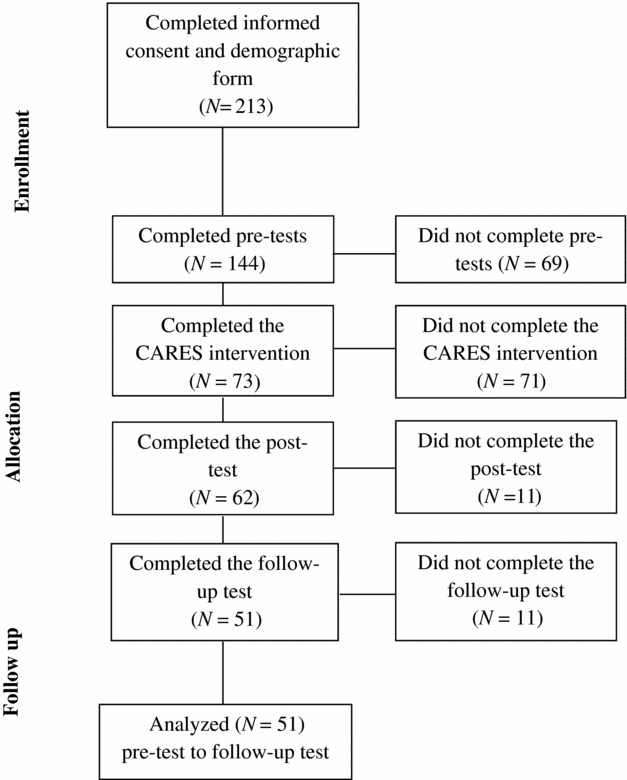
Two hundred and thirteen participants were sent pre-tests after completing the informed consent and demographic form. We received 144 completed pre-tests and lost contact with 69 participants. Those with completed pre-tests were sent the access codes and instructions for the CARES® Program. There were 73 participants who completed CARES® and 71 participants who did not. Of the 73 eligible participants who completed CARES®, 11 did not complete the post-test and 11 did not complete the follow-up test. A completion rate of 24% was achieved as N = 51 of the initial 213 participants completed the entire study protocol. Age was the only demographic factor that differed significantly between participants who dropped out (M = 45.3, SD = 14.5) and participants who completed the study (M = 51, SD = 14.2), with drop outs being younger in age. Please refer to Figure 1 for more details on the participant flow.
Participant flow.

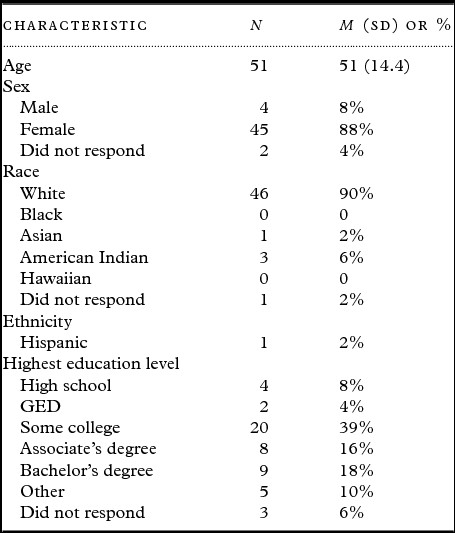
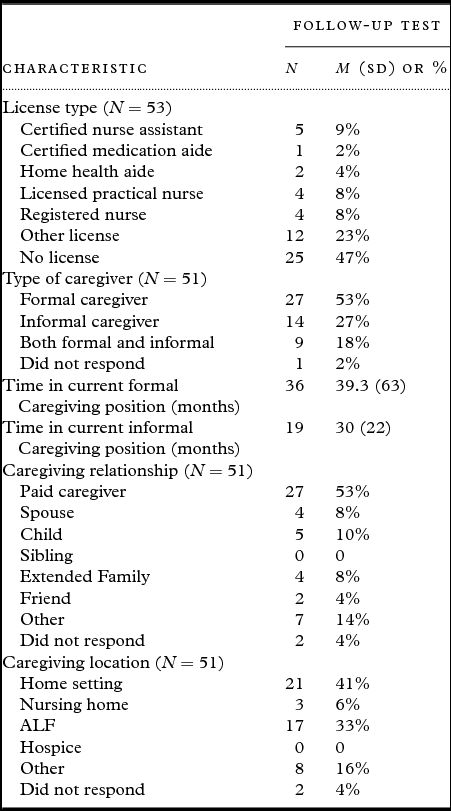
The analytic sample (N = 51) had an average age of 51 years (SD = 14.4). The majority were female (88%) and white (90%). Over half of the sample had some college (39%), an Associate's (16%), or Bachelor's degree (18%). Thirty-one percent of the participants were licensed caregivers as either paraprofessional nurse aides (CNA, CMA, HHA), or nurses (LPN, or RN) while 23% had a different type of license captured as “other.” Forty-seven percent of the sample had no license for caregiving. When asked type of caregiver, 53% reported being formal, 27% informal, and 18% were both formal and informal. Formal caregivers’ (who were not also informal caregivers) previous experience ranged from 2 weeks to 30 years with a median of two year's previous experience. Previous experience averaged three years and four months among formal caregivers. Informal caregivers’ (who were not also formal caregivers) previous experience ranged from one month to six years, with an average of two years and six months experience. For family members, 10% of the sample cared for a parent and 8% cared for a spouse. The most frequent reported setting for caregiving was the home (41%), followed by an assisted living facility (33%), other (16%), and nursing home (6%). Please refer to Tables 1 and 2 for more details.
Demographic profile of analytic sample (N = 51)

Caregiving characteristics of analytic sample

Note: Participants were given the option to choose more than one license, if applicable, for a total of 53. All other characteristics listed were out of 51.
Analysis
Descriptives and frequencies were performed for all variables of interest. χ 2 tests for independence were performed on the Likert-scaled items from the competency subscale among all caregivers. For analysis on the pre-, post-, and follow-up knowledge and video assessments, a Multivariate Analysis of Variance (MANOVA) was conducted. An a priori power estimate for MANOVA projected a sample of 48 was needed to achieve power of 0.80.
Results
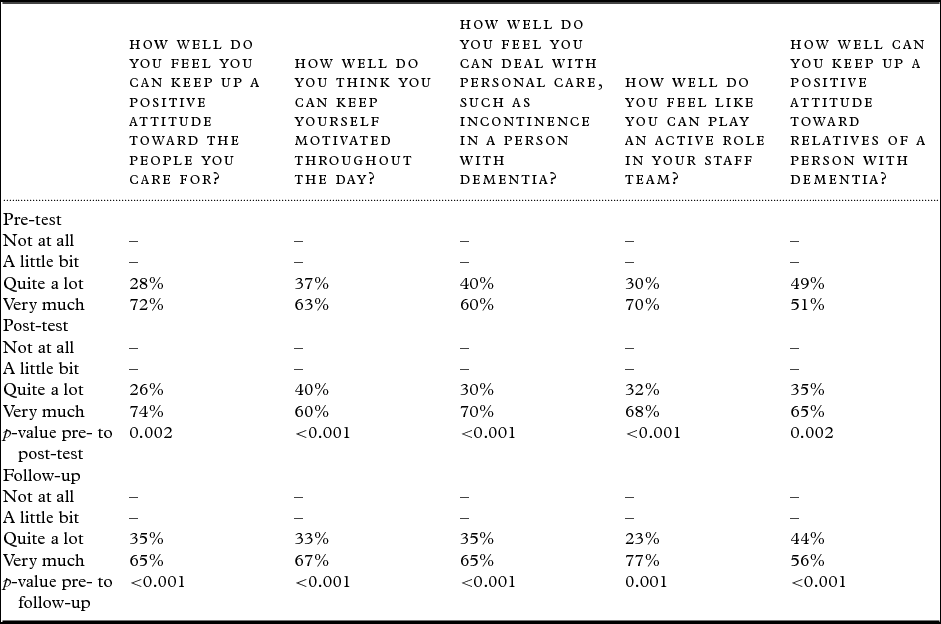
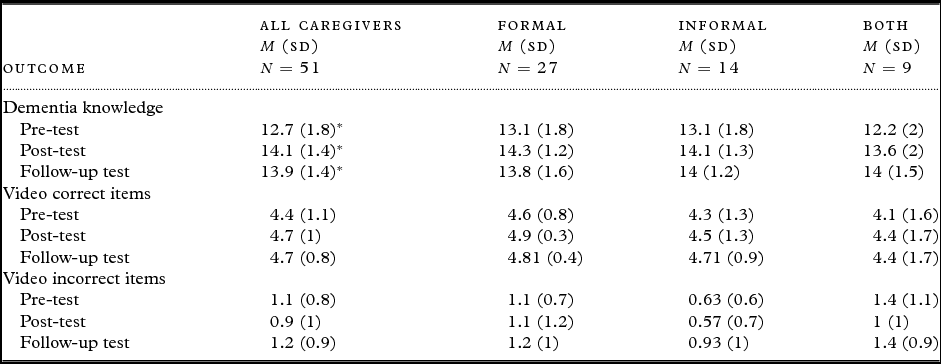
Participants were only included in the analysis if they completed the pre-test, the post-test, and follow-up test 30-days later (N = 51). Descriptives and frequencies of the three main outcomes can be found on Tables 3 and 4.
Analytic sample of the sense of competence in dementia care staff scale among caregivers (N = 43)

Note: Cells with <5 responses were removed to meet test assumptions.
Dementia-knowledge and person-centered care identification

Note: All caregivers served as the analytic sample; *p < 0.05. Analyses were not performed by subtype.
The χ 2 test of independence was used to determine change in competency as measured by the SCIDS subscale immediately after the CARES® program and after a 30-day delay. Responses with less than five endorsements were removed to meet test assumptions resulting in a sample of N = 43 for the SCIDS subscale analysis. Participants were asked how well they could perform a specific task with the answer choices of “not at all,” “a little bit,” “quite a lot,” and “very much.” From pre-to post-test, all five individual items of the SCIDS subscale significantly changed, with three of the five items (keeping a positive attitude toward people you care for χ 2 (1, N = 43) = 9.37, p = 0.002, dealing with personal care χ 2 (1, N = 43) = 15.86, p < 0.001, and keeping a positive attitude toward relatives of people with dementia χ 2 (1, N = 43) = 8.95, p = 0.002) improving to greater ratings of “very much,” while two items (keeping motivated through the day χ 2 (1, N = 43) = 18.55, p < 0.001 and playing an active role in the care team χ 2 (1, N = 43) = 13.44, p < 0.001) declined and shifted in higher endorsements of “quite a lot” compared to “very much.” From pre-test to the 30-day follow-up test, significant differences were seen for all five items. Improvements in competency were observed with greater endorsements of “very much” on four of the five items (attitude toward relatives χ 2 (1, N = 43) = 11.79, p < 0.001; motivation χ 2 (1, N = 43) = 15.20, p < 0.001; personal care χ 2 (1, N = 43) = 15.77, p < 0.001; active team member χ 2 (1, N = 43) = 9.79, p = 0.001). The fifth item, keeping a positive attitude toward care recipients, declined, χ 2 (1, N = 43) = 12.35, p < 0.001, whereby participants responded at a greater frequency on the follow-up with “quite a lot” versus “very much” compared to the pre-test or post-test. Table 3 presents frequencies of the analytic sample.
A MANOVA was calculated to examine performance on the pre-, post-, and follow-up test (N = 51). Before analysis, data were examined and confirmed for multivariate normality. Results indicated a difference in means among the three time points, Wilk's Λ = 0.86, F(6, 286) = 3.7, p = 0.001 with a multivariate effect size of w 2 = 0.09. Univariate follow-up tests using the Tukey's Studentized Range (HSD) with an α = 0.025 revealed differences from pre- to post-test and pre- to follow-up test for the dementia knowledge questionnaire total score F(2, 150) = 7.71, p < 0.001. Performance on the dementia knowledge questionnaire improved from pre-test (M = 12.7, SD = 1.83) to post-test (M = 14.1, SD = 1.4) and from pre-test to follow-up (M = 13.9, SD = 1.42). No significant effect was found among the video caregiving items, either on correctly endorsed, F(5, 150) = 1.63, p = 0.19 or incorrectly endorsed items, F(2, 150) = 1.01, p = 0.36. While not significant, there was an increase in video item scores for correct items from pre-test (M = 4.41, SD = 1.12) to post-test (M = 4.71, SD = 0.1) and pre-test to follow-up (M = 4.73, SD = 0.8), and a decrease for incorrect items from pre-test (M = 1.08, SD = 1.12) to post-test (M = 0.90, SD = 1), though pre-test to follow-up scores (M = 0.1.16, SD = 0.92) did not improve for the incorrect items.
Table 4 reports descriptive statistics for all study caregivers’ variables who identified as formal, informal, or both. Due to inadequate power, differential analysis was not performed from pre-test to follow-up based on caregiver role (i.e. informal vs. formal caregivers).
Discussion
A rigorous pre–post and 30-day follow-up design tested changes in knowledge, self-reported competence, and person-centered care identification after the CARES Dementia Basics Program. The evaluation included both informal and formal caregivers across all caregiving settings. Overall results indicated the CARES® Dementia Basics Program was successful in improving dementia-specific knowledge and certain aspects of sense of competence in caring for persons with dementia. The person-centered care video item did not change as result of the program. The present study contributes evidence that an online training program taken by a sample of both formal and informal caregivers modestly improved dementia knowledge and some aspects of caregiving competency 30-days post-training.
Significant but modest improvements were reported in dementia-specific knowledge at both post-test and 30-day follow-up test. Scores, however, were slightly lower at the 30-day follow-up test compared to the post-test. Consistent with other studies, retaining knowledge at the immediate post-test level remains one of the largest challenges in online training programs (Harahan and Stone, Reference Stone2007; Stone, Reference Stone2007). Continued evalution of time points beyond post-testing will provide more insight into how to best support caregivers in practice.
Competency in one's caregiving role is an important component to improve conditions for both the care provider and care recipient. In an evaluation of direct care workers, Zimmerman et al. (Reference Zimmerman2005) reported that direct care workers who have person-centered care attitudes toward dementia care perceive themselves to be better trained for the daily care of persons with dementia. Additionally, caregivers’ attitudes toward both care recipients and family members of care recipients are related to the use of person-centered care techniques and ratings of recipient quality of life (Winzelberg et al., Reference Winzelberg, Williams, Preisser, Zimmerman and Sloane2005).
The five questions of the SCIDS competency subscale began with favorable ratings from participants, with over half of the sample rating “very much” to all of the items. The positive endorsements in competency among the subscale at baseline likely reflects the considerable caregiving experience reported in this sample. From pre-to post-test, ratings of “very much” strengthened for three of the five items on the SCIDS scale: “keeping a positive attitude towards family members,” “keeping a positive attitude towards care recipients,” and “dealing with personal care tasks.” The two remaining items, “keeping oneself motivated throughout the day” and “playing an active role in your staff team” demonstrated a slight decline in the rating of “very much” as compared to “quite a lot” from pre-test to post-test.
In evaluation of pre-test to follow-up test, only one SCIDS item “keeping a positive attitude toward the people you care for” declined while the other four items increased in self-reported ratings. It is hypothesized that learning more about dementia and its inevitable decline may sensitize the caregiver over time to the negative consequences of dementia, especially the complexity of care leading to an increase in caregiver burden and possibly even negative feelings toward the care recipient, as seen in the attitude item declining at 30-days post-training. If so, this suggests that education may need to counteract the information on the inevitable cognitive decline with more positive, person-centered information specific to stage-related cognitive changes.
These findings may also reflect the limits of a one-time 4-hour training and its ability to sustain a high sense of competence among caregivers who understand the continuous decline of those with Alzheimer's disease. Indeed, the overall gains in competence were moderate. Perhaps, competency could be better maintained with the implementation of ongoing booster or refresher sessions among caregivers. Similarly, personalizing the training experience, either through the presence of a coach (Ducharme et al., Reference Ducharme, Dube, Levesque, Saulnier and Giroux2011; Griffiths et al., Reference Griffiths, Whitney, Kovaleva and Hepburn2016), a communication forum (Cristancho-Lacroix et al., Reference Cristancho-Lacroix, Wrobel, Cantegreil-Kallen, Dub, Rouquette and Rigaud2015; Hattink et al., Reference Hattink2015), or feedback on homework assignments/exercises (Kajiyama et al., Reference Kajiyama2013; Blom et al., Reference Blom, Zarit, Groot Zwaaftink, Cuijpers and Pot2015) could potentially improve longer term outcomes. Individualized programs that create more meaningful learning experiences have been reported within in-person training (Gitlin et al., Reference Gitlin2003; Brodaty and Arasaratnam, Reference Brodaty and Arasaratnam2012) and are in need of further investigation within online formats.
The SCIDS measure used to assess competency was validated for formal caregivers but not among informal caregivers, who were ~30% of the sample. Perhaps, the mixed results reflect a measure not sensitive to the unique needs of informal caregivers, such as heightened emotional caregiver burden. In addition to educational interventions, a review by Brodaty and Donkin (Reference Brodaty and Donkin2009) suggests multi-component, individualized training programs are more successful at addressing emotional burden for informal caregivers, a consideration for future project development. It is our hope that the systematic framework provided in the CARES training lends itself to empower caregivers to communicate with their social support network and healthcare professionals to work toward alleviating burden.
Online educational opportunities continue to grow in popularity in the modern learning environment and provide a medium to connect with caregivers regardless of location. Even though there are numerous advantages to online learning, opportunity still remains to create interactive assessments that allow for better evaluation of translating knowledge into practice. The video-vignette assessment was intended to evaluate person-centered care techniques learned through the CARES® program in lieu of in person observation. The findings of the video-vignette assessment were not statistically significant, but change was observed in the hypothesized direction among the accurate test questions, suggesting a trend in correctly identifying person-centered care techniques after the CARES® training. Online training programs are moving toward more engaging and interactive assessments, and video-vignette case studies are becoming more prevalent in this modality of learning (Irvine et al., Reference Irvine, Bourgeois, Billow and Seeley2007; Irvine et al., Reference Irvine, Billow, Gates, Fitzwater, Seeley and Bourgeois2012). In future research, it may be beneficial to include differing case studies within the video-vignettes to determine if certain content areas lend themselves better or worse to heightened applied skills. It may also enhance the richness of the evaluations to include an open-ended component to complement the case study vignettes where participants verbalize examples of proper and improper caregiving techniques, articulating how one would have performed in the same caregiving scenario.
Our study design was unique because the formal and informal caregiving populations participated in the same online training program. Indeed, not only did the participants’ sample include formal and informal caregivers, but also caregivers currently identifying in both roles, a subpopulation rarely examined in the literature. In preliminary analyses not reported here, the raw descriptives of caregiving type (formal, informal, both) are suggestive of a trend among both formal and informal caregivers to similarly benefit from training. Future research, however, should explore how diverse groups of caregivers respond to online dementia training programs. Indeed, identification of training programs that are appropriate for all caregiving types and that lead to sustained improved care over time are still needed (Stone, Reference Stone2007). Moreover, our study utilized a three time point design, not common in the field of dementia training programs. If the online training programs are conducted to improve the caregiver and care recipient condition, evaluations beyond immediate post-test are necessary to validate the transfer of learning into practice.
The present study has limitations; findings about educational improvement may not be generalizable to all caregivers because the study was offered for free to caregivers in the state of Oregon. Compared to what is known regarding the demographic characteristics of formal caregivers, this study sample was older with notable educational achievement. The range of ages represented within the study sample (37–65) reflect approximately 65% of informal caregivers from a nationally representative sample, while the sex distribution over represented female informal caregivers (ASPE, 2014) and showed limited ethnic diversity, which may be due to Oregon's general demographic make-up. All participants had previous experience, with an average of over two and three years caregiving among informal and formal caregivers. Interestingly, rates of current licensure associated with caregiving was low, with only 31% of the sample identifying as either a certified nurse assistant, a home health aide, a certified medication aide, a licensed practical nurse, or registered nurse. Caregivers were more likely to report they had no license (47%), or had another type of license (23%) that was not captured in our question. Both the low license rates and high rates of care provided in the home or assisted living facility likely reflect Oregon's efforts to transition long-term care services to the least restrictive community settings.
Although we achieved a power estimate of 0.80 within our sample, the study had high dropout rates from pre-test to 30-day follow-up. A gift card lottery was introduced into the study to encourage participation, but perhaps a lottery was not a large enough incentive. Enhanced outreach and greater incentives for the participant sample could potentially reduce dropout rates in future studies. Time spent for each participant within the CARES® Dementia Basics program was assessed but additional measurement of absorption and comprehension of material could have increased the validity of our findings. Lastly, even though a 30-day follow-up period was included, longer evaluation periods (i.e. 3, 6, or 12 months) are desirable.
In conclusion, this study indicates that CARES® Dementia Basics Program modestly improved caregivers’ knowledge and components of caregiving competence. The versatility of the principles taught within the training, specifically person-centered care, behavioral modification, and the systematic CARES® framework can be applied to a variety of caregiving situations. The next steps for evaluation of the CARES® Dementia Basics Program would be to observe and evaluate performance, because the goal of online training programs is to ultimately improve caregiving skills, leading to better outcomes for care recipients.
Conflict of interest
None.
Description of authors’ role
M.L. Pleasant, V. Molinari, and K. Hyer jointly assisted in formulation of the research question, design of the study, data collection, data analysis, and paper write-up. J.V. Hobday, S. Fazio, and N. Cullen assisted in formulation of the research question and study design.
Acknowledgments
The authors would like to acknowledge and thank the National Alzheimer's Association and Oregon Care Partners for the opportunity to participate in this evaluation. In addition, the support staff from the National Alzheimer's Association, Oregon Care Partners, and HealthCare Interactive were essential to the success of the project. This research was supported in part by funding from the National Alzheimer's Association.