


Introduction
Cognitive theories of Obsessive-Compulsive Disorder (OCD) have generated a range of research into the phenomenology and psychopathology of this problem (Freeston, Rheaume and Ladouceur, Reference Freeston, Rhéaume and Ladouceur1996; Rachman, Reference Rachman1997; Salkovskis, Reference Salkovskis1985, Reference Salkovskis1999; Rachman, Reference Rachman2002). One of the key outstanding questions concerns why people with obsessional problems have such difficulty in stopping actions such as hand washing and checking, on the basis that the occurrence of such behaviour is common in the “normal” population. According to Salkovskis’ cognitive account, difficulties in stopping can be accounted for by the way in which people with OCD appraise the consequences of the failure to achieve certainty. This can be explained by the affected person's appraisal of their responsibility to ensure that serious harm does not occur, which leads them to require unusually stringent criteria for deciding that an action has been properly completed (Salkovskis, Reference Salkovskis1999). It is proposed that this manifests as the application of “Elevated Evidence Requirements” (EER) for the decision about whether or not an action is complete and can therefore be terminated. The results of a previous study examining obsessional washing in OCD were consistent with this hypothesis (Wahl, Salkovskis and Cotter, Reference Wahl, Salkovskis and Cotter2008). Obsessional as opposed to non-obsessional washes were found to involve a greater number of criteria (including a range of subjective criteria such as achieving a “just right” feeling) in the decision to stop washing. The comparison used in that study was between people with obsessional problems in whom the main problem was washing and those in whom the obsessional problem took another form. It was not established whether or not the use of EER is specific to washing compulsions or is, as hypothesized, also characteristic of other types of compulsions. The main objective of the present study is to replicate and extend the results of Wahl et al. (Reference Wahl, Salkovskis and Cotter2008) in order to determine whether EER is also a characteristic of compulsive checking.
The main competing theory of repeated checking has focused on the idea that a cognitive deficit forces obsessional checkers to check repeatedly in order to compensate for their cognitive impairment as either intentional or unintentional perseveration. The deficits implicated have included visuo-spatial memory (Aronowitz et al., Reference Aronowitz, Hollander, Decaria, Cohen, Saoud and Stein1994; Boone, Ananth, Philpott, Kaur and Djenderedjian, Reference Boone, Ananth, Philpott, Kaur and Djenderedjian1991; Dirson, Bouvard, Cottraux and Martin, Reference Dirson, Bouvard, Cottraux and Martin1995; Tallis, Pratt and Jamani, Reference Tallis, Pratt and Jamani1999; Zielinski, Taylor and Juzwin, Reference Zielinski, Taylor and Juzwin1991), memory for action (Rubenstein, Peynircioglu, Chambless and Pigott, Reference Rubenstein, Peynircioglu, Chambless and Pigott1993; Sher, Mann and Frost, Reference Sher, Mann and Frost1984) and impairments in the ability to shift set (Head, Bolton and Hymas, Reference Head, Bolton and Hymas1989; Veale, Sahakian, Owen and Marks, Reference Veale, Sahakian, Owen and Marks1996). A more subtle deficit is suggested by Savage and colleagues who propose that deficits in executive functioning may result in the use of counter-productive organizational strategies and therefore the prolongation of ritualizing (Savage et al., Reference Savage, Baer, Keuthen, Brown, Rauch and Jenike1999, Reference Savage, Deckersbach, Wilhelm, Rauch, Baer and Reid2000; Savage and Rauch, Reference Savage and Rauch2000).
Moritz, Kloss, Von Eckstaedt and Jelinek (Reference Moritz, Kloss, Von Eckstaedt and Jelinek2009) assessed nonverbal and verbal memory accuracy and confidence in 43 participants with OCD and a comparison group of 46 healthy controls, in an attemp to further examine the proposed memory deficit hypothesis. The results of this study showed that there was no difference in the performance of participants with OCD and healthy controls. No impairments for verbal versus nonverbal and immediate versus delayed memory were noted and there were no significant group differences for memory confidence (Moritz et al., Reference Moritz, Kloss, Von Eckstaedt and Jelinek2009). Moritz et al. (Reference Moritz, Kloss, Von Eckstaedt and Jelinek2009) acknowledge that, although not found in this study, the occurance of difficultites with memory accuracy and confidence, when found, is largely mediated by contextual factors (Moritz et al., Reference Moritz, Wahl, Zurowski, Jelinek, Hand and Fricke2007). Under experimental conditions of high responsibility, memory confidence (but not accuracy) was significantly decreased in participants with OCD comparable to controls (Moritz et al., Reference Moritz, Wahl, Zurowski, Jelinek, Hand and Fricke2007; Boschen and Vuksanovic, Reference Boschen and Vuksanovic2007).
Other studies have distanced themselves from the idea of a structural cognitive impairment and instead emphasized the importance of meta-memory functions such as confidence in memory (Ecker and Engelkamp, Reference Ecker and Engelkamp1995; McNally, Reference McNally, Goodman and Rudorfer2000, van den Hout and Kindt, Reference van den Hout and Kindt2003a, Reference van den Hout and Kindt2003b, Reference van den Hout and Kindt2004); this view is consistent with the position proposed in the present paper. A number of studies have demonstrated that as a check is repeated a decline in memory confidence occurs. van den Hout and Kindt (Reference van den Hout and Kindt2003a) conducted a series of experiments in which they asked non-clinical participants to check a virtual stove and to provide ratings on their memory confidence, vividness and details of the virtual stove. Post checking it was found that memory confidence, vividness and details all decreased, whilst memory accuracy remained unaffected. A number of studies have replicated these findings with other undergraduate populations (Boschen, Wilson and Farrell, Reference Boschen, Wilson and Farrell2011; Dek, van den Hout, Giele and Engelhard, Reference Dek, Van Den Hout, Giele and Engelhard2010; Linkovski, Kalanthroff, Henik and Anholt, Reference Linkovski, Kalanthroff, Henik and Anholt2013; van den Hout and Kindt, Reference van den Hout and Kindt2004) utilizing real objects (e.g. kitchen stoves) (Coles, Radomsky and Horng, Reference Coles, Radomsky and Horng2006; Fowle and Boschen, Reference Fowle and Boschen2011; Radomsky, Dugas, Alcolado and Lavoie, Reference Radomsky, Dugas, Alcolado and Lavoie2014; Radomsky, Gilchrist and Dussault, Reference Radomsky, Gilchrist and Dussault2006) and specifically with OCD patients for whom checking is a primary part of their problem (Radomsky et al., Reference Radomsky, Dugas, Alcolado and Lavoie2014).
A cognitive theory of prolonged ritualizing in OCD (Salkovskis, Reference Salkovskis1999) draws on this latter work, suggesting that not only do obsessional patients have low confidence in the performance of a check but also have concerns or doubts about its outcome, which motivates them to check over and over again, paradoxically further undermining their confidence in that memory. Where memory deficits appear to be observed in OCD, these are thus most likely to be a consequence of strategic factors, in that the person with OCD is trying too hard to be certain about the outcome of their decision (Salkovskis, Reference Salkovskis and Rapee1996). Cognitive theory suggests that people with OCD believe that they can only be sure when they effortfully achieve an internal feeling of “just right”.
Coles, Frost, Heimberg and Rhéaume (Reference Coles, Frost, Heimberg and Rhéaume2003) found that the related phenomenon of “not just right feelings” was associated with OCD features and perfectionism in an undergraduate sample. They found a strong relationship for “not just right feelings” with checking and ordering behaviours. In a further study utilizing an undergraduate population significant relationships were found between “not just right feelings” and OCD symptoms and theoretical constructs including responsibility and incompleteness, but not for non-OCD related constructs (i.e. depressive symptoms and social anxiety) (Coles, Heimberg, Frost and Steketee, Reference Coles, Heimberg, Frost and Steketee2005). Similar observations in non-clinical populations have been made by Davey's group (Davey, Startup, Zara, Macdonald and Field, Reference Davey, Startup, Zara, Macdonald and Field2003) who have linked EER in worriers to the notion of “mood-as-input” and responsibility, suggesting synergistic effects (Startup and Davey, Reference Startup and Davey2003). The mood-as-input hypothesis proposes that an individual's decision to either continue or terminate a task is based on an interaction between their “stop rules” for the task and the information available to them as to whether the goal of the task has been met. It is hypothesized that the individual's concurrent mood is considered as an important source of information by which task completion is assessed (e.g. negative mood could be taken as evidence that the task in not complete) (Meeten and Davey, Reference Meeten and Davey2011).
Theoretically the outcome of a check is deemed to be much more important to an obsessional checker than to others (Salkovskis, Reference Salkovskis1999); therefore criteria that are more likely to be used when one is making a “life or death” decision, may be used by obsessional checkers in determining when to stop checking (subjective criteria). These criteria are characterized by their reference to internal states of feelings or moods, as opposed to criteria based on the perception of external observation (objective criteria). The inclusion of EER in cognitive theory suggests that the termination of a compulsion requires unusually large numbers of both types of criteria to be fulfilled before a decision can be reached, with “just right” feelings central to this decision. When applying this theory to compulsive checking, a person who is checking if the door is locked would consider multiple “objective” criteria, such as whether they could hear the sound of the bolt “clicking” into place, whether the door looks as if it is locked, whether they felt the bolt close, and whether they could push the door open. Obsessional checkers may also use multiple “subjective” criteria by considering if it now “felt right” or complete to them, if they were completely satisfied with the check, if they had any doubts that the check was done, and that their mood was consistent with the certainty of a successful outcome. Only if the obsessional checker felt satisfied by the answers to these questions would they terminate the check.
All of these factors will, as described above, lead to memory distrust and the urge to check more. The present study seeks to extend and refine the methodology and content of the previous obsessional washing study conducted by Wahl et al. (Reference Wahl, Salkovskis and Cotter2008). The “feeling” concept is elaborated by incorporating new items referring to the importance of a feeling of “completeness” and “satisfaction”. In the previous washing interview study (Wahl et al., Reference Wahl, Salkovskis and Cotter2008) an obsessional control group who had no significant washing symptoms was used. A comparable control group for this study was not possible, as obsessional patients without any checking problems are considerably less common. Checking (to make sure that something is right) is not only the most frequent compulsion (Rasmussen and Tsuang, Reference Rasmussen and Tsuang1986) but can be an intrinsic element of compulsive rituals, including washing, ordering and repeating. An anxious control group (AC) was therefore included in this study to control for the potentially confounding effects of anxiety, depression and patient status. The primary hypotheses under investigation are that obsessional checkers will rate “subjective” criteria as more important than anxious and non-clinical controls and more criteria will be regarded as important by obsessional participants, and that achieving a feeling of “rightness” will be rated as more important for obsessional checkers than for the two control groups.
Additionally, obsessional checkers are expected to employ effortful and conscious decision making strategies in order to terminate a check, and that more obsessional than non-obsessional individuals will experience a change in mood at the end of the check, which influences their decision to stop.
Finally, at the end of the check, it is expected that the responsibility for something bad happening will be higher for obsessional checkers than for the control groups, and that obsessional checkers will be less certain about the outcome of their check than controls.
Method
Participants
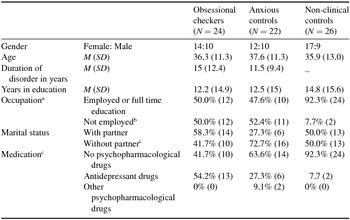
Twenty-four obsessional checkers (OC), 22 anxious controls (AC) and 26 non-clinical controls (NC-C) participated in the study recruited from a specialist Anxiety Disorders Clinic. The diagnosis of both clinical groups was based on the Structured Clinical Interview for DSM IV (SCID) (First, Spitzer, Gibbon and Williams, Reference First, Spitzer, Gibbon and Williams2002). Obsessional patients were classified as “obsessional checkers” if they met DSM-IV criteria for the checking problem alone, or if checking was their “primary” obsessional problem (based on distress, interference with everyday activities, and the time spent checking). Potential participants were excluded if they were under 16 or over 75 years of age or had a current or previous history of psychotic symptoms. Gender ratio, average age, educational achievements, marital and occupational status, the length of the primary problem and current medication for each group are displayed in Table 1.
Socio-demographic characteristics

Notes: Cells contain percentage figures and total frequencies in brackets per group or M and SD.
a For one anxious control participant information about occupational status is missing.
b Not employed includes unemployed, housewife/houseman or retired.
c For one obsessional participant information about medication is missing.
Using Chi-squared analysis, there was no difference in the proportion of males and females in each group, χ2(2) = 0.611, p = .737, nor was the marital status significantly different between groups, χ2(2) = 4.745, p = .093. Occupational status, however, was significantly different between groups, χ2(2) = 13.645, p < .001, in the non-clinical control group the proportion of employed participants was higher than in the two clinical groups (92.3% vs 50% and 47.6% employed or full time education for NC-C, OC, and AC respectively). Neither age nor years spent in full time education was significantly different between groups, F(2,69) = 0.120, p = .887 for age; F(2, 68) = 1.758, p = .180 for years in education. The anxious control group consisted of two participants with Panic Disorder (9.1%), eight participants with Panic Disorder with Agoraphobia (35.4%), five participants with Post Traumatic Stress Disorder (22.7%) and seven participants with Social Phobia (31.8%). On average, both clinical groups had suffered from their particular problem for a comparable length of time, t(44) = 1.081, p = .286, with M = 15, SD = 12.4 for Obsessive Checkers, M = 11.5 and SD = 9.4 for Anxious controls.
Measures
Standardized questionnaires
The standardized questionnaires used were the Beck Anxiety Inventory (BAI: Beck, Epstein, Brown and Steer, Reference Beck, Epstein, Brown and Steer1988), Beck Depression Inventory (BDI: Beck, Ward, Mendelsohn, Mock and Erbaugh, Reference Beck, Ward, Mendelsohn, Mock and Erbaugh1961); The State-Trait Anxiety Inventory (STAI: Spielberger, Reference Spielberger1983) and the Obsessive-Compulsive Inventory (OCI: Foa, Kozak, Salkovskis, Coles and Amir, Reference Foa, Kozak, Salkovskis, Coles and Amir1998).
The Checking Interview
Pilot work on the structure of the checking interview indicated a problem in identifying checking behaviours in obsessional checkers and checking behaviours in non-clinical controls. Use of OCD specific instructions meant that non-clinical controls were not able to identify a check, whilst instructions more appropriate to non-clinical controls often failed to pinpoint obsessional behaviour in the obsessional group. Slightly different definitions of checking were therefore used for checkers and for the two control groups. The definition of a compulsive check for the obsessive checkers was:
This means a situation when you felt driven to check something. This can be in response to an intrusion (that is doubts, ideas or a thought like “Something terrible is going to happen if I don't check”) or it may be in direct response to something going wrong.
and the definition of a check for the comparison groups was:
This means a situation when you actively tried to find out whether something has happened or not happened. For example, checking whether the light is switched off, the front door is locked, the gas is off, whether you have the keys with you.
Participants were asked to remember in detail an identified recent checking experience, with the interviewer prompting them to recall specific details such as where they were, who they were with, and how they were feeling to facilitate recollection. Participants were asked to imagine exactly what they did when they checked and to describe out loud the sequence of the check. Participants were asked to describe how they decided to stop checking on that occasion and what factors influenced their decision. Participants were asked to rate each reason provided on a 0 (not at all important) to 100 (extremely important) Visual Analogue Scale (VAS). Details of the checking behaviour were recorded verbatim.
The Checking Inventory
The washing inventory developed by Wahl et al. (Reference Wahl, Salkovskis and Cotter2008) was modified to make it applicable to checking for the purposes of this study. Seven items aimed at exploring the use of “subjective” and “objective” criteria were added. Participants were asked to indicate the importance of each criterion in deciding when to stop checking, and they rated their responses on a VAS from 0 (not at all important) to 100 (extremely important).
Participants were asked to rate objective criteria with regards to how important it was that they could “physically” tell that it was OK to stop checking and what the “physical information” was composed of (e.g. “How important was it that you could see it/ hear it/ feel it by touching it/ smell it?”). Participants were asked to rate subjective criteria with reference to the importance of “feeling right” being something that they either actively and effortfully tried to achieve or was a consequence of the check. Participants were asked if their mood changed during the check and what this meant and were asked to rate how anxious they felt at the end of the check. Participants were also asked to rate the perceived strategic/effortful nature of the decision making process, the perceived responsibility for something bad happening at the end of the check, and the perceived certainty of the outcome of the check. The test-retest reliability of individual items of this scale has previously been found to be in the range of 0.75-0.79 (Wahl et al., Reference Wahl, Salkovskis and Cotter2008).
The following composite variables were used in the analysis of the checking inventory:
-
− Subjective or internally referenced criteria; means of the following variables: “feeling right”, “feeling completely satisfied”, “mentally struggling with the decision”, “trying hard enough”, “being mentally or physically exhausted”.
-
− Objective or externally referenced criteria; means of the variables “seeing it”, “feel it by touching it”, “hearing it”, and “smelling it”.
-
− Overall number of criteria: Each criterion variable (with the exception of “How important was it that you could physically tell that it was OK?” and “How important was it that you knew from the way that you felt about things that they were right or complete?”) was transformed into a binary variable. If the original value was zero, the new value was “0”, each value greater than zero was “1” in the new variable. The new variable “number of criteria” is the sum over these new binary variables and represents the total number of criteria being considered.
-
− Number of extremely important criteria: Sum of those criteria on the checking inventory that had been given a rating of greater than 80. Eighty was chosen as representing an extremely high importance (on the basis of face validity).
-
− “Controlled” processing: Means of the two items “consciously deciding” and “with deliberate effort”.
Procedure
Participants were sent a set of questionnaires in the post (BDI, BAI, OCI, RIQ, STAIT trait), a checking inventory and two visual analogue scales. They were given written instructions to complete the questionnaires and have the VAS and the checking inventory ready for the arranged time when they would be phoned and interviewed. For all participants the interview started with a definition of a check as described above, and continued by asking participants to recall a specific time in the last few days in which they had carried out a check. Participants were asked how they decided to stop checking at that particular time. Once the answers to these open questions had been obtained, participants were asked to fill in the checking inventories.
Treatment of data
Quantitative analyses
The overall type one error probability was set at α = 0.05. Mixed-model ANOVA was the main procedure for the parametric data. The Tukey Honestly Significant Difference Test (Tukey HSD) was employed for post hoc analysis of the parametric procedure when differences between all three groups were of interest. Helmert contrasts were used when the difference between the obsessional patients and the mean of both control groups was investigated. Kruskal-Wallis and Mann-Whitney tests for follow-up analyses were used for non-parametric data. Chi-square analysis was used to compare frequencies of categories between groups. With the exception of Tukey HSD tests, post hoc tests were Bonferroni corrected.
Qualitative analyses of the interview data. A content analysis was conducted with the main focus on the question: “How did you decide when to stop checking?” All classifications and ratings were done without knowing which group the participant belonged to.
The data were reduced using a category system developed for the present study with similar reasons given by participants being allocated to a common category according to a manual (the category system is available from the authors on request). Once all reasons under “How did you decide when to stop checking?” had been coded, and the inter-rater reliability established, one rater read through the complete interviews again in order to see whether at some point during the interview any other reasons for stopping were mentioned or whether the meaning of any of the stopping criteria changed when the interview context was taken into account. If any new reasons emerged, they were categorized using the above mentioned process. The content and frequency of the final categorization were then compared between groups using quantitative methods.
To establish the inter-rater reliability of the category system a second rater, who was blind to diagnosis, rated all interviews using the final categories and coding rules. The inter-rater reliability was calculated using Cohen's Kappa coefficient, which represents the standardized percentage agreement above that expected by chance (Wirtz and Caspar, Reference Wirtz and Caspar1994). The inter-rater agreement for the category system was high (Cohen's Kappa = 0.83).
Categories used
Each statement responding to the question: “How did you decide when to stop checking?” was classified according to the category system described above. The categories were grouped on the basis of whether the decision was predominantly based on “objective” (i.e. perceptions of external changes) or “subjective” criteria (i.e. referring to some kind of internal state or mood or rule) and on what type of “subjective” and “objective” criteria were employed, resulting in four larger categories that were of theoretical interest.
-
1. External, perception: comprising statements that were based on a sensory perception.
-
2. Internal, feeling/mood: indication that a general feeling of rightness/ completeness, satisfaction, mood or an epistemological sense of “just knowing” was considered for the decision to stop checking.
-
3. Internal rules, memory: memory related cues determined the end of the check.
-
4. Internal, effort: indication that a certain amount of effort had to be put into the check.
Results
Measures of psychopathology
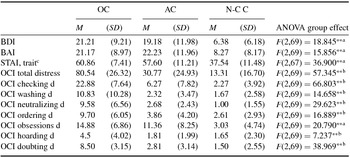
A description of the psychopathology measures per group and group comparison statistics are given in Table 2. Obsessional checkers and anxious-control participants are comparable in terms of measures of depression (BDI) and anxiety (BAI, STAI trait); the non-clinical control group has lower scores compared to both clinical groups on all of the above measures. The obsessional group reported higher distress in terms of measures of obsessionality (OCI total distress) and compulsive checking (OCI checking distress subscale) compared to both control groups. Anxious and non-clinical controls do not differ in terms of overall obsessionality or checking symptomatology. An identical pattern emerges for the other OCI distress subscales with the exception of obsessions. The two clinical groups are not different on the OCI obsessions subscale but have significantly higher scores than the non-clinical control group.
Measures of psychopathology

Notes: ** p < .001.
a Post hoc Tukey HSD tests showed that the non-clinical participants had significantly lower scores than the two clinical groups (ps < 0.05), the clinical groups did not differ significantly.
b Post hoc Tukey HSD tests showed that obsessional checkers had significantly higher scores than the non-clinical group and the anxious control group (ps < .05), who did not differ significantly from each other.
c For STAI, trait, data of two checkers were incomplete.
Checking inventory
Description of the type and length of the reported check
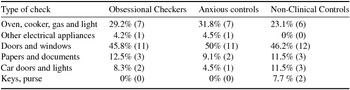
Participants reported performing a variety of recent checks, including checks of doors, windows, oven or cookers, gas, lights and other electrical appliances, going over forms and documents to see whether there are any mistakes on them and checking whether one has their keys and purse. Table 3 summarizes the types of checks per group. Chi-square analysis indicated that there were no significant differences in the proportions of types of checks between groups, χ2(10) = 5.906, p = .823. Since assumptions of ANOVA were violated for the length of the check, a Kruskal-Wallis test and subsequent Mann Whitney tests were used. The Kruskal-Wallis test demonstrated a significant difference in the length of the check between groups, Kruskal-Wallis χ2(2) = 17.376, p < .001; median of 300 s, 36.25 s and 66.67 s for OC, AC, and NC-C, respectively. Follow-up Mann Whitney tests showed that the obsessional checkers reported taking significantly longer for the check than the non-clinical controls, Z = −3.200, p < .001, and the anxious controls, Z = 3.922, p < .001. Non-clinical and anxious controls were not significantly different from each other, Z = −0.812, p = .417.
Types and length of checks.

Notes: Cells contain percentages (and total frequencies in brackets) of different checks per group and for the length of the reported check the median in seconds per group, range in brackets; N = 24, 22 and 26 for obsessional checkers, anxious and non-clinical controls, respectively.
Objective and subjective criteria
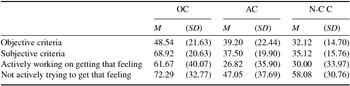
The criteria were subjected to a mixed model ANOVA with type of criterion (subjective vs. objective) as the within subject factor and group (Obsessional checkers (OC) vs. anxious controls (AC) vs. non-clinical controls (NC-C)) as the between subject factor. Means and standard deviations per group are shown in Table 4. There was a significant type of criterion main effect, F(1,69) = 7.540, p < .01, and a significant effect of group, F(2,69) = 17.668, p < .001. These effects were modified by a significant interaction between type of criterion and group, F(2,69) = 6.419, p < .01. In order to further investigate this interaction, Helmert contrasts were used separately for subjective and objective criteria. For subjective criteria, the overall comparison between groups was significant, F(2,69) = 24.389, p < .025. The difference between obsessional checkers and the two control groups was significant, with a mean difference of 32.61, p < .025; 97.5% confidence interval: 21.84 to 43.37. The difference between the control groups was not significant, with a mean difference of −2.385, p = .662. For objective criteria, the overall group differences were significant, F(2,69) = 4.358, p < .025. The difference between checkers and the two control groups was significant, with a mean difference of 12.882, p < .025; 97.5% confidence interval: 1.59 to 24.17, the difference between the two control groups was not significant, with a mean difference of −7.09, p = .218.
Importance of objective and subjective criteria and feeling of rightness on VAS (0 = not at all important, 100 = extremely important), means and standard deviations

In summary, obsessional checkers rated subjective criteria as more important than the two control groups. They also rated objective criteria as more important than the two control groups, although not to the same extent as the subjective criteria.
Feeling of rightness
The variables “feeling right because you actively worked on getting that feeling” and “feeling right although you did not try to have that feeling” were subjected to a mixed model MANOVA with “type of feeling right” (actively trying to get it vs. not actively trying to achieve it) as within subject factor and group (OC vs. AC vs. NC-C) as between subjects factor. Table 4 presents means and standard deviations per group. There was a main effect of “type of feeling right”, F(1,69) = 11.155, p < .001, and a main effect of group, F(2,69) = 9.345, p < .001; the interaction was not significant, F(2,69) = 0.768, p = .468. Not actively trying to achieve the feeling of rightness was more important for all groups than actively trying to feel right about the check (means of 59.14 vs. 39.50). Post hoc Tukey HSD tests indicated that obsessional checkers rated both types of feeling right as more important than anxious controls and non-clinical controls (means of 66.98, 36.94, and 44.04, for OC, AC and NC-C, respectively; both ps < .01). The control groups were not significantly different from each other, p = .588.
Obsessional checkers thus rated actively achieving a feeling of “rightness” as more important than non-obsessional individuals. However, they also rated the importance of not actively trying to feel right as more important than the control groups, and the group differences were not different for the two types of using the feeling of rightness.
Number of criteria being considered
The variable “number of criteria” was subjected to a one-way ANOVA with group (OC vs. AC vs. NC-C) as a between subjects factor. The maximum number of criteria that could be considered was 15. There was a significant effect of group, F(2,69) = 16.879, p < .001. Post hoc Tukey HSD tests demonstrated that checkers used a significantly higher number of criteria than both control groups, M = 12.63, SD = 1.69, M = 9.04, SD = 3.06; M = 9.31, SD = 2.24 for OC, AC and NC-C, respectively; ps < .001; the control groups were not significantly different from each other, p = .923.
The number of extremely important criteria were subjected to a one-way ANOVA with group (OC vs. AC vs. NC-C) as between subject's factors. The group differences were significant, F(2,67) = 20.793, p < .001. Post hoc Tukey HSD tests demonstrated that obsessional checkers rated more criteria as extremely important than both control groups, M = 8.46, SD = 2.78; M = 3.50, SD = 2.97; M = 4.05, SD = 3.01 for OC, AC and NC-C, respectively; ps < .001. Control groups were not significantly different from each other, p = .802.
Consistent with predictions, both the overall number of criteria being considered and the number of criteria being regarded as extremely important was greater for the obsessional checkers than the other two groups.
Effortful processing
The rating of how effortful the decision was, was subjected to a one-way ANOVA with group (OC vs. AC vs. NC-C) as between subjects’ factors. The groups were significantly different from each other, F(2,69) = 40.278, p < .001. Post-hoc Tukey HSD tests demonstrated that obsessional checkers reported the “stop” decision to be more conscious and to require more effort than anxious controls and non-clinical controls, M = 74.66, SD = 27.45; M = 23.57, SD = 28.12; M = 13.20, SD = 18.24 for OC, AC and NC-C, respectively; ps < .001. Non-clinical and anxious controls were not significantly different from each other, p = .337. Obsessive checkers thus rated the decision making process as requiring more strategic processing than the control groups.
Mood changes
Thirteen obsessional checkers (59.1%), six anxious controls (28.6%) and eight non-clinical controls (36.8%) reported experiencing a mood change that influenced their decision to stop the check. Using Chi-square analysis, the proportions of participants reporting mood changes were not significantly different between groups, χ2(2) = 5.161, p < .076. All anxious and non-clinical controls and all but one obsessional checker experienced a mood improvement.
Since the variable “anxiety” was not normally distributed, it was subjected to a Kruskal-Wallis analysis with group as a factor (OC vs. AC vs. NC-C). The group differences were significant, Kruskal-Wallis χ2(2) = 31.384, p = .001, with medians of 56.67 (range = 90.0), 2.86 (range = 60.0) and 2.50 (range = 70.0) for OC, AC, and NC-C, respectively. Follow-up Mann Whitney tests demonstrated that obsessional checkers had higher scores than anxious controls, Z= −4.533, p < .001, and non-clinical controls, Z = −4.930, p = .001. There were no significant differences between the two control groups, Z = −0.242, p = .809. There was thus only a trend for mood changes to occur for more obsessional checkers than controls. In line with predictions, obsessional checkers are more anxious at the end of the check than non-obsessional individuals.
Frequency of self-reported reasons to stop checking
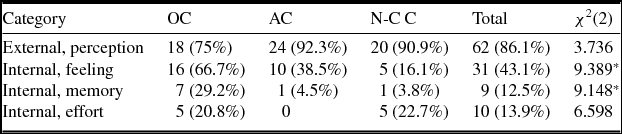
Each statement identified as a response to the question: “How did you decide when to stop checking?” was classified according to the category system as described above. Frequencies and percentages of each category separately for each group are displayed in Table 5. Categories with significant differences between groups were internal, feelings, χ2(2) = 9.389, p < .01, and internal, memory, χ2(2) = 9.143, p < .01. Post hoc comparison demonstrated that more obsessional checkers than non-clinical controls reported using some kind of internal feeling based criterion, χ2(1) = 8.937, p < .01. The differences between obsessional checkers and anxious controls, χ2(1) = 3.978, p = .046, and between the two control groups, χ2(1) = 1.373, p = .241, did not reach significance allowing for Bonferroni correction. Analysing the individual items composing the larger categories, only the category “it feels right” was significantly different between groups, χ2(2) = 13.644, p < .01. Follow up analyses demonstrated that more obsessional checkers than anxious controls, χ2(1) = 8.693, p < .01, and non-clinical controls, χ2(1) = 7.989, p < .01, reported using a feeling of “rightness”. Anxious and non-clinical controls were not different from each other, χ2(1) = 0.201, p = .654.
Reasons for stopping a check, frequencies and percentages

*p < .01.
For “internal, memory”, none of the post hoc comparisons reached the stricter alpha of p < .01, with χ2(1) = 4.843, p = .028 for OC = AC; χ2(1) = 5.953, p = .015 for OC = NC-C; and χ2(1) = 1.373, p = 0.241 for AC = NC-C.
Number of criteria
The number of reasons participants gave to the question “How did you decide when to stop checking?” was counted and subjected to a one-way ANOVA with group (OC vs. AC vs. NC-C) as a between subjects factor. Group was significant, F(1,69) = 15.848, p < .001. Obsessional checkers reported to use an average of 3.83 reasons (SD = 1.79), anxious controls an average of 2.05 reasons (SD = 1.13), and non-clinical controls an average of 1.92 reasons (SD = 0.89). Multiple comparison tests demonstrated that obsessional checkers reported using more criteria than anxious controls and non-clinical controls, Tukey HSD, ps < .001. The control groups were not different from each other, Tukey HSD, p = .945. Obsessional checkers reported using more criteria than the control groups.
Discussion
The main objective of this study was to investigate the use of EER by participants who have OCD during an “obsessional check” relative to a “non-obsessional” check. A comparison was made with both non-clinical and anxious controls. The results are consistent with the use of all aspects of EER for the termination of an obsessional check: obsessional checkers rated subjective criteria as significantly more important relative to anxious and non-clinical controls. Objective criteria were also rated as more important for obsessional checkers than for the two control groups. Obsessional checkers reported using more criteria for the termination of the check and rated more criteria as “extremely important” than the control groups. The decision making process involved in the termination of the check was rated as more effortful by checkers than by the comparison groups, and it was also reported by them as taking longer. Qualitative analysis of the interview data was consistent with these findings for the subjective data. For the obsessional checkers, “feelings” in general and feeling of “rightness” in particular were associated with the termination of a check, whereas they were not for the control groups. However in the analysis, groups did not differ in their perceptions of the use of objective criteria for the termination of a check, perhaps reflecting the perceived relative importance. External criteria might have a lower salience in the OCD participants mind than subjective criteria, possibly because objective criteria are continuously considered during the check whereas subjective criteria may be important only for the final decision. If this is so, objective criteria would not be so strongly associated with the termination of a check relative to subjective criteria, but may still play an important role for the decision, as reflected in the importance ratings. Further studies are necessary to clarify the absolute and relative importance of objective criteria for an obsessional check.
This study examined the way in which feelings of “rightness” are employed and whether these are conceptually similar to a feeling of anxiety or mood change. It appears that obsessional checkers actively try to reach a feeling of “rightness” from the beginning, whereas this was not identified as important by non-obsessional individuals. Additionally, obsessional checkers reported that it is also more important for them than for the controls to feel “right” by the end of the check without actively trying to get this feeling. This suggests that both ways of using the feeling of rightness are more important for obsessional checkers, and that the way of employing it is unlikely to be a distinct discriminating factor between obsessional checkers and non-obsessionals.
The relationship between “feeling of rightness” and anxiety and mood changes was explored. There was a trend for mood changes to occur for more obsessional checkers than controls, and it is therefore possible that mood changes are associated with the feeling of rightness. It has previously been suggested that there may be important interactions between mood and the decision to stop (Salkovskis, Reference Salkovskis and Rapee1996). These concepts are similar to the “mood-as-input” hypothesis used in the context of worry (Startup and Davey, Reference Startup and Davey2001). Future studies are required to address this question, using a more sensitive measure of mood change. Anxiety, however, was significantly higher for obsessional checkers than for controls at the end of the check. Several ways in which anxiety and the use of EER are associated are plausible. For example, being anxious could be an indicator of the significance of the situation, and therefore obsessional checkers could be more likely to use EER. Alternatively, EER could be associated with a reduction in anxiety.
The present study closely matched previous investigations of EER in obsessional washers both in form and findings. In a previous interview study (Wahl et al., Reference Wahl, Salkovskis and Cotter2008), participants were interviewed about specific situations varying in the degree of urgency to wash their hands using questionnaires and a semi-structured interview. Washers rated subjective criteria as more important for the termination of the washes than non-washing obsessional and non-clinical controls. They also identified more subjective criteria in the interviews than controls, for both the most and least needed wash. Overall, the findings on stopping criteria are consistent with the cognitive model of OCD (Salkovskis, Reference Salkovskis1999), which proposes that the use of problematic stopping criteria in obsessional patients is motivated by inflated appraisals of the threat and responsibility implications of the failure to properly complete an action and resolve uncertainty concerning the outcome of one's own behaviour. However, the exact relationship of inappropriate stopping criteria to the intrusive thoughts and their long term involvement in the maintenance of the obsessional problem, as proposed in the cognitive behavioural model, were not addressed in the current study and require further investigation.
Acknowledgements
Conflict of interest: The authors have no conflicts of interest with respect to this publication.



Comments
No Comments have been published for this article.