

An increasing number of companies in Switzerland have a strong interest in a healthy workforce and pay growing attention to activities that help them to retain their employees (Füllemann, Inauen, Jenny, Moser, & Bauer, Reference Füllemann, Inauen, Jenny, Moser and Bauer2017; Geisen, Reference Geisen2010; Geisen, Lichtenauer, Roulin, & Schielke, Reference Geisen, Lichtenauer, Roulin and Schielke2008). Private and social insurance agencies in Switzerland are also in favour of better support of employees and a stronger commitment to return-to-work activities (Buys et al., Reference Buys, Wagner, Randall, Yu, Geisen, Harder and Howe2016; Geisen, Reference Geisen2010; Organisation for Economic Co-operation and Development [OECD], 2014b). Measures that improve working conditions, maintain the workforce, and create more efficient returns to work are also considered important for avoiding unemployment and shifting from paid work to disability pensions. International research has noted the potential contribution to returns on investment resulting from disability management (Buys & Randall, Reference Buys and Randall2009; Harder & Scott, Reference Harder and Scott2005). This has also been confirmed for companies in Switzerland (Geisen et al., Reference Geisen, Lichtenauer, Roulin and Schielke2008). Companies are increasingly recognising both direct and indirect costs, including productivity losses created by high fluctuation ratios and the loss of employees through illness and accident. Reducing such losses requires the implementation of more comprehensive and systematic programs to identify and support employees to stay at their current post or to switch to another job.
Against the backdrop of recent developments in companies’ promotion of health and disability management, the question remains how employees in companies in Switzerland perceive these developments and practices, and what they think of the activities of their employers.Footnote 1 Therefore, this article focuses on the employee perspectives on disability management activities within their companies and discusses employee perceptions of disability management as it relates to job satisfaction, moral, sickness absence, and health in Swiss companies. Starting with an overview on the international development of disability management since the 1990s an insight is given on the development of disability management in Switzerland. On this basis, the findings of our study on employee perception of disability management in private and public companies in Switzerland are presented and discussed.
International Perspectives: Disability Management in the Making
In Switzerland, disability management is still more a scientific concept than a usual practice. It is used to describe what companies are doing to support their employees and to prevent ill health (Geisen et al., Reference Geisen, Lichtenauer, Roulin and Schielke2008). In Swiss companies, these activities are variously named; for example, health management, case management, ability management, or social counselling. The situation is similar in other countries (Geisen, Lichtenauer, Roulin, & Schielke, Reference Geisen, Lichtenauer, Roulin and Schielke2011; Niehaus, Magin, Marfels, Vater, & Werkstetter, Reference Niehaus, Magin, Marfels, Vater and Werkstetter2008). However, disability management also has a legal meaning, which has been incorporated into social welfare and social insurance legislation and practice in some countries, including the United States (US), Canada, Australia and New Zealand, under workers compensation fund laws (Harder & Scott, Reference Harder and Scott2005; Huang, Wagner, & Harder, Reference Huang, Wagner and Harder2011), and in Germany within the Code of Social Law (§84 Abs. 2; Niehaus et al., Reference Niehaus, Magin, Marfels, Vater and Werkstetter2008). Disability management is thereby understood as an extension of workers’ rights not only to be protected at the workplace but also to receive sufficient and professional support to return to work. This has led to better understandings of workplace safety measures and return to work activities. In Switzerland, neither a worker’s right nor a company’s duty to offer support to return to work has so far been legislated.
Despite the limitations, disability management has been recognised in several countries as enhancing working conditions and ultimately resulting in labour force stability. Its impact has also grown and deepened through the activities of international organisations. As early as 2002, the International Labour Office (ILO) launched a code of conduct in disability management (ILO, 2002), and it has supported developing countries to introduce disability management legislation and practices. The World Health Organization (WHO) demands equal rights and participation in the labour market for people with disabilities, which also requires the introduction of disability management programs to retain workers who are facing an acquired disability (WHO & World Bank, 2011).
Yet, despite international acknowledgement of the potential contributions to be made by disability management, academic research specifically addressing its value is limited, especially in international perspectives across multiple social environments. We also lack research into employees’ perspectives on disability management, including its contribution to individual health and wellbeing. A review of the extant literature suggests that research in this area has been primarily focused on rates of and reasons for return to work (Bloch & Prins, Reference Bloch and Prins2001; Labriola, Reference Labriola2008; Young et al., Reference Young, Wasiak, Roessler, McPherson, Anema and van Poppel2005), activities targeted at particular health problems (Schultz, Stowell, Feuerstein, & Gatchel, Reference Schultz, Stowell, Feuerstein and Gatchel2007; Waddell & Burton, Reference Waddell and Burton2005), programs to encourage return to work (Costa-Black, Cheng, Li, & Loisel, Reference Costa-Black, Cheng, Li and Loisel2011; Gensby, Labriola, Irvin, Amick, & Lund, Reference Gensby, Labriola, Irvin, Amick and Lund2014; Tjulin, MacEachen, & Ekberg, Reference Tjulin, MacEachen and Ekberg2010), prevention of disability (Loisel et al., Reference Loisel, Buchbinder, Hazard, Keller, Scheel, van Tulder and Webster2005; Pomaki, Franche, Murray, Khushrushahi, & Lampinen, Reference Pomaki, Franche, Murray, Khushrushahi and Lampinen2012), and policies relating to employment of individuals with disabilities (Beyer, Jordán de Urríes, & Verdugo, Reference Beyer, Jordán de Urríes and Verdugo2010; Dempsey & Ford, Reference Dempsey and Ford2009; Parmenter, Reference Parmenter2011).
Disability Management in Switzerland
Currently, the Swiss social security schemes important to disability management efforts include the health insurance, accident insurance and unemployment insurance schemes. Other important Swiss systems include the federally regulated disability insurance program, daily allowance insurance and pension funds (Geisen, Reference Geisen2011). To qualify for federal disability insurance, an applicant must be able to demonstrate a health impairment that is causally related to an injury that has rendered a person unfit to work in the long term. This system initially attempts to restore, maintain, or improve the person’s earning capacity through entry, maintenance or re-entry into the workforce. If first efforts are unsuccessful, a disability pension will be provided to eligible beneficiaries. In addition to the possibility of a disability pension for ongoing, income-disrupting health problems, employees must pay into employer-based pension systems which are compulsory for employees earning 21’150 Swiss francs or more per annum (Duell, Tergeist, Bazant, & Cimper, Reference Duell, Tergeist, Bazant and Cimper2009).
In Switzerland, employer responsibility for sick pay is comparatively low, depends on employee tenure, and is often included in collective bargaining agreements. Moreover, with these agreements only 22% of Swiss employees are covered by continued wage payments by the Daily Allowance Insurance (OECD, 2014b, p. 47).Footnote 2 However, starting at the beginning of the new millennium, this scheme began to introduce disability management services, supporting employer-provided return to work efforts. Consequently, having Daily Allowance Insurance is now a benefit for employers seeking access to professional support in the case management of their workers’ health problems.
In the past 20 years, Switzerland has experienced an increase in uptake of disability pensions, which has led to policies to encourage company support for retaining and reintegrating employees (Duell et al., Reference Duell, Tergeist, Bazant and Cimper2009). In line with the motto ‘Rehabilitation before pension’, Swiss social insurance systems are increasingly encouraging improved prevention and return to work measures, including disability management programs. Although Swiss social security systems now provide incentives to implement disability management, companies are not obliged to adopt the measures proposed or to implement disability management processes. It thus remains important to demonstrate the value of disability management programs and services, both to the economic success of the employer, and to the health and wellbeing of employees.
Since the beginning of the millennium, disability management in Switzerland has evolved not only in practice in private and public companies but also in theoretical and empirical research (Geisen, Reference Geisen2015; Geisen, Kraus, Ochsenbein, Schmid, & Studer, Reference Geisen, Kraus, Ochsenbein, Schmid and Studer2013; Geisen et al., Reference Geisen, Lichtenauer, Roulin and Schielke2008, Reference Geisen, Lichtenauer, Roulin and Schielke2011). In particular, one study, researched the practice of disability management in Swiss companies for the first time, using a multimethod design, and both qualitative and quantitative methods. The study included a quantitative survey in eight companies of all employees who had been supported by the company’s disability management during the last five years. Most of them (78%) had confidence in the support they received and greatly appreciated that the employer had programs to support and care for employees facing severe illness or injury (Geisen et al., Reference Geisen, Lichtenauer, Roulin and Schielke2008, Reference Geisen, Lichtenauer, Roulin and Schielke2011). Whereas this study focused on big companies, a mixed-method study on small and medium sized enterprises SMEs also using quantitative and qualitative methods, showed that many of these companies are also engaged in disability management activities, but do not have access to resources to improve and develop their activities. Often the problem is not primarily the lack of financial resources but the absence of professional knowledge and case management (Geisen et al., Reference Geisen, Kraus, Ochsenbein, Schmid and Studer2013).
Current Study on Employees’ Perception of Disability Management
Despite the empirical findings, historical developments, and theoretical discussions described above, there remains a need for ongoing and up-to-date research into disability management, because this field is developing dynamically, e.g. with regard to mental health issues as a new challenge for companies. It is of growing importance to companies, especially in the countries facing tremendous demographic change and skills shortages in some segments of the economy (Beaudry, Green, & Sand, Reference Beaudry, Green and Sand2013; Ferreira, Reference Ferreira2011; Gehrig, Gardiol, & Schaerrer, Reference Gehrig, Gardiol and Schaerrer2010; Lobsiger, Morlok, Frey, & Oswald, Reference Lobsiger, Morlok, Frey and Oswald2014; Veen, Reference Veen2008; Zölch & Mücke, Reference Zölch and Mücke2015), and it receives more and more attention from welfare state authorities (Bolliger, Fritschi, Salzgerber, Züricher, & Hümbelin, Reference Bolliger, Fritschi, Salzgerber, Züricher and Hümbelin2012; Ferrier, Reference Ferrier, Burke and Smith2008; OECD, 2003). In social policy fields, there is growing consent that supporting employees at risk of losing their job due to illness or injury to keep their place is more effective for employee wellbeing than starting support later (Bolliger et al., Reference Bolliger, Fritschi, Salzgerber, Züricher and Hümbelin2012; OECD, 2014a). Furthermore, there are also many advantages for most companies to keeping their employees at work, even in different conditions (Buys et al., Reference Buys, Wagner, Randall, Yu, Geisen, Harder and Howe2016; Füllemann et al., Reference Füllemann, Inauen, Jenny, Moser and Bauer2017; Geisen et al., Reference Geisen, Lichtenauer, Roulin and Schielke2008). In general, it can be stated that the field of disability management is as dynamic as it is complex, so that there is a continuing need for research, especially in disability management practice. In particular, research into employee perspectives would provide especially useful contributions to the literature, which focuses often on experts, policy makers, employers or disability management practitioners’ perspectives (Geisen et al., Reference Geisen, Kraus, Ochsenbein, Schmid and Studer2013; Niehaus et al., Reference Niehaus, Magin, Marfels, Vater and Werkstetter2008). But with regard to the high importance of employees participation in disability management (Geisen et al., Reference Geisen, Hassler, Ochsenbein, Buys, Randall, Harder and Dan2016; Geisen et al., Reference Geisen, Lichtenauer, Roulin and Schielke2008; Gensby & Husted, Reference Gensby and Husted2013), for further development of disability management it is very important to improve knowledge about employees’ perception and perspective on disability management. Hence, the present study attempted to address these gaps through a quantitative study in Switzerland that considered employee perceptions of disability management as they relate to job satisfaction, workplace morale, sickness absence, and physical and mental health. The following aims guided our research:
1. Describe the relationship between efforts at disability prevention and job satisfaction, physical health, mental health, workplace morale, and absenteeism in a Swiss sample of companies.
2. Describe the relationship between stay at work schemes and job satisfaction, physical health, mental health, workplace morale, and absenteeism.
3. Describe the relationship between return to work policies and job satisfaction, physical health, mental health, workplace morale, and absenteeism.
4. Compare disability management in private and public, and in the union and nonunion sectors.
5. Compare disability management by gender.
Methods
An international research team of scholars from Australia, Canada, China, and Switzerland considered disability management perspectives across national boundaries, collecting data in each country through use of local research teams. The research was approved by the Research Ethics Board of the University of Northern British Columbia. Informed consent was obtained from all individual participants included in the study.
Procedures
Survey data was collected in seven companies in Switzerland. Participant organisations were recruited via convenience sampling (Patton, Reference Patton2002). Inclusion criteria included having had a disability management program in place for a minimum of two years, and a workforce of 100 or more employees. Data collection for the Swiss survey was completed in both online and paper-and-pencil format. The seven companies included one private pharmaceutical company (n=29), one township (n=34), two state owned companies from the mailing sector (n 1=56; n 2=81), two private insurers (n 1=35; n 2=103) and one state owned public transport company (n=144). For the comparison of the public and private companies, we treated the state owned companies as public companies.
Measures
We were unaware of any existing survey that would adequately measure employee perspectives on disability management and was generalisable across a variety of national contexts. Therefore, we created a survey to meet our needs, which we reviewed for appropriateness of use. The survey was translated into German and French (Swiss sample), as well as both Simple and Traditional Chinese (Chinese sample); to ensure that the meaning was maintained, the survey was reverse translated back into English.
The survey focused on three aspects of a disability management program, which are disability prevention (DP), stay at work (SAW) and return to work (RTW). To measure employee knowledge of DP, SAW and RTW, several items were asked; for example, ‘My company takes measures to prevent disability in the workplace’. Each item included a 5-point Likert scale ranging from 1 [strongly agree] to 5 [strongly disagree]. Furthermore, the employees were asked about their perception on the influence of DP, SAW, and RTW on job satisfaction, physical and mental health, workplace morale, and sickness absence. Some examples are ‘The workplace disability management program contributes positively to my morale at work’ and ‘The workplace disability management program contributes to employee morale’. Moreover, we collected demographic data including age, gender, number of children, relationship status, education, subjective physical and mental health, and so on.
Participants
A total of 482 employees from seven different companies responded to the Swiss survey. Of these, 34.6% (N=167) were employed in the private sector and 65.4% (N=315) in the public sector. The average age of respondents was 43.1 years (SD=11.309), 54.0% reporting as male (N=255) and 46.0% reporting as female (N=217). Most respondents were not part of a union (63.2%; N=299), 36.2% (N=171) of the respondents reported to be unionised. Most respondents had secondary education (61.2%; N=255), with 37.0% of respondents reporting postsecondary education (N=154). Respondents had worked an average of 16.9 years (SD=13.451) with their current employer, and 71.8% were working full-time. After adjusting to the US dollar and purchasing power, the sample had an average income of US$103,565.26 (SD=US$47,243.48). The respondents reported fairly good physical health (M=2.32, SD=.902; scale from 1 [very good] to 5 [poor]) and mental health (M=2.25, SD=.945). Likewise, they reported missing little time due to disability or illness in the year prior to survey (M=1.77, SD=1.092; scale from 1 [none] to 6 [6 months or more]), with only 3.3% respondents self-reporting a disability (N=16). Respondents also reported high job satisfaction (M=1.86, SD=.733; scale from 1 [very satisfied] to 5 =[very dissatisfied]) and workplace morale (M=1.68, SD=.611; scale from 1 [strongly agree] to 5 [strongly disagree]).
Results
Descriptive statistics
Respondents agreed that their companies have DP programs (M=1.92, SD=.717; scale from 1 [strongly agree] to 5 [strongly disagree]), SAW programs (M=2.16, SD=.930), and RTW programs (M=2.02, SD=.834). When asked if their company’s disability management programs contribute to job satisfaction, physical health, mental health, and workplace morale, respondents only slightly agreed that these programs were of benefit to themselves (M=2.18, SD=.783; M=2.47, SD=.811; M=2.46, SD=.824; M=2.39, SD=.795; scale from 1 [strongly agree] to 5 [strongly disagree]) and their coworkers (M=2.20, SD=.750; M=2.33, SD=.756; M=2.38, SD=.763; M=2.42, SD=.724). Respondents perceived even less benefit in their company’s disability management programs in terms of reducing sick time that they took off themselves (M=3.06; SD=.934), though they saw slightly greater benefit in reducing sick time taken by coworkers (M=2.68, SD=.817). Despite the minor benefits seen in the disability management programs in these domains, respondents agreed that their company should continue the disability management programs (M=1.75, SD=1.008).
Regression Analyses
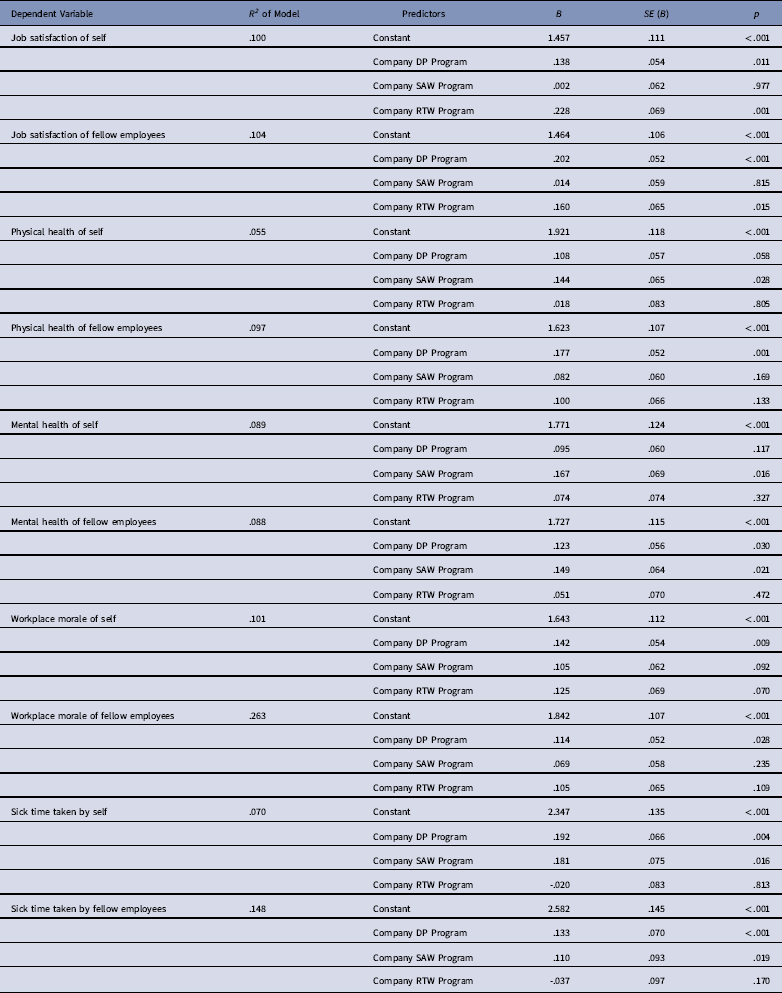
Multivariate regression was employed to predict the influence of employee perceptions of their company’s implementation of DP, SAW and RTW initiatives in their workplace (from 1 [strongly agree] to 5 [strongly disagree]) on their own and coworkers’ job satisfaction, physical health, mental health, workplace morale and time missed due to illness.
Disability management program’s influence on job satisfaction
Both DP and RTW predicted perceptions of disability management’s influence on individual and coworker job satisfaction, with employees perceiving DP and RTW as beneficial to their own and coworkers’ job satisfaction. SAW was not predictive of disability management’s influence on job satisfaction of the individual or coworkers (see Table 1).
Standard Regression of Company Disability Management Program Variables in Prediction of Employee Workplace Perceptions

Disability management program’s influence on physical health
Only SAW predicted perceptions of disability management’s influence on individual respondent, but not coworker, physical health. Conversely, DP was predictive of physical health for the coworker but not the respondent. RTW was not predictive of disability management’s influence on the physical health of respondents or coworkers. That is, employees reported SAW as beneficial to their own physical health, while reporting DP as beneficial to the physical health of their coworkers.
Disability management program’s influence on mental health
SAW predicted perceptions of disability management’s influence on both respondent and coworker mental health. Additionally, DP predicted perceptions of disability management’s influence on the mental health of coworkers, but not of the respondent. That is, employees reported SAW as beneficial to their own and coworkers’ mental health, and DP as beneficial to the mental health of coworkers.
Disability management program’s influence on morale
Only DP predicted disability management’s influence on workplace morale for both the respondent and coworkers, with employees perceiving DP as beneficial to their own and coworkers’ morale. Neither SAW nor RTW was predictive of disability management’s influence on respondent or coworker morale.
Disability management program’s influence on sick time
Both DP and SAW predicted disability management’s influence on respondent and coworker sick time, with employees seeing benefits in DP and SAW for reducing sick time taken by themselves and their coworkers. RTW was not predictive of disability management’s influence on sick time taken by respondents or coworkers.
Group Difference Analyses
Public versus private companies
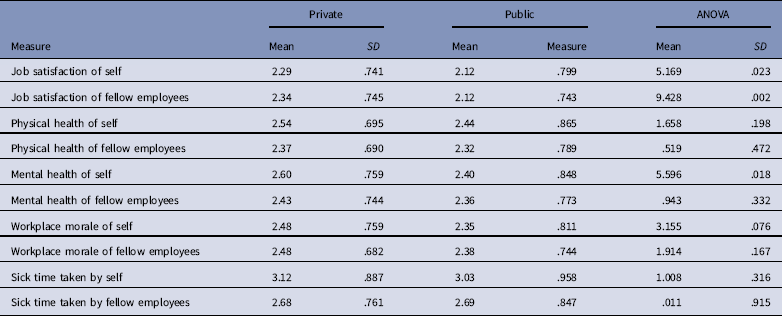
One-way ANOVA was employed to compare responses between participants in public and private companies about their perceptions of the influence of disability management on their own and coworkers’ job satisfaction, physical health, mental health, workplace morale and time missed due to illness. Significant differences were revealed for both respondent and coworker responses to job satisfaction, and individual responses to mental health. Respondents in public companies ranked disability management’s influence on their individual and coworkers’ job satisfaction, and individual mental health higher than did respondents in private companies (see Table 2).
Means, Standard Deviations (SD), and Results of One-Way ANOVAs Comparing Employee Workplace Perceptions by Private vs Public Companies

Union versus nonunion
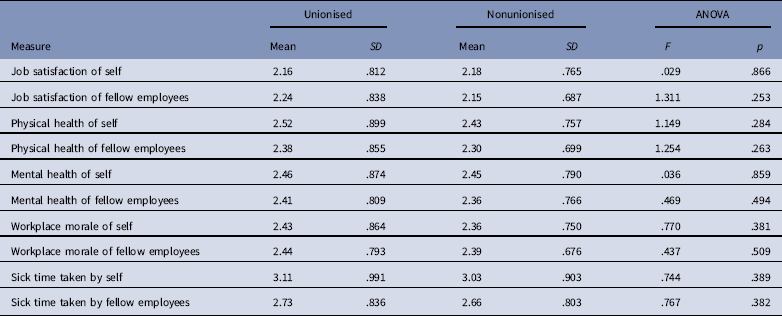
One-way ANOVA was employed to compare responses between participants in unionised and nonunionised workplaces about their perceptions of the influence of disability management on their own and coworkers’ job satisfaction, physical health, mental health, workplace morale and time missed due to illness. No significant differences were revealed for any variable (see Table 3).
Mean, Standard Deviation (SD), and Results of One-Way ANOVAs Comparing Employee Workplace Perceptions by Unionised vs Nonunionised Employees

Gender
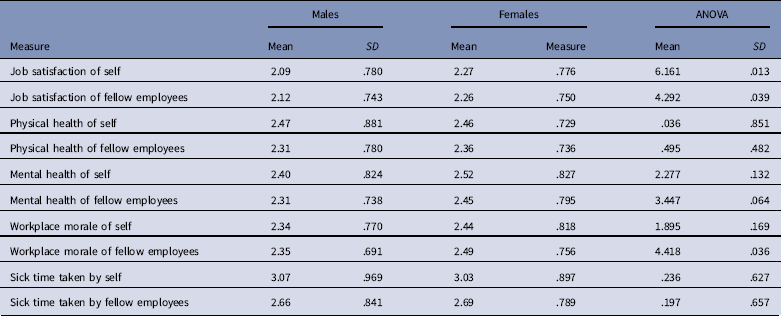
One-way ANOVA was used to compare responses between men and women about their perceptions of the influence of disability management on their own and coworkers’ job satisfaction, physical health, mental health, workplace morale and time missed due to illness. Significant differences were revealed for both respondent and coworker responses to job satisfaction, and coworker responses to workplace morale. Male respondents ranked disability management’s influence on their own and coworkers’ job satisfaction, and the workplace morale of coworkers higher than did female respondents (see Table 4).
Means, Standard Deviations (SD), and Results of One-Way ANOVAs Comparing Employee Workplace Perceptions by Gender

Discussion
This study aimed to contribute to the disability management literature in the form of a quantitative analysis of employee perspectives in Switzerland. The results revealed that Swiss employees are aware of DP, SAW and RTW schemes in their workplaces. Although employees in Switzerland reported only moderate benefits of disability management programming, they generally feel that the available programs are of high quality and think that such programs should continue.
In perceptions of disability management to predict job satisfaction, physical health, mental health, morale and absenteeism, Swiss employees report most benefit for DP and SAW programs. Specifically, they see RTW programs contributing only to job satisfaction for both themselves and coworkers. In contrast, DP efforts are seen as contributing to job satisfaction, workplace morale and reduced absenteeism for both the respondent and their coworkers, and to the mental and physical health of coworkers. Similarly, SAW efforts are seen as contributing to mental health and reduced absenteeism for both self and coworkers, as well as physical health for the self. A reason for this could be that DP is of relevance to all the employees compared to RTW programs, which are only beneficial for those in need. Furthermore, DP programs have a long tradition in the framework of the Swiss welfare state; for example, as occupational health and safety of the accident insurance.
In our difference analyses, we determined that, in Switzerland, disability management efforts provided by public organisations are more often seen as beneficial for the mental health of respondents and the job satisfaction of both respondents and coworkers, than they are in private organisations. The difference between private and public company employees’ perceptions of disability management can be explained by the higher social responsibility that employees in public companies see realised by their employers compared with private companies. Public employers are considered model employers, whereas expectations can be lower in private companies. However, this positive effect ascribed by public employees to their employers is a new finding in disability management research. Research so far shows private companies in a better position than public ones (Buys et al., Reference Buys, Wagner, Randall, Yu, Geisen, Harder and Howe2016; Wagner et al., Reference Wagner, Buys, Yu, Geisen, Harder, Randall and Howe2017), so further enquiry is needed before we can draw definite conclusions.
Gender differences are also evident in that men are more likely to report value related to disability management programs with respect to job satisfaction for both themselves and coworkers, and workplace morale for coworkers. The reported gender difference can be explained by the tendency of men to contribute more general trust in programs and technics to improve health conditions and support in a company. The employer’s engagement in this area makes it to a valuable activity, whereas women are more likely to see more responsibility upon their own and not so much the responsibility of the employer. However, further research is also needed on that issue.
Limitations
The present study was limited in several ways, including the cross-sectional nature of data collection and the small sample size. Given our cross-sectional method, we cannot be sure of the directionality of the relationships. For example, it may be that employees whose job satisfaction is greatest are more likely to report more positive views of disability management. Our data is also limited by the convenience nature of our sample; that is, only organisations that agreed to participate were included, perhaps leading to a sample particularly committed to disability management principles. Other limitations include the general nature of our team-developed questionnaire. We required a questionnaire that was general enough to withstand differences in national contexts and translatable into multiple languages. Such an internationally applicable questionnaire resulted in a lack of specifically Swiss data and a potential for misinterpretation.
Conclusion
The results of this quantitative survey of Swiss employees’ perceptions of disability management show that the employees value the program in terms of job satisfaction, health, morale and absenteeism. Therefore, disability management can be of strategic use to companies in designing comprehensive health strategies. Employees see DP and SAW initiatives as having the highest impact on themselves and their coworkers, whereas RTW schemes are perceived as more limited in their impact. This attitude can hinder the introduction of efficient and comprehensive disability management programs despite the increased interest of companies, social and private insurance schemes, and social policymakers to strengthen them.