INTRODUCTION
As the field of law evolves to become ever more global, legal information professionals employed by law firms and government agencies increasingly support the work of multilingual attorneys whose legal practices are transnational in scope. Similarly, academic law librarians are often asked to assist faculty members and students in researching comparative law topics involving foreign legal systems, and to provide research instruction for advanced degree students who received their primary legal training in foreign jurisdictions.
Although many of us have some working knowledge of at least one foreign language, our familiarity with foreign legal terminology is often limited. It can be especially challenging to assist patrons in locating jurisdiction-specific secondary law sources in languages other than English if we are completely unfamiliar with the language of the jurisdiction.
The best tool for locating credible secondary sources on foreign, comparative, and international law topics in multiple languages is the Index to Foreign Legal Periodicals (IFLP), the world's only multilingual legal journal index. What follows in this article is a brief introduction to the IFLP, an overview of its key features, the indexing process, and future developments.
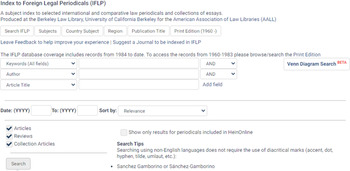
The IFLP's search screen.

IFLP - WHAT IS IT?
The Index to Foreign Legal Periodicals is the preeminent multilingual index to articles and book reviews appearing in more than 750 legal journals published worldwide. It provides in-depth coverage of not only international law, but also US law, comparative law, common law, civil law, and the law of nearly every jurisdiction. The IFLP also analyses the contents of about fifty individually published collections of legal essays, festschriften, melanges, and congress reports each year.
Under the ownership of the American Association of Law Libraries, the IFLP is composed of more than 400,000 index records, fully searchable by various access points or keywords. The IFLP is now fully integrated with HeinOnline's electronic research platform, allowing access to over 80,000 full-text articles. If your library already subscribes to HeinOnline, the IFLP is available as an affordable, cost-effective add-on to your subscription.
As the only available, fully searchable multilingual legal journal index from 1985 forward, the IFLP is an essential tool for any researchers in the field of comparative, foreign, and international law. A review of the history of the Index demonstrates how it has evolved over the decades to earn its preeminent status.
EVOLUTION OF THE INDEX
The need for an index to foreign legal periodicals was not realized in the legal information profession until the 1950s. Prior to World War II, foreign and international law, private and public, and the national legal systems of non-common law jurisdictions was not a priority to researchers.Footnote 1 The post-war era, however, introduced effective international and supranational organizations, the vast expansion of global trade, and freer movement of people.Footnote 2 The need for bibliographic and indexing control of these developing areas of law became apparent as journal literature focusing on foreign, international, and comparative law began to proliferate.
Journal literature, by nature of its transitory and chronological publishing of articles, can be impossible to retrieve without some permanent index. A monumental accomplishment in the early 20th century, the Index to Legal Periodicals developed its own system of classifying and organizing legal information that is used by researchers to this day. As more periodicals focusing on international and foreign law grew in abundance, users found the Index to Legal Periodicals ill-equipped to handle research needs.Footnote 3
In 1955, the American Association of Law Libraries (AALL) appointed William B Stern, the Associate & Foreign Law Librarian of the Los Angeles County Law Library, to chair a special committee charged with developing plans for indexing and abstracting international and foreign legal materials. Stern soon recognized the need to control and direct the increasing volume of journal literature on foreign, comparative and international law in a systematic manner. With financial backing in the form of two grants from the Ford Foundation, the committee began the daunting task of developing the IFLP.Footnote 4
The most difficult aspect of developing the IFLP were subject headings. The IFLP was to be the first legal index that was multi-lingual in coverage and multi-disciplinary in scope.Footnote 5 Subject headings needed to provide descriptions for concepts used by multiple legal systems.Footnote 6 Subject headings also required the flexibility to evolve in tandem with legal concepts and terminology. Creating a new subject heading classification system that reached for a universally understandable legal terminology with little to no precedent was an astonishing success.Footnote 7
Subject headings are the driving force behind effective searching of the IFLP. For many years articles included in the index could be classified under up to three subject headings. With the goal of providing more detailed and specific indexing information for articles, the IFLP now provides up to 5 different subject headings per article. The IFLP currently includes 850 subject headings.
The IFLP was initially housed in London at the Institute of Advanced Legal Studies (IALS) from 1960 to 1984 under the leadership of K Howard Drake (1959–1967) and then Willi Steiner (1968–1984). Upon Steiner's retirement in 1985, Tom Reynolds, then Associate Law Librarian, was chosen as the new general editor and the University of California, Berkeley Law Library was selected to house the operation. Reynolds retired from his position as General Editor in 2010 and was succeeded by Marci Hoffman, Associate Director at the UC Berkeley Law Library and current General Editor.Footnote 8
Availability of material to index greatly changed over the years. In the first decade of publication, the IFLP relied on complimentary copies of periodicals. The IFLP benefits from being housed at Berkeley Law Library, which has the largest and most comprehensive collection of international and foreign law materials in the western United States. The first issue of the IFLP, published in 1960, claimed to have indexed 263 titles.Footnote 9 Today, the number of titles has increased to more than 750 journals indexed.
The format in which users can search the IFLP has also evolved over time. Since its inception, IFLP has been a print resource. In the early 1990s, the Index moved to an electronic environment and was hosted on several different platforms. In 2011, IFLP migrated to its current platform on HeinOnline. The decision to go with HeinOnline was simple. Hein offered a robust search engine, an ability to link to full-text journal literature, and they showed an interest in further developing the database. Hein also took over publishing the print version of the Index.Footnote 10
KEY FEATURES
A key benefit of the IFLP's migration to HeinOnline is that more than 80,000 of the articles indexed by the IFLP are now available in full text on Hein's legal research platform. Direct linking enables easy access to the full-text articles. As with other Hein databases, image-based scans of the articles, with their original formatting and pagination, are available for download as searchable PDF files. For those articles that are not available in full text on HeinOnline, the IFLP provides users with a complete citation to facilitate inter-library loan borrowing.
Equally impressive is the diversity of subjects covered by the IFLP. These include public international law, private international law, comparative law, civil law, common law, the law of foreign jurisdictions, and even US law analysed from a non-American perspective. A common misconception is that Index is primarily for academic research. In fact, many of the articles indexed in the IFLP focus on various aspects of international economic law, including bankruptcy, competition law, international commercial arbitration, investor-state dispute settlement, international trade, regulatory compliance, and other topics that will be of interest to legal practitioners representing multinational enterprises whose operations cross jurisdictional lines. Bear in mind that many of the English language journals covered by the Index publish articles that focus on non-English speaking jurisdictions, making the law of those jurisdictions more accessible to students and practitioners whose primary language is English.
Each article indexed in the IFLP is assigned one or more subject headings in English, French, German, and Spanish, thereby making it possible to search or browse by subject in these languages for articles published in the same or any language. IFLP subject headings with the most entries include bankruptcy, civil law, constitutional law, international law, and international trade.
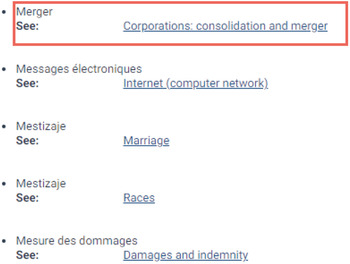
To view the alphabetical list of subject headings, with cross-references to equivalent terms in all four languages, click on the ‘Subjects’ tab in the center of the IFLP homepage. For example, if you go to M and look for ‘Mergers’, it will direct you to the hyperlinked subject ‘Corporations: Consolidation and Merger’, which is the index term used by IFLP (Figure 2).
The alphabetical list of subject headings with cross-references.

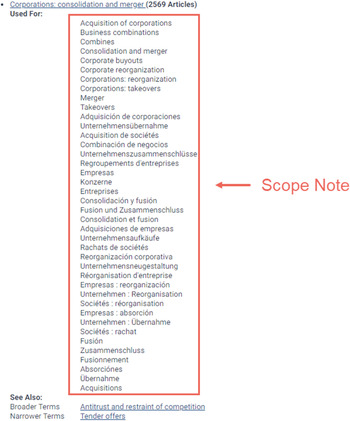
You will also notice a scope note that gives the various subjects for which the index term is used. For example, ‘Corporations: Consolidation and Merger’ is used for the subjects ‘takeovers’, ‘fusión’ and ‘rachat de sociétés’, among many others. You'll also see broader and narrower related index terms that you might be interested in (Figure 3).
Broader and narrower terms.

Browsing the list of subject headings is particularly useful for monolingual librarians with little or no knowledge of foreign legal terminology. For example, navigating to the subject heading ‘close corporations’ will enable the monoglot English speaker to quickly identify the French, German, and Spanish equivalents of this term without having to consult multiple dictionaries.
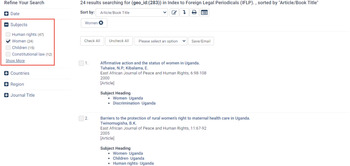
You could also choose to begin with a Country Subject. Say you wanted to research women's rights in Uganda. You could click ‘Country Subject’, then navigate to Uganda. This creates a results list of 224 articles predominantly about Uganda. If you use the filters on the left and narrow your results to those having the subject ‘women’, you will find 24 on-point articles. You can also combine browsing by subject with keyword searching by clicking the ‘search within results’ arrow icon (Figure 4).
Searching by country subject.

KEYWORD SEARCHING
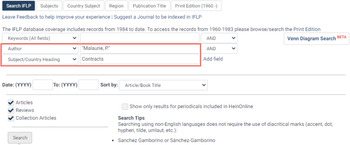
The IFLP's search interface supports keyword searching and field searching in multiple languages. When you click the ‘Search IFLP’ tab, you can do a keyword search across all the fields and use AND, OR, and other connectors to link terms. You can also choose to restrict your search terms to particular fields like author, journal title, or article title. The hints on the search page advise you that for author searches, to search by last name or by last name and first initial. So if you wanted to see all of the articles by Philippe Malaurie, you could select the field ‘Author’ from the drop-down menu and type ‘Malaurie, P.’ in the search box. If you were only interested in Malaurie's articles relating to contracts, you could additionally type the term ‘Contracts’ in the next field, changing the dropdown to ‘Subject’ (Figure 5), or you could instead use the post-search filters to refine your results after searching by author.
Author and subject searching.

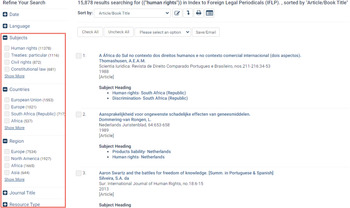
Post-search filters enable users to refine search results by date, language of publication, subject, country, and geographic region (Figure 6). Users may save search queries to their MyHein account and set up email alerts to notify them when new records that meet their search criteria are added to the Index. To organize their saved content, users may add a descriptive tag to each saved query or alert. You can also search digitized copies of the print volumes from 1960 to 2019 by clicking the ‘Print Edition (1960-)’ tab.
Post-search filters enable users to refine search results by date, language of publication, subject, country, and geographic region.

EXPERTISE PROVIDED BY HUMANS
The IFLP's Editorial Board relies on a team of multilingual human indexers, not machines, to analyse articles and assign subject headings. These indexers possess the necessary language skills and knowledge of law and legal bibliography. The indexers are assigned a group of journal titles based on their abilities. They evaluate each article and add the appropriate subjects from our controlled list of subject headings, which is closely based on the Library of Congress system. Additionally, if there is a specific geographic region pertaining to the subject matter, a geographic heading is assigned (but not necessarily required).
The IFLP Advisory Board, comprised of specialist foreign, comparative and international law librarians, evaluates prospective journals for inclusion in the Index. The Board considers journals that are available in print, subscription databases and open access. They also consider other factors, such as those that emerged from several surveys conducted a few years ago regarding the lack of depth of coverage for certain countries or regions.
NEW DEVELOPMENTS
As information technology and access to information electronically develops, so does the Index. When the Advisory Board considers new titles to add to the Index, one of the primary considerations is electronic access to the complete articles. Open access and subscription resources are evaluated by the Board and Hein makes every effort to link to or license the content.
Recently, the editors decided to add new content to the database on a monthly basis rather than quarterly. This change has allowed Hein and the editors to develop a new current awareness feature that will allow users to set up a profile and receive alerts about new journal articles recently added to the IFLP database. This new tool will be very similar to the Current Index to Legal Periodicals (CILP), a resource available on HeinOnline. Look for information about this new enhancement towards the end of 2021 or early 2022.
Other new additions to the IFLP records include adding more DOI information to allow researchers easier access to the content, including the complete first name of the author rather than just the first initial, and adding more subject headings to provide more access points for locating relevant articles.
The editors and the advisory board are constantly considering ways to improve the Index and welcome suggestions and comments from the legal research community.
CONCLUSION
Want to learn more about the Index and how it can help you meet the needs of practitioners, faculty members, and students who are researching foreign, international, and comparative law topics? Check out the recorded webinar ‘Maximizing the Index to Foreign Legal Periodicals in all Law Libraries’, available on the AALL website: https://elearning.aallnet.org/products/maximizing-the-index-to-foreign-legal-periodicals-in-all-law-libraries#.
If you are interested in learning more about the Index or a free trial, check out the blog posts on the HeinOnline Blog or contact Hein for more information: https://home.heinonline.org/blog/iflp/.