Illnesses due to respiratory infections, such as influenza, are a significant problem in healthcare settings, and staff working in healthcare settings can transmit influenza and other respiratory viruses to patients. This is especially true in long-term-care (LTC) facilities, such as nursing homes and assisted living facilities, where patients have longer lengths of stay and frequently need assistance with activities of daily living. Long-term-care patients are at increased risk for morbidity and mortality associated with influenza due to older age, chronic respiratory diseases, and other comorbidities,Reference Menec, MacWilliam and Aoki 1 , Reference Smith, Bennett and Bradley 2 and outbreaks of seasonal influenza are common in these settings.Reference Smith, Bennett and Bradley 2 – Reference Gupta, Zhao and Cooke 7 Due to close contact with patients, healthcare personnel (HCP) have an increased level of exposure to influenza and a greater risk of contracting influenza than other adults.Reference Kuster, Shah and Coleman 8 HCP also have the potential to spread influenza to patients and have been identified as the likely source of infection in some influenza outbreaks.Reference Voirin, Payet and Barrat 9 , Reference Eibach, Casalegno and Bouscambert 10
Vaccination of HCP against influenza can help reduce rates of influenza-like illness and mortality among LTC patientsReference Hayward, Harling and Wetten 11 – Reference Dolan, Harris and Clarkson 16 ; however, the extent of the benefit remains unclear.Reference Ng and Lai 17 , Reference Thomas, Jefferson and Lasserson 18 When combined with high vaccination rates among patients, vaccination of HCP may also reduce the likelihood of influenza outbreaks.Reference Shugarman, Hales, Setodji, Bardenheier and Lynn 19 , Reference Wendelboe, Avery, Andrade, Baumbach and Landen 20 Influenza vaccination can also reduce the number of illnesses and sick days among HCP.Reference Lemaitre, Meret and Rothan-Tondeur 14 , Reference Ng and Lai 17 Infection prevention practices, such as hand hygiene and respiratory/cough etiquette, are also important for preventing the spread of respiratory infections in LTC settings. 21
For these reasons, it is widely recommended that HCP in LTC facilities receive an annual seasonal influenza vaccine to protect both themselves and their patients.Reference Smith, Bennett and Bradley 2 , 22 , Reference Black, Yue and Ball 23 Many facilities have instituted efforts to improve employee vaccination rates, including mandatory vaccination policies, yet national vaccination rates remain suboptimal. Overall, the influenza vaccine coverage among US HCP was 79% for the 2015–2016 influenza season but was only 69% for HCP in LTC facilities.Reference Black, Yue and Ball 23 These rates fall well short of the Healthy People 2020 goal of 90%. 24
Healthcare personnel cite many reasons for not getting vaccinated for influenza, and many factors may influence their adherence to infection prevention policies and practices. This survey was designed to assess knowledge, attitudes and practices (KAP) regarding infection prevention policies and influenza vaccination among staff at a LTC facility. Better understanding of perceptions of influenza vaccination and influenza prevention among HCP in LTC settings may aid in the development of better educational programs and vaccination promotional campaigns.
METHODS
Setting
The survey was conducted at a 120-bed LTC facility located in St Louis, Missouri, which provides both long term residential care and shorter-term skilled nursing care to a diverse patient population. The facility has had a mandatory influenza vaccination policy in place for staff since 2008. Healthcare personnel who fail to receive an influenza vaccination and do not have an approved exemption are excluded from employment.
Survey
The survey included 3 sets of questions. Questions assessing knowledge and attitudes about prevention of respiratory infections asked HCP to respond to a series of statements using a 5-point Likert scale from “strongly disagree” to “strongly agree.” Questions assessing infection prevention practices asked HCP to indicate whether they and their coworkers always, usually, sometimes, rarely, or never performed these actions as part of their usual practice. Healthcare personnel were also asked to respond to 4 multiple-choice questions assessing knowledge of facility infection prevention policies. Questions assessing attitudes about influenza vaccination asked HCP to respond to a series of statements using a 5-point Likert scale from “strongly disagree” to “strongly agree.” Healthcare personnel were also asked to indicate whether their children usually receive an influenza vaccination, whether they would still get the influenza vaccine if the facility did not have a mandatory staff vaccination policy, and the reason they would or would not get vaccinated. Healthcare personnel were also asked to record their gender, race, occupation, and number of years working in healthcare.
Between October and December 2015, paper survey forms were distributed at staff meetings, staff vaccination events, and enrollment sessions for a surveillance study being conducted at the facility. Additional surveys were placed in common areas on the nursing floors (eg, nurses’ stations, break rooms, work areas), the administrative office, and the physical therapy office, along with envelopes for collecting completed surveys. Participation was voluntary and anonymous. Completion of the survey indicated consent for survey participation. Healthcare personnel from all departments were invited to participate, regardless of the extent of patient contact or full-time/part-time status. Respondents answered as many or as few questions as they chose, so response rates varied by question.
Statistical Analysis
Study data were collected and managed using REDCap electronic data capture tools hosted at Washington University.Reference Harris, Taylor, Thielke, Payne, Gonzalez and Conde 25 Data were analyzed using IBM SPSS Statistics for Windows, version 23.0 (IBM, Armonk, NY). Survey responses were compared between HCP with more patient contact (ie, nurses, patient care technicians, physical therapists, occupational therapists, and recreation therapists) versus less patient contact (ie, administrators, social workers, dieticians, food services, environmental services, and facilities staff) and for HCP with more experience (≥10 years) versus less experience (0–9 years) working in health care. Healthcare personnel who did not provide occupation or years of experience data were excluded from those analyses. Differences in responses between comparison groups were considered notable if they were 10% or greater.
The study protocol was reviewed and approved by the Washington University Human Research Protection Office. No data could be collected about HCP who chose not to participate in the survey.
RESULTS
Of 170 full- and part-time HCP working at the facility, 73 completed the survey, a 42.9% response rate. Healthcare personnel who completed the survey were 67.1% female and represented a range of occupations (Table 1). Forty-two of the survey respondents who provided occupation information (57.5%) had occupations with more direct contact with patients, while 21 (28.8%) had occupations with less patient contact. More than half of the survey respondents who recorded the number of years they have worked in healthcare had >10 years of experience (n=45, 61.6%), and 18 (24.7%) had >30 years of experience.
Demographic Characteristics of the Survey Respondents

Knowledge and Attitudes Regarding Preventing Respiratory Viral Infections
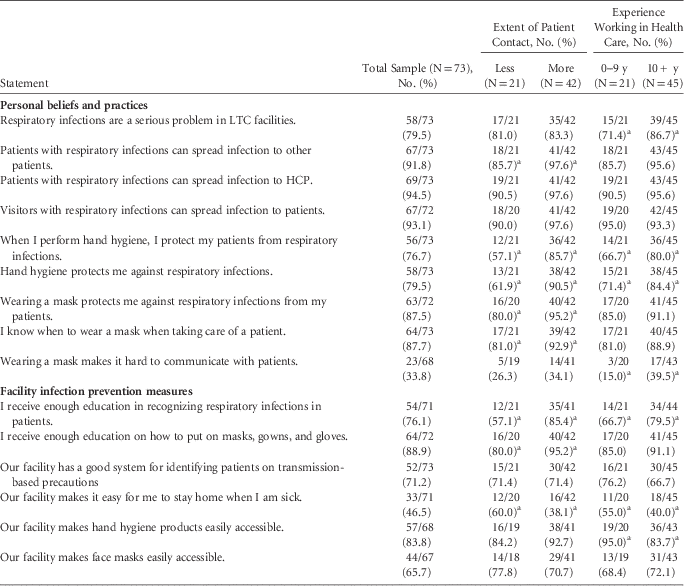
A high proportion of HCP provided responses to the questions assessing personal beliefs and practices about respiratory viral infections that were supportive of infection prevention practices, although some areas of concern were identified (Table 2). Twenty percent of HCP did not agree that respiratory infections are a serious problem in LTC facilities, and 23% did not agree that performing hand hygiene protects patients from respiratory infections. Attitudes about facility infection prevention measures varied. Only 76% of HCP stated that they receive enough training to recognize respiratory infections in patients, and only 71% stated that the facility has a good system for identifying patients on transmission-based precautions. Although more than 80% of HCP indicated that hand hygiene supplies were readily available, only 66% said that face masks were easily accessible. Less than half (46.5%) stated that the facility makes it easy for them to stay home when they are sick.
Proportion of LTC HCP Who Selected “Agree” or “Strongly Agree” to Questions Assessing Knowledge and Attitudes Regarding Respiratory Viral Infections and Prevention, Stratified by Patient Contact and Years of Experience Working in Health Care

NOTE. LTC, long term care; HCP, healthcare personnel.
a >10% difference in responses between categories.
Answers to these questions did not vary greatly by years of experience, except that a smaller proportion of less experienced versus more experienced HCP agreed that practicing hand hygiene protects them from respiratory infections (71.4% vs 84.4%) and a greater proportion of more experienced HCP stated that wearing a face mask makes it difficult to communicate with patients (39.5% vs 15.0%) (Table 2). However, answers to several of the infection prevention knowledge questions did vary by the extent of occupational contact with patients (Table 2). A greater percentage of HCP with more versus less patient contact agreed that practicing hand hygiene protects patients (85.7% vs 57.1%) and themselves (90.5% vs 61.9%) from respiratory infections. In addition, a larger proportion of more versus less experienced HCP stated that they receive enough education on how to recognize respiratory infections in patients (85.4% vs 57.1%), but only 38.1% of HCP with more patient contact versus 60.0% of HCP with less patient contact agreed that the facility makes it easy for them to stay home when they are sick.
Infection Prevention Practices
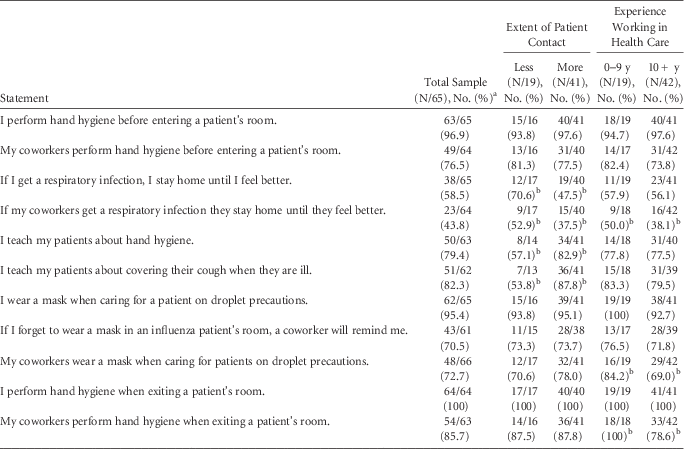
Most HCP reported that they usually or always perform hand hygiene before entering a patient’s room (96.9%) and when exiting a patient’s room (100%), but a smaller percentage reported that their coworkers performed hand hygiene before entering (76.5%) or when exiting a patient’s room (85.7%) (Table 3). Similarly, although a suboptimal percentage of HCP said that they usually or always stay home from work when they are sick (58.5%), an even smaller percentage (43.8%) reported that their coworkers stay home from work when sick. Responses to the infection prevention practices questions did not vary significantly by years of experience, except that 100% of HCP with <10 years of experience said that their coworkers usually or always perform hand hygiene when exiting a patient’s room, versus 78.6% of HCP with 10 or more years of experience (Table 3). Responses did differ by the extent of occupational contact with patients (Table 3). A greater proportion of HCP with less versus more patient contact indicated that, if they get a respiratory infection, they stay home from work until they feel better (70.6% vs 47.5%). A larger proportion of HCP with less patient contact also reported that their coworkers stay home from work when sick (52.9% vs 37.5% of staff with more patient contact).
Proportion of LTC HCP Selecting “Usually or Always” to the Infection Prevention Practices Questions, Stratified by Patient Contact and Years of Experience Working in Health Care

NOTE. LTC, long term care; HCP, healthcare personnel.
a Only 65 of the 73 survey participants completed this section of the survey form.
b >10% difference in responses between categories.
Responses to these questions were also compared for male and female HCP (data not shown). There were few notable differences in responses to the survey questions by gender; however, a smaller proportion of women versus men stated that the facility makes it easy for them to stay home when they are sick (35.4% of women vs 75.0% of men).
The questions assessing knowledge of facility infection prevention policies indicated some variability in knowledge about transmission-based precautions for patients with influenza (Table 4). Less than half of the HCP who completed the survey (47.5%) knew that the appropriate precautions for a patient with influenza are standard and droplet precautions. Although answers to this question did not vary by experience, a larger proportion of HCP with more versus less patient contact selected the appropriate level of precautions (59.0% vs 35.3%) (Table 4). When asked about contact precautions, the majority of HCP (85.2%) correctly indicated that this included wearing a gown and gloves. A lower percentage of HCP (71.7%) correctly indicated that droplet precautions included putting on a face mask.
Knowledge of Infection Prevention Precautions Among LTC HCP, Stratified by Patient Contact and Years of Experience Working in Health Care

NOTE. LTC, long term care; HCP, healthcare personnel.
a Only 61 of the 73 survey participants completed this section of the survey form.
b >10% difference in responses between categories.
c Italics indicate the correct responses.
Attitudes Toward Influenza Vaccination
Responses to questions assessing influenza vaccination attitudes indicated that some HCP were skeptical about the benefits of vaccination (see Table 5). Overall, 60 staff members (82.2%) agreed that vaccinating HCP protects patients from influenza; 58 (79.5%) agreed that vaccinating patients protects them from influenza; 56 (77.8%) thought that the influenza vaccine is safe; and only 53 (72.6%) agreed that the influenza vaccine is effective in preventing influenza. Responses to these questions did not vary by years of experience, except that 86.7% of HCP with 10 or more years of experience stated that the influenza vaccine protects patients from influenza versus 71.4% of HCP with less than 10 years experience (Table 5). However, a greater percentage of HCP with more versus less patient contact indicated that the influenza vaccine is effective (78.6% vs 66.7%) and that they want patients to get the influenza vaccine (90.2% vs 66.7%).
Proportion of LTC HCP Selecting “Agree” or “Strongly Agree” to the Influenza Vaccine Knowledge and Attitudes Questions, Stratified by Patient Contact and Years of Experience in Health Care

NOTE. LTC, long term care; HCP, healthcare personnel.
a >10% difference in responses between categories.
Moreover, 51 (71.8%) staff members indicated that they would still get the influenza vaccine annually, even if it was not required by the facility (Table 5). Among HCP who indicated they would still get the influenza vaccine, 30 (58.8%) said that they would do this to protect themselves, 13 (25.4%) said that they would get the vaccine to protect family or friends, and 3 (5.9%) said they would get the vaccine to protect their patients. Healthcare personnel who said they would not get the influenza vaccine provided a variety of reasons, with the most frequent being not liking shots (n=7, 35%), not wanting to put chemicals in their body (n=5, 25.0%), and a belief that the vaccine does not work well enough (n=4, 20%) (data not shown).
DISCUSSION
This survey of HCP at a single LTC facility indicates that, although knowledge about respiratory infections and infection prevention was generally good, there is room for improvement. Survey responses revealed gaps in understanding, even among staff with 10 or more years of experience working in healthcare. This finding shows the need for continuing education for HCP at this facility, which is supported by the finding that almost one-quarter of survey respondents indicated that they did not get enough training in recognizing respiratory infections in patients. Areas where gaps in knowledge were identified include (1) the fact that respiratory infections are a serious problem in LTC facilities; (2) the importance of hand hygiene for prevention of respiratory infections; and (3) appropriate transmission-based precautions for patients with influenza.
The survey also identified issues with supply availability and infection prevention processes at this facility that may potentially contribute to the spread of respiratory infections. LTC facilities should ensure that hand hygiene supplies and face masks are easily accessible and that HCP know where to find them. Efforts may also be needed to improve infection prevention signage and alert systems at this facility because as nearly 30% of HCP did not think the facility had a good system for identifying patients who should be on transmission-based precautions.
Survey responses were stratified by 2 key variables: level of patient contact and years of experience in healthcare. There was an association between these 2 variables with 76.2% of HCP with more patient contact having 10 or more years of experience versus 52.4% of HCP with less patient contact. As expected, respondents who had closer contact with patients had better knowledge of infection prevention practices, as well as better understanding of facility transmission-based precautions procedures. However, because all HCP at this facility are likely to have at least occasional patient contact and contact with other HCP, it is important that all staff receive training on infection prevention policies and practices. Although we expected that HCP with more experience working in healthcare would have better knowledge of infection prevention practices, data from this survey suggest that this was not the case at this facility; few differences in responses were identified for HCP with >10 versus 0–9 years of experience.
The results of this survey also indicate that improvements to sick-leave practices may be needed at this facility. Society of Healthcare Epidemiology of America (SHEA)/Association for Professionals in Infection Control (APIC) guidelines for infection prevention and control in LTC facilities stress the importance of a reasonable sick-leave policy because ill HCP may cause significant outbreaks and because staff with communicable diseases should not have direct contact with patients.Reference Smith, Bennett and Bradley 2 However, less than half of the HCP who completed this survey stated that the facility makes it easy for them to stay home when they are sick, and only 59% indicated that they stay home from work when they have a respiratory infection. In this sample, HCP with more patient contact, who have more potential to spread disease to patients, reported more difficulty taking sick time than other staff members, and a smaller proportion of female versus male HCP stated that the facility makes it easy for them to stay home when they are sick. Because there were more women in staff roles that involve more direct patient contact, it is unclear whether the observed differences in perceptions regarding taking sick leave were related more to gender or to job category.
Answers to the survey questions assessing attitudes toward influenza vaccination revealed that some HCP at this facility have reservations about the influenza vaccine. Healthcare personnel expressed concerns about shots in general, about vaccine safety and effectiveness, and about potential side effects or adverse reactions. Future education efforts at this facility should stress the safety and effectiveness of influenza vaccination to counter these beliefs and to increase staff acceptance of the mandatory vaccination policy. Prior studies have shown that belief in the effectiveness and safety of the influenza vaccine is associated with higher rates of vaccination among HCP in LTC settings.Reference Daugherty, Blake, Grosholz, Omer, Polivka-West and Howard 26 – Reference Looijmans-van den Akker, van Delden and Verheij 28
This survey study has several limitations. It was conducted at a single LTC facility, the response rate to the survey was low, and the small sample size limited our ability to stratify results by occupation and gender. The surveyed facility also had a mandatory vaccination policy, which may limit generalizability of the findings to facilities without such a policy. The survey also relied on self-reported data, and staff may have overreported adherence with infection prevention procedures, such as hand hygiene. Additionally, although HCP were asked to complete the survey only once, this could not be guaranteed because the survey was anonymous. However, analysis of the demographic information for the completed surveys showed no patterns of concern for potential duplications.
This survey of HCP in a single LTC facility, despite its limitations, identified several gaps in infection prevention knowledge and training, barriers to infection prevention practices, and misperceptions concerning the safety and effectiveness of the influenza vaccine and the risk posed by influenza for both patients and HCP. The issues identified by this survey may serve as targets for future staff education and vaccine promotion efforts. Addressing barriers to vaccination among HCP may help to improve vaccination rates in settings where mandatory vaccination is not in effect and can also help to improve staff buy-in at facilities with mandatory vaccination policies.Reference Nace, Hoffman, Resnick and Handler 29 – Reference Lam, Chambers, MacDougall and McCarthy 31 Larger HCP surveys of staff from LTC facilities across the United States would help to define future interventions.
ACKNOWLEDGMENTS
The findings and conclusions in this report are those of the authors and do not necessarily represent the official position of US Centers for Disease Control and Prevention (CDC).
Financial support: This study was supported by a CDC Safety and Healthcare Epidemiology Prevention Research Development (SHEPHeRD) contract (no. RFTOP 2014-002), administered by Health Core.
Potential conflicts of interest: All authors report no conflicts of interest relevant to this article.