Prosthetic joint infection is a potentially catastrophic complication of total hip replacement and total knee arthroplasty (TKA) surgeries that is associated with significant morbidity and mortality. The incidence of joint replacement procedures is high, with >1 million total hip and total knee replacement procedures performed each year in the United States. Reference Steiner, Andrews, Barrett and Weiss1,Reference Kremers, Larson and Crowson2 In part because of the aging of the “baby boomers,” higher rates of diagnosis and treatment of advanced arthritis, and growing demand for improved mobility and quality of life, the annual procedure volumes is likely to increase considerably in the foreseeable future, making joint replacements the most common elective surgical procedures in the coming decades. Reference Zardi and Franceschi3 For example, the demand for primary TKA (pTKA) is projected to increase to 3.48 million pTKAs and 250,000 revision TKAs (rTKAs) in the United States by 2030. Reference Kurtz, Ong, Lau, Mowat and Halpern4
The incidence of surgical site infection (SSI) after pTKA and rTKA has been reported to range from 0.4% to 15.6%; SSI varies with the patient population evaluated, the type of surgical procedure, and the definition of SSI. Reference Rasouli, Restrepo, Maltenfort, Purtill and Parvizi5–Reference Teo, Yeo, Chong and Tan7 Systematic review and meta-analysis have shown that the 30-day readmission rate in orthopedic specialties is 5.4% (range, 4.8%–6.0%). Reference Edmiston, Chitnis, Lerner, Folly, Holy and Leaper8 These infections prolong hospital stays, with a doubling of rehospitalization rates and tripling of healthcare costs. Reference Zardi and Franceschi3,Reference Cook, Piatt, Barnes and Edmiston9 SSIs may result in extended periods of hospitalization and reoperations, and they poses a significant clinical and financial burden. Reference Ahmed and Haddad10–Reference Edmiston and Leaper13
Reviews of administrative claims databases enable efficient longitudinal analyses of large numbers of patients and are useful for population-based studies and quality improvement efforts. Reference Benchimol, Smeeth and Guttmann14 In the current analysis, we utilized the IBM MarketScan Commercial Claims and Encounters (CCAE, IBM, Armonk, NY), Medicare Supplemental and Coordination of Benefits (MDCR), and Multi-State Medicaid (MDCD) databases. We collected data regarding rate of infection, comorbid risks, and all-cause incremental costs in patients undergoing pTKA and rTKA.
Methods
Data sources
In this retrospective cohort study, we used the IBM MarketScan Commercial Claims and Encounters (CCAE), Medicare Supplemental and Coordination of Benefits (MDCR), and Multi-State Medicaid (MDCD) databases. The CCAE contains information on individuals aged <65 and are the primary insured, spouse, or dependent. The Medicare database includes information for individuals who are aged ≥65 years and are Medicare eligible with supplemental insurance being paid for by their current or former employer. Data for the CCAE and Medicare databases are collected from >300 large, self-insured US employers and >25 US health plans. The Medicaid database contains data from >48 million Medicaid enrollees from multiple states. The databases comprise enrollment information, demographics, and adjudicated health insurance claims (eg, inpatient, outpatient, and outpatient pharmacy).
A standard extract from these databases consists of 3 files. The first file is an enrollment file that includes patient sociodemographic and health insurance payer-type information. The second file is a medical file that includes detailed records for hospital inpatient and outpatient admissions and services across different facilities of care captured using International Classification of Disease, Ninth Edition Clinical Modification (ICD-9-CM) and ICD-10 diagnosis codes, procedure coding system (PCS) codes, and common procedural terminology (CPT) codes (fourth edition). The third file is a drug file (ie, pharmacy claims). The files are linkable, based on an encrypted patient identification number. Approval from our institutional review board was not necessary to conduct this study because data within these databases are deidentified and comply with Health Insurance Portability and Accountability Act (HIPAA) regulations.
Variable and outcome definitions
All identified variables and outcomes were based on the presence of specific ICD and CPT codes associated with patient visits in the pre-, peri-, and post-TKA periods. The code list for the study outcomes (postoperative superficial and deep infection) are listed in Supplementary Table S1 (online).
Patient population
Patients in the database who underwent pTKA or rTKA (identified using ICD-10 PCS codes or CPT-4 codes) between January 1, 2016, and March 31, 2018, in either outpatient or inpatient settings of care were considered for inclusion. The date of hospitalization for TKA was defined as the index date. Patients were included if they were 18 or older and continuously enrolled for at least 12 months before and 180 days after the index TKA. The 12-month enrollment before TKA was important to ensure sufficient medical history in the claims to identify comorbidities at time of TKA. Patients having another pTKA or a primary hip arthroplasty procedure undertaken from 12 months before the index to 2 years after the index, were excluded to avoid including other potential sources of SSI in the analyses. Patients with femoral fractures at time of index surgery were excluded because their TKA may have resulted from fracture and not osteoarthritis. For the pTKA cohort, we applied additional exclusion criteria: nonelective cases, unicompartmental knee arthroplasties, and presence of deep or superficial incisional SSI before the pTKA and up to 2 days after the pTKA (to avoid including existing infection in the analysis).
Patient variables
Demographic characteristics that were evaluated included age, sex, and health insurance type (ie, commercial, Medicare, or Medicaid). Baseline clinical characteristics included comorbidities prior to TKR as assessed by the Elixhauser comorbidity index (ECI). The ECI estimates an aggregate measure of comorbidity using 31 dimensions and has also been shown to be associated with risk of mortality and healthcare utilization. Reference Elixhauser, Steiner, Harris and Coffey15,Reference Menendez, Neuhaus, van Dijk and Ring16 A comorbid condition was identified if at least 1 ICD-10 diagnosis code for the comorbid condition in question was identified in the patient’s claims within the 12-month pre-TKA period.
Outcomes
The primary outcome was occurrence of deep incisional infection (defined as any new diagnosis for deep incisional infection or osteomyelitis) from 2 days to 180 days after pTKA. Secondary outcomes included occurrence of superficial incisional SSI and incremental healthcare costs associated with deep and superficial infections, evaluated from the perspective of the Commercial payer, at 6 and 12 months following TKA. Infection was defined as the presence of at least 1 diagnosis of infection in the period ranging from 2 days (48 hours) to 180 days after TKA. The first day after TKA was excluded to prevent inclusion of infections present on admission POA). For the evaluation of deep incisional infection following rTKA, subgroup analyses were also conducted to assess the cumulative hazard of deep incisional SSI from 2 to 180 days after index surgery, excluding patients with a diagnosis of deep infection at time of revision. We estimated the risk of deep infection in patients with knee revisions that were not performed because of an infection and the occurrence of deep incisional infection from 30 to 180 days after index surgery for all patients with rTKA. This subgroup analysis excluded cases for whom a new deep infection diagnosis was only reported in the 2–30 days after index surgery. Thus, we excluded patients that might have had an infection prior to revision and those who had a follow-up visit with that diagnosis but no new infection thereafter.
Statistical analyses
Descriptive statistics included means and standard deviations (SDs) for all continuous variables and proportions for categorical variables. Analyses were performed separately for pTKA and rTKA patients. Time to superficial and deep incisional SSI >6 months was represented with Kaplan-Meier survival curves. Cox proportional hazard models were used to examine the effects of preoperative patient characteristics (demographics and pre-existing comorbid factors) and surgical characteristics (year of surgery) on the hazard of superficial or deep incisional SSI. Hazard ratios (HRs), 95% confidence intervals (CIs), and P values were reported. For cost analyses, all-cause costs of all inpatient and outpatient care from TKA discharge to 6- and 12-months after discharge were calculated for each patient. The cost associated with infection were defined as the incremental, marginal, cost of care in patients with infection compared to patients without infection. Generalized linear models with γ (gamma) distribution and log links were used to estimate the adjusted all-cause incremental cost associated with superficial and deep incisional SSI. All costs were adjusted to 2021 US dollars using the US Bureau of Labor Statistics consumer price index. 17
Results
Patient baseline demographic and clinical characteristics
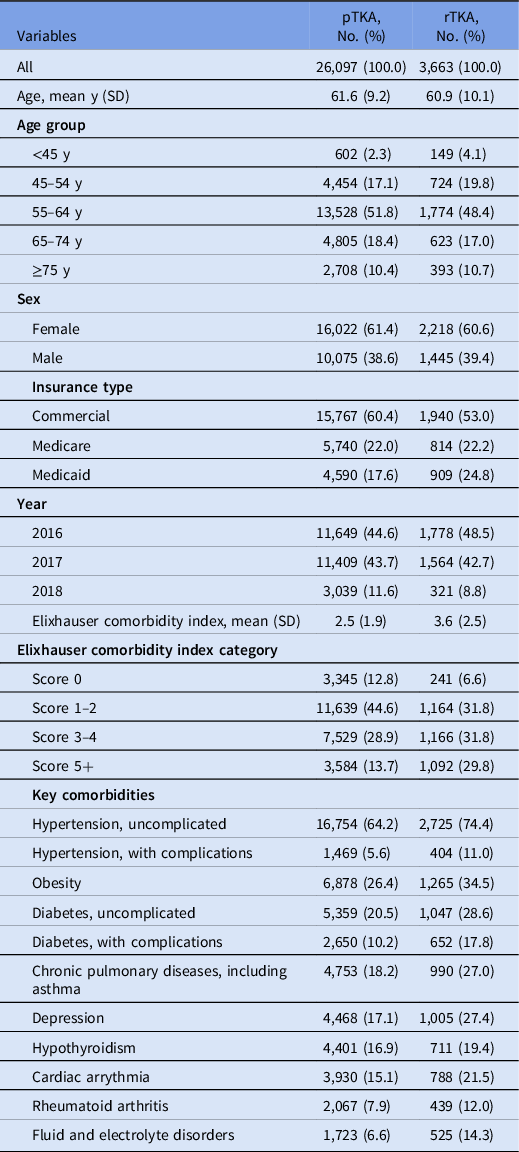
In total, 26,097 pTKA patients and 3,663 rTKA patients were included in the analyses. Baseline demographic and clinical characteristics for patients with pTKA and rTKA are presented in Table 1. The mean ages were 61.6 years (SD, 9.2) for the pTKA group and 60.9 years (SD, 10.1) for the rTKA group. Females accounted for 61.4% of pTKA patients and 60.6% of rTKA patients. For the pTKA group, 60.4% of patients had commercial insurance, 22.0% had Medicare, and 17.6% had Medicaid. For the rTKA group, 53.0% of revision patients had commercial insurance, 22.2% had Medicare, and 24.8% had Medicaid.
Baseline Demographic and Clinical Characteristics for Patients Undergoing Primary Total Knee Arthroplasty (pTKA) and Revision Total Knee Arthroplasty (rTKA)

Mean ECI scores were higher among patients with rTKA (3.6; SD, 2.5) compared with patients after pTKA (2.5, SD, 1.9), with a larger proportion of patients with ECI at 5 or above in the rTKA versus pTKA group (29.8% vs 13.7%). As expected from the ECI results, individual comorbidities were also far more common in the rTKA group versus the pTKA group. For example, 11.0% of the rTKA group versus 5.6% of the pTKA group had hypertension with complications; 34.5% of the rTKA group versus 26.4% of the pTKA group were obese; and 17.8% of the rTKA group versus 10.2% of the pTKA group had diabetes with complications. The entire table of all complications, for all patient subgroups, is presented in Supplementary Table S2 (online).
Superficial and deep incisional SSI rates and timing
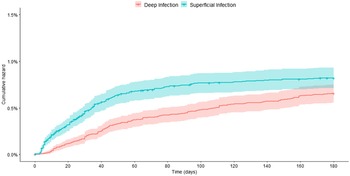
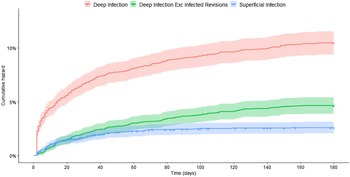
Among 26,097 pTKA patients, 170 (0.65%; 95% CI, 0.56%–0.75%) developed a deep incisional SSIs and 213 (0.82%; 95% CI, 0.71%–0.93%) developed superficial SSIs by the 6-month postoperative time point. Among 3,663 rTKA patients, 363 (10.44%; 95% CI, 9.36%–11.51%) developed deep incisional SSIs, and 93 (2.60%; 95% CI, 2.07%–3.13%) developed superficial SSIs. From the subgroup analyses of the rTKA cohort, deep SSIs were observed at 6 months in 4.65% (95% CI, 3.88%–5.41%) of patients who had no prior history of deep infection before revision, which increased to 7.86% (95% CI, 6.94%–8.79%) of patients when the first 30 days after revision were excluded. The first subanalysis was performed to undersand risk in patients with aseptic revision. The second subanalysis was performed to exclude, from the infection pool, patients who may have been diagnosed very early after revision, possibly with a remnant of a prior infection (ie, “history of infection”) versus a truly new infection.
Kaplan-Meier curves for the main analyses and the subgroup analyses are shown in Figures 1 and 2. Supplementary Table S3 (online) lists key patient characteristics in groups with deep incisional SSIs, superficial SSIs, or no infection. No differences in age were observed between patients who developed SSIs versus patients who did not. The proportion of female patients was greater in the “no infection” group versus any of the SSI groups. For the pTKA cohort, the subgroup with no infection was 61% female; the subgroup with deep SSI was 55% female; the subgroup with superficial SSI was 59% female. For the rTKA cohort, the subgroupw with no infection was 62% female; the subgroup with deep SSI was 48% female; and the subgroup with superficial SSI was 49% female. These findings suggest that males were potentially more likely to develop SSI.
Cumulative hazard for superficial and deep infection following primary total knee arthroplasty (pTKA). At 6 months after pTKA, the cumulative hazard for superficial and deep infection reached 0.82% (95% CI, 0.71%–0.93%) and 0.65% (95% CI, 0.56%–0.75%), respectively.

Cumulative hazard for superficial and deep infection following revision total knee arthroplasty (rTKA). At 6 months after TKA, the cumulative hazard for superficial and deep incisional infection reached 2.60% (95% CI, 2.07%–3.13%) and 10.44% (95% CI, 9.36%–11.51%), respectively. When patients with deep incisional infection at the time of rTKA were excluded, the rate of new deep incisional infection at 6 months after revision reached 4.65% (95% CI, 3.88%–5.41%).

Mean ECI values were highest in patients with deep SSIs compared to superficial SSIs and no infection. For the pTKA cohort, the mean ECI for patient with deep SSI was 3.6 (SD, 2.4); the mean ECI for patients with superficial SSI was 3.1 (SD, 2.3); and the mean ECI for patients with no infection was 2.5 (SD, 1.9). For the rTKA cophort, the mean ECI for patients with deep SSI was 5.1 (SD, 3.1); the mean ECO for patients with superficial SSI was 4.4 (SD, 2.4); and the mean ECI for patients with no infection was 3.4 (SD, 2.4).
Similarly, the percentage of patients with an ECI score ≥5 increased significantly in subgroups with deep SSIs and superficial SSIs compared to patients with no infection. For the pTKA subgroup of patients with an ECI ≥5, 32% had zeep SSI, 23% had superficial SSI, and 14% had no infection. For the rTKA subgroup of patients with an ECI f ≥5, 51% had deep SSI, 43% had superficial SSI, and 27% had no SSI. Key comorbidities by postinfection status are shown in the Supplementary Table S4 (online). The proportion of patients with comorbidities were higher in the deep SSI group compared to the group with no infection. For example, diabetes with complication was observed in 16% of pTKA patients with deep SSI but only 10% of pTKA patients with no infection. Although differences were clearly evident between patients with deep infection versus no infection, for many key comorbidities, patients in the superficial infection group were not different from those in the group with no infection.
Risk factors for SSI
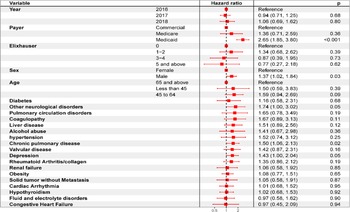
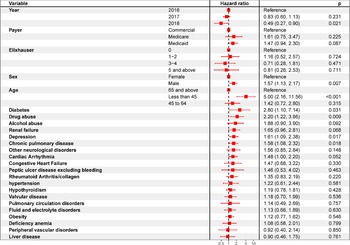
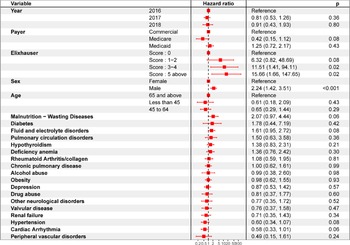
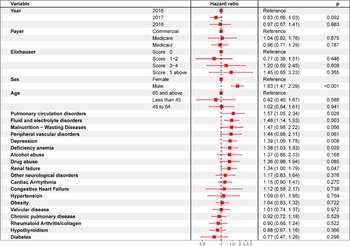
For superficial and deep SSI, the hazard ratios associated with key clinical and comorbid variables are shown in Figures 3–6. The Cox model outputs are shown in Supplementary Table S5 (online). Few patient variables were associated with increased hazard for superficial SSI following pTKA (Fig. 3). Males (vs female) patients and Medicaid recipients (vs commercial-payer recipients) were at increased risk for superficial infection. For male patients, the hazard ratio (HR) was 1.37 (95% CI, 1.02–1.84), and for Medicaid patients, the HR was 2.65 (95% CI, 1.85–3.80). Neurological disorders, chronic pulmonary diseases, and depression were also associated with increased risks for superficial SSI. Hazard ratios for deep SSI are shown in Fig. 4. Males (vs female) pateints and patients aged <45 years were at increased risk. The HR for male patients was 1.57 (95% CI, 1.13–2.17), and the HR for patients aged <45 was 5.00 (95% CI, 2.16–11.56). Among all the chronic conditions evaluated, diabetes had the highest hazard ratio (2.80; 95% CI, 1.10–7.14), followed by drug use (2.20; 95% CI, 1.22–3.95). As observed with superficial SSIs, pulmonary diseases, neurological disorders, and depression were also associated with increased hazard for deep SSI. In cases of rTKA, the hazard ratios for superficial SSI are shown in Fig. 5. Male (vs female) patients were also at increased risk (HR, 2.24; 95% CI, 1.42–3.51). No individual comorbidity was associated with increased hazard of SSI; however, a higher ECI, indicative of a combination of potential comorbidities, was associated with a higher hazard for infection. Those with ECIs of 3–4 had an HR of 11.51 (95% CI, 1.41–94.11), and those with an ECI ≥5 had an HR of 15.66 (95% CI, 1.66–147.65). For rTKA, the HRs for deep SSI are shown in Fig. 6. For all other cases, male (vs female) patients were at increased risk, with an HR of 1.83 (95% CI, 1.47–2.29). Pulmonary circulation disorders, fluid and electrolyte disorders, and depression were also associated with increased risk of deep SSI.
Hazard ratios of demographic and comorbid variables for superficial SSI following primary total knee arthroplasty (pTKA).

Hazard ratios of demographic and comorbid variables for deep SSI following primary total knee arthroplasty (pTKA).

Hazard ratios of demographic and comorbid variables for superficial SSI following revision total knee arthroplasty (rTKA).

Hazard ratios of demographic and comorbid variables for deep SSI following revision total knee arthroplasty (rTKA).

Costs associated with SSI
Adjusted all-cause incremental costs (US$, inflation adjusted to 2021) associated with superficial and deep incisional SSI, compared to patients with no infection, were modeled for individuals with commercial insurance. Supplementary Table S6 (online) lists all costs and associated statistics. The presence of superficial infection after pTKA increased total healthcare costs by $14,298 (95% CI, $7,583–$21,013) at 6 months and by $20,870 (95% CI, $7,821–$33,920) at 12 months. For deep infections, these incremental costs averaged $41,381 (95% CI, $22,901–$59,862) at 6 months and $54,664 (95% CI, $22,025–$87,303) at 12 months. For patients with rTKA and superficial infection, incremental costs were significantly higher, averaging $27,138 (95% CI, $7,294–$46,981) at 6 months and $29,176 (95% CI, $4,739–$53,612) at 12 months. For rTKA patients who developed deep incisional SSI, the incremental costs were $58,158 (95% CI, $41,745–$74,572) at 6 months and $59,491 (95% CI: $36,700–$82,281) at 12 months.
Discussion
Although patients with pTKA had a relatively low risk of deep incisional infection (0.65%; 95% CI, 0.56%–0.75%) and superficial incisional infection (0.82%; 95% CI, 0.71%–0.93%); patients undergoing an rTKA had a higher risk of deep incisional SSI (10.44%; 95% CI, 9.36%–11.51%) or superfical incicional SSI (2.60%; 95% CI, 2.07%–3.13%). The rates of SSI following rTKA observed in this analysis were somewhat lower than our findings in an earlier analysis, in which SSI rates were 15.6% for rTKA and 2.1% for pTKA. Reference Teo, Yeo, Chong and Tan7 The differences in SSI rates may be due to differences between the patient populations evaluated, differences in the timing of data collection, or differences in the diagnosis coding used in the studies.
Other studies and reporting systems such as the National Healthcare Safety Network (NHSN) and the National Surgical Quality Improvement Program (NSQIP) have described SSI rates in hospitals and regions. These systems often rely on self-reporting of SSI from hospitals and healthcare systems and have limited postoperative periods (30–90 days, depending on procedures). Reference Christensen, Dowler and Doron18 In our study, we focused on individual diagnoses, observed both in the inpatient and outpatient settings, with the objective of capturing all infections, including those that may have been treated beyond 90 days. Therefore, compared to reporting from NSQIP or NHSN or similar systems, our study may have included a larger number of infection events. However, code-based surveillance can miss selective infections that might have been detected by manual methods.
The factor most associated with increased risk of SSI in the current study was male sex. The reason for these findings is unclear; however, this observation aligns with results from previous peer publications. Reference Teo, Yeo, Chong and Tan7,Reference Lai, Bohm, Burnell and Hedden19,Reference Offner, Moore and Biffl20 This may be a result of differences in cell-mediated immune responses between sexes. It is also possible that male sex is linked to other unmeasured variables and that the results are confounded. Age <45 years was strongly associated with deep incisional infections among patients with pTKA (5.00; 95% CI, 2.16–11.56). This finding is in direct contrast with previous studies, which have reported that older patients are more vulnerable to infection after total joint replacement because of low immune status and poor nutritional status. Reference Wu, Qu, Liu, Li, Mao and Zhu21,Reference Li, Zhang, Chan, Fung, Fu and Chiu22 Again, unmeasured variables may have been a contributing confounding factor.
Individual comorbidities were not associated with an increased hazard for superficial infection following pTKA or rTKA. In patients with rTKA, however, >3 concurrent comorbidities resulted in an increased hazard for superficial infection (HR, 11.51; 95% CI, 1.41–94.11) and ≥5 comorbidities had an HR of 15.66 (95% CI, 1.66–147.65). Some individual comorbidities were associated with an increased hazard for deep infection. Following pTKA, patients with the following comorbidities had increased hazard for deep infection: diabetes, drug and alcohol use, depression, and chronic pulmonary disease (CPD). Depression and CPD may show associations due to confounding. Following rTKA, these comorbidities were associated with increased hazards for deep infection: pulmonary circulation disorders, fluid and electrolyte disorders, depression, deficiency anemia, and renal failure. These conditions may be indicative of general poor health, which in turn may be associated with reduced immunity. For example, fluid and electrolyte disorders may be a result of long-term uncontrolled diabetes and/or advanced kidney disease.
Efforts to improve clinical outcomes within surgical disciplines has evolved from dogmatic to evidence-based practices based on well-designed laboratory, prospective-cohort clinical studies and case–control studies; randomized controlled trials (RCTs); systematic reviews and meta-analyses; and clinical experience. Multiple surgical disciplines have documented the benefit of combining evidence-based practices into an SSI surgical care bundle. The primary determinant of an SSI is dependent on comorbid risk factors, degree of contamination at the time of closure, microbial virulence, and host-tissue immunocompetence. Reference Belda, Aguilera and Garcia de la Asuncion23 In an effort to reduce the risk of infection after arthroplasty, modifiable risk factors have been mitigated through implementation of an orthopedic surgical care bundle, which is supported by evidence-based analysis and is free of dogmatic surgical practice. Reference Goswami, Stevenson and Parvizi24 Currently, several 1A evidence-based care-bundle components can be applied to mitigate the risk of orthopedic infection, including nasal decolonization, preadmission antiseptic bathing with chlorhexidine gluconate, glycemic control, normothermia, and use of antimicrobial sutures. Reference Cook, Piatt, Barnes and Edmiston9,Reference Edmiston and Leaper13,Reference Belda, Aguilera and Garcia de la Asuncion23,Reference Goswami, Stevenson and Parvizi24
In the present analysis, the adjusted average all-cause incremental costs associated with SSI were substantial. These adjusted average all-cause incremental commercial costs ranged from $14,298 to $29,176 for superficial incisional SSI and from $41,381 to $59,491 for deep incisional SSI. A substantial proportion of these costs were incurred by 6 months; however, costs did continue to increase from 6 to 12 months. We focused our cost analysis on the commercial cohort for multiple reasons. The Medicare database does not include all Medicare-eligible patients, only those with supplemental insurance paid for by their employer. Also, Medicaid data are provided by a small proportion of states that varies from year to year, and data pertaining to delayed Medicaid reimbursement may not be available.
The current study had several important strengths. We evaluated ICD-10 (or CPT) codes in the real-world setting to assess the true risk of SSI among patients after pTKA and rTKA. We used an administrative claims database, which facilitated an efficient analysis of large numbers of diverse patients. The use of ICD codes to enhance the identification of surgical site infection has been validated for several selective surgical procedures such as mastectomy, abdominal hysterectomy, colectomy, and C-sections. Reference Olsen, Ball, Nickel, Wallace and Fraser25–Reference Miner, Sands, Yokoe, Freedman, Thompson, Livingston and Platt27 The use of Cox proportional hazards models for the evaluation of factors associated with SSI is another strength of the study because Cox proportional hazard models have more statistical power than logistic regression models (cf, they take into account the time until events occur). Reference van der Net, Janssens, Eijkemans, Kastelein, Sijbrands and Steyerberg28
This study also had several limitations. We evaluated infection rates up to 6 months after pTKA or rTKA. Whereas most superficial incisional infections occur in the early weeks after surgery, some deep incisional infections may occur several months after TKA. In 2006, a large analysis showed that ∼29% of deep infections occurred within 3 months (“early”), 35% occurred within 3–12 months, and 36% occurred after 1 year. Reference Phillips, Crane, Noy, Elliott and Grimer29 We limited our analysis to 6 months after index surgery because we required a large cohort of patients with complete medical history at least 12 months before and 6 months after TKA. Increasing the observation period would have reduced the sample size available for analysis. Furthermore, we relied on the presence of diagnosis and procedural codes obtained from healthcare institutional insurance claims, and we did not include selective social factors that may or may not have been reported in the claims data.
The observational design makes it difficult to draw causal inferences given the lack of randomization and the challenges associated with a lack of clinically relevant variables for the adjustment of confounders. Potential coding errors, misclassifications within the databases, and recording bias secondary to financial incentives are possible and unknown. The data reflect interactions patients have with the healthcare system, and diagnoses and treatments may be underreported or missing based on patient preferences or access challenges. The findings from this database study may not be generalizable to all populations of patients with pTKA and rTKA. Finally, we evaluated the risk of all-cause revisions using our analysis of the specific causes for revisions.
In conclusion, in this real-world analysis, postoperative SSI occurred most commonly following rTKA in a large database cohort and was associated with multiple comorbid risk factors. Male patients and patients with comorbidities, including chronic pulmonary disease, pulmonary circulatory disorders, fluid and electrolyte disorders, malnutrition, drug abuse and depression, had an increased risk of SSI within 180 days of pTKA or rTKA. Finally, as in previous analyses of surgical site infection following total joint arthroplasty, the financial liability to the patient, insurance providers, and healthcare system represents a substantial fiscal burden.
Supplementary material
To view supplementary material for this article, please visit https://doi.org/10.1017/ice.2023.10
Acknowledgments
Financial support
No financial support was provided relevant to this article.
Conflicts of interest
C.E.E., M.S., and D.J.L. are members of the Ethicon Speaker’s Bureau. C.E.H., J.W.R. are employed by MedTech Epidemiology, Real-World Data Sciences, Johnson & Johnson, New Brunswick, NJ. N.J.G. is employed by MedTech Health Economics and Market Access, Johnson & Johnson, Markham, Ontario, Canada.