“Duverger’s Law” asserts that first-past-the-post (FPTP) electoral systems induce a tendency toward two parties. We argue that the Law provides a necessary but not sufficient condition for the explanation of a long-term, two-party equilibrium in party systems. First, Cox (Reference Cox1997) demonstrates that any Duvergerian equilibrium holds only at the level of the electoral unit, that is, in a single district. Thus, the law cannot be the exclusive basis for explaining a two-party system in the nation.Footnote 1 The integration of disparate, geographically based electoral units across the country, as well as across levels of elected office, is what creates a genuine two-party system. Moving from a unit by unit to a single national two-party system requires additional explanation. Second, even if that integrative step is accomplished, the explanation will not tell us which two parties emerge at the national level and whether they remain the two major national parties that compose the two-party system over time, that is, the durability of a two-party system.
This paper offers a coherent, scientific explanation that allows us to answer these two questions: (1) why is there variation in the number of parties in FPTP systems across the world, and in particular why are there any two-party systems, and (2) why is there variable durability in the identity of the two parties that make up even the most stable two-party systems?Footnote 2 We propose additions to the Duvergerian explanations based on FPTP that we call “the APP” for ambition, the presidency, and policy. We argue that these three factors are the fundamental factors that shape the individual choices of ambitious politicians and the development of political parties in order to answer the question “Why two parties?”
We first consider the central results about Duvergerian equilibriums. We then argue that ambition theory, when combined with the existence of a presidency and its national electorate, explains the integration of a two-party system both across electoral units within a country and across levels of government. The presidency establishes two-party dominance at the national level. Ambition theory provides the glue of two-partyism that works from the presidency down to the House and Senate, and even down to the state legislatures. We then consider the strategic choices of parties, in the context of a spatial model, to examine competition over policy as a partial explanation for the durability of a particular two-party system, that is, the sustained success of two particular major parties or “Why these two parties?” Our discussion in particular stresses the importance of agenda control to maintain divergence on a dominant policy dimension, while also suppressing latent dimensions that could upset the existing party duopoly. In the end, we claim that FPTP and the APP together can account for a durable two-party duopoly as typified by the US case, but the failure of any one part can lead to multi-party systems and/or instability over the identity of the two parties even in the two-party case. This constellation of factors, taken together, help explains why the United States has had a durable two-party system composed of exactly the same two parties over much but not all of its history.
Why Two Parties? Theory and Evidence for the Necessity and Insufficiency of Duverger’s Law
Duverger’s Law asserts that in FPTP (or “plurality winning”) electoral systems, there is a tendency toward two-partyism (Duverger Reference Duverger1954). His assertion was an empirical generalization, although he gave reasons for his empirical observation, reasons that served as a basis for models based on strategic voting (which he subsequently disavowed, 1986). As Riker (Reference Riker1982) argued, Duverger’s Law stated in more general terms the kind of argument that Henry Droop first used in 1869 in defense of his position in favor of proportional representation. Droop noted both the tendency toward concentration of voting on the two leading candidates (which is the consequence of strategic voting in the electorate) and its district-by-district nature. Cox (1997) formalized this Droop–Duverger claim, embedding it in a precise theory of voter choice under the assumption of instrumentally rational voters. Votes are cast for the purpose of affecting the outcome of the current election (and valuing only that), and voters use a form of rational expectations (effectively using a Harsanyi-like Bayesian updating rule) in forming expectations about the actions of other citizens. In equilibrium, beliefs are consistent with voter strategies, which converge to voter support for at most two candidates in a single-member district under FPTP (which is about the only rule to use in single-member districts (SMD)). Cox (1994) generalized this result to his famous “m+1” rule, such that the number of parties that, in equilibrium, receive votes is one more than the number of seats at stake in the district with a single non-transferable vote.
Many researchers have noted that Duverger’s Law only applies within a single electoral district (e.g., Cox and Monroe 1995; Cox Reference Cox1997). As Chibber and Kollman (Chibber and Kollman Reference Chibber and Kollman1998; Chibber and Kollman Reference Chibber and Kollman2004) point out, a country with p single-member districts may have only two parties within each district but a total of 2p parties at the national level. Previous work has shown that although not strictly perfect, party competition at the district level roughly approximates the predictions of Duverger’s Law (Chibber and Kollman Reference Chibber and Kollman2004; Singer and Stephenson Reference Singer and Stephenson2009; Singer Reference Singer2013). When observing the party landscape at the national level (i.e., when aggregating across all electoral districts), however, one can see a great deal of variation in the number and durability of parties among FPTP.
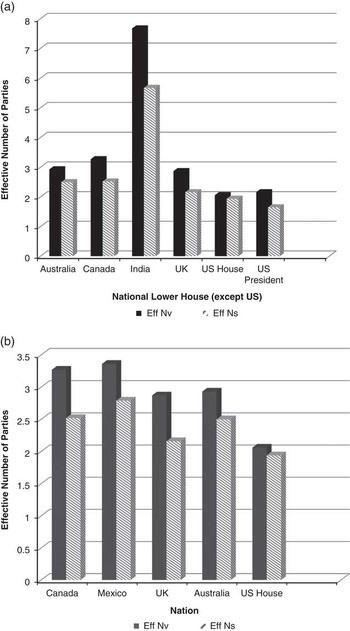
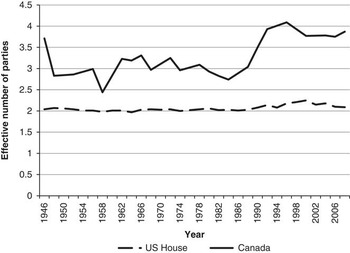
To illustrate, we report in Figure 1(a) the average effective number of parties, in terms of votes cast (Eff Nv) and seats (Eff Ns) won in the lower house, for a number of FPTP democracies since World War II (Gallagher Reference Gallagher2012). India is a clear outlier (see Chibber and Kollman Reference Chibber and Kollman2004). But even if it is excluded, as in Figure 1(b), there remains substantial variation in the total number of effective parties. Only the United States has an effective number of parties that is close to the anticipated two.Footnote 3 Another illustration of this point tracks the over-time variation in the effective number of parties in the United States and Canada. The data in Figure 2 show the consistent difference between the two countries’ party systems, while also illustrating just how remarkably stable the American two-party system has been during the post-War era. All of this shows that FPTP may be necessary, but it is evidently not sufficient to induce a two-party system.
(a, b) Effective number of parties by votes and seats, various first-past-the-post (FPTP) electoral systems (1945–2008) Note: based on data from Gallagher (Reference Gallagher2012).

Effective number of parties by votes, United States and Canada (1945–2008) Note: based on data from Gallagher (Reference Gallagher2012).

A third example, which provides clearer evidence of the potency of Duverger’s Law, is the experience of New Zealand. It used FPTP through the 1993 elections and then switched to a mixed FPTP-PR electoral system (usually denoted MMD) after a referendum on that question passed that year. From the end of World War II through 1993, New Zealand approximated a Duvergerian party system with an average effective number of parties of 2.53 by votes and 1.96 by seats. Almost immediately upon introduction of the new system, the effective number of parties grew, averaging 3.59 and 3.28 parties by votes and seats, respectively.
Besides the number of parties, another important characteristic of a party system is the identity of the major parties. In the United States, the Democrats and the Republicans have been the two major parties since the 1850s, a period of stability that is longer than the time most other nations have been democracies. But this era of stability was initiated by the replacement of the Whigs by the Republican Party. For the United Kingdom, a two-party system consisting of the Conservatives and Liberals survived through World War I, with Labour replacing the Liberals as one of the major two parties in the 1920s. Canada also has had long-term dominance of two major parties, the Liberal and Progressive Conservative Parties, but has seen that dominance roiled dramatically during the last few decades with little clarity right now as to which parties will emerge as the two major parties for the long term (or whether there will be only two major parties). Thus, hidden within the patterns of Figure 2 for both stability and variability in the effective number of parties is the potential for variability in the identity of the major parties within a system over time.Footnote 4
Although an explanation for the number of parties and their long-term durability may be closely related, we think it is helpful to separate them, at least for matters of presentation. We do so because the derivation of Duverger’s Law, such as by Cox (1997), makes no assumptions about policy spaces and, consequently, the utility functions of voters constrained by the requirements of a spatial model. Adding assumptions of a spatial model permits, of course, stronger derivations but more limited ones—more limited because the range of circumstances covered by assuming utility functions defined over policy spaces is necessarily more restricted than the range of circumstances covered without making those assumptions. Thus, we first focus on the more general model of preferences in a Cox-like setting to study the role of ambition on the number of parties and the integration of parties across electoral units. We then focus on a spatial model with voter utilities defined over a Euclidean policy space to study the role of policy and agenda setting in derivations of both the number and the identity of the parties in a party system.
Integration of the Party System and the Special Role of a Presidency: Ambition and Extension of Two-Party Systems from the Electoral Unit to the Nation
In this section, we examine the role of career ambition among politicians as a means of integrating parties across the various units of office. This question of party integration is especially pertinent for party systems in countries under a federal form of government. In spite of the division between the federal and state levels in the United States, essentially all state legislators share the same party affiliations as members of Congress. In all years since 1947, the percentage of seats in all of the lower chambers of the state legislatures in the United States that was held by a non-Democrat or non-Republican is less than one-half of one percent.Footnote 5 Past institutional rules tied state to national politics, such as the appointment by state legislatures of US Senators and electors to the Electoral College. But even though these rules are no longer used, the integration of the party system to state governments strongly persists.
We argue that a presidential system like the United States, which has a nationwide FPTP system to elect the office that is most desired by ambitious politicians, provides the strongest impetus for the extension of two-party competition (between the same two parties) across all elective offices—from the presidency, to the national legislature, and down to the state legislatures. This claim rests on career ambition and is thus not directly a story about policy that requires a formal set of assumptions about utility over a policy space.
Importance of the Presidency in the United States
The president is elected by a nationwide electorate under FPTP rules (or what closely approximates it), which fosters the development of two national parties. Aldrich (Aldrich Reference Aldrich2005; Aldrich Reference Aldrich2011) shows how the development of parties by the 1800 election shaped their behavior. Each party that held unified control of a state government in 1800 used that unified control to change that state’s law concerning how to allocate its electoral votes. That is, both parties took every opportunity they had to manipulate state governments’ institutional rules to further their chances of winning the presidency and vice presidency, and they did so by reducing the directness of the popular vote for president. The evidence therefore suggests that the presidential election did indeed serve, almost immediately, as a national unifying force for the two emerging parties. The early and rapid change from 1796 to 1800 suggests keen awareness of the utility for doing so in an increasingly structured and restrictive way, and a competitive impulse to do so immediately. Further development of the parties during the 19th century, in particular the development of the modern mass (Democratic) party by the efforts of Martin Van Buren for the 1828 presidential election and continued through the 1830s further shows that American parties were organized for the purpose of winning the presidency (Aldrich Reference Aldrich1995; Aldrich Reference Aldrich2011).
Our argument is that party competition for the presidency, which is the highest elected office in the political career ladder, frames the choices of ambitious politicians running for lower offices. Contrasting the method of selection of the highest office in the United States and United Kingdom highlights the importance of the presidency. Whereas Duvergerian electoral incentives contribute to two-party competition for the presidency, prime ministerial candidates are not directly elected in a public election and hence do not face the same pressures toward two-partyism. Hence, the career opportunity structures between the two countries are quite different, which has consequences on their party systems.
Ambition and the Integration of the Political Parties Across Districts
We argue that ambition binds the two-party system, which is firmly established by the pursuit for the presidency, across all offices in the United States. Schlesinger (1966) argued that the ambition for a lifelong career in elective politics was central to the proper functioning of democracy— ambition is what ties the actions of the office seeker and office holder to the wishes of the public that elect them. He offered two kinds of career ambitions, what he called “static” and “progressive.”Footnote 6 Static ambition is the desire to be elected and reelected to the same office repeatedly, such as Robert Byrd (D-W. Va.) who was senator for 52 consecutive years. Progressive ambition is the desire to climb what Schlesinger called the “opportunity structure,” from the bottom toward the top, that is, from least to most desirable office. In the United States, the career ladder goes from the local and state offices, US House, US Senate, and finally to the presidency at the pinnacle. Rohde (1979) transforms this account into a model of decision making under risk, that is, the “calculus of candidacy,” in which he assumes that every politician has progressive ambition. What differentiates the static from the progressive career is the confluence of risks and costs associated with running for one office compared with another.
In these types of models, we examine expected utilities across actions, a k:
 $$EU(a_{k} )=\mathop \sum\limits_j P_{{jk}} U(O_{j} ){\minus}C_{k} ,$$
where P jk is the probability of outcome j occurring from choice k, U(O j) the utility of outcome k, and C k the cost of taking choice k. Rohde (1979) uses this framework to analyze the choice of whether to run for reelection or to instead run for higher office. Aldrich (Reference Aldrich2011, 50–60) extends Rohde’s calculus to a “calculus of party affiliation” (see also Abramson et al. Reference Abramson, Aldrich and Rohde1987; Aldrich and Bianco Reference Aldrich and Bianco1992). An important variable in these “calculus” problems is the probability of achieving an outcome (i.e., winning office) based on the choice of action (P jk). Because of the positive impact of party affiliation on the likelihood of winning office, there is a tendency to affiliate with a party, rather than run as an unaffiliated independent.Footnote 7 But there is also the FPTP-based incentive to affiliate with one of the two leading parties in the electoral unit (if there are parties there at all, rather than autonomous candidacies), which is that, given the existence of major parties in advance of the decision to run for office, P jk is simply much larger if k is one of the two major parties.
Although these works provide a good argument for why politicians will want to affiliate with a major/credible party, a remaining question, and the one that is the focus of our paper, is why politicians across different electoral units coalesce around the same two parties. We argue that career ambition with the presidency as the most desirable office leads to the integration of the party system. If one is looking ahead to a long career in politics, then one values not only election for the current office but also for offices that might be held in the future. Thus, ambition for higher office, such as the presidency, influences career choices today.
Consider, for example, someone considering a run for the Senate today and desiring to keep options open for a run for presidency at the next time point. The assumption of career ambition is that, for all candidates, the Senate is highly valued, but the presidency is even more highly valued. Thus, for all careerists, U(O p)>U(O s), where p denotes the presidency and s the Senate seat. As office seekers, per se, they get a fixed value for holding the office, regardless of party affiliation, if any. As the president is elected in a way that approximates FPTP, the probability of winning that office is higher if the candidate is affiliated with a national major party. Focusing on the decision to run for the Senate today and the presidency tomorrow for simplicity, her expected utility of affiliating with party k is
 $$\eqalignno{ & EU(a_{{kt}} )=[P_{{sk}} U(O_{s} ){\minus}C_{k} ]{\plus}\delta EU(a_{{kt{\plus}1}} ), \cr & EU(a_{{kt{\plus}1}} )=P_{{pkt{\plus}1}} U(O_{p} ){\minus}C_{{kt{\plus}1}} , $$
where the utility of not holding office is normalized at 0, P jk denotes the probability of winning office j from choosing affiliation k at time t or t+1, and δ the time discount parameter (0<δ<1).Footnote 8 A key assumption is that the probability of winning the presidency in the next period, P pkt+1, in part depends upon the choice of party in the current period, a kt. In particular, party switching reduces that likelihood: if a kt≠a kt+1, then P pk+1 is especially small. One can imagine electoral costs to party switching, such as a negative effect on a candidate’s credibility or difficulty in winning the presidential primary as an outside candidate.Footnote 9 Under this assumption, an ambitious politician, who accounts for her future career trajectory, conditions her affiliation choice today based on expectations of future electoral viability for higher office. That is, forward-thinking candidates choose party affiliation not only to ensure a long career, but also a career with upward mobility.Footnote 10
As a more concrete example, suppose a politician is deciding whether to run for a Senate seat as a member of the Libertarian or Republican Party. Suppose further that affiliating with the Libertarian gives her a slightly higher probability of winning a Senate seat, but essentially zero chance of winning the presidency. If the politician only cares about winning the Senate seat, then choosing the Libertarian party is perfectly rational. But if she cares about one day running for president, then she may instead choose the Republican Party from the outset. This dynamic will lead Senate candidates to coalesce on the two major parties. Now consider a politician running for a House seat. Given the choices of Senate candidates, the politician knows that winning a Senate seat will necessitate affiliating with a major party at that stage. Thus, if she is interested in one day running for the Senate, then she should choose to affiliate with one of the major parties when running for the House seat. This logic continues to work its way down to state legislative seats.
The development of the Republican Party in the South illustrates this explanation. Until the 1960s, there was essentially no Republican Party in the South. The Democratic Party won all gubernatorial, senatorial, and virtually every House race from the states of the former confederacy throughout the first half of the 20th century. The emergence of the civil rights movement in the 1950s, however, split the Democratic Party. In 1964, Barry Goldwater, the Republican nominee for president who had voted against the Civil Rights Act earlier that year, was able to carry five southern states for president that year (and no other, except his home state of Arizona). J. Strom Thurmond, Senator from South Carolina, switched from the Democratic to the Republican Party that year in part in light of Goldwater’s vote on the civil rights bill. He became the second Republican in the Senate from the South during that century.Footnote 11 In the two successive presidential elections, Nixon followed a “southern strategy” to win support in that region. The real breakthrough for the Republican Party in the South for other offices did not come in large numbers until 1980, after the presidency was moving toward the Republican Party in the South. Although the party’s success for the presidency revealed that it was possible for an ambitious careerist to be a Republican in the South, it took considerable time for that to work its way from entry level on up to the higher levels of office, as party members climbed up the ranks.Footnote 12
Is the US Distinctive in Vertical Integration?
The United States is distinct in two respects. First, it is distinct among FPTP nations in having an elected office with a nationwide district under FPTP rules, which generates incentives for a two-party system at the peak of the opportunity structure. This Duvergerian two-party equilibrium for the presidency flows down the opportunity structure as ambitious politicians, who desire the presidency, affiliate with one of the two presidential parties in advance, which integrates the two parties down to the lower offices.
The method of selection for the highest office, rather than the powers of the prime minister versus the president, is the distinguishing factor that contributes to the differences in the party systems of the United States and the United Kingdom.Footnote 13 The indirect selection of national leaders, such as prime ministers in a parliamentary system, may offer some but weaker incentives toward two-partyism.Footnote 14 Winning the prime ministership (or party leadership position more generally) requires a different set of considerations than the electoral incentives and hence behaviors induced by direct election under FPTP. A prime ministerial candidate is concerned with forming alliances with individual and sets of individual MPs. This concern is especially relevant, as votes of no confidence keep the head of government closely aligned with intra-parliamentary politics. Post-election bargaining and coalition formation, however, lacks the Duvergerian pressures rooted in electoral politics and is not enough in itself to establish a two-party over a multi-party system, as we can observe in the many multi-party, minority governments that form. Our argument is not that there is no effect at all of PM ambition on party affiliation at lower levels of office. We simply argue that the effect toward two-party dominance is substantially weaker and less efficient than in a presidential system.
The second respect in which the United States is distinct is its large number of elective offices, which makes the opportunity structure very long and filled with many different offices.Footnote 15 Of course, all federal systems under FPTP induce a similar incentive but are often much weaker for one of three reasons. One is that, of the nations in Figure 1, only the United States has an office that is elected nationwide under FPTP. Second, most countries have considerably shorter opportunity structures. Third, voting behavior may not reinforce the careerism incentive across levels of office as much as in the United States. For example, the political parties that compete for office in Canada often differ significantly between the provincial and federal levels.Footnote 16 Although both countries use a federal form of government, the Canadian provinces are generally understood to have retained more autonomy over important policy areas compared with the US states, which has important consequences on the opportunity structure that influences the choices of politicians and the development of the party system. For instance, a party organization might develop two independent wings under the circumstance of autonomous provinces, one at the provincial and one at the federal level, without any coordination between the two levels (e.g., the Liberal Party of Canada and the current Ontario Liberal Party), which differs from the organization of American parties at the national and state and local levels. There could also be explicit disagreement between the two wings, for example, the name change of the Yukon Progressive Conservative Party to the Yukon Party in 1991 as the provincial wing cut ties with its federal party namesake.Footnote 17 And, of course, Quebec has had a series of Québécois parties that compete strongly for votes and on issues relevant to French-speaking Canada, and thus often are mostly provincial issues, and focus less on dominion-wide issues.
Differences in the domains between the national and regional governments, and consequently the development of party organizations, should lead us to expect different career patterns between members of the US Congress and members of the Canadian parliament (also see Gaines Reference Gaines1999; Docherty Reference Docherty2011) For the past several decades, roughly one-half or a little more of House members had previously served in a state legislature.Footnote 18 In Canada, however, only about 7 percent of House of Commons members had served in the provincial legislature from the 1960s up through 1984 (Barrie and Gibbins Reference Barrie and Gibbins1989).Footnote 19 Although Canadian legislators presumably are just as ambitious as their American counterparts, differences in the opportunity structure contribute to sharply different career patterns.Footnote 20
Policy, Agenda Control, and Two-Party Duopoly
The theory to this point consists of two major steps. The first is the response of voters (according to Cox 1987) and/or politicians (according to others such as Riker Reference Riker1982) to the incentives induced by FPTP toward creating a two-party system, that is, a derivation of Duverger’s Law. This regularity is applicable to each electoral unit individually. Second, we proposed above that the combination of career ambition and a nationwide FPTP electoral system for the peak office (i.e., the presidency in the United States) provides the logical basis for vertically integrating the various unit-level two-party systems into a nationwide two-party system. This second step is what differentiates the United States from the other FPTP nations in Figure 1. That is to say, FPTP, combined with politicians ambitious to climb the opportunity structure, provide a sufficient set of conditions to explain why the United States has a two-party system, whereas the other nations do not.
In this section, we add the assumption of competition over a policy space to accomplish two additional steps of explanation. First, narrowing voter motivations to policy-based considerations provides an account of party behavior that reinforces the two-party equilibrium in the results already presented. Second, accounting for policy provides a potentially long-term equilibrium in which the same two parties will persist, at more or less a consistent pair of policy positions, keeping any third party from being able to enter the competition and stabilizing divergent policy alternatives. We use a spatial model of electoral competition to highlight the importance of policy and agenda control in sustaining this particular two-party duopoly. Such a model therefore illustrates necessity of adding (policy-based) agenda control as a further condition for two-party stability.
Palfrey (Reference Palfrey1984) modeled a situation where the two major parties simultaneously choose platforms in anticipation of a third-party entrant, who enters in the second period. He proved that there is a unique equilibrium in which the two major parties tie and that there is no point at which a third party can enter and win.Footnote 21 If, for example, ideal points are uniformly distributed on the interval [0,1], then the two parties will choose platforms at 1/4 and 3/4. The threat of entry generates divergence, and the two established parties survive and are identified as such by voters due to the two parties’ respective durable and divergent policy positions, which is the basis for a policy-based reputation (see Snyder and Ting Reference Snyder and Ting2002; Grynaviski Reference Grynaviski2010). This sort of result does not explain why there are two established incumbent parties in the first place, which is the role of Duvergerian results, but it does explain why these two particular parties hold sway and what they need to do to fend off any third-party upstart (see also Lee Reference Lee2012).
Examples of Agenda Control to Maintain Equilibrium in the United States and the United Kingdom
In the following two cases, three groups negotiated over the dominant dimension. These cases are illustrations of Palfrey-like behavior, that is, maneuvering on a single axis of policy. We then turn to extend his results to multiple dimensions to further examine the importance of agenda control and consider a final empirical application.
The US government shutdown on October 1, 2013, due to failure of agreement between the two parties. The Republican majority leadership in the House refused to bring to a vote a “clean” spending bill (i.e., continuing resolution, CR), which excluded any provisions to delay or defund the Affordable Care Act. This decision was made despite the fact that it had already passed the Senate, and there was general consensus that the clean CR had the support of a clear majority of House members.Footnote 22 Keith Poole provides two illustrations of this point.Footnote 23 Poole estimates that although the Republican majority mostly opposed passage of a discharge petition to bring a clean continuing resolution to a House vote, the petition would have passed by a two vote majority assuming all GOP members who voiced some support for the petition would have actually voted for it. Thus, Speaker Boehner was (at least for a time) able to use control of the agenda to avoid policy changes opposed by the majority conference. Second, Poole analyzes the actual vote ending the shutdown on the evening of October 16. In this case, although opposed by a majority of the Republican conference, Speaker Boehner did not exercise agenda control, allowing the vote onto the House floor, which led to an outcome favored by Democrats.Footnote 24
This is an apparent application of what has come to be known as the “Hastert Rule,” in which the majority party refuses to bring to the floor any bill that does not receive majority support within the majority party. In other words, to pass, a bill would have to receive a majority vote from the majority party and a majority on the floor. This is exactly the condition used by Aldrich (Reference Aldrich1994) in deriving his result that provides the formal basis for conditional party government.Footnote 25 This case illustrates the use of agenda control to achieve divergent policy positions, following the logic of Palfrey (1984), to block third party entry. The Republican Party revealed a somewhat more extreme stance than ideal for a general election, by the use of agenda control, to thwart defection by conservative Tea Party members to potentially form a third-party splinter.Footnote 26
An alternative application of similar reasoning is to observe convergence toward the center to thwart a centrist third party. The United Kingdom has a stable three-party system, although the most centrist party (now the Liberal Democratic Party) has a long history of winning a far higher percentage of the vote than seats in parliament.Footnote 27 Except for twice since World War II, including the current government, this third party has been unable to deny a majority of seats to whichever major party that won the most votes.Footnote 28 It has thus been a constant presence and almost constantly ineffective as a third party. That nearly changed in 1981. During that year, senior MPs in the Labour Party defected to merge with the Liberal Party to create the centrist option, the Social Democratic Party (SDP), which later that year joined with the Liberal Party in the SDP–Liberal Alliance, a precursor to the Liberal Democrats.Footnote 29 The Labour defections came because, the defectors claimed, the party had become too extreme. That Labour was too far left for even senior MPs was due in part to rules that empowered the most left-leaning elements of the party the ability to ensure selection of many MP contenders suitable to their policy preferences. The loss of moderate leadership, of course, hurt the party even more, and it required a variety of internal reforms in candidate selection and other aspects of party politics (see Seyd Reference Seyd1999). These helped enable Tony Blair to become party leader and eventually win election the “Third Way,” a variant of US president Clinton’s “triangulation,” that is, moving toward the center (e.g., Laybourne 2001, 32). Labour was able to move back toward (but not all the way to) the center to stave off competition from the SDP–Liberal Alliance, which it had essentially tied in terms of the popular vote in the 1983 elections. The party accomplished this policy shift in part by changing the way its candidates were selected and in part by changing the way its platform was constructed and enacted, and thus by changing, in this case enhancing, agenda control.Footnote 30
Threat to the persistence of this system today is perhaps coming from parties working new dimensions of politics, devolution in the case of the Scottish National Party and Plaid Cymru (and the parties of Northern Ireland) and immigration, EU membership, and related issues such as the British National Party and UK Independence Party. In the 1950s and 1960s in the United States, southern Democrats operated as something of a third-party “balancer” choosing to support in Congress northern Democrats when it suited, forming a typical party coalition vote, or forming a “Conservative Coalition” vote by supporting Republicans. This happened because of the rise in salience of a second dimension in US politics in the 1950s. The Civil Rights Movement and related events made those issues salient, and Poole-Rosenthal roll call voting estimates show these issues were nearly orthogonal to the standard New Deal economic issues that separated Democrats from Republicans. But to analyze these situations, we need to extend the Palfrey model beyond a single dimension of policy competition.
Agenda Control in Two Dimensions
Palfrey’s (Reference Palfrey1984) equilibrium is quite rigid due to the specificity of unidimensionality. In this case, parties exert a form of agenda control, one which consists solely of their public policy positions, with a third party able to seek to win only by taking a position on the single dimension. What happens when this rigidity is relaxed, for example, if a third party can help shape the policy agenda, such as by changing the salience of some additional policy dimension?
We begin by extending a close variant of Palfrey’s model to two dimensions.Footnote 31 We assume that all voters have two-dimensional weighted Euclidean-based utility functions in a policy space  $\Omega =\left[ {{\minus}1,1} \right]{\times}\left[ {{\minus}1,1} \right]\,\subset\,{\Bbb R}^{2} $
. We allow the relative weight of the second dimension to vary from infinitesimal (and thus yielding a virtually one-dimensional policy space) to being the dominantly weighted dimension (i.e., where the salience of the first dimension has become virtually zero). Starting with the location of the major parties fixed on the first dimension at (−1/2, 0) and (1/2, 0) (the Palfrey-equilibrium platforms) and allowing the third party to enter at a vote-maximizing platform in the two-dimensional space, given the major parties’ platforms, we find the salience values that support a two-party equilibrium (i.e., the two established parties remain tied for first place and neither party having any incentive to deviate). We show in the appendix:
Proposition: For varying levels in the relative salience of the two dimensions, we make three statements regarding a two-party equilibrium:
a. Divergent major party platforms on the first dimension is an equilibrium even with positive values of salience of a new second dimension. That is, the original Palfrey result of major party dominance holds even when a second dimension is introduced.
b. If the second dimension is sufficiently salient, and if the two original parties keep to their original, divergent platforms on the first dimension, then the third party can enter and win the election.
c. If the second dimension is sufficiently salient, then the new two-party equilibrium is one in which two parties have platforms that diverge on the second dimension, and the remaining party is held to last place. As the original equilibrium is replaced by this entirely new pair of policy positions, which two parties hold those equilibrium positions determine who the two, surviving, new major parties will be. It could be the two original major parties, or it could the new entrant and one old one.
Remark 1: As long as the salience of the first dimension remains “dominant” the one-dimensional equilibrium holds in two-space, which we understand to mean that the same two parties with the same two platforms persist.
Remark 2: When the salience parameter “flips” so that the second dimension emerges as the newly dominant dimension, the two leading parties that are divergent on the new dimension are not necessarily the same two major parties as before the change in issue salience. A new party could have emerged on the new dimension, replacing one of the older parties.Footnote 32
The driving logic is that the major parties choose strategies in order to minimize the available space (votes) for a third-party entrant. Policy divergence is sufficient to do this in a unidimensional context, as shown by Palfrey. In the case of two dimensions, a third-party entrant can win more votes by taking advantage of an increasingly salient second dimension.
The substantive point is that agenda control matters. Existing research has noted the connection between ideologies and the number of parties in a country. The more issue dimensions (i.e., social/political cleavages) that are salient, the more parties we should expect (Taagepera and Grofman Reference Taagepera and Grofman1985). Our argument, however, considers how political elites might influence how many and which issue dimensions are salient. Another aspect of the equilibrium is policy divergence on the dominant policy dimension, which agenda control can also help attain as discussed above. The failure of agenda control in either instance risks upsetting the Duvergerian equilibrium in which a successful third party enters and at least one major party risks losing its major party status to the new party.
Empirical Illustration of Agenda Control: The Democrat–Whig Era in the United States
In the late 1830s and into the 1850s, two major issues dominated policy in the United States, the tariff and related aspects of the political economy of national development, and slavery and related “social cultural” issues. These two issues were the defining issues of the two distinct policy dimensions in Congress, as illustrated in Poole-Rosenthal estimates of this period (Poole and Rosenthal, 2007). Thus, the condition of our extension of the Palfrey model is satisfied. The status quo before the formation of the Democrat–Whig party system was agreement between the two parties to disagree on the tariff and related issues, but they would work to ensure that slavery was kept off the agenda, that is to keep the salience of the second dimension as low as possible. To do so, the two parties exploited the status quo. The inherited status quo had a North–South balance in the Senate by law (the Missouri Compromise, negotiated by Clay in 1820), which could only by altered by positive legislation, that is, by admission of more states from one region rather than the other. Until the 1850s, this duopolistic feature was demonstrated publicly by consistent admission of states in a way that maintained North–South balance (specifically ensuring that the smaller region by population, the South, never dipped below 50 percent of the seats in the Senate). As a result, the South maintained a veto over changes in laws related to slavery, including admission of new states (and thus of new Senators).
This veto required additional commitment from both parties to cement it into place.Footnote 33 The two parties used a variety of devices to bind themselves and to bind each other to agreement to keep the slavery dimension off the national agenda (see Aldrich Reference Aldrich2011, for elaboration). That is, they worked both internally and externally with each other to control the agenda in order to focus attention on a single major dimension of party conflict.
Of course, as elaborate as the parties could design their rules, failure to act in Congress is an imperfect means of controlling the policy agenda to keep slavery low in salience, and slavery could not be kept off the agenda indefinitely by these means. Still, it was suppressed for a lengthy period of time. Thus, Clay as the Great Conciliator forged various compromises for just that purpose. The two parties were able to use their institutional design to suppress the issue even after it had passed one chamber. In particular, the Wilmot Proviso twice passed the House (1846 and 1847) but failed both times in the Senate, still under the “balance rule,” as did the attempt to make it a part of the Treaty of Guadalupe Hildago in 1848. The growth of the nation, almost all in a non-slave direction (i.e., both in terms of geography and of the economy and culture), finally meant that the Congress was unable to suppress the issue in the public, and no compromise was possible. Instead, the Republican Party replaced the Whigs as the major party to compete with the Democrats, a party that won the presidency without a single southern electoral vote in 1860 and won on a pledge of “free labor, free soil, free men.” Slavery had become the dominant dimension and the original duopoly failed, as the Whig Party collapsed, the Republican Party took its place on a very different coalition, and the Democratic Party changed as well, becoming much more southern.
Discussion and Concluding Remarks
Although FPTP might establish two-party competition district-by-district, that electoral rule by itself does not necessarily establish a true, national two-party system in which the same two parties compete for a wide slate of offices across all districts. There is indeed a wide variation in the effective number of parties across FPTP electoral systems. Thus, Duverger’s Law does not specify a sufficient condition for two-party politics. Nor does it say to which two parties the electorate’s considerations converge or under what circumstances a new two-party system might replace an old one. The question therefore remains, “Why (these) two parties?”
We offered a scientific explanation of the emergence and persistence of two-partyism, what we refer to as the “APP”: ambition, the presidency, and policy. The APP explains why some FPTP systems have persistent and durable two-party systems with the same two parties over lengthy periods of time, whereas other FPTP systems have variable numbers of parties and/or variable identities of major parties over time, often relatively shorter periods of time. We compared the United States as the clearest example of such a two-party system with other FPTP systems to provide empirical application and illustration of the theoretical argument.
The presidency and ambition theory together explain the integration of a party system across electoral districts and levels of office. The presidency is the only office with a national constituency, and it firmly establishes two-party competition for that office, given its method of selection, which provides the basis for the national positioning of the parties and their national reputation. As the most valued office (i.e., the top of the ambition hierarchy), the presidency establishes the opportunity structure that focuses the affiliation decision of ambitious politicians for all offices in the political career ladder on those same two major parties.
To further examine the foundations of two-party competition and the durability of party systems, we introduced policy-based considerations and the strategic choices of parties by utilizing a two-dimensional spatial model, which builds on the observations of Palfrey (Reference Palfrey1984). Two strategies contribute to the continuation of a two-party system, (a) policy divergence on the main issue dimension of party conflict, and (b) the suppression of new issue dimensions. Our examples, drawing from the United States and United Kingdom cases, highlight the importance of agenda control in achieving both goals in order to sustain a particular two-party duopoly.
In sum, the unique confluence of institutional features and the strategic choices of voters, candidates and parties shaped by those institutions creates a two-party system in the United States. We provided a more solid theoretical foundation to assess the variation in party systems across FPTP countries by clarifying what factors lead to multi-party competition but in the US case answering the question, “Why two parties?”
Appendix
The basic intuition of our model is presented here. A more formal proof is available online at http://faculty.unlv.edu/dlee. We consider a two-dimensional space  $\Omega =\left[ {{\minus}1,1} \right]{\times}\left[ {{\minus}1,1} \right]\,\subset\,{\Bbb R}^{2} $
. Voters weigh the x-dimension by s∈(0,∞) and the y-dimension by
 ${\textstyle{1 \over s}}$
. If s>1, then the x-dimension is more salient than the y-dimension. If s=1, then the dimensions are equally salient. If s<1, then the y-dimension is more salient. A simplifying transformation accounts for the relative dimensional salience. We can instead analyze a two-dimensional policy space
 $\tilde{\Omega }=[{\minus}s,s]{\times}[{\minus}{\textstyle{1 \over s}},{\textstyle{1 \over s}}]$
, where s∈(0,∞) is the salience parameter. That is, we can squeeze or stretch the policy space to account for salience, in which case voter indifference curves are circular instead of elliptical. Voters are uniformly distributed on this space and vote sincerely for their most preferred (closest) candidate. Palfrey considers the unidimensional case, which in our set-up produces major party (D and R) platforms at
 $({\minus}{\textstyle{s \over 2}},0)$
and
 $({\textstyle{s \over 2}},0)$
.
We first simply ask what values of s sustain such platforms as a two-party equilibrium, that is, leaves the third candidate (T) with the lowest vote share. To answer this question, we consider the case where the major parties cannot readily adjust their platform to a change in salience, which is the case of parties with fixed (policy) reputations. These platforms indeed are equilibrium platforms as long as T is left in last place (neither major party has an incentive to deviate as long as the third party is in last place).
To show this, we can specify what platform a vote-maximizing third party will choose for varying levels of salience, given the major parties’ divergent platforms. To find the salience point up to which a third party is kept in last place, we simply find the salience value that leaves the third party with fewer than one-third of the votes (point a in the proposition). Once the salience of the second dimension crosses that threshold, however, the third party wins (point b). In that case, instead diverging on the second dimension is an equilibrium where two parties tie for first and the third party is stuck in last place (point c). To prove this last point, simply flip the two dimensions (instead treat the second dimension as the dominant “first” dimension), and it straightforwardly follows from the proof of point a.