Introduction
Proton-pump inhibitors (PPIs) are among the most frequently prescribed drug classes in older populations (McCarthy, Reference McCarthy2010). In Italy, PPIs are the first ranked agents in terms of pharmaceutical costs; three are among the top 30 drugs (AIFA, 2017). They are prescribed to treat peptic disease, or to elderly taking antiplatelet therapy (Eusebi et al., Reference Eusebi2017). However, 40%–60% of all PPIs prescriptions have been proven inappropriate; moreover, these agents are generally prescribed to older subjects on a long-term or continuous basis (Haastrup et al., Reference Haastrup, Rasmussen, Hansen, Christensen, Søndergaard and Jarbøl2016). Neurological adverse events (including affective and cognitive disorders) have been associated with use of PPIs (Polimeni et al., Reference Polimeni, Cutroneo, Gallo, Gallo, Spina and Caputi2007; Vialou et al., Reference Vialou2014).
By the WHO adverse drug reactions database, depression is rarely associated with use of PPIs. However, information regarding this effect was derived from observations of short-term drug exposures in younger patients. In particular, an evidence of a link between PPIs and depression was derived from case reports (Polimeni et al., Reference Polimeni, Cutroneo, Gallo, Gallo, Spina and Caputi2007); incidentally, a large cohort study aiming at determining the association between use of PPIs and risk of dementia in older subjects reported a significantly higher prevalence of PPIs use among participants diagnosed with depression (Gomm et al., Reference Gomm2016). Indeed, we have not been able to find previous population studies specifically aiming at evaluating the association between PPIs and depression.
Thus, we assessed the association of PPIS use with depression in an unselected older population.
Methods
In the setting of an Italian Health Ministry study that involved five towns, all 344 inhabitants aged 75 years or older who were living in the town of Tuscania (Italy) on January 1st, 2004 were enrolled, without exclusion criteria (Laudisio et al., Reference Laudisio2007). Additional details are available in Appendix 1.
No subjects had active peptic ulcer, nor were on Helicobacter pylori eradication therapy.
The Institutional Review Board of the Catholic University approved the study protocol, and all patients gave informed consent.
Depressive symptoms were evaluated using the Italian version of the 30-item Geriatric Depression Scale (GDS) (Yesavage et al., Reference Yesavage1982–Reference Yesavage1983); The recommended cut-off score of 11 was adopted to diagnose depression.
Drugs were coded according to the Anatomical Therapeutic and Chemical codes. Particularly, we considered agents coded A02BC (PPIS), C09B (H2-receptor antagonists), and A02AD (antacids). Daily dosages were also calculated. No patients were on sucralfate.
Participants’ diagnoses and treatments were obtained by general practitioners, and confirmed by the study physicians. Diagnoses were coded according to the International Classification of Diseases, ninth edition, Clinical Modification codes (WHO-ICD). Particularly, we considered peptic disease by the presence of gastritis, gastroesophageal reflux disease (GERD), or history of peptic ulcer.
Physical activity was measured using the Physical Activity Scale for the Elderly questionnaire (PASE) (Washburn et al., Reference Washburn, Smith, Jette and Janney1993), cognitive performance by the Hodkinson Abbreviated Mental Test (Hodkinson, Reference Hodkinson1972), functional ability by the Katz’ activities of daily living (ADLs) (Katz et al., Reference Katz, Ford, Moskowitz, Jackson and Jaffe1963), and the Lawton and Brody scale for instrumental activities of daily living (IADLs) (Lawton and Brody, Reference Lawton and Brody1969).
Blood samples were obtained after overnight fast.
Statistical analysis
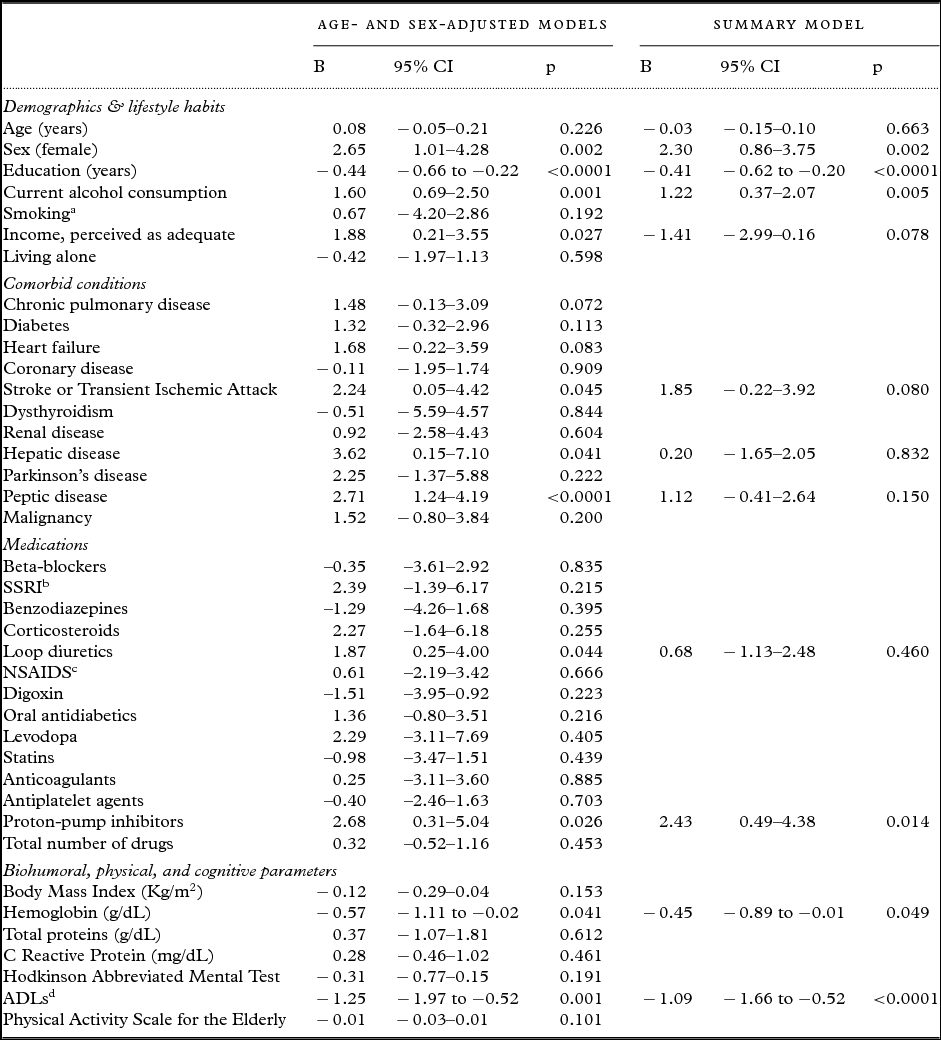
Statistical analyses were performed using SPSS for Mac 20.0. Differences were considered significant at the p < 0.050 level. Data of continuous variables are presented as mean values ± standard deviation or medians and inter-quartiles. Differences according to use of PPIs were assessed using ANOVA or the non-parametric Mann–Whitney U test. The two-tailed Fisher exact test was used for dichotomous variables (Table 1). Linear regression was used to estimate the association of variables of interest, including use of PPIs, with the GDS score. To assess the role of confounding in the association between GDS score and use of PPIs, groups of variables (as depicted in Table 2) were first examined using separate age- and sex-adjusted models. Those variables, significant at p < 0.050 in these initial models, were simultaneously entered into a summary model. Abnormally distributed variables were analyzed after log transformation.
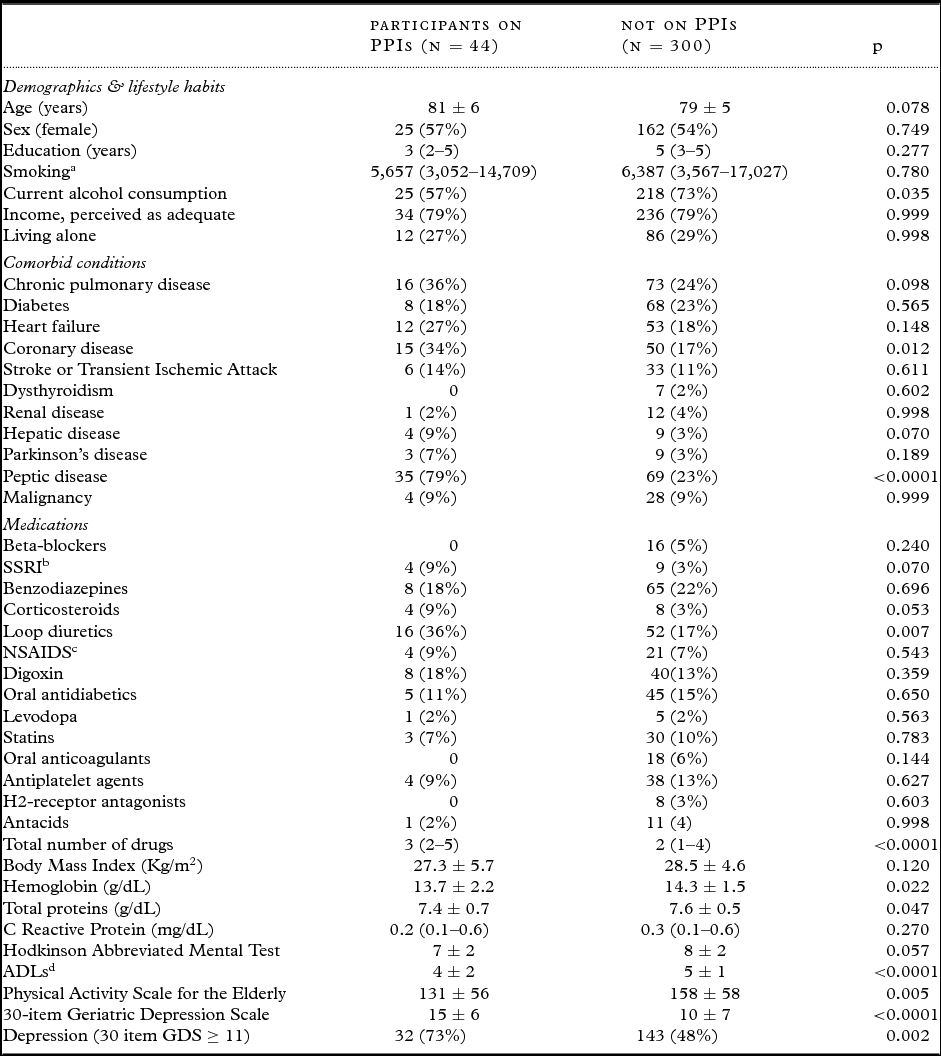
Characteristics of 344 participants according to use of proton-pump inhibitors (PPIs)

a Total lifetime pack years.
b Selective Serotonin Reuptake Inhibitor.
c Non-steroidal anti-inflammatory drugs.
d Katz's Activities of Daily Living.
Association (B coefficients, and 95% confidence intervals, CI) of the 30-item Geriatric Depression Scale with the variables of interest in the initial (age and sex-adjusted), and summary (fully adjusted) regression models. All the covariates were entered simultaneously into the regression models

a Total lifetime pack years.
b Selective Serotonin Reuptake Inhibitor.
c Non-steroidal anti-inflammatory drugs.
d Katz's Activities of Daily Living.
The summary set of covariates was also analyzed using a logistic regression model having depression (GDS ≥ 11) as the dependent variable, after excluding subjects on SSRIs. Eventually, the summary model was analyzed in multinomial logistic regression having GDS cut-off points for no (0–10), mild (11–20), and severe depression (21–30) as the dependent variable (Table S2, available as supplementary material attached to the electronic version of this paper at www.journals.cambridge.org/jid_IPG). To assess any association between mood and use of H2 antagonists or antacids, the same linear and logistic fully adjusted models were reanalyzed after entering these medications instead of PPIs.
Also, we evaluated the association of PPIs dosages with depression. To rule out any interaction between peptic disease and mood, the adjusted linear and logistic models were reanalyzed after the exclusion of peptic disease. Also, analysis of the interaction term “PPIs*peptic disease” and “PPIs*coronary disease” was performed using the adjusted logistic regression model to ascertain if the association between PPIs and depression varied according to the diagnosis of peptic or coronary disease. Eventually, we calculated the percent population attributable risk, i.e. the proportional reduction of depression cases that might be obtained by avoiding PPIs (Basu and Landis, Reference Basu and Landis1995).
Results
The mean GDS score was 11 ± 7. Depression (GDS ≥11) was found in 163 (47%) participants.
The characteristics of participants by use of PPIs are depicted in Table 1.
The characteristics of participants according to depression are depicted in Table S1.
None of participants had a definite diagnosis of major depression according to the DSM IV criteria. However, diagnosis of depression was recorded in 38% of medical records, with high agreement with GDS ≥11 (Cohen's Kappa 0.79, p < 0.0001).
Use of PPIs was detected in 44/344 (13%) participants; of these, 29 (66%) were on omeprazole, (median daily dosage 20, IQR 20–40); 5 (11%) took esomeprazole, (median dosage 40 mg, IQR 20–40), 5 (11%) received lansoprazole (median dosage 30 mg, IQR 15–30), 4 (9%) were on rabeprazole (median dosage 20 mg, IQR 20–40), and 1 (2%) took pantoprazole (20 mg). Use of H2 antagonists was recorded in 8 (2%) participants; 12 (3%) took antacids.
Participants on PPIs had higher GDS scores, and higher prevalence of depression (Table 1); conversely, subjects who took H2-receptor antagonists or other antacids had similar GDS scores (13 ± 7 vs. 11 ± 7, p = 0.482, and 13 ± 8 vs. 11 ± 7, p = 0.194, respectively).
In the fully adjusted linear regression model, use of PPIs was associated with higher GDS scores (B = 2.43, 95% CI = 0.49–4.38; p = 0.014), also excluding peptic disease (B = 2.43, 95% CI = 0.48–4.37; p = 0.014).
Depression was associated with use of PPIs in the fully adjusted logistic regression (OR = 2.38, 95% CI = 1.02–5.58; p = 0.045, Table S2), also excluding peptic disease (OR = 2.39, 95% CI = 1.02–5.78; p = 0.044) or use of SSRI (OR = 2.45, 95% CI = 1.04–5.76; p = 0.040).
Both GDS cut-offs of 11–20 and 21–30 were associated with use of PPIs in multinomial logistic regression having a GDS cut-off 0–10 as reference (Table S2). Also, analysis of the interaction term indicated that the association of use of PPIs with depression did not vary according to diagnosis of peptic (p = 0.676), or coronary disease (p = 0.157).
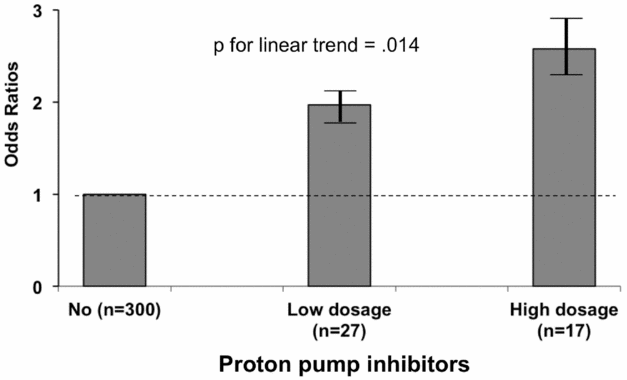
Interestingly, increasing PPIs dosages were associated with increasing probability of depression (p for linear trend = 0.014, Figure 1). The effect of single agents could not be analyzed due to the insufficient sample power of strata.
Probability of depression (i.e. GDS score ≥ 11) according to increasing PPIS dosages.

Eventually, calculation of the population attributable risk indicated that withdrawal of PPIs would reduce by 14.3% the prevalence of depression in the study population.
Discussion
Our results indicate that use of PPIs is independently associated with increased depressive symptoms, as well as depression, in community-dwelling older participants. The probability of depression increases with increasing PPIs dosages; withdrawal of PPIs would reduce by 14% the cases of depression. No differences were found in the prevalence or severity of depressive symptoms according to use of H2-receptor antagonists or antacids.
The pathophysiology of the association between PPIs use and depression is unclear. PPIs, which cross the blood-brain barrier, might affect cognition, possibly through decreased clearance of β-amyloid brain levels (Haenisch et al., Reference Haenisch2015; Linder et al., Reference Linder, Tamboue and Clements2016). Depressive symptoms in advanced age often precede the onset of dementia by years; thus, depressive symptoms in our participants might represent a prodromal symptom of cognitive impairment (Singh-Manoux et al., Reference Singh-Manoux2017). Also, use of PPIs yields marked and sustained increases in serum gastrin levels; this increase is mediated by the release of gastrin-releasing peptide (Valvassori et al., Reference Valvassori2010). This peptide and its receptor can be found in the dorsal hippocampus and amygdala, where they induce behavioral alterations found in anxiety, depression, and dementia. Also, hypergastrinemia stimulates the cholecystokinin type B receptors expressed in the central nervous system, further influencing the regulation of anxiety, feeding, and locomotion (Valvassori et al., Reference Valvassori2010).
Also, our finding of a dose-effect relationship in the association of PPIs use with mood alterations is in line with previous reports of an increased risk of adverse outcomes, including osteoporosis, fractures, and mortality, according to increasing PPIs dosages (Maggio et al., Reference Maggio2013; van der Hoorn et al., Reference van der Hoorn, Tett, de Vries, Dobson and Peeters2015).
This study was conducted in a whole population of community-dwelling elderly, with comprehensive information regarding risk factors, diseases, medications, and objective parameters. Nevertheless, due its cross-sectional design, this study does not allow to ascertain any cause–effect relationships, also because unmeasured factors might confound the association of treatment with depressive symptoms. Also, no data were available about the duration of PPIs treatment. In our population, no formal diagnosis of major depressive disorders was recorded. However, such a categorical approach might be difficult to apply in elderly people, in whom mood disorders can be masked by complex organic conditions and drug treatments. Moreover, elderly subjects tend to underreport depressed mood. Instead of the categorical approach, a dimensional approach based upon depressive symptoms questionnaires, such as the GDS, might be useful. In fact, studies that measure depressive symptoms through questionnaires report higher rates of depression than those adopting a categorical approach (Vaccaro et al., Reference Vaccaro2017). Eventually, the study was conducted in a rural setting, and results might not apply to other populations.
Our results indicate that treatment with PPIs might account for a relevant quote of depression in older populations. Given the prevalent use of these drugs and the negative outcomes of depression in advanced age, physicians should test mood of elderly subjects who take PPIs. Overall, additional caution should be applied regarding length of use and dosages of these agents in older patients.
Conflict of interest
None.
Description of authors’ roles
AL, RAI, and GZ carried out the study and data analyses, and drafted the manuscript. AL and LP carried out the samples analyses. AL and GZ participated in the design of the study and performed the statistical analysis. GZ, AG, MRLM, and RB conceived of the study, and participated in its design and coordination and helped to draft the manuscript. AL, RAI, DLV, LP, and SG reviewed the paper for important intellectual content. All the authors read and approved the final manuscript.
All authors read and approved the final manuscript.
Acknowledgments
This research was partially supported as a “targeted project” (SS9.4.2) by the Italian Ministry of Health.
Supplementary material
To view supplementary material for this article, please visit https://doi.org/10.1017/S1041610217001715