INTRODUCTION
Neuropathologically, multiple sclerosis (MS) is an idiopathic inflammatory disorder associated with multiple focal areas of axonal demyelination throughout the central nervous system. Although their distribution is highly variable, demyelinating lesions are most often found in the deep white matter of the frontal lobes and the corpus callosum (Brownell & Hughes, 1962). However, a relationship between the location of demylinating lesions and specific types of cognitive impairment has not consistently been identified, and an increasingly prominent view is that diffuse white matter disease may be a more important determinant of cognitive dysfunction than the location of demyelinating lesions (see, Feinstein, 2004; Nocentini et al., 2001).
It is estimated that approximately fifty percent of individuals with multiple sclerosis present with neurocognitive impairment (DeSousa et al., 2002). Diffuse white matter pathology is likely to negatively impact virtually all aspects of cognitive functioning and consistent with this possibility, deficits in executive functioning, speed of information processing, attention, and retrospective memory have been identified (Beatty et al., 1989; Beatty et al., 1993; Griffiths et al., 2005; Henry & Beatty, 2006). However, deficits in memory are among the most consistently reported findings, and in their meta-analytic review of short-term, long-term, and working memory, Thornton and Raz (1997) concluded that MS is associated with significant impairment on all three types of retrospective memory.
Given the evidence for retrospective memory impairment in MS it would be surprising if the disorder were not also associated with deficits in prospective memory (i.e., memory for future intentions). This is because prospective memory tasks also involve a retrospective component (Cohen et al., 2001; McDaniel & Einstein, 1992), (i.e., successfully performing a prospective memory task requires not only recall of something that is to be done in the future, but also retrieval of what it is that needs to be done). This latter component clearly implicates retrospective memory. However, few studies to date have investigated how prospective memory is affected by MS, and in particular, it remains to be established whether individuals with MS present with deficits in the prospective (in addition to the retrospective) component of prospective memory, as has been argued to be the case for both individuals who have sustained a traumatic brain injury (Henry et al., in press), and older adults (Craik, 2003).
Although Sullivan et al. (1990) analyzed responses on a self-report survey of perceived cognitive problems, and found that approximately one fifth of adults with MS experience difficulties with prospective memory in everyday life, to date only two experimental studies have directly assessed how capacity for prospective memory is affected by the presence of MS (Bravin et al., 2000; McIntosh-Michaelis et al., 1991). Using a time-based prospective memory task, Bravin et al. (2000) asked participants to remind the experimenter to check their pulse after 60 minutes had elapsed, and found that the MS group were significantly poorer at remembering both that they had been asked to remind the experimenter to do something (the retrospective component), and at remembering to implement the delayed intention (i.e., the prospective component of the task). Bravin et al. (2000) also asked participants to sign their name at the bottom of a sheet of paper after five minutes on a clerical checking task. Although this difference failed to attain significance, there was a clear trend indicating that MS participants performed more poorly on both components of the task. In another study, McIntosh-Michaelis et al. (1991) compared MS and control participants using the Rivermead Behavioural Memory Test (RBMT), a measure of “everyday” memory functioning, which includes a behavioral prospective memory task. The task in question involved taking and hiding a personal item from the participant, which the participant was then instructed to ask to be returned at the end of the testing session. Of those with MS, 58% failed to complete this task successfully, compared to 47% of controls with rheumatoid arthritis.
Although the results from both of these studies are consistent with the possibility that individuals with MS exhibit prospective memory impairment, they are limited by the use of a single response prospective memory task where performance cannot be discriminated beyond correct or incorrect on a one-off trial. Thus, these studies provide relatively limited information regarding the extent, scope or implications of problems experienced by those with MS. They also fail to identify or investigate the conditions under which they are most likely to occur.
The aim of the current study is therefore to conduct a more comprehensive assessment of prospective memory functioning in relation to MS. This will be achieved using Virtual Week, a laboratory measure of prospective memory that closely represents the types of prospective memory tasks that actually occur in everyday life, and provides an opportunity to investigate the different sorts of prospective memory failures that occur. Specifically, Virtual Week involves prospective memory tasks that are plausible, have multiple responses, and includes different kinds of prospective memory tasks, such as regular (routine, recurring tasks), irregular (one-off, non-recurring tasks), as well as time- and event-based (whereas the former requires the participant to perform a specified behavior after the passage of a given amount of time, for the latter the required behavior is prompted by an external cue). For a detailed description of this measure, see Rendell and Craik (2000).
Virtual Week has been found to be very sensitive to the effects of aging on prospective memory (Rendell & Craik, 2000) and also discriminates between patients with bipolar disorder and healthy controls (Rendell et al., 2002). Thus, using Virtual Week it will be possible to quantify the nature and magnitude of any prospective memory deficits associated with MS. Standardized measures of retrospective memory will also be included to ascertain whether, if any prospective memory failures are associated with MS, these are disproportionate relative to any retrospective memory failures observed.
METHODS
Participants
There were 20 participants in the MS group and 20 participants in the control group. Of the participants with MS, 18 presented with Relapsing Remitting MS and two with Primary Progressive MS. The majority of participants with MS were recruited via referrals from neurologists and via advertisements. The mean years since diagnosis of MS was 6.6 and ranged from 2 to 25 (SD = 5.05). The mean age in years of the groups did not differ significantly, t(38) = 0.21, p = .83. The MS group ranged in age from 29 to 55 years (M = 42.9, SD = 8.87) and the control group from 27 to 55 years (M = 42.3, SD = 8.84). Control participants matched for age (±3 years), and education were recruited from the general community via advertisements and word of mouth. There were 4 men and 16 women in the MS group and 5 men and 15 women in the control group. The MS and control groups did not significantly differ in the number of years of education completed [M = 13.7, SD = 3.77 and M = 14.3, SD = 2.83, respectively; t(38) = 0.63, p = .54] or with regard to their verbal intelligence, as indexed by the Peabody Picture Vocabulary Test (M = 184.1, SD = 7.52 and M = 188.5, SD = 7.19, respectively; t(38) = 1.89, p = .066).
MATERIALS
Virtual Week
Performance on this laboratory measure of prospective memory was the primary dependent measure of interest in the present study. Virtual Week is a board game, in which participants move around the board with the roll of a dice. The times of day people are typically awake are marked on the board, with each circuit of the board representing a day. As participants move around the board, they are required to make choices about daily activities and remember to carry out lifelike activities (prospective memory tasks). Each “day” of Virtual Week includes 10 prospective memory tasks (4 regular, 4 irregular, and 2 time-check tasks), permitting the nature of any prospective memory impairment that may be associated with MS to be precisely identified. The four regular prospective memory tasks simulate the kinds of regular tasks that occur as one undertakes normal duties, two of which are time-based (i.e., triggered by passing a particular time on the board), and two of which are event-based (i.e., triggered by some information shown on an Event Card). The four irregular prospective memory tasks simulate the kinds of occasional tasks that occur in everyday life; again, two of these tasks are time-based and two are event-based. Finally, the two time-check tasks require the participant to “break set” from the board game activity, and monitor real time on the stop-clock that was displayed prominently, and indicate when a specified period of time has passed. We used the version as set out in Rendell and Craik (2000) with two minor modifications. Firstly, a few of the terms used in the descriptions of activities were changed to be relevant for Australian participants (e.g., “take-out” was changed to “take-away”); secondly, the game was reduced from seven virtual days to five virtual days.
Background Cognitive Measures
The Words List Test (Wechsler, 1997b) was used to index long-term memory. The standard administration procedure was followed, with participants asked to recall as many words as possible from List A over four successive trials, with a maximum total score of 12 words per trial. A list of 12 different words (List B) was then read out, and again, the participants were asked to recall as many words as possible. Finally, as a measure of short-delay recall, participants were asked to recall as many words as possible from List A as they could without being re-exposed to this original list. The Contrast 1 score compares the number of items recalled on the first trial of List A and the number of items recalled on List B, and thus quantifies the degree to which recall of words on List A interferes with learning of List B. The Contrast 2 score compares performance on List A Trial 4 and performance on the same list after presentation of List B, and thus establishes whether presentation of List B interferes with consolidation of learning of List A. The Learning Slope indicates how much a person is able to benefit from repetition. Finally, the short-delay recall measure provides an index of whether material has been retained in more than temporary form.
Digits Forward and Digits Backward (Wechsler, 1997a) were used to index short-term memory. In Digits Forward a series of digits were read aloud, and the participant was required to recall these digits back in the original sequence. For Digits Backward, the participant was required to repeat the digits back, but in the reverse order.
Procedure
The human data collected in this research was obtained in compliance with the regulations of the Australian Catholic University and the research was conducted with the approval of the Human Research Ethics Committee of the Australian Catholic University. Each participant was tested individually in a single session lasting from 90 minutes to three hours. To reduce the effects of fatigue, tests were administered at a clear table, free of distractions, in the morning where possible. Participants were given a brief overview of the purpose of the study and informed consent was obtained. Participants then completed a brief demographic questionnaire, followed by each of the background cognitive measures.
In the introduction to Virtual Week, participants were explicitly informed about the purpose of the game. They were told that the game would assess the kinds of choices they make in completing daily activities and how they go about remembering to do things. The details of the game were then explained. With regard to the prospective memory tasks, participants were told that there would be some tasks they would be asked to do later, and that they should inform the researcher about such tasks when passing the set time square or when they encountered the specified event. They were encouraged to inform the researcher even if late. Participants then completed a practice circuit, during which the researcher explained the procedures and responded to any questions. The practice day had four irregular tasks, but not the regular or time-check tasks; these latter tasks were explained after the practice day and before starting the first day of Virtual Week. Before commencing the game, participants were required to recite verbatim the regular and time-check prospective memory task details, twice. Participants were warned that it would be a busy five days. During the game, the participant sat at a desk and played the game alone with the researcher sitting quietly behind and to one side. The participants became engaged in a kind of running commentary of each virtual day (or a continuous conversation with themselves) as they read aloud from the Event and Start Cards. Their comments indicated they were strongly identifying with the Event Card activities and the prospective memory tasks and that participants had embraced the game.
Ten prospective memory tasks were given on each virtual day. Four were the same “regular” tasks that were performed each day; they simulated taking medications, two were time-based (11:00 am and 9:00 pm) and two were event-based (breakfast and dinner). Two further tasks were also performed each day; these were the “time-check” tasks in which the participant informed the researcher when the stop-clock (which was in full view) showed 2 minutes 30 seconds and 4 minutes 15 seconds. The remaining four prospective memory tasks were “irregular”—that is, different on each day. Two of these tasks were presented at the start of each circuit, and two were presented on Event Cards picked up during the circuit; in both cases, one of the two tasks was time-based and one was event-based.
Additionally, it is possible to differentiate between focal and nonfocal time-based tasks. This is because for the time-based versions of the regular and irregular tasks in Virtual Week the time target is the virtual time of day in the virtual day and is therefore relatively focal to the ongoing activity. In contrast, the time-check task may be considered as a more nonfocal time-based task, as the time target is independent of the virtual time of day in Virtual Week.
As noted previously, the original Virtual Week consisted of seven circuits, representing seven days, but in the present study participants were asked to complete only five days and one practice day. This minor modification was made to minimize the fatigue, which is a common and disabling symptom of MS (Schwid et al., 2002). Answers were scored in five categories. Correct scores indicated the target item was remembered at the correct time (correct time for the time-check task was within 10 seconds of the target time and for the other tasks it was before next roll of the dice); Late items were remembered after the correct time criterion but before the end of the virtual day; participants were marked Wrong when they recalled the details incorrectly or recalled the correct item at the incorrect time; Miss indicated the participant did not remember the target item at any time. Items scored No Content indicated individuals remembered to do “something” at the correct time but were unable to remember the target item. No content indicated success on the prospective memory component on the task, and failure on the retrospective component.
RESULTS
Background Cognitive Tests
In Table 1, the Ms and SDs, and the results of inferential statistical tests comparing participants with MS and controls are presented for each of the background cognitive measures. It can be seen that the MS and control groups did not differ significantly on any of these measures.
Neuropsychological characteristics for participants with multiple sclerosis (MS) and controls

Prospective Memory: Virtual Week
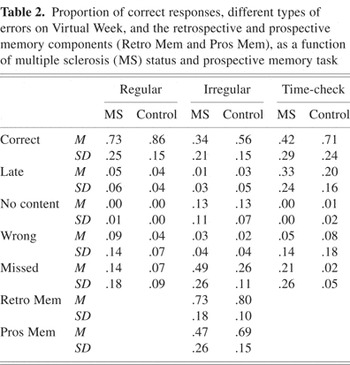
The proportion of correct prospective memory responses are presented in Table 2 as a function of MS status (MS group, control group) and prospective memory task (regular, irregular, time-check). These data were analyzed with a 2 × 3 mixed ANOVA with the between subjects variable of MS status and the within subjects variable of prospective memory task. These two variables did not significantly interact, F(2,76) = 1.87, MSE = 0.03, p = .161, η2 = .05, but they were both significant main effects.
Proportion of correct responses, different types of errors on Virtual Week, and the retrospective and prospective memory components (Retro Mem and Pros Mem), as a function of multiple sclerosis (MS) status and prospective memory task

Thus, the main effect of MS status indicated that the control group had a significantly greater proportion of correct responses (M = .71, SD = .22) than the MS group (M = .49, SD = .30), F(1,38) = 15.90, MSE = 0.09, p < .001, η2 = .30. Post hoc Tukey tests on the second main effect for prospective memory task, F(2,76) = 39.14, MSE = 0.03, p < .001, η2 = .51, revealed that participants had significantly more correct responses on regular tasks (M = .79, SD = .21) than the time-check task (M = .56, SD = .30) and on both these tasks participants had significantly more correct responses than on the irregular tasks (M = .45, SD = .22).
Table 2 also shows the pattern of errors on the Virtual Week. The pattern replicated the following key features of the pattern reported by Rendell and Craik (2000); most of the errors involved a failure to respond (missed responses). Late responses were rare for regular and irregular tasks but were a key error for the time-check tasks. Whereas wrong responses were generally infrequent for all categories of task, they occurred relatively more frequently for regular and time-check tasks than for irregular tasks. On irregular tasks, missed responses represented the major source of error, but no content responses were also reasonably prevalent. It is of note that no content responses were virtually never made for either regular or time-check tasks. Overall the results indicate that, as in Rendell and Craik (2000), the content of the prospective memory tasks was nearly always either remembered reasonably accurately or not remembered at all.
Finally, for the irregular tasks we analyzed the retrospective and prospective memory components1
We thank an anonymous reviewer for suggesting a method to separate out the retrospective and prospective memory components of Virtual Week. The reviewer suggested that the prospective memory component could be derived by pooling all on time responses (correct + wrong), and dividing this score by all possible responses, whereas the retrospective component could be derived by dividing on time (correct) responses by all on time responses (correct + wrong). However, whilst error data for Virtual Week is reported in Table 2 (“late,” “no content,” “wrong,” and “missed”), it would be necessary to additionally categorize “wrong” content responses as being “wrong and on time” versus “wrong and not on time” in order to derive the measures of prospective and retrospective memory as operationalized by the anonymous reviewer, and this information was unfortunately not available. However, whilst “wrong” responses were made relatively infrequently for all categories of task, for Irregular tasks, the proportion was so small as to be negligible (.03 for MS participants and .02 for controls). Further, it is for Irregular tasks that the subdivision between the Prospective and Retrospective Memory component is of greatest interest (relative to regular and time-check tasks, irregular tasks are the most challenging to retrospective memory). Thus, the prospective and retrospective memory components were derived for irregular tasks only. For this category of task, the prospective memory component was derived by dividing all on time responses (which correspond to “correct” and “no content” responses) by all possible responses, whilst the corresponding retrospective memory component was derived by dividing all on time correct responses (“correct”) by all on time responses (“correct” + “no content”).
As noted previously, the regular and irregular tasks included time- and event-based prospective memory tasks. Analysis confirmed that there were no systematic differences between these two types of task. A 2 × 2 × 2 mixed ANOVA was conducted with the between subjects variable of MS status (MS group, control group) and the within subjects variables of prospective memory target (time-based, event-based) and prospective memory task (regular, irregular). Prospective memory target was not a significant main effect F(1,38) = 0.05, MSE = 0.03, p = .830, η2 = .001 and did not significantly interact with MS status F(1,38) = 0.68, MSE = 0.03, p = .415, η2 = .02 or with prospective memory task, F(1,38) = 2.65, MSE = 0.03, p = .112, η2 = .07. The three way interaction between prospective memory target, MS status and prospective memory task was also not significant, F(1,38) = 1.14, MSE = 0.03, p = .29, η2 = .03.
As noted previously, in Virtual Week the time target may be regarded as relatively focal to the ongoing activity. In contrast, the time-check task could be considered as more nonfocal. A comparison of regular event-based, regular focal time-based and regular nonfocal time-based tasks was therefore possible, and the proportion of correct responses as a function of these three types of tasks is shown in Figure 1. A 2 × 3 mixed ANOVA was conducted with the between subjects variable of MS status (MS group, control group) and the within subjects variable of prospective memory target (regular event-based, regular focal time-based, regular nonfocal time-based). There was a significant main effect of prospective memory target, F(2,76) = 16.10, MSE = 0.04, p < .001, η2 = .30, and of MS status, F(1,38) = 10.05, MSE = 0.10, p = .003, η2 = .21 but these variables did not significantly interact, F(1,38) = 2.38, MSE = 0.04, p = .100, η2 = .06. Post hoc Tukey tests revealed that participants had significantly fewer correct responses on regular nonfocal time-based tasks (M = .56, SD = .30) than both the regular focal time-based tasks (M = .81, SD = .24) and the regular event-based tasks (M = .77, SD = .26) but the differences were not significant on the latter two tasks.

Proportion of correct responses on the regular tasks in Virtual Week as a function of prospective memory target type and multiple sclerosis (MS) status (bars represent SE and the SD is the numbers in parentheses)
DISCUSSION
The results indicate that MS is associated with significantly increased difficulties with prospective memory irrespective of task type (regular, time-check, irregular, focal, or nonfocal). This differs with Rendell and Craik's (2000) finding of minimal age differences on the regular tasks and substantial age deficits on the other tasks. Given that the regular tasks in Virtual Week impose only minimal demands on retrospective memory (i.e., remembering what it is that needs to be done), these results suggest that MS is associated with generalized prospective memory deficits, and in particular, difficulties are not simply restricted to the retrospective memory component, but also extend to the prospective memory component (i.e., the implementation of delayed intentions). Importantly, a research poster presented by Kardiasmenos et al. (2004) using the same Virtual Week methodology also found that MS participants were significantly impaired on this measure, and that deficits were not restricted to the retrospective memory component, but extended to the prospective component of the task.
Time versus Event-based Prospective Memory
Of the specific prospective memory task types, it is of note that in the prospective memory literature most importance has typically been attributed to the distinction between time- and event-based tasks. It is therefore of note that no differences were found between the event and time-based versions of the regular or irregular tasks in the original Virtual Week study in their sensitivity to age effects (Rendell & Craik, 2000), which contrasts with other evidence indicating time-based prospective memory is often associated with greater age-related impairment (for a review see, Henry et al., 2004)
It is suggested that the equivalent sensitivity of time- and event-based prospective memory tasks to the presence of MS that was found in the present study may have been because, relative to most laboratory time-based prospective memory tasks, the time-based regular and irregular tasks in Virtual Week have considerable external cues (the time is cued by the activities relevant to the virtual time of day, and the time is clearly seen and “encountered” on the Virtual Week Board Game). The provision of these cues may therefore have equated these tasks to the event-based tasks in terms of their reliance on self-initiated processing, representing the situation in daily life where some times of day can have strong environmental cues. Thus, further research is required to ascertain whether MS does differentially affect time relative to event-based prospective memory.
Focal versus Nonfocal Processing
McDaniel & Einstein (2000) argue that prospective memory tasks can be carried out using either automatic monitoring, where cues “pop into mind,” or instead by strategic, effortful monitoring, where cues are actively searched for during the ongoing task. Einstein and McDaniel (2005) assume that distinct target events presented in focal awareness of the processing activities required for the ongoing task are likely to depend on automatic processes. Indeed, age differences have been found to be larger on event-based prospective memory tasks that were low rather than high in focal processing (Rendell et al., in press). Although previously this distinction has only been applied to event-based prospective memory tasks (for classification of tasks, see Einstein & McDaniel, 2005), Virtual Week provides the opportunity for a somewhat parallel task distinction to be applied to time-based prospective memory tasks. In Virtual Week, the time target for the regular and irregular tasks is the virtual time of day in the virtual day. As noted previously, this time target has strong links to the ongoing activity and therefore is relatively focal to the ongoing activity. In contrast, the time-check task may be regarded as a more nonfocal time-based tasks, as the time targets are independent of the virtual time of day in Virtual Week. A comparison of regular event-based, regular focal time-based and regular nonfocal time-based tasks indicated that all participants had significantly fewer correct responses on regular nonfocal time-based tasks relative to both the regular focal time-based tasks and the regular event-based tasks. These results indicate that, similar to controls, individuals with MS are likely to experience greater difficulty implementing delayed intentions when the prospective memory task demands are presented outside of focal awareness of the ongoing task.
Accounting for Prospective Memory Failures in MS
Because deficits in retrospective memory are among the most consistently documented deficits associated with MS (see, e.g., Thornton & Raz, 1997), the MS participants in the present study may be regarded as relatively cognitively intact, as they were not significantly impaired on any of the background measures of long- and short-term memory administered. In the measure of Virtual Week, the retrospective memory requirements of the PM task may be regarded as most clearly corresponding to delayed memory performance, in that after being given the initial instructions, participants are required to recall what it is that they need to do after a period of time has elapsed. Thus, although the two groups did not differ significantly on a short-delay recall measure, clearly the claim that the prospective memory impairment observed in the MS group is not attributable to impaired retrospective memory would be stronger had the study included a delayed recall interval that was longer to more clearly equate the retrospective memory demands in Virtual Week. However, for the prospective memory tasks for which retrospective memory demands were greatest (irregular tasks), the prospective (but not the retrospective) component was significantly impaired. Further, for prospective memory failures to be attributable to difficulties with retrospective memory this would predict a substantial proportion of errors being recorded as no content (i.e., remembering that something should be done, but forgetting what it was). However, in the present study the majority of errors were misses (i.e., failures to respond). Finally, as noted previously, the finding of deficits on regular tasks in Virtual Week (tasks which impose relatively low demands on retrospective memory and which are not subject to age effects) is also consistent with the argument that MS is associated with generalized prospective memory difficulties. Thus, overall evidence suggests that the prospective memory impairment observed in the MS sample in the present study cannot simply be attributed to failures of retrospective memory.
CONCLUSION
The current study indicates that MS is associated with prospective memory deficits and that these deficits are pervasive irrespective of task type. The results also indicate that failures of retrospective memory are not the major cause of this impairment. This is important because, unlike retrospective memory, prospective memory is not routinely assessed in individuals with MS. The magnitude of the prospective memory deficits seen, and the consistency of these deficits irrespective of the specific task demands, indicate the importance of assessing this capacity.
ACKNOWLEDGMENTS
This research was supported by an Australian Catholic University Large Grant to Peter Rendell. The information in this manuscript and the manuscript itself is new and original and it has never been published either electronically or in print. The authors have no financial or other relationships that could be interpreted as a conflict of interest affecting this manuscript.