1 Introduction and summary
An element x of a lattice L is modular if it makes the formula
 $$ \begin{align*} \forall y,z\in L:\,y\le z\longrightarrow(x\vee y)\wedge z=(x\wedge z)\vee y \end{align*} $$
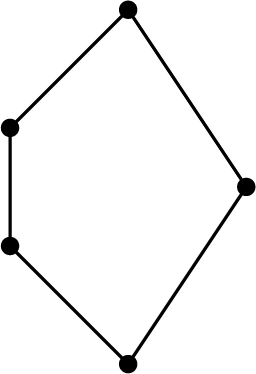
hold true. Modular elements enjoy a distinguished position in lattices. The interest in them is explained by the fact that modular elements of L are exactly the ones that are not the central elements of any pentagon (that is, the five-element nonmodular sublattice shown in Figure 1) of L (see [Reference Ježek7, Proposition 2.1]).
Pentagon.

Modular elements played a crucial role in the study of first-order definability in the lattice
 $\mathbb {S}{\scriptstyle \mathbb {EM}}$
of all semigroup varieties [Reference Ježek and McKenzie8]. Although a complete description of modular elements in
 $\mathbb {S}{\scriptstyle \mathbb {EM}}$
is still unknown, a number of profound results have been obtained in this direction. In particular, the set of all modular elements in
 $\mathbb {S}{\scriptstyle \mathbb {EM}}$
is uncountably infinite. More information can be found in the comprehensive survey article [Reference Vernikov9] in the context of studying special elements of various types in the lattice
 $\mathbb {S}{\scriptstyle \mathbb {EM}}$
.
The present article is concerned with modular elements of the lattice
 $\mathbb {M}{\scriptstyle \mathbb {ON}}$
of all varieties of monoids, that is, semigroups with an identity element. Even though monoids are very similar to semigroups, the situation turns out to be very different. Compared with the lattice
 $\mathbb {S}{\scriptstyle \mathbb {EM}}$
, the systematic study of the lattice
 $\mathbb {M}{\scriptstyle \mathbb {ON}}$
has begun relatively recently, although the first results in this direction were obtained back in the late 1960s. In particular, the problem of describing modular elements of the lattice
 $\mathbb {M}{\scriptstyle \mathbb {ON}}$
remained open (see the recent survey [Reference Gusev, Lee and Vernikov4, Section 9.1]). The goal of the present note is a complete solution to this problem. We present an exhaustive countably infinite list of monoid varieties that are modular elements of the lattice
 $\mathbb {M}{\scriptstyle \mathbb {ON}}$
.
Let us briefly recall a few notions that we need to formulate our main result. Let
 $\mathcal {X}$
be a countably infinite set called an alphabet. As usual, let
 $\mathcal {X}^\ast $
denote the free monoid over the alphabet
 $\mathcal {X}$
. Elements of
 $\mathcal {X}$
are called letters and elements of
 $\mathcal {X}^\ast $
are called words. We treat the identity element of
 $\mathcal {X}^\ast $
as the empty word, which is denoted by
 $1$
. Words and letters are denoted by lower case Latin letters. However, words unlike letters are written in bold. An identity is written as
 $\mathbf {u} \approx \mathbf {v}$
, where
 $\mathbf {u},\mathbf {v} \in \mathcal {X}^\ast $
; it is nontrivial if
 $\mathbf {u} \ne \mathbf {v}$
. A variety
 $\mathbf {V}$
satisfies an identity
 $\mathbf {u} \approx \mathbf {v}$
if for any monoid
 $M\in \mathbf {V}$
and any substitution
 $\varphi \colon \mathcal {X} \to M$
, the equality
 $\varphi (\mathbf {u})=\varphi (\mathbf {v})$
holds in M.
For any set
 $\mathcal W$
of words, let
 $M(\mathcal W)$
denote the Rees quotient monoid of
 $\mathcal {X}^\ast $
over the ideal of all words that are not subwords of any word in
 $\mathcal W$
. Given a set
 $\mathcal W$
of words, let
 $\mathbf M(\mathcal W)$
denote the monoid variety generated by
 $M(\mathcal W)$
. For brevity, if
 $\mathbf {w}_1,\ldots ,\mathbf {w}_k\in \mathcal {X}^\ast $
, then we write
 $M(\mathbf {w}_1,\ldots ,\mathbf {w}_k)$
(respectively,
 $\mathbf M(\mathbf {w}_1,\ldots ,\mathbf {w}_k)$
) rather than
 $M(\{\mathbf {w}_1,\ldots ,\mathbf {w}_k\})$
(respectively,
 $\mathbf M(\{\mathbf {w}_1,\ldots ,\mathbf {w}_k\})$
).
As usual, let
 $\mathbb {N}$
denote the set of all natural numbers. For any
 $n\in \mathbb {N}$
, we denote by
 $S_n$
the full symmetric group on the set
 $\{1,\ldots ,n\}$
. For any
 $n,m\in \mathbb {N}$
and
 $\rho \in S_{n+m}$
, we define the words
 $$ \begin{align*} \mathbf{a}_{n,m}[\rho]&:=\bigg(\prod_{i=1}^n z_it_i\bigg)x\bigg(\prod_{i=1}^{n+m} z_{i\rho}\bigg)x\bigg(\prod_{i=n+1}^{n+m} t_iz_i\bigg),\\ \mathbf{a}_{n,m}^\prime[\rho]&:=\bigg(\prod_{i=1}^n z_it_i\bigg)\bigg(\prod_{i=1}^{n+m} z_{i\rho}\bigg)x^2\bigg(\prod_{i=n+1}^{n+m} t_iz_i\bigg). \end{align*} $$
We denote by
 $\mathbf {M}{\scriptstyle \mathbf {ON}}$
the variety of all monoids.
Our main result is the following theorem.
Theorem 1.1. For a monoid variety
 $\mathbf {V}$
, the following are equivalent:
-
(i)
 $\mathbf {V}$
is a modular element of the lattice
$\mathbb {M}{\scriptstyle \mathbb {ON}}$
;
-
(ii)
$\mathbf {V}$
is either the variety
$\mathbf {M}{\scriptstyle \mathbf {ON}}$
or satisfies the identities
$$ \begin{align*} \begin{aligned} &x^2\approx x^3,\,x^2y\approx yx^2,\,xyzxty\approx yxzxty,\,xzytxy\approx xzytyx,\\ &xzxtxysy\approx xzxtyxsy,\,xzxytysy\approx xzyxtysy,\,\mathbf{a}_{n,m}[\rho]\approx \mathbf{a}_{n,m}^\prime[\rho] \end{aligned} \end{align*} $$
for all
$n,m\in \mathbb {N}$
and
$\rho \in S_{n+m}$
; -
(iii)
$\mathbf {V}$
coincides with one of the varieties
$$ \begin{align*} &\mathbf M(\emptyset),\,\mathbf M(1),\mathbf M(x),\,\mathbf M(xy),\,\mathbf M(xt_1x),\,\ldots,\, \mathbf M(xt_1x\cdots t_nx),\,\ldots,\\ &\mathbf M(\{xt_1x\cdots t_nx\mid n\in\mathbb{N}\}), \mathbf M(xzxyty,xt_1x),\,\ldots,\, \mathbf M(xzxyty,xt_1x\cdots t_nx),\,\ldots,\\ &\mathbf M(\{xzxyty,xt_1x\cdots t_nx\mid n\in\mathbb{N}\}),\,\mathbf{M}{\scriptstyle\mathbf{ON}}. \end{align*} $$


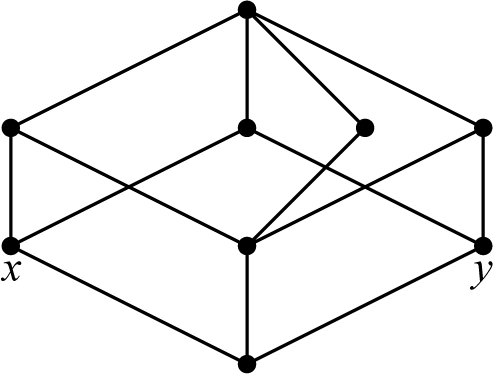
In general, the set of modular elements in a lattice need not form a sublattice. For example, the elements x and y of the lattice in Figure 2 are modular but their join
 $x\vee y$
is not. However, Theorem 1.1 shows that the set of all modular elements of the lattice
 $\mathbb {M}{\scriptstyle \mathbb {ON}}$
forms a sublattice and, moreover, all proper monoid varieties that are modular elements in
 $\mathbb {M}{\scriptstyle \mathbb {ON}}$
constitute an order ideal in
 $\mathbb {M}{\scriptstyle \mathbb {ON}}$
.
Modular elements whose join is not modular.

The article consists of three sections. Some definitions, notation and auxiliary results are given in Section 2, while Section 3 is devoted to the proof of Theorem 1.1.
2 Preliminaries
An identity
 $\mathbf {u} \approx \mathbf {v}$
is directly deducible from an identity
 $\mathbf {s} \approx \mathbf {t}$
if there exist words
 $\mathbf {a},\mathbf {b} \in \mathcal {X}^\ast $
and a substitution
 $\varphi \colon \mathcal {X} \to \mathcal {X}^\ast $
such that
 $\{\mathbf {u}, \mathbf {v}\} = \{\mathbf {a}\varphi (\mathbf {s})\mathbf {b},\mathbf {a}\varphi (\mathbf {t})\mathbf {b}\}$
. A nontrivial identity
 $\mathbf {u} \approx \mathbf {v}$
is deducible from a set
 $\Sigma $
of identities if there exists some finite sequence
 $\mathbf {u} = \mathbf {w}_0,\ldots , \mathbf {w}_m = \mathbf {v}$
of words such that each identity
 $\mathbf {w}_i \approx \mathbf {w}_{i+1}$
is directly deducible from some identity in
 $\Sigma $
.
Proposition 2.1 (Birkhoff’s completeness theorem for equational logic; see [Reference Burris and Sankappanavar1, Theorem II.14.19]).
A monoid variety defined by a set
 $\Sigma $
of identities satisfies an identity
 $\mathbf {u} \approx \mathbf {v}$
if and only if
 $\mathbf {u} \approx \mathbf {v}$
is deducible from
 $\Sigma $
.
Given a variety
 $\mathbf {V}$
, a word
 $\mathbf {u}$
is called an isoterm for
 $\mathbf {V}$
if the only word
 $\mathbf {v}$
such that
 $\mathbf {V}$
satisfies the identity
 $\mathbf {u} \approx \mathbf {v}$
is the word
 $\mathbf {u}$
itself.
Lemma 2.2 [Reference Jackson6, Lemma 3.3].
Let
 $\mathbf {V}$
be a monoid variety and
 $\mathcal W$
a set of words. Then,
 $M(\mathcal W)\in \mathbf {V}$
if and only if each word in
 $\mathcal W$
is an isoterm for
 $\mathbf {V}$
.
The alphabet of a word
 $\mathbf {w}$
, that is, the set of all letters occurring in
 $\mathbf {w}$
, is denoted by
 $\operatorname {\mathrm {alph}}(\mathbf {w})$
. For a word
 $\mathbf {w}$
and a letter x, let
 $\operatorname {\mathrm {occ}}_x(\mathbf {w})$
denote the number of occurrences of x in
 $\mathbf {w}$
. A letter x is called simple (respectively, multiple) in a word
 $\mathbf {w}$
if
 $\operatorname {\mathrm {occ}}_x(\mathbf {w})=1$
(respectively,
 $\operatorname {\mathrm {occ}}_x(\mathbf {w})>1$
). The set of all simple (respectively, multiple) letters in a word
 $\mathbf {w}$
is denoted by
 $\operatorname {\mathrm {sim}}(\mathbf {w})$
(respectively,
 $\operatorname {\mathrm {mul}}(\mathbf {w})$
).
Lemma 2.3 [Reference Gusev and Vernikov5, Lemma 2.17].
Let
 $\mathbf {u}\approx \mathbf {v}$
be an identity of
 $M(xy)$
. If
 $\mathbf {u}= \mathbf {u}_0t_1\mathbf {u}_1\cdots t_m\mathbf {u}_m$
, where
 $\operatorname {\mathrm {sim}}(\mathbf {u})=\{t_1,\ldots ,t_m\}$
, then
 $\mathbf {v}=\mathbf {v}_0t_1\mathbf {v}_1\cdots t_m\mathbf {v}_m, \operatorname {\mathrm {alph}}(\mathbf {u}_0\cdots \mathbf {u}_m)=\operatorname {\mathrm {alph}}(\mathbf {v}_0\cdots \mathbf {v}_m)$
and
 $\operatorname {\mathrm {sim}}(\mathbf {v})=\{t_1,\ldots ,t_m\}$
.
The following statement was established in [Reference Gusev and Vernikov5, proof of Lemma 3.5].
Lemma 2.4. Let
 $\mathbf {V}$
be a monoid variety such that
 $M(xt_1x\cdots t_nx)\in \mathbf {V}$
. If
 $M(\mathbf {p}\,xy\,\mathbf {q})\notin \mathbf {V}$
, where
 $\mathbf {p}:=a_1t_1\cdots a_kt_k$
and
 $\mathbf {q}:=t_{k+1}a_{k+1}\cdots t_{k+\ell }a_{k+\ell }$
for some
 $k,\ell \ge 0$
, and
 $a_1,\ldots ,a_{k+\ell }$
are letters such that
 $\{a_1,\ldots ,a_{k+\ell }\}=\{x,y\}$
and
 $\operatorname {\mathrm {occ}}_x(\mathbf {p}\mathbf {q}),\operatorname {\mathrm {occ}}_y(\mathbf {p}\mathbf {q})\le n$
, then
 $\mathbf {V}$
satisfies the identity
 $\mathbf {p}\,xy\,\mathbf {q}\approx \mathbf {p}\,yx\,\mathbf {q}$
.
If
 $\mathbf {w}$
is a word and
 $\mathcal Z\subseteq \operatorname {\mathrm {alph}}(\mathbf {w})$
, then we denote by
 $\mathbf {w}_{\mathcal Z}$
(respectively,
 $\mathbf {w}(\mathcal Z)$
) the word obtained from
 $\mathbf {w}$
by removing all occurrences of letters from
 $\mathcal Z$
(respectively,
 $\operatorname {\mathrm {alph}}(\mathbf {w})\setminus \mathcal Z$
). If
 $\mathcal Z=\{z\}$
, then we write
 $\mathbf {w}_z$
rather than
 $\mathbf {w}_{\{z\}}$
.
The expression
 $_{i\mathbf {w}}x$
means the ith occurrence of a letter x in a word
 $\mathbf {w}$
. If the ith occurrence of x precedes the jth occurrence of y in a word
 $\mathbf {w}$
, then we write
 $({_{i\mathbf {w}}x}) < ({_{j\mathbf {w}}y})$
.
3 Proof of Theorem 1.1
We will prove Theorem 1.1 following the scheme (i)
 $\Rightarrow $
(ii)
 $\Rightarrow $
(iii)
 $\Rightarrow $
(i).
(i)
 $\Rightarrow $
(ii). Let
 $\mathbf {V}$
be a proper monoid variety which is a modular element of the lattice
 $\mathbb {M}{\scriptstyle \mathbb {ON}}$
. Then, the variety
 $\mathbf {V}$
satisfies the identities
 $$ \begin{align} x^2\approx x^3,\ x^2y\approx yx^2 \end{align} $$
by [Reference Gusev and Lee3, Proposition 4.3].
If
 $M(xyx)\notin \mathbf {V}$
, then it follows from [Reference Gusev and Vernikov5, Lemma 3.3(i)] that
 $\mathbf {V}$
satisfies the identities
 $x^2y\approx xyx\approx yx^2$
which, evidently, imply all the identities listed in item (ii) of Theorem 1.1. So, we may further assume that
 $M(xyx)\in \mathbf {V}$
.
The rest of the proof proceeds in three steps.
Step 1:
 $\mathbf {V}$
satisfies the identities
 $xyzxty\approx yxzxty$
and
 $xzytxy\approx xzytyx$
.
Arguing by contradiction, suppose that
 $\mathbf {V}$
violates the identity
 $xyzxty\approx yxzxty$
. Then,
 $M(xyzxty)\in \mathbf {V}$
by Lemma 2.4. Let
 $\mathbf {X}^\prime $
denote the monoid variety defined by the identity
 $$ \begin{align*} \mathbf{u}:=z_1t_1z_2t_2\,c^2z_1bz_2\,xcy\,b\,s_1xs_2y\approx z_1t_1z_2t_2\,c^2z_1bz_2\,ycx\,b\,s_1xs_2y=:\mathbf{v}. \end{align*} $$
We need the following auxiliary result.
Claim 3.1. The words
 $\mathbf {u}$
and
 $\mathbf {v}$
can only form an identity of
 $\mathbf {X}^\prime $
with each other.
Proof. Take
 $\mathbf {w}\in \{\mathbf {u},\mathbf {v}\}$
and consider an arbitrary identity of the form
 $\mathbf {w}\approx \mathbf {w}^\prime $
that holds in
 $\mathbf {X}^\prime $
. We are going to verify that
 $\mathbf {w}^\prime \in \{\mathbf {u},\mathbf {v}\}$
. By Proposition 2.1 and evident induction, we may assume without any loss that the identity
 $\mathbf {w}\approx \mathbf {w}^\prime $
is directly deducible from the identity
 $\mathbf {u}\approx \mathbf {v}$
, that is, there exist words
 $\mathbf {a},\mathbf {b} \in \mathcal {X}^\ast $
and a substitution
 $\varphi \colon \mathcal {X} \to \mathcal {X}^\ast $
such that
 $(\mathbf {w}, \mathbf {w}^\prime ) = ( \mathbf {a}\varphi (\mathbf {u})\mathbf {b},\mathbf {a}\varphi (\mathbf {v})\mathbf {b} )$
. Notice that every subword of
 $\mathbf {w}$
of length
 $>1$
occurs in
 $\mathbf {w}$
exactly once and each letter occurs in
 $\mathbf {w}$
at most thrice. It follows that:
-
(*)
$\varphi (v)$
is either the empty word or a letter for any
$v\in \operatorname {\mathrm {mul}}(\mathbf {u})=\operatorname {\mathrm {mul}}(\mathbf {v})$
.


Suppose first that
 $\varphi (c)=1$
. In this case, if
 $\varphi (x)=1$
or
 $\varphi (y)=1$
, then
 $\varphi (\mathbf {u})=\varphi (\mathbf {v})$
and so
 $\mathbf {w}^\prime \in \{\mathbf {u},\mathbf {v}\}$
, as required. So, we may assume that
 $\varphi (x)\ne 1$
and
 $\varphi (y)\ne 1$
. Then,
 $\varphi (x)$
and
 $\varphi (y)$
are letters by statement (
 $\ast $
). These letters must be distinct since no letter occurs in
 $\mathbf {w}$
more than thrice. However, the word
 $\mathbf {w}$
does not contain any subword consisting exclusively of nonlast occurrences of two distinct letters in
 $\mathbf {w}$
, while the first occurrences of the letters
 $\varphi (x)$
and
 $\varphi (y)$
are adjacent in
 $\mathbf {w}$
, which is a contradiction.
Suppose now that
 $\varphi (c)\ne 1$
. Then,
 $\varphi (c)=c$
because c is the only letter that occurs thrice in both
 $\mathbf {u}$
and
 $\mathbf {w}$
. Hence,
 $$ \begin{align*} \varphi(z_1bz_2x)= \begin{cases} z_1bz_2x&\text{if } \mathbf{w}=\mathbf{u}, \\ z_1bz_2y&\text{if } \mathbf{w}=\mathbf{v}. \end{cases} \end{align*} $$
Further, it follows from statement (
 $\ast )$
that
 $\varphi (b)=b$
, whence
 $$ \begin{align*} (\varphi(x),\varphi(y))= \begin{cases} (x,y)&\text{if } \mathbf{w}=\mathbf{u}, \\ (y,x)&\text{if } \mathbf{w}=\mathbf{v}. \end{cases} \end{align*} $$
Since
 $({_{1\mathbf {u}}}x)<({_{1\mathbf {u}}}y)<({_{2\mathbf {u}}}x)<({_{2\mathbf {u}}}y)$
and
 $({_{1\mathbf {v}}}y)<({_{1\mathbf {v}}}x)<({_{2\mathbf {v}}}x)<({_{2\mathbf {v}}}y)$
, it follows that the case when
 $\mathbf {w}=\mathbf {v}$
is impossible. Therefore,
 $(\varphi (x),\varphi (y))=(x,y)$
in either case. This implies that
 $\mathbf {w}^\prime =\mathbf {v}$
and we are done.
Put
 $\mathbf {X}:=\mathbf M(\mathbf {u},\mathbf {v})\wedge \mathbf {X}^\prime $
. Consider an arbitrary identity of the form
 $\mathbf {u}\approx \mathbf {w}$
that is satisfied by the variety
 $\mathbf {X}\vee \mathbf {V}$
. In view of Claim 3.1,
 $\mathbf {w}\in \{\mathbf {u},\mathbf {v}\}$
. Since
 $M(xyzxty)\in \mathbf {V}$
, Lemma 2.2 implies that
 $\mathbf {w}(x,y,s_1,s_2)=\mathbf {u}(x,y,s_1,s_2)=xys_1xs_2y$
. Hence,
 $\mathbf {w} = \mathbf {u}$
. We see that
 $\mathbf {u}$
is an isoterm for the variety
 $\mathbf {X}\vee \mathbf {V}$
. By a similar argument, we can show that
 $\mathbf {v}$
is also an isoterm for
 $\mathbf {X}\vee \mathbf {V}$
. Then,
 $$ \begin{align*} (\mathbf{X}\vee \mathbf{V})\wedge \mathbf M(\mathbf{u},\mathbf{v}) = \mathbf M(\mathbf{u},\mathbf{v}) \end{align*} $$
by Lemma 2.2. It is easy to see that the identity
 $xyzxty\approx yxzxty$
holds in
 $M(\mathbf {u},\mathbf {v})$
. Then,
 $\mathbf {V}\wedge \mathbf M(\mathbf {u},\mathbf {v})$
satisfies
 $\mathbf {u}\stackrel {\mathbf {V}}\approx \mathbf {u}_cc^2\stackrel {\mathbf M(\mathbf {u},\mathbf {v})}\approx \mathbf {v}_cc^2\stackrel {\mathbf {V}}\approx \mathbf {v}$
. By the very definition, the identity
 ${\mathbf {u}\approx \mathbf {v}}$
is satisfied by
 $\mathbf {X}$
as well. Since
 $\mathbf {X}\subset \mathbf M(\mathbf {u},\mathbf {v})$
, we have
 $$ \begin{align*} \mathbf{X}\vee(\mathbf{V}\wedge\mathbf M(\mathbf{u},\mathbf{v}))\subset (\mathbf{X}\vee \mathbf{V})\wedge \mathbf M(\mathbf{u},\mathbf{v}) = \mathbf M(\mathbf{u},\mathbf{v}), \end{align*} $$
which contradicts the fact that
 $\mathbf {V}$
is a modular element of
 $\mathbb {M}{\scriptstyle \mathbb {ON}}$
. Therefore,
 $\mathbf {V}$
satisfies
 $xyzxty\approx yxzxty$
. By the dual argument, we can show that
 $xzytxy\approx xzytyx$
holds in
 $\mathbf {V}$
.
Step 2:
 $\mathbf {V}$
satisfies the identity
 $\mathbf {a}_{n,m}[\rho ]\approx \mathbf {a}_{n,m}^\prime [\rho ]$
for all
 $n,m\in \mathbb {N}$
and
 $\rho \in S_{n+m}$
.
Arguing by contradiction, suppose that
 $\mathbf {V}$
violates
 $\mathbf {a}_{p,q}[\pi ]\approx \mathbf {a}_{p,q}^\prime [\pi ]$
for some
 ${p, q\in \mathbb {N}}$
and
 $\pi \in S_{p+q}$
. Then,
 $M(\mathbf {a}_{n,m}[\rho ])\in \mathbf {V}$
for some
 $n,m\in \mathbb {N}$
and
 $\rho \in S_{n+m}$
by [Reference Gusev2, Lemma 4.8]. For brevity, put
 $$ \begin{align*} &\mathbf{p}:= \begin{cases} z_1t_1\cdots z_nt_n &\text{if }1\le 1\rho\le n, \\ y_1s_1y_2s_2\,z_1t_1\cdots z_nt_n &\text{if }n< 1\rho\le n+m, \end{cases} \\ &\mathbf r:= \begin{cases} z_{n+1}t_{n+1}\cdots z_{n+m}t_{n+m}\,s_1y_1s_2y_2 &\text{if }1\le 1\rho\le n, \\ z_{n+1}t_{n+1}\cdots z_{n+m}t_{n+m} &\text{if }n< 1\rho\le n+m. \end{cases} \end{align*} $$
Let
 $$ \begin{align*} \mathbf{X}:= \begin{cases} \mathbf M(y^2xtx,xy^2tx)&\text{if }1\le 1\rho\le n, \\ \mathbf M(xtxy^2,xty^2x)&\text{if }n< 1\rho\le n+m. \end{cases} \end{align*} $$
Consider an arbitrary identity of the form
 $$ \begin{align*} \mathbf{u}:=\mathbf px\bigg(\prod_{i=1}^{n+m-1} z_{i\rho}\bigg)y_1z^2y_2z_{(n+m)\rho}x\mathbf r\approx \mathbf{v} \end{align*} $$
that is satisfied by the variety
 $\mathbf {X}\vee \mathbf {V}$
. In view of Lemma 2.2,
 $$ \begin{align*} &\mathbf{v}_{\{y_1,y_2,s_1,s_2,z\}}=\mathbf{u}_{\{y_1,y_2,s_1,s_2,z\}}=\mathbf{a}_{n,m}[\rho],\\&\mathbf{v}_{\{x,z\}}=\mathbf{u}_{\{x,z\}}=\mathbf{p}\bigg(\prod_{i=1}^{n+m-1} z_{i\rho}\bigg)\,y_1y_2z_{(n+m)\rho}\mathbf r,\\&\mathbf{v}(y_1,s_1,z)=\mathbf{u}(y_1,s_1,z)= \begin{cases} y_1z^2s_1y_1&\text{if }1\le 1\rho\le n, \\y_1s_1y_1z^2&\text{if }n< 1\rho\le n+m, \end{cases} \\&\mathbf{v}(y_2,s_2,z)=\mathbf{u}(y_2,s_2,z)= \begin{cases} z^2y_2s_2y_2&\text{if }1\le 1\rho\le n, \\y_2s_2z^2y_2&\text{if }n< 1\rho\le n+m. \end{cases} \end{align*} $$
It follows that
 $\mathbf {v} = \mathbf {u}$
. We see that the word
 $\mathbf {u}$
is an isoterm for the variety
 $\mathbf {X}\vee \mathbf {V}$
. Then,
 $$ \begin{align*} (\mathbf{X}\vee \mathbf{V})\wedge \mathbf M(\mathbf{u}) = \mathbf M(\mathbf{u}) \end{align*} $$
by Lemma 2.2.
Now, we are going to verify that
 $M(\mathbf {u})$
satisfies the identity
 $$ \begin{align*} \mathbf{a}:=\mathbf{u}_z=\mathbf px\bigg(\prod_{i=1}^{n+m-1} z_{i\rho}\bigg)y_1y_2z_{(n+m)\rho}x\mathbf r \approx\mathbf pz_{1\rho}x\,\bigg(\prod_{i=2}^{n+m-1} z_{i\rho}\bigg)\,y_1y_2z_{(n+m)\rho}x\mathbf r=:\mathbf{a}^\prime. \end{align*} $$
We consider an arbitrary substitution
 $\psi \colon \mathscr X \to M(\mathbf {u})$
and show that
 $\psi (\mathbf {a})=\psi (\mathbf {a}^\prime )$
. We may suppose that at least one of the elements
 $\psi (\mathbf {a})$
or
 $\psi (\mathbf {a}^\prime )$
is nonzero and forms a subword of
 $\mathbf {u}$
. If
 $\psi (x)=1$
, then
 $\psi (\mathbf {a})=\psi (\mathbf {a}^\prime )$
and we are done. So, we may further assume that
 $\psi (x)\ne 1$
. Clearly, none of the letters
 $s_1,s_2,t_1,\ldots ,t_{n+m}$
belongs to
 $\operatorname {\mathrm {alph}}(\psi (x))$
because all these letters are simple in
 $\mathbf {u}$
, while
 $x\in \operatorname {\mathrm {mul}}(\mathbf {a})=\operatorname {\mathrm {mul}}(\mathbf {a}^\prime )$
. Further, none of the letters
 $y_1,y_2,z_1,\ldots ,z_{n+m}$
belongs to
 $\operatorname {\mathrm {alph}}(\psi (x))$
because there is a simple letter between the first and the second occurrences of any of these letters in
 $\mathbf {u}$
, while there are no simple letters between the first and the second occurrences of x in both
 $\mathbf {a}$
and
 $\mathbf {a}^\prime $
. Finally,
 $x\notin \operatorname {\mathrm {alph}}(\psi (x))$
because
 $$ \begin{align*} \psi\bigg(\bigg(\prod_{i=1}^{n+m-1} z_{i\rho}\bigg)y_1y_2z_{(n+m)\rho}\bigg) \end{align*} $$
cannot contain
 $z^2$
as a subword. Therefore,
 $\psi (x)=z$
. Then,
 $\psi (y_1)=\psi (y_2)=\psi (z_{2\rho })=\cdots =\psi (z_{(n+m)\rho })=1$
. Assume that
 $\psi (z_{1\rho })\ne 1$
. Then,
 $\psi (\mathbf {a}^\prime )$
is a subword of
 $\mathbf {u}$
, and if
 $1\le 1\rho \le n$
(respectively,
 $n< 1\rho \le n+m$
), the image of the second (respectively, first) occurrence of
 $z_{1\rho }$
in
 $\mathbf {a}^\prime $
under
 $\psi $
must contain the first (respectively, second) occurrence of
 $y_1$
in
 $\mathbf {u}$
, which is a contradiction. Therefore,
 $\psi (z_{1\rho })=1$
, whence
 $\psi (\mathbf {a})=\psi (\mathbf {a}^\prime )$
. Thus, we have proved that the identity
 $\mathbf {a}\approx \mathbf {a}^\prime $
holds in
 $M(\mathbf {u})$
.
Then,
 $\mathbf {V}\wedge \mathbf M(\mathbf {u})$
satisfies
 $$ \begin{align*} \mathbf{u}\stackrel{\mathbf{V}}\approx \mathbf{u}_zz^2=\mathbf az^2\stackrel{\mathbf M(\mathbf{u})}\approx \mathbf{a}^\prime z^2\stackrel{\mathbf{V}}\approx \mathbf pz_{1\rho}x\bigg(\prod_{i=2}^{n+m-1} z_{i\rho}\bigg)y_1z^2y_2z_{(n+m)\rho}x\mathbf r=:\mathbf{u}^\prime. \end{align*} $$
It follows from the very definition of
 $\mathbf {X}$
that
 $\mathbf {X}\subset \mathbf M(\mathbf {u})$
and the identity
 $\mathbf {u}\approx \mathbf {u}^\prime $
is satisfied by
 $\mathbf {X}$
. Then,
 $$ \begin{align*} \mathbf{X}\vee(\mathbf{V}\wedge\mathbf M(\mathbf{u}))\subset (\mathbf{X}\vee \mathbf{V})\wedge \mathbf M(\mathbf{u}) = \mathbf M(\mathbf{u}), \end{align*} $$
which contradicts the fact that
 $\mathbf {V}$
is a modular element of
 $\mathbb {M}{\scriptstyle \mathbb {ON}}$
. Therefore,
 $\mathbf {V}$
satisfies
 $\mathbf {a}_{n,m}[\rho ]\approx \mathbf {a}_{n,m}^\prime [\rho ]$
for all
 $n,m\in \mathbb {N}$
and
 $\rho \in S_{n+m}$
.
Step 3:
 $\mathbf {V}$
satisfies the identities
 $xzxtxysy\approx xzxtyxsy$
and
 $xzxytysy\approx xzyxtysy$
.
If
 $M(xyxzx)\notin \mathbf {V}$
, then, by Lemma 2.2, the variety
 $\mathbf {V}$
satisfies an identity
 $xyxzx\approx x^pyx^qzx^r$
with either
 $p>1$
or
 $q>1$
or
 $r>1$
. In any case, this identity together with the identities (3.1) imply the identity
 $xyxzx\approx x^2yz$
, and so the identities
 $xzxtxysy\approx xzxtyxsy$
and
 $xzxytysy\approx xzyxtysy$
. So, we may further assume that
 $M(xyxzx)\in \mathbf {V}$
.
Arguing by contradiction, suppose that
 $\mathbf {V}$
violates the identity
 $xzxtxysy\approx xzxtyxsy$
. Then,
 $M(xzxtxysy)\in \mathbf {V}$
by Lemma 2.4. Let
 $\mathbf {X}^\prime $
denote the monoid variety defined by the identity
 $$ \begin{align*} \mathbf{u}:=xs_1xs_2z_1t_1z_2t_2\,cz_1bz_2\,xcy\,b\,s_3y\approx xs_1xs_2z_1t_1z_2t_2\,cz_1bz_2\,ycx\,b\,s_3y=:\mathbf{v}. \end{align*} $$
We need the following auxiliary result.
Claim 3.2. The words
 $\mathbf {u}$
and
 $\mathbf {v}$
can only form an identity of
 $\mathbf {X}^\prime $
with each other.
Proof. Take
 $\mathbf {w}\in \{\mathbf {u},\mathbf {v}\}$
and consider an arbitrary identity of the form
 $\mathbf {w}\approx \mathbf {w}^\prime $
that holds in
 $\mathbf {X}^\prime $
. We are going to verify that
 $\mathbf {w}^\prime \in \{\mathbf {u},\mathbf {v}\}$
. By Proposition 2.1 and evident induction, we may assume without any loss that the identity
 $\mathbf {w}\approx \mathbf {w}^\prime $
is directly deducible from the identity
 $\mathbf {u}\approx \mathbf {v}$
, that is, there exist words
 $\mathbf {a},\mathbf {b} \in \mathcal {X}^\ast $
and a substitution
 $\varphi \colon \mathcal {X} \to \mathcal {X}^\ast $
such that
 $(\mathbf {w}, \mathbf {w}^\prime ) = ( \mathbf {a}\varphi (\mathbf {u})\mathbf {b},\mathbf {a}\varphi (\mathbf {v})\mathbf {b} )$
. Notice that every subword of
 $\mathbf {w}$
of length
 $>1$
occurs in
 $\mathbf {w}$
exactly once. It follows that:
-
(*)
$\varphi (v)$
is either the empty word or a letter for any
$v\in \operatorname {\mathrm {mul}}(\mathbf {u})$
.


Suppose first that
 $\varphi (c)=1$
. In this case, if
 $\varphi (x)=1$
or
 $\varphi (y)=1$
, then
 $\varphi (\mathbf {u})=\varphi (\mathbf {v})$
and so
 $\mathbf {w}^\prime \in \{\mathbf {u},\mathbf {v}\}$
, as required. So, we may assume that
 $\varphi (x)\ne 1$
and
 $\varphi (y)\ne 1$
. Then,
 $\varphi (x)$
and
 $\varphi (y)$
are letters by statement (
 $\ast $
). Since x is the only letter that occurs thrice in both
 $\mathbf {u}$
and
 $\mathbf {v}$
, we have
 $\varphi (x)=x$
. It follows that the image of
 ${_{1\mathbf {w}}}y$
under
 $\varphi $
must be either
 ${_{2\mathbf {w}}}c$
(if
 $\mathbf {w}=\mathbf {u}$
) or
 ${_{2\mathbf {w}}}b$
(if
 $\mathbf {w}=\mathbf {v}$
), which is a contradiction.
Suppose now that
 $\varphi (c)\ne 1$
. Then,
 $\varphi (c)\in \{b,c\}$
because b and c are the only multiple letters of
 $\mathbf {w}$
between the first and second occurrences of which there are no simple letters. If
 $\varphi (c)=b$
, then
 $$ \begin{align*} \varphi(z_1bz_2x)= \begin{cases} z_2xcy&\text{if } \mathbf{w}=\mathbf{u}, \\ z_2ycx&\text{if } \mathbf{w}=\mathbf{v}, \end{cases} \end{align*} $$
and, by statement (
 $\ast $
),
 $\varphi (b)\in \{x,y\}$
. However, this contradicts the fact that there are simple letters between
 ${_{2\mathbf {w}}}x$
and
 ${_{3\mathbf {w}}}x$
as well as between
 ${_{1\mathbf {w}}}y$
and
 ${_{2\mathbf {w}}}y$
in
 $\mathbf {w}$
. Hence,
 $\varphi (c)=c$
and so
 $$ \begin{align*} \varphi(z_1bz_2x)= \begin{cases} z_1bz_2x&\text{if } \mathbf{w}=\mathbf{u}, \\ z_1bz_2y&\text{if } \mathbf{w}=\mathbf{v}. \end{cases} \end{align*} $$
Further, it follows from statement (
 $\ast )$
that
 $\varphi (b)=b$
, whence
 $$ \begin{align*} (\varphi(x),\varphi(y))= \begin{cases} (x,y)&\text{if } \mathbf{w}=\mathbf{u}, \\ (y,x)&\text{if } \mathbf{w}=\mathbf{v}. \end{cases} \end{align*} $$
Since
 $({_{1\mathbf {u}}}x)<({_{2\mathbf {u}}}x)<({_{3\mathbf {u}}}x)<({_{1\mathbf {u}}}y)<({_{2\mathbf {u}}}y)$
and
 $({_{1\mathbf {v}}}x)<({_{2\mathbf {v}}}x)<({_{1\mathbf {v}}}y)<({_{3\mathbf {v}}}x)<({_{2\mathbf {v}}}y)$
, it follows that the case when
 $\mathbf {w}=\mathbf {v}$
is impossible. Therefore,
 $(\varphi (x),\varphi (y))=(x,y)$
in either case. This implies that
 $\mathbf {w}^\prime =\mathbf {v}$
and we are done.
Put
 $\mathbf {X}:=\mathbf M(\mathbf {u},\mathbf {v})\wedge \mathbf {X}^\prime $
. Consider an arbitrary identity of the form
 $\mathbf {u}\approx \mathbf {w}$
that is satisfied by the variety
 $\mathbf {X}\vee \mathbf {V}$
. In view of Claim 3.2,
 $\mathbf {w}\in \{\mathbf {u},\mathbf {v}\}$
. Since
 $M(xzxtxysy)\in \mathbf {V}$
, Lemma 2.2 implies that
 $\mathbf {w}(x,y,s_1,s_2,s_3)=\mathbf {u}(x,y,s_1,s_2,s_3)=xs_1xs_2xys_3y$
, then,
 ${\mathbf {w} = \mathbf {u}}$
. We see that
 $\mathbf {u}$
is an isoterm for the variety
 $\mathbf {X}\vee \mathbf {V}$
. By a similar argument, we can show that
 $\mathbf {v}$
is an isoterm for
 $\mathbf {X}\vee \mathbf {V}$
as well. Then,
 $$ \begin{align*} (\mathbf{X}\vee \mathbf{V})\wedge \mathbf M(\mathbf{u},\mathbf{v}) = \mathbf M(\mathbf{u},\mathbf{v}) \end{align*} $$
by Lemma 2.2. It is easy to see that
 $xzxtxysy\approx xzxtyxsy$
holds in
 $M(\mathbf {u},\mathbf {v})$
. Recall that
 $\mathbf {V}$
satisfies the identities (3.1) and
 $\mathbf {a}_{n,m}[\rho ]\approx \mathbf {a}_{n,m}^\prime [\rho ]$
for all
 $n,m\in \mathbb {N}$
and
 $\rho \in S_{n+m}$
. Then,
 $\mathbf {V}\wedge \mathbf M(\mathbf {u},\mathbf {v})$
satisfies
 $\mathbf {u}\stackrel {\mathbf {V}}\approx \mathbf {u}_cc^2\stackrel {\mathbf M(\mathbf {u},\mathbf {v})}\approx \mathbf {v}_cc^2\stackrel {\mathbf {V}}\approx \mathbf {v}$
. By the very definition, the identity
 ${\mathbf {u}\approx \mathbf {v}}$
is satisfied by
 $\mathbf {X}$
as well. Since
 $\mathbf {X}\subset \mathbf M(\mathbf {u},\mathbf {v})$
, we have
 $$ \begin{align*} \mathbf{X}\vee(\mathbf{V}\wedge\mathbf M(\mathbf{u},\mathbf{v}))\subset (\mathbf{X}\vee \mathbf{V})\wedge \mathbf M(\mathbf{u},\mathbf{v}) = \mathbf M(\mathbf{u},\mathbf{v}), \end{align*} $$
which contradicts the fact that
 $\mathbf {V}$
is a modular element of
 $\mathbb {M}{\scriptstyle \mathbb {ON}}$
. Therefore,
 $\mathbf {V}$
satisfies
 $xzxtxysy\approx xzxtyxsy$
. By the dual argument, we can show that
 $xzxytysy\approx xzyxtysy$
holds in
 $\mathbf {V}$
.
This proves the implication (i)
 $\Rightarrow $
(ii).
(ii)
 $\Rightarrow $
(iii). If
 $M(xyx)\notin \mathbf {V}$
, then it follows from [Reference Gusev and Vernikov5, Lemma 3.3(i)] that
 $\mathbf {V}$
coincides with one of the varieties
 $\mathbf M(\emptyset )$
,
 $\mathbf M(1)$
,
 $\mathbf M(x)$
or
 $\mathbf M(xy)$
and we are done. Assume now that
 $M(xyx)\in \mathbf {V}$
. Denote by
 $\mathscr W$
the set of all words in
 $\{xzxyty,\,xt_1x\cdots t_nx\mid n\in \mathbb {N}\}$
that are isoterms for
 $\mathbf {V}$
. Notice that, in this case, the variety
 $\mathbf M(\mathscr W)$
coincides with one of the varieties
 $$ \begin{align*} &\mathbf M(xt_1x),\,\ldots,\, \mathbf M(xt_1x\cdots t_nx),\,\ldots,\,\mathbf M(\{xt_1x\cdots t_nx\mid n\in\mathbb{N}\}),\\ &\mathbf M(xzxyty,xt_1x),\,\ldots,\, \mathbf M(xzxyty,xt_1x\cdots t_nx),\,\ldots,\,\mathbf M(\{xzxyty,xt_1x\cdots t_nx\mid n\in\mathbb{N}\}). \end{align*} $$
According to Lemma 2.2,
 $\mathbf M(\mathscr W)\subseteq \mathbf {V}$
. It remains to verify that
 $\mathbf {V}\subseteq \mathbf M(\mathscr W)$
. Arguing by contradiction, suppose that
 $\mathbf M(\mathscr W)\ne \mathbf {V}$
. Then, there is an identity
 $\sigma $
which holds in
 $\mathbf M(\mathscr W)$
but does not hold in
 $\mathbf {V}$
. Now, [Reference Gusev and Vernikov5, Proposition 3.15] and its proof allow us to assume that
 $\sigma $
coincides with either the identity
 $$ \begin{align} x\bigg(\prod_{i=1}^nt_ix\bigg)\approx x^2\bigg(\prod_{i=1}^nt_i\bigg), \end{align} $$
where
 $n\in \mathbb {N}$
, or the identity
 $$ \begin{align} \bigg(\prod_{i=1}^k a_it_i\bigg) xy \bigg(\prod_{i=k+1}^{k+\ell} t_i a_i\bigg)\approx\bigg(\prod_{i=1}^k a_it_i\bigg) yx \bigg(\prod_{i=k+1}^{k+\ell} t_ia_i\bigg), \end{align} $$
where
 $k,\ell \ge 0$
and
 $\{a_1,\ldots ,a_{k+\ell }\}=\{x,y\}$
. Notice that an identity of the form (3.3) does not hold in
 $\mathbf {V}$
if and only if it coincides (up to renaming of letters) with the identity
 $xzxyty\approx xzyxty$
. If
 $\sigma $
equals (3.2), the word
 $xt_1x\cdots t_nx$
is an isoterm for
 $\mathbf {V}$
by [Reference Gusev and Vernikov5, Lemma 3.3(ii)]. This word must belong to the set
 $\mathscr W$
, which contradicts our assumption that
 $\sigma $
is satisfied by
 $\mathbf M(\mathscr W)$
. If
 $\sigma $
coincides with the identity
 $xzxyty\approx xzyxty$
, then the word
 $xzxyty$
is an isoterm for
 $\mathbf {V}$
by Lemma 2.4. However, this contradicts our assumption that
 $\sigma $
holds in
 $\mathbf M(\mathscr W)$
. Therefore,
 $\mathbf {V}= \mathbf M(\mathscr W)$
and we are done.
(iii)
 $\Rightarrow $
(i). It follows from [Reference Gusev and Lee3, Theorem 1.1] that the varieties
 $\mathbf M(\emptyset )$
,
 $\mathbf M(1)$
,
 $\mathbf M(x)$
and
 $\mathbf M(xy)$
are modular elements of
 $\mathbb {M}{\scriptstyle \mathbb {ON}}$
. So, we may further assume that
 $\mathbf {V}=\mathbf M(\mathscr W)$
for some
 $\mathscr W\subseteq \{xzxyty,xt_1x\cdots t_nx\mid n\in \mathbb {N}\}$
. In particular,
 $M(xyx)\in \mathbf {V}$
.
Arguing by contradiction, suppose that
 $\mathbf {V}$
is not a modular element of the lattice
 $\mathbb {M}{\scriptstyle \mathbb {ON}}$
. This means that there are monoid varieties
 $\mathbf {X}$
and
 $\mathbf {Y}$
such that
 $\mathbf {X}\vee \mathbf {V}=\mathbf {Y}\vee \mathbf {V}$
,
 $\mathbf {X}\wedge \mathbf {V}=\mathbf {Y}\wedge \mathbf {V}$
but
 $\mathbf {X}\subset \mathbf {Y}$
.
We need the following auxiliary result.
Claim 3.3. Let
 $\mathbf {u}\approx \mathbf {v}$
be an identity of
 $\mathbf {X}$
. If
 $\mathbf {u}\approx \mathbf {v}$
holds in
 $\mathbf M(\{xt_1x\cdots t_nx\mid n\in \mathbb {N}\})$
, then
 $\mathbf {u}\approx \mathbf {v}$
is satisfied by
 $\mathbf {Y}$
as well.
Proof. If the identity
 $\mathbf {u}\approx \mathbf {v}$
holds in
 $\mathbf {V}$
, then it also holds in
 $\mathbf {X}\vee \mathbf {V}$
and so in
 $\mathbf {Y}$
because
 $\mathbf {X}\vee \mathbf {V}=\mathbf {Y}\vee \mathbf {V}$
. So, we may further assume that
 $\mathbf {V}$
violates
 $\mathbf {u}\approx \mathbf {v}$
. This is only possible when
 $M(xzxyty)$
violates
 $\mathbf {u}\approx \mathbf {v}$
and
 $M(xzxyty)\in \mathbf {V}$
, because
 ${\mathbf {V}\subseteq \mathbf M(\{xzxyty,xt_1x\cdots t_nx\mid n\in \mathbb {N}\})}$
and
 $\mathbf {u}\approx \mathbf {v}$
is satisfied by
 $M(\{xt_1x\cdots t_nx\mid n\in \mathbb {N}\})$
. Then,
 $M(xzxyty)\notin \mathbf {Y}$
because
 $M(xzxyty)\in \mathbf {X}$
otherwise, which contradicts the fact that
 $M(xzxyty)$
violates
 $\mathbf {u}\approx \mathbf {v}$
.
If
 $M(xyx)\in \mathbf {Y}$
, then
 $\mathbf {Y}$
satisfies
 $xzxyty\approx xzyxty$
by Lemma 2.4. Now, let
 $M(xyx)\notin \mathbf {Y}$
. Then, Lemma 2.2 implies that the variety
 $\mathbf {Y}$
satisfies an identity
 $xyx\approx x^pyx^q$
with either
 $p>1$
or
 $q>1$
. Further, it follows from Lemma 2.4 that
 $\mathbf {X}\vee \mathbf M(xyx)$
satisfies
 $xzxyty\approx xzyxty$
. Then,
 $\mathbf {X}$
also satisfies the identity
 $x^pzx^qyty\approx x^pzyx^qty$
. Evidently, the last identity holds in the variety
 $\mathbf {V}$
as well. Therefore, it is satisfied by
 $\mathbf {Y}$
because
 $\mathbf {Y}\subset \mathbf {X}\vee \mathbf {V}$
. Thus, we see that the identity
 $xzxyty\approx xzyxty$
holds in the variety
 $\mathbf {Y}$
in any case.
Let
 $\mathbf {u}=\mathbf {u}_0t_1\mathbf {u}_1\cdots t_m\mathbf {u}_m$
, where
 $t_1,\ldots ,t_m$
are all the simple letters of the word
 $\mathbf {u}$
and
 $\mathbf {u}_0,\ldots ,\mathbf {u}_m\in \mathscr X^\ast $
. Then, by Lemma 2.3,
 $\operatorname {\mathrm {sim}}(\mathbf {v})=\{t_1,\ldots ,t_m\}$
and
 $\mathbf {v}=\mathbf {v}_0t_1\mathbf {v}_1\cdots t_m\mathbf {v}_m$
for some
 $\mathbf {v}_0,\ldots ,\mathbf {v}_m\in \mathscr X^\ast $
.
It is easy to see that the identity
 $xzxyty\approx xzyxty$
implies the identities
 $$ \begin{align*} \mathbf{u}\approx \mathbf{p}_0\mathbf{q}_0t_1 \mathbf{p}_1\mathbf{q}_1\cdots t_m \mathbf{p}_m\mathbf{q}_m=:\mathbf{u}^\prime,\ \ \mathbf{v}\approx \mathbf{p}_0^\prime\mathbf{q}_0^\prime t_1 \mathbf{p}_1^\prime\mathbf{q}_1^\prime\cdots t_m \mathbf{p}_m^\prime\mathbf{q}_m^\prime=:\mathbf{v}^\prime, \end{align*} $$
where the word
 $\mathbf {p}_i$
(respectively,
 $\mathbf {q}_i$
) is obtained from the word
 $\mathbf {u}_i$
by retaining only the first (respectively, nonfirst) occurrences of letters in
 $\mathbf {u}$
, while the word
 $\mathbf {p}_i^\prime $
(respectively,
 $\mathbf {q}_i^\prime $
) is obtained from the word
 $\mathbf {v}_i$
by retaining only the first (respectively, nonfirst) occurrences of letters in
 $\mathbf {v}$
. By the very construction of the words
 $\mathbf {u}^\prime $
and
 $\mathbf {v}^\prime $
, the identity
 $\mathbf {u}^\prime \approx \mathbf {v}^\prime $
holds in the monoid
 $M(xzxyty)$
and so in the variety
 $\mathbf {V}$
. Since
 $\mathbf {X}$
satisfies
 $xzxyty\approx xzyxty$
and
 $\mathbf {u}\approx \mathbf {v}$
, the identity
 $\mathbf {u}^\prime \approx \mathbf {v}^\prime $
also holds in
 $\mathbf {X}$
. Then,
 $\mathbf {Y}$
satisfies
 $\mathbf {u}^\prime \approx \mathbf {v}^\prime $
as
 $\mathbf {Y}\subseteq \mathbf {X}\vee \mathbf {V}$
. It follows that
 $\mathbf {u}\approx \mathbf {v}$
holds in
 $\mathbf {Y}$
because the identities
 $\mathbf {u}\approx \mathbf {u}^\prime $
and
 $\mathbf {v}\approx \mathbf {v}^\prime $
are consequences of
 $xzxyty\approx xzyxty$
.
It follows from Lemma 2.2 and Claim 3.3 that there is a least
 $k\in \mathbb {N}$
such that the word
 $xt_1x\cdots t_kx$
is not an isoterm for
 $\mathbf {X}$
. Then,
 $\mathbf {X}$
satisfies a nontrivial identity
 $xt_1x\cdots t_kx\approx \mathbf {w}$
for some
 $\mathbf {w}\in \mathscr X^\ast $
. It follows from Lemma 2.3 that
 $\mathbf {w}=x^{e_0}t_1x^{e_1}\cdots t_kx^{e_k}$
for some
 $e_0,\ldots ,e_k\ge 0$
. Since k is the least natural number for which the word
 $xt_1x\cdots t_kx$
is not an isoterm for
 $\mathbf {X}$
, at least one of the numbers
 $e_0,\ldots ,e_k$
must exceed
 $1$
.
Now, consider an arbitrary identity
 $\mathbf {a}\approx \mathbf {b}$
of
 $\mathbf {X}$
. Applying the identity
 $xt_1x\cdots t_kx\approx \mathbf {w}$
to the words
 $\mathbf {a}$
and
 $\mathbf {b}$
, we can replace their subwords of the form
 $x\mathbf f_1x\cdots \mathbf f_kx$
by
 $x^{e_0}\mathbf f_1x^{e_1}\cdots \mathbf f_kx^{e_k}$
. In other words, the identity
 $xt_1x\cdots t_kx\approx \mathbf {w}$
can be used to convert the words
 $\mathbf {a}$
and
 $\mathbf {b}$
into some words
 $\mathbf {a}^\prime $
and
 $\mathbf {b}^\prime $
, respectively, so that the identity
 $\mathbf {a}^\prime \approx \mathbf {b}^\prime $
holds in
 $M(\{xt_1x\cdots t_nx\mid n\in \mathbb {N}\})$
(because the word
 $xt_1x\cdots t_{k-1}x$
is an isoterm for
 $\mathbf {X}$
and at least one of the numbers
 $e_0,\ldots ,e_k$
exceeds
 $1$
). Therefore, the variety
 $\mathbf {X}$
can be defined by
 $\{xt_1x\cdots t_kx\approx \mathbf {w}\}\cup \Sigma $
for some set
 $\Sigma $
of identities holding in
 $M(\{xt_1x\cdots t_nx\mid n\in \mathbb {N}\})$
.
Further, if
 $M(xt_1x\cdots t_kx)\in \mathbf {V}$
, then
 $M(xt_1x\cdots t_kx)\notin \mathbf {Y}$
because
 $\mathbf {X}\wedge \mathbf {V}=\mathbf {Y}\wedge \mathbf {V}$
. In this case, it is easy to deduce from Lemmas 2.2 and 2.3 that
 $\mathbf {Y}$
satisfies a nontrivial identity
 $xt_1x\cdots t_kx\approx x^{f_0}t_1x^{f_1}\cdots t_kx^{f_k}=:\mathbf {w}^\prime $
, where at least one of the numbers
 $f_0,\ldots ,f_k$
exceeds
 $1$
. Since
 $\mathbf {X}\subset \mathbf {Y}$
, the identity
 $\mathbf {w}\approx \mathbf {w}^\prime $
holds in
 $\mathbf {X}$
. Clearly, this identity is satisfied by
 $\mathbf {V}$
as well. Hence,
 $\mathbf {X}\vee \mathbf {V}=\mathbf {Y}\vee \mathbf {V}$
satisfies
 $\mathbf {w}\approx \mathbf {w}^\prime $
and, therefore,
 $\mathbf {Y}$
satisfies
 $xt_1x\cdots t_kx\approx \mathbf {w}$
.
Suppose now that
 $M(xt_1x\cdots t_kx)\notin \mathbf {V}$
. In this case, it is easy to deduce from Lemmas 2.2 and 2.3 that
 $\mathbf {V}$
satisfies the identity
 $xt_1x\cdots t_kx\approx \mathbf {w}$
. Since
 $\mathbf {X}\vee \mathbf {V}=\mathbf {Y}\vee \mathbf {V}$
, we see that this identity holds in
 $\mathbf {Y}$
.
According to Claim 3.3, all the identities in
 $\Sigma $
are satisfied by
 $\mathbf {Y}$
, which contradicts
 $\mathbf {X}\subset \mathbf {Y}$
. Therefore,
 $\mathbf {V}$
is a modular element of the lattice
 $\mathbb {M}{\scriptstyle \mathbb {ON}}$
. Theorem 1.1 is thus proved.
Acknowledgment
The author thanks the anonymous referee for several useful comments.