Introduction
Alzheimer's disease (AD) and other types of dementia are reported to shorten life expectancy (Jorm, Reference Jorm1990; Heeren et al., Reference Heeren, van Hemert and Rooymans1992; Molsa et al., Reference Molsa, Marttila and Rinne1995; Aguero-Torres et al., Reference Aguero-Torres1999; Boersma et al., Reference Boersma, van den Brink, Deeg, Eefsting and van Tilburg1999; Wolfson et al., Reference Wolfson2001) which has a direct impact on prevalence rates and service needs. In order to assist patients and their families and to plan appropriate services, it is useful to know how long persons with dementia will live and how many years of life are lost (Bowen et al., Reference Bowen, Malter, Sheppard and Kukull1996; Ganguli et al., Reference Ganguli, Dodge, Shen, Pandav and DeKosky2005).
Variables such as type of dementia (Gühne et al., Reference Gühne, Riedel-Heller and Angermeyer2005) and disease severity (Drachman et al., Reference Drachman, O'Donnell, Lew and Swearer1990; Doody et al., Reference Doody, Massman and Dunn2001; Aguero-Torres et al., Reference Aguero-Torres, Qiu, Winblad and Fratiglioni2002; Gühne et al., Reference Gühne, Riedel-Heller and Angermeyer2005; Bhargava et al., Reference Bhargava2006; Yaffe et al., Reference Yaffe, Petersen, Lindquist, Kramer and Miller2006) influence survival time. The impacts of gender and age at diagnosis are inconclusive (Gühne et al., Reference Gühne, Riedel-Heller and Angermeyer2005). Generally, older age predicts shorter survival (Reisberg et al., Reference Reisberg, Ferris, Franssen and Shulman1996; Yaffe et al., Reference Yaffe, Petersen, Lindquist, Kramer and Miller2006), but so does early disease onset and hence younger age at diagnosis (Koedam et al., Reference Koedam2008). Moreover, life expectancy in general (Molsa et al., Reference Molsa, Marttila and Rinne1995) as well as survival time after dementia diagnosis appear to be increasing (Barclay et al., Reference Barclay1985a; Wood et al., Reference Wood, Whitfield and Christie1991; Beard et al., Reference Beard1994; Forbes et al., Reference Forbes, Gentleman and Park1995) perhaps due to improvements in patient care or because of earlier diagnosis (Beard et al., Reference Beard1994; Keene et al., Reference Keene, Hope, Fairburn and Jacoby2001). A temporal increase in survival time would directly influence service needs.
Reported average survival times in dementia vary from three to ten years (Hier et al., Reference Hier, Warach, Gorelick and Thomas1989; Bracco et al., Reference Bracco, Gallato, Grigoletto and Lippi1994; Aevarsson et al., Reference Aevarsson, Svanborg and Skoog1998; Boersma et al., Reference Boersma, van den Brink, Deeg, Eefsting and van Tilburg1999; Wolfson et al., Reference Wolfson2001; Brookmeyer et al., Reference Brookmeyer, Corrada, Curriero and Kawas2002; Larson et al., Reference Larson2004; Roberson et al., Reference Roberson2005) and differ when calculated from onset of symptoms or from time of diagnosis. Also, changes in dementia management, especially the advent of cholinesterase inhibitors (ChEI), may have influenced survival times. Survival times also vary depending on whether studies focus on prevalent or incident cases. Many studies report survival time with dementia but few compare dementia survival and life expectancy in the general population.
We reviewed the literature on survival with dementia in order to provide patients, their families, health care planners, and policy-makers with more accurate estimates of survival times following dementia diagnosis and years of life lost. As published data were too heterogeneous to allow a meta-analysis, we performed a systematic literature review.
We aimed to determine survival time after diagnosis of dementia and the loss of years of life in various subsamples categorized by age at diagnosis, gender, dementia type, dementia severity, and temporal effects.
Methods
Search strategy
Medline, Pre-Medline, Embase, CINAHL, PsycInfo, and the Cochrane Database of Systematic Reviews were searched from August 2010 backwards for the following terms in either abstract or title: “Alzheimer's disease” or “dementia” or “vascular dementia” (VaD) or “frontotemporal dementia” (FTD) or “lewy body dementia” combined with “prognosis” or “survival” or “mortality” or “death.” Results were limited to English language journal articles involving human subjects. Of the 12,473 references found, 367 were deemed relevant by title and abstract. All of these were accessed in full text and their reference lists hand-searched. Additional papers were included if relevant and found through other sources, yielding 395 papers for consideration in the review.
Exclusion/inclusion criteria
We excluded reviews, meta-analyses, letters, comments, and editorials, papers that did not report disease duration, median or mean survival time in the text or tables, and papers not presenting other relevant data such as age of the cohort or sample sizes for subsamples.
Only articles reporting mean or median survival time from diagnosis or survival time from other starting points, such as symptom onset or study entry, that included additional information allowing us to calculate survival from diagnosis were included. Even though time of diagnosis varies by health-seeking behavior, physician acumen, healthcare system, and cultural background, we considered this more reliable than reports of symptom onset which are influenced by patient and caregiver sensitivity to symptoms, retrospective memory, and differing thresholds as well as culture and attitudes. All articles were reviewed by at least two authors. We reviewed contentious articles again as a team and reached consensus about inclusion.
Analyses
Reported survival times were matched with the life expectancy in the general population by age, sex, country, and year. Life-table data were derived from the Human Life-Table Database (http://www.lifetable.de) (Max Planck Insitute for Demographic Research et al., 2007). Although some papers already reported comparisons with life expectancy in healthy controls or the general population, we still compared their data with the Human Life-Table Database to minimize variability between papers. We calculated the years of life lost by subtracting the reported survival times from life-table data of given countries and years matched by age at diagnosis and weighted by the gender ratio. We used the median year of the recruitment period as the reference year for comparisons with life-tables. The relative loss of remaining life expectancy was calculated by dividing the years of life lost by the matched life expectancy in the general population.
Variables or categories that were considered to influence survival time in dementia were used to analyze the data, namely:
1. Age at diagnosis: Late onset dementia populations (i.e. LOD, 65 years of age and older at symptom onset) versus people with younger onset dementia (i.e. YOD, patients with symptom onset before the age of 65 years).
2. Gender: men versus women
3. Type of dementia: Alzheimer's disease (AD), mixed dementia, vascular dementia (VaD), frontotemporal dementia (FTD), dementia with Lewy bodies (DLB) versus other types of dementia (others).
4. Severity: mild versus moderate versus severe dementia at the time of diagnosis
5. Epoch/decade of study: Cholinesterase inhibitors such as donepezil may increase survival for patients with dementia (Gasper et al., Reference Gasper, Ott and Lapane2005). With donepezil having been approved by the US Food and Drug Administration (FDA) in late 1996 (Emilien et al., Reference Emilien, Beyreuther, Masters and Maloteaux2000; Eisai Inc. and Pfizer Inc., 2008), papers were classified as being published before (Epoch 1) and in or after (Epoch 2) 1997, since it is unlikely that patients would have had broad access to cholinesterase inhibitors prior to them becoming readily available on the market.
Ethical approval was neither applicable nor sought for this review paper.
Results
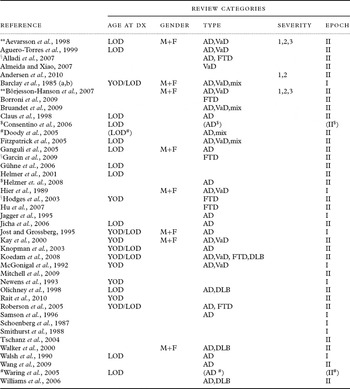
Forty-two papers comprising data for more than 11,000 dementia patients reported mean or median survival times from diagnosis or other data needed to calculate survival time from diagnosis. All studies included in this review are listed in Table 1. Of note, not all papers reported relevant data for each category of interest (i.e. age at diagnosis, gender, type of dementia, severity, or epoch). For a more detailed description of included studies, please see Table S1, available as supplementary material attached to the electronic version of this paper at www.journals.cambridge.org/jid_IPG.
Included papers (in alphabetical order) and the review categories they reported data for

** = both studies (Goteborg 85+ and Goteborg 95+) could potentially report data on the same or at least very similar populations even though both cohorts were contacted independently (i.e. one is not the follow-up of the other); § = 30% of Alladi et al. paper have also been included in Hodges et al. (Reference Hodges, Davies, Xuereb, Kril and Halliday2003); there might be also overlap with Garcin et al. (Reference Garcin2009); $ = Consentino et al. and Helzner et al. report data for the same population but for different categories and hence both were included ($ = data available for the same category and hence only a larger sample was considered); # = Doody et al. and Waring et al. report data of the same population but for different categories and hence both were included (# = data available for the same category and hence only a larger sample was considered); AD = Alzheimer's disease, DLB = dementia with Lewy bodies; Dx = diagnosis; F = females; FTD = Frontotemporal dementia; LOD = late onset dementia; M = males; Mix = mixed dementia; VaD = Vascular dementia; YOD = younger onset dementia; 1 = mild dementia; 2 = moderate dementia; 3 = severe dementia; I = Epoch 1 (prior to 1997); II = Epoch 2 (1997 and after).
Twenty-one papers reported data from the USA, 19 from Europe, and three from Australia. Cox proportional hazard models and other types of survival analysis which controlled for varying follow-up durations and censored cases were most commonly used by the authors to analyze data (35 studies). Seven papers used a descriptive approach to survival time (i.e. calculating mean or median survival times) as all their patients were followed prospectively until death (two studies) or considered retrospectively post mortem (five studies) and censoring was unnecessary (see Table S1). For the remaining studies, the follow-up length ranged from 18 months (Mitchell et al., Reference Mitchell, Arnold, Dawson, Nestor and Hodges2009) to up to 22 years (Schoenberg et al., Reference Schoenberg, Kokmen and Okazaki1987) with five years being most frequent (eight studies).The percentage of patients dying during the course of the study varied considerably, ranging from as little as 10% (Borroni et al., Reference Borroni2009) to 100% (Table S1).
Category 1: age at diagnosis – younger onset versus late onset dementia
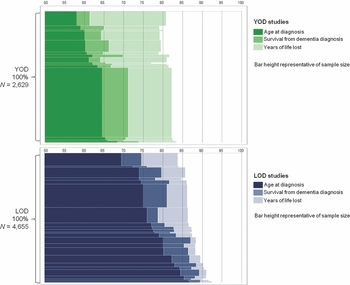
Ten studies reported survival data for 2,629 patients with YOD. These included younger onset AD, VaD, FTD, and other dementias. For late onset dementia (LOD), 17 articles were identified reporting survival data for a total of 4,655 patients (see Table 1 and Table S2; the later is available as supplementary material attached to the electronic version of this paper at www.journals.cambridge.org/jid_IPG).
Figure 1 depicts age at diagnosis, survival with dementia, as well as years of life lost compared to the general population in the identified samples with YOD and LOD. The height of bars indicates the sample size and represents a study's individual share of the total number of patients considered in the respective category.
Age at diagnosis, survival time, and years of life lost in YOD and LOD.

Survival with a diagnosis of YOD ranged from 1.3 years in a sample of patients with FTD with motor neuron disease (Hodges et al., Reference Hodges, Davies, Xuereb, Kril and Halliday2003) to 7.9 years in patients with YOD in general (Knopman et al., Reference Knopman, Rocca, Cha, Edland and Kokmen2003). It was comparable to survival in LOD patients which ranged from 1.8 years in a sample of 85-year-old men (Aevarsson et al., Reference Aevarsson, Svanborg and Skoog1998) to 7.2 years in 74-year olds (Knopman et al., Reference Knopman, Rocca, Cha, Edland and Kokmen2003). Within each group (i.e. YOD vs. LOD), the length of survival was not related to either younger or older age at diagnosis.
YOD patients lost a lot more of their remaining life expectancy than patients with LOD (reports range from 9.6 to 19.4 years and 1.3 to 9.2 years, respectively). In both groups, greater loss of years was associated with younger age at diagnosis.
As the loss of life expectancy highly depends on the age of a patient (i.e. young patients have more years to lose than old patients), we also calculated the relative loss of life expectancy. As with the absolute loss of years, the relative loss of remaining life expectancy was greater in YOD as compared to LOD patients. YOD patients lost 60–94% of their life expectancy on average, while LOD patients lost between 16 and 73% of their remaining life span. Only 20% of LOD samples fell within the reported YOD range at all (Aevarsson et al., Reference Aevarsson, Svanborg and Skoog1998; Olichney et al., Reference Olichney1998; Koedam et al., Reference Koedam2008) (see Figure S1, available as supplementary material attached to the electronic version of this paper at www.journals.cambridge.org/jid_IPG).
Category 2: gender
Eight studies compared mean or median dementia survival times in 473 men and 862 women (Table 1; also see Table S2). Age at diagnosis, survival with dementia, as well as years of life lost for men and women are available online (see Figure S2, available as supplementary material attached to the electronic version of this paper at www.journals.cambridge.org/jid_IPG).
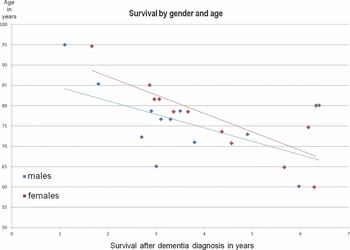
Survival in men and women was similar and ranged from 1.1 to 6.4 years and 1.6 to 6.3 years, respectively (Ganguli et al., Reference Ganguli, Dodge, Shen, Pandav and DeKosky2005). In both, men and women, older age was associated with shorter survival; this association was weaker in men (see Figure 2).
Survival in men and women by age at diagnosis.

When looking at absolute numbers, women seem to lose more years of their remaining life span (loss ranged from 1.4 to 15.3 years in women versus 0.4 to 11.4 years in men). The relative loss of remaining life expectancy ranged from 6% to 79% in men and 30% to 71% in women (Table S2) and decreased with older age in both groups. Despite one outlier in each group accounting for the lower boundaries of the reported ranges (Ganguli et al., Reference Ganguli, Dodge, Shen, Pandav and DeKosky2005), relative loss of life expectancy seemed to be similar in men and women (see Figure S3, available as supplementary material attached to the electronic version of this paper at www.journals.cambridge.org/jid_IPG).
Category 3: type of dementia
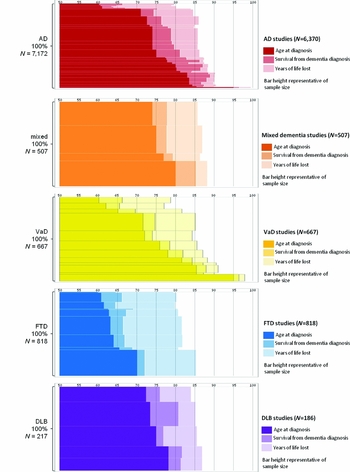
The majority of papers reported survival data for patients with AD (see Table 1; 26 studies; 6,370 AD patients in total). Eleven studies investigated the impact of VaD on survival in 667 patients. Seven studies examined survival in 818 patients with any FTD-like dementia including behavioral variant FTD, semantic dementia, progressive non-fluent aphasia, etc. Four studies each reported survival data for a total of 507 patients with mixed dementia and 186 patients with DLB.
Among all dementia subtypes, survival in AD patients seemed slightly more favorable, with maximum reported survival times (Williams et al., Reference Williams, Xiong, Morris and Galvin2006) exceeding survival reports of other dementia types by more than a year (Figure 3; also see Table S2). VaD and FTD were the only dementia subtypes with a strong association between age at diagnosis and length of survival (i.e. younger patients having a more favorable outcome than older patients). In AD, this trend was only observed when YOD–AD studies were excluded (see Figure S4(a)–(e), available as supplementary material attached to the electronic version of this paper at www.journals.cambridge.org/jid_IPG).
Age at diagnosis, survival time, and years of life lost in AD, mixed dementia, VaD, FTD, and DLB.

Absolute loss of years varied greatly by dementia subtypes, ranging from 0.9 years (Williams et al., Reference Williams, Xiong, Morris and Galvin2006) to 16.7 years in AD (Samson et al., Reference Samson, van Duijn, Hop and Hofman1996) and 11.5 years (Hu et al., Reference Hu2007) to 15.4 years in FTD (Hodges et al., Reference Hodges, Davies, Xuereb, Kril and Halliday2003). Across all subtypes, VaD and FTD were associated with the greatest relative loss of remaining life expectancy (51% to 84% and 72% to 84%, respectively) (see Table S2). While greater relative loss was strongly associated with younger age in VaD patients – and to a lesser extent also in AD and mixed dementia patients – the opposite was true for FTD and DLB patients (see Figure S5, available as supplementary material attached to the electronic version of this paper at www.journals.cambridge.org/jid_IPG).
Category 4: dementia severity at time of diagnosis
Three studies reported mean or median survival times for a total of 580 patients with varying degrees of dementia severity at time of diagnosis (i.e. mild or very mild dementia, moderate dementia, severe dementia; Table 1). Dementia severity was largely based on clinicians' ratings following patient or informant interviews (Aevarsson et al., Reference Aevarsson, Svanborg and Skoog1998; Börjesson-Hanson et al., Reference Börjesson-Hanson, Gustafson, Skoog, Borjesson-Hanson, Gustafson and Skoog2007) or the Clinical Dementia Rating (CDR) at the time of diagnosis. Survival in patients with very mild and mild dementia (n = 278, seven subsamples) ranged from 2.9 years to as much as 7.0 years. For patients with moderate (1.5–3.0 years, n = 167, five subsamples) or severe dementia (1.4–2.4 years, n = 135, three subsamples), survival was shorter and seemed to vary less (Figure 4, also see Table S2).
Age at diagnosis, survival time, and years of life lost in mild, moderate, and severe dementia.

The amount of years lost compared to the general population varied not only with dementia severity but also strongly with age at diagnosis within each severity group (see Table S2).
The relative loss was greatest for severe dementia cases (51% to 69%) followed by moderate (39% to 61%) and mild dementia (−1% to 44%). In all three groups, greater relative loss was related to younger age at time of diagnosis.
Category 5: temporal trends/epoch
We also compared temporal effects on survival and years of life lost after dementia diagnosis (i.e. studies published before 1997 (Epoch 1) and studies published in 1997 or later (Epoch 2)).
Ten studies published before 1997 reported mean or median survival after a dementia diagnosis for 1,769 participants. By contrast, the 30 studies reporting survival data since 1997 (Epoch 2) included a total of 10,295 patients (Table 1; see Table S2).
Reported data suggest slightly longer survival in studies published after 1997. Close to a quarter of all studies published after 1997 (Epoch 2) reported longer survival times than the longest reported survival time of Epoch 1 papers (i.e. 6.1 years).
However, length of survival in general was not associated with calendar year suggesting other than pure temporal effects causing this increase in survival in more recent years.
Temporal epoch seemed to influence the absolute loss of life span only marginally. Reports ranged from 3.1 to 16.7 years for Epoch 1 and 0.9 to 19.4 years for Epoch 2. In both groups, greater loss of years was strongly associated with younger age.
The reported ranges of relative loss of life expectancy before and after 1997 overlap hugely (Epoch 1: 36% to 87%; Epoch 2: 10% to 87%).
We then examined survival and relative loss of life expectancy by calendar year (see Figure S6, available as supplementary material attached to the electronic version of this paper at www.journals.cambridge.org/jid_IPG). Data reports suggest a slight increase in survival and decrease in loss of life expectancy in more recent years. However, this might be caused by the fact that early papers in particular reported data for very young dementia patients while some of the more recent papers studied very old samples. We therefore attempted to create more homogenous groups by selecting only those samples that fell within a certain age range (i.e. 65–78 years, as studies in both epochs reported data for patients within this age range). This post hoc selection process balanced our findings in that survival differences between epochs almost vanished.
Discussion
To our knowledge, this is the first literature review examining survival time in dementia which reports years of life lost in comparison to life expectancy in the matched population. We found that the impact overall of dying from dementia decreases with increasing age across categories of interest. Survival in men and women was similar and negatively associated with age at diagnosis. Due to their generally longer life expectancy, women seemed to lose slightly more years of their remaining life span than men. This is especially interesting as female gender is often considered more favorable in the context of dementia mortality (Claus et al., Reference Claus1998; Helmer et al., Reference Helmer, Joly, Letenneur, Commenges and Dartigues2001; Wolfson et al., Reference Wolfson2001; Aguero-Torres et al., Reference Aguero-Torres, Qiu, Winblad and Fratiglioni2002; Knopman et al., Reference Knopman, Rocca, Cha, Edland and Kokmen2003). Survival was also negatively associated with age across varying dementia subtypes, with the association being strongest in VaD followed by FTD. The relative loss of life expectancy appeared to be greatest in FTD and VaD. This might, however, be due to the general lower age in FTD patients and comorbid conditions being more frequent in patients with VaD compared to other dementia subtypes. Prima facie, survival time decreases with increasing severity of the disease. However, survival reports in groups of varying dementia severity at diagnosis are still sparse and conclusions from our findings remain limited. Survival time reported in more recently published studies did not appear to differ greatly from studies published before donepezil's introduction to the market once age of samples was kept homogenous. Any differences are likely due to the fact that earlier papers reported survival in very young patients which would have affected their loss of life expectancy.
There are a number of limitations to interpreting the data. Studies on mortality in patients with dementia are difficult to compare directly (Ganguli et al., Reference Ganguli, Dodge, Shen, Pandav and DeKosky2005) for many reasons. First, most studies refer to selected groups of patients; some are based on volunteers or patients referred to research clinics and others on patients in nursing homes or on community samples. Second, while follow-up was mainly prospective ranging from as few as 1.5 years to as many as 22 years, some studies were retrospective. Third, some studies included only prevalent or incident cases; others included both. Fourth, some studies were limited to certain age cohorts which were not consistent over samples and chances are that there may have been some overlap between LOD and YOD patients. Fifth, most studies did not compare survival rates of dementia patients to either (age- and sex-matched) control groups or census data from reference populations. Some report age-specific mortality rates, others standardized mortality ratios and population attributable risks; few studies used the life-table method to estimate the survival rate (Barclay et al., Reference Barclay, Zemcov, Blass and Sansone1985b; Martin et al., Reference Martin, Miller, Kapoor, Arena and Boller1987).
This review is also limited by a range of methodological and procedural assumptions that we had to impose in order to conduct this review. First, we considered both mean and median survival from time of dementia diagnosis assuming that in the general population with an expected normally distributed remaining life expectancy, mean and median would be the same. However, unlike general population survival, study populations could have been heavily skewed. Second, while the end point of death is incontrovertible, duration has been calculated from study baseline, symptom onset, or diagnosis. We used time from diagnosis as our anchor point as it was the most widely reported and we considered it would be more reliable than symptom onset even though diagnosis varies with health professional availability, acumen, and accessibility. Further, if some types of dementia are more likely to be diagnosed later in the course of their disease, e.g. FTD, this will reduce subsequent disease duration and years of life lost. Third, despite our review's strict inclusion eligibility criteria, the resulting samples are still very heterogeneous (e.g. incident and prevalent cases, wide-ranging follow-up intervals). Fourth, survival time in healthy controls was only available for some papers. However, in order to calculate the years of life lost, we needed to compare dementia survival time to the life expectancy in the general population. To keep variation at a minimum, we compared all papers to life expectancies matched for country, year, age, and gender ratio retrieved from www.lifetables.de regardless of whether they reported survival in controls. This method might underestimate the years of life lost since life-tables include dementia cases in the population. This could be especially important for the oldest old for whom the percentage with dementia will be substantially higher. However, control group survival is not an appropriate comparison either because often the dementia-free sample is significantly younger than the dementia sample (Wood et al., Reference Wood, Whitfield and Christie1991; Jagger et al., Reference Jagger, Clarke and Stone1995; Aguero-Torres et al., Reference Aguero-Torres1999; Tschanz et al., Reference Tschanz2004; Gühne et al., Reference Gühne, Riedel-Heller and Angermeyer2005). Fifth, the implemented classification rule for epochs (before 1997 versus 1997 and after) was arbitrary and blunt given that articles seldom state the number of people treated with cholinesterase inhibitors and the year of publication does not equate to period of study. Sixth, longitudinal studies of prevalent cases from study entry (rather than from time of diagnosis or onset of symptoms) introduce survivor bias. If patients who had already died by the time of entry into the cohort could have been accounted for, survival times would have been lower. Penultimately, the biggest caveat is that comparisons of studies of any kind almost always assume that data are equally weighted, for instance, by sample size. Scatter plots of survival or relative loss of life expectancy regard all individual studies as equal, whereas, in fact, they are not. Statistically weighting studies was not possible for methodological reasons. We attempted to work around this issue by graphically weighting studies using bar charts with varying widths to represent relative sample size. When bar charts were not an appropriate way to represent data, we created scatter plots even though these do not control for varying sample size.
There were also some generally limiting factors. For certain dementia subtypes, the survival evidence is still sparse (e.g. mixed dementia and DLB). We were only able to identify and include four studies each investigating the impact of dementia on survival in these patient cohorts. Likewise, the evidence for survival in groups of patients with varying levels of dementia severity is still limited. Predictors of shorter survival, causes of death, and comorbid diseases are reported in some of the studies but not consistently. Even though it is essential to consider these variables when interpreting survival data and years of life lost, these data were seldom available. Many studies had to be excluded due to deficiencies as simple as not reporting subsample numbers, mean ages, and sex distribution; others omitted disease severity and time/year when the study was conducted resulting in possible selection bias. Often, reviewed samples were also very small.
Implications for clinicians
What should clinicians tell their patients or their families? First, duration from diagnosis is quite variable ranging on the average from 1.1 to 8.5 years and cannot be predicted accurately. For individuals, it might be much longer than that. Second, survival time depends greatly on interactions of age and severity at diagnosis, gender, or type of dementia. Across both, men and women, as well as across most dementia subtypes, survival was negatively associated with age in that the older a patient with a certain dementia diagnosis is at time of diagnosis the shorter he/she will live with that dementia. At the same time, older persons will lose less of their remaining life expectancy due to their more advanced age.
Recommendations for future research
In order to avoid limitations noted in this review, we recommend that studies should:
1. Describe sample/recruitment process properly:
i. Key demographic details – age range, mean age (and SD) for specific subsamples (if applicable), gender, accommodation setting
ii. Time/year when study was conducted, severity of disease, diagnosis, diagnostic criteria, housing (e.g., accommodation setting), use of antidementia medication and incident versus prevalent cases.
iii. For population-based studies, state whether or not prevalent cases were excluded or not.
iv. If a diagnosis was given at study entry, it should be stated in the text.
v. If reporting age at study entry, also state time from diagnosis to study entry.
2. Use consistent terminology: (see Figure S7, available as supplementary material attached to the electronic version of this paper at www.journals.cambridge.org/jid_IPG).
i. Specify meanings of terms such as survival, disease duration, years with disease, etc., i.e. survival from birth (Williams et al., Reference Williams, Xiong, Morris and Galvin2006), from symptom onset, from symptom onset to study entry, or from study entry to death.
ii. Avoid ambiguous terminology (e.g. duration of survival from time of first evaluation (Hier et al., Reference Hier, Warach, Gorelick and Thomas1989) or length of stay in hospital after diagnosis (Smithurst and Pozzi, Reference Smithurst and Pozzi1988)). Even the term onset of dementia could mean onset of symptoms or when diagnostic criteria for dementia were first met (Tschanz et al., Reference Tschanz2004).
3. Report survival time:
Many papers performed survival analysis using Kaplan–Meier methods and/or Cox proportional hazard models but did not report mean or median survival time and therefore could not be included. Some showed plots of survival curves but did not report survival data as numbers in the text; median survival times from graphs are too inaccurate.
4. Report causes of death whenever possible:
Causes of death were not reported consistently across papers. While death certificates are often inaccurate, these data would be indicative though not definitive to find out how many deaths are attributed to dementia per se.
5. Control analysis for physical health problems/ comorbid conditions:
Few papers listed comorbid conditions that were controlled for in survival analyses (or presented hazard ratios for them).
Conclusions
The reduction of life expectancy by dementia varies according to a number of factors. Accurate estimation of life expectancy is important for advising patients and their families of prognosis and when planning services. Future research should carefully define terminology.
Conflict of interest
All three authors have worked on drug trials for patients with MCI and AD sponsored by major pharmaceutical companies including Eisai Pharmaceuticals, Eli Lilly and Company, GlaxoSmithKline, H Lundbeck A/S, Janssen-Cilag Pty Limited, Medivation Inc., Novartis Pharmaceuticals, Pfizer Inc., Prana Biotechnology Limited, sanofi-aventis, Voyager Pharmaceutical Corporation, and Wyeth Limited.
Dr. Brodaty has been a consultant, advisory board member, and sponsored speaker for H Lundbeck A/S, Janssen-Cilag Pty Limited, Medivation Inc., Novartis Pharmaceuticals, Pfizer Inc., Prana Biotechnology Limited, Voyager Pharmaceutical Corporation, and Wyeth Limited.
Description of authors' roles
The paper was conceptualized by Henry Brodaty. Louisa Gibson and Katrin Seeher conducted the literature searches, reviewed all the articles, and extracted data. Contentious articles were reviewed again by all the three authors. Katrin Seeher drafted an initial version of the paper. The final paper was then prepared by all three authors.
Acknowledgments
No funding was received to conduct this research. The authors would like to thank Annette Altendorf, Kaarin Anstey, John Crawford, and Lee-Fay Low for their comments on previous drafts of the paper.