





Nutrition plays a pivotal role in general health and well-being of patients. Its role in the management of various non-communicable diseases, including the potentially fatal ones such cancer and CVD, as well as acute conditions such as infections is widely recognised and acknowledged(Reference Mancin, Sguanci and Cattani1).
Malnutrition is a frequent problem faced by hospitalised patients with studies reporting a prevalence ranging between 20 % and 50 % in various settings(Reference Norman, Pichard and Lochs2). In fact, it has been estimated that one-third of patients admitted to the hospital already have malnutrition, and many of them will experience a further deterioration of their nutritional status during the hospitalisation(Reference Tappenden, Quatrara and Parkhurst3). In Lebanon, recent data suggest that malnutrition is prevalent among 35·6 % of hospitalized patients(Reference Ouaijan, Hwalla and Kandala4). Undernutrition is among the primary issues related to negative health outcomes. In this regard, it was associated in several studies with longer hospitalisation, higher readmission frequency, decreased quality of life and increased mortality rates(Reference White, Guenter and Jensen5). Moreover, from economic point of view, malnutrition adds additional costs to the healthcare system, which are estimated to reach 2·1 to 10 % of the national healthcare spending in Europe(Reference Khalatbari-Soltani and Marques-Vidal6). Although it is mainly the responsibility of the dietician to provide nutrition care for the patients, however, in the hospital setting, nurses are frequently involved in the process as well. As members of the healthcare team, they are often responsible to monitor the timely provision of food trays, monitoring food intake and early detection of malnutrition(Reference Mancin, Sguanci and Cattani1).
According to the WHO, non-communicable diseases (NCD) accounted for 75 % of all non-pandemic-related deaths globally in 2021(7). The development and progression of these diseases are attributed to various factors among which nutrition plays a crucial role. In the matter of fact, globally, dietary factors contributed to 7·9 million NCD death in 2019(Reference Qiao, Lin and Wu8). Numerous determinants of dietary choices have been identified with nutrition knowledge being among the most important ones as it can affect the dietary patterns and consequently, the nutritional status and risk of developing diseases(Reference Gruber, Iwuchukwu and Sperr9). Indeed, it was previously reported that nutrition knowledge has a positive effect on dietary changes(Reference Pillai, Liang and Thwaites10). Dieticians are responsible to provide appropriate services aiming to change the dietary choices of individuals in order to promote health and manage diseases; among others, they should be able to correctly communicate nutrition knowledge to their patients(Reference Vrkatić, Grujičić and Jovičić-Bata11). However, due to their frequent contact with patients, nurses often provide nutritional advices as well to patients and are considered as a trustworthy source of nutritional information(Reference Mogre, Ansah and Marfo12).
Taking into account of the fundamental role of nurses in communicating nutrition information, screening for malnutrition and enabling patients to comply with prescribed interventions, it is crucial that they have adequate level of knowledge, positive attitudes and correct practices regarding nutritional care. However, previous studies suggested that the nurses’ knowledge, attitudes and practices (KAP) related to various nutrition key areas such as nutrition care of hospitalized, surgical, older, diabetes mellitus, enteral feeding and malnutrition patients and secondary prevention of NCD are not optimal and need to be improved(Reference Ang, Zhang and Cai13–Reference Zare-Kaseb, Sarmadi and Nazari19). However, there are no studies in Lebanon, assessing the KAP of nurses working in Lebanese hospitals.
Lebanon is witnessing an economic crisis that has deeply affected the healthcare sector(Reference Bou Sanayeh and El Chamieh20). The salaries on nurses drastically decreased and many of them, especially those who are highly educated and experienced, left the country for better opportunities abroad(Reference Nassar, Abdallah and Najib21). Additionally, the nursing curriculum in Lebanese Universities does not include nutrition courses. Therefore, assessing the KAP of nurses working in Lebanese hospitals is crucial in order to elucidate any possible gaps in the delivery of care to the patients. If found not optimal, this will allow to develop well targeted nutrition education programs for nursing staff. Additionally, it will highlight whether there is a need to redefine the responsibilities of hospital staff members to deliver a well-structured multidisciplinary healthcare to patients.
The main aim of the study is to assess the nurses’ Malnutrition Knowledge, Attitudes and Practices (M-KAP) as well as their general nutrition knowledge about food groups and nutrient sources and diet, disease and weight associations. The factors associated with M-KAP and general nutrition knowledge will be investigated as well.
Methodology
Study design and participants
A cross-sectional study was conducted between May and June 2025 among nurses working in different hospitals in North Lebanon (nine private and four public hospitals). An online questionnaire was developed using Google Forms. The administration of the hospital and/or the directors of nurse from different departments were contacted in advance in order to get their consent. The online questionnaire was communicated to the nurses working in the inpatient departments of these hospitals via emails and WhatsApp groups.
Sample procedure
An appropriate sample size was calculated using Raosoft software, with a population size of 11 829 according to the statistics issued by the Order of Nurses(22). To detect a prevalence of poor KAP of 50 % with a 95 % confidence level and 5 % precision, a minimum sample of 373 nurses was needed. A total of 404 nurses agreed to participate in the study and provided complete data.
Measurement instrument
The measurement instrument was a multi-component questionnaire composed of four sections that assessed the socio-demographic characteristics, health and eating habits, M-KAP and general nutritional knowledge of the nurses. The average duration for completion of the questionnaire was 20 min. The questionnaire was piloted in advance on a group composed of twenty nurses from different departments to ensure its clarity. The piloting revealed that all questions were clear.
Socio-demographic characteristics
After a careful review of the existing literature, a group of socio-demographic characteristics was found to be extensively studied in relation to healthcare providers nutrition-related KAP or commonly found associated with it(Reference Ben Allal, El Mlili and Najdi14,Reference Farzaei, Shahbazi and Gilani16,Reference Shakhshir and Alkaiyat17) . Therefore, these variables were included in our study, and they encompass gender (male and female), marital status (married, single and divorced), educational status (Technique superior/baccalaureate technique (TS2/TB3), license academic (LA)/license technique (LT)/bachelor of science in nursing (BSN) and master degree, the latter category was removed because it yielded 0 responses), years of experience (categorized for the purpose of the analysis into <3 years, 3–10 years, ≥15 years), occupational title (practical nurses, head nurses and supervisor/chief nurses), shift pattern (always day, always night and day and night), type of hospital (private and public), hospital district (Tripoli, Akkar, Miniyeh and Batroun El-Koura) and nationality of the participant (Lebanese, non-Lebanese). For the purpose of this analysis, the hospital district categories were regrouped into Tripoli and others.
Knowledge, attitudes and practices related to malnutrition
The quality of nutrition care provided by the nurses was assessed using the Malnutrition Knowledge, Attitude, and Practices (M-KAP) questionnaire(Reference Keller, Laur and Atkins23,Reference Laur, Marcus and Ray24) . This tool comprises three subsections that assess knowledge (M-Knowledge) (fifteen questions), attitudes (M-attitudes) (five questions) and practices (M-practices) (seven questions). For knowledge and attitudes, each question had five options ranging from strongly disagree to strongly agree allocated from one to five points, respectively. The scoring of negative questions was reversed. For practices, four options were listed ranging from never to always and scored from one to four, respectively. The total score was subsequently calculated by summing up all the points. The Arabic version of the questionnaire, which was validated previously, was used in the current study (Cronbach alpha were as follows: 68 % for knowledge, 67 % for attitudes, 80·5 % for practice and 77 % for KAP)(Reference Shakhshir and Alkaiyat17).
General nutritional knowledge
The nutritional knowledge of the nurses was measured using the revised Arabic version of the General nutritional knowledge questionnaire (GNKQ)(Reference Bataineh and Attlee25). The original English version, developed by Kliemann et al.(Reference Kliemann, Wardle and Johnson26), comprises four sections as follows: GNKQ1 assessing nutritional knowledge regarding dietary recommendations (eighteen questions), GNKQ2 examining knowledge about food groups and nutrient sources (thirty-six questions), GNKQ3 evaluating knowledge pertinent to healthy food choices (thirteen questions) and GNKQ4 analysing knowledge about the associations between diet, disease and weight (twenty-one questions)(Reference Kliemann, Wardle and Johnson26). A revised Arabic version of the GNKQ was previously developed and encompasses eighty-six questions instead of eighty-eight after removal of two culturally sensitive questions in sections Introduction and Results, and each question was scored 1 if correct or 0 if incorrect(Reference Bataineh and Attlee25). Scores are calculated for each section by adding up the scores of each question, and total score was calculated by summing up the scores of each section. Higher scores indicate higher knowledge(Reference Bataineh and Attlee25). The Arabic version showed high reliability and validity among Arab youth with high Cronbach’s α of 0·91 and high external reliability (P = 0·350; intra-class correlation coefficient = 0·84). Each section of the questionnaire also showed adequate internal and external consistency and validity with Cronbach’s α ranging between 0·70 and 0·83(Reference Bataineh and Attlee25). Due to concerns related to the length of the questionnaire, only sections Methodology (GNKQ2) and 4 (GNKQ4) were used in the present study because they were deemed directly reflective of the study’s objectives.
Statistical analysis
Data analysis was carried out using the Statistical Package for the Social Sciences (SPSS, version 23.0). The median score was calculated for the total M-KAP score (107), and each of its three domains, M-Knowledge (63·0), M-Attitudes (22·0) and M-Practices (23·5), separately, as well as for the GNKQ2 (19·0) and GNKQ4 (13·0). For the purpose of the analysis, these variables were transformed into binary variables based on the corresponding median scores. Correlational analysis using the χ2 test was conducted to examine the association between various socio-demographic variables with M-KAP and its domains and with GNKQ 2 and GNKQ 4. Five modified Poisson regression analysis with robust variance estimation was carried out to find the factors associated with each of GNKQ2, GNKQ4, M-KAP, M-knowledge, M-Attitudes and M-Practices. Although logistic regression is commonly used for binary outcomes, it provides OR, which may overestimate the association when the outcome is not rare. Since the prevalence of the outcomes of interest was expected to be relatively high, modified Poisson regression was selected to directly estimate adjusted prevalence ratios with 95 % CI, which provides a more interpretable measure of association for cross-sectional KAP studies. The choice of the factors to be included in each regression analysis was based on the results of the χ2 test, where all variables that were found significantly associated with the outcome in question (GNKQ2, GNKQ4, M-KAP, M-knowledge, M-Attitudes or M-Practices) were included in the corresponding regression analysis. Therefore, age, gender, educational level, years of experience and occupational title were included in the regression analysis studying the factors associated with GNKQ2, while educational level, years of experience, occupational title and M-KAP were included in the regression analysis of the factors associated with GNKQ4. On the other hand, marital status, occupational title, working hours, type of hospital, hospital district and nationality were included in the regression analysis studying the factors associated with M-KAP, while occupational title, working hours, type pf hospital and hospital district were included in the regression analysis of the factors associated with M-Attitude. Finally, marital status, occupational title and hospital district were included in the regression analysis of the factors associated with M-Practice. Additionally, χ2 was used to assess the association between malnutrition knowledge (M-knowledge), malnutrition attitudes (M-attitudes) and malnutrition practices (M-practices). Modified Poisson regression analysis with robust variance estimation was carried out including all variables that were found to be significantly associated with M-KAP, GNKQ2 and/or GNKQ4. Statistical significance was set at P value <0·05.
Results
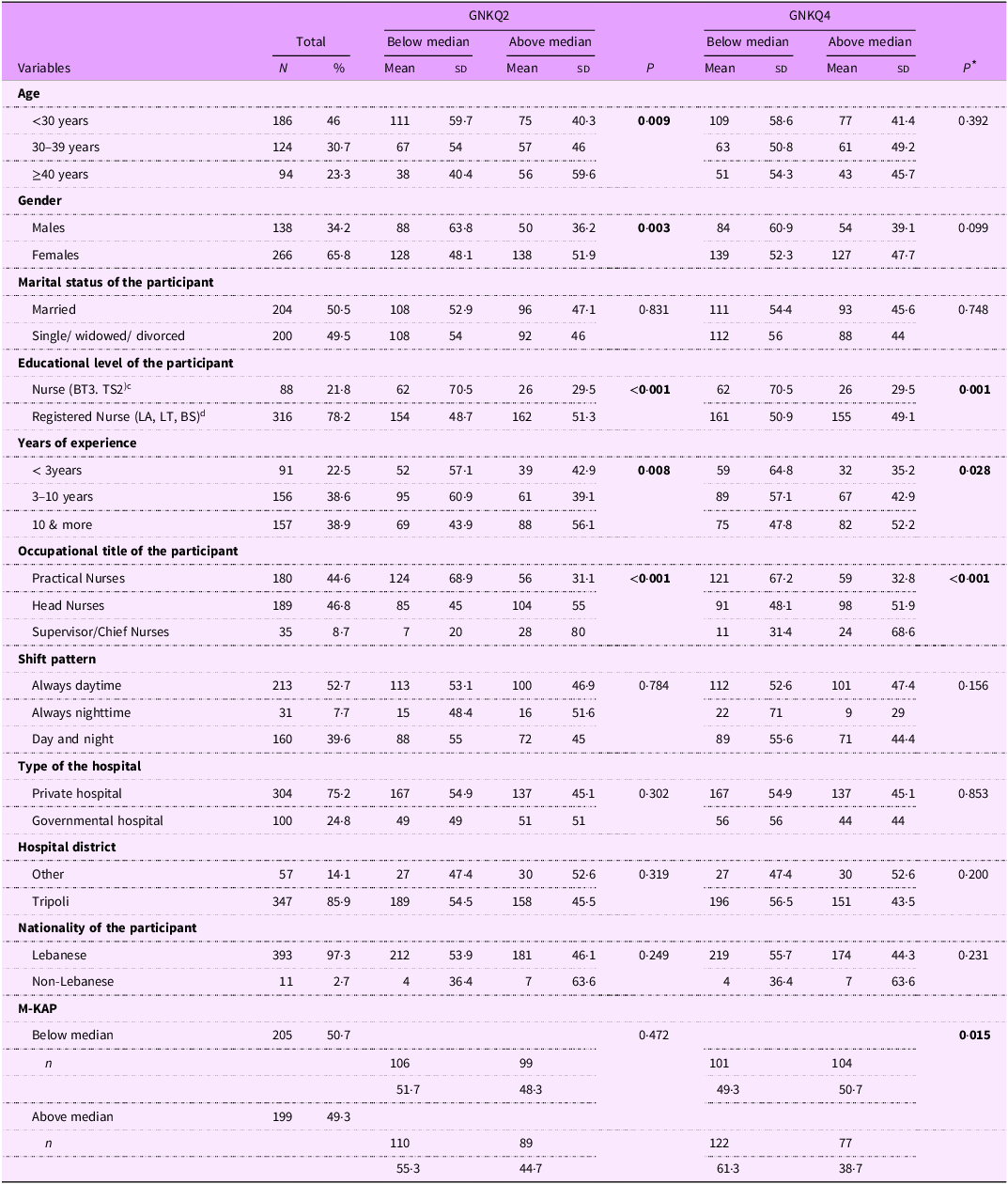
Table 1 describes the characteristics of the study participants. Around half of the study participants (46 %) were aged less than 30 years, 56·8 % were females and 50·5 % were married. Most of the nurses (78·2 %) were holding license academic (LA), license technique (LT) or bachelor of science in nursing (BSN) degrees, with none holding a master degree, and 38·9 % had more than 10 years of work experience. The distribution of occupational titles was as follows in our sample: 46·8 % head nurses, 44·6 % practical nurses and 8·7 % supervisor/chief nurses. The majority of nurses were working during daytime only (52·7 %), three quarter of them (75·2 %) were working in private hospitals and 85·9 % were working in hospitals located in Tripoli. The sample constituted mainly of Lebanese nurses (97·3 %). The mean of the GNKQ2 score was 19·19 (±4·85), which equals to 53·30 %, whereas the mean of the GNKQ4 was 12·94 (±3·01), which corresponds to 61·62 %.

Table 1. Long description
The table has 14 rows and 12 columns. The columns are labeled as follows: Variables, Total (N and %), GNKQ2 (Below median Mean, Below median SD, Above median Mean, Above median SD, P), GNKQ4 (Below median Mean, Below median SD, Above median Mean, Above median SD, P). The rows are labeled as follows: Age (<30 years, 30-39 years, >=40 years), Gender (Males, Females), Marital status of the participant (Married, Single/widowed/divorced), Educational level of the participant (Nurse (BT3, TS2), Registered Nurse (LA, LT, BS)), Years of experience (<3 years, 3-10 years, 10 & more), Occupational title of the participant (Practical Nurses, Head Nurses, Supervisor/Chief Nurses), Shift pattern (Always daytime, Always nighttime, Day and night), Type of the hospital (Private hospital, Governmental hospital), Hospital district (Other, Tripoli), Nationality of the participant (Lebanese, Non-Lebanese), M-KAP (Below median, Above median). The table presents the mean and standard deviation of GNKQ2 and GNKQ4 scores for different participant characteristics, along with p-values indicating the significance of the differences.
a GNKQ2: section 2 (food groups and nutrient sources) of the general nutrition knowledge questionnaire.
b GNKQ4: section 4 (associations between diet, diseases, and weight) of the general nutrition knowledge questionnaire.
c TS2/TB3: Technique superior/baccalaureate technique.
d (LA)/ (LT)/ (BSN): license academic/ license technique/ bachelor of science in nursing.
M-KAP: Malnutrition knowledge, attitudes and practices.
* χ2 test.
Bold values represent significance at P < 0·05.
The association between the socio-demographic characteristics of study participants and GNKQ2 and GNKQ4 is presented in Table 1. GNKQ2 was positively associated with the age of participants, female gender, educational level and years of experience (P values = 0·009; 0·003; <0·001 and 0·008, respectively). Additionally, supervisor/chief nurses had a better knowledge compared with head and practical nurses (P value <0·001). As for the GNKQ4, it was positively associated with the educational level (P value = 0·001) and years of experience (P value = 0·028). Furthermore, GNKQ4 was negatively associated with M-KAP (P = 0·015). Similar to the GNKQ2, supervisor/chief nurses had a better knowledge about the associations between diet, disease and weight compared with head and practical nurses (P value <0·001).
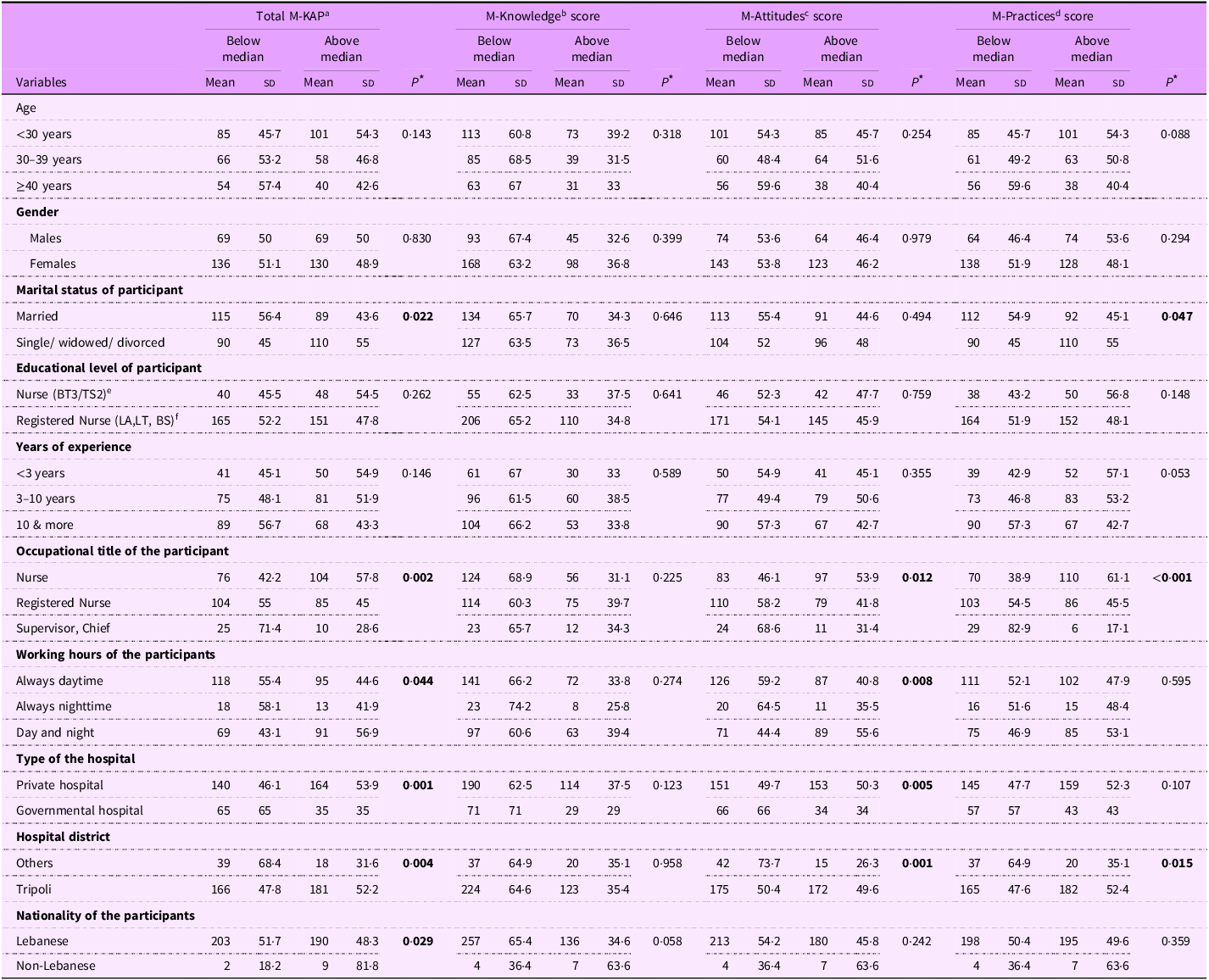
Table 2 illustrates the association between socio-demographic characteristics of study participants and M-KAP. The mean M-KAP total score was 104·86 (±11·32), with a minimum of 65 and a maximum of 124. Being married, occupying a supervisor/chief position, having nighttime shifts always, practicing in governmental hospitals and in hospitals located outside Tripoli and having a Lebanese nationality are associated with poor M-KAP (P value = 0·022, 0·002, 0·044, 0·001, 0·004 and 0·029). None of the socio-demographic characteristics were associated with M-Knowledge alone (all P values > 0·05). Occupying a supervisor/chief position and practicing in hospitals located outside Tripoli was associated with poor M-attitudes (P value = 0·012 and 0·001, respectively) and poor M-practices (P value = <0·001 and 0·015, respectively). Additionally, having always nighttime shifts and working in governmental hospitals is associated with poor M-attitudes (P value = 0·008 and 0·005) whereas being married, occupying a supervisor/chief position and working in hospitals located outside Tripoli were associated with poor M-practices (P value = 0·047; <0·001 and 0·015, respectively).
Association between socio-demographic characteristics of study participants with M-KAPa and its individual domains

Table 2. Long description
A table with 11 columns and 25 rows. The columns are labeled with variables, total M K A P score, M Knowledge score, M Attitudes score, and M Practices score. Each score column is divided into below median and above median with mean and standard deviation values. The rows list variables such as age, gender, marital status, educational level, years of experience, occupational title, working hours, type of hospital, hospital district, and nationality. The table shows mean and standard deviation values for each variable split by below and above median scores. The P values indicate statistical significance for each variable. All values are approximated.
a M-KAP: Malnutrition knowledge, attitudes and practices.
b M-Knowledge: Malnutrition knowledge.
c M-Attitudes: Malnutrition attitudes.
d M-Practices: Malnutrition practices.
e TS2/TB3: Technique superior/baccalaureate technique.
f (LA)/ (LT)/ (BSN): license academic/ license technique/ bachelor of science in nursing.
* χ2 test.
Bold values represent significance at P < 0·05.
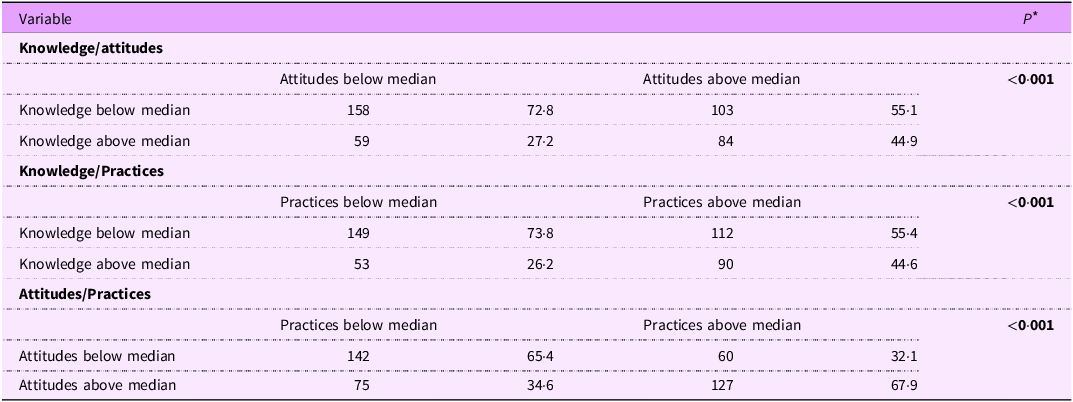
The association between malnutrition M-knowledge, M-attitudes and M-practices is presented in Table 3. A positive association was detected between M-knowledge and M-attitudes (P value <0·001) and between M-knowledge and M-practices (P value <0·001). Furthermore, practices were positively associated with M-attitudes (P value <0·001).
Association between malnutrition knowledge, attitudes and practices

Table 3. Long description
The table presents the association between malnutrition knowledge, attitudes, and practices. It has three sections: Knowledge/attitudes, Knowledge/Practices, and Attitudes/Practices. Each section is divided into two columns based on median values. The first section has two rows: Knowledge below median and Knowledge above median. The second section has two rows: Knowledge below median and Knowledge above median. The third section has two rows: Attitudes below median and Attitudes above median. Each row contains four values representing different categories.
aM-Knowledge: malnutrition knowledge.
bM-Attitudes: Malnutrition attitudes.
cM-Practices: Malnutrition practices.
* Pearson correlation.
Bold values represent significance at P < 0·05.
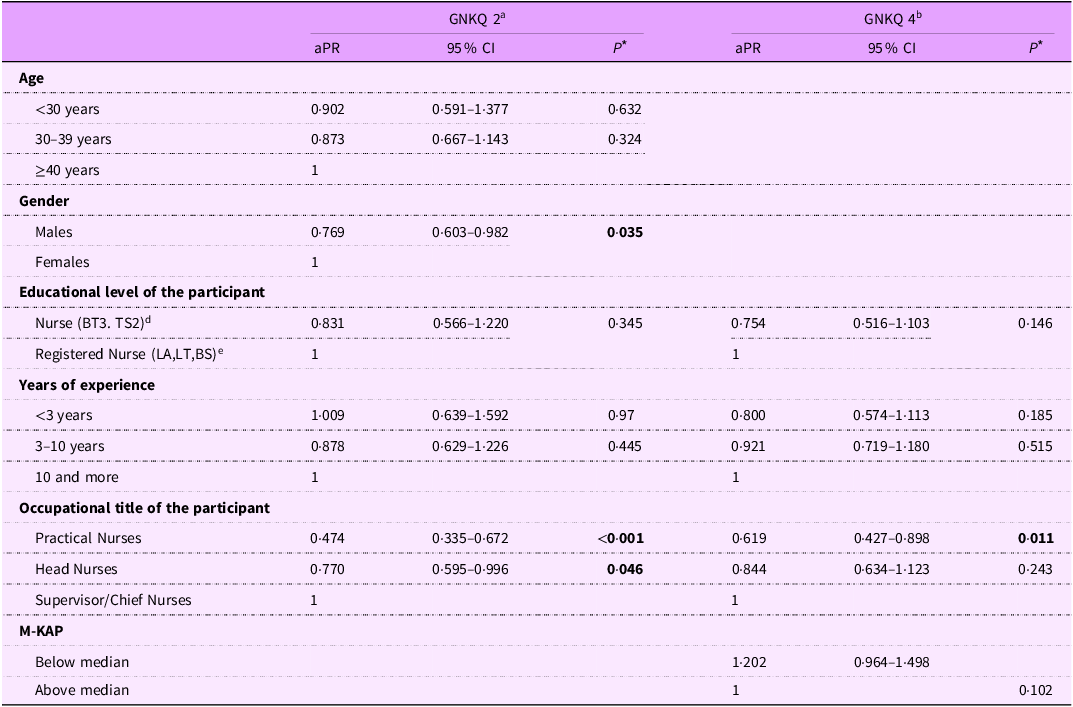
The results of the regression analysis revealed that males had lower GNKQ2 compared with females (aPR, 0·769; 95 % CI, 0·603–0·982, P value = 0·035). Furthermore, compared with supervisor/chief nurses, practical and head nurses had lower GNKQ2 (aPR, 0·474; 95 % CI, 0·335–0·672, P value <0·001 and aPR, 0·770; 95 % CI, 0·595–0·996, P value = 0·046, respectively). Furthermore, practical nurses had lower GNKQ4 compared with supervisor/chief nurses (OR, 0·619; 95 % CI, 0·427–0·898, P value 0·011) (Table 4).

Table 4. Long description
A table comparing factors associated with GNKQ2 and GNKQ4 through regression analysis. The table has 19 rows and 6 columns. Column headers are Age, Gender, Educational level of the participant, Years of experience, Occupational title of the participant, and M-KAP. Row labels include different categories such as age groups, gender, educational levels, years of experience, occupational titles, and M-KAP levels. Each row provides adjusted prevalence ratios (aPR), 95% confidence intervals (CI), and P-values for GNKQ2 and GNKQ4. Notable trends include lower GNKQ2 for males compared to females, and lower GNKQ2 and GNKQ4 for practical and head nurses compared to supervisor/chief nurses.
a GNKQ2: section 2 (food groups and nutrient sources) of the general nutrition knowledge questionnaire.
b GNKQ4: section 4 (associations between diet, diseases and weight) of the general nutrition knowledge questionnaire.
cAdjusted prevalence ratio.
d TS2/TB3: Technique superior/baccalaureate technique.
e (LA)/ (LT)/ (BSN) : license academic/ license technique/ bachelor of science in nursing.
* Modified Poisson regression analysis.
Bold values represent significance at P < 0·05.
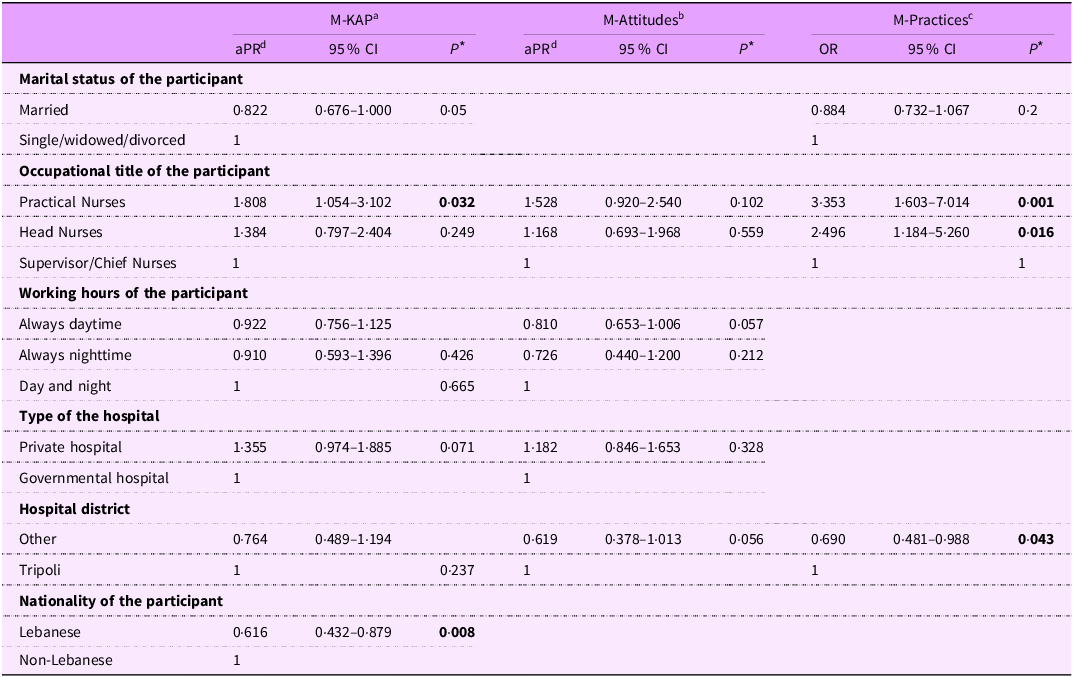
As for the M-KAP, lower levels were observed among supervisor/chief nurses compared with practical nurses (aPR, 1·808; 95 % CI, 1·054–3·102, P value = 0·032). Moreover, Lebanese nurses had lower M-KAP compared with non–Lebanese nurses (aPR, 0·616; 95 % CI, 0·432–0·879, P value = 0·008). Taking into account malnutrition practices, practical and head nurses had better adequate M-practices compared with supervisor/chief nurses (aPR, 3·353; 95 % CI, 1·603–7·014, P value = 0·001 and aPR, 2·496; 95 % CI, 1·184–5·260, P value = 0·016, respectively) and nurses working in hospitals outside Tripoli had lower M-practices compared with those working in Tripoli (aPR, 0·690; 95 % CI, 0·481–0·988, P value = 0·043) (Table 5).

Table 5. Long description
The table presents factors associated with M-KAP, M-Attitudes, and M-Practices through regression analysis. It has 12 rows and 12 columns. The columns are labeled as M-KAP, M-Attitudes, and M-Practices, each with sub-columns for aPR, 95% CI, and P value. The rows are categorized by marital status, occupational title, working hours, type of hospital, hospital district, and nationality of the participant. Each category lists specific values for aPR, 95% CI, and P value. Notable trends include lower M-KAP levels among supervisor/chief nurses compared to practical nurses and lower M-KAP among Lebanese nurses compared to non-Lebanese nurses. Practical and head nurses show better M-Practices compared to supervisor/chief nurses, and nurses working outside Tripoli have lower M-Practices compared to those working in Tripoli.
a M-KAP, malnutrition knowledge, attitudes and practices.
b M-Attitudes: Malnutrition attitudes.
c M-Practices: Malnutrition practices.
d Adjusted prevalence ratio.
* Modified Poisson regression analysis.
Bold values represent significance at P < 0·05.
Discussion
To the best of our knowledge, this is the first study to assess the general nutritional knowledge and malnutrition-KAP among nurses working in the hospitals in Lebanon. Our study revealed that malnutrition knowledge was positively associated with malnutrition attitudes and practices, while malnutrition practices were positively correlated with malnutrition attitudes. Additionally, our results showed that occupational title and nationality were significantly associated with the total KAP-M score, while practices analysed individually were significantly correlated with the occupational title of the nurses and the location of the hospital. As for the selected sections of the general nutrition knowledge questionnaire, a significant correlation with gender and the occupational title of the nurses was detected.
The mean percentage of GNKQ2 and GNKQ4 was 53·3 % and 61·62 %, respectively (not reported in the results tables). The mean percentage of the GNKQ2 in our study was similar to the one reported among nursing students in the UAE (53·3 % and 57·53 %, respectively), while the GNKQ4 was even slightly higher in our sample compared with the one reported among nursing students in the UAE (61·61 % and 53·86 %, respectively)(Reference Ibrahim and Aldawsari27). Another study conducted in Kuwait among university students studying various majors revealed a mean GNKQ2 score of 17·25 ± 5·41 and a mean GNKQ4 score of 9·53 ± 3·07(Reference Husain, Ashkanani and Al Dwairji28). These scores correspond to a mean percentage GKNQ2 score of 47·92 %, which is comparable to our results and to a mean percentage GNKQ4 score of 45·38 % which is considerably lower than the one reported in the current study. This implies that nurses in our sample are potentially equipped with better nutrition knowledge about the associations between diet, disease and weight than the general population, which enables them to communicate relatively adequate nutrition information with the public. Similarly, the mean M-KAP total score in the present study was 104·86 (±11·32), with a minimum of 65 and a maximum of 124 (not reported in the results tables), which seems to be higher than the scores found among nurses and other healthcare professionals in similar studies. A recent study conducted in Palestine found that the mean M-KAP score was 85·62 ± 9·50 with a minimum of 45 and a maximum of 113(Reference Shakhshir and Alkaiyat17). Similarly, an earlier study conducted among hospital staff in Canada reported a mean score of 93·6 (minimum 51 and maximum 124)(Reference Laur, Marcus and Ray24). Although the results are satisfying, many gaps still exist. For example, around 85 % of the nurses believe that diet cola is high in added sugar, and around half of them believe that fruits and butter are good sources of protein. Two-third of nurses are not familiar with BMI cutoff points and around ¾ of nurses do not know which food is recommended to decrease the risk of cancer. As for practices, only 66 % of nurses check if the patient has all that he needs to eat, and only 52 % visit and check a patient during their meal time to see how well he is eating (Supplementary tables S1, S2). Indeed, in Lebanon, the barriers for the delivery of a better malnutrition care practices as identified by dieticians were gaps in malnutrition knowledge among hospital staffs including nurses(Reference Kawtharani, El Khoury and Mattar29).
Female nurses had a better general nutritional knowledge related to food groups and nutrient sources (GNKQ2) compared with their counterparts. The results of previous studies concerning the gender differences in relation to nutrition knowledge among healthcare stuff are equivocal. For example, no gender difference was detected in the level of nutrition knowledge in relation to secondary prevention among nurses in Morocco(Reference Ben Allal, El Mlili and Najdi14), whereas male nurses in Iran had better knowledge about nutritional management of diabetes compared with female nurses(Reference Farzaei, Shahbazi and Gilani16). Therefore, the gender differences in relation nutrition knowledge among nurses can potentially be related to the exact topic being investigated. Indeed, although we found an association between GNKQ2 and gender, we were not able to find similar results for GNKQ4 and M-knowledge. Nerveless, superior nutritional knowledge among females compared with males has been documented in other different populations. Females medical staff in a tertiary hospital exhibited a higher degree of nutrition literacy compared with males(Reference Mo, Zhu and Guo30). Among university students and employees, women exhibited a higher functional literacy related to knowledge of dietary guidelines compared with men(Reference Svendsen, Torheim and Fjelberg31). Similar results were reported by Worsley et al. (2014), where Australian female adults reported higher knowledge of foods and nutrients than males(Reference Worsley, Wang and Byrne32).
General nutritional knowledge about food groups and nutrient sources (GNKQ2) and about the associations between diet, disease and weight (GNKQ4) were higher among supervisor/chief nurses compared with practical nurses, while practical nurses had higher levels of M-KAP and M-practices. This finding was expected as the job description of the practical nurses implies their practical involvement in the patient care, whereas head/supervisor nurses are responsible in overlooking the nursing care process and guiding the practical nurses in addition to administrative responsibilities. Therefore, although the supervisor/chief nurses had a better general nutrition knowledge, their M-KAP, M-practices were less optimal compared with practical nurses. Recently, it is no longer appropriate for nurses to provide care just based on nursing expertise and theoretical understanding, but their job go beyond this towards delivering high-quality nutrition nursing. In a similar study conducted among nurses working in a hospital in Palestine, it was highlighted that practical and staff nurses showed higher M-KAP and M-practices scores compared with physicians(Reference Shakhshir and Alkaiyat17). This implies that the role of nurses in the hospitals is starting to evolve to encompass nutrition care as well.
Our results revealed nationality was also associated with M-KAP, with Lebanese nurses having lower M-KAP scores compared with non-Lebanese one. In this study, most of the non-Lebanese nurses held the Palestinian nationality. Palestinian refugees are a minority group living in Lebanon. The Lebanese government restricts many professions to non-Lebanese citizens, however, allow them to work in few like the nursing profession(33). This creates a competitive atmosphere to Palestinian refugee in Lebanon to hold identical, or even higher academic qualifications, compared with their Lebanese colleagues. Palestinian nurses are continuously engaged in additional training and workshops to update their skills in order to secure their hospital position, which can be translated into the higher knowledge, attitude and practices observed in the present study.
Nurses working in hospitals located in Tripoli had better practices compared with nurses practicing in other hospitals in North Lebanon. As a major urban and academic centre, Tripoli benefits from a concentration of university-trained nurses, greater institutional support, and more frequent access to nutrition-focused training programs, workshops, and educational materials(Reference El-Jardali, Dimassi and Dumit34,Reference Mallah, El Gerges and Jaoude35) . Moreover, urban hospitals are more likely to offer continuing education and host conferences, which enhance nurses’ exposure and engagement with evidence-based practices. In contrast, rural and underserved areas face lower nurse retention, fewer training opportunities, and a heavier reliance on vocational education, all of which can negatively impact practice levels(Reference El-Jardali, Alameddine and Jamal36).
In the present study, the correlational analysis between M-knowledge, M-attitude and M-practices revealed that they were all positively associated with each other. Although the current study did not take into consideration the potential confounding variables that could have affected these associations, however, many studies have consistently proven that the attitudes of the nurses are of prime importance in order to be successfully translated into knowledge and practices(Reference Hamdan, Zidan and Badrasawi37,Reference Zhou, Hao and Guo38) . Additionally, a previous study revealed that poor nutritional care practices for patients in surgical wards was associated with poor knowledge and attitudes among Ethiopian nurses(Reference Enyew Belay, Asemahagn and Belay15). Furthermore, several studies have shown that higher levels of knowledge resulted in more patients being examined for malnutrition and being detected earlier(Reference Mowe, Bosaeus and Rasmussen39,Reference Yalcin, Cihan and Gundogdu40) . Future studies are needed to validate our findings and to examine whether they persist after controlling for potential confounding variables.
Nutrition is a core element of patient care. An interdisciplinary approach to nutrition care is recommended in hospital settings to target malnutrition, with nurses playing a central role(Reference Tang, Wen and Tang41,Reference Tappenden, Quatrara and Parkhurst42) . Although it is mainly the job of the dietician to assess patients, formulate appropriate diagnosis and develop adequate interventions, nurses are often also involved. They are usually responsible for screening as well as for facilitating compliance with nutritional prescriptions. Additionally, while dieticians should conduct the comprehensive nutrition education, nurses should reinforce these teachings and respond to patient’s questions(Reference Tang, Wen and Tang41,Reference Tappenden, Quatrara and Parkhurst42) . Therefore, it is critical that nurses process appropriate nutrition-related knowledge, attitudes and practice in order to fulfill these tasks correctly.
Strengths and limitations
The current study is the first study conducted in Lebanon that evaluated the nurses’ KAP related to malnutrition as well as their general nutrition knowledge about food sources of nutrients, and diet and disease relationships, and the factors associated to each. Additionally, the study used validated tools to assess M-KAP and general nutrition knowledge. However, some limitations should be noted. First, the nurse’s participation in the study was voluntary, and selection bias therefore cannot be overlooked. Second, our results cannot be generalised to hospitals located in other governorates in Lebanon because the study was conducted in North Lebanon governorate only. Finally, due to the cross-sectional design, causal relationships cannot be established.
Conclusion and recommendations
Even though our findings show that the nutrition knowledge about the associations between diet, disease and weight among nurses seems to be better than the one reported in the general population, and although the M-KAP of Lebanese nurses is better than the one reported in other countries, many gaps still exist and there is room for improvement. The prevalence of malnutrition in Lebanese hospitals is alarming with 35·6 % of hospitalised patients being malnourished(Reference Ouaijan, Hwalla and Kandala4). Our results suggest that a better knowledge is significantly associated with better attitudes and practices, therefore, in order to improve the nutritional status of these patients, it is of prime importance to increase knowledge among nurses. This can be achieved at two levels. First, by integrating nutrition courses (theoretical as well as practical) in the list of courses taught during the nursing studies, knowing that in Lebanon nutrition courses as mostly bypassed in the nursing curriculum. Second, by the integration of the nutrition care as part of the continuous education of the nurses where they can obtain updated nutrition knowledge as well as hands-on trainings. These courses should be developed after a thorough examination of the exact gaps that exist in each hospital to be effective and well targeted. In the matter of fact, it has been reported that after completion of recent professional nutrition training, nurses were more likely to feel positive about nutrition care as part of their duties(Reference Schönherr, Halfens and Lohrmann43). Finally, disparities in the fulfillment of duties should be eliminated at administrative level. Although it is role of the practical nurses to provide patient-care, head/supervisor nurses should have good level of M-KAP in order to adequately guide and supervise them. In order to do so, there is a need to increase awareness about the role of nutrition in disease management/prevention among the whole healthcare staff including head/supervisor nurses. The hospital environment should be encouraging and facilitating rather than inert or even hostile. Adjusting hospital policies to include clear protocols and guidelines for nutrition care, covering various aspects such as regular nutrition screening and documentation among others is mandatory. This should come along with a clear distribution of roles between various healthcare staff members and positions.
Supplementary material
For supplementary material accompanying this paper visit https://dx.doi.org/10.1017/S1368980026103619.
Author contributions
Conceptualisation: Zeina El-Ali, Rosy Mitri
Methodology: Zeina El-Ali, Rosy Mitri, Maha Dankar
Formal analysis: Rosy Mitri, Zeina El-Ali
Investigation: Maha Dankar
Writing – original draft: Zeina El-Ali, Rosy Mitri
Writing – review & editing: Zeina El-Ali, Rosy Mitri, Maha Dankar
Supervision: Zeina El-Ali, Rosy Mitri
All authors read and approved the final manuscript
Financial support
This research received no specific grant from any funding agency, commercial or not-for-profit sectors.
Competing interests
All authors declare that there is no potential conflict of interest in this study.
Ethical standards
This study was conducted according to the guidelines laid down in the Declaration of Helsinki, and all procedures involving research study participants were approved by the Institutional Review Board at Beirut Arab University (IRB number: 2025-H-0236-HSC-0733). Since the study was web-based, and in order to obtain written consent, the online questionnaire included the sentence: ‘I agree to participate in this study’. Nurses were also informed that participation was voluntary and that anonymity and confidentiality would be protected.


 Open access

