Introduction
Facial expressions are a rich source of emotional information and mediate a large majority of human communication. The ability to produce and decode facial expressions of emotion is regarded as a crucial skill in successful social interactions (Darwin, Reference Darwin1965). Deficits have been hypothesized to underlie interpersonal problems, and also the complex interactions between social and cognitive processes known as socio-cognitive difficulties, in several psychopathological disorders, including eating disorders (EDs) (e.g. Mendlewicz et al. Reference Mendlewicz, Linkowski, Bazelmans and Philippot2005). The presence of anxious cognitions, particularly in social situations (e.g. Hinrichsen et al. Reference Hinrichsen, Wright, Waller and Meyer2003), is one example of a socio-cognitive difficulty in those with eating disorders (EDs).
Several studies using experimental paradigms have found disturbances in the processing of facial expressions of emotion in EDs. Disturbances have been found in anorexia nervosa (AN) (Kucharska-Pietura et al. Reference Kucharska-Pietura, Nikolaou, Masiak and Treasure2003; Pollatos et al. Reference Pollatos, Herbert, Schandry and Gramann2008; Joos et al. Reference Joos, Cabrillac, Hartmann, Wirsching and Zeeck2009), mixed ED diagnostic groups (Zonnevylle-Bender et al. Reference Zonnevylle-Bender, van Goozen, Cohen-Kettenis, van Elburg and van Engeland2002), and in BN (Kühnpast et al. Reference Kühnpast, Pollatos and Schandry2009). A range of methodologies have been used in these studies, including reaction time and recognition paradigms. Outcome measures also vary and include speed to accurately recognize different emotions, ability to classify or misclassify them, and visual evoked potentials. In AN, for example, Kucharska-Pietura et al. (Reference Kucharska-Pietura, Nikolaou, Masiak and Treasure2003) found that patients were impaired on recognition of number of negative emotions, particularly sadness and fear, compared to healthy controls. Pollatos et al. (Reference Pollatos, Herbert, Schandry and Gramann2008) found more mistakes in AN patients than healthy controls in recognition of neutral, sad and disgusted faces. Patients also showed no overall modulation of emotional face processing, increased N200 amplitudes to all emotions, and decreased visual evoked potentials to all negative emotions in the P300 time range, compared to controls. In a mixed group, including those with BN, Zonnevylle-Bendek et al. (Reference Zonnevylle-Bender, van Goozen, Cohen-Kettenis, van Elburg and van Engeland2002) found that patients made more errors when asked to label and recognize facial expressions, with no distinction being made between type of emotion in the analyses. Using event-related potentials, Kühnpast et al. (Reference Kühnpast, Pollatos and Schandry2009) found that patients with BN who viewed neutral, happy, fearful and angry facial expressions showed reduced N2 and higher P3 amplitudes. This suggested deficits in early automatic emotion classification, and increased attentional allocation later in compensation, compared to healthy controls. A few studies in AN report no deficits (e.g. Mendlewicz et al. Reference Mendlewicz, Linkowski, Bazelmans and Philippot2005; Kessler et al. Reference Kessler, Schwarze, Filipic, Traue and von Wietersheim2006), but failure to exclude medicated patients seems a likely explanation (Jänsch et al. Reference Jänsch, Harmer and Cooper2009). For example, Mendlewicz et al. (Reference Mendlewicz, Linkowski, Bazelmans and Philippot2005) found no differences in accuracy, including when intensity of emotion was considered, for a range of different emotional expressions in AN compared to control participants. However, when AN participants were separated into those free of central nervous system (CNS) acting medication versus those not free, the unmedicated generally performed more poorly (Jänsch et al. Reference Jänsch, Harmer and Cooper2009). Overall, there is thus growing consensus that EDs are characterized by disturbances in the processing of facial expressions.
Neuroimaging studies of facial expressions of emotion have used a range of different facial expressions. Sad and fearful faces have been very commonly used, particularly when the interest has been in investigating the correlates of depression and anxiety, in relation to either clinical presentations or analogue states. Depressive and anxious symptoms are also common in those with EDs, but are typically regarded as secondary to the core symptoms, and their investigation thus seems to be less urgent. Two emotions, however, have been of particular interest in EDs and, although not uniquely associated with EDs, it has been hypothesized that they may have specific significance in their presentation. Indeed, one analysis suggests that they may be ‘coupled together’ in EDs (Fox & Harrison, Reference Fox and Harrison2008). These emotions are disgust (Davey et al. Reference Davey, Buckland, Tantow and Dallos1998) and anger (Waller et al. Reference Waller, Babbs, Milligan, Meyer, Ohanian and Leung2003). Evidence that processing these emotions is disturbed in those with EDs comes primarily from self-report questionnaire studies. More recently, tasks involving the identification of facial expressions of emotion have found disturbance in these emotions in AN for disgust and anger (Jänsch et al. Reference Jänsch, Harmer and Cooper2009) and for anger in AN (Joos et al. Reference Joos, Cabrillac, Hartmann, Wirsching and Zeeck2009) and those at risk of EDs (Jones et al. Reference Jones, Harmer, Cowen and Cooper2008). Fox & Harrison (Reference Fox and Harrison2008) reviewed the growing self-report literature on both emotions in EDs and conducted a novel experimental study, concluding that a core basic anger, closely linked to a more acceptable expression of disgust, characterizes those with EDs. The increasing interest in these two emotions in EDs, and their potential significance compared to their role in other disorders, thus prompted the current focus.
The regulation and the control of emotion have also been of interest in EDs. Theoretically, disturbances in processing (including identification) of facial expressions are likely to reflect failure of normal emotional regulation and control. To date, these processes have been captured only on self-report measures (e.g. Luck et al. Reference Luck, Waller, Meyer, Ussher and Lacey2005; Corstorphine et al. Reference Corstorphine, Mountford, Tomlinson, Glenn Waller and Meyer2007). They have typically been conceptualized using schema models, in which avoidance of affect maintains the associated core or negative beliefs (e.g. Waller et al. Reference Waller, Cordery, Corstorophine, Hinrichsen, Lawson, Mountford and Russell2007; Pallister & Waller, Reference Pallister and Waller2008) in the same way that this mechanism is hypothesized to function to maintain the core beliefs identified in schema models of general psychopathology (Beck et al. Reference Beck and Freeman1990; Young, Reference Young1994). It is important to note that avoidance is this context is understood broadly, and can include volitional and automatic processes, aversive conditioning, repression, suppression and denial, and also distraction, and avoidance at the emotional, cognitive and behavioural levels (Young, Reference Young1994). As such, it may not map neatly onto the divisions used for conceptualizing emotional regulation in neuroscience (e.g. as outlined by Ochsner & Gross, Reference Ochsner and Gross2005).
The neural correlates of emotional face processing, including anger and disgust, have been widely investigated in healthy volunteers (HVs) using functional magnetic resonance imaging (fMRI). Studies indicate that a distinct neural network is involved in their processing. The key areas are the parieto-temporal cortices (including the precuneus), the prefrontal cortex (PFC), the amygdala and insula, and also wider limbic regions. Within the network, the amygdala is important in recognition of emotion, principally negative emotion, including anger and disgust. There is also strong a priori evidence implicating the amygdala and insula in processing facial expressions of anger and disgust (Phillips et al. Reference Phillips, Young, Senior, Brammer, Andrew, Calder, Bullmore, Perrett, Rowland, Williams, Gray and David1997; Calder et al. Reference Calder, Keane, Manes, Antoun and Young2000; Anderson et al. Reference Anderson, Christoff, Panitz, De Rosa and Gabrieli2003; Krolak-Salmon et al. Reference Krolak-Salmon, Henaff, Isnard, Tallon-Baudry, Guenot, Vighetto, Bertrand and Mauguière2003; Wicker et al. Reference Wicker, Keysers, Plailly, Royet, Gallese and Rizzolatti2003; Jabbi et al. Reference Jabbi, Swart and Keysers2007; von dem Hagen et al. Reference von dem Hagen, Beaver, Ewbank, Keane, Passamonti, Lawrence and Calder2009).
The neural basis of emotional regulation seems to lie in higher cortical areas, particularly the PFC but also the medial frontal cortex (MFC) (Phillips et al. Reference Phillips, Drevets, Rauch and Lane2003) These areas have also been associated with the processing of angry (Blair et al. Reference Blair, Morris, Frith, Perrett and Dolan1999; Harmer et al. Reference Harmer, Perrett, Cowen and Goodwin2001) and disgusted facial expressions (e.g. Wicker et al. Reference Wicker, Keysers, Plailly, Royet, Gallese and Rizzolatti2003). Higher cortical areas interact with posterior and subcortical systems that represent modality-specific information (Ochsner & Gross, Reference Ochsner and Gross2005). This suggestion is consistent with the model proposed by Phillips et al. (Reference Phillips, Drevets, Rauch and Lane2003), where cognitive control of emotion is associated with prefrontal activity in combination with activity in the amygdala (Lebrecht & Badre, Reference Lebrecht and Badre2008). It applies to viewing angry (Nakamura et al. Reference Nakamura, Kawashima, Ito, Sugiura, Kato, Nakamura, Hatano, Nagumo, Kubota, Fukuda and Kojima1999; Hariri et al. Reference Hariri, Bookheimer and Mazziotta2000; Ochsner et al. Reference Ochsner, Bunge, Gross and Gabrieli2002) and disgusted facial expressions (Nomura et al. Reference Nomura, Ohira, Haneda, Iidaka, Sadato, Okada and Yonekura2004). As outlined by Ochsner & Gross (Reference Ochsner and Gross2005), changes in emotional experience thus correlate with changes in prefrontal and/or amygdala activity.
Neural correlates of emotional face processing have been explored in several psychiatric disorders (see, for example, a review by Etkin & Wager, Reference Etkin and Wager2007). In anxiety disorders and depression, both highly co-morbid with EDs, studies find hyperactivation in the amygdala and insula in response to emotional faces (e.g. Leppänen, Reference Leppänen2006; Etkin & Wager, Reference Etkin and Wager2007), including in faces displaying anger or disgust. This seems to be a robust finding, although it is observed more frequently in social anxiety and specific phobia than post-traumatic distress disorder (PTSD; Etkin & Wager, Reference Etkin and Wager2007). Some studies with psychiatric patients have also examined activity in the prefrontal and anterior cingulate cortices to determine their role in emotional regulation. A meta-analysis found hypoactivity in these areas in PTSD but not in social anxiety or specific phobia (Etkin & Wager, Reference Etkin and Wager2007). In depression, hypoactivity in these regions is typically found (e.g. Mayberg et al. Reference Mayberg, Liotti, Brannan, McGinnis, Mahurin, Jerabek, Silva, Tekell, Martin, Lancaster and Fox1999; Davidson et al. Reference Davidson, Pizzagalli, Nitschke and Putnam2002).
fMRI has been used in EDs, primarily to investigate neural response to food and/or weight and shape stimuli (e.g. Uher et al. Reference Uher, Murphy, Brammer, Dalgleish, Phillips, Ng, Andrew, Williams, Campbell and Treasure2004). One study investigated neural response to disgusting stimuli (not facial expressions) in BN, and found no differences compared to HVs (Schienle et al. Reference Schienle, Vaitl and Schäfer2004). To the best of our knowledge, no study has investigated facial expressions of emotion using fMRI in EDs.
The present study investigated neural correlates of processing of emotional faces, specifically angry and disgusted facial expressions, in patients with BN. Given the theoretical and empirical importance of these emotions in EDs, other negative facial expressions were not assessed. Individuals with BN rather than AN were selected to avoid confounds associated with low weight and changes in brain volume. Based on the role of affect and the importance of affective avoidance in cognitive theories of EDs, it was tentatively hypothesized that BN would be associated with reduced amgydala and insula activation compared to HVs. Activation in the PFC and the MFC was also investigated. Given the associated mood disturbance, analyses controlled for any depressive and anxious symptoms.
Method
Participants
Using the SCID-CV (First et al. Reference First, Spitzer, Gibbon and Williams1996), 12 female patients who met criteria for a current diagnosis of BN were recruited. Patients who additionally met criteria for previous or current major depression were included but not those with any other co-morbid diagnosis. Sixteen healthy female participants (HVs) were screened to be free of any current or previous DSM-IV Axis I diagnosis (APA, 2000) and not currently dieting. All participants were free of psychotropic medication with the exception of one patient who had taken an antihistamine tablet in the morning prior to scanning in the afternoon. Where significant between group differences were found, analyses were rerun excluding this participant to confirm the initial results.
Measures
Participants completed two self-report questionnaires with reliable and valid psychometric properties. These were the 26-item Eating Attitudes Test (EAT-26; Garner et al. Reference Garner, Olmsted, Bohr and Garfinkel1982), a measure of the symptoms associated with EDs, and the Hospital Anxiety and Depression Scale (HADS; Zigmond & Snaith, Reference Zigmond and Snaith1983), which assesses symptoms of anxiety (HADS-A) and depression (HADS-D).
fMRI task design
During fMRI scanning, participants completed a perceptual task involving the matching of disgusted and angry facial expressions. In this task, nine 30-s blocks of a sensorimotor control task (condition A) were interleaved with eight 30-s blocks of the emotional task: four blocks of disgust (condition B) and four blocks of anger (condition C). To reduce potential carry-over effects, cycles of alternation between conditions were counterbalanced across subjects. Thus, during the course of the 8.5-minute experiment, half of the subjects completed the order ABACABACABACABACA and the remaining subjects ACABACABACABACABA. During the emotional matching task, subjects viewed a trio of faces derived from a standard set of pictures of facial affect (Matsumoto & Ekman, Reference Matsumoto and Eckman1988). Faces were presented in a triangular configuration and subjects selected the one of two (bottom) faces (probes) that expressed the same emotion as the target (top) face, with the incorrect response being a neutral face. Faces were male or female in equal numbers overall. Each emotional block consisted of six trials, presented sequentially for 5 s. During the sensorimotor control task, subjects viewed a trio of geometric shapes (rectangles) in a triangular configuration and selected the one of two (bottom) shapes that matched the orientation (either vertical or horizontal) of the target (top) shape. Each sensorimotor control block consisted of six trials, presented sequentially for 5 s. Stimuli were presented using E-Prime version 1.0 (Psychology Software Tools Inc., USA) and projected onto an opaque screen at the foot of the scanner bore, which participants viewed using angled mirrors. Participant responses were made on an MRI-compatible keypad. Both matching accuracy and reaction times were recorded by E-Prime. The tasks completed by participants were therefore implicit recognition tasks, including for the emotional stimuli, thus maximizing the likelihood of obtaining limbic responses (e.g. Phillips et al. Reference Phillips, Medford, Young, Williams, Williams, Bullmore, Gray and Brammer2001).
fMRI data acquisition
Imaging data were collected using a 1.5-T Siemens Sonata scanner located at the Oxford Centre for Clinical Magnetic Resonance Research (OCMR). Functional imaging consisted of 23 contiguous T2*-weighted echo-planar image (EPI) slices [repetition time (TR) 2000 ms, echo time (TE) 28 ms, field of view (FOV) 192×192, slice thickness 4 mm]. A turbo FLASH sequence (TR=12 ms, TE=5.65 ms, voxel size=1 mm3) was also acquired to facilitate later co-registration of the fMRI data into standard space.
fMRI data analyses
fMRI data analysis was carried out using FSL version 5.98 (Smith et al. Reference Smith, Jenkinson, Woolrich, Beckman, Behrens, Johansen-Berg, Bannister, De Luca, Drobnjak, Flitney, Nizzy, Saounders, Vickers, Zhang, De Stefano, Brady and Matthews2004). Preprocessing included within-subjects image realignment (Jenkinson et al. Reference Jenkinson, Bannister, Brady and Smith2002), non-brain removal (Smith, Reference Jenkinson, Bannister, Brady and Smith2002), spatial normalization [to a Montreal Neurological Institute (MNI) 152 stereotactic template], spatial smoothing using a Gaussian kernel (5 mm full-width at half-maximum), and high-pass temporal filtering (to a maximum of 0.008 Hz).
In the first level of analysis, individual activation maps were computed using the general linear model with local autocorrelation correction (Woolrich et al. Reference Woolrich, Ripley, Brady and Smith2001). Two explanatory variables were modelled: disgust and anger. These were modelled by convolving each emotion block with a haemodynamic response function, using a variant of a γ function (i.e. normalization of the probability density function of the γ function), with a standard deviation of 3 s and a mean lag of 6 s. In addition, temporal derivatives were included in the model as covariates of no interest to increase statistical sensitivity. Contrasts of interest were disgust versus baseline, anger versus baseline, and disgust versus anger (and vice versa).
In the second level of analysis, individual subject's data were combined using full mixed-effects analysis (Woolrich et al. Reference Woolrich, Behrens, Beckmann, Jenkinson and Smith2004). This approach accounts for within-subject variability and allows population inferences to be drawn. Significant activations were identified using a cluster-based threshold of statistical images [Z=2.00 and a (corrected) spatial extent threshold of p<0.05 (Friston et al. Reference Friston, Jezzard and Turner1994)].
Given strong a priori evidence implicating the amygdala and insula in the processing of facial expressions of disgust and anger (Phillips et al. Reference Phillips, Young, Senior, Brammer, Andrew, Calder, Bullmore, Perrett, Rowland, Williams, Gray and David1997; Blair et al. Reference Blair, Morris, Frith, Perrett and Dolan1999; Calder et al. Reference Calder, Keane, Manes, Antoun and Young2000; Harmer et al. Reference Harmer, Perrett, Cowen and Goodwin2001; Anderson et al. Reference Anderson, Christoff, Panitz, De Rosa and Gabrieli2003; Krolak-Salmon et al. Reference Krolak-Salmon, Henaff, Isnard, Tallon-Baudry, Guenot, Vighetto, Bertrand and Mauguière2003; Wicker et al. Reference Wicker, Keysers, Plailly, Royet, Gallese and Rizzolatti2003; Jabbi et al. Reference Jabbi, Swart and Keysers2007; von dem Hagen et al. Reference von dem Hagen, Beaver, Ewbank, Keane, Passamonti, Lawrence and Calder2009), region-of-interest (ROI) analyses were also performed. Five-mm spheres were generated around a central coordinate taken from previous papers that used a similar task. For the amygdala the coordinates were −24, −4, 20 and for the insula the coordinates were−38, 17, 9 (Phillips et al. Reference Phillips, Young, Senior, Brammer, Andrew, Calder, Bullmore, Perrett, Rowland, Williams, Gray and David1997; Surguladze et al. Reference Surguladze, Brammer, Keedwell, Giampietro, Young, Travis, Williams and Phillips2005). An ROI in the PFC was also generated using a 5-mm sphere around the coordinates −40, 28, 0 and a final ROI in the medial frontal cortex was generated around the coordinates −42, 42, 16 (Blair et al. Reference Blair, Morris, Frith, Perrett and Dolan1999; Hariri et al. Reference Hariri, Bookheimer and Mazziotta2000).
The percentage signal change in relevant contrasts (angry or disgusted facial expression condition versus baseline) for whole-brain and ROI analyses was then extracted from the FSL analysis and these data were entered into SPSS (SPSS Inc., USA) and analysed using univariate analyses of variance (ANOVAs). As noted earlier, because of the potential confounds of differences in anxiety and depression between patients and controls, all significant analyses were rerun using analyses of covariance (ANCOVAs) with anxiety and depression as covariates. Age was additionally entered as a covariate in all analyses because of a trend towards a difference between the groups in mean age. As all the significant analyses reported below remained significant when this was done, the results of these analyses are not reported separately. Finally, simple correlational analyses were used to investigate potential connectivity between brain regions (ROIs) independently of the tasks.
Results
Sample characteristics
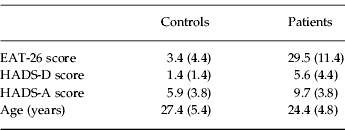
Group characteristics are shown in Table 1. These were as expected, with the BN patient group having a significantly higher score on the EAT-26 [F(1, 26)=6.91, p=0.01] and higher levels of depression and anxiety on the HADS [depression subscale HADS-D: F(1, 25)=11.83, p<0.01; anxiety subscale HADS-A: F(1, 25)=6.91, p=0.01, data from one participant missing). HVs and those with BN were similar in age [mean 27.38 (s.d.=5.44) and 24.42 (s.d.=4.67) years respectively; F(1, 26)=2.25, p=0.15].
Group characteristics

EAT-26, Eating Attitudes Test, 26-item version; HADS-D, Hospital Anxiety and Depression Scale, depression subscale; HADS-A, Hospital Anxiety and Depression Scale, anxiety subscale.
Values given as mean (standard deviation).
Behavioural results: response accuracy and latency
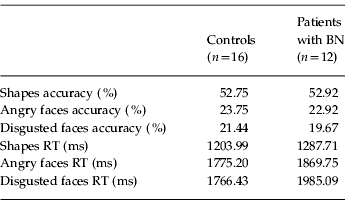
Patients were less accurate at matching angry and disgusted facial expressions of emotion [F(1, 26)=5.37, p=0.03] in the absence of between-group differences in reaction times (all p values >0.2). By contrast, there were no between-group differences in accuracy or reaction time when matching shapes (all p values >0.2), suggesting that difference in matching facial expressions was not driven by a deficit in simple perceptual skill. The mean scores for accuracy and reaction time for faces and shapes are shown in Table 2.
Mean scores for behavioural data for the two groups

BN, Bulimia nervosa; RT, reaction time.
fMRI results
Whole-brain analysis
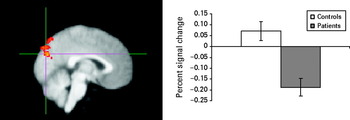
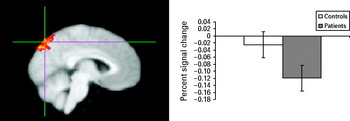
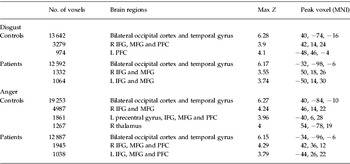
Compared to baseline, facial expressions of anger and disgust activated a network of brain regions in patients and HVs. Table 3 indicates the brain regions activated in each task (disgust and anger versus baseline) separately. There were no significant within- or between-group differences for the disgust versus anger (or vice versa) contrasts. The between-groups comparison for disgust revealed that patients had decreased activation in the precuneul/cuneal cortex (extending into the lateral occipital for the anger contrast) compared to HVs [463 voxels, max z=3.06, MNI coordinates (−2, −30, 30); Fig. 1]. Univariate ANOVA on the extracted signal change from this cluster showed that the between-groups difference survived removal of the patient taking antihistamine [F(1, 25)=15.15, p<0.01], and controlling for depression and anxiety [F(1, 23)=11.31, p<0.01]. A similar pattern was evident in response to facial expressions of anger [600 voxels, max z=2.39, MNI coordinates (−4, −78, 52); Fig. 2], again this survived removal of the patient taking antihistamine [F(1, 25)=34.48, p<0.01] and controlling for depression and anxiety [F(1, 23)=11.31, p<0.01].
Decreased activation in precuneus to facial expressions of disgust in patients compared to controls (cross-hairs at MNI coordinates −2, −82, 30).

Decreased activation in precuneus to facial expressions of anger in patients compared to controls (cross-hairs at MNI coordinates −4, −78, 52).

Brain regions significantly activated in response to facial expressions of disgust and anger compared to baseline

R, Right; L, left; IFG, inferior frontal gyrus; MFG, medial frontal gyrus; PFC, prefrontal cortex; MNI, Montreal Neurological Institute.
ROI analyses
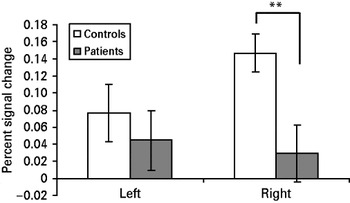
ROI analysis revealed decreased right amygdala activation in patients compared to HVs in response to facial expressions of anger [F(1, 26)=9.16, p<0.01]. This remained significant when the antihistamine patient was removed [F(1, 25)=8.25, p<0.01, Fig. 3] and remained a trend when depression and anxiety were controlled [F(1, 23)=3.76, p=0.065]. The extracted signal change from the left and right amygdalae was entered into an ANOVA with a within-subjects factor of laterality. A trend towards a laterality×group interaction was revealed, confirming a between-groups difference in the right amygdala [F(1, 26)=3.98, p=0.057]. There was no between groups difference in amygdala or insula activation to disgusted faces (both p values >0.19) or in the insula to angry faces (p>0.15). There were no between-group differences in the PFC or MFC ROIs for anger or disgust (all p values >0.50). In a simple correlational analysis, where the extracted signal change from the ROIs was correlated during appropriate contrasts, there were no significant correlations of note.
Percentage signal change in left and right amygdalae in response to facial expressions of anger. ** Between-groups difference in univariate ANOVA at p<0.01.

Discussion
Neural correlates of the processing of facial expressions of disgust and anger were investigated in patients with BN and in HVs. Compared to HVs, key findings in the BN group were decreased activation in the precuneus in response to negative facial expressions of anger and disgust. These were revealed in the whole-brain analysis. ROI analyses revealed decreased activation in the right amygdala in patients compared to HVs when processing angry facial expressions.
Decreased activation in the right amygdala in the BN patients in response to angry facial expressions, which remained, albeit in attenuated form, when depression and anxiety were controlled, is consistent with a cognitive/schematic explanation where the mechanism is avoidance, as outlined in the introduction. However, other potential explanations exist, as described here.
Amygdala deactivation in the patients occurred only in the right amygdala. This may be because implicit emotional processing tasks (as used here) have previously been found to activate the limbic system, particularly the right amygdala (Morris et al. Reference Morris, Öhman and Dolan1999; Pegna et al. Reference Pegna, Khateb, Lazeyras and Seghier2004). Thus the nature of the task may be partly responsible for this finding. The right amygdala, compared to the left, may also be sensitive to learned emotion (fear) and its expression (Knight et al. Reference Knight, Nguyen and Bandettini2005). It also seems to respond to emotion more rapidly but displays a faster decrease in response over time (Phillips et al. Reference Phillips, Medford, Young, Williams, Williams, Bullmore, Gray and Brammer2001). These findings do not explain the between-groups difference in activity, but may contribute to an explanation of this difference. Of particular interest are studies of amygdala deactivation, for example in paranoia (Russell et al. Reference Waller, Cordery, Corstorophine, Hinrichsen, Lawson, Mountford and Russell2007). Patients with paranoid symptoms, like BN patients, are less accurate at identifying emotions in a behavioural task. They show amygdala deactivation and also selective attention in visual scan path studies (Freeman et al. Reference Freeman, Garety and Phillips2000; Green et al. Reference Green, Williams and Davidson2003). These findings have been interpreted as vigilance avoidance, consistent with general amygdala findings, where paranoia is associated with initial hyper- or selective attention followed by emotional avoidance (Green & Phillips, Reference Green and Phillips2004). A similar hypothesis has been suggested for social anxiety (Campbell et al. Reference Campbell, Sareen, Paulus, Goldin, Stein and Reiss2007), and may also fit the BN patients studied here.
The pattern of findings may also fit with emotional blunting, seen in both paranoia and BN, or with the notion of greater habituation to emotional stimuli in BN. Such explanations do not necessarily involve a cognitive dimension, at least for the patient findings; for example, it may be that the cognitive emotional link (as described, for example, by Ochsner & Gross, Reference Ochsner and Gross2005; see also Phillips et al. Reference Phillips, Drevets, Rauch and Lane2003) is well developed in the HVs but is not similarly well developed in the BN patients, and a more behavioural explanation, potentially unconscious and learned, best fits the patient data.
Lack of differential neural response in the insula, particularly in relation to disgusted facial expressions, is noteworthy. However, as expected based on robust findings in HVs, disgusted and angry facial expressions activated the insula in both groups of participants. One possibility is that presentation of angry and disgusted facial expressions close together in the current paradigm may have had an impact on the discrete response normally found to disgusted facial expressions (Fusar-Poli et al. Reference Fusar-Poli, Placentino, Carletti, Landi, Allen, Surguladze, Benedetti, Abbamonte, Gasparotti, Barale, Perez, McGuire and Politi2009). However, failure to find differences is consistent with findings in an HV and BN patient study of disgusting (non-facial) stimuli, where such overlap was not evident in the paradigm used, yet there were no between-group differences (Schienle et al. Reference Schienle, Vaitl and Schäfer2004). Contrary to our hypothesis, disgust and angry facial stimuli may not therefore be reliably associated with a differential neural response in the insula in patients with BN compared to HVs.
Contrary to what might be expected from existing neuroimaging findings (Phillips et al. Reference Phillips, Drevets, Rauch and Lane2003; Ochsner & Gross, Reference Ochsner and Gross2005) and from schema theory as applied to EDs (Waller et al. Reference Waller, Cordery, Corstorophine, Hinrichsen, Lawson, Mountford and Russell2007; Pallister & Waller, Reference Pallister and Waller2008), there was no between-group difference in the PFC ROI. This provides preliminary evidence that reduced amygdala activation in BN may not be secondary to prefrontal or MFC modulation. As outlined earlier, non-cognitive explanations may therefore best fit the patient data. Alternatively, the precuneus findings may contribute to a rather different cognitive explanation.
Decreased activation in the precuneus in the patients is particularly significant given that it emerged in the whole-brain analysis. The precuneus is involved in self-referential processing, first-person perspective taking and mental representation (Fossati et al. Reference Fossati, Hevenor, Lepage, Graham, Grady, Keightley, Craik and Mayberg2004; Ofek & Pratt, Reference Ofek and Pratt2005), in addition to visuospatial imagery, episodic (and autobiographical) memory and consciousness (Cavanna & Trimble, Reference Cavanna and Trimble2006). It is important to note that participants viewed facial expressions of another person. Similar performance on the perceptual shape-matching tasks seems to rule out a specific role for visuospatial functioning in the between-group differences found here. However, patients were less accurate when matching faces displaying angry and disgusted expressions on the behavioural task, which suggests a specific deficit when processing emotional content in facial expressions. In the context of precuneus activity, one possibility is that, when HVs encounter emotional expressions of anger and disgust in another person, they generate internal representations of these states in relation to themselves and experience the emotion as if it were their own. This suggests a (normal) well-developed awareness of their own and others' internal states, and indeed is consistent with their (normal) neural response. However, patients with BN show decreased activation in the precuneus, suggesting that failure of such mental representation occurs when they view facial expressions of anger and disgust. The direction of causality is unclear; failure of first-person perspective taking and associated mental representation may be driven by lower level amygdala deactivation (e.g. reflecting blunted emotional response, or other learned or innate responding), or it may be that failure in higher level cognitive processing leads to decreased emotional response reflected in amygdala deactivation or, more plausibly perhaps, a combination of both occurs. The explanation is consistent, however, with the theoretical notion that understanding of others' and understanding of one's own internal state are interdependent (e.g. Fonagy et al. Reference Fonagy, Gergely, Jurist and Target2002). The current finding is also consistent with theories suggesting that failures in understanding others' and one's own internal states (i.e. lack of mentalization or theory of mind, both of which are cognitive or cognitive affective explanations) may occur in EDs, including BN (e.g. Skårderud, 2007 a,b). A cognitive explanation, but a different one from that considered in current neuroscience models of emotional control and regulation, with their focus on the role of the PFC or the MFC (Phillips et al. Reference Phillips, Drevets, Rauch and Lane2003; Ochsner & Gross, Reference Ochsner and Gross2005), and one that is different from that detailed in schema theory as it is applied to EDs (Waller et al. Reference Waller, Cordery, Corstorophine, Hinrichsen, Lawson, Mountford and Russell2007; Pallister & Waller, Reference Pallister and Waller2008) might therefore be relevant. Lack of theory of mind may be the key cognitive deficit. This is not necessarily incompatible with some applications of schema theory, including in EDs. Indeed, an integrated metacognitive and cognitive theory that can capture both schema theory and the ability to reflect on and understand one's own mental state, that is metacognitive thinking, has been outlined for BN (Cooper et al. Reference Cooper, Todd and Wells2009). In sum, the role of the precuneus in viewing emotional faces in BN may need further exploration; exploration of how and why the area may be functionally related to viewing emotional faces needs particular attention. Constraining the relevant attentional, cognitive and theory of mind parameters, based on neuroscientific and clinical conceptualization, may help to explore this further.
Both whole-brain and ROI analyses were used in the study. Although the use of ROIs can have some limitations, particularly in reducing the statistical strength of the differences that are likely to be significant, this is balanced in the current study by the use of ROIs that were very tightly defined by the task in question, and there were definite a priori reasons here for selecting the particular areas used. Perhaps the greatest limitation here is that we did not control for multiple comparisons either across space or across ROIs. However, given the study was conceived as exploratory, it can be argued that such control may be premature (Rothman, Reference Rothman1990).
The present study is the first of its kind in EDs, and finding decreased activation in the amygdala and precuneus in BN compared with HVs is, to the best of our knowledge, novel. The study recruited BN patients who were not taking centrally acting medication, which is known to affect performance on this type of task (one exception was the patient who had taken an antihistamine tablet, but all significant analyses were rerun excluding this participant to check that this did not bias the results). Importantly, the study controlled for depression and anxiety, which are known to affect behavioural performance and patterns of neural activity in response to this type of emotional processing task, and thus the findings seem to be specific to the ED symptoms of the participants rather than to co-morbid depressive or anxious symptoms. As a first study the results are preliminary and require replication. The explanations proposed are tentative, and need further exploration to provide evidence for their validity. Future work should also consider alternative designs and methods, including those with greater sophistication than were used here, in addition to the use of larger samples.
Acknowledgements
We are grateful to all the individuals who took part in this study. The study was funded by an Oxfordshire Health Services Research Committee grant to M.J.C.
Declaration of Interest
C.J.H. is on the advisory board of P1vital Ltd and holds shares in the company. She is also company director and share holder of Oxford Psychologists Ltd. C.J.H. has received paid consultancy from GlaxoSmithKline, Servier, J&J, AstraZeneca and P1vital. P.J.C. has been a paid member of advisory boards of Eli Lilly, Servier and Wyeth and a paid lecturer for AstraZeneca, Eli Lilly, Servier and GlaxoSmithKline. He has received remuneration for scientific advice given to legal representatives of GlaxoSmithKline.