Introduction
Detecting and interpreting information from the environment is crucial both to survival and reproductive success of organisms (Dall et al., Reference Dall, Giraldeau, Olsson, McNamara and Stephens2005). Insects rely on a combination of different sensory cues in a wide arrange of intra- and interspecific behaviours, including courtship (Skals et al., Reference Skals, Anderson, Kanneworff, Löfstedt and Surlykke2005; Villagra et al., Reference Villagra, Pinto, Penna and Niemeyer2011). Acoustic signals (including airborne and substrate-borne sounds) affect mating decisions in many insect taxa (Alexander, Reference Alexander1967; Ewing, Reference Ewing1989; Sivinski & Webb, Reference Sivinski and Webb1989; Čokl & Virant-Doberlet, Reference Čokl and Virant-Doberlet2003; Mazzoni et al., Reference Mazzoni, Lucchi, Ioriatti, Virant-Doberlet and Anfora2010; Eriksson et al., Reference Eriksson, Anfora, Lucchi, Virant-Doberlet and Mazzoni2011); they are produced by various mechanisms, including stridulation, percussion, vibration, clicking and air expulsion (Ewing, Reference Ewing1989; Greenfield, Reference Greenfield2002; Claridge, Reference Claridge, Drosopoulos and Claridge2005). Among parasitic Hymenoptera, olfactory cues play an important role in sexual recognition and selection (Ayasse et al., Reference Ayasse, Paxton and Tengö2001), both at long (Quicke, Reference Quicke1997) and short (McClure et al., Reference McClure, Whistlecraft and McNeil2007) distances. Moreover, parasitoids frequently use mechanical signals to communicate with sexual partners (Danci et al., Reference Danci, Takács, Schaefer and Gries2010; Joyce et al., Reference Joyce, Aluja, Sivinski, Vinson, Ramirez-Romero, Bernal and Guillen2010), and several species integrate olfactory and acoustic cues in mating sequences (Sivinski & Webb, Reference Sivinski and Webb1989; Joyce et al., Reference Joyce, Hunt, Bernal and Vinson2008; Canale et al., Reference Canale, Benelli and Lucchi2012). Communication through wing fanning has been reported in a parasitic wasp as a behaviour generating airborne signalling during courtship (Danci et al., Reference Danci, Takács, Schaefer and Gries2010). Wing fanning is displayed by males of different parasitoid species as a universal component of courtship (Gordh & DeBach, Reference Gordh and DeBach1978; Bourdais & Hance, Reference Bourdais and Hance2009). In courting males of many braconids this behaviour can play multiple roles, such as contributing to communication (McClure et al., Reference McClure, Whistlecraft and McNeil2007; Joyce et al., Reference Joyce, Aluja, Sivinski, Vinson, Ramirez-Romero, Bernal and Guillen2010), enhancing female activity (Sivinsky & Webb, Reference Sivinski and Webb1989), affecting female receptivity (Field & Keller, Reference Field and Keller1993; Kimani & Overholt, Reference Kimani and Overholt1995), facilitating male orientation towards females (Vinson, Reference Vinson1972) and ensuring that males secure female mates (Rungrojwanich & Walter, Reference Rungrojwanich and Walter2000). In this paper we describe acoustically the wing-fanning behaviour of Psyttalia concolor (Szépligeti) (Hymenoptera: Braconidae) males, displayed towards females and other males.
Psyttalia concolor is a generalist synovigenic koinobiont larval–pupal endoparasitoid of many Tephritidae. This braconid is known to attack 14 tephritids on different plants, both wild and cultivated, although only two are known as typical hosts in its native range: the Mediterranean fruit fly, Ceratitis capitata (Wiedemann), and the olive fruit fly, Bactrocera oleae (Rossi) (Wharton & Gilstrap, Reference Wharton and Gilstrap1983). In Italy, P. concolor can be found spontaneously associated, in late autumn, with B. oleae in Sicily, southern Sardinia and in various areas of coastal Tuscany (Raspi et al., Reference Raspi, Loni, Canovai and Canale2007). This parasitoid was used in Italy and in other Mediterranean climates for the biological control of B. oleae, with limited success (Daane & Johnson, Reference Daane and Johnson2010). It has recently been released in Californian olive groves as part of biological control projects carried out in that area (Yokoyama et al., Reference Yokoyama, Rendon and Sivinski2008). Recent studies demonstrated that fanning behaviour has a crucial role in the courtship sequence of P. concolor and that the male mating status does not influence its courtship behaviour (Benelli & Canale, Reference Benelli and Canale2012; Benelli et al., Reference Benelli, Bonsignori, Stefanini and Canale2012a). Male fanning is frequently displayed towards conspecific males as well, as reported for other braconids (Sivinski & Webb, Reference Sivinski and Webb1989; Xiong, Reference Xiong2008) and wingless males show significantly lower mating success compared with winged males (Benelli et al., Reference Benelli, Bonsignori, Stefanini and Canale2012a). High-speed video recordings showed that frequency, pulse duration and interpulse interval (IPI) of fanning males during female courtship differed significantly in successful mating attempts compared with unsuccessful ones, suggesting that in P. concolor male wing fanning is a crucial selective filter to mating. However, the survey of wing-fanning behaviour conducted by Benelli et al. (Reference Benelli, Bonsignori, Stefanini and Canale2012a) does not enable description of acoustic parameters of wing-fanning signals. By contrast, in our acoustic study we were able to: (i) describe the airborne component of the vibration that the female receives at a certain distance; (ii) acquire specific components of the sound required to set further manipulative experiments; (iii) ascertain the involvement of other possible sound-producing organs, which are not video-visible but which could be involved in sound production. In addition, for males approaching females (either virgin or mated) we examined the courtship song performances to detect which signal parameters were related to mating success.
Materials and methods
Parasitoid and host rearing
Rearing of P. concolor and C. capitata was carried out in the insectary of Pisa University (Italy), according to materials and methods recently described by Canale & Benelli (Reference Canale and Benelli2012). To obtain virgin specimens of P. concolor, emerging males and females were immediately sexed and individually stored in glass vials (diameter 20 mm, height 60 mm) at 21 ± 1 °C, 48 ± 10% relative humidity and L16:D8 photoperiod. Mated wasps were obtained by placing a virgin pair in a glass vial. After mating, specimens were stored individually in a glass vial, fed with a solution of sugar and water (10% w/v) and tested 24 h later.
Sound recording
Courtship recordings were done on sexually mature 48-hour-old P. concolor individuals (Benelli & Canale, Reference Benelli and Canale2012; Benelli et al., Reference Benelli, Bonsignori, Stefanini and Canale2012a). Wasps were placed in a rectangular polycarbonate testing arena (20 × 20 × 20 mm wide) with transparent sides and open top, covered with white chiffon fabric. Recordings were done with an AKG C 1000 S condenser microphone (AKG Acoustics, Nashville, Tennessee, USA; frequency response of 50–20,000 Hz and sensitivity of 6 mV/Pa) positioned at 5 mm from the chiffon wall of the arena. Signals were amplified and digitalised on external soundcard (DMX 6Fire USB, 24 bit/192 kHz A/D converter) before being recorded on a PC (Acer TravelMate 6592) at a sampling rate of 44 kHz using Adobe Audition 3.0 (Syntrillium Software, San Jose, California, USA). Wing fanning performed by a virgin male during courtship or copulation attempts in the presence of (i) a virgin or (ii) a mated female (i.e. mating occurred 24 h before) was recorded. Immediately after, it was noted whether the courting male reached a successful mating. As it was known that fanning behaviour and copulation attempts were frequently displayed between males, wing fanning displayed by a male toward another virgin male (iii) was also investigated. In all experiments, recordings started once the two wasps were placed together in the arena. For each replicate, recordings lasted 8 min or until mating. All wasps were used for only one recording trial. Thirty replications were performed for each experiment, with the exception of courtships and copulation attempts towards virgin females (n = 60). All recordings were done between 09:00 and 16:30 h, over several days, under controlled conditions (21 ± 1 °C, 48 ± 10% relative humidity and natural photoperiod). Between each behavioural bioassay, the odour-cleaning procedure was as follows: the testing arena was first washed for about 30 s with warm water at 35–40 °C, then cleaned in a water bath with mild soap for about 5 min, rinsed with hot water for about 30 s, and finally rinsed with distilled water at room temperature.
Measurement of fanning acoustic parameters
In agreement with Joyce et al. (Reference Joyce, Aluja, Sivinski, Vinson, Ramirez-Romero, Bernal and Guillen2010) and Benelli et al. (Reference Benelli, Bonsignori, Stefanini and Canale2012a), for each fanning recording the first series of 15 of more consecutive pulses produced by male wing fanning during courtship was used for courtship acoustic measurements. Three components of the first series of pulses were used: the second pulse from the beginning of the series, the middle pulse of the series, and the second to last pulse at the end of the series. For each male, data from three IPIs were averaged across them. In the case of an even number of pulses, the middle pulse was calculated using the formula [(total pulses/2) + 1]. The sound editing software Raven 1.4 (Cornell Laboratory of Ornithology, Ithaca, New York, USA) was used to measure pulse duration (s), pulse dominant frequency (Hz) (FFT 2048) and IPI (s) (i.e. the time between the onset of two consecutive pulses) for each of these three components (Joyce et al., Reference Joyce, Aluja, Sivinski, Vinson, Ramirez-Romero, Bernal and Guillen2010). To evaluate the statistical differences in mean value between different treatments, data were processed by JMP 7, using a weighted general linear model with one fixed factor: y = Xß + ε where y is the vector of the observations (e.g. frequency, pulse or interpulse duration), X is the incidence matrix, ß is the vector of fixed effects (i.e. the mate sexual identity for table 1, the mating success for table 2) and ε is the vector of the random residual effects.
Psyttalia concolor. Variables measured in male wing fanning (WF) performed in the presence of a male (♂) or a female (♀), the latter either virgin or mated. Parameters were measured first during courtship (court) and then during pre-copulation (copul). For each male, frequency, pulse and inter-pulse were calculated by averaging the three values obtained from three non-consecutive interpulse intervals, in order to obtain a weighted value of each parameter for each individual. Thirty replicates were performed for each parameter, with the exception of courtship and copulation attempts towards virgin females (n = 60). Values of the same column followed by different letters are significantly different (P < 0.05; general linear model followed by Tukey–Kramer HSD test).

♂ – virgin ♂ court WF: wing fanning performed during courtship of a virgin male.
♂ – virgin ♀ court WF: wing fanning performed during courtship of a virgin female.
♂ – virgin ♂ copul WF: wing fanning performed in pre-copulation to a virgin male.
♂ – virgin ♀ copul WF: wing fanning performed in pre-copulation to a virgin female.
♂ – mated ♀ court WF: wing fanning performed during courtship of a mated female.
♂ – mated ♀ copul WF: wing fanning performed in pre-copulation to a mated female.
Psyttalia concolor. Variables measured in male wing fanning (WF) performed before a successful (SM) or unsuccessful (UM) mount. Parameters were measured first during courtship (court) and then during pre-copulation (copul). For each male, frequency, pulse and inter-pulse parameters were calculated by averaging the three values obtained from three non-consecutive interpulse intervals, in order to obtain a weighted value of each parameter for each individual. Thirty replicates were performed for each parameter. Values of the same column followed by different letters are significantly different (P < 0.05; general linear model followed by Tukey–Kramer HSD test).

SM court WF: wing fanning performed during courtship before a successful mount.
UM court WF: wing fanning performed during courtship before an unsuccessful mount.
SM copul WF: wing fanning performed during pre-copulation before a successful mount.
UM copul WF: wing fanning performed during pre-copulation before an unsuccessful mount.
Results
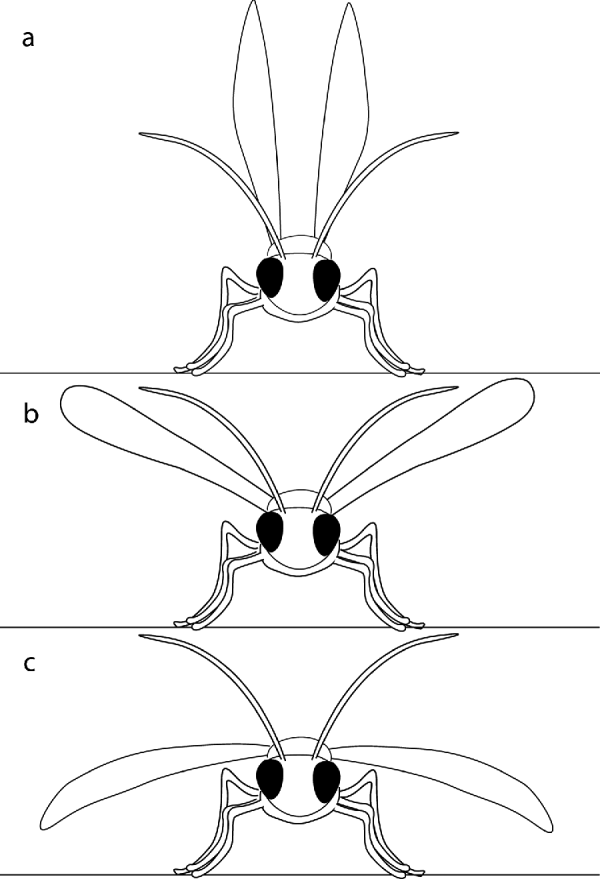
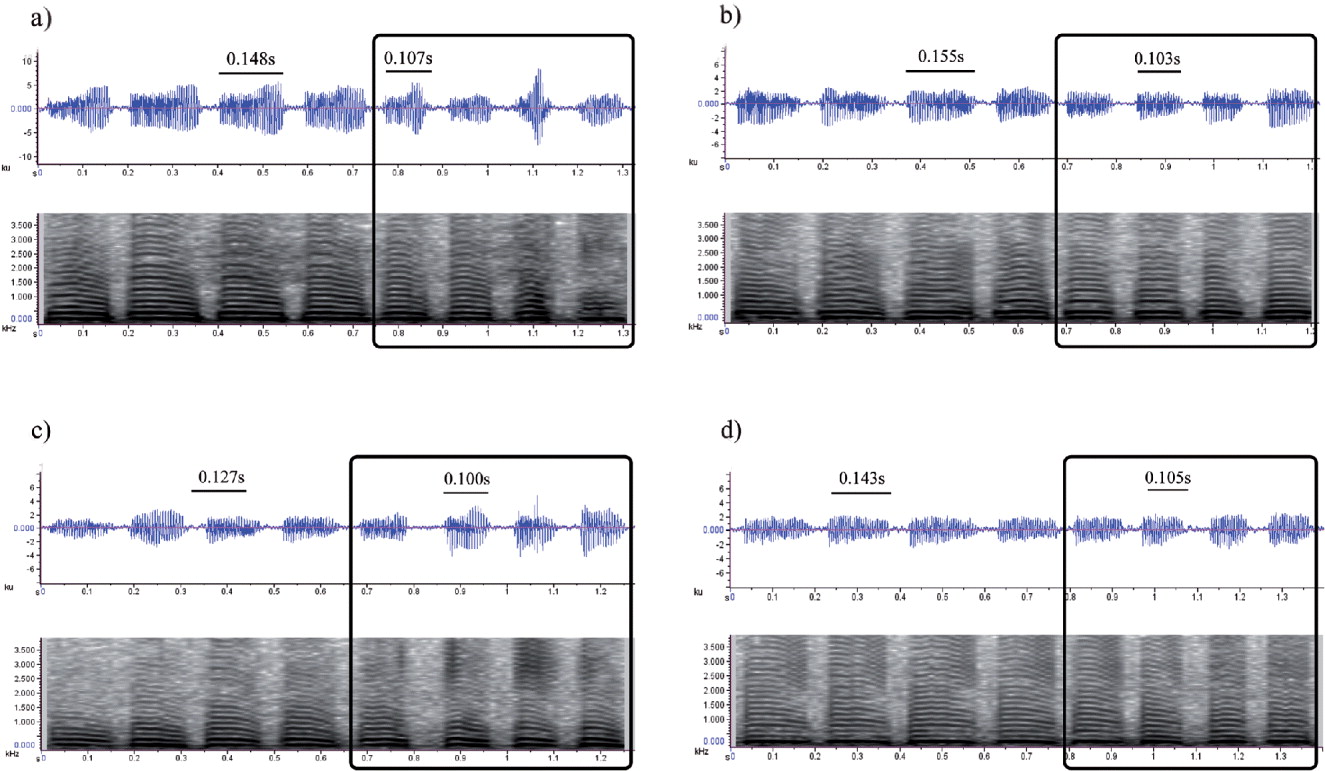
Wing fanning starts when the male is in close proximity of the mate (at about 1 cm). During wing fanning, P. concolor wings are kept raised and moved rhythmically in a dorsoventral fashion (fig. 1). Males produce a series of uninterrupted regular sound pulses that change in duration as a function of courtship or copulation phases (table 1). The pulses show harmonic spectral structures with a fundamental and dominant frequency of about 180 Hz, decreasing in the last part of each pulse (fig. 2).
Psyttalia concolor. Male wing movements during a fanning act in frontal view: (a) start position – the wing tips are brought from a position over the thorax; (b) median position – the wings form an angle of about 160° to each other; (c) final position – the wing tips reach a point distal to the starting position, before rapidly returning to (a).

A representative signal sequence of Psyttalia concolor male wing fanning (WF), in which both signals are shown: WF courtship and WF pre-copulation in a black rectangle for each interaction studied. Signals are viewed in Waveform (above) and Spectrogram (below). (a) WF towards a virgin female, followed by an unsuccessful mating; (b) WF towards a virgin female, followed by a successful mating; (c) WF towards a virgin male; (d) WF towards a mated female, followed by an unsuccessful mating.

Table 1 reports the differences in signal parameters displayed by P. concolor virgin males during the courtship phase and copulation attempt, in the presence of either virgin or mated females, or other males. Significant differences were highlighted regarding fanning frequency (F = 7.217, df = 5, P < 0.0001), pulse duration (F = 54.335, df = 5, P < 0.0001) and IPI (F = 9.667, df = 5, P < 0.0001) displayed by males among different treatments, while we did not detect any difference in male signal quality, when they were courting either mated or virgin females.
Table 2 shows significant differences in pulse duration (F = 50.913, df = 3, P < 0.0001) and IPI (F = 12.232, df = 3, P < 0.0001), but not in fanning frequency (F = 0.303, df = 3, P = 0.823) performed by P. concolor males before successful or unsuccessful matings. We found that all three parameters (frequency, IPI, pulse duration) changed according to the behavioural context. Frequency was found to be sex dependent, as differences were observed only between male–male and male–female interactions (table 1). In fact, when males faced females, the signal frequency was significantly higher. However, the IPI shortened when passing from courtship to pre-copula, so proving to be affected by the behavioural stage (table 1). By contrast, the pulse duration was longer during courtship than in pre-copula, and in the presence of females rather than males (table 1). In addition, it is remarkable that pulse duration was found to be significantly longer in successful mating attempts (table 2).
Discussion
The recent study of Benelli et al. (Reference Benelli, Bonsignori, Stefanini and Canale2012a) stressed the importance of male wing fanning in the courtship sequence of P. concolor, highlighting its crucial role in increasing the likelihood of attracting a mate. However, in that study wing fanning parameters were described using only high-speed video recordings. Therefore, information on the airborne component of the vibration, the possible involvement of other sound-producing organs and the acquisitions of specific components of the sound was lacking. The present investigation shows that the wing fanning produces an airborne sound with specific temporal and spectral characteristics that can be relevant in determining mating success. The courtship song produced by fanning males presents a pattern similar to other Braconidae (Opiinae), being characterised by a sequence of pulses, emitted at regular intervals and with clear harmonics (Joyce et al., Reference Joyce, Aluja, Sivinski, Vinson, Ramirez-Romero, Bernal and Guillen2010). However, there is no trace of elements such as percussion clicks or other signals already reported in Braconidae (Microgastrinae) (Field & Keller, Reference Field and Keller1993; Danci et al., Reference Danci, Takács, Schaefer and Gries2010).
Significant differences in terms of acoustical parameters were found when male wing fanning was displayed in the presence of either females or males. In particular, we observed higher frequencies and longer pulses in the presence of females, during both courtship and copulation attempts. Instead, fanning frequencies during courtship of mated females did not differ from those displayed towards virgin females. This could be because of the production of sex pheromones and/or attractants that does not cease or diminish after mating, as already noted for other species (McClure et al., Reference McClure, Whistlecraft and McNeil2007). Furthermore, these results suggest different male efforts in producing signals according to the behavioural context. In fact, when facing other males, pulses are of shorter duration and of lower frequency, thus implying a comparatively reduced energetic cost in their production that would make the male–male wing fanning a sort of exhibition between rivals. By contrast, the best performances (energetically more expensive) would be done only in presence of potential partners. Whatever the reason for the different song parameters, it was highlighted that the signal parameters are different throughout courtship. Our hypothesis is that a male could systematically adjust his signalling behaviour only when aware of the sexual identity of the nearby individual. Pulse duration recorded during copulation attempts was shorter with respect to that measured during courtship, in agreement with a previous finding in P. concolor (Benelli et al., Reference Benelli, Bonsignori, Stefanini and Canale2012a) and Diachasmimorpha longicaudata (Ashmead) (Sivinski & Webb, Reference Sivinski and Webb1989). According to Benelli et al. (Reference Benelli, Bonsignori, Stefanini and Canale2012a), any detectable difference was noted among copulation fanning performed by P. concolor males towards virgin and mated females or other males. The substantial similarity between the main sound parameters measured in this acoustic study or acquired by the high-speed video recordings (Benelli et al., Reference Benelli, Bonsignori, Stefanini and Canale2012a) suggests the exclusive role of the wings in signal production.
In our study male success in mating was affected by wing-fanning quality in the courtship phase, but not during copulation attempts. This finding is not uncommon among insects, and similar results were acknowledged also for some dipterans, Drosophilidae (Aspi & Hoikkala, Reference Aspi and Hoikkala1995) and Tephritidae (Webb et al., Reference Webb, Sivinski and Litzkow1984; Briceño & Eberhard, Reference Briceño and Eberhard2002; Benelli et al. Reference Benelli, Canale, Bonsignori, Ragni, Stefanini and Raspi2012b). Our recordings clearly show that fanning sound displayed before a successful courtship differs with respect to that performed before an unsuccessful courtship for their mean duration of pulses. This latter evidence matches with findings reported for P. concolor itself by Benelli et al. (Reference Benelli, Bonsignori, Stefanini and Canale2012a) and Cotesia rubecula (Marshall), in which it was noted that some male courtship behaviour traits (e.g. walk-fan and pulse) were longer during successful courtships than during unsuccessful ones (Field & Keller, Reference Field and Keller1993). The duration of the signal can be used by females for mate choice, as a cue to male fitness. Females of the grasshopper Chorthippus biguttulus L. prefer songs made of long syllables (Wittman et al., Reference Wittman, Kolss and Rehinold2011). Holzer et al. (Reference Holzer, Jacot and Brinkhof2003) demonstrated that the courtship signal parameters of the field cricket Gryllus campestris L. are affected by food availability, which positively influences male fitness; this would be the reason why females choose calls of longer duration (Hedrick, Reference Hedrick1986). Indeed, signal duration and pulse rate are known to be important for female choice in many insect and spider taxa (e.g. Jang & Greenfield, Reference Jang and Greenfield1996; Parri et al., Reference Parri, Alatalo, Kotiaho, Mappes and Rivero2002). For example, a longer pulse or a higher rhythm of emission would indicate male health and fitness. Thus, it looks conceivable that females of P. concolor would use signal duration as an indicator of male quality. In reality, we did not find any effect due to IPI: although we measured a certain intraspecific variation in pulse duration, which was eventually associated with mating success, IPI parameters were rather constant. The latter are probably a species-specific feature related to recognition between individuals. Indeed, Benelli et al. (Reference Benelli, Bonsignori, Stefanini and Canale2012a) reported some differences in this regard, but in that case the experimental adopted procedures and methodologies were much different, and sound characteristics were deducted only from video recordings. Proper courtship components are commonly of little specificity and consequently more subjected to sexual selection, whereas highly conserved parameters are basically connected to mechanisms of call and identification (Nattier et al., Reference Nattier, Robillard, Amedegnato, Couloux, Cruaud and Desutter-Grandcolas2011). Indeed, there are cases in which signal duration is mainly correlated with mate location rather than courtship (e.g. De Groot et al., Reference De Groot, Čokl and Virant-Doberlet2011a,Reference De Groot, Derlink, Pavlovčič, Prešern, Čokl and Virant-Doberletb), but this happens for those species, such as leafhoppers and planthoppers, that use sounds/vibrations also for this purpose. Psyttalia concolor mating strategy probably includes the initial use of female-borne sex attractants (Canale et al., Reference Canale, Benelli and Lucchi2012), whereas sounds are emitted only in very short-range situations, when mate location has been already accomplished (Benelli et al., Reference Benelli, Bonsignori, Stefanini and Canale2012a). It follows that wing fanning produces a proper courtship song. To date, the receptors involved in the perception of these acoustic signals in P. concolor are unknown. In the honeybee, Dreller & Kirchner (Reference Dreller and Kirchner1993) demonstrated the existence of an antennal chordotonal organ (Johnston's organ) involved in mechanical communication at short distance. However, wing-fanning sounds may be detected by mechanosensitive sensilla present along the insect body (Yager, Reference Yager1999), and dedicated studies are necessary to identify the structures involved in the detection of wing-fanning sounds in the courtship interactions we describe. Further research is in progress to evaluate possible effects of abiotic factors (e.g. mass-rearing practices and geographical origin) on P. concolor fanning performances, as suggested by a recent research conducted on different braconid species (Joyce et al., Reference Joyce, Aluja, Sivinski, Vinson, Ramirez-Romero, Bernal and Guillen2010). Moreover, the substrate-borne component features of the wing fanning, already described in other braconids (Field & Keller, Reference Field and Keller1993; Joyce et al., Reference Joyce, Aluja, Sivinski, Vinson, Ramirez-Romero, Bernal and Guillen2010), are under investigation for P. concolor as well, with the aim of fully understanding the meaning of the signals in the mating behaviour of this wasp.