1. Introduction
In view of remarkable applications and progresses in laboratory experiments such as low-temperature plasmas, radio-frequency plasma discharge, plasma crystals (Shukla & Mamun Reference Shukla and Mamun2002), semiconductor material processing (Kokura et al. Reference Kokura, Yoneda, Nakamura, Mitsuhira, Nakamura and Sugai1999), nanomaterials (Boufendi & Bouchoule Reference Boufendi and Bouchoule2002) etc, dusty plasmas have received great attention in investigating various collective effects. In laboratory plasmas, dust grains are usually negatively charged, due to the electron and ion fluxes on the surface of dust. These fluxes can be significantly affected by any fluctuations in plasma parameters which change the variations of the dust charge. Wave propagation in such complex systems is therefore expected to be substantially different from the ordinary two-component plasmas. Because of dust charge, new time and space scales come into play. Therefore, due to the presence of the charged dust grains in plasmas, different kinds of collective processes exist and very rich wave modes can be excited in dusty plasmas (El-Labany & El-Taibany Reference El-Labany and El-Taibany2003; El-Taibany & Sabry Reference El-Taibany and Sabry2005; Moslem & El-Taibany Reference Moslem and El-Taibany2005; Mamun Reference Mamun2008; Tribeche & Boumezoued Reference Tribeche and Boumezoued2008; Alinejad Reference Alinejad2010, Reference Alinejad2012; Bains, Tribeche & Gill Reference Bains, Tribeche and Gill2011; Gharaee, Afghah & Abbasi Reference Gharaee, Afghah and Abbasi2011; Shahmansouri & Alinejad Reference Shahmansouri and Alinejad2013). Among them, one of the most important well-established low-frequency waves is dust-ion acoustic (DIA) waves where the dust grains do not participate in the wave motion. Shukla & Silin (Reference Shukla and Silin1992) were the first to report theoretically the existence of DIA waves, and later their existence was confirmed experimentally by Barkan, D’Angelo & Merlino (Reference Barkan, D’Angelo and Merlino1996). After that, the linear and nonlinear properties of DIA waves were extensively studied by many authors during the past few years (Kourakis & Shukla Reference Kourakis and Shukla2003; Alinejad & Tribeche Reference Alinejad and Tribeche2010; Wang et al. Reference Wang, Guo, Jiang, Zhou, Ni, Qian and Shen2010; Mushtaq et al. Reference Mushtaq, Nasir Khattak, Zulfiqar and Qamar2012).
In a dispersive nonlinear medium the propagation of localized waves is known to be subjected to amplitude modulation. This may be due to the parametric wave coupling, interaction between high- and low-frequency modes or simply the nonlinear self-interaction of the carrier wave. Under certain conditions, the system evolution shows modulation instability, leading to the formation of envelope solitons through the localization of wave energy. Such solitons governed by a nonlinear Schrödinger (NLS) equation in one dimension are the result of a balance between the nonlinearity (self-focusing) and the wave group dispersion. When such a balance is maintained dynamically, stable solitons may exist even under strong perturbations. These long-lived localized excitations can propagate in the medium over long distances, remarkably surviving impacts with each other (Robinson Reference Robinson1997). It should be noted that for two and three dimensions, there exist unstable soliton solutions to the nonlinear Schrödinger equation. In such systems, the effect of nonlinear self-focusing can dominate over the dispersion, and wave packets can undergo wave collapse, attaining short scales and high intensities before dissipating.
The modulation instability of the envelope DIA waves has been conclusively verified by a series of theoretical studies (Amin, Morfill & Shukla Reference Amin, Morfill and Shukla1998; Duan, Lü & Zhao Reference Duan, Lü and Zhao2001; Jukui & He Reference Jukui and He2003; Xue Reference Xue2003; Kourakis & Shukla Reference Kourakis and Shukla2004; Misra, Chowdhury & Chowdhury Reference Misra, Chowdhury and Chowdhury2007). Amin et al. (Reference Amin, Morfill and Shukla1998) investigated the modulation instability properties of DIA waves by using the multiple-scale technique. Kourakis & Shukla (Reference Kourakis and Shukla2003, Reference Kourakis and Shukla2004) studied the modulational instability and localized excitations of DIA waves in weakly coupled plasma. They showed a wide instability region which depends on the finite ion temperature, the angle between modulation and propagation direction and dust number density. The effects of dust particle charge fluctuations and nonplanar geometry on the DIA wave modulation wave were investigated in Duan et al. (Reference Duan, Lü and Zhao2001) and Jukui & He (Reference Jukui and He2003). Also, Misra et al. (Reference Misra, Chowdhury and Chowdhury2007) investigated the effect of nonthermal electrons on modulation instability of DIA wave packets by using a matching approach.
All these works are valid when the dissipation in the system, which is related to the loss of the plasma particles to dust grains by absorption and collisions, is neglected. This assumption in dusty plasma can be valid if the ions and electrons entering the surface of dust recombine into neutral atoms, which then enter the plasma and ionize again. Thus, the numbers of electrons and ions are preserved. Such a mechanism including ionization and recombination is dependent on the particle density, which means that the collective behaviour in a plasma system can be strongly affected. In the presence of ion–dust collision effects, Xue (Reference Xue2003) investigated the modulational instability of DIA in a dusty plasma system. He found that the influence of collisions would modify the modulational instability of the wave packets and could not admit any stationary envelope waves. However, the model used in Xue (Reference Xue2003) is limited to the viscosity and friction of ion fluid, which means that the effects of the plasma ionization and ion recombination on the surface of dust particles have been neglected. On the other hand, in most laboratory dusty plasmas, it is necessary to take into account a source of ions to ionization and recombination processes (Luo, D’Angelo & Merlino Reference Luo, D’Angelo and Merlino1999; Nakamura, Bailung & Shukla Reference Nakamura, Bailung and Shukla1999; Nakamura & Sarma Reference Nakamura and Sarma2001). Plasma particles are continuously being created by ionization and then lost by recombination in the same time scales. In Luo et al. (Reference Luo, D’Angelo and Merlino1999), a hot (
 ${\sim}2000$
–
 $2500$
K) plate used in the end region of a Q machine was irradiated along with a beam of caesium atoms. Thus, the caesium ions had been produced through ionization of caesium atoms. In this case, the caesium ions had been produced through ionization of caesium atoms at the surface of the plate. Therefore, it is important to investigate how the effects of plasma ionization, ion recombination on dust particles and a loss of ion momentum change the amplitude of DIA wave modulation in such a collisional dusty plasma.
In this paper, we have investigated the propagation of envelope solitons and the modulational instability of DIA wave packets in a weakly dissipative dusty plasma. The dissipative mechanisms are considered, which are related to the ionization, recombination and ion loss frequencies. We study the consequences arising from such a dissipative system, and derive a new modified nonlinear Schrodinger equation using the multiple time scales. The effect of the plasma parameters on the modulational instability criterion for the modified NLS equation is numerically investigated. It is shown that the appearance of a stability region is mainly because of the dissipative term, when the modulational instability ceases.
The organization of the paper is as follows. The basic set of dynamical equations governing our plasma model is presented in § 2. A new modified nonlinear Schrödinger equation is derived by the multiple time scale method in § 3. The modulation instability and growth rate of DIA waves are studied in § 4. Finally, a discussion is provided in § 5.
2. Basic equations
Let us consider a one-dimensional collisional unmagnetized dusty plasma consisting of a mixture of warm ion fluid, Boltzmann-distributed electrons and stationary dust grains. We assume that (i) the size of the particles is much smaller than the electron Debye length and the distance between grains; (ii) the dust particles are stationary in the ion acoustic time scale; (iii) the heat-transfer process which might affect the propagation of ion-acoustic waves is neglected; (iv) the number densities of electrons and ions are assumed to be constant due to the competition of the processes of electron and ion recombination on the dust particles in the absence of perturbation; (v) generation of ions from dust particles in the ionization source model is neglected (Samsonov & Goree Reference Samsonov and Goree1999). In such a dusty plasma system, the dynamics of a low-frequency electrostatic perturbation can be governed by the following set of normalized equations (Goree et al. Reference Goree, Morfill, Tsytovich and Vladimirov1999; Vladimirov, Ostrikov & Yu Reference Vladimirov, Ostrikov and Yu1999; Cramer & Vladimirov Reference Cramer and Vladimirov2001; Popel et al. Reference Popel, Golub, Losseva, Ivlev, Khrapak and Morfill2003):
 $$\begin{eqnarray}\displaystyle & \displaystyle \frac{\partial n_{i}}{\partial t}+\frac{\partial }{\partial x}(n_{i}u_{i})=-{\it\upsilon}_{r}n_{i}+{\it\upsilon}_{i}n_{e}, & \displaystyle\end{eqnarray}$$
 $$\begin{eqnarray}\displaystyle & \displaystyle \frac{\partial u_{i}}{\partial t}+u_{i}\frac{\partial u_{i}}{\partial x}+\frac{\partial {\it\phi}}{\partial x}=-\frac{{\it\sigma}}{n_{i}}\frac{\partial n_{i}}{\partial x}-{\it\upsilon}_{i}^{eff}u_{i}, & \displaystyle\end{eqnarray}$$
 $$\begin{eqnarray}\displaystyle & \displaystyle \frac{\partial ^{2}{\it\phi}}{\partial x^{2}}=n_{e}-n_{i}+(1-{\it\mu}), & \displaystyle\end{eqnarray}$$
 $n_{i}$
is the ion number density normalized by its equilibrium value
 $n_{i0}$
,
 $u_{i}$
is the ion fluid speed normalized to the ion-acoustic speed
 $C_{i}=(k_{B}T_{e}/m_{i})^{1/2}$
and
 ${\it\phi}$
is the electrostatic wave potential normalized to
 $k_{B}T_{e}/e$
. Here
 ${\it\sigma}=T_{i}/T_{e}$
, with
 $T_{i}$
 $(T_{e})$
being the ion (electron) temperature and
 ${\it\mu}=n_{e0}/n_{i0}=1-Z_{d}n_{d0}/n_{i0}$
stands for the fractional number density of the electrons relative to that of the ion number density. Also,
 ${\it\upsilon}_{r}$
is the frequency of the ion recombination on dust particles,
 ${\it\upsilon}_{i}$
is the plasma ionization frequency which increases exponentially with electron temperature
 $T_{e}$
and
 ${\it\upsilon}_{i}^{eff}$
is the effective frequency characterizing a loss in the ion momentum due to recombination on dust particles and Coulomb elastic collisions between ions and dust grains. The time and space variables are given in the units of the ion-plasma period
 ${\it\omega}_{pi}^{-1}=({\it\varepsilon}_{0}m_{i}/n_{i0}e^{2})^{1/2}$
and the Debye length
 ${\it\lambda}_{De}=({\it\varepsilon}_{0}k_{B}T_{e}/n_{i0}e^{2})^{1/2}$
, respectively. Equation (2.1) shows that the continuity equation for the ions in the plasma model under consideration takes into account plasma production where the main mechanism of ionization is electron impact ionization, as shown in Cramer & Vladimirov (Reference Cramer and Vladimirov2001). In laboratory and space dusty plasma an important traditional approach is the case that the source of ionization is due to the conventional electron impact ionization. Thus, the ionization rate is proportional to the electron density (Goree et al.
Reference Goree, Morfill, Tsytovich and Vladimirov1999; Vladimirov et al.
Reference Vladimirov, Ostrikov and Yu1999; Popel et al.
Reference Popel, Golub, Losseva, Ivlev, Khrapak and Morfill2003). On the other hand, in the experimental plasma, when the electron mean free paths are so long that the neutrals are ionized presumably in collisions with the wall, the ionization source term in the evolutionary equation for the ion density should be dependent on the ion density. In the experiments of Nakamura et al. (Reference Nakamura, Bailung and Shukla1999) and Nakamura & Sarma (Reference Nakamura and Sarma2001) with the partial pressure of a neutral argon gas
 $(3{-}6)\times 10^{-4}$
torr and the electron temperature
 $T_{e}=0.1~\text{eV}$
, the electron–neutral collisions are on the order of
 $10^{4}~\text{cm}$
, which is much larger than the length of the device (90 cm) and its diameter (40 cm). Hence, the ionization term is independent of the electron density.
The electrons are assumed to be close to a Maxwellian equilibrium. The corresponding densities are
 $n_{e}={\it\mu}\text{e}^{{\it\phi}}$
. It should be noted that in dusty plasma, microparticles continuously absorb electrons and ions, and there exist plasma particle fluxes from the regions where there are no dust grains. In this case, due to the dust particle charging, the effects of ion density and ion momentum dissipation should be included. We ignore the ion-neutral collisions, which would exert a drag force on the ion species. This is justified by consideration of the ion time scales, so that the dust grains can be considered as stationary (Popel et al.
Reference Popel, Golub, Losseva, Ivlev, Khrapak and Morfill2003).
3. Derivation of modified NLS equation
In order to investigate the modulation of a nonlinear dust-ion-acoustic wave and associated stability/instability profiles of this wave in the plasma model under consideration, we use the standard multiple-perturbation technique (Taniuti & Yajima Reference Taniuti and Yajima1969; Jeffery & Kawahara Reference Jeffery and Kawahara1982).
The nonlinear amplitude modulation mechanism generates other harmonics by increasing the carrier-wave amplitude, where the dynamics of the slowly varying amplitude (envelope) can be studied near the equilibrium state. Let us define
 $S=(n,u,{\it\phi})$
, which describes the state of the system at a given position
 $x$
and a time
 $t$
. We assume that
 $S$
takes the form of a modulated wave packet, i.e. the composition of a fast carrier wave with a slow variation in amplitude. In such a condition, we consider a small deviation from the equilibrium state, and expand the dynamical variables as
 $$\begin{eqnarray}\displaystyle & \displaystyle S=S^{(0)}+\mathop{\sum }_{m=1}^{\infty }{\it\varepsilon}^{(m)}S^{(m)}, & \displaystyle\end{eqnarray}$$
 $$\begin{eqnarray}\displaystyle & \displaystyle S^{(m)}=\mathop{\sum }_{l=-m}^{l=m}S_{l}^{(m)}(X_{m},T_{m})\exp [\text{i}l(kx-{\it\omega}t)]. & \displaystyle\end{eqnarray}$$
Here,
 $k$
and
 ${\it\omega}$
are real variables which represent the frequency and wavenumber of the electrostatic wave packet, which are normalized by
 ${\it\omega}_{pi}$
and
 ${\it\lambda}_{De}^{-1}$
, respectively, and
 ${\it\varepsilon}$
is a small dimensionless parameter measuring the weakness of nonlinearity. The variable
 $S^{(0)}$
denotes the equilibrium state, which is given by
 $n^{(0)}=1$
and
 $u^{(0)}={\it\varphi}^{(0)}=0$
. All the perturbed states are related to the fast scales due to the phase term
 $(kx-{\it\omega}t)$
, whereas the slow scales only enter the
 $l$
th-harmonic perturbation
 $S_{l}^{(n)}$
. The latter states satisfy the reality condition
 $S_{-l}^{(m)}=S_{l}^{(m)^{\ast }}$
, where the asterisk denotes the complex conjugate. Analysis of modes by the multiple-time scale implies that the wave amplitudes are allowed to depend on the new stretched coordinates as
 $X_{m}={\it\varepsilon}^{m}x$
and
 $T_{m}={\it\varepsilon}^{m}t$
, where
 $m=1,2,\ldots$
. It should be noted that the above stretched variables and the expanded states in (3.2) introduce two kinds of coordinate systems. These are
 $(x,t)$
, in which a rapid variation of the carrier wave exists, and
 $(X_{m},T_{m})$
, a coordinate system with a slowly modulated wave packet. Assuming that the ion recombination frequency, the plasma ionization frequency and the effective frequency are smaller than the ion-plasma frequency, i.e. weak dissipation, we assume that
 ${\it\upsilon}_{r}\approx {\it\varepsilon}^{2}{\it\upsilon}_{r0}$
,
 ${\it\upsilon}_{i}\approx {\it\varepsilon}^{2}{\it\upsilon}_{i0}$
and
 ${\it\upsilon}_{i}^{eff}\approx {\it\varepsilon}^{2}{\it\upsilon}_{i0}^{eff}$
, and where subscript 0 denotes unperturbed value and is considered to be constant. For a typical dusty argon plasma (as shown in Vladimirov & Ostrikov (Reference Vladimirov and Ostrikov2004)), when
 $T_{e}\sim 10~\text{eV}$
,
 $T_{i}\sim 1~\text{eV}$
,
 $a\sim 5~{\rm\mu}\text{m}$
(
 $a$
is the average dust radius),
 $n_{e}\sim 5\times 10^{5}~\text{cm}^{-3}$
and
 ${\it\mu}=0.1$
, the inequality
 ${\it\upsilon}\ll 1$
is satisfied, where
 ${\it\upsilon}=({\it\upsilon}_{i},{\it\upsilon}_{r},{\it\upsilon}_{i}^{eff})$
indicate the dissipative frequencies. In fact, the dissipative frequencies were obtained as
 ${\it\upsilon}\sim 3\times 10^{7}{-}5\times 10^{18}~\text{s}^{-1}$
and
 ${\it\omega}\sim 10^{10}$
, which validate our assumption.
We now proceed by applying the Taylor series expansion to electron and ion densities in (2.3) and then substituting the expressions (3.1) and (3.2) along with stretching coordinates into the basic equations (2.1)–(2.3). Then, by collecting the terms in the different powers of
 ${\it\varepsilon}$
, we can obtain
 $n$
th-order reduced equations with
 $l$
th-harmonic contributions. The first-order
 $(m=1)$
equation with
 $l=1$
can lead to the dispersion relation for the first-harmonic amplitudes. Because of considering the modulation of a plane wave, the dependent quantities are all set to zero except for
 $l=\pm 1$
. In this case, the dispersion relation for the DIA wave can be found as
 $$\begin{eqnarray}{\it\omega}^{2}=\frac{k^{2}}{(k^{2}+{\it\mu})}+k^{2}{\it\sigma},\end{eqnarray}$$
which clearly shows the dependence of the phase velocity
 $(V_{ph}={\it\omega}/k)$
of DIA waves on the temperature parameter (via
 ${\it\sigma}$
) and on the fractional number density of the electrons relative to that of the ion number density (via
 ${\it\mu}$
). We find that the dispersion relation (3.3) has a similar form to the one derived by Kako & Hasegawa (Reference Kako and Hasegawa1976) for ordinary plasmas with cold ions and isothermal electrons if one replaces
 ${\it\mu}=1$
and ignores the ion temperature. This also coincides exactly with the equation derived in Kourakis & Shukla (Reference Kourakis and Shukla2003, Reference Kourakis and Shukla2004) upon omitting the ion temperature. It is obvious that the phase velocity of the wave increases with the increase in the ion temperature and decreases with equilibrium electron density. Also, we can see from the dispersion relation (3.5) that the phase velocity is not affected by the ionization, the recombination and the ion loss. For all parameter values of interest,
 ${\it\omega}$
is positive. Thus, the linear DIA wave is always stable. Besides the dispersion relation, the set of equations for
 $m=1$
and
 $l=1$
gives us the first-harmonic quantities of density and fluid velocity in terms of
 ${\it\varphi}_{1}^{(1)}$
as
 $$\begin{eqnarray}\displaystyle & \displaystyle n_{1}^{(1)}=(k^{2}+{\it\mu}){\it\varphi}_{1}^{(1)}, & \displaystyle\end{eqnarray}$$
 $$\begin{eqnarray}\displaystyle & \displaystyle u_{1}^{(1)}=\frac{{\it\omega}}{k}(k^{2}+{\it\mu}){\it\varphi}_{1}^{(1)}. & \displaystyle\end{eqnarray}$$
 $m=2$
and
 $l=1$
, we obtain an equation in which the coefficient of
 ${\it\varphi}_{1}^{(2)}$
vanishes by the dispersion equation (3.3), and the coefficient of
 $\partial {\it\varphi}_{1}^{(1)}/\partial X_{1}$
, after equating to zero, provides the following solvability condition:
 $$\begin{eqnarray}V_{g}=\frac{k}{{\it\omega}}\left(\frac{{\it\mu}}{(k^{2}+{\it\mu})^{2}}+{\it\sigma}\right).\end{eqnarray}$$
Here,
 $V_{g}$
is the group velocity of DIA waves, and it is easy to verify that
 $V_{g}=\partial {\it\omega}/\partial k$
. The compatibility constraint displays that all the first-order harmonic amplitudes should be functions of the moving coordinate
 ${\it\xi}=X_{1}-V_{g}T_{1}$
, which represents an envelope wave moving at the group velocity. The second-order harmonic modes of the carrier wave can also be given by
 $$\begin{eqnarray}\displaystyle & \displaystyle n_{1}^{(2)}=(k^{2}+{\it\mu}){\it\varphi}_{1}^{(2)}-2\text{i}k\frac{\partial {\it\varphi}_{1}^{(1)}}{\partial X_{1}}, & \displaystyle\end{eqnarray}$$
 $$\begin{eqnarray}\displaystyle & \displaystyle u_{1}^{(2)}=\frac{{\it\omega}}{k}(k^{2}+{\it\mu}){\it\varphi}_{1}^{(2)}-\text{i}\left[\frac{1}{k}(k^{2}+{\it\mu})\left(V_{g}-\frac{{\it\omega}}{k}\right)+2{\it\omega}\right]\frac{\partial {\it\varphi}_{1}^{(1)}}{\partial X_{1}}. & \displaystyle\end{eqnarray}$$
 $(m=2,l=2)$
arising from the nonlinear self-interaction of the carrier waves are found to be proportional to the square of the corresponding first-order elements, e.g. in terms of
 $[{\it\varphi}_{1}^{(1)}]^{2}$
as
 $$\begin{eqnarray}\displaystyle & \displaystyle n_{2}^{(2)}=\left[(4k^{2}+{\it\mu})A+\frac{{\it\mu}}{2}\right][{\it\varphi}_{1}^{(1)}]^{2}, & \displaystyle\end{eqnarray}$$
 $$\begin{eqnarray}\displaystyle & \displaystyle u_{2}^{(2)}=\frac{{\it\omega}}{k}\left[(4k^{2}+{\it\mu})A+\frac{{\it\mu}}{2}-(k^{2}+{\it\mu})^{2}\right][{\it\varphi}_{1}^{(1)}]^{2}, & \displaystyle\end{eqnarray}$$
 $$\begin{eqnarray}\displaystyle & \displaystyle {\it\varphi}_{2}^{(2)}=A[{\it\varphi}_{1}^{(1)}]^{2}, & \displaystyle\end{eqnarray}$$
 $$\begin{eqnarray}A=\frac{1}{2k^{2}}\left[-\frac{{\it\mu}}{3}+(k^{2}+{\it\mu})^{2}+\frac{2}{3}{\it\sigma}(k^{2}+{\it\mu})^{3}\right].\end{eqnarray}$$
The zeroth-harmonic modes appear due to the self-interaction of the modulated carrier wave. Its expression cannot be determined completely within the second order, and we should consider the third-order equation. Thus, the
 $l=0$
component of the third-order
 $(m=3)$
part of the reduced equations determines the following second-order quantities in the zeroth harmonic:
 $$\begin{eqnarray}\displaystyle & \displaystyle n_{0}^{(2)}={\it\mu}[B+1]\,|{\it\varphi}_{1}^{(1)}|^{2}, & \displaystyle\end{eqnarray}$$
 $$\begin{eqnarray}\displaystyle & \displaystyle u_{0}^{(2)}=\left[-\frac{2{\it\omega}}{k}(k^{2}+{\it\mu})^{2}+V_{g}[{\it\mu}(B+1)]\right]|{\it\varphi}_{1}^{(1)}|^{2}, & \displaystyle\end{eqnarray}$$
 $$\begin{eqnarray}\displaystyle & \displaystyle {\it\varphi}_{0}^{(2)}=B|{\it\varphi}_{1}^{(1)}|^{2}, & \displaystyle\end{eqnarray}$$
 $$\begin{eqnarray}B=\frac{[V_{g}^{2}{\it\mu}+{\it\mu}{\it\sigma}-(k^{2}+3{\it\mu}/2)-2{\it\sigma}(k^{2}+{\it\mu})^{2}]}{1-V_{g}^{2}{\it\mu}+{\it\sigma}{\it\mu}}.\end{eqnarray}$$
Finally, we obtain the
 $l=1$
component of the third-order
 $(m=3)$
part of the reduced equations,
 $$\begin{eqnarray}\displaystyle & & \displaystyle \frac{\partial n_{1}^{(2)}}{\partial T_{1}}+\text{i}k(n_{-1}^{1}u_{2}^{2})+\text{i}ku_{0}^{(2)}n_{1}^{(1)}+\text{i}kn_{0}^{(2)}u_{1}^{(1)}+\text{i}kn_{2}^{2}u_{-1}^{(1)}+\frac{\partial u_{1}^{(1)}}{\partial X_{2}}+\frac{\partial u_{1}^{(2)}}{\partial X_{1}}+\frac{\partial n_{1}^{(1)}}{\partial T_{2}}\nonumber\\ \displaystyle & & \displaystyle \qquad \quad =-{\it\upsilon}_{r0}n_{1}^{(1)}+{\it\upsilon}_{i0}{\it\phi}_{1}^{(1)},\end{eqnarray}$$
 $$\begin{eqnarray}\displaystyle & & \displaystyle \frac{\partial u_{1}^{(2)}}{\partial T_{1}}+\frac{\partial u_{1}^{(1)}}{\partial T_{2}}-\text{i}{\it\omega}n_{0}^{(2)}u_{1}^{(1)}+\text{i}{\it\omega}n_{2}^{(2)}u_{-1}^{(1)}+2\text{i}{\it\omega}n_{-1}^{(1)}u_{2}^{(2)}+2\text{i}ku_{-1}^{(1)}u_{2}^{(2)}+\text{i}ku_{0}^{(2)}u_{1}^{(1)}\nonumber\\ \displaystyle & & \displaystyle \quad -\,\text{i}ku_{2}^{(2)}u_{-1}^{(1)}+\text{i}kn_{-1}^{(1)}(u_{1}^{(1)})^{2}+\text{i}kn_{1}^{(1)}u_{-1}^{(1)}u_{1}^{(1)}-\text{i}kn_{1}^{(1)}u_{1}^{(1)}u_{-1}^{(1)}+{\it\sigma}\frac{\partial n_{1}^{(2)}}{\partial X_{1}}+{\it\sigma}\frac{\partial n_{1}^{(1)}}{\partial X_{2}}\nonumber\\ \displaystyle & & \displaystyle \quad \qquad =-\frac{\partial {\it\phi}_{1}^{(2)}}{\partial X_{1}}-\frac{\partial {\it\phi}_{1}^{(1)}}{\partial X_{2}}-2\text{i}kn_{-1}^{(1)}{\it\phi}_{2}^{(2)}-\text{i}kn_{0}^{(2)}{\it\phi}_{1}^{(1)}-\text{i}kn_{2}^{(2)}{\it\phi}_{-1}^{(1)}-{\it\upsilon}_{i0}^{eff}u_{1}^{(1)},\end{eqnarray}$$
 $$\begin{eqnarray}\displaystyle 2\text{i}k\frac{\partial {\it\phi}_{1}^{(2)}}{\partial X_{1}}+2\text{i}k\frac{\partial {\it\phi}_{1}^{(1)}}{\partial X_{2}}+\frac{\partial ^{2}{\it\phi}_{1}^{(1)}}{\partial X_{1}^{2}}={\it\mu}{\it\phi}_{2}^{(2)}{\it\phi}_{1}^{(1)}+{\it\mu}{\it\phi}_{0}^{(2)}{\it\phi}_{1}^{(1)}+\frac{1}{2}{\it\mu}|{\it\phi}_{1}^{(1)}|^{2}{\it\phi}_{1}^{(1)}. & & \displaystyle\end{eqnarray}$$
Substituting the above reduced expressions (3.4a
)–(3.10) into (3.11a–c
), and eliminating the term
 ${\it\phi}_{1}^{(2)}$
, we can obtain the following modified NLS equation for the propagation of modulated DIA wave packets in the weakly dissipative dusty plasma:
 $$\begin{eqnarray}\text{i}\frac{\partial {\it\phi}}{\partial {\it\tau}}+P\frac{\partial ^{2}{\it\phi}}{\partial {\it\xi}^{2}}+Q|{\it\phi}|^{2}{\it\phi}=-\text{i}R{\it\phi},\end{eqnarray}$$
where
 ${\it\phi}={\it\varphi}_{1}^{(1)}$
and the slow variables
 ${\it\xi}=X_{1}-V_{g}T_{1}$
and
 ${\it\tau}=T_{2}$
. In the above equation, the coefficients
 $P$
,
 $Q$
and
 $R$
are given by
 $$\begin{eqnarray}P=-\frac{V_{g}^{2}}{2{\it\omega}}+\frac{1}{2{\it\omega}}\left(\frac{{\it\mu}(5k^{2}+{\it\mu})}{(k^{2}+{\it\mu})^{3}}+{\it\sigma}\right),\end{eqnarray}$$
 $$\begin{eqnarray}\displaystyle Q & = & \displaystyle -{\it\omega}\left[-2(k^{2}+{\it\mu})^{2}+\frac{k{\it\mu}V_{g}}{{\it\omega}}(B+1)+(4k^{2}+{\it\mu})A+\frac{{\it\mu}}{2}\right]\nonumber\\ \displaystyle & & \displaystyle +\,\frac{1}{2}\frac{k^{2}}{{\it\omega}(k^{2}+{\it\mu})}\left[(4k^{2}+{\it\mu})A-{\it\mu}\left(B+\frac{1}{2}\right)\right]-\frac{1}{2}{\it\omega}(k^{2}+{\it\mu})-\frac{k^{2}}{{\it\omega}}A\nonumber\\ \displaystyle & & \displaystyle +\,\frac{k^{2}{\it\mu}}{2{\it\omega}(k^{2}+{\it\mu})^{2}}\left[B+A+\frac{1}{2}\right],\end{eqnarray}$$
 $$\begin{eqnarray}R={\textstyle \frac{1}{2}}({\it\upsilon}_{r0}(k^{2}+{\it\mu})-{\it\upsilon}_{i0}-{\it\upsilon}_{i0}^{eff}).\end{eqnarray}$$
In the aforementioned equations, the dispersion coefficient
 $P$
(which is related to the curvature of the dispersion curve) and the nonlinearity coefficient
 $Q$
are functions of the wavenumber
 $k$
, ion temperature and electron concentration. The additional term
 $-\text{i}R{\it\phi}$
in the right-hand side of (3.12) exists in the modified NLS equation due to the effects of ionization, recombination and ion loss (weak dissipation). It is worth noting that if the particle loss and ionization are ignored in our analysis, i.e.
 $R=0$
(in collisionless dusty plasma), the modified NLS equation will be reduced to the ordinary NLS equation. We can see from (2.13a,b
) that the nonlinear term
 $Q$
and the dispersion term
 $P$
are not affected by ion–dust collisions. From the expression of the coefficient
 $R$
, we observe that the dissipative term can strongly affect the modulational instability. In the next section, we will show that the collisions, the ion loss and the ionization are responsible for the modification of the stability and instability regions.
4. Modulational instability region
Now, we focus on the existence region of the modulational instability and the stability/instability solutions of the modified NLS equation (3.12). In order to do that, let us first find a constraint on the occurrence of the modulation instability of (3.12). Following the standard instability analysis, we separate the perturbed amplitude
 ${\it\phi}$
into two parts as
 $$\begin{eqnarray}{\it\phi}=[{\it\phi}_{0}+{\it\delta}{\it\phi}({\it\tau},{\it\xi})]\exp \left[-\text{i}\int _{0}^{{\it\tau}}{\rm\Delta}({\it\tau})\,\text{d}{\it\tau}-R{\it\tau}\right],\end{eqnarray}$$
where
 ${\it\phi}_{0}$
is the amplitude of the pump carrier waves, which is much larger than the perturbation, i.e.
 ${\it\phi}_{0}\gg |{\it\delta}{\it\phi}|$
, and
 ${\rm\Delta}({\it\tau})=-Q{\it\phi}_{0}^{2}\exp (-2R{\it\tau})$
is the nonlinear frequency shift. Substituting (4.1) into (3.12), after linearizing, we obtain
 $$\begin{eqnarray}\text{i}\frac{\partial {\it\delta}{\it\phi}}{\partial {\it\tau}}+P\frac{\partial ^{2}{\it\delta}{\it\phi}}{\partial {\it\xi}^{2}}+Q|{\it\phi}_{0}|^{2}\text{e}^{-2R{\it\tau}}({\it\delta}{\it\phi}+{\it\delta}{\it\phi}^{\ast })=0.\end{eqnarray}$$
Now, separating the real and imaginary parts of the amplitude disturbance, as shown in Xue (Reference Xue2003), we obtain the following nonlinear dispersion relation for the small-amplitude modulation of the DIA wave packet:
 $$\begin{eqnarray}{\it\Omega}^{2}=(PK^{2})^{2}\left(1-\frac{K_{c}^{2}({\it\tau})}{K^{2}}\right),\end{eqnarray}$$
where
 $K_{c}^{2}({\it\tau})=(2Q|{\it\phi}_{0}|^{2}/P)\exp (-2R{\it\tau})$
is the critical modulational wavenumber, and
 $K$
and
 ${\it\Omega}$
are the perturbation wavenumber and frequency, respectively. If one neglects the ion–dust collisions, i.e.
 $R=0$
, the dispersion relation reduces to
 ${\it\Omega}^{2}=P^{2}K^{2}(K^{2}-2Q|{\it\phi}_{0}|^{2}/P)$
, which is the well-known modulational instability of the electrostatic wave packets in plasma. It is obvious that the dissipative term
 $R$
strongly affects the nonlinear dispersion relation and critical wavenumber. Also, the coefficients of the dispersion term
 $P$
, nonlinear term
 $Q$
and damping term
 $R$
are related to a number of physical parameters such as ion temperature, population of dust particles and ion–dust collisions. Thus, these parameters are expected to significantly change the stability characteristics of modulated DIA waves. On the other hand, (4.3) shows that the modulation instability sets in for a wavenumber satisfying
 $K<K_{c}$
, or for all wavelengths above the threshold
 ${\it\lambda}_{c}=2{\rm\pi}/K_{c}$
, provided the frequency of the perturbation is negative. If the nonlinear saturation occurs, the formation of a nonlinear envelope localized structure may be expected. Otherwise, i.e.
 $K>K_{c}$
, the wave is stable under the modulation. In the case that the right-hand side of (4.3) is negative, the local instability growth rate is given by
 ${\it\Gamma}=PK^{2}(K_{c}^{2}({\it\tau})/K^{2}-1)^{1/2}$
. Contrary to what has been found in the collisionless dusty plasma (Saini & Kourakis Reference Saini and Kourakis2008), as
 $K_{c}$
decreases exponentially with time
 ${\it\tau}$
, the instability growth rate decreases with time when the instability condition is satisfied. Therefore, the conditions based on the negative sign of
 $PQ$
, i.e.
 $K^{2}<K_{c}^{2}({\it\tau})$
, yield a period
 ${\it\tau}>{\it\tau}_{max}=1/2R\ln 2Q|{\it\phi}_{0}|^{2}/K^{2}P$
, when the modulational instability will cease. This means that when the time
 ${\it\tau}$
exceeds a maximum one (
 ${\it\tau}_{max}$
), the relation
 $K^{2}<K_{c}^{2}$
may be destroyed even if the inequality
 $PQ>0$
is satisfied. Thus, the permitted maximum time of the modulational instability may be estimated by
 ${\it\tau}_{max}<1/R$
. This modulational instability period arises due to the combined effects of ionization, recombination and ion loss. The critical wavenumber and modulation instability region can also be affected strongly due to the collisional effects between particles. If we neglect the dissipative term,
 $R$
, the critical modulation wavenumber will be independent of time and then there is no constraint on time for the modulational instability region. Physically, in this case, there are two types of stationary envelope soliton from the NLS equation. These are: bright envelope soliton which is modulationally unstable and dark envelope soliton which is always stable. For the two cases of envelope solitons, if
 $R\rightarrow 0$
, the width is proportional to
 $|P|$
and the soliton amplitude is inversely proportional to
 $|Q|$
(Fedele & Schamel Reference Fedele and Schamel2002; Fedele, Schamel & Shukla Reference Fedele, Schamel and Shukla2002; Kourakis & Shukla Reference Kourakis and Shukla2005). In our cases, the stability and instability regions are dependent on time
 ${\it\tau}$
because of the existence of the dissipative term.
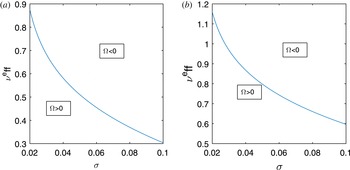
Stability/Instability region in
 ${\it\upsilon}_{i0}^{eff}{-}{\it\sigma}$
plane at fixed values of
 ${\it\phi}_{0}=0.01$
,
 ${\it\tau}=5$
,
 ${\it\upsilon}_{i0}=0.05$
,
 ${\it\mu}=0.2$
,
 $K=0.01$
and
 $k=1$
for different values of the frequency of the ion recombination on dust particles with (a)
 ${\it\upsilon}_{r0}=0.5$
and (b)
 ${\it\upsilon}_{r0}=0.7$
.

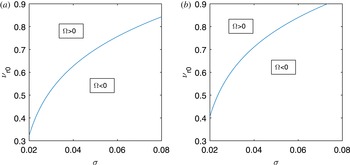
Stability/Instability region in
 ${\it\upsilon}_{r0}{-}{\it\sigma}$
plane at fixed values of
 ${\it\phi}_{0}=0.01$
,
 ${\it\tau}=4$
,
 ${\it\upsilon}_{i0}=0.05$
,
 ${\it\mu}=0.2$
,
 $K=0.01$
and
 $k=1$
for different values of the effective frequency characterizing a loss in the ion momentum with (a)
 ${\it\upsilon}_{i0}^{eff}=0.8$
and (b)
 ${\it\upsilon}_{i0}^{eff}=0.9$
.

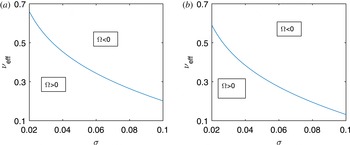
Stability/Instability region in
 ${\it\upsilon}_{i0}^{eff}{-}{\it\sigma}$
plane at fixed values of
 ${\it\phi}_{0}=0.01$
,
 ${\it\tau}=5$
,
 ${\it\upsilon}_{r0}=0.4$
,
 ${\it\mu}=0.3$
,
 $K=0.01$
and
 $k=1$
for different values of the plasma ionization frequency with (a)
 ${\it\upsilon}_{i0}=0.02$
and (b)
 ${\it\upsilon}_{i0}=0.09$
.

Now, we are in a position to carry out some numerical work to investigate the DIA envelope soliton existence domain as well as the instability region. In figures 1–3, the stable
 $({\it\Omega}^{2}>0)$
and unstable
 $({\it\Omega}^{2}<0)$
regions are shown for different values of the plasma parameters. The modulational instability regions in the space of parameters
 ${\it\upsilon}_{i0}^{eff}$
and
 ${\it\sigma}$
are illustrated in figure 1, for different values of ion recombination frequency (a)
 ${\it\upsilon}_{r0}=0.5$
, (b)
 ${\it\upsilon}_{r0}=0.7$
. We observe that the permitted instability regions decrease as the frequency of ion recombination on dust becomes large. This is reasonable because of the expression of the dissipative term
 $R$
in (3.13c
); the contribution of the ion recombination frequency is positive. In such a condition, the critical modulational wavenumber reduces, which leads to a wide domain of the stability, as well shrinking the modulational instability region. This is an expected behaviour because the permitted maximum time of the modulational instability,
 ${\it\tau}<1/R$
, decreases. Indeed, the instability growth will cease when the frequency of ion recombination on dust particles increases. In figures 2 and 3, we have investigated the effects of
 ${\it\upsilon}_{i0}^{eff}$
and
 ${\it\upsilon}_{i0}$
on the modulational instability regions. We observe that occurrence of stable and unstable regions is significantly related to the values of
 ${\it\upsilon}_{i0}^{eff}$
and
 ${\it\upsilon}_{i0}$
. The graphs display that the permitted instability regions become wider as the effective frequency and plasma ionization frequency increase. These results can also be explained by considering the expression of
 $R$
. It is obvious that the contributions of
 ${\it\upsilon}_{i0}^{eff}$
and
 ${\it\upsilon}_{i0}$
in (3.13c
) are negative; thus, increasing these parameters leads to an increase in the critical modulation wavenumber
 $K_{c}$
. Then, one can conclude that the modulational instability region will increase. However, the combined action of all the dissipative mechanisms due to the collisions between ions and dust reveals the following criterion for the maximum time for occurrence of the modulational instability:
 $$\begin{eqnarray}{\it\tau}_{max}<\frac{2}{{\it\upsilon}_{r0}(k^{2}+{\it\mu})-{\it\upsilon}_{i0}-{\it\upsilon}_{i0}^{eff}}.\end{eqnarray}$$
This shows that the carrier wave amplitude instability region decreases when the ion recombination on dust particles is the dominant dissipative process. Otherwise, the stability domain decreases when the ion loss and ionization are the dominant dissipative processes. This confirms what has been found in figures 1–3.
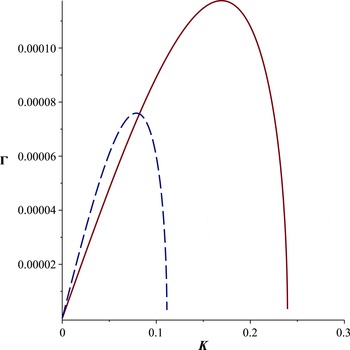
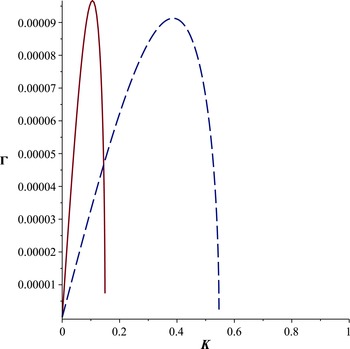
Figure 4 displays the effect of ion temperature on the growth rate
 ${\it\Gamma}$
of the modulational instability. We observe that the growth rate is significantly affected by the ion temperature in the weakly dissipative plasma. An increase of ion temperature leads to a decrease in the growth rate of modulational instability. In figure 5, we study the variation of modulation instability growth rate with the electron population for a fixed value of the carrier wavenumber. We observe that as the electron concentration increases in the weakly dissipative plasmas, the growth rate of the modulational instability decreases. This means that the instability growth rate as well as the instability window appears to increase in a plasma containing a higher concentration of dust particles. This completely confirms results obtained in Kourakis & Shukla (Reference Kourakis and Shukla2004) for a dusty plasma without source and sink.
Variation in growth rate of modulational instability with
 $K$
at fixed values of
 ${\it\phi}_{0}=0.01$
,
 $k=1$
,
 ${\it\mu}=0.01$
,
 ${\it\tau}=0.6$
,
 ${\it\upsilon}_{i0}=0.7$
,
 ${\it\upsilon}_{r0}=0.01$
and
 ${\it\upsilon}_{i0}^{eff}=0.7$
. The solid curve corresponds to
 ${\it\sigma}=0.015$
and dashed curve corresponds to
 ${\it\sigma}=0.02$
.

Variation in growth rate of modulational instability with
 $K$
at fixed values of
 ${\it\phi}_{0}=0.01$
,
 $k=1$
,
 ${\it\sigma}=0.02$
,
 ${\it\tau}=0.6$
,
 ${\it\upsilon}_{r0}=0.01$
,
 ${\it\upsilon}_{i0}=0.5$
and
 ${\it\upsilon}_{i0}^{eff}=0.8$
. The solid curve corresponds to
 ${\it\mu}=0.01$
and dashed curve corresponds to
 ${\it\mu}=0.02$
.

5. Conclusion
We have investigated the modulational instability of dust-ion acoustic waves in an unmagnetized dusty plasma, taking into account the combined effects of ionization, recombination, ion loss and ion temperature. Owing to the presence of the dissipative mechanism, a new modified nonlinear Schrodinger equation with a linear dissipative term is derived by employing the multiple space time scales technique. It is shown that these effects cause a restriction on the unstable regions of the modulational carrier wave amplitude. Observing which of the stable or unstable domains exists is significantly dependent on the source and sink effects. It is shown that the permitted instability region decreases as the frequency of ion recombination in dust grains becomes large. This also shows that instability growth will cease in the presence of ion recombination. Further, the instability region for higher ionization (ion-loss) frequency is considerably larger than the low-frequency cases. It is also found that the instability growth rate increases due to more concentration of the dust particles. The effect of ion temperature is also found to restrict the modulational instability growth rate.
The results of the present investigation yield improved understanding of the propagation of modulational DIA waves. They show that when the dissipative mechanisms are included in such plasmas, the permitted instability regions are modified in a way that depends on these effects. These results can also be used to understand the nonlinear features of modulated waves in space and laboratory dusty plasma.
Acknowledgements
The authors are thankful to the referees for their valuable comments to improve the quality of this paper. This work has been supported financially by the Research Institute for Astronomy and Astrophysics of Maragha (RIAAM) under research project no. 1/3252-56.