Introduction
Anthropogenic activities have caused various hazardous forms of pollution which range from the production of waste materials to construction materials. The pollution of soils by the migration of leachates containing heavy metals is a significant problem. Furthermore, carbon dioxide emitted by the materials industry, e.g. in the manufacture of cement, is also of significant environmental concern.
Geotechnical engineers have played a pivotal role in addressing these environmental concerns, i.e. through the treatment and disposal of wastes, since the late 1970s. Although landfilling as an engineered waste disposal system has been used widely since the 1970s, long-term control of leachate is still a major concern. Natural clay, compacted clay, and geosynthetic clay liners, which are current liner systems, are designed to reach an hydraulic conductivity of <9×10⁻⁹ m/s. Nonetheless, the possibility of geosynthetic puncture, mechanical defects, and hydraulic defects reduces the physical containment by barriers because of the possibility of leachate migration. The long-term diffusion of pollutants through synthetic and mineral liners is of great concern (Daniel Reference Daniel1993). In general, mineral liners cannot perform as impermeable layers to leachate over the long term.
The natural attenuation technique, which simultaneously incorporates chemical attenuation and physical containment, has attracted increased interest in terms of reducing the migration of potential contaminants. This approach, instead of providing a physical barrier only, exploits the attenuation capacity of a liner material to decrease major contaminants, contributing to increased landfill security with less environmental risk of leachate migration (Bagchi Reference Bagchi1987; Thornton and Lerner Reference Thornton and Lerner2001).
Even though mineral liners possess high attenuation capacity due to ion exchange, adsorption, and precipitation reactions (Bagchi Reference Bagchi1987; Ganjian et al. Reference Ganjian, Classie, Tyrer and Atkinson2004), shrinkage, desiccation cracking, chemical attack, expansion potential, and flow rate due to consolidation make their long-term performance unreliable (Daniel Reference Daniel1993; Ganjian et al. Reference Ganjian, Classie, Tyrer and Atkinson2004). The scarcity of suitable local mineral materials that can satisfy the minimum requirements of active-passive barriers is also a pressing problem. Portland cement and lime have been used either to treat local soil or to modify the aforementioned imperfections (Rogers Reference Rogers1968; Firoozfar and Khosroshiri Reference Firoozfar and Khosroshiri2016). Composite soil-cement liners have also been utilized for the disposal of hazardous waste (Prashanth et al. Reference Prashanth, Sivapullaiah and Sridharan2001). However, due to the fact that one ton of CO2 is emitted to produce one ton of Portland cement, means that the production of such cement is, itself, a threat to the environment. Moreover, Portland cement and lime threaten soil and water resources by changing the pH of these natural resources (Pacheco-Torgal et al. Reference Pacheco-Torgal, Castro-Gomes and Jalali2008). Alternative materials are required, therefore, to mitigate the environmental hazard. Geopolymers have received much attention in civil engineering projects as suitable alternatives to Portland cement. Despite their excellent properties, including good early strength, chemical durability, limited shrinkage, freeze-thaw resistance, corrosion resistance, and chemical containment capability (Davidovits Reference Davidovits1994; Pacheco-Torgal et al. Reference Pacheco-Torgal, Labrincha, Leonelli, Palomo and Chindaprasirt2015), geopolymerization has not been applied widely in the design of active-passive liners in landfill sites.
Geopolymerization involves the activation of alumino-silicate resources with medium to highly alkaline solutions. Its reaction products are amorphous, alkaline, aluminosilicate hydrates considered to be a zeolite precursor (Pacheco-Torgal et al. Reference Pacheco-Torgal, Labrincha, Leonelli, Palomo and Chindaprasirt2015). Alkaline activation enhances the negatively charged sites that can adsorb cations in solution to reach a balance (Wang et al. Reference Wang, Li and Zhua2007). In fact, a solution containing heavy metals may act as a charge-balancing agent. The high alkalinity of geopolymers favors the precipitation of heavy metals due to to the formation of precipitates retained strongly by the matrix (Ganjian et al. Reference Ganjian, Classie, Tyrer and Atkinson2004; Pacheco-Torgal et al. Reference Pacheco-Torgal, Labrincha, Leonelli, Palomo and Chindaprasirt2015). Moreover, the exchange of heavy metals and alkali is a reason for cation exchange reactions similar to those observed in clays and zeolites (Engelhardt and Michel Reference Engelhardt and Michel1987). Davidovits (Reference Davidovits1991) confirmed that geopolymers show a great capacity to adsorb toxic chemical wastes similar to zeolites due to their molecular sieving property. Some studies reported the applicability of geopolymeric materials to the stabilization and solidification of waste materials (Davidovits and Comrie Reference Davidovits and Comrie1988; Davidovits et al. Reference Davidovits, Comrie, Paterson and Ritcey1990), which justify their attenuation capacity. Furthermore, a recent trend has begun to use geopolymer products in wastewater treatment and in the removal of heavy metals from solution (Al-Zboon et al. Reference Al-Zboon, Al-Harahsheh and Bani Hani2011; Javadian et al. Reference Javadian, Ghorbani, Tayebi and Hosseini2015). Geopolymeric products can work as chemical containment systems.
In a geopolymerization process, reaction products and their properties depend heavily on the alkali type and concentration, aluminosilicate sources, reaction time, and curing condition (Pacheco-Torgal et al. Reference Pacheco-Torgal, Labrincha, Leonelli, Palomo and Chindaprasirt2015). Among available low-Ca precursors, fly ash has received much attention due to its availability and relatively low cost. Fly ash, as a by-product of coal-fired power-generating plants, is readily available in many countries, such as India, the USA, Thailand, and Brazil (Judith et al. Reference Judith, Stephen and Michael1992). In order to reduce the cost of fly-ash disposal, meaningful applications for its reuse are needed. In contrast to class C fly ash, which contains significant amounts of Ca, the main chemical components of class F fly ash are silica, alumina, and iron oxides. Class F fly ash shows pozzolanic behavior after mixing with alkaline materials (Pacheco-Torgal et al. Reference Pacheco-Torgal, Labrincha, Leonelli, Palomo and Chindaprasirt2015). The oxygen atoms of the silica, alumina, and iron oxides are free to react with water and control the charge of their surfaces based on the pH of the environment. The low- and high-pH environments create positively and negatively charged surfaces of silica, alumina, and iron oxides, respectively, contributing to geopolymer adsorption capacity in all pH conditions (Mohan and Gandhimathi Reference Mohan and Gandhimathi2009). Many researchers have confirmed the applicability of the raw fly ash, alkali-modified fly ash, and the by-products of fly ash to various applications, including soil stabilization, removal of heavy metals, geopolymerization, and zeolite production (Chakradhar and Kotach Reference Chakradhar and Katoch2016; Pacheco-Torgal et al. Reference Pacheco-Torgal, Labrincha, Leonelli, Palomo and Chindaprasirt2015). As the dissolution of calcium is responsible for the degradation processes of cemented materials (Pacheco-Torgal et al. Reference Pacheco-Torgal, Labrincha, Leonelli, Palomo and Chindaprasirt2015), geopolymers containing low-Ca precursors, such as class F fly ash, exhibit superior chemical stability compared to the cement products or high-Ca waste materials (Van Jaarsveld et al. Reference Van Jaarsveld, Van Deventer and Lorenzen1998; Fernández Pereira et al. Reference Fernández Pereira, Galiano, Querol, Antenucci and Vale2009). Regarding the type of alkaline solution, among alkalis used for alkaline activation, NaOH releases more alumina and silica and increases cation exchange capacity (CEC) (Van Jaarsveld et al. Reference Van Jaarsveld, Van Deventer and Schwartzman1999). The performance of fly ash activated with NaOH solutions has been investigated extensively for the adsorption of organic dyes and the removal of heavy metals, such as Cu, Pb, and Cd (Li et al. Reference Li, Wang and Zhu2006; Wang et al. Reference Wang, Li and Zhua2007; Al-Zboon et al. Reference Al-Zboon, Al-Harahsheh and Bani Hani2011; Mužek et al. Reference Mužek, Svilović and Zelić2014 Javadian et al. Reference Javadian, Ghorbani, Tayebi and Hosseini2015). For this reason, fly ash-based geopolymers may be viable alternatives to modified mineral materials as active-passive liners. The porosity and conductivity of the final products are controlled essentially by the type and concentration of activators, water content, and curing condition, which must be adjusted depending on the contaminants in the specific leachate. In the present study, the most relevant information about the efficiency of clay-fly ash-based geopolymers activated by NaOH solution will be reviewed as a sustainable active-passive liner material.
MINIMUM REQUIREMENTS FOR ACTIVE-PASSIVE LINER MATERIALS
Hydraulic Conductivity
The physical containment capability of a liner system depends heavily on hydraulic conductivity, which must remain at <9×10⁻⁹ m/s for all sorts of waste. In order to meet this threshold, the compacted clay liner must possess intrinsic properties of minimum fines content of >20–30%, gravel content of <30%, plasticity index of <7–10%, and maximum particle size of <25–50 mm (Daniel Reference Daniel1993). In many cases, clays that meet the parameters mentioned are in short supply. Furthermore, the low hydraulic conductivity of a compacted clay liner is associated with a high plasticity index of the clay, which decreases long-term serviceability because of increased consolidation flow rate and drying shrinkage. On the other hand, hydraulic conductivity, which is lower than this threshold limit, prevents leachate from percolation through a liner and consequently diminishes the natural attenuation performance of the liner (Bagchi Reference Bagchi1987). This threshold can be taken into account as a boundary for both physical and chemical containments in an active-passive liner.
Chemical Resistance
Strong resistance to chemical attack plays an essential role in ensuring long-term durability and serviceability of liners because chemical attack and freeze-thaw cycles cause deterioration of the properties of liner materials and enhance their hydraulic conductivity (Chamberlain et al. Reference Chamberlain, Iskander and Hunsicker1990; Koch Reference Koch2002).
Attenuation Capacity
The natural attenuation processes involved in a solid liner are sorption, ion exchange, biological action, precipitation, and filtration mechanisms (Bagchi Reference Bagchi1987; Ganjian et al. Reference Ganjian, Classie, Tyrer and Atkinson2004; Glasser Reference Glasser2013). The sorption process itself is divided into two individual processes referred to as adsorption and absorption (filtration). As a physicochemical process, the former is controlled by the specific surface area and negatively charged sites. The latter, which is a physical mechanism, pertains to the diffusion of contaminants into the structure of a porous particle (Pignatello and Xing Reference Pignatello and Xing1996). The extent of sorption depends heavily on the properties of sorbents and contaminants, including their size, shape, molecular structure, functional groups, solubility, polarity, charge distribution, and pH (Pignatello Reference Pignatello1998). Filtration or absorption mechanisms physically entrap solid particles into pore structures of liner systems. The pore size of a liner and the hydraulic gradient of the leachate control the performance of this mechanism. Pore size and leachate gradients affect the filtration performance of liners (Fuller Reference Fuller1977). Precipitation is also influenced by ionic species, temperature, acid-base pH, redox potential, and solvent concentration (Minnesota Reference Minnesota1978). Regardless of the initial pH of the soil, the pH of a leachate-saturated soil becomes near-neutral, adversely affecting the precipitation mechanism. Moreover, the ion exchange reactions are controlled by the atomic radius and the valence of the ions (Mitchell Reference Mitchell1976). Microorganisms will also control the adsorption, breakdown, or containment of the contaminants due to biological actions (Fuller Reference Fuller1977).
Shear Resistance
Liners must also be strong enough to endure the pressure induced by dumping and compaction operations during field-operational phases. In order to provide a strong surface, an adequate compressive strength of 5 N/mm2 was recommended by Ganjian et al. (Reference Ganjian, Classie, Tyrer and Atkinson2004). In addition, liners must be stable enough to satisfy the criteria for the stability of side slopes of above-ground landfills (Daniel Reference Daniel1993).
Volumetric Shrinkage
Desiccation cracks, occurring due to the loss of moisture, affect significantly the performance of liners. Desiccation cracks lead to reduced mechanical strength and greater compressibility and hydraulic conductivity (Chertkov Reference Chertkov2000). The threshold limit of volume shrinkage must be limited to 4%, therefore (Kleppe and Olson Reference Kleppe and Olson1985).
COMMON ACTIVE-PASSIVE LINERS
Because geosynthetic layers are impermeable to water, geosynthetic clay liners possess insignificant leachate-attenuation capacities. At the other end of the spectrum, compacted clay liners have been used as natural attenuation systems because of their acceptable attenuation capacity. For hydraulic conductivity, however, the threshold limit of 9×10⁻⁹ m/s is practically impossible to reach. Furthermore, punctures and tears induced during waste placement, desiccation cracks, aging, and diffusion of chemical substances threaten physical containment in the synthetic membranes and compacted clay liners (Daniel Reference Daniel1993). Desiccation and cracking might also increase the hydraulic conductivity by as much as 1000 times compared with the value measured in the laboratory (Daniel Reference Daniel1984).
Compacted clay liners attenuate the concentration of heavy-metal ions by means of adsorption, precipitation, and cation-exchange mechanisms. The sorption capacity of kaolinite to remove lead, cadmium, nickel, and copper from landfill leachate was reported by Majone et al. (Reference Majone, Papini and Rolle1998). Clay liners work well at adsorbing Pb, Zn, Cu, Ba, Cr, and Al, whereas they exhibit only moderate capacity to immobilize Ni, NH4, As, Cd, K, Na, Mg, and Fe and weak capacity to attenuate the concentration of B, sulfate, chloride, Mn, and Hg (Bagchi Reference Bagchi1987). Macro-fabric fissures within a clay layer decrease proper contact between the leachate and the soil, however, thereby reducing the attenuation capacity of compacted clay liners (Bagchi Reference Bagchi1987). The sealing properties of compacted clay liners may be affected adversely by chemical attack because strong acids and bases can dissolve soil structure, form channels, and enhance hydraulic conductivity (Daniel Reference Daniel1993). Furthermore, hydraulic conductivity and chemical properties change for several reasons, including particle flocculation, reduced double-layer thickness, desiccation, and variation in cation charge and the electrolyte concentration. These, consequently, threaten the chemical and physical containment in liners (Broderick and Daniel Reference Broderick and Daniel1990). Cementitious materials are also applied either as physical or chemical containment barriers (Ganjian et al. Reference Ganjian, Classie, Tyrer and Atkinson2004). Based on US guidelines, an impermeable flexible membrane, 30 mm thick, sandwiched between two 150-mm layers of soil-cement, showed promising results as a physical containment barrier for toxic waste (Schevon and Damas Reference Schevon and Damas1986; Dinchak Reference Dinchak2009). Besides, the chemical containment mechanism in Portland cement has been investigated in detail for nuclear waste (UK Nirex 1993). A highly alkaline environment precipitates many metals in the form of relatively insoluble salts when they migrate through a cementitious liner. An increase in pH from 8 to 12.5 decreases the solubility of U, Pu, Pa, and Am by 1–3.5 orders of magnitude. Nonetheless, this process is a sacrificial action leading to the dissolution of cement hydrates and consequently diminishes the chemical and physical containment capacity of the liner. Moreover, electropositive metals may not be suitable or at least less appropriate for immobilization by Portland cement (Ganjian et al. Reference Ganjian, Classie, Tyrer and Atkinson2004; Glasser Reference Glasser2013). The drawbacks of the current active-passive liners and/or the scarcity of suitable local soils which satisfy the above-mentioned requirements both mean that sustainable liner materials are required.
CLAY-FLY ASH-BASED GEOPOLYMERS AS ACTIVE-PASSIVE LINER MATERIALS
Several studies have been carried out to evaluate the performance of waste materials, such as steel slag and fly ash, as liner materials (Nhan et al. Reference Nhan, Graydon and Kirk1996; Hettiaratchi et al. Reference Hettiaratchi, Achari, Joshi and Okoli1999; Sivapullaiah and Lakshmikantha Reference Sivapullaiah and Lakshmikantha2004; Andreas et al. Reference Andreas, Diener and Lagerkvist2014). These residual materials can improve significantly the sorption capacity of volatile organic compounds in comparison to typical inorganic clays (Palmer et al. Reference Palmer, Edil and Benson2000). For multi-layer liners constructed with waste materials, suitable physical blocking, chemical buffering capacity, and relatively high resistance to organic acids were reported by Ganjian et al. (Reference Ganjian, Classie, Tyrer and Atkinson2004). Those authors showed that the combination of cement kiln dust with Lagoon ash, shell sand and chrome alumina, granulated blast furnace slags and Run-of-Station ash, cement kiln dust, ferrosilicate slag or ground granulated blast furnace slag with the Portland cement, chrome alumina slag, and Greensand fulfills the requirements. Among all of the waste materials available, however, low-Ca precursors, including metakaolin and class-F fly ash, are favored for use in landfill liners because of their low Ca content – Ca adversely affects liner durability.
Among all available low-Ca precursors, class-F fly ash has been used most widely because of its interesting properties. Many studies have evaluated the utility of both classes of raw fly ash or a mixture of fly ash with other materials, e.g. bentonite, cement, lime, gypsum, or sand as a physical liner barrier (Vesperman et al. Reference Vesperman, Edil and Berthouex1985; Shackelford and Glade Reference Shackelford and Glade1994; Palmer et al. Reference Palmer, Edil and Benson2000; Prashanth et al. Reference Prashanth, Sivapullaiah and Sridharan2001; Yeheyis et al. Reference Yeheyis, Shang and Yanful2009); Sivapullaiah and Moghal (Reference Sivapullaiah and Moghal2011) indicated that adding 10–20% bentonite, gypsum, or lime to fly ash could cause the hydraulic conductivity of the liner to decrease to <10–9 m/s. Mixtures of class-F and class-C fly ashes with coarse aggregates, compacted at water contents above optimal, could achieve hydraulic conductivity values near or <10–9 m/s, according to Palmer et al. (Reference Palmer, Edil and Benson2000). The usability of the mixtures of cement and class-F fly ash for the construction of a landfill liner by evaluation of the hydraulic conductivity, shrinkage behavior, compressibility, and shear strength parameters was explored by Mishra and Ravindra (Reference Mishra and Ravindra2015). The results showed that the mixture of 90% fly ash and 10% cement compacted at 5% optimum moisture content satisfied the value limits of hydraulic conductivity and volume shrinkage, 9×10⁻⁹ m/s and 4%, respectively. Regarding the attenuation potential, some research studies have shown that alkali-modified fly ash absorbs most toxic elements found in leachates (Chakradhar and Kotach Reference Chakradhar and Katoch2016). Oruh and Nuri Ergun (Reference Oruh and Nuri Ergun2010) also suggested that fly ash and red mud were more effective than phosphor gypsum in mitigating Zn in leachate. Bowders et al. (Reference Bowders, Gidley and Usmen1990) showed that the addition of cement or lime to fly ash reduced the leaching capacity of Cu, Cd, Cr, and Pb, while the addition of bentonite increased the metals content in leachate. The effectiveness of the addition of even 2.5% cement to fly ash in order to reduce the leaching rate of Mo and Cr was reported by Creek and Shackelford (Reference Creek and Shackelford1992).
Although raw or alkali-modified fly ashes exhibit acceptable adsorption capacity, their by-products including zeolites and geopolymers show superior sorption capacity because of the greater possibility of cation-exchange reactions, specific surface area, precipitation reactions, and molecular-sieving properties (Li et al. Reference Li, Wang and Zhu2006; Al-Zboon et al. Reference Al-Zboon, Al-Harahsheh and Bani Hani2011; Mužek et al. Reference Mužek, Svilović and Zelić2014). Due to the adverse effects of Ca on the long-term durability and formation of zeolite, class-F fly ash is deemed to perform better than class-C fly ash as a landfill liner. Low-Ca geopolymers might be a suitable material for the immobilization of Zn because that reacts with the Ca in Portland cement and dissolves the cementitious matrix (Fernández Pereira et al. Reference Fernández Pereira, Galiano, Querol, Antenucci and Vale2009). This is the so-called ‘sacrificial immobilization mechanism’ of Portland cement alluded to above (Ganjian et al. Reference Ganjian, Classie, Tyrer and Atkinson2004; Glasser Reference Glasser2013). In spite of the Ca-rich cement products, blends rich in class-F fly ash may form zeolite in the long term, which guarantees their long-term durability and attenuation capacity (Glasser Reference Glasser2013). The presence of a type of zeolite, i.e. hydroxy sodalite, was suggested as the by-product of a fly ash-based geopolymer with NaOH (Palomo et al. (Reference Palomo, Alonso and Fernandez-Jiménez2004). Hydroxysodalite, a superior sorptive zeolite, has often been used as a hydrophilic compound for the separation of water from various organic materials (Ruen-ngam et al. Reference Ruen-ngam, Rungsuk, Apiratikul and Pavasant2009). The presence of zeolites Na-P and herschelite as secondary reaction products are illustrated in Fig. 1 (Fernández-Jiménez et al. Reference Fernandez-Jiménez, Cristelo, Miranda and Palomo2017).
The presence of zeolites Na-P and herschelite as secondary reaction products (reproduced from Fernández-Jiménez et al. 2017 with the permission of Elsevier)

The physical and chemical properties of geopolymers make them attractive candidates for both waste stabilization and heavy-metal immobilization (Davidovits and Comrie Reference Davidovits and Comrie1988; Davidovits et al. Reference Davidovits, Comrie, Paterson and Ritcey1990). Geopolymerization, which may be promising in terms of chemical attenuation capacity, is a low-energy technique for creating an environmentally benign barrier from solid waste that can immobilize heavy metals. One study found that leaching of Pb with 6000 mg/L initial concentration from polluted samples decreased to a range varying from 25.3 mg/L to only 2.1 mg/L when polluted samples were treated by geopolymerization (Comire et al. Reference Comire, Paterson and Ritcey1989). The leaching behavior of Cu and Pb from a mixture of kaolinite and fly-ash activated with either NaOH or KOH was investigated by Van Jaarsveld et al. (Reference Van Jaarsveld, Van Deventer and Lorenzen1998). The Cu- and Pb-bearing samples showed similar leaching behaviors. In the immobilization process, heavy metals were incorporated into the matrix as cations through physical encapsulation and chemical bonding (Van Jaarsveld et al. Reference Van Jaarsveld, Van Deventer and Lorenzen1998). The immobilization behaviors of Pb, Cu, and Zn showed that the mobilization of heavy metals decreased with an increase in pH. Other than for As, the other heavy metals, such as Cd, Pb, Zn, Sn, Ni, Mn, Cu, and Cr, were inert at high pH (Waijarean et al. Reference Waijarean, Asavapisit and Sombatsompop2014). Leaching of Pb, Cu, and Zn was reduced by an increase in pH, according to Suzuki and Ono (Reference Suzuki and Ono2008). These results justify the use of alkaline activation to immobilize heavy metals. Geopolymeric powders are also used for the removal of heavy metals from wastewater by adsorption and ion-exchange mechanisms (Al-Zboon et al. Reference Al-Zboon, Al-Harahsheh and Bani Hani2011; Javadian et al. Reference Javadian, Ghorbani, Tayebi and Hosseini2015). Not surprisingly, the physical and chemical properties of geopolymers control their attenuation capacity.
A comparison between the attenuation potential of conventional clay liners and geopolymers, drawn from the literature, is presented in Table 1. The majority of the investigations into geopolymers are about specific types of heavy metals. NH4 + and Cl– are adsorbed better by geopolymers than by clays, while NH4 + is partly attenuated by the compacted clay liner due to cation-exchange reactions.
A comparison of attenuation capacity between compacted clay liners and geopolymers (data from Pacheco-Torgal et al. Reference Pacheco-Torgal, Labrincha, Leonelli, Palomo and Chindaprasirt2015; Bagchi Reference Bagchi1987)

H: High, L: Low, M: Medium
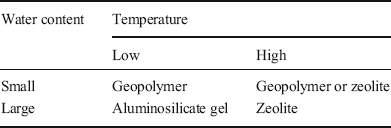
In order to define the steps of geopolymerization and the formation of aluminosilicate gels, a model was proposed (Fig. 2). The final stage of geopolymerization clearly produced a porous structure which controls the contaminant capacity and hydraulic conductivity of the final products. Water content and curing temperature are of paramount importance in determining the type of final reaction products (Table 2). Temperatures of ~40–80°C can be considered as the distinguishing line between “low” and “high” temperature (Provis et al. Reference Provis, Lukey and Van Deventer2005). High temperatures, contributing to the formation of geopolymer or zeolite, cannot be practical in landfill sites. Nevertheless, the water content and alkali concentration can be adjusted appropriately to achieve suitable final products. At low temperatures, amorphous aluminosilicate gels and geopolymer can be produced with large and small water contents, respectively. Although the ratio of water to alkali is important, the range 10–20% is considered to mark the border between the large and small water contents (Provis et al. Reference Provis, Lukey and Van Deventer2005). Geopolymer is the polymerization of aluminosilicate gels with the contributions of alkaline metals and smaller water contents and greater alkali concentrations leading to quicker reactions and more amorphous geopolymer.
Model proposed to form aluminosilicate gels (reproduced from Pacheco-Torgal et al. 2015, with the permission of Elsevier)

Products of solid aluminosilicates at various temperatures and water contents (reproduced from Provis et al. Reference Provis, Lukey and Van Deventer2005; copyright 2005 the American Chemical Society)

A highly amorphous geopolymer was produced from waste coal fly ash as an adsorbent for removal of Pb from wastewater (Al-Zboon et al. Reference Al-Zboon, Al-Harahsheh and Bani Hani2011). Those authors combined certain portions of fly ash with 14 M NaOH solutions to obtain a mass ratio of 1.25 for the fly ash/NaOH; the adsorption capacity of the geopolymer was best when this ratio was >1.2. The paste was cured at 105°C for 24 h in an oven and then kept at ambient temperature for 3 days. The removal efficiency was enhanced when geopolymer dosage, contact time, and temperature increased and the initial concentration of Pb decreased (Al-Zboon et al. Reference Al-Zboon, Al-Harahsheh and Bani Hani2011). A similar preparation method was used by Mužek et al. (Reference Mužek, Svilović and Zelić2014), who mixed portions of fly ash with 16 M NaOH and Na silicate solutions to reach 0.4 for the solution/ash ratio. The curing processes were selected as 24 h at 85°C followed by another 3 days at room temperature. Finally, the geopolymers were crushed to obtain particles with diameters of <0.045 mm. Fourier-transform infrared spectra for the geopolymer and raw fly ash are shown in Fig. 3. In all geopolymeric materials, new bonds in the regions of 1653 cm –1 and 3456 cm –1 are the signs of bending and stretching vibrations of (H–O–H), referring to the presence of water necessary for the hydrolysis of aluminosilicate precursors. The peaks at 1087 cm–1 and 1015 cm–1 in the raw fly ash and geopolymer, respectively, refer to the asymmetric stretching vibrations of Si–O–Si and Al–O–Si bonds (Mollah Reference Mollah, Hess and Cocke1994; Rao et al. Reference Rao, Hess, Cocke and Lauer1994). The decrease observed in the intensity of the peaks could be attributed to the dissolution of primary phases and the formation of amorphous alumino-silicate gels.
FTIR spectra of raw fly ash and geopolymer sample (reproduced with permission from Mužek et al. Reference Mužek, Svilović and Zelić2014; copyright 2014, the European Desalination Society).

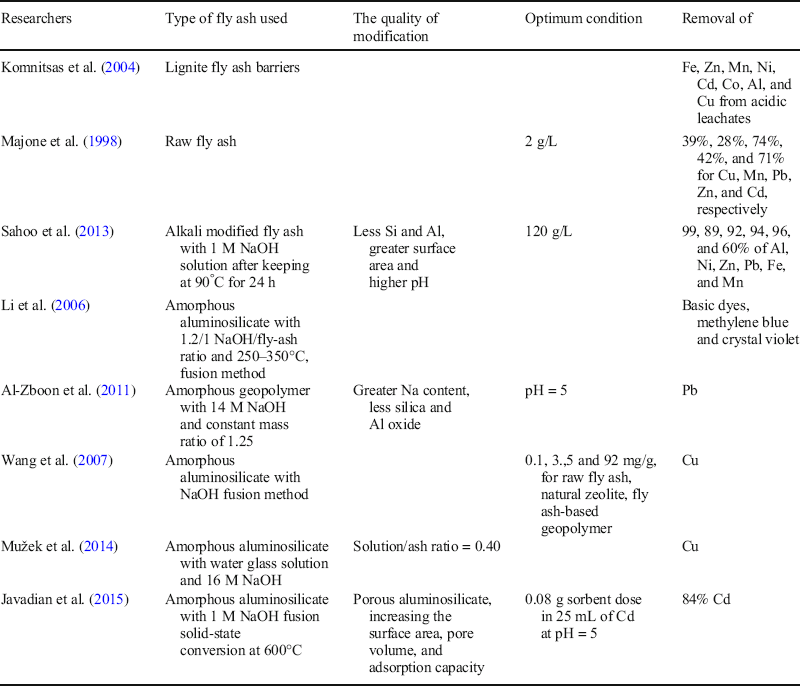
The results of some major research studies of the attenuation capacity of raw fly ash and its by-products are listed in Table 3. As reported by Javadian et al. (Reference Javadian, Ghorbani, Tayebi and Hosseini2015), 0.08 g of fly ash-based geopolymer in a 25 mL solution could attenuate 84% of Cd, while Shahoo et al. (Reference Sahoo, Tripathy, Panigrahi and Equeenuddin2013) showed that 120 g/L of alkali-modified fly ash could adsorb 71% of Cd. This proved the better performance of a fly ash-based geopolymer compared to an alkali-modified fly ash.
A summary of selected studies elaborating on the adsorption ability of raw fly ash and by-products

In previous research, the fusion method and hydrothermal processes were used to convert fly ash to amorphous geopolymers. In the fusion method, fly ash is mixed with solid alkali under fusion temperatures (Li et al. Reference Li, Wang and Zhu2006; Wang et al. Reference Wang, Li and Zhua2007). Due to the need for high temperature, this method is not applicable in the field to construct a liner. The hydrothermal process introduced by Davidovits (Reference Davidovits1991) can also produce amorphous aluminosilicate from fly ash. In this method, the aluminosilicate minerals react with an alkaline solution at temperatures of between 20 and 100°C, which are practical in the field.
The studies mentioned used geopolymer powders as adsorbent materials, while a liner system is expected to work as a finite layer. In such a case, the surface area available will be decreased and the micro- and macro-porosity of a liner play fundamental roles in its attenuation capacity. The first condition to attenuate chemical substances is attributed to the percolation of leachate into liner systems. Further study is needed to obtain the correct fly ash/alkali ratio and alkaline solution concentration when a geopolymer is to be used as a finite layer.
Fly-ash properties, activator type and concentration, and curing condition are significant factors which control the pore structure of fly ash-based geopolymers. In contrast to the conditions that form an amorphous geopolymer, the porosity of the geopolymer will increase if the fly-ash particles are larger, the alkali concentration lower, the liquid/solid ratio higher, and the silica content lower (Zhang et al. Reference Zhang, Wang and Provis2012). Based on the target contaminants in a specific leachate, the alkali concentration, water content, and fly ash/alkali ratio must be adjusted in order to produce a simultaneously suitable porous structure. A small dosage of activator (18%) leads to a larger pore size with wide pore-size distribution (19.8–2342 Å) whereas a larger activator dosage (30%) results in a smaller pore size with narrower distribution (19.8–1155 Å). This is due to the fact that greater activator dosages increase the dissolution of particles and the formation of aluminosilicate gels (Ishwarya Reference Ishwarya2013). The porosity of geopolymers decreased with increases in the relative humidity of the environment (Criado et al. Reference Criado, Fernández Jiménez, Sobrados, Palomo and Sanz2012). Samples cured for 30 days inside air-tight containers with relative humidity of 90% at 80°C were much more compacted than those cured at the same temperature but with 40–50% relative humidity.
Hydraulic conductivity tests reveal that the fly ash-based binders show lower hydraulic conductivity than in conventional cement binders (Fig. 4) due to the much smaller pore size, although their porosities may be comparable. If both moduli of activator and liquid/solid ratio are = 1.5, hydraulic conductivity shows the lowest value, while if the moduli of activator and liquid/solid ratio are 0.5 and 1.5, respectively, hydraulic conductivity is ~10–9 m/s (Ma et al. Reference Ma, Hua and Ye2013). As noted above, this value has been presented as the threshold hydraulic conductivity for active-passive liners (Daniel Reference Daniel1993). A larger liquid/solid ratio produces more porosity with smaller pore size (Table 4). It also shows that the pore size of fly ash-based binders is mostly in the range 10–50 nm, while Portland cement binders have larger pores, ranging from 20 to 200 nm. The capillary absorption is very high for fly ash-based binders in comparison to Portland cement binders (Zhang et al. Reference Zhang, Wang and Provis2012). Greater capillary absorption may be appropriate for the attenuation capacity because absorption is a major mechanism involved in the attenuation process.
Variation in a hydraulic conductivity and b porosity of geopolymers with activator modulus and liquid:solid ratio (reproduced from Ma et al. Reference Ma, Hua and Ye2013 with the permission of Elsevier)

The fraction (%) of total porosity represented by various pore sizes from <10 to >100 nm and total porosity for fly ash-based binders prepared with various liquid/solid and water/solid ratios. Values for Portland cement are given for comparison (Zhang et al. Reference Zhang, Wang and Provis2012).

Some research studies have used geopolymerization appropriately to improve the mechanical properties of local soil (e.g. Rios et al. Reference Rios, Cristelo, Viana Da Fonseca and Ferreira2016). Because this process decreases the plasticity limits of clay, shrinkage cracking, long-term consolidation, and occasional chemical instability can, therefore, be controlled by geopolymerization. Montmorillonite showed a significant decrease in plastic limit after activation with NaOH, whereas small changes in plastic limit were observed for illite (Alastair et al. Reference Alastair, Andrewa, Pascaline, Mark and Pete2018). Clay minerals can also be used as a proper filler for fly ash-based geopolymers which might contribute to the attenuation process due to its aluminosilicate content.
Finally, geopolymers can satisfy all the minimum requirements introduced earlier for an active-passive barrier. A compressive strength of 35 MPa for fly ash activated with 8–12 M NaOH solution was reported by Palomo et al. (Reference Palomo, Grutzeck and Blanco1999). Both fly ash-based geopolymers and clay-fly ash-based geopolymers may be sustainable active-passive liners that can reduce the intrinsic problems of the common liners. Evaluation of the attenuation capacity of clay-treated fly ash-based geopolymers is often ignored, however. For this reason, as the properties of final products are related directly to the primary composition, the following sections clarify the characteristics of the components involved in the use of clay-fly ash-based geopolymers as liner materials.
COMPONENTS OF THE PROPOSED LINER (CLAY-FLY ASH GEOPOLYMER)
Fly Ash and its Sorption and Durability
As a source of amorphous aluminosilicates, class-F fly ash consists of hollow spheres of various sizes, including major vitreous phases with some minor crystalline phases, such as quartz, mullite, hematite, magnetite, and some calcium oxides. An advantage of fly ash is its Si to Al ratio in the range of 1–2, which is appropriate for geopolymerization (Pacheco-Torgal et al. Reference Pacheco-Torgal, Castro-Gomes and Jalali2008).
Class-F fly ash possesses a high affinity for metal ions because of the existence of alumina, silica, Fe oxides, and unburned carbon in its chemical composition. Furthermore, it has a porous structure, fine particles, and a large specific surface area in any environment. The low- and high-pH values lead to positively and negatively charged silica surfaces, respectively, which adsorb variously charged particles. Alumina and iron oxides also follow the same pattern of developing positive or negative charges depending on the pH value of the environment (Mohan and Gandhimathi Reference Mohan and Gandhimathi2009). Accordingly, raw fly ashes are appropriate adsorbent materials, especially in alkaline environments (Chakradhar and Kotach Reference Chakradhar and Katoch2016). However, they show less adsorption capacity than their by-products, which include zeolites and geopolymers (Li et al. Reference Li, Wang and Zhu2006; Wang et al. Reference Wang, Li and Zhua2007; Al-Zboon et al. Reference Al-Zboon, Al-Harahsheh and Bani Hani2011; Mužek et al. Reference Mužek, Svilović and Zelić2014). Studies which prove the adsorption capacities of raw fly ash and amorphous geopolymers are listed in Table 3. The research confirmed that class F fly ash-based geopolymer has superior adsorption capacity, which suggests fly ash as an alternative material containing reactive aluminosilicates. All of this makes the class-F fly ash-based geopolymer a viable alternative for heavy-metal removal from aqueous solutions. The ambient temperature, NaOH content, initial concentration of contaminants, and adsorbent dosage all influence the removal efficiency of heavy metals. The sorption of Cu ions was reported by Mužek et al. (Reference Mužek, Svilović and Zelić2014) to increase with increase in temperature, which is a positive feature because waste degradation usually produces heat, enhancing the sorption capacity. Commonly only 50% of fly ash participates in the geopolymerization process (Palomo et al. Reference Palomo, Alonso and Fernandez-Jiménez2004). Thus, the sorption capacity of non-reacted fly ash is also regarded as a worthwhile benefit to attenuate contaminants by geopolymeric liners.
Long-term chemical resistance is also a significant advantage of low-Ca fly ash-based geopolymers over cementation and clay liners. In general, alkaline aluminosilicates are more durable than Ca aluminosilicate because most degradation processes of cemented materials, such as sulfate, alkali, and acid attacks, are attributed to the dissolution of Ca (Pacheco-Torgal et al. Reference Pacheco-Torgal, Castro-Gomes and Jalali2008). Fly ash-based geopolymer shows high resistance in acid media, elevated temperatures, and against freeze-thaw cycles and are also less prone to expansion (Bakharev Reference Bakharev2005; Fu et al. Reference Fu, Cai and Wu2011). A decrease of only 30% was observed in the resistance of alkaline activated fly ash binders after 150 freeze–thaw cycles (Dolezal et al. Reference Dolezal, Skvara, Svoboda, Sulc, Kopecky, Pavlasova, Myskova, Lucuk and Dvoracek2007). Drying shrinkage was also very high for a fly ash-based geopolymer, as confirmed by Ma and Ye (Reference Ma and Ye2015) but did not cause early age cracking in the fly ash-based geopolymer because it had a very small early-age elastic modulus and also showed large creep strains with relaxation. Although fly-ash geopolymers exhibited greater drying shrinkage compared to Portland cement (Temuujin et al. Reference Temuujin, Van Riessen and Williams2009), their drying shrinkage was considerably less than in compacted clays.
NaOH and its Sorption and Durability
The type of the alkaline solution exerts considerable control over the dissolution of aluminosilicate components. NaOH solution increases the leaching of silica and Al ions compared to KOH solution (Van Jaarsveld et al. Reference Van Jaarsveld, Van Deventer and Schwartzman1999), contributing to the production of more aluminosilicate gels.
A solution produced using KOH and Na silicate forms amorphous products, while NaOH solution may produce compositions similar to that of natural zeolite (Palomo et al. Reference Palomo, Grutzeck and Blanco1999). The possibility of zeolite-like products, higher pH, and more dissolution of aluminosilicate contents make NaOH solution a rewarding option for the geopolymerization of fly ash.
The most efficient immobilization of Pb, Cu, and Cd was recorded for NaOH solution rather than for a Na silicate-containing solution (Phair et al. Reference Phair, Van Deventer and Smith2004). Because Na ions lead to weaker bonds compared to K, it is more exchangeable and, thus, increases the CEC, which contributes to greater adsorption capacity. All of the above-mentioned studies (Table 3), which investigated the adsorption capacity of fly ash-based geopolymers, used NaOH as the alkaline activator (Skvara et al. Reference Skvara, Šmilauer, Hlaváček, Kopecký and Ćilová2012).
Furthermore, the type of alkali activator affects considerably the pore size and porosity of fly ash-based geopolymer. Fly ash activated by NaOH possessed much greater porosity than the binder activated by a solution of NaOH mixed with Na silicate (Fig. 5) (Paloma et al. 1999). Because a larger silica content forms a more compacted structure due to the formation of more aluminasilicate gel, a fly ash-based geopolymer activated by NaOH has greater porosity than binders activated by Na2O·0.5SiO2 (Komljenović et al. Reference Komljenović, Baščarević and Bradić2010). Bakharev (Reference Bakharev2005) also confirmed that specimens activated with non-silicate alkaline activators resisted sulfate attack better.
SEM images of fly ash-based binders using various activator solutions: a activated by 12 M NaOH for 24 h at 85°C, Si/Al = 1.5; b activated by Na2O·SiO2 for 24 h at 85°C, Si/Al = 2.8 (reproduced from Palomo et al. Reference Palomo, Grutzeck and Blanco1999 with the permission of Elsevier)

CONCLUSION AND FUTURE PROSPECTS
In presenting a scope of work for the future, this review provides general information about the usability of clay-fly ash-based geopolymers as active-passive liners in order to reduce environmental concerns. Although raw fly ash performs well as an active-passive barrier, its by-products, including geopolymers, show superior attenuation capacity which justifies their utilization as active-passive liners. In general, in addition to showing superior long-term durability and sorption capacity, fly ash activated with NaOH can produce various porous structures depending on the alkaline concentration, Si content, and curing condition. It can offer admixtures with flexible components that can be adjusted to tweak the properties of the final geopolymers, thereby making them most suitable for the contaminant species in a leachate. In general, the following are the proposed grounds for prospective research on the potential performance of clay-fly ash-based geopolymers as active-passive liners.
(1) NaOH solution offers promise as a competent activator owing to the fact that it improves CEC, immobilization, the dissolution of aluminosilicate precursors, the possibility of forming zeolites, and porous structure. Further elaboration is needed.
(2) Fly ash provides an appropriate Si:Al ratio, which is in the range of 1–2. Furthermore, in contrast to clays, all states of fly ash included in the final geopolymers, such as raw fly ash, alkali-modified fly ash, aluminosilicate gels, and zeolites, exhibit excellent sorption capacity. Fly ash is, therefore, suggested as a good precursor for active-passive liners. Again, further elaboration is required.
(3) Because the physical properties of fly ash-based geopolymers, including porosity and hydraulic conductivity, are very dependent on the activator concentration, water content, and curing conditions, the components of fly ash-based geopolymers can be adjusted according to the requirements of specific projects, So, they offer flexible admixtures for liner materials to reach the requirements. Further investigations are suggested to shed more light on this issue.
(4) The agglomeration of nano-crystalline zeolites bonded by aluminosilicate gels guarantees the long-term durability of liners. Unlike current liner materials, the passage of time is expected to enhance the long-term performance of geopolymers because of the possibility of forming zeolites. Further scrutiny is required here also.
(5) Smaller alkali concentration, larger liquid:solid ratios, and smaller silica contents will cause greater porosity in geopolymers, while these conditions reduce the possibility of the formation of amorphous geopolymers. Further investigations are necessary to determine appropriate alkali concentration, water content, and the ratio of fly ash to alkali to reach appropriate pore structure and produce enough amorphous geopolymer.
(6) When geopolymerization is used to modify the properties of local clay minerals, the clays, as filler by default, also form a good aluminosilicate precursor, providing more Si. Clay minerals can participate in the attenuation process while their desiccation shrinkages, long-term consolidation, and chemical instability can be improved. This, however, is subject to further clarification.
Compliance with Ethical Standards
Conflict of Interest
No funding was received to carry out this research. There are no conflicts of research to be reported. No human/animal rights issue is relevant here.