

Introduction
Grassland silage management is generally conducted in an ad hoc manner, with no conscious attempt to re-use wheel ways as with arable fields. Traffic can cause soil compaction with increased bulk density, increased shear strength, reduced porosity (Douglas et al., Reference Douglas, Campbell and Crawford1992) and reduced air and water permeability (Davies et al., Reference Davies, Eagle and Finney1993; Chyba et al., Reference Chyba, Kroulík, Krištof, Misiewicz and Chaney2014). Generally, moist soil is more susceptible to compaction (Alakukku, Reference Alakukku1999) hence, in years with normal weather patterns, soil/crop damage will occur as a result of operations during the spring or autumn months. The first wheeling causes most of the compaction (Davies et al., Reference Davies, Eagle and Finney1993) with subsequent incremental effects as numbers of passes increases (Raghavan et al., Reference Raghavan, McKyes, Stemshorn, Gray and Beaulieu1977). The total number of machine passes on a field can be 11 or more with normal (N) traffic systems; potentially a large area of the field can suffer from soil compaction damage. The extent of field traffic for a forage harvester and round baler in a study was 63.8% and 63.4% of the field area, respectively (Kroulik et al., Reference Kroulík, Misiewicz, Chyba and White2014).
Soil compaction effects on grass yields have been quantified by several studies: (i) grass yield decrease due to soil compaction in the range 5–74% (Are et al., Reference Are, Reintam, Selge and Sanchez de Cima2015; Douglas & Crawford, Reference Douglas and Crawford1991 & 1992; Frost, Reference Frost1988; Rasmussen & Møller, Reference Rasmussen and Møller1981; Reintam et al., Reference Reintam, Krebstein, Sanchez de Cima and Leeduks2013), with long-term yield decrease for UK conditions in the range of 5–20% with a mean of 13% (Douglas and Crawford, Reference Douglas and Crawford1993; Frost, Reference Frost1988; Hargreaves et al., Reference Hargreaves, Ball and Baker2014); (ii) the largest yield decrease took place during the first cut (Frost, Reference Frost1988; Hargreaves et al., Reference Hargreaves, Ball and Baker2014); (iii) yield may increase significantly for the second cut, however, the total yield for the year is not significantly more than for a zero traffic system (Elonen, Reference Elonen1986; Hargreaves et al., Reference Hargreaves, Ball and Baker2014). Douglas et al. (Reference Douglas, Crawford and Campbell1995) conducted an eight-year experiment to investigate the effect of zero and reduced ground pressure traffic systems on forage yield in a comparison with a N system in Scotland (ryegrass and clay loam soil). Over the period, 14.7% (13.7 t ha−1) and 14.0% (13.1 t ha−1) more dry matter was produced with zero traffic and reduced ground pressure systems respectively, than the N system, with the largest yield decrease generally in the first cut for N traffic (wet soil conditions related to the amount of rainfall following spring application of fertiliser), also, N traffic with wet soil conditions during cutting decreased the yield of the next cut.
Controlled Traffic Farming (CTF) is a traffic management system where all the field traffic is confined to permanent wheel ways across the field (Chamen, Reference Chamen2011). The trafficked area depends on the base module width: for example: 6–8 m systems result in approximately 25% of the field having a trafficked area, reducing to approximately 17% for 12 m systems (Chamen, Reference Chamen2011). Although CTF systems are becoming accepted for cereal production in the UK, currently with some 50 000 ha in production (Godwin, Reference Godwin2015), there are no robust data about CTF for grassland. Kjeldal (Reference Kjeldal2013) and Pedersen (Reference Pedersen2012) reported that CTF is practiced for grass production in Scandinavia, with the most popular module width of 12 m (trafficked area from 13 to 26%) and mower widths from 6 to 12 m.
In terms of the economics of CTF for grassland production Stewart et al. (Reference Stewart, Copland, Dickson and Douglas1998) reported on an evaluation of perennial ryegrass grown for silage in contrasting wheel-traffic systems on clay loam soil in a Scottish climate. Based on eight years of experimental data the zero and reduced ground pressure traffic systems produced gross margins (GM) of £500 ha−1 and £503 ha−1 respectively, 19% greater than the GM in the N system (£421 ha−1). The estimated current value of these margins are £714 ha−1, £718 ha−1 and £601 ha−1, taking into account the Consumer Prices Index published by the UK Office for National Statistics. Alvemar (Reference Alvemar2014) conducted an economics study on the profitability of CTF for grass silage production based on dairy farms in Sweden. The economics models were developed and tested on a hypothetical dairy farm consisting of 300 ha of clay soils (144–160 ha in grassland), 300 dairy cows and single farm payments of 143 £ ha−1 (exchange rate 1 GBP = 12.1 SEK March 2016). This suggested that yield increase is the most important factor affecting the profitability when converting to CTF. The potential extra profit due to CTF was £40 to £49 ha−1yr−1.
The objectives of this work were to: (i) use a 9 m wide CTF system for one season to assess the potential increase in grass dry matter (DM) yield, (ii) review the commercially available equipment and (iii) use the values derived to determine the economic value of implementing a CTF system for grass production.
Materials and methods
Experimental site and baseline measurements
An 8 ha perennial ryegrass (Lolium perenne) field (freely drained sandy loam soil) at SRUC Dairy Research Farm, Southwest Scotland (N55:02:45, W03:35:56) was split into two 3.5 ha areas. Management history of the grass sward was the same up to the point the field was split in April 2015. The layout of each field was a rectangle (218 m x 160 m) with one of two traffic management treatments imposed: N and CTF.
Forty initial measurement points were set up on a grid system across both the treatment fields before the first silage cut. Measurements of penetrometer resistance, soil bulk density (0–10 cm) and soil visual evaluation of soil structure (VESS) were completed at each sampling point to confirm the uniformity of soil structure. Soil samples were also taken from each point to assess the variation of phosphorous (P) and potassium (K) levels along with the pH, that could contribute to yield prior to management during the season.
Field management
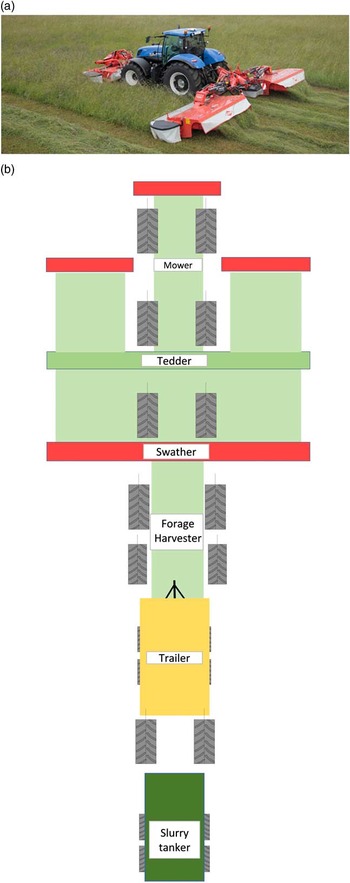
The field was managed as a three cut silage system in May, July and August. Silage was harvested via a three 3 m beam mower (overall working width 9 m (See Figure 1a)). Following mowing, spreading and raking operations brought the three cut rows into one central row. The cut grass was harvested the following day with a forage harvester (width to outer edges of wheels, 3.1 m) and two tractor and trailer combinations (tractor wheels outer width 3.2 m). The latter ran alongside the harvester (approximately 2 m away) for the N and along the next set of parallel wheel tracks for the CTF system, thus maintaining a 9 m separation and providing a trafficked area of 19%.
(a) Triple gang mower of the type envisaged for a 9 m controlled traffic system and (b) illustration of the machines and operations involved.

Dairy cow slurry at a rate of 30 m3 ha−1, by tanker and splash plate, was applied twice through the season (May and July, after the silage cuts); the second application in July was applied with a narrower application band as a result of the thicker consistency of the slurry. The CTF management pattern had to follow one of the wheel tracks and added a further wheeling to the original pattern resulting overall in 30% of the area tracked. Inorganic fertiliser, as urea, was applied at a rate of 60 kg N ha after the first cut.
A GPS system with a 15 cm pass to pass accuracy and sight posts set up at the ends of each A-B line, for a manual check on the accuracy, allowed the same wheel tracks to be followed in the CTF system. The operations on the N field were conducted first to reduce any bias of machinery operators from the controlled movements. Each field was cut around the headlands three times and then the A-B lines completed using the headlands for turning. Real Time Kinematic (RTK) GPS tracked all vehicle movements across both treatment fields (N and CTF) during grassland management. The RTK systems enabled operators to return to the same location in the field repeatedly to within +/− 25 mm for the CTF system. The intensity and spatial coverage of traffic across each treatment for each field operation were identified from the RTK traffic maps.
Total yield off-takes from both fields were recorded at each harvest by weighing each full trailer using a static weigh bridge. DM contents were calculated from 10 grab samples from each trailer after it had been weighed.
Statistical analysis
Data were analysed using Genstat version 16. The main treatments of tractor passes and N compared to CTF were analysed on a randomised basis using Genstat ANOVA. Any significance was investigated with a student t-test at a level of significance of P<0.05.
Results
Field experiment
The baseline physical measurements taken at the initial 40 sampling points in the grid across the fields, showed no significant differences in soil structural condition. The chemical assessment of the soil at the same sampling points across the two fields did produce a significant difference (P<0.001) between the N and CTF for soil extractable phosphorous. However, the concentration of P would indicate that extra P was unlikely to provide any additional growth response to grass (PDA, 2011).
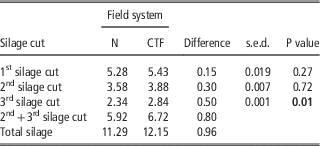
The weather during the management of the field (March to September) was wetter than the long-term average (1980 to 2010) for March (+38.8mm), May (+42.5mm), July (+70.4mm) and Aug (+20.5mm); the mean air temperature was very similar (0.3oC lower) to the long-term mean (11.7oC) during the same period. There was no significant difference in yield for the treatments during the first cut (Table 1). The 2nd silage cut gave a 0.30 t ha−1 increase in DM yield for the CTF compared to the N field (P=0.72) and 0.5 t ha−1 (P<0.01) for the 3rd silage cut compared to the N.
Total Dry Matter (DM) off-take and differences (t ha−1) from the two field systems, normal (N) and controlled traffic farming (CTF).

Discussion
Field experiment
As expected the difference in DM yield was only 0.15 t ha−1 (P=0.27) between the two fields for the first silage cut, as the systems had not been established prior to this cut and were the same across both fields. The differences in yield between the two fields increased as management operations continued for the 2nd and 3rd silage cuts. DM yield of the second and third cuts combined gave a 13.5% (0.80 t ha−1) increase for the field with the 9 m CTF system compared to the N field (P<0.05). This was very similar to the mean UK figure from the literature for the increase of CTF over N traffic from soil compaction of 13%. The 9 m working width was chosen from a consideration of available equipment.
Commercially available equipment
A wide range of commercial equipment was assessed to determine their basis for different widths of CTF system within grass silage production. The aim for each system was to select a combination of machinery that could be used with little or no physical modification or impact on field operations. Additionally, the machines were assessed for compatibility with potential arable (combinable crop) operations on the same farm.
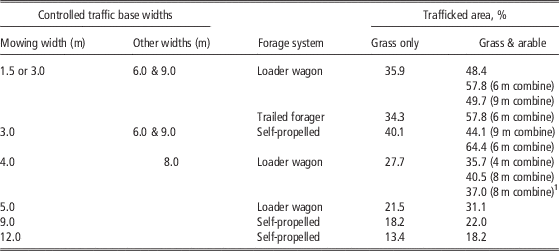
CTF systems ranging from common widths of 3 m to 12 m were feasible, with tracked areas ranging from 40% to 13%. When arable operations were introduced, the tracked areas ranged from 58% to 18%. Several options were possible, with the 5, 9 and 12 m systems leading to the lowest tracked areas for both grassland and arable operations (Table 2).
Summary of the different CTF systems proposed and their associated tracked areas.

1 Combine on rubber tracks.
There are two shortcomings with the 4 and 5 m systems: a) a loader wagon is required and are relatively uncommon in the UK, and b) the mower has heavily loaded wheels running on the non-trafficked bed. A 3 m system involves machines with little or no modification but requires a tractor with a track gauge of 1.5 m and because of its narrower width, has a greater tracked area than the wider systems.
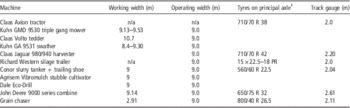
A 9 m system is achievable based on mowers such as in Figure 1a, along with standard tedders, swathers, harvester and dribble bar slurry applicator (Figure 1b). Harvesting with this 9 m system relies on delivery from a self-propelled harvester to a rear hitch trailer that is swopped on the headland when full. There is presently no option for delivering to a trailer running in the adjacent traffic lane 9 m away. A further reduction in tracked area could be achieved if the gauge of the harvester and other machinery in the operation were more closely aligned (Table 3). Introducing arable operations to this system does not increase the tracked area overly, with a predicted 22% being achieved (Table 3).
Machinery assumed for a 9 m controlled traffic system.

1 Tyres on the axle that creates the widest footprint for the particular machine.
The greatest constraint when introducing a 9 m or any other CTF system is its effect on harvesting work rate. Where a tractor and trailer are involved for example, the present action is for the driver to take the shortest route to the field exit, but this would compromise the system completely. Extra discipline and commitment are central to the success of any CTF system used for grass forage production.
Economic analysis
The economic analysis followed a similar format to Godwin et al. (Reference Godwin, Richards, Wood, Welsh and Knight2003) for assessing the potential for precision farming in cereal production. It considered the direct economic advantages from any improvements in forage yield alongside the additional costs of implementation, but did not include other less tangible benefits such as the savings in re-establishment and fuel costs.
A range of trafficked areas (%) were used in the calculations, as the trafficked area depends upon the operating track gauges and wheel widths of available equipment, this should enable farmers and/or contactors to estimate the benefits of CTF for their system, as well as an individual farmer and/or contractor to estimate future benefits with the longer-term investment in replacement equipment. As the cost/ha is influenced by the area harvested/cut the analysis was conducted for a range of areas up to 1500ha/cut based upon harvesting rates of 75ha/day (Farmers Weekly, 2016) and 20 work-days/cutting period. The annual benefits of CTF were based upon the following assumptions: (i) average yield for 2 and 3 ‘cut’ managed grassland harvest systems in the UK is 12 t ha−1 and 16.6 t ha−1 of dry matter respectively, with a value of £72 t−1, (data obtained from SRUC) (ii) conventional traffic management covers 80% of the field area and (iii) the removal of the traffic increases forage yields by 13%.
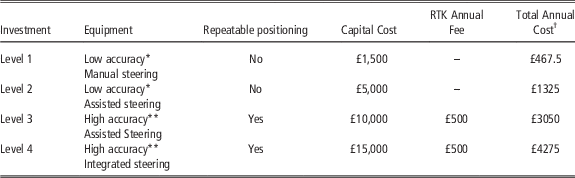
The additional annual cost of CTF over random traffic farming was based upon four different levels of capital investment (Table 4), as the level of expenditure is dependent upon the scale of the operation. The additional costs are focused on the costs of the guidance systems only, as it is assumed that initially a farmer or contractor would use existing equipment (as discussed earlier) and that improvements to equipment matching would be part of the normal longer-term replacement policy. In practice, multiple field vehicles would need to be fitted with guidance systems and therefore in the analysis, the costs of each individual system were estimated, from which the costs of up to 4 guidance systems are considered.
Current typical commercial equipment guidance costs/system (less VAT).

* (+/−150–200 mm), These will result in an increase in trafficked area due to their inaccuracy and non-repeatable positioning.
**(+/−20 mm) Real Time Kinematic (RTK)
† The total annual cost includes interest rates (4.5%), depreciation (15%), maintenance (5%) and training (£100/year) (Nix, Reference Nix2015).
Analysis showed that reducing the trafficked area from 80% to 45% increased the yield by 0.53 t ha−1 and 0.73 t ha−1 for the 2 and 3 cut systems respectively. However, if the trafficked area was reduced to 15% this further increased the yield benefit to 1.00 t ha−1 and 1.36 t ha−1 for the 2 and 3 cut systems, respectively. These yield increases were valued between £38 ha−1 and £98 ha−1 and agreed with suggested benefits from earlier studies (Stewart et al. Reference Stewart, Copland, Dickson and Douglas1998) when adjusted for retail price inflation (Alvemar, Reference Alvemar2014). A 1% reduction in the trafficked area increased the benefit of CTF at rates between £1.10 ha−1 and £1.50 ha−1 for the 2 and 3 cut systems respectively. The cost/ha/year for 4 low accuracy - manual steering systems is less than £18.70 for areas in excess of 100 ha/harvest; 4 high accuracy (RTK) - integrated systems cost less than £85.50 for areas in excess of 200 ha/harvest reducing to £11.40 for areas greater than 1500 ha/harvest. The break-even area for 4 low accuracy - manually steered systems is 50 ha/year for a 45% trafficked area CTF system with 2 cuts a year and increases to 450 ha/year for 4 high accuracy (RTK) - integrated steering systems. With 3 cuts a year the break-even area for four low accuracy - manually steered systems is 28 ha/year for a 35% trafficked area. This increased to 78 ha/year for 4 low accuracy - assisted steering systems and 250 ha for 4 high accuracy (RTK) – integrated steering systems. With a CTF system having a trafficked area of 15% the break-even area for 4 high accuracy (RTK) – integrated steering systems is 175 ha. The data given in Hargreaves et al. (Reference Hargreaves, Peets, Chamen, Misiewicz, White and Godwin2016) are aimed at allowing the benefits, costs and break-even areas of individual systems to be estimated and investment choices to be made.
Conclusion
The combined yield of the second and third cuts gave a 13.5% (0.80 t ha−1) increase for the CTF field compared to the N field indicating a relatively rapid response to CTF as a result of the reduced damage to soil structure and grass sward. There are suitable ranges of commercially available equipment to enable farmer/contractors to design CTF systems with module widths from 3 m to 12 m. Overall the economics analysis showed that provided navigation systems are wisely selected for the size of the operation and their constraints recognised, then CTF in grass silage production can be cost effective. There were reductions in the cost of production with both 2 and 3 cut silage systems. The data also provides a basis for negotiation between a farmer and contractor when considering the benefits and costs of grass CTF systems.
Acknowledgements
This work was funded by AHDB Dairy as part of the Grassland, Forage and Soils partnership.