A large and expanding body of research in political science documents numerous domains in which female and male legislators exhibit different behaviors with important political implications. This literature on in-office gender differences has thus far remained relatively silent on the question of whether female and male politicians respond differently to being held politically accountable for their actions. That is, it is unclear whether the fundamental accountability mechanisms that are in play for elected office holders – having one's actions subject to public scrutiny and being dependent on voters’ approval to get re-elected and keep their jobs – motivate a different decision-making calculus between women and men. That this question is mostly unexplored is surprising for two reasons: first, because gender-based effects are documented in nonpolitical studies of the consequences of being held accountable for actions, and second, because political accountability holds a central role in theories of democratic representation and responsiveness. Moreover, there is evidence that when women in office take certain actions while being scrutinized by voters, they are judged systematically differently—often more harshly and stereotypically—than their male counterparts who engage in the same behavior (Bauer, Harbridge and Krupnikov Reference Bauer, Harbridge and Krupnikov2017; Dolan Reference Dolan2010; Lawless Reference Lawless2004). Combined with overall higher levels of risk aversion among women in the general population (Croson and Gneezy Reference Croson and Gneezy2009), this raises the expectation that being held politically accountable entails greater negative consequences for female decision makers and may, under certain conditions, amplify risk-averse behavior. Do women and men who hold elected office indeed act differently under conditions of heightened political accountability? If so, how?
In this article, I explore these questions empirically and provide evidence on gender divergence in the impact of political accountability on the decision-making logic of in-office representatives. I do so in the context of status quo bias, a choice anomaly that is highly consequential in political decision making, and to which that politicians have a well-known susceptibility. In my analysis, status quo bias emerges as a likely source of gender differences in elite behavior under public scrutiny. Using an experiment administered in person to 377 incumbent members of parliament in Belgium, Canada, and Israel, I examined the degree to which female and male politicians prefer policy choices presented to them alternatively as the status quo or as a deviation from it. I experimentally manipulated the implied level of political accountability in the task and found that men and women in office respond markedly differently to accountability primes when deciding whether to adhere to or abandon economic policy plans presented as the status quo. Specifically, female politicians exhibited a stronger preference for the status quo policy when the task's implied accountability was high, whereas their male peers exhibited the opposite tendency, being more likely to abandon the status quo when political accountability was amplified. These findings generally held true across different country cases (and importantly, outside the American political context, from which the bulk of evidence supporting current theory on in-office gender differences is derived), and they are robust to various controls. These results also appear to be unique to office holders. Administering the same experiment to citizen samples in the studied countries, men and women in the general population did not exhibit such differences in response to political accountability primes. Taken together, these findings provide preliminary evidence that female and male legislators react differently to institutional incentives that are normally assumed to influence elected officials uniformly. They subsequently raise additional questions on the origins and nature of gender-based divergence in elite behavior.
The article is arranged as follows: The next section briefly reviews the existing literature on gender-based differences in in-office decision making, on accountability, and on status quo bias. The subsequent section describes the study design and the sample. The results and a discussion of the findings are presented thereafter.
THEORETICAL MOTIVATION
This article deals with the intersection of three separate research threads in political science: (a) the literature on gender differences in elite behavior; (b) research on political accountability and its consequences for in-office decision making; and (c) expressions of the status quo bias in politics. Examining the impact of accountability on politicians’ status quo bias through a gender lens, although novel, directly extends from existing research: a review of the literature suggests that as levels of political accountability increase, behavioral differences between women and men in office in specific decision-making instances become more pronounced. This is so principally because women in office are more often subject to negative stereotypical judgment by voters, especially when public attention is focused on actions that violate gendered expectations and when elections are looming (Bauer Reference Bauer2014, Reference Bauer2015a, Reference Bauer2017; Cassese and Holman Reference Cassese and Holman2017; Ono and Yamada Reference Ono and Yamada2016). Because both public scrutiny and electoral proximity are foundational elements of the concept of political accountability, women in office likely operate in a different accountability-based incentive environment relative to their male counterparts (Esarey and Schwindt-Bayer Reference Esarey and Schwindt-Bayer2018). Against that backdrop, adhering to what is perceived as the status quo is portrayed in the literature as an appealing anticipatory blame-avoidance heuristic for female politicians. In contrast, male politicians, all else being equal, are less likely to be evaluated negatively for deviating from what voters perceive as the existing state of affairs. Here, I provide a short review of each of these three threads of research and lay out the resulting empirical expectations.
Gender Differences in In-Office Behavior
Gender-based differences in personality, behavior, and reasoning have been documented extensively by scholars in psychology, economics, health studies, and many other domains (among the vast literature see, e.g., Andreoni and Vesterlund Reference Andreoni and Vesterlund2001; Archer Reference Archer2004; Eagly and Johnson Reference Eagly and Johnson1990; Feingold Reference Feingold1994; Gneezy, Niederle, and Rustichini Reference Gneezy, Niederle and Rustichini2003; Wood and Eagly Reference Wood and Eagly2002). Such differences are also frequently found in the context of political behavior. Women and men exhibit different average levels of political knowledge (Mondak and Anderson Reference Mondak and Anderson2004), political interest and efficacy (Bennett and Bennett Reference Bennett and Bennett1989; Deth Reference van Deth2000; Verba, Burns, and Schlozman Reference Verba, Burns and Schlozman1997), activism (Coffé and Bolzendahl Reference Coffée and Bolzendahl2010), turnout (Hooghe and Stolle Reference Hooghe and Stolle2004), political attitudes (Inglehart and Norris Reference Inglehart and Norris2003), and social and political issue preferences (Andreoni and Vesterlund Reference Andreoni and Vesterlund2001; Box-Steffensmeier, De Boef, and Lin Reference Box-Steffensmeier, De Boef and Lin2004; Sidanius et al. Reference Sidanius, Levin, Liu and Pratto2000; Whitaker Reference Whitaker2010).
These differences (and often even the perceptions of such gender differences; see Fridkin and Kenney Reference Fridkin and Kenney2014; Lawless Reference Lawless2004) are frequently brought up as explanations for the overwhelming gender gap in political representation, which is still highly persistent in most countries (Karpowitz and Mendelberg Reference Karpowitz and Mendelberg2014; Lawless and Fox Reference Lawless and Fox2005, Reference Lawless and Fox2010; Wolbrecht, Beckwith, and Baldez Reference Wolbrecht, Beckwith and Baldez2008).Footnote 1 Thus, it is not surprising that women and men in elected office also frequently have consistently different preferences and behaviors. Women and men in office have different political leadership styles. Women emphasize cooperation, compromise, and coalition-building, whereas men play up authority, hierarchy, coercion, and masculinity (Dittmar, Sanbonmatsu, and Carroll Reference Dittmar, Sanbonmatsu and Carroll2018; Kathlene Reference Kathlene1994; Rinehart Reference Rinehart2013; Rosenthal Reference Rosenthal1998; Thomas Reference Thomas1994). Women support, speak on, direct attention to, and successfully pass legislation on certain policy issues far more than men do, most notably on issues considered ‘women's issues’ (e.g., abortion rights, women's health, and child support) (Childs Reference Childs2004, Reference Childs2008; Dodson Reference Dodson2006; Gerrity, Osborn, and Mendez Reference Gerrity, Osborn and Mendez2007; Little, Dunn, and Deen Reference Little, Dunn and Deen2001; Lovenduski and Norris Reference Lovenduski and Norris2003; Osborn Reference Osborn2012; Swers Reference Swers2002, Reference Swers2013; Tremblay Reference Tremblay2012; Volden, Wiseman, and Wittmer Reference Volden, Wiseman and Wittmer2018). Female politicians, on average, take more liberal positions than their male counterparts, and they show greater support for social welfare (Huddy, Cassese, and Lizotte Reference Huddy, Cassese and Lizotte2008; Reingold Reference Reingold, Wolbrecht, Beckwith and Baldex2008). Women are arguably more productive lawmakers overall than men (Volden, Wiseman, and Wittmer Reference Volden, Wiseman and Wittmer2013), and they speak more in parliament on substantive policy issues (Pearson and Dancey Reference Pearson and Dancey2011). Women are more effective at securing spending for their constituencies (Anzia and Berry Reference Anzia and Berry2011; Lazarus and Steigerwalt Reference Lazarus and Steigerwalt2018), and they provide better constituency service and responsiveness (Richardson, Jr., and Freeman Reference Richardson and Freeman1995; Thomsen and Sanders Reference Thomsen and Sanders2017), especially on women's issues (Butler Reference Butler2014).
At the same time, other research highlights consistent similarities in behavior among men and women in office, which is commonly attributed to growing ideological polarization between parties, increasingly making party affiliation an overarching determinant of voting patterns and other forms of legislative behavior (Dittmar Reference Dittmar2015). Examining roll-call voting among American state legislators, Hogan (Reference Hogan2008) found overall similar voting behavior by women and men on economic and regulatory policies. Also studying state legislatures, Reingold (Reference Reingold2003) found that women and men have similar policy preferences and roll-call records as well as very similar legislative styles and strategies. An absence of gender differences in roll-call voting, together with similar levels of overall liberalism, was also reported by Schwindt-Bayer and Corbetta (Reference Schwindt-Bayer and Corbetta2004) among members of the US House of Representatives. Reingold (Reference Reingold2003) further documented similar responsiveness to constituents among women and men, conforming with a null gender effect on decisions to spend time on constituency casework (Ellickson and Whistler Reference Ellickson and Whistler2001).
All of these studies deal with in-office behaviors that may be the result of multiple processes and causes: selection effects, personality differences, within-parliament group dynamics, and divergence in substantive issue preferences, among others. Another important explanatory factor for these documented differences and similarities is that women and men who hold elected office are judged systematically differently by the public, which on its own can motivate gender-based behavioral divergence, whether as an anticipatory response or as a reactive response to such dynamics (Lazarus and Steigerwalt Reference Lazarus and Steigerwalt2018). The supply side of this equation has been extensively documented in literature on the differences in how male and female politicians are judged by citizens. The evidence suggests that these stereotypical judgments result in adverse electoral consequences for women under certain conditions (Bauer Reference Bauer2015b, Reference Bauer2017; Cassese and Holman Reference Cassese and Holman2018; Clayton et al. Reference Clayton, Robinson, Johnson and Muriaas2019; Lawless Reference Lawless2004; O'Brien Reference O'Brien2015; Paul and Smith Reference Paul and Smith2008; Sanbonmatsu Reference Sanbonmatsu2002; Schneider and Bos Reference Schneider and Bos2014). Self-reported evidence has documented female politicians’ acute awareness of the different standards by which they are judged by voters, the media, and their peers (Dittmar Reference Dittmar2015; Dittmar, Sanbonmatsu, and Carroll Reference Dittmar, Sanbonmatsu and Carroll2018; Hayes and Lawless Reference Hayes and Lawless2016).Footnote 2
Political Accountability
In politics, accountability is tied to holding (and risking the loss of) political office (Bueno De Mesquita and Siverson Reference Bueno De Mesquita and Siverson1995; Healy and Malhotra Reference Healy and Malhotra2013), and it has a central role in theories of elite political decision making, legislative behavior, and democratic representation (Ashworth Reference Ashworth2012; Przeworski, Stokes, and Manin Reference Przeworski, Stokes and Manin1999). The impact of political accountability depends on two fundamental assumptions. First, politicians’ actions are public, that is, open to scrutiny by citizens and the media. Second, politicians’ actions have potential electoral repercussions; politicians are interested in staying in office (or in seeking higher office), and they can be voted out by dissatisfied citizens. Importantly, accountability in politics is a distinct subset of the broader psychological concept of being held accountable, which consists of having to justify your actions to others, with potential repercussions.Footnote 3
Political accountability as defined here results in important behavioral implications: Politicians who are interested in remaining in office and are publicly scrutinized for their actions are motivated to act in ways that maximize voters’ positive impression of them to gain these voters’ support (Arnold Reference Arnold1992; Kingdon Reference Kingdon1989; March and Olsen Reference March and Olsen1995; and see Ashworth Reference Ashworth2012 for a review). Futhermore, influential theories in economics and political science rely heavily on this reasoning to explain elite political decision making and derivative policy patterns (e.g., Downs and Rocke Reference Downs and Rocke1994; Ferejohn Reference Ferejohn1986; Soroka and Wlezien Reference Soroka and Wlezien2010; Weaver Reference Weaver1986). How politicians respond to these incentives in their decision making is not particularly well understood. It is unclear whether different politicians interpret and react to a looming election, or public scrutiny, in the same way. For example, politicians who are confident in their likelihood of retaining office may amplify risk taking, whereas those who are less electorally safe might employ a different approach toward risk taking when considering such features of their politically accountable position (Sheffer and Loewen Reference Sheffer and Loewen2017). If politicians are evaluated differently for the same in-office actions by those who hold them accountable because of their gender, we certainly do not have strong empirical evidence for whether this results in women and men in office adopting uniquely distinct responses when operating in an environment with high political accountability. Höhmann (Reference Höhmann2019) has also provided evidence from Germany that female representatives’ ability to dedicate resources to women's issues is constrained by their electoral safety.
Although very few studies have attempted to directly examine gender differences in the context of political accountability,Footnote 4 research on accountability in other domains documents important gender effects. When experimentally comparing choices made in a public (i.e., observed) settings versus an unobservable condition, men exhibit stronger behavior change than women (Grolleau, Kocher, and Sutan Reference Grolleau, Kocher and Sutan2016, but see Lefebvre and Vieider Reference Lefebvre and Vieider2013 for an example of a uniform accountability effect). Women and men also respond differently to being held accountable by peer groups with different gender compositions (Brandts and Garofalo Reference Brandts and Garofalo2012). We further know that adolescent women and men exhibit different willingness to take risks on behalf of groups when such tasks are conducted publicly; women show increased risk aversion, partly owing to lower “social confidence” (Alan et al. Reference Alan, Ertac, Kubilay and Loranth2016). Similarly, women tend to downgrade their self-assessment when held accountable, particularly when the quality of their choices is observable, whereas men do not (Ludwig, Fellner-Röhling, and Thoma. Reference Ludwig, Fellner-Röhling and Thoma2017; Thoma Reference Thoma2016).
These findings suggest that the decision making of women and men in office could be affected differently by the fact that they are operating in an environment that holds them politically accountable for their actions. Moreover, because women and men are evaluated systematically differently by citizens who hold politicians accountable (Bauer Reference Bauer2017; Lawless Reference Lawless2004), it is likely that a compound process makes gender-based differences in responses to choices made under public scrutiny and with electoral consequences more pronounced.Footnote 5
A separate compounding factor is that stereotypical judgments of female politicians tend to be dependent on the substance of the issue at hand: they are most pronounced when citizens evaluate the competence of women and men on ‘men's issues’ such as defense and crime, and (in the opposite direction) on social welfare and ‘women's issues’ (Lawless Reference Lawless2004, 482). Economic policy, which is the domain of interest in this study, lends itself the least to either kind of stereotypical attribution and, arguably, poses a harder test for the expectations posited here because activating accountability considerations when gender stereotyping does not clearly map onto the issue at hand may have less of a gender-divergent outcome.
An open question in this context is in what aspects of political decision making are we most likely to observe gender differences under these conditions. One well-documented and highly influential choice anomaly—the status quo bias—is a likely candidate.
Status Quo Bias
An overpreference for choices perceived to be the status quo, or the default state of affairs, is a persistent choice anomaly in virtually any decision-making domain, and it has been consistently shown to influence a wide variety of outcomes (Kahneman, Knetsch, and Thaler Reference Kahneman, Knetsch and Thaler1991). This is especially true in the context of public policy and politics: status quo bias is one of the sources of the incumbency advantage (Quattrone and Tversky Reference Quattrone and Tversky1988). It is viewed as responsible for adverse economic performance and for the retention of failed and/or harmful policies (Crandall et al. Reference Crandall, Eidelman, Skitka and Morgan2009; Fernandez and Rodrik Reference Fernandez and Rodrik1991; Howitt and Wintrobe Reference Howitt and Wintrobe1995; Samuelson and Zeckhauser Reference Samuelson and Zeckhauser1988). An innate preference for and justification of the status quo carries potentially long-term implications for disadvantaged groups in society because their discriminated status is entrenched by the impact of status quo preference on system justification (Jost, Banaji, and Nosek Reference Jost, Banaji and Nosek2004).
Although individuals in general are strongly susceptible to the status quo bias in their decision making, political scientists often make the opposite assumption about politicians as a group by describing them as strongly motivated to abandon or modify existing policies. This predisposition toward a platform of change has been claimed to be both a successful campaigning strategy and a frequently observed in-office policy-making style (Aragonès, Postlewaite, and Palfrey Reference Aragonès, Postlewaite and Palfrey2007; Cai et al. Reference Cai, Treisman, Gordon, Gibson, Gimpelson and Gilman2009; Capelos Reference Capelos2005; Fu and Li Reference Fu and Li2014; Majumdar and Mukand Reference Majumdar and Mukand2004). This preference is in line with evidence that politicians as a group are more risk-seeking than the general population (Sheffer et al. Reference Sheffer, Loewen, Walgrave, Soroka and Shaefer2018). Yet whether opting for change and abandoning the status quo is what happens when these politicians are elected and face scrutiny is a separate issue that has scarcely been tested empirically. Almost all of the evidence has been obtained from nonelites, and it suggests the opposite: that accountability strongly amplifies status quo bias in public choice tasks.Footnote 6 As Tetlock and Boettger (Reference Tetlock and Boettger1994) show, individuals exhibit a stronger status quo bias when policy choices they are making (in that study, in the context of public health) involve having to justify them to others. Importantly, the theory on status quo preference by political elites does not explicitly consider heterogeneity among elites in its expression. This consideration is potentially consequential, particularly because nonelites do vary in predictable ways in the degree to which they exhibit a preference for the status quo (e.g., by age) (Samuelson and Zeckhauser Reference Samuelson and Zeckhauser1988). In the context of the status quo bias under conditions of heightened political accountability, it is likely that gender factors in as well. As argued by Tetlock and Boettger (Reference Tetlock and Boettger1994) (see also Esarey and Schwindt-Bayer, Reference Esarey and Schwindt-Bayer2018), having to justify your choices to others amplifies status quo bias and is a product of risk aversion. Higher levels of innate risk aversion incentivize blame-avoidance behavior, which in turn translates to stronger adherence to what is perceived as the current state of affairs, presumably because it is an easier position to defend and justify.
Overall, the aforementioned literature supports the gender-difference hypothesis on status quo bias response in two ways. First, women are, on average, more risk-averse than men (Byrnes, Miller, and Schafer Reference Byrnes, Miller and Schafer1999; Croson and Gneezy Reference Croson and Gneezy2009). If risk aversion is indeed the mechanism that underlies a heightened status quo preference in response to conditions of accountability, than we should expect, on average, that under such circumstances, women will exhibit a stronger status quo preference than men. Conversely, when the implied accountability of the task is reduced, risk seeking or avoidance plays a smaller role in choice calculus; thus, gender differences in expressions of the status quo bias should be smaller or absent.
Second, office-holding women are more likely to receive blame by citizens and, thus, to be more strongly motivated to act in ways that minimize it, because of gender-based stereotypical judgments (Lazarus and Steigerwalt Reference Lazarus and Steigerwalt2018). This is especially true when women act in ways that deviate from or violate the status quo. For example, female candidates are evaluated consistently more harshly when they disagree with their party position compared to male counterparts (Vraga Reference Vraga2017), which is reflected in citizens’ negative judgments on their sincerity, competence, and leadership. Thus, male candidates have more freedom to diverge from their party positions without being punished as much by voters. Similarly, female politicians who are perceived to be ‘first movers’ in adopting certain campaign strategies are disproportionally punished by voters relative to men, at least when it comes to using negative ads. Voters are much more forgiving when they believe that a female candidate simply followed her opponent's lead in those instances (Krupnikov and Bauer Reference Krupnikov and Bauer2014; see also Ennser-Jedenastik, Dolezal, and Mueller Reference Ennser-Jedenastik, Dolezal and Mueller2017). And finally, exhibiting masculine traits (and arguably risk-taking behavior is a classic masculine trait) tends to backfire for women more than for men when they are judged by outside partisans (Bauer Reference Bauer2017; see also Puwar Reference Puwar2004). When being evaluated by the general public, they face greater negative consequences for actions that are perceived as aggressive; thus, they should be more strongly motivated to make choices that gives them some insurance. The idea that those biased judgments do lead to behavior change by women is in line with additional research making the argument that gender stereotypes have little effect on electoral behavior exactly because female candidates engage in preemptive strategies designed to downplay them (Bos Reference Bos2011; Gordon, Shafie, and Crigler Reference Gordon, Shafie and Crigler2003).
In sum, being held politically accountable for in-office actions amplifies the appeal of choices presented as the status quo. But the factors that account for the appeal of the status quo (namely, inherent risk aversion that is further fueled by motivation to avoid attributions of blame by voters) are especially salient for female office holders. As a result, my expectation is that under conditions of high political accountability, female politicians will, on average, exhibit stronger status quo bias compared to their male counterparts, whereas these differences should be significantly reduced when accountability primes are absent.Footnote 7
These expectations apply specifically to elected officials. A related question is whether nonelite women who are presented with scenarios that involve higher implied political accountability will act differently than nonelite men, or if such differences are unique to office-holders. Answering this question helps unpack the source of in-office behavior differences and could inform our understanding of how and when they are formed. Two previously mentioned mechanisms work in concert to produce the expected gendered patterns: one is a priori risk preference differences among men and women that feed into status quo preference, and the other is changes to decision making brought about by the different experiences of men and women in office and, in particular, different expectations regarding how the public judges their actions. On the one hand, men being more risk-seeking than women is regularly documented in the general population as well, which may lead to similar patterns among nonelites. On the other hand, lived experience in holding office, and especially insight into how female representatives are perceived by voters, is likely far less common among those outside of elected politics, meaning that any effects originating from this factor should be diminished among nonelites. I therefore remain agnostic regarding the likelihood of seeing in nonelites the same results that I expect to observe among politicians. I have, however, attempted to answer this question directly by fielding the same experiment to citizen samples in the studied countries, thus providing a base rate as a backdrop against which the main findings can be evaluated.
STUDY DESIGN
My empirical approach in this study is to evaluate politicians on a hypothetical, politically relevant, decision-making task using a survey administered to participants in person and allowing for random assignment of respondents to different experimental conditions. This design is also inherently comparative, with data collected in three countries. As Cammisa and Reingold (Reference Cammisa and Reingold2004) noted, studies of gender differences, and of women in general, in legislative politics tend to focus on single-country cases rather than compare behaviors across parliament cases and subgroups. Evaluating the impact of accountability across multiple legislative chambers further substantiates the findings reported here.
Data used in this study were collected as part of the Infopol Project, in which incumbent politicians from the national and regional parliaments of Belgium, Canada, and Israel were interviewed in person and responded (on tablets and laptops) to various question modules, including the one studied here. The challenge of administering established experimental modules to sufficiently large numbers of politicians is a long-standing inference impasse in political science. Druckman and Lupia (Reference Druckman and Lupia2012) explain that “Typical experimental subjects often lack the experience needed to act ‘as if’ they were professional legislators; yet, legislators themselves are often reluctant to participate in experiments as subjects” (Reference Druckman and Lupia2012, 1178). Here, I was able to administer the studied vignette to more than 300 incumbents, allowing for a sufficiently high-powered design and direct comparability with results obtained from nonelites who were presented with the same task.
Recruiting politicians to take part in interview-embedded controlled tasks is not the only way to observe preference for choice anomalies and other traits that politicians exhibit. Alternatively, it is possible to estimate personality traits and other individual differences from legislative speech (Ramey, Klingler, and Hollibaugh Reference Ramey, Klingler and Hollibaugh2015), to observe politicians’ behavior on key votes, or to investigate other markers, such as their decisions over financial matters (Grose Reference Grose2013). Also, as embodied in the literature on electoral business cycles, it is possible to infer choice preferences of politicians and governments from aggregate policy outcomes by relying on “revealed preferences” (Alesina Reference Alesina1988; Drazen Reference Drazen2000; Krause and Méndez Reference Krause and Méndez2005). However, these approaches have several important shortcomings that warrant the usage of evaluations collected directly from politicians using vignettes.
First, the choices that are put in front of politicians while in office are themselves likely endogenous to their preference for the status quo or change. Second, political decisions are often (or even typically) multidimensional, “multi-issue,” or both. Accurately characterizing the degree to which a given choice reflects, for the politician, the status quo or a departure from it is difficult and vulnerable to post hoc reasoning. Third, making inferences from collective choices (e.g., votes in parliaments or government decisions) or from aggregate outcomes on the motivations and preferences of individual politicians is challenging. Fourth, political behaviors such as passing legislation or committee voting often follow a partisan logic that constrains politicians and obscures our ability to observe their individual preferences.
Essentially, any attempt to evaluate politicians’ preference for certain choices—in this case the choice between the status quo and a departure from it—entails a trade-off between internal and external validity. By administering a decision-making task based on well-established vignettes to sitting politicians, I sought to evaluate a preference for the status quo in a reliable and comparable way and to subsequently benchmark these preferences against well-established population averages on the same tasks. This design thus improves internal validity. In contrast, because a vignette study evaluates choices on a hypothetical task, it carries reduced external validity. I nevertheless believe that the advantages to this approach, and particularly the ability to collect individual-level choice data directly from incumbents, together with the aforementioned shortcomings of alternative approaches, justify this choice. I further sought to maximize external validity by using a strongly political scenario (a choice between two economic policy platforms that a party is debating) to simulate a dilemma politicians are more likely to encounter in office relative to other standard tasks used to evaluate status quo bias.
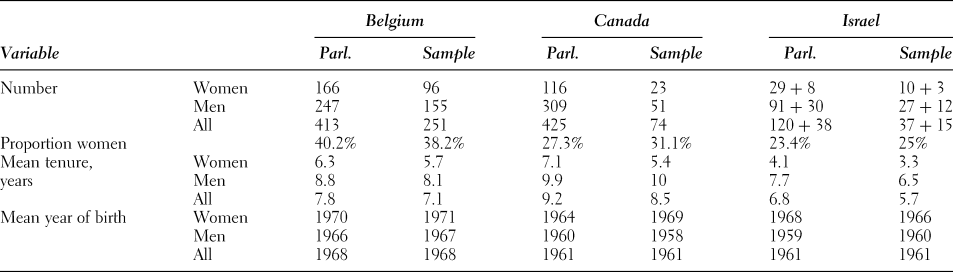
The data for this study were collected in the second round of the Infopol Project interviews, fielded during 2015 in all three participating countries.Footnote 8 The interviews took 45 minutes to an hour to complete. Table 1 provides key sampling information on subjects in each country. In total, 377 politicians were interviewed and completed the reported experiment (Belgium, N = 251; Canada, N = 74; Israel, N = 52). In all three countries, the project team was able to interview members of parliament (MPs) from all major parties, from both the governing coalition and the opposition, often in proportions that were roughly similar to the relative share of seats each party had in the relevant parliament. Participants in the study had, at the time of the interview, somewhat shorter tenures than peers who did not participate (about a year and a half shorter), but this difference was only significant in Belgium (two-sided t-test p = .013) and not in Canada (p = .400) or in Israel (p = .210). Participating politicians were also younger by a year or less on average (varying by country) than nonparticipants, but this difference was not significant in any country. The proportions of women and men in the studied legislatures and in the experiment sample were similar, and differences in the proportions of women and men between in-sample and out-sample politicians were not significant in either country. (χ 2 test p values: Belgium, .315; Canada, .421; Israel, .742.)
Descriptive statistics by country

Parl., parliaments in which sampling was conducted in the study. Sample, politicians who participated in the status quo experiment. In Israel, participants were both incumbent Members of Knesset (MKs), and 15 exiting MKs who were interviewed shortly after the 2015 election.
In Belgium, incumbents participating in the status quo experiment were recruited from the national Chamber of Representatives (N = 96), from the Flemish Parliament (N = 98), and from the Walloon Parliament (N = 45, including 12 French-speaking members of the Parliament of Brussels-Capital Region). An additional 12 participating incumbents (among 31 such office holders at the time of the interview) were either party heads or cabinet ministers who did not serve as members of either parliament. In Canada, incumbents participating in this study were recruited from the House of Commons (N = 45) and from the Ontario Legislative Assembly (N = 29). In Israel, participants were incumbent members of Knesset (N = 37), Israel's only legislature, and an additional 15 exiting members of Knesset who were not re-elected following the 2015 election in Israel and were interviewed shortly thereafter. A full breakdown by chamber and party is available in the supplementary information online.
In addition to the participating politicians, I administered the same module to representative general population samples collected in all three participating countries, which were balanced on relevant national demographics (age, gender, language, and geographical distribution, where relevant). These surveys were conducted online using established local panel vendors, and the wording and presentation of the modules were identical to those presented to politicians (Belgium: N = 2,751; Canada: N = 619; Israel: N = 1,005).Footnote 9
The module used to evaluate the status quo bias in this study uses a design similar to (but modified from) the original modules used by Samuelson and Zeckhauser (Reference Samuelson and Zeckhauser1988, see also Anderson Reference Anderson2003), in which participants were asked to make a choice between two alternatives and were randomly assigned to see one of the two described as the default or current state of the world, and the other, by implication, as a departure from it. I employed a scenario in which MPs were required to adopt one of two policy plans, each having different GDP growth and deficit projections (either 3% growth and 3% deficit (“3 + 3”), or 5% growth and 5% deficit (“5 + 5”). I randomly varied which one was presented as keeping up with the current state of the economy on these indicators and which one was presented as a change from the current state. This scenario is highly politically relevant compared with situations normally used to evaluate status quo bias. However, the information provided was intentionally limited to two indicators (i.e., GDP growth and deficit), owing to the length of the survey during which the module was presented, and the need to engage participating politicians on a task that they could realistically consider within the given time frame. This design further followed the common expectation that elite decision makers often rely on only one or two indicators when making economics-related policy choices (Jones and Baumgartner Reference Jones and Baumgartner2005).
I intentionally presented a choice between two plans that appeared roughly similar in the tradeoffs they presented and that focused on technical economic indicators. Although it still posed a real dilemma, this scenario minimized ideological sorting and thus had the benefit of providing a ‘blank slate’ for testing status quo preference.Footnote 10 Furthermore, citizens often do not possess accurate knowledge nor stables preference regarding indicators such as GDP growth and budget deficit levels (Anderson Reference Anderson2007; Healy and Malhotra Reference Healy and Malhotra2013), which should have made it easier for participants to believe that either of the growth/deficit scenarios represented the current state of the economy. In contrast, respondents can be expected to be much better informed on the status of domains and plans (e.g., the legality of same-sex marriage.). Ideologically charged and more salient scenarios make it difficult to isolate the stand-alone effect of the status quo, which I sought to maximize in the current design.
To evaluate the impact of the implied accountability of the task, I included an additional treatment, orthogonal to the status quo treatment, by adding or removing text that described the situation as happening a month before an upcoming election and noted that there was news media pressure to know the respondent's position on the issue. Both of these aspects, emphasizing the public nature of the task and the potential electoral repercussions of the decision, represent the core constructs of political accountability (Lerner and Tetlock Reference Lerner and Tetlock1999). This results in a 2×2 random assignment design.Footnote 11
The full texts of the module used follow. The square brackets contain the low- and high-accountability treatments; the different status quo frames are listed separately. This text was translated to the relevant language(s) in each country where the module was fielded:
1. Status quo - 3 + 3:
“[Imagine that / Going into the coming elections,] your party has to adopt an economic policy plan. The party has to choose between two plans: plan A will keep the rate of economic growth and budget deficit at their current levels. The rate of economic growth is currently 3% and the budget deficit is 3%. Plan B would increase the rate of economic growth by 2% while also increasing the budget deficit by 2%.
[(empty) / A month before the elections, reporters ask you which plan you would support.]
Which plan would you vote for?”
2. Status quo - 5 + 5:
“[Imagine that / Going into the coming elections,] your party has to adopt an economic policy plan. The party has to choose between two plans: plan A will keep the rate of economic growth and budget deficit at their current levels. The rate of economic growth is currently 5% and the budget deficit is 5%. Plan B would decrease the rate of economic growth by 2% while also decreasing the budget deficit by 2%.
[(empty) / A month before the elections, reporters ask you which plan you would support.]
Which plan would you vote for?”
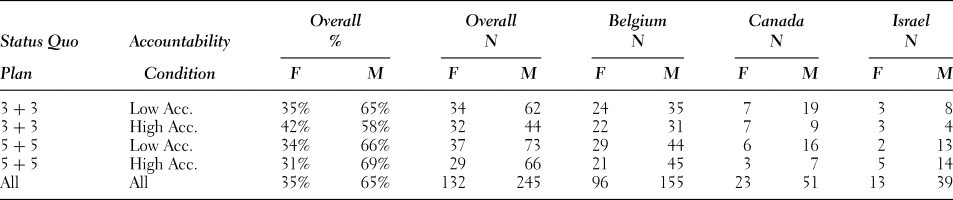
Table 2 reports the number of respondents in each treatment cell overall and per country, broken down by gender, which is the subgroup breakdown of interest in this study. On the aggregate, the proportion of female and male politicians in each experimental condition are similar, especially given the constraint of conducting random assignment of relatively small groups of participants into four cells using three separate country procedures.
Experimental treatment condition assignment for participating politicians by gender

Acc., accountability; N, number; F, female; M, male.
RESULTS
The quantity of interest in this analysis is the overall proportion of respondents choosing the policy plan presented as the status quo under the different accountability conditions. Here, I report raw proportions of the quantities of interest alongside regression analysis of the same data. Although this is the most straightforward approach for interpreting the results, it could be affected by treatment assignment imbalance introduced in the data collection phase of the project, as a result of the three country cases conducting random assignment offline separately. Specifically, random assignment of politicians to the accountability treatment resulted in 206 respondents in the low-accountability condition and 171 in the high-accountability condition. This imbalance nears conventional levels of statistical significance (equal proportions test p = .079). To establish that the results are not influenced by this imbalance, I conducted an additional analysis of the same quantities (reported in the following section) by simulating a condition assignment likelihood of 0.50 on each treatment, using Clarify software (Tomz, Wittenberg, and King Reference Tomz, Wittenberg and King2003). The results are virtually identical to the raw proportions, suggesting that this is not a major concern. The full results from this procedure are reported in the supplementary information online.Footnote 12
In the aggregate, across both status quo conditions and the low- or high-accountability conditions, 67% of MPs chose the plan presented as the status quo, and 33% chose to abandon it in favor of the nondefault plan. These quantities vary by country, although in all cases the participating politicians exhibit a very strong status quo preference: In Belgium, 64% of politicians opted for the status quo choice. In Canada, 77% did so, and in Israel the proportion was 69%. These country differences do not meet conventional levels of statistical significance (χ 2 = 4.410; p = .110). Full by-country results are available in the supplementary information online.
Overall, female politicians exhibited slightly lower status quo preference than men (66% compared to 68%, respectively), but these differences were far from statistically significant (χ 2 = 0.109; p = .741). This pattern held true across individual country cases, with no significant gender differences.Footnote 13
For comparison, I examined the rate of status quo preference in the general population samples collected in each country. Overall, citizens exhibited a lower status quo preference than politicians (64% vs. 67%) but not significantly so (two-sided t-test p = .178). This similarity between politicians and citizens held true in Belgium (64% and 65%, respectively) and in Israel (68% and 64%). In Canada, politicians were significantly more likely to adhere to the status quo than citizens: 76% of MPs choose the status quo compared with 60% of citizens (two-sided t-test p = .004).
As with politicians, I found no significant overarching gender differences in status quo preference among citizens. Female respondents opted for the status quo plan 63% of the time, and male respondents did so 65% of the time (χ 2 = 1.409; p = .235). There were no significant or substantive gender differences within each country case.
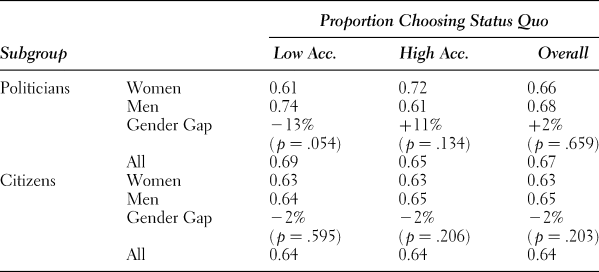
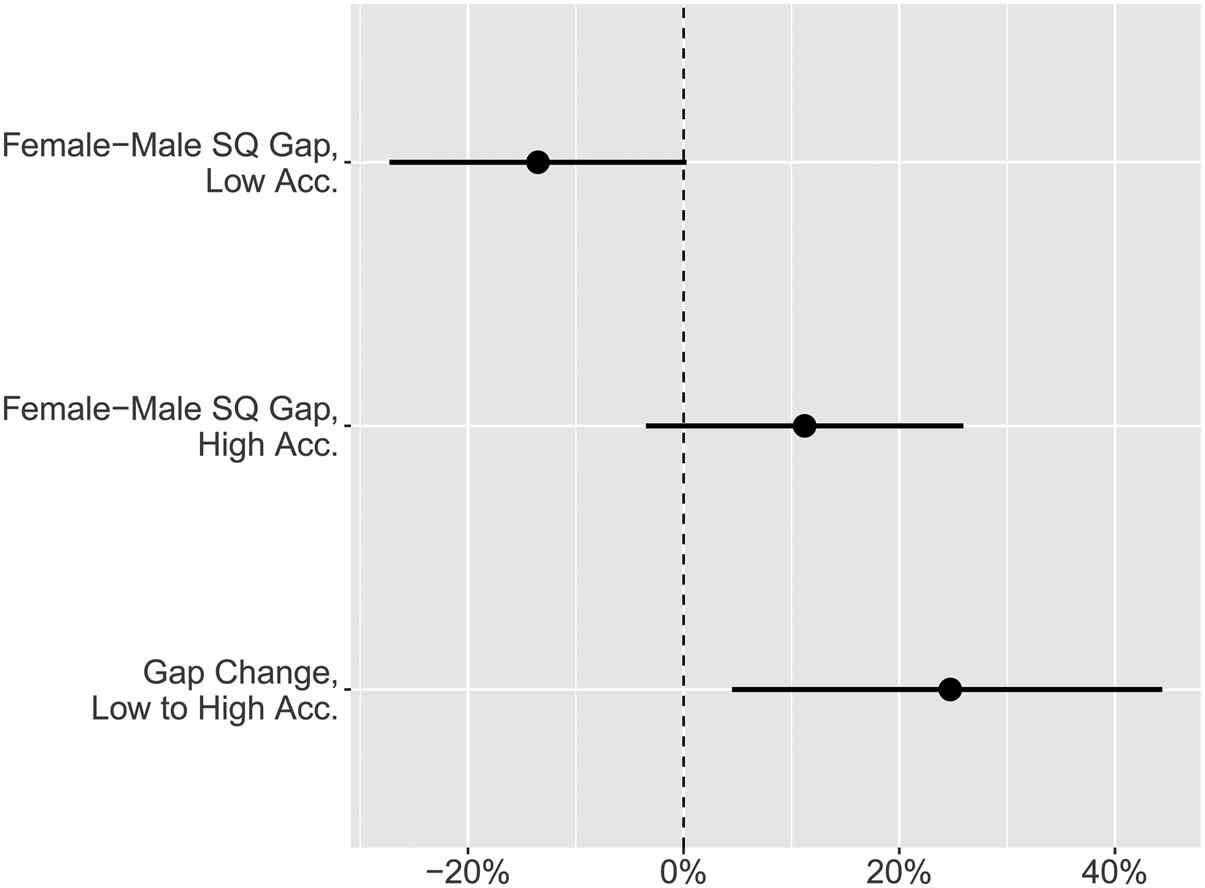
Looking at the status quo preference proportions reported in Table 3, there is a clear divergence between male and female politicians in their response to the accountability treatment. Priming accountability resulted in the proportion of women preferring the status quo plan increasing from 61% to 72%, whereas for men an inverse pattern occurred, with the proportion decreasing from 74% to 61%. Both of these changes resulted in a female–male status quo preference gap that changed from −13% under low accountability to + 11% under high accountability, a + 24% net change. Although the observed increase in status quo preference for female politicians was expected in light of existing literature, the finding regarding male politicians’ increased willingness to abandon the status quo under high accountability is more curious and cannot be readily accounted for by current theoretical arguments. One potential explanation is that male politicians identify the promotion of change as a more electorally appealing strategy and, together with the reduced reputational risk for men associated with being a ‘first mover,’ have stronger incentives to abandon the status quo choice.
Proportion of respondents opting for the plan presented as the status quo, by subgroup and accountability treatment condition

Acc., accountability. Reported p values are obtained from two-sided t-tests of the difference between women and men in each treatment condition and overall.
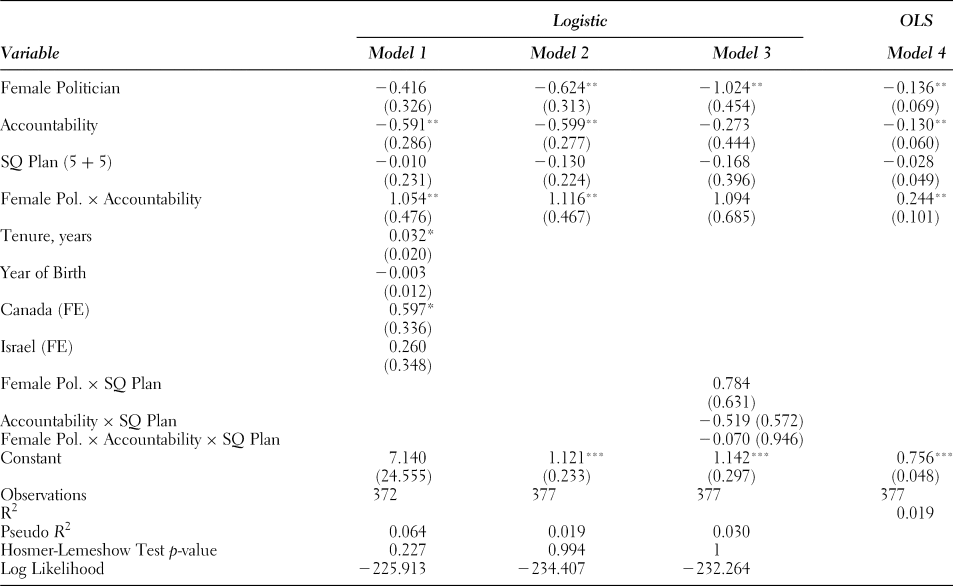
To evaluate whether this differential impact of the accountability treatments for women and men in office was significant, I estimated a logit model with status quo preference as the outcome and the treatment variables and gender as predictors. I also included an interaction term of gender and the accountability treatment. I further included country fixed effects and added controls for age and tenure length because both are strongly correlated with politicians’ gender (see Table 1). Female politicians in the current sample, and in the legislatures, had a lower mean tenure length and were, on average, four and a half years younger than their male peers. These differences were consistent across the three countries.Footnote 14 For robustness checks, I also estimated a model with only gender and the experimental treatments as predictors as well as an additional model in which the status quo plan treatment was interacted with gender and with the accountability treatment.
The full regression results are reported in Table 4; the main model is reported in the first column. Accountability and gender had a significant interaction. For male politicians, high accountability resulted in a significant decrease in their likelihood of choosing the alternative presented as the status quo. Female politicians were less likely to choose the status quo plan than men under the low-accountability condition, and they exhibited a significantly increased status quo preference when accountability was high. The substantive content of the status quo plan (either the 3 + 3 or the 5 + 5 plan) had no impact on these dynamics.Footnote 15 As shown in model 2, the results held without controls and were substantively similar under the added interactions in model 3, although the interaction term of gender and accountability did not meet conventional levels of statistical significance. Model 4 was a linear regression replication of model 2, providing a more direct quantification of the effect sizes in percentage points. Further robustness checks with party fixed effects and electoral safety controls are included in the supplementary information online. The results were similar.
Estimation results: Impact of experimental treatments on status quo preference by politicians

Note:*p < 0.1; *p < 0.05; ***p < 0.01
The dependent variable is the choice type made in the status quo experiment, coded 1 for the choice presented as the status quo and 0 for the alternative. Accountability is 0 for low, 1 for high. SQ Plan is 0 for the 3 + 3 plan, 1 for the 5 + 5 plan. First three estimated models are logit regressions. Model 4 is an ordinary linear regression. Standard errors reported in parentheses. Maximum likelihood pseudo R 2 and real R 2 values reported for each model.
Figure 1 presents the gender gap in status quo preference for politicians under each accountability condition, and the change in this gap when moving from low to high accountability. The latter corresponds to the value of the interaction coefficient in model 4 in Table 4. A substantively large and statistically significant 24% change occurred in the status quo gender gap, reflecting a full reversal of its direction, when moving from low to high accountability. Even though both male and female politicians strongly exhibited status quo bias under all conditions, men did so far more than women under low accountability, and women did so more than men under high accountability.
Difference in status-quo preference between female and male politicians, by accountability condition. Dots are the percentage point gap between women and men in each condition, with the bottom row presenting the percentage point change in the gap, moving from low to high accountability. Bars are 95% confidence intervals.

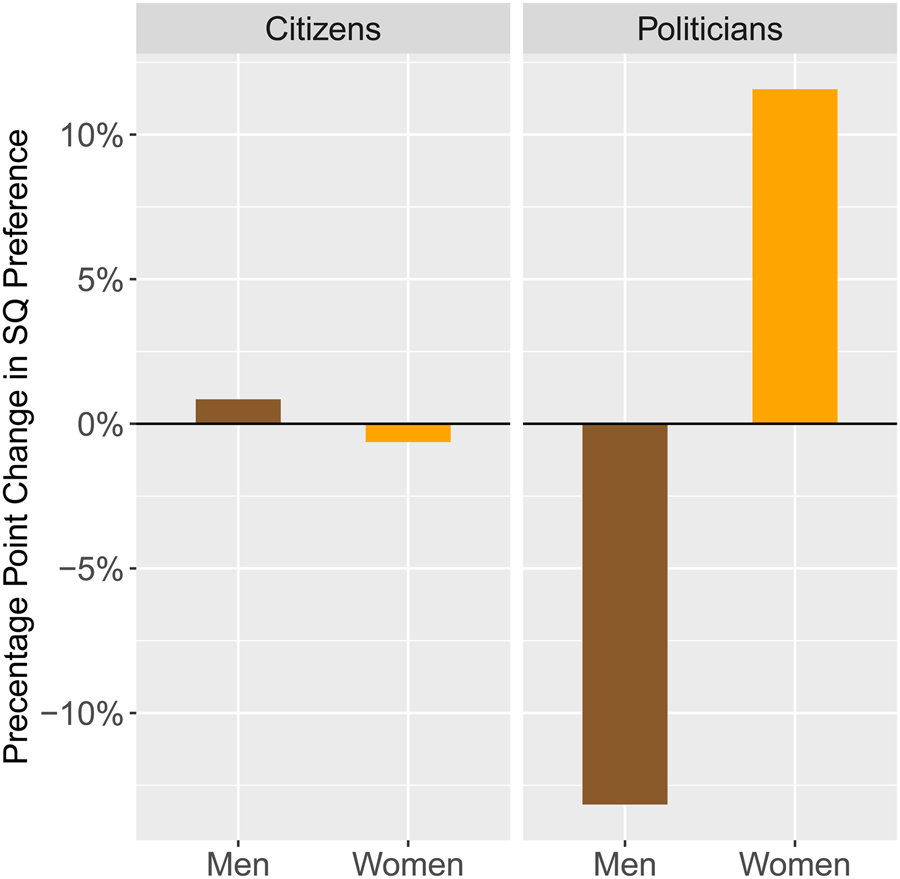
Figure 2 presents the differential impact of heightened accountability on the status quo preference for women and men participating in the experiment. For citizens, the accountability treatment had an essentially null effect for both women and men, with a −0.9% change in status quo preference for women in the high-accountability condition compared to low accountability, with a + 0.5% change for men. As described in the preceding text, for politicians, the effect of accountability was large and contradictory: male politicians exhibited a 13% decrease in status quo preference, from 74.1% to 60.9%, whereas the female politicians’ status quo preference increased by 11%, from 60.6% to 72.1%.
Effect of accountability treatment on status-quo preference, by respondent type and gender. Quantities are percentage point change in status-quo choice for each group when moving from low to high accountability.

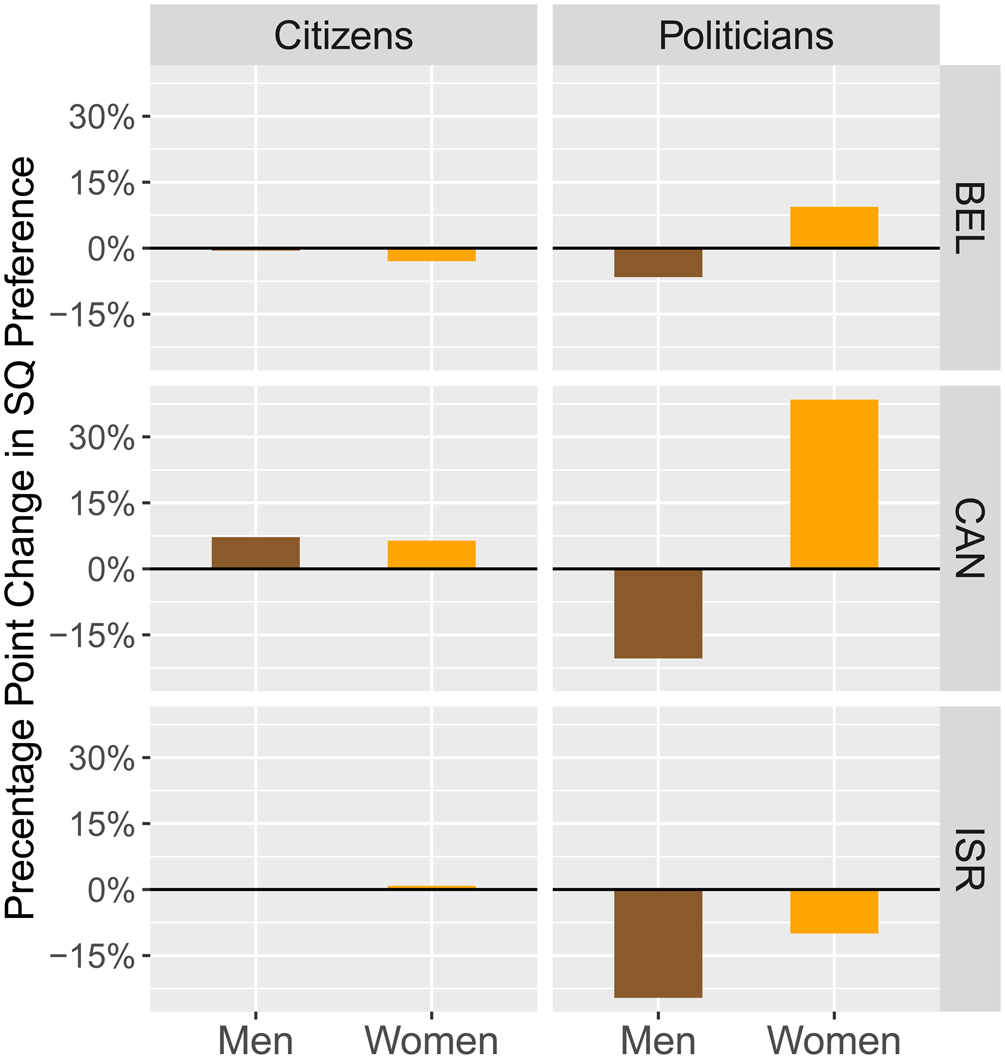
The results are relatively consistent across country cases, as illustrated in Figure 3 (see the supplementary information online full results). In Belgium and Canada, female politicians increased their status quo preference when accountability was heightened (+9.3% and + 38.5%, respectively), and men's status quo preference decreased (−6.5% and −20.3%). In Israel, incumbent men's status quo preference decreased when accountability was high (−24.6%), but women's status quo preference did not increase (−10%). Three points of reservation are worth noting with respect to the results in Israel: First, only 13 female members of Knesset participated in the experiment, across both accountability conditions; thus, it is difficult to extract a statistically valid inference from the observed proportions. Second, despite the small sample size, the negative impact of accountability on status quo preference among female Israeli politicians was less than half of that observed in their male peers. Finally, no significant country effects were included when estimating the full models.
Effect of accountability treatment on status-quo preference, by country, respondent type, and gender. Quantities are percentage point change in status-quo choice for each group when moving from low to high accountability.

DISCUSSION
Women and men in elected office have, on average, different substantive preferences, representation styles, and levels of legislative effectiveness. They also follow different trajectories on the way to getting elected, and they have very different in-office experiences. The study and analysis provide evidence that female and male politicians also react differently when the implied accountability levels of politically relevant tasks they are faced with are manipulated. Priming the fundamental aspects of political accountability results in divergent patterns: female politicians escalate their preference for status quo policies, whereas male politicians are more likely to abandon them.
The theoretical explanation promoted in this article for this finding is that gendered responses to political accountability reflect persistent risk aversion and blame avoidance by women who are stereotypically—and negatively—evaluated in the male-dominated environment of elected politics. We know that female politicians are often judged more harshly for their actions and are at a greater risk of losing public support for similar behavior (Bauer, Harbridge, and Krupnikov Reference Bauer, Harbridge and Krupnikov2017; Deen and Little Reference Deen and Little1999; Holman, Merolla, and Zechmeister Reference Holman, Merolla and Zechmeister2011; Johnson et al. Reference Johnson, Murphy, Zewdie and Reichard2008; O'Brien Reference O'Brien2015), so the observed divergence could be a rational preemptive response to the kind of reaction women in office learn to expect. As a result, conditions of increased public scrutiny and the presence of elections (both constituent elements of a decision environment with high levels of political accountability) are more likely to promote different response patterns by elected women and men. Here too, additional research could help substantiate the link between such anticipatory thinking and gender-based differences.
The findings reported here fit with the aforementioned theoretical framework, but that does not conclusively rule out other explanations. One potential reason to expect political accountability to influence men and women in office differently, even without assuming preemptive behavior in the face of unfavorable public opinion, is that female politicians, as a group, are on average younger and have shorter tenures than their male peers. Thus, they are structurally more electorally vulnerable and have a stronger incentive to adopt behaviors that minimize their likelihood of losing office, such as adhering to what is perceived as maintaining existing policies rather than risking change. This explanation seems at best partial: First, the results presented here are robust to the inclusion of controls for age and tenure length, meaning that the effects found cannot be fully explained by these factors. Furthermore, the electoral safety of female and male politicians in the countries studied does not appear to differ consistently, and the results are also robust to the inclusion of a measure evaluating individual politicians’ electoral vulnerability.
Another possible explanation is that these results are driven by the issue domain of the task at hand. Existing research demonstrates that women in office are more likely to introduce, support, and successfully implement legislation and policies that deviate from a male-dominated policy status quo. Thus, being held politically accountable could operate differently in domains on which women are expected to be pioneers relative to those in which they are assuming a less gendered role, such as decisions on economic growth and deficits. Substantiating this hypothesis requires additional research comparing legislators’ behavior on decision tasks with policies from different domains.
This latter possibility is directly related to an important limitation of this study: it evaluates the status quo bias using a single-issue economic policy vignette that attempts to minimize the risk of introducing noise from factors that cannot be controlled experimentally, such as strong prior preferences. This kind of policy choice is nevertheless a common scenario. Elected officials often have to adjudicate between alternatives that do not readily map onto ideological fault lines or where prior knowledge on the status quo policy is weak (e.g., in health and education policy). Yet for many other policy issues, politicians have clear knowledge on what the status quo is and have strong ideological opinions on its desirability.
This domain-specific context may reduce the extent to which one choice being the status quo rather than the other could change a politicians’ decision making and, subsequently, the visibility of the gender-based differences identified here. Moreover, opting for extending the current policy is commonly assumed in existing studies to be a risk-averse heuristic, but in various examples of certain representatives, supporting the status quo becomes the riskier strategy (e.g., when public opinion shifts rapidly in favor of previously unpopular policies, as was recently the case in the United States for same-sex marriage, legalization of marijuana, or universal healthcare). Examining such issues could even entail a reversal of gender-based expectations regarding status quo bias. These limitations underscore the need for further research evaluating these gender and status quo dynamics in additional issue areas.
This study highlights important aspects of gender differences in elite political behavior that require scholarly attention. First, differences between incumbent men and women in decision-making styles and traits are worthy of further exploration because they can influence political outcomes in more intricate ways than those resulting from differences in substantive policy preferences. Female and male politicians often choose to focus on different issues in their legislative work, to speak on divergent topics, and to pay attention to different facets of the same policy issues. But they can also reason differently when dealing with identical problems and adjudicating between the same policy alternatives by adopting distinct choice heuristics. One such choice anomaly—susceptibility to status quo bias—is realized in opposite ways by men and women under the same accountability conditions, suggesting that more public scrutiny or electoral proximity can motivate different economic policy preferences by men and women in office. Similarly, female politicians are more risk-averse or less overconfident than their male peers, as is often the case outside of politics, which may have a direct impact on policy outcomes that encapsulate these decision-making traits, such as international conflict or domestic use of force. Specifically, the more women are elected to office and the more authority they have, the more we can expect norms and outcomes to be affected (Karpowitz and Mendelberg Reference Karpowitz and Mendelberg2014; Phillips Reference Phillips1995).
The political selection funnel may be especially consequential to our understanding of such patterns. If the kinds of men and women who pursue elected office are more similar to one another in their reasoning and personality characteristics than they are representative of the demographic groups they belong to, or if socialization while in elected office strongly dominates the adoption of choice heuristics, then we should have more reserved expectations regarding the possible impact of gender equity in elite politics.Footnote 16 Establishing the impact of such processes relative to long-standing gender differences documented in nonelite studies has the potential to provide a more complete picture of how individual motivations, social processes, and institutional factors operate together in shaping the experiences and choices of elected women and men.
SUPPLEMENTARY MATERIAL
To view supplementary material for this article, please visit https://doi.org/10.1017/S1743923X19000825.
ACKNOWLEDGMENTS
I am grateful to Peter Loewen, Stefaan Walgrave, Stuart Soroka, Tamir Sheafer, and the members of the INFOPOL team for enabling this project. I am also grateful to Jennifer Lawless, Rose McDermott, Tali Mendelberg, and Danielle Thomsen for generously providing advice and feedback that greatly improved this article. This article further benefited from feedback provided by participants in the University of Toronto 2018 Political Behaviour Group. I thank the anonymous reviewers and editors for their thoughtful suggestions and comments.