Takotsubo cardiomyopathy, also known as stress cardiomyopathy, broken heart syndrome, or apical ballooning syndrome, was first described in Japan in 1990 Reference Sato, Taiteishi, Uchida, Kodama, Haze and Hon1 . Takotsubo cardiomyopathy is characterised by transient systolic dysfunction of the left ventricle with wall motion abnormalities resembling myocardial infarction without angiographic evidence of coronary artery obstruction Reference Medeiros, O’Connor and Baicu2–Reference Abe, Kondo, Matsuoka, Araki, Dohyama and Tanio4 . The name of this condition originated from the Japanese term for an octopus trap, “tako-tsubo,” which is a fishing pot with a narrow neck and round bottom that describes the shape of left ventricular apical ballooning during systole. Takotsubo cardiomyopathy can present with a variety of symptoms, but chest pain, dyspnoea, and syncope are the most common presenting features Reference Templin, Ghadri and Diekmann5 . Takotsubo cardiomyopathy is frequently triggered by various emotional or physical stress and is most commonly reported in adult post-menopausal women Reference Templin, Ghadri and Diekmann5–Reference Wittstein, Thiemann and Lima7 . ST elevation is frequently seen on Electrocardiogram (EKG), and cardiac biomarkers, troponin, and brain natriuretic peptide are often elevated in patients with takotsubo cardiomyopathy Reference Templin, Ghadri and Diekmann5 . Mortality in adults is approximately 4% Reference Templin, Ghadri and Diekmann5 , and among adult survivors, the condition normalises within 1–4 weeks Reference Sharkey, Lesser and Zenovich6–Reference Kurisu, Sato and Kawagoe11 .
Takotsubo cardiomyopathy is an uncommon condition in children, and the prevalence in this population has not been well described. The purpose of this study is to evaluate the epidemiology and outcomes of takotsubo cardiomyopathy in hospitalised children in the United States.
Methods
A retrospective analysis was performed using the Healthcare Cost and Utilization Project’s Kids’ Inpatient Database of the Agency for Healthcare Research and Quality to evaluate the epidemiology and outcomes of children with takotsubo cardiomyopathy in the years 2012 and 2016. The Kids’ Inpatient Database is designed to permit researchers to study a broad range of conditions, specifically rare diagnoses and procedures, related to child health issues. The Kids’ Inpatient Database can be used to identify, track, and analyse national trends in health care utilisation, charges, quality, and outcomes. It excludes data elements that could directly or indirectly identify individuals. It includes 4179 and 4200 hospitals and 44 and 47 states in 2012 and 2016, respectively. All children from the age of 1 month to 20 years with the diagnosis of takotsubo cardiomyopathy were included in this study. International Classification of Diseases (ICD)-9 diagnosis code 429.83 and ICD-10 diagnosis code I51.81 were used to identify patients with takotsubo cardiomyopathy. The presence of associated psychiatric illnesses and substance use disorders were identified using Agency for Healthcare Research and Quality’s Clinical Classifications Software. The Clinical Classifications Software condenses several ICD-9-CM or ICD-10-CM codes into a smaller number of clinically meaningful categories that are more useful for presenting descriptive statistics than are individual ICD-9-CM/ICD-10-CM codes 12 . Other associated conditions or procedures were identified using relevant ICD-9 or ICD-10 codes. Anoxic brain injury or cardiac arrest or cerebral oedema was grouped together and labelled anoxic injury, and anoxic brain injury or cerebral oedema was grouped and labelled anoxic brain injury for analysis. Total charges in 2012 were adjusted for inflation to 2016 values 13 .
Statistical analysis
Complex sampling and data weighting (for national estimates) were employed for all analyses. Gender, age group, race, median household income of patient’s zip code, and primary payer were used to describe the demographic characteristics of the study population. Length of stay and total charges were described as medians with interquartile range. Univariate and multivariable analyses were used to assess mortality outcomes. Univariate and multivariable analyses were used to analyse mortality outcomes. Variables with a p-value of less than 0.1 by univariate analysis were included in the binary regression model. IBM SPSS Statistics for Windows, version 25 (IBM Corp., Armonk, NY, USA) was used for data analysis, and a p-value < 0.05 was considered statistically significant.
Results
Prevalence of takotsubo cardiomyopathy in hospitalised children
Among a total of 4,852,767 (95% confidence interval: 4,852,404–4,853,130) hospital discharges, takotsubo cardiomyopathy occurred in 153 (95% confidence interval: 124–181) discharges. The prevalence (per 100,000 discharges) of takotsubo cardiomyopathy was 3.14 (95% confidence interval: 2.55–3.72).
Demographic characteristics
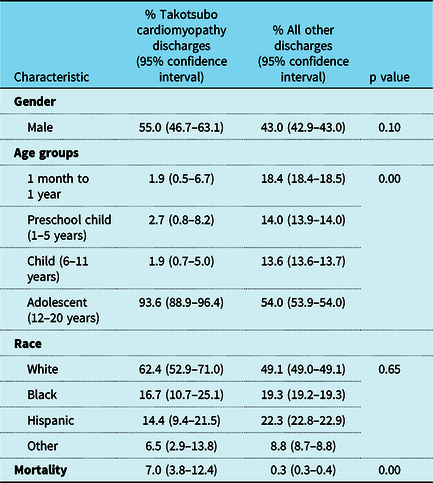
Among children discharged with the diagnosis of takotsubo cardiomyopathy, 55.0% (95% confidence interval: 46.7–63.1%) were males, 93.6% (95% confidence interval: 88.9–96.4%, p = 0.00) were adolescents (12–20 years), and 62.4% (95% confidence interval: 52.9–71.0%, Table 1) were white. The median age for takotsubo cardiomyopathy was 19 years (interquartile range: 18–20). Eighty-nine percent of patients were between 12 and 20 years.
Demographic characteristics for takotsubo cardiomyopathy and other discharges

Psychiatric and substance use disorders
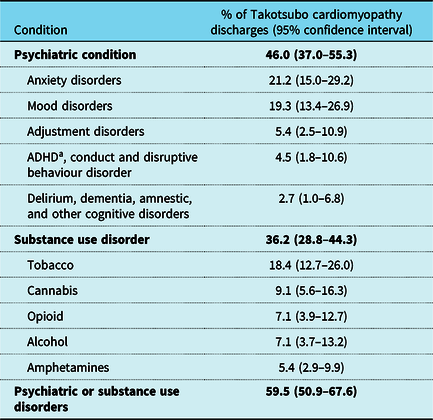
A psychiatric or substance use disorder was noted in 59.5% (95% confidence interval: 50.9–67.6%; Table 2). Anxiety disorder was documented in 21.2% (95% confidence interval: 15.0–29.2%) and mood disorder in 19.3% (95% confidence interval: 13.4–26.9%). Among substance use, tobacco use was documented in 18.4% (12.7–26.0%), cannabis use in 9.1% (95% confidence interval: 5.6–16.3%), and amphetamines use in 5.4% (95% confidence interval: 2.9–9.9%). Table 2 describes various psychiatric and substance use disorders noted in our study.
Psychiatric and substance use disorder in children with takotsubo cardiomyopathy

a Attention-deficit hyperactivity disorder
Outcomes
The median length of stay was 5 days (interquartile range: 2.71–15), and the median total charges were $75,080 (interquartile range: 32,176–198,336). The mortality rate was 7.0% (95% confidence interval: 3.8–12.4%). Sepsis was noted in 22.8% (95% confidence interval: 16.6–30.6%) of the patients, and it was not associated with increased mortality. Factors associated with increased mortality by univariate analysis are presented in Table 3. On multivariable analysis, only anoxic injury was associated with increased mortality (odds ratio = 39.42, 95% confidence interval: 4.85–320.11, p = 0.001).
Univariate analysis of factors affecting mortality in children with takotsubo cardiomyopathy

Discussion
Takotsubo cardiomyopathy is an uncommon condition in children with a prevalence of 3.1 per 100,000 discharges. It occurs more commonly in adolescent males with underlying psychiatric or substance use disorder. Mortality in our cohort was 7%, and it was higher when associated with anoxic injury.
Our study from a large national paediatric discharge database shows higher prevalence of takotsubo cardiomyopathy in males, unlike previously published studies in which takotsubo cardiomyopathy is equally distributed or more prevalent in female children Reference Hernandez14–Reference Urbinati, Pellicori, Guerra, Capucci and Clark16 and adult women Reference Templin, Ghadri and Diekmann5 . The median ages in previously published studies were 8–9 years compared to our study in which more than 90% of the patients were in the age group of 12–20 years Reference Topal, Topal, Dogan, Tiryaki and Biteker15,Reference Urbinati, Pellicori, Guerra, Capucci and Clark16 . The differences in gender and age distribution between this study and those previously published may be because our data represent a large, national sample, whereas previously published studies were limited to case series or single institution studies.
Psychiatric conditions were commonly associated with takotsubo cardiomyopathy in our study. There is a paucity of data in children associating psychiatric disorders with takotsubo cardiomyopathy. However, multiple studies in adults have demonstrated an association between anxiety, depression, or mood disorders with takotsubo cardiomyopathy Reference Templin, Ghadri and Diekmann5,Reference Kastaun, Schwarz and Juenemann17–Reference Suárez Bagnasco and Núñez-Gil21 . Emotional or physical stress is a well-established trigger for the development of takotsubo cardiomyopathy Reference Templin, Ghadri and Diekmann5,Reference Hernandez14,Reference Topal, Topal, Dogan, Tiryaki and Biteker15 . Events that have been associated with takotsubo cardiomyopathy in adults and children include loss of a family member, motor vehicle accident, public speaking, fear of procedure, tragic news, extreme excitement or surprise, arguments, sepsis, surgery, competition, and drug abuse Reference Templin, Ghadri and Diekmann5,Reference Hernandez14,Reference Topal, Topal, Dogan, Tiryaki and Biteker15 . Stress (physical, psychological, emotional) is a common phenomenon in all these conditions. The underlying pathophysiology for development of takotsubo cardiomyopathy secondary to stress is not well understood, but it is postulated that exaggerated sympathetic stimulation leading to catecholamine excess may play a role Reference Wittstein22 . Studies have demonstrated higher levels of circulating catecholamines and elevated norepinephrine levels in coronary sinus blood samples from patients with takotsubo cardiomyopathy Reference Wittstein22,Reference Kume, Kawamoto and Okura23 . There are a few possible mechanisms to explain the association between sympathetic stimulation and takotsubo cardiomyopathy. Increased sympathetic tone from mental or physical stress is known to cause coronary vasoconstriction in patients without evidence of coronary vascular disease Reference Lacy, Contrada and Robbins24 . Coronary microvascular spasm may cause abnormal coronary flow in the absence of coronary obstruction Reference Wittstein, Thiemann and Lima7,Reference Bybee, Prasad and Barsness25,Reference Sadamatsu, Tashiro, Maehira and Yamamoto26 . Another possible mechanism is direct myocyte injury from elevated catecholamine levels Reference Mann, Kent, Parsons and Gt27 . Myocardial biopsies from patients with takotsubo cardiomyopathy have revealed contraction band necrosis which is generally seen in states of excess catecholamine production such as pheochromocytoma or subarachnoid haemorrhage Reference Wittstein22 . Patients with depression have an exaggerated norepinephrine response to emotional stress, and those with anxiety disorder have decreased catecholamine reuptake Reference Mausbach, Dimsdale and Ziegler28,Reference Alvarenga, Richards, Lambert and Esler29 . The combination of exaggerated sympathetic response to stress along with increased cardiac sensitivity to sympathetic response makes these patients vulnerable to develop takotsubo cardiomyopathy Reference Ghadri, Wittstein and Prasad30 .
A sizeable portion of children in the present study had substance use disorder. Substance abuse can lead to takotsubo cardiomyopathy through several mechanisms. A review by Kido et al. showed that 68.2% of drug-induced takotsubo cardiomyopathy cases were related to states of catecholamine excess Reference Kido and Guglin31 . Cannabis is known to cause tachycardia acutely, bradycardia, and hypotension with chronic use, and it may impair myocardial contractility Reference Sanchez, Sennhauser, Lozier and Purow32–Reference Bonz, Laser and Küllmer34 . Smoking is a known risk factor in adults for the development of takotsubo cardiomyopathy Reference Deshmukh, Kumar, Pant, Rihal, Murugiah and Mehta19 . Withdrawal from opiates is known to induce a state of catecholamine surge which may lead to withdrawal symptoms Reference Fuentealba, Forray and Gysling35–Reference Sarcon, Ghadri, Wong, Luscher, Templin and Amsterdam37 , and this may contribute to the development of takotsubo cardiomyopathy.
In 2005, a study described the association of takotsubo cardiomyopathy with sepsis in adults Reference Park, Kang and Song8 . Few case reports and case series in paediatrics have reported sepsis to be a trigger for takotsubo cardiomyopathy Reference Topal, Topal, Dogan, Tiryaki and Biteker15 . The exact mechanism of sepsis-induced takotsubo cardiomyopathy is uncertain. Proposed pathophysiological mechanisms of myocardial dysfunction in sepsis include decreased coronary perfusion leading to myocardial ischaemia; action of cardiac depressant inflammatory mediators such as tumor necrosis factor-alpha and interleukin-1; myocardial depression from endotoxin release; and stimulation of sympathetic nervous system leading to massive catecholamine release and exogenous administration of catecholamine Reference Cappelletti, Ciallella, Aromatario, Ashrafian, Harding and Athanasiou38–Reference Krishnagopalan, Kumar, Parrillo and Kumar41 . In adults, takotsubo cardiomyopathy is seen in increasing frequency in patients with severe sepsis; however, it is associated with low in-hospital mortality Reference Vallabhajosyula, Deshmukh, Kashani, Prasad and Sakhuja42 . Similarly, 22.8% of the discharges in our study had the diagnosis of sepsis, and the hospital mortality was low. However, we could not ascertain temporal relationship between sepsis and takotsubo cardiomyopathy.
Mortality in children with takotsubo cardiomyopathy in our study was 7% compared to that in adults which was 4.1% Reference Templin, Ghadri and Diekmann5 . Mortality in this condition in children has not been well established due to paucity of published data.
Currently, there is no specific guideline regarding the diagnosis and management of takotsubo cardiomyopathy in children. Although takotsubo cardiomyopathy is more prevalent in the adult population, it may occur in children with comparable presentation, triggers, EKG, and imaging findings to those of adults Reference Hernandez14,Reference Topal, Topal, Dogan, Tiryaki and Biteker15 . Paediatric studies have demonstrated complete recovery of ventricular function between 3 days and 3 months of presentation Reference Hernandez14,Reference Topal, Topal, Dogan, Tiryaki and Biteker15 . Although takotsubo cardiomyopathy is uncommon in children, it is important that clinicians be aware of its association with other comorbid conditions.
Limitations
Our study has several limitations. Administrative databases are subject to coding errors, which may include omission of codes and use of incorrect codes. Administrative databases are limited to the extent of the data granularity that is built into them. It was not possible to review individual charts to obtain specific information about aetiology, presentation, management, and outcomes. In addition, chronology of events is not recoded for the most part in the Kids’ Inpatient Database. Hence, temporal associations could not be established.
Conclusions
Takotsubo cardiomyopathy is a rare diagnosis in children with a mortality of 7%. It is more prevalent in adolescent males, and psychiatric and substance use disorders are common in children with takotsubo cardiomyopathy. It should be considered in the differential diagnosis of children presenting with cardiac dysfunction and psychiatric or substance use disorder or sepsis.
Acknowledgements
None.
Financial Support
This research received no specific grant from any funding agency, commercial, or not-for-profit sectors.
Conflicts of Interest
None.
Ethical Standards
This article does not contain any studies with human participants or animals performed by any of the authors.