

The quality of adolescent relationships is a major contributor to adjustment during the adolescent years (Jager, Reference Jager2011; Raudino, Fergusson, & Horwood, Reference Raudino, Fergusson and Horwood2013). The quality of relationships may influence learning (Bowles, Reference Bowles2008a; Mussweiler & Ruter, Reference Mussweiler and Ruter2003), wellbeing (Allen, Moore, Kuperminc, & Bell, Reference Allen, Moore, Kuperminc and Bell1998; Armsden, & Greenberg, Reference Armsden and Greenberg1987), help seeking for major life problems at adolescence (Fallon & Bowles, Reference Fallon and Bowles1999, Reference Fallon and Bowles2001), communication (Bowles, Reference Bowles2008b), and the positive transition to adulthood (Jager, Reference Jager2011). A large amount of the research into adolescent relationships has focused on dyadic (two-person) relationships, such as relationships with friends or individual family members. Little relationship research has focused on equity, and even less has focused on transrelational equity, the equity of multiple salient relationships and the influence of one relationship on another (Buunk & Van Yperen, Reference Buunk and Van Yperen1991). General theories such as social comparison theory (Piko, Skultéti, Luszczynska, & Gibbons, Reference Piko, Skultéti, Luszczynska and Gibbons2010) and, more particularly, equity theory (Hatfield & Sprecher, Reference Hatfield and Sprecher1995; Sprecher, Reference Sprecher1998) help explain interactions in adult relationships, but such theories have yet to be well tested with adolescents. In the current study, the major interest is establishing whether theories pertinent to adult relationships, and the corresponding affective responses, are consistent with adolescents’ relationships with significant others.
Social comparison is a human characteristic that is involved in most of our encounters. For example, social comparison can influence health behaviours (Piko et al., Reference Piko, Skultéti, Luszczynska and Gibbons2010), adolescent material possessions (Chan, Reference Chan2008), satisfaction in intimate relationships (Van Yperen & Buunk, Reference Van Yperen and Buunk1990), and sexual enjoyment of adults (Galinsky & Sonenstein, Reference Galinsky and Sonenstein2013). One of the major subtypes of social comparison theory is equity theory, which has become a cultural universal since research began over 25 years ago (Hatfield & Rapson, Reference Hatfield, Rapson, Van Lange, Kruglanski and Higgins2011). This theory was originally derived from economic models and has been applied in explaining the behaviour-emotion link associated with inequity in close adult relationships (Hatfield & Rapson, Reference Hatfield, Rapson, Van Lange, Kruglanski and Higgins2011; Sprecher, Reference Sprecher1986). As noted by Adams (Reference Adams1965), exchange relationships are at the core of equity theory (Al-Zawahreh & Al-Madi, Reference Al-Zawahreh and Al-Madi2012). Within relationships, individuals provide inputs and receive outcomes. Inputs are what individuals perceive as having value and being brought by themselves or put into the relationship (Pritchard, Reference Pritchard1969). Outcomes are what individuals perceive as returns to themselves that have value or utility. Fairness in exchange is achieved when an individual's outcomes are in proportion to their inputs (Adams, Reference Adams1965; Longmore & Demaris, Reference Longmore and DeMaris1997) and balance with the other person's inputs and outcomes (Galinsky & Sonenstein, Reference Galinsky and Sonenstein2013; Hatfield & Sprecher, Reference Hatfield and Sprecher1995; Sprecher, Reference Sprecher1998). Comparisons may be made consciously or unconsciously, and an individual or a group of individuals may be relevant when making such comparisons (Pritchard, Reference Pritchard1969).
Equity theory proposes that all individuals have an embedded tendency to seek reciprocity in their relationships, with perceptions of inequity leading to distress and subsequent redress or adjustment of the input/outcome ratio (Hatfield, Walster, & Berscheid, 1978, as cited in Bakker et al., Reference Bakker, Schaufeli, Demerouti, Janssen, Van Der Hulst and Brouwer2000). Equity theory has four propositions (Hatfield et al., 1978, as cited in Bakker et al., Reference Bakker, Schaufeli, Demerouti, Janssen, Van Der Hulst and Brouwer2000; Hatfield & Rapson, Reference Hatfield, Rapson, Van Lange, Kruglanski and Higgins2011), summarised as follows: (1) people seek to maximise pleasure and minimise pain; (2) society maintains and rewards fair and equitable behaviour; (3) people feel comfortable when they experience equity; if they are overbenefitted, they may experience pity, guilt, and shame, and if underbenefitted, they may experience anger, sadness, and resentment; (4) people in inequitable relationships will reduce their distress by restoring psychological equity, actual equity, or leaving the relationship.
Other research has linked equity and affects; for example, equitable relationships in adults are the most satisfying and positive (Van Yperen & Buunk, Reference Van Yperen and Buunk1990). Individuals who perceive they are underbenefitted feel they are treated unfairly (Hegtvedt, Reference Hegtvedt1990) and experience distress (Al-Zawahreh & Al-Madi, Reference Al-Zawahreh and Al-Madi2012; Hegtvedt, Reference Hegtvedt1990; Walster, Berscheid, & Walster, Reference Walster, Berscheid and Walster1973). The greater the level of inequity, the more distress that is felt for both partners (Donoghue & Fallon, Reference Donoghue and Fallon2003). Those who are overbenefitted may feel guilt-related affects (Hatfield, Traupmann, Sprecher, Utne, & Hay, Reference Hatfield, Traupmann, Sprecher, Utne, Hay and Ickes1985) and those who are underbenefitted may experience anger, guilt, and depression (Sprecher, Reference Sprecher1992). Much of the research linking equity with emotional responses has been completed within the context of adult romantic relationships.
Equity theory offers an alternative way to understand the dynamics of adolescent relationships and affects. Equity and fairness are central principles in education institutions, and research reflects the importance of equity in school settings and in relations with teaching staff. For example, with an Italian sample of adolescent students, Molinari, Speltini, and Passini (Reference Molinari, Speltini and Passini2013, p. 71) concluded that when positive teacher behaviour is perceived as fair it is predictive of school success. Sprecher's (Reference Sprecher1992) important early research into equity of young adult relationships showed that responses to vignettes of underbenefitted relationships were significantly more angry, guilty and depressed, and less happy, content, satisfied and loving in comparison to the overbenefitted group. Sprecher (Reference Sprecher1992) suggests that various combinations of negative and positive affects and processes for calculating affect scores (e.g., subtracting positive affects from negative) to measure distress in relationships have generated inconsistency in results. Guerrero, La Valley, and Farinelli (Reference Guerrero, La Valley and Farinelli2008) used measures of guilt, anger and sadness or depression to measure the response to inequity in relationships, and consistent with Jovanović (Reference Jovanović2015), who argued that a brief, general Positive Affect Negative Affect Schedule (PANAS; six positive and six negative affects) was satisfactory for measuring wellbeing. It is argued here that the four positive and three negative affects previously associated with in/equity in relationships (Sprecher, Reference Sprecher1992) is relevant to adolescent reactions to levels of equity.
The general ecological explanation of adolescent relations provides an overarching theoretical frame guiding this research. According to Bronfenbrenner (Reference Bronfenbrenner, Moen, Elder and Luscher1995), significant others relate specifically to a person's microsystem; in particular, those most likely to influence the values of the individual. In the case of the adolescent, ‘the belief systems of parents, teachers, mentors, spouses, and close friends and associates may be especially important’ (Bronfenbrenner, Reference Bronfenbrenner, Moen, Elder and Luscher1995, p. 638). In this research, it was decided that the most potentially significant others from the microsystem would be included and that they are parents, siblings, friends, and teachers. The equity and associated affects that adolescents share with these significant others is the focus of the research.
To date there appears no other research related to equity with teachers’ and adolescents’ relationships. Similarly, a literature search identified only one article related to the equity of older adolescent children and their parents (Vogl-Bauer, Kalbfleisch, & Beatty, Reference Vogl-Bauer, Kalbfleisch and Beatty1999). In this study, the authors concluded that adolescents in the overbenefitted category reported higher ratings on relationship satisfaction, positivity with relationships, openness, felt more assured, spent more time with significant others, and worked more on joint tasks. Similarly, equity research specifically with friends at adolescents has not been researched.
Previous research involving 700 romantically involved adult respondents showed that 13% of men were underbenefitted, 62% of men were in equitable relationships, and 25% were overbenefitted (Hatfield, Greenberger, Traupmann, & Lambert, Reference Hatfield, Greenberger, Traupmann and Lambert1982). By comparison, in a similar study, 25% of women were underbenefitted, 59% of women were in equitable relationships, and 16% were overbenefitted (Van Yperen & Buunk, Reference Van Yperen and Buunk1990). On the basis of this analysis, we would expect that the majority, approximately 60%, of males and females would be in the equitable condition, and between 15% and 25% would be in the underbenefitted and overbenefitted categories. As adolescents have fewer possibilities of reciprocating in relationships than adults, it is possible that greater levels of inequity will be experienced by adolescents. One of the assumed principles of equity theory is that the individuals in the exchange activity have the same or different but comparably equivalent material to exchange. This is not so in adolescent-adult relationships where adolescents have affection, time, conversation, and social behaviour to exchange, but they do not have other resources, particularly material resources, competencies and skills to exchange, as adults do. Therefore, it is very possible that adolescent-adult relationships will be perceived as more inequitable than adolescent-adolescent relationships.
Recent research into equity theory and adolescence has shown that although equity is a strong social norm, as adolescents age they prefer to maximise their resources or benefit themselves, which is stronger for males than females, and they become more flexible in their equity preferences (Meuwese, Crone, Rooij, & Güroğlu, Reference Meuwese, Crone, Rooij and Güroğlu2015). Research into whether adolescents’ preference for equity has been found to vary was as a function of the experimental design, context, and the age of the adolescents (Almas, Cappelen, Sørensen, & Tungodden, Reference Almas, Cappelen, Sørensen and Tungodden2010; Fehr, Bernhard, & Rockenbach, Reference Fehr, Bernhard and Rockenbach2008; Fehr, Glatzle-Rutzler, & Sutter, Reference Fehr, Glatzle-Rutzler and Sutter2013; Meuwese et al., Reference Meuwese, Crone, Rooij and Güroğlu2015; Steinbeis, Bernhardt, & Singer, Reference Steinbeis, Bernhardt and Singer2012).
Finally, little research has specifically investigated the link between the age of adolescents and perceptions of equity. In a comprehensive survey of the literature into how children approach making judgments about input-outcome ratios, Hook and Cook (Reference Hook and Cook1979) concluded that prior to the age of 13, adolescents were unlikely to be able to make judgments as adults do. They noted that children below the age of 13 were unlikely to be able to accommodate the complexity of the cognitive processing required to make judgments about equity. Similarly, older female adolescents have been found to make more nuanced judgments compared to younger adolescents when making judgments about distributive justice (McGillicuddy-De Lisi, De Lisi, & Van Gulik, Reference McGillicuddy-De Lisi, De Lisi and Van Gulik2008). Sprecher's (Reference Sprecher1992) research shows that underbenefitted young adult females were more generally distressed and experienced stronger negative affect and lower positive affect than young adult males in the underbenefitted category. Therefore, the current research will also consider the adolescents’ age and gender.
The research hypotheses and exploratory questions of the current study are:
-
1. Which of the relationships with parents, siblings, friends and teachers are rated most frequently equitable, overbenefitting and underbenefitting by students, and are the levels of equity with one relationship independent of the equity of other relationships?
-
2. Are there significant differences in the frequency (percentage) of students in each level of equity with parents, siblings, friends and teachers?
-
3. Do the patterns of adolescents’ positive and negative affects associated with levels of equity in the four relationships reflect the patterns from the adult research?
-
4. Do age, gender, and levels of equity influence and interact with the affects associated with the four relationships?
Method
Participants
The sample consisted of 280 adolescents from one regional secondary college in the Melbourne metropolitan area. Of the 280 recruited participants, 69 were enrolled in Year 7 (early secondary school), 34 were females (mean age =12.59 years, SD = 0.56) and 35 were males (mean age = 12.77 years, SD = 0.60). A Year 9 group of 71 respondents was comprised of 36 females (mean age =14.64 years, SD = 0.72) and 35 males (mean age = 14.63 years, SD = 0.55). The older group of 68 Year 11 students was comprised of 38 females (mean age = 16.18 years, SD = 0.73) and 30 males (mean age = 16.43 years, SD = 0.57). Only data from students with both parents at home were included. Of the 280 respondents included in the research, 202 had siblings. Other frequencies in the analysis vary as a result of missing data in some cells.
Materials and Procedure
Participants completed the survey items in their weekly class tutorial groups. The first questionnaire was a modified version of the Hatfield Global Measure of Equity Scale (Hatfield et al., Reference Hatfield, Greenberger, Traupmann and Lambert1982). This measure has been used in several studies (e.g., Canary & Stafford, Reference Canary and Stafford1992; Floyd & Wasner, Reference Floyd and Wasner1994; Galinsky & Sonenstein, Reference Galinsky and Sonenstein2013; Hatfield et al., Reference Hatfield, Greenberger, Traupmann and Lambert1982; Schafer, Keith, & Lorenz, Reference Schafer, Keith and Lorenz1984; Sprecher, Reference Sprecher1986, Reference Sprecher1988; Traupmann, Hatfield, & Wexler, Reference Traupmann, Hatfield and Wexler1983; van Yperen & Buunk, Reference Van Yperen and Buunk1990) and has the strengths of high face validity and parsimony. The questionnaire has one complex item requiring the respondent to make a judgment about themselves in relation to four significant others (parents, siblings, friends, and teachers) and decide whether they are underbenefitted, overbenefitted, or experiencing equity.
Respondents were then asked to respond to the Global Measure of Equity (Hatfield & Rapson, Reference Hatfield, Rapson, Van Lange, Kruglanski and Higgins2011), which asks respondents to ‘Please think of the relationship you have with your parents/siblings/teachers/friends. Consider what you put into your relationship with your parents/siblings/teachers/friends compared with what you get out of the relationship, and what your parents/siblings/teachers/friends put in compared with what they get out of it, how does the relationship “stack up”? Please circle the number that is above the statement that most closely represents how you feel about the relationship.’ For each of the four relationship types, participants chose one of seven items ranging from: ‘I am getting a much better deal than my parents/siblings/friends/teachers’ (1) to ‘My parents/siblings/friends/teachers are getting a much better deal’ (7). Three levels of equity can be derived from the 7-point Likert-type scale with ratings of 1–3 representing the overbenefitted category, 4 indicating an equitable relationship and 5–7 representing an underbenefitting relationship for the adolescent. A mean score was generated to represent the level of equity of each relationship for the cohort, with a mean of 4 indicating the relationship is perceived equitably, a mean below 4 indicating the relationship is percieved as overbenefitted, and a mean above 4 indicating the relationship is perceived as underbenefitted. Previous research, such as Galinksy and Sonenstein (Reference Galinsky and Sonenstein2013) and Sprecher (Reference Sprecher2001a, Reference Sprecher2001b), have similarly classified responses to this item into three categories (overbenefitted, equitable, and underbenefitted).
Next, participants were asked to rate each relationship in terms of positive or negative affect. Sprecher (Reference Sprecher1992) showed that four positive and three negative affects were salient to equity levels in close relationships. The four positive affects were: happy, content, satisfied, and loving; and the three negative affects were: angry, guilty, and depressed. The seven affects were rated separately in relation to the four individual relationships on a Likert-type scale. The respondents were asked, ‘Thinking about your relationship with your parents/siblings/friends/teachers, overall . . . how angry, guilty, depressed, happy, content, satisfied, loving do you feel?’ Participants responded according to a 5-point scale: not at all angry/guilty/depressed/happy/content/satisfied/loving (1) to extremely angry/guilty/depressed/happy/content/satisfied/ loving (5). The four positive affects (happy, content, satisfied, and loving) were averaged to create a positive affect coefficient associated with each relationship, and the mean of the three negative affects (angry, guilty, depressed) resulted in a negative affect coefficient for each relationship.
Results
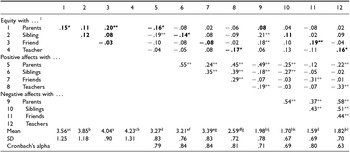
The correlation of the relationship equity means scores, and positive and negative affects are shown in Table 1. As would be expected, there were moderate, significant, negative correlations between positive emotions and negative emotions. Correlations of the scores of equity (range 1–7) of each relationship showed that there was little evidence of a consistent transrelational equity. Only parents with siblings (r = .15) and with teachers (r = .20) were significant but weak correlations. The affects of each relationship with the affects of each other relationship were significant and ranged from .24 to .55 for positive affects and -.37 to -.54 for negative affects. Cronbach's alpha coefficient for the positive affects was high, but the coefficients for the negative affects with siblings and teachers were low but still approximated an acceptable range, as according to conventional rules, this coefficient should exceed 0.70 (Nunnally & Bernstein, Reference Nunnally and Bernstein1994; Panayides, Reference Panayides2013; see Table 1).
The Descriptive Data, Correlation and Alpha Reliability of the Factors

Note: *Correlation is significant at the 0.05 level (two-tailed); **Correlation is significant at the 0.01 level (two-tailed); n = ranged from 198 to 208; mean scores, within three analyses: equity, positive affects and negative affects with the same superscripts are significant at the .05 level.
1 Overbenefit of self is a low score; underbenefit of self is a high score and as the zero point is the mid-point of the scale, correlations of the scores of equity of each relationship were not shown. The positive and negative affects associated with each of the relationship equity ratings are shown in bold type. Equity ratings with the same superscript were significantly different at .01 level. Affect ratings with the same superscript were significantly different at .01 level.
To establish the rank of the relationships, the average equity of relationships was calculated first by generating a mean score for each relationship (parents, siblings, teachers, friends), with lower mean scores indicating an overbenefitting relationship for an adolescent respondent and higher scores indicating being underbenefitted (Table 1). The four mean scores were compared using a one-way, repeated measures ANOVA followed by post-hoc comparisons (Table 1). The within-subjects ANOVA showed that there were significant differences between the mean ratings of the four relationships, F(3, 597) = 13.31, p = .001, η2 = .06. The most-to-least overbenefitting relationships for the adolescents were, in order, with parents, siblings, friends, and more equitable/underbenefitting was with teachers.
Mean scores for positive and negative affects of each of the four relationship types were compared using two ANOVAs, followed by post-hoc comparisons (Table 1). Participants rated relationships significantly differently in terms of positive affect, F(3, 603) = 68.69, p = .001, η2 = .26, and negative affect, F(3, 606) = 21.02, p = .001, η2 = .09. Teachers were rated significantly less positively, in terms of affect, than the other relationship types. Parents were rated significantly more negatively when compared to friends, siblings and teachers for negative affects.
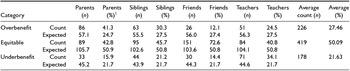
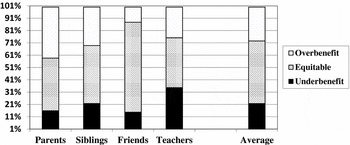
Table 2 shows the frequency of respondents in each relationship when scores are categorised into three levels of equity: overbenefitted (1–3), equitable (4) and underbenefitted (5–7). A crosstabulation with weighted chi-squared analysis, based on the raw scores converted to percentages (as there was a slight variation on the absolute numbers in each comparison), showed that there were significant differences between groups, χ2(6, 399) = 40.17, p = .001; χ2 = 0.19; Table 2). The analysis revealed the most equitable relationship shared with adolescents was with friends, with 151 adolescents indicating they were in this category, far more adolescents than was expected (n = 104). Next most equitable was siblings, then parents, and the lowest count and greatest discrepancy was with teachers. The relationship most overbenefitting adolescents was with parents, with a count of 86 (expected was n = 57), followed by siblings, teachers, and friends. Adolescents had the most underbenefitting relationship with teachers, with a count of 71 (expected was n = 34) and the lowest underbenefitting relationship with friends (Figure 1).
The Equity of Adolescent Relationships With Four Significant Others

Note: 1Level of equity within relationship expressed as a percentage.
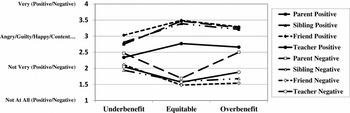
The levels of equity associated with four relationships.

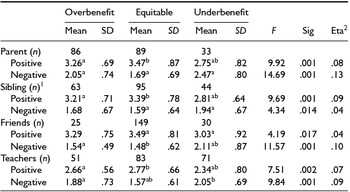
The relationship of the positive and negative affective responses to the levels of equity associated with each relationship is shown in Table 3. For each relationship, an ANOVA with polynomial and Bonferroni contrasts involving the positive and negative emotions (two dependent variables) and independent variables (IV) of gender and age level (three groups) was separately analysed with the level of equity (IV; underbenefit, equitable, and overbenefit). The four interactions involving gender and level of equity for each relationship and the main effect of gender and level of equity were not significant. Similarly, the four interactions involving age level for each relationship and main effect of age level were not significant. The main effect of level of equity for each relationship was significant and showed a consistent, significant pattern between equity in all four relationships. For positive affects, the highest rating across all relationships was those in the equitable condition followed by those in the overbenefit condition, and lowest positive affect was for those in the underbenefit condition. A consistent pattern was found for the negative affects for each group, with the underbenefit group scoring highest; lower was the overbenefit group, and lowest rating on negative affects was for the equity group (Figure 2). In each three-way comparison of equity, the equitable group was significantly different from at least one of the under- or overbenefit groups. Table 3 shows the means scores that were significantly different. For parent positive, sibling positive, teacher positive, and friend negative affects, the underbenefit group was significantly different to those in the equitable and overbenefit conditions. For the sibling positive and the friend negative affects, the underbenefit group was significantly different from only those in the equity condition. For the negative affects associated with teachers, the underbenefit group was significantly different to those in the equity condition, who were significantly different to those in the overbenefit condition. Finally, for the negative affects associated with parents, each equity group score was different to each other.
Relational Equity With Parents, Siblings, Friends and Teachers

Note: Means with the same superscript are significantly different at least at the .05 level. 1202 respondents had siblings.
Positive and negative affects associated with three levels of equity for four significant relationships.

Discussion
In summary, the mean ratings of respondents showed that the relationship with parents was perceived as the most overbenefitting for adolescents, followed by siblings and friends, and the least overbenefitting was with teachers. Analysis of the categorical levels of equity (underbenerfitted, equitable, overbenefitted) showed that for each relationship, higher positive affect and lower negative affects were associated with adolescents in the equitable condition. Hence, the patterns of equity and the patterns of affects were similar to those found in adult relationships. No gender effects or age effects were found in the analyses.
There are a number of points of interest that might be observed from the distribution of the levels of equity across the four relationships. The mean ratings of equity (Table 1) showed that adolescents have the most self-beneficial relationships from parents, siblings, friends, and then teachers. This pattern conforms with Bronfenbrenner's (Reference Bronfenbrenner, Moen, Elder and Luscher1995) model, in which family members are the most central relationships, followed by those who are less central. Hence, according to this pattern, outside the family there are friends, followed by teachers. The pattern of mean scores of the four relationships conforms to the previous research associated with adults and close relationships about equity (Hatfield et al., 1978, as cited in Hatfield & Rapson, Reference Hatfield, Rapson, Van Lange, Kruglanski and Higgins2011) and is further informed by considering each relationship in terms of three categories of equity.
The categorisation of each relationship into three levels of equity — underbenefitted, equitable, and overbenefitted — also showed a consistent pattern. First, there was a relatively similar perception of equity in relationships compared with adults (Hatfield et al., Reference Hatfield, Greenberger, Traupmann and Lambert1982; Van Yperen & Buunk, Reference Van Yperen and Buunk1990). When averaged across the four relationships, the proportion of adolescents in the equitable condition was 51%, with 27% in the overbenefit condition and 22% in the underbenefit condition, despite the early research being based on intimate relationships. Second, the proportion of people in each of the levels of equity in sibling relationships closely approximated the average of all four (Table 2). Third, the most equitable relationship, by far the largest proportion, was perceived for friends. Fourth, the relationship in which adolescents are the most overbenefitted is with parents, and the least equitable and most underbenefitted relationship is with teachers. The results also showed that there were various modulations across relationships, and that while adults seek to maintain equity in relationships (Galinsky & Sonenstein, Reference Galinsky and Sonenstein2013; Hatfield & Sprecher, Reference Hatfield and Sprecher1995; Sprecher, Reference Sprecher1998), perhaps adolescents cannot function equitably as adults do. Adults have far greater choice in regard to the variety of inputs and outcomes and the accommodation and frequency of the equity cycle. They also have more experience with cognitively adjusting to generate balance (Sechrist, Suitor, Howard, & Pillemer, Reference Sechrist, Suitor, Howard and Pillemer2014). Adults also have greater facility to decide whether to stay or go — they have higher locus of control and a greater variety of resources to exchange than adolescents.
Adolescents report different levels of equity in different relationships. Most important among the findings is the relatively large number of students in the equitable category for relations with friends, the large number of adolescents in the underbenefit categories in relations with teachers, and the large number of adolescents in the overbenefit category with parents. This may be best explained by: (1) differences in the nature and context of the relationships; (2) the exchange potential of the relationships — what adolescents offer as inputs and ‘take’ from relationship; and (3) a capacity for apprehending different levels and different types of relationships that are experienced at the same time, that is, apprehending and operating with these relationships while making adjustment with limited control over the exchange, because adolescents have little to exchange compared with adults. Balancing the complexity of equity issues of the four relationships and the corresponding emotional reactions highlights the high levels of cognitive processing and self-regulation required of adolescents. The implications of these findings are important for those who work most closely with adolescents, suggesting that young adolescents are capable of making complex equity evaluations. Importantly, it appears that there is no apparent developmental progression to the making of complex, equity-based judgments made by adolescents. The context of the adolescent relationships vary widely, and consequently, so too do the inputs and outcomes, and input/outcome ratios within relationships and contexts.
It is important to recall that a key principle of equity theory is balance, where participants in the relationship perceive they receive equivalent gains and costs through the exchange of inputs and outcomes (rewards and costs) in comparison to the relationship partner's inputs and outcomes (Galinsky & Sonenstein, Reference Galinsky and Sonenstein2013; Hatfield & Sprecher, Reference Hatfield and Sprecher1995; Sprecher, Reference Sprecher1998). So, while the general equity patterns found for adults is consistent for the four relationships in this research, adolescents have less to exchange — less capital, fewer resources, less discretion and lower locus of control — they are compelled to keep company with family, classmates, and teachers to a large degree. Further, for some adolescents in some relationships, such as with powerful adults, teachers, employers, coaches or community group leaders, the inputs may be limited to performance in learning outcomes and assessment tasks. This may explain the low score for teachers. This research suggests that adolescents not engaging in the social and economic exchanges of adults continues to late adolescence in this research. This could become a very stifling and constricting exchange process if the adolescent does not appreciate the value of accepting the discomfort of not being fully engaged in an economy valued by adults in which adolescents do not yet fully function. Adults feel distress and redress such inequities in various ways through reciprocity (Hatfield et al., 1978, as cited in Bakker et al., Reference Bakker, Schaufeli, Demerouti, Janssen, Van Der Hulst and Brouwer2000) or they leave the relationship. For the adolescent, the inequity may generate negative reactions such as dissonance (Adams, Reference Adams1965), disruptive or explosive behaviour (acting out, aggression), and feelings of negative affect, with internalising behaviour and seeking to contain negative affect. This may explain the inequity associated with relations with teachers as there is so little that can be effectively exchanged between teachers and a student without generating an imbalance (Buunk & Van Yperen, Reference Buunk and Van Yperen1991). The imbalance of equity and corresponding negative emotions brought to the relationship by students may also be experienced by teachers as (di)stress, resulting in increased burnout as a reaction to absence of reciprocity with students (Bakker et al., Reference Bakker, Schaufeli, Demerouti, Janssen, Van Der Hulst and Brouwer2000).
Just as the manifestations of equity/inequity in adult relationships were found to be reflected in adolescent relationships, so were the affective responses to levels of inequity (research hypothesis 2). The general pattern of positive affects fits the pattern of satisfaction and equity from previous research (Buunk & Van Yperen, Reference Buunk and Van Yperen1991) and affective responses of young adults (Sprecher, Reference Sprecher1992). Even though the relationship qualities and age of respondents varies from the adolescents who responded in this research, the responses associated with levels of equity conform to the original propositions (Hatfield et al., 1978, p. 6, as cited in Hatfield & Rapson, Reference Hatfield, Rapson, Van Lange, Kruglanski and Higgins2011). The consistent pattern showed that the underbenefitted group were significantly less positive and more negative than those in the equitable and overbenefitted groups (Table 3). There were significant differences for rating of parents showing elevated negative affects for all equity conditions, but particularly associated with the underbenefitted and overbenefitted group compared with the equitable group. There were also low positive affects associated with all levels of equity involving teachers, and teachers were found to be rated as the least positive relationship. Finally, the ratings of negative affects revolved around a rating of ‘not very’ (angry, guilty . . .) and the positive affects were around the midpoint (happy, content . . .), indicating that neither the negative affects nor the positive affects were particularly elevated. It may be that students cope with inequity by modulating affects relatively moderately. Developing strategies for dealing with inequity and the affects associated with each type of relationship is necessary as the demands of friendship are very different to the demands of studentship (Yum & Canary, Reference Yum and Canary2009). The main caveat on the research relates to the small sample size of students, and the second is that the sample was drawn from one school; however, the research contributes to the corpus of information about adolescent behaviour and equity.
A remedy to imbalances in equity in adolescent relationships is to expand the economic principles that underpin equity theory to emphasise values over an economic explanations of exchange. Doing so would allow for a refocus from principles founded on exchange models to a value-based set of principles to be taught within the context of the family. It may be that it is in these contexts that adolescent-teacher relationships may build a sense of equity based on commonly shared understandings, values, and shared positive experiences rather than primarily economic and exchange.
Finally, the analyses showed there was no significant effect on equity and affect involving gender or age. The previous finding from Hook and Cook (Reference Hook and Cook1979) suggesting that adolescents aged 13 and older were able to make complex judgments pertaining to equity in the same way that adults do was found supported and was not significantly different to that of the mid- and older-aged adolescent. Contrary to McGillicuddy-De Lisi et al. (Reference McGillicuddy-De Lisi, De Lisi and Van Gulik2008), there were no gender effects for any of the three age groups or generally.
The findings from this research should be generalised with caution as this research has a number of limitations. First, as it involved one school, the nature of the analysis meant that there was a relatively small n in a number of the cells. This is the first research involving adolescents and equity theory, and although it appears students were able to make equity judgments about relationships and their affective responses to the experience of equity and inequity, there is no evidence to specifically indicate at what age students can make such judgments.
Future research could investigate the link between equity, locus of control, and the range of reactions to redress profound feelings of inequity. Correspondingly, identifying the mechanisms, both adaptive and maladaptive, used by adolescents to address and reduce inequity transactionally, psychologically and transrelationally would advance the field (Hatfield & Rapson, Reference Hatfield, Rapson, Van Lange, Kruglanski and Higgins2011). Following the work of Bakker et al. (Reference Bakker, Schaufeli, Demerouti, Janssen, Van Der Hulst and Brouwer2000), investigating third-party reactions to situations where there is prolonged inequity in relationships without the possibility of redress, such as for teachers, law enforcement officers and parents, would lead to an advancement of the understanding of inequity and how it is dealt with adaptively and maladaptively. Finally, cross-cultural research would be of interest to investigate and establish whether equity perceptions and corresponding affective responses are culturally specific.
Author Note
As the author is the Editor of Journal of Relationships Research, an independent, double-blind review was completed by an Editorial Board member.
Author Biography
Terry Bowles has a background in practice and leadership in schools, and in clinical, educational and developmental psychological practice, and research. He is currently working at the Melbourne Graduate School of Education, training educational and developmental psychologists. His work looks at clinical and normal functioning, focusing on motivation, achievement, communication, and relationships.
Declaration of Conflicting Interests
The author declares no potential conflicts of interest with respect to the research, authorship, and/or publication of this article.
Funding
The author(s) received no financial support for the research, authorship, and/or publication of this article.