INTRODUCTION
This article presents and updates marine fish zooarchaeological material from Icelandic archaeological sites produced by the North Atlantic Biocultural Organization (NABO) dating from the first settlement of Iceland (Landnám, the mid-ninth century) through the nineteenth century. These data are examined against climate proxy data sets, specifically those focused on sea ice and storminess. Previous scholarship has revealed changing patterns in the zooarchaeological material that are most often understood as having been caused by the changing dynamics of the trade in dried gadids (members of the family Gadidae, known informally as the cod family) and more specifically in the trade of dried cod (Gadus morhua) (Perdikaris et al., Reference Perdikaris, Hambrecht, Brewington, McGovern and Plogmann2007). This article examines these data against the climate proxy data to ask whether changes in the zooarchaeological patterns correlate in time with major changes in sea-ice conditions and/or storminess. We find no direct correlation in the medieval period and some possible correlation in the early modern period. However, climate impacts are mediated by a variety of social, political, economic, and technological variables in each period examined.
This paper focuses on the analysis of the zooarchaeological material at the level of “number of identified specimens” (NISP).Footnote 1 NISP data can be used to understand the importance of marine fish in human settlements (relative to terrestrial resources) and to analyze the influence of outside market forces on Icelandic settlements through the examination of differential deposition of bone elements. This article is a first step toward investigating the relationships among Iceland; its maritime hinterland (meaning the regions of the surrounding ocean that Icelanders fished); changing climates; and various social, cultural, and economic forces.
Previous research has documented the origins of the trade in dried gadids in early medieval Scandinavia, its spread through northwestern Europe with the migrations of the Viking Age, and its transformation from a local trade to a mature commodity-based regional trade (Perdikaris, Reference Perdikaris1999; Barrett et al., Reference Barrett, Locker and Roberts2004a; Perdikaris and McGovern, Reference Perdikaris, McGovern, Sicking and Abreu-Ferrera2009). For a variety of reasons, the archaeology of the Icelandic fish trade in the later medieval and early modern periods has been examined less intensively than that of earlier periods. In part, this is due to the fact that since the nineteenth century, the Settlement (ca. AD 870–930) and the Commonwealth (AD 930–1262) periods have dominated the archaeology of Iceland (Friðriksson, Reference Friðriksson1994; Hambrecht, Reference Hambrecht2012; Harrison and Snæsdóttir, Reference Harrison and Snæsdóttir2013). Paralleling this, the community of researchers interested in the archaeology of the North Atlantic cod trade has tended to focus on the origins of the trade and its spread throughout Europe in the medieval period (Perdikaris, Reference Perdikaris1999; Enghoff, Reference Enghoff2000; Barrett et al., Reference Barrett, Locker and Roberts2004a, Reference Barrett, Locker and Roberts2004b, Reference Barrett, Orton, Johnstone, Harland, Van Neer, Ervynk and Callum2011; Dobney and Ervynck, Reference Dobney, Ervynck, Haselgrove and Moore2007; Orton et al., Reference Orton, Morris, Locker and Barrett2014). As a result, there was a lack of published data on late medieval (ca. AD 1262–1500) and early modern (AD 1500–1800) Icelandic archaeological data relevant to fish. Yet older unpublished data exist, and new data have been produced. Specifically, over the past decade many archaeological excavations in Iceland have been funded by a variety of Icelandic, U.S., and European sources (Leverhulme Trust) as well as through the private sector (what in the United States would be referred to as cultural resource management). While these projects focused on a variety of periods in Iceland's history, they uncovered a significant amount of late medieval and early modern material, including fish bones. This allows for a broader temporal approach that makes possible the examination of Icelandic fish exploitation over the whole of the last millennium and its examination in the context of the rich North Atlantic paleoclimate proxy data sets available. This article will present the first broad analysis of the fish bones from these projects as well as from older existing assemblages.
PALEOECOLOGY OF SUBARCTIC AND ARCTIC SEAS (PESAS) AND MARITIME HISTORICAL ECOLOGY
The historical ecology of exploited fish populations in the past is increasingly seen as an important perspective for understanding current issues in fishery management (Barnard et al., Reference Barnard, Starkey and Holm2012; Engelhard et al., Reference Engelhard, Thurstan, MacKenzie, Alleway, Bannister, Cardinale and Clarke2015; Orton, Reference Orton, Schwerdtner Máñez and Poulsen2016). The importance of this approach is best illustrated through the emergence of maritime historical ecology (MHE), which draws together natural scientists, environmental historians, archaeologists, and holders of local and traditional knowledge to broaden our understanding of and increase the production of successful long-term outcomes in marine resource management (Engelhard et al., Reference Engelhard, Thurstan, MacKenzie, Alleway, Bannister, Cardinale and Clarke2015). MHE is investigating the place of both premodern human impacts, and changing climates and oceanographic conditions on important marine fish populations. Problems that might be better served with deeper temporal data sets, such as issues around shifting baseline syndrome, are a major focus of MHE. Archaeological data have a natural affinity to this agenda due to their ability to produce data from periods that do not include written records and to complement existing written records. Archaeology also can look at the social and economic dynamics of this relationship at the level of household and within socioeconomic strata of populations who are often not well represented in primary sources. Conversely, MHE has the potential to bring archaeological data into contemporary dialogues around fishery sustainability in a powerful way. Engelhard et al. (Reference Engelhard, Thurstan, MacKenzie, Alleway, Bannister, Cardinale and Clarke2015) provide a concise summary of the progress and the potentials of MHE for directly contributing to the European Commission's Integrated Maritime Policy (Commission of European Communities, 2007) and the U.S. Interagency Ocean Policy Task Force's National Ocean Policy Implementation Plan (US Interagency Ocean Policy Task Force National Ocean Policy Implementation Plan, 2010).
ARCHAEOLOGICAL AND HISTORICAL CONTEXT
To examine whether marine fish zooarchaeological patterns in Iceland changed during periods of significant climate change, the patterns themselves need to be defined. The Icelandic fish-bone data sets used in this article reflect at least three major phases in Icelandic MHE and fisheries history. What follows is a short digest of the main periods in Icelandic fishing history identified through archaeology and historical sources.
Viking Age artisanal fisheries
Archaeological evidence suggests that intensive exploitation of gadids and the production of air-dried preserved fish began in Iron Age Arctic Norway (Perdikaris, Reference Perdikaris1999) and spread with Viking Age colonists and merchants to the British Isles, the Faroes, and Iceland from the period of the first Viking migrations (late eighth century) through the eleventh century (Perdikaris et al., Reference Perdikaris, Hambrecht, Brewington, McGovern and Plogmann2007; Brewington et al., Reference Brewington, Hicks, Edwald, Einarsson, Anamthawat-Jonsson, Cook and Ascough2015; Barrett and Orton, Reference Barrett and Orton2016). The absence of marine fish bones on inland British and Continental archaeological sites before the “fish event horizon” (FEH) ca. AD 1000 has been well documented (Barrett et al., Reference Barrett, Locker and Roberts2004a, Reference Barrett, Orton, Johnstone, Harland, Van Neer, Ervynk and Callum2011). However, archaeofauna from the inland lake Mývatn region in northern Iceland from stratified deposits datable by volcanic tephra and accelerator mass spectrometry radiocarbon to the period between ca. AD 877 and AD 938 (well before the FEH range of ca. AD 950–1050; see Batt et al., Reference Batt, Schmid and Vesteinsson2015; Schmid et al., Reference Schmid, Dugmore, Vesteinsson and Newton2017) contain substantial amounts of postcranial gadid bones, revealing a significant use of marine fish on inland sites (McGovern et al., Reference McGovern, Vesteinsson, Fridriksson, Church, Lawson, Simpson and Einarsson2007; Perdikaris et al., Reference Perdikaris, Hambrecht, Brewington, McGovern and Plogmann2007; Harrison, Reference Harrison, Harrison and Maher2014a; Brewington, Reference Brewington2015). Similar findings from the same period on inland sites in other regions of Iceland and the discovery of contemporary fishing sites on the coast appear to confirm that this pattern extended throughout early Icelandic settlement (Harrison, Reference Harrison2014b). These early artisanal fisheries distributed headless processed (air-dried) gadids to inland Icelandic communities in substantial amounts (McGovern et al., Reference McGovern, Perdikaris, Einarsson and Sidell.2006). Yet they lack standardization of fish cutting and they exhibit a higher level of inter-gadid diversity than the later medieval trade. While most of the fish were processed into a flat-dried product akin to present-day klipfisk but not salted (leaving the heads and most of the thoracic and precaudal vertebrae at the coastal landing site), some round-dried fish (with the full vertebral series present) similar to the later well-documented “stockfish” product were also transported to inland consumers. Evidence for this early period of intra-Icelandic transfer of preserved fish from coastal producer site to a wide range of inland consumers is growing but remains poorly understood in detail.
High medieval intensification
A key period in the development of this initially subsistence and local trade-based activity for Iceland is the thirteenth through the fifteenth centuries, which have been identified by maritime historians as a period of rapid increase in sea fishing throughout Europe (Boulhosa, Reference Boulhosa and Imsen2010; Kowaleski, Reference Kowaleski, Barrett and Orton2016). The mid-thirteenth century appears to mark a major increase in the use of Icelandic and other distant-water cod for provisioning major European urban centers (Orton et al., Reference Orton, Morris, Locker and Barrett2014, Reference Orton, Schwerdtner Máñez and Poulsen2016; Locker, Reference Locker, Barrett and Orton2016; Van Neer and Ervynck, Reference Van Neer, Ervynck, Barret and Orton2016). In the thirteenth century two major changes appear in the Icelandic zooarchaeological record. (1) The faunal zooarchaeological record moves from one in which a variety of gadids such as Atlantic cod, haddock (Melanogrammus aeglefinus), ling (Molva molva), and saithe (Pollachius virens) are present to one in which cod becomes dominant. (2) The size of the Atlantic cod being caught becomes increasingly consistent and standardized (Perdikaris, Reference Perdikaris1999; Amundsen et al., Reference Amundsen, Perdikaris, McGovern, Krivogorskaya, Brown, Smiarowski, Storm, Modugno, Frik and Koczela2005; Krivogorskaya et al., Reference Krivogorskaya, Perdikaris and McGovern2005; Harrison et al., Reference Harrison, Roberts and Adderley2008). Both of these phenomena are the product of the integration of the Icelandic cod fisheries into larger market networks and the resulting commodification of dried-cod products, especially stockfish (Hambrecht, Reference Hambrecht and Leone2015; McGovern et al., Reference McGovern, Perdikaris, Einarsson and Sidell.2006; Perdikaris, Reference Perdikaris1999; Perdikaris et al., Reference Perdikaris, Hambrecht, Brewington, McGovern and Plogmann2007). This high medieval intensification is reflected in multiple archaeofauna and is a major topic for archaeological (Harrison et al., Reference Harrison, Roberts and Adderley2008; Harrison, Reference Harrison2013, Reference Harrison, Harrison and Maher2014a) and interdisciplinary collaborations combining documentary and archaeological evidence under the Humanities for Environment Circumpolar Observatories initiative (Hartman et al., Reference Hartman, Ogilvie, Ingimundarsson, Dugmore, Hambrecht and McGovern2017; https://hfe-observatories.org/observatories/circumpolar-observatory, last accessed 2.15.19).
Late medieval and early modern fisheries
English activity in Icelandic waters began at least by the beginning of the fifteenth century, peaked in the sixteenth century, and remained important through the first half of the seventeenth century (Jones, Reference Jones, Reid and Ashcroft2000; Wubs-Mrozewicz, Reference Wubs-Mrozewicz, Sicking and Abreu-Ferrera2008; Boulhosa, Reference Boulhosa and Imsen2010; Agnarsdottir, Reference Agnarsdottir2016). The Hanseatic League (Hansa) was active in Icelandic waters by the end of the fifteenth century (Agnarsdottir, Reference Agnarsdottir2016). The English traded for fish and other Icelandic products and carried out their own fisheries from seasonal shore stations, while the Hansa were traders and not fishermen (Mehler and Gardiner, Reference Mehler, Gardiner, Pope and Lewis-Simpson2013). A trade monopoly controlled by Denmark was instituted in 1602, and this became the main conduit for the stockfish trade in Iceland during the early modern period (Gunnarsson, Reference Gunnarsson1983). Archaeological as well as textual sources make it clear that stockfish had become by this point one of the major sources of nutrition for Icelandic households as well as one of the main sources of export income. Yet historical evidence suggests that beginning in the sixteenth century, the Icelandic fishery became less important at a global scale. Historical sources also suggest that there was a possible decrease in the amount of fish brought in during parts of the late seventeenth century and into the eighteenth century. While in some cases these drops in catch were attributed to the presence of extensive sea ice, in others they were not, and a variety of social and market influences could have contributed to this (Ogilvie and Jonsdottir, Reference Ogilvie and Jonsdottir2000; Ogilvie and Jonsson, Reference Ogilvie and Jonsson2001).
PALEOCLIMATE DATA
Several climate variables have been studied in relation to different facets of the human occupation of Iceland. Most notably, temperature has been examined as a source of impact on the productivity of terrestrial resources in a number of studies (McGovern et al., Reference McGovern, Bigelow, Amorosi and Russell1988, Reference McGovern, Vesteinsson, Fridriksson, Church, Lawson, Simpson and Einarsson2007; Dugmore et al., Reference Dugmore, Church, Buckland, Edwards, Lawson, McGovern, Panagiotakopulu, Simpson, Skidmore and Sveinbjarnardóttir2005, Reference Dugmore, Borthwick, Church, Dawson, Edwards, Keller, Mayewski, McGovern, Mairs and Sveinbjarnardóttir2007; Casely and Dugmore, Reference Casely and Dugmore2007). Looking specifically at the relationship between fishing, climate, and human settlement in Iceland one can use sea-surface temperature, sea-ice, and storminess records recovered from a variety of proxies. The main sources will be the sea-ice proxy data generated by historical sources (Ogilvie, Reference Ogilvie1984, Reference Ogilvie, Bradley and Jones1992, Reference Ogilvie1996; Ogilvie and Jonsdottir, Reference Ogilvie and Jonsdottir2000) and from high-resolution sea-ice and storminess reconstructions (Massé et al., Reference Massé, Rowland, Sicre, Jacob, Jansen and Belt2008; Nelson et al., Reference Nelson, Ingram, Dugmore, Streeter, Peeples, McGovern and Hegmon2016). The nondocumentary sea-ice proxy was derived from identifying the presence of chemicals produced by sea-ice algae in ocean cores. The source used here tested this proxy against the documentary record built by Ogilvie and found it accurate (Massé et al., Reference Massé, Rowland, Sicre, Jacob, Jansen and Belt2008). Periods of prolonged sea ice and storminess were recognized hazards to inshore and offshore fishing in Iceland (Ogilvie and Jonsdottir, Reference Ogilvie and Jonsdottir2000).
Previous work on climate impacts in Iceland have identified three major periods of disturbance and stress using a multiproxy temperature reconstruction (Mann et al., Reference Mann, Woodruff, Donnelly and Zhang2009), an alkonene sea-surface temperature reconstruction from an ocean core taken off northern Iceland (Sicre et al., Reference Sicre, Hall, Mignot, Khodri, Ezat, Truong and Eiríksson2011), a GISP2 Na+-based storminess proxy (Dawson et al., Reference Dawson, Elliott, Mayewski, Lockett, Noone, Hickey, Holt, Wadhams and Foster2003), and sea-ice reconstructions using a variety of geologic/biological and historical proxies (Ogilvie, Reference Ogilvie1984, Reference Ogilvie, Bradley and Jones1992, Reference Ogilvie1996; Ogilvie and Jonsdottir, Reference Ogilvie and Jonsdottir2000; Massé et al., Reference Massé, Rowland, Sicre, Jacob, Jansen and Belt2008; Nelson et al., Reference Nelson, Ingram, Dugmore, Streeter, Peeples, McGovern and Hegmon2016). Relative to sea ice, two of these periods are particularily relevant to marine fishing. One is in the fourteenth century, which saw increased sea ice off Icelandic shores. The second spans the late seventeenth century through the nineteenth century, which also saw an increase in sea ice (Ogilvie, Reference Ogilvie1996; Massé et al., Reference Massé, Rowland, Sicre, Jacob, Jansen and Belt2008). These sea-ice episodes rarely impacted all of Iceland. In general, the southern and southeastern coasts of Iceland see little to no sea ice. The northern, northwest, and eastern coasts are generally where sea ice appears offshore. This paper will be examining sites in all of these regions, except for the southern coast, as no good marine fish zooarchaeological records exist for that area.
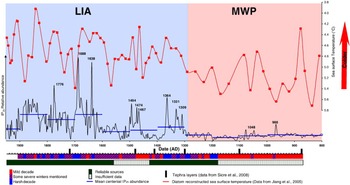
The Na+ storminess proxy is relevant to the marine fish zooarchaeological record as well. This proxy is a measure of Na+ anomalies in the GISP2 ice core that are used to estimate periods of greater than average storminess. Specifically the Na+ record reveals an increase in storminess beginning in the early fifteenth century. This increase in storminess is the beginning of a long period of relative storminess through the nineteenth century (Dawson et al., Reference Dawson, Elliott, Mayewski, Lockett, Noone, Hickey, Holt, Wadhams and Foster2003; Fig. 1).
An aggregation of three proxies, a diatom-based sea-surface temperature proxy, a biomarker (IP25) sea-ice proxy, and at the bottom, a representation of historical documentary data on sea ice (Ogilvie Reference Ogilvie1984, Reference Ogilvie, Bradley and Jones1992, Reference Ogilvie1996). Note the periods of prolonged sea ice in the late thirteenth and fourteenth centuries and the late seventeenth through early nineteenth centuries. LIA, Little Ice Age; MWP, Medieval Warm Period. Tephra layers data from Sicre et al., Reference Sicre, Jacob, Ezat, Rousse, Kissel, Yiou, Eiriksson, Knudsen, Jansen and Turon2008; diatom-reconstructed sea-surface temperature data from Jiang et al., Reference Jiang, Eiriksson, Schulz, Knudsen and Seidenkrantz2005. Image from Massé et al. (Reference Massé, Rowland, Sicre, Jacob, Jansen and Belt2008).

METHODS AND SITES
The zooarchaeological data to be discussed come from sites that were chosen for the size of their assemblages and comparability between them. Sites chosen had good enough preservation that marine fish remains could be identified down to species level. Sites where no species identification was possible were left out. All of the sites were excavated using a protocol established by the Fornleifastofnun Islands (Institute for Archaeology, Iceland) (Lucas, Reference Lucas2003). This is a modified single-context excavation protocol modeled on Museum of London Archaeological Service procedures, and all contexts were dry sieved through 4 mm mesh with extensive whole-soil sampling for flotation. All faunal material was analyzed according to standardized NABO methodologies using the ninth edition of the NABONE recording package (a Microsoft Access database supplemented with specialized Microsoft Excel spreadsheets, available for download at www.nabohome.org, last accessed 5.12.19) (McGovern et al., Reference McGovern, Hambrecht, Brewington, Feeley, Harrison, Hicks, Smiarowski, Lev-Tov, Wapnish and Gilbert2017). Faunal material analyses were conducted at the University of Maryland Zooarchaeology Laboratory, the Hunter College Zooarchaeology Laboratory, and the Brooklyn College Zooarchaeology Laboratory, and made use of their comparative collections and those of the American Museum of Natural History (New York City) and the National Museum of Natural History (Washington, DC). All fragments were identified as far as taxonomically possible. Bone fragment quantification makes use of the NISP method (Grayson, Reference Grayson1984). Only positively identified fragments of fish bone were given species-level identification, with those unidentifiable to species placed in the family category where possible (often gadid), while others were identified simply as fish. The identifications of gadids follows the International Council on Archaeozoology (ICAZ) Fish Remains Working Group recommendations (Cannon, Reference Cannon1987). Marine fish species that were present in significant percentages (>1%) were included in this study. Small numbers of bones of wolf fish (Anacharsis lupus) and flatfish (pleuronectiformes) are occasionally present on some sites.
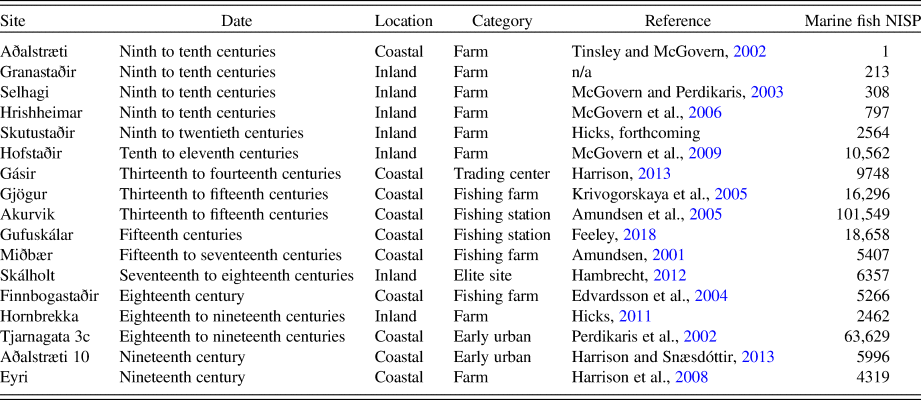
The sites have been divided into two geographic categories—inland and coastal—reflecting the fact that the coastal sites were all involved in both fishing and production of dried-fish products, while the inland sites were consumer sites. Though inland farms were often directly involved in fishing on the coasts through fishing rights and labor, the sites themselves did not host the production of dried-fish products. This relationship between the coastal and inland sites is defined quite clearly in the zooarchaeological record, especially in the case of cod. The coastal site faunal assemblages are most often dominated by cranial elements, while the inland ones are most often dominated by vertebral elements (Krivogorskaya et al., Reference Krivogorskaya, Perdikaris and McGovern2005; Perdikaris et al., Reference Perdikaris, Hambrecht, Brewington, McGovern and Plogmann2007). This reflects the fact that dried-cod products were headless, and the processing left the cranial elements at the production sites, whereas the vertebral elements that were left on the dried product appear at consumer sites (Table 1).
Sites selected for this article with the date ranges of the assemblages, site location, site category, primary reference, and marine fish “number of identified specimens” (NISP). The date ranges are only for the portions of the assemblages that were used for this article. These date ranges are further broken down in later figures. A sample reference for each site has been included.

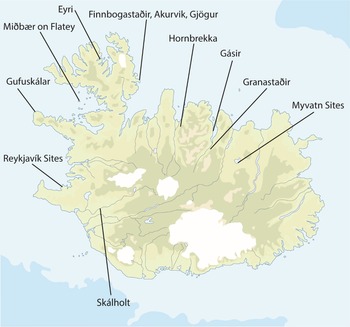
The sites can be further divided into different socioeconomic categories: farms, coastal fishing farms, fishing stations, early urban sites, trading sites, and elite sites. Farms focused on the raising of domestic animals, primarily sheep along with smaller numbers of cattle and horses. Coastal fishing farms were centers of pastoral activity but also were heavily involved in fishing, both for subsistence and trade purposes. The two examples of dedicated fishing stations that are included operated at very different scales. Akurvik was a small seasonal fishing station in the northwest of Iceland, while Gufuskálar was a large (by Icelandic standards) fishing station, inhabited year-round. Akurvik was likely staffed by inhabitants of local farms during the fishing season (winter), while Gufuskálar was possibly inhabited by full-time fisherfolk (Krivogorskaya et al., Reference Krivogorskaya, Perdikaris and McGovern2005; Pálsdottir and Sveinbjarnson, Reference Palsdottir and Sveinbjarnarson2011). There are two sites defined as early urban that are associated with late eighteenth-century and nineteenth-century Reykjavík, Tjarnagata 3c and Aðalstræti, where larger-scale fish processing took place (Perdikaris et al., Reference Perdikaris, Amundsen and McGovern2002; Tinsley and McGovern, Reference Tinsley and McGovern2002; Harrison and Snæsdóttir, Reference Harrison and Snæsdóttir2013). Skálholt was the cathedral farm of the bishop of southern Iceland from the medieval period to the late eighteenth century and is defined as “elite.” It was on the wealthy end of Iceland's socioeconomic scale, and its zooarchaeological and archaeological data sets confirm this assessment (Hambrecht, Reference Hambrecht2011, Reference Hambrecht2012; Table 1, Fig. 2).
Map of Iceland with location of the sites discussed in this article. The Reykjavík sites are: Aðalstræti and Tjarnagata. The Myvatn sites are: Hrisheimar, Hofstaðir, Selhagi, and Skutustaðir.

MARINE FISH ZOOARCHAEOLOGICAL PATTERNS
Marine fish versus terrestrial resources
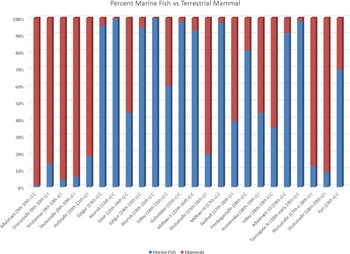
Figure 3 presents the percentages of marine fish remains versus those of terrestrial mammals at a variety of sites dating from Landnám through the nineteenth century and serves as a good basic proxy for the engagement of Icelanders with marine fishing.
Percent of marine fish versus terrestrial mammal remains from Icelandic archaeological sites. C, coastal; I, Inland.

From Landnám through the eleventh century, both inland and coastal sites are dominated by terrestrial animals. Yet perhaps more significant, and a phenomenon that has been noted in the literature, is the presence of marine fish at inland sites from the earliest years of Icelandic settlement (McGovern et al., Reference McGovern, Vesteinsson, Fridriksson, Church, Lawson, Simpson and Einarsson2007). These remains strongly suggest that the Scandinavian settlers of Iceland brought with them the knowledge of gadid fish processing and trading. The fish remains found on these earliest inland sites suggest a strong link between Iron Age Norwegian dried-gadid production and the introduction of dried marine fish products to inland sites in the British Isles after the turn of the first millennium AD. Placed alongside current understandings of the introduction of dried marine fish products to inland regions of Britain, for example, these data suggest that it was the Scandinavian migrations of the Viking Age that brought the trade in dried gadids to the rest of northwest Europe (Barrett et al., Reference Barrett, Locker and Roberts2004b; Perdikaris et al., Reference Perdikaris, Hambrecht, Brewington, McGovern and Plogmann2007).
From the thirteenth century through the nineteenth century, the coastal sites are dominated by marine fish. This was a reflection of an economy that combined local subsistence, internal Icelandic trade, and participation in the trade in processed fish with Europe (McGovern et al., Reference McGovern, Perdikaris, Einarsson and Sidell.2006; Perdikaris et al., Reference Perdikaris, Hambrecht, Brewington, McGovern and Plogmann2007; Boulhosa, Reference Boulhosa and Imsen2010). The data suggest a pattern in which inland sites show a greater reliance on marine fish through time. Yet to further investigate these patterns in more detail, we need to investigate more specific marine fish data.
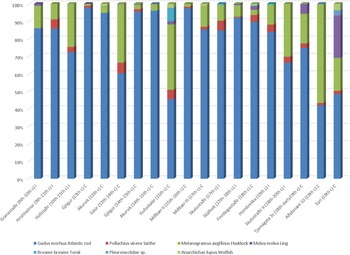
The great bulk of marine fish remains in Icelandic archaeofaunal assemblages are gadids. Figure 4 shows only gadid species data and the occasional presence of halibut (Hippoglossus hippoglossus) where this presence is greater than or equal to 1% of the whole fish assemblage.
Percent of gadid species fish remains from Icelandic archaeological sites. C, coastal; I, Inland.

As is well documented in previous articles, data for the Landnám through to the twelfth to thirteenth centuries reveal a mix of different gadids being caught and consumed. This has generally been interpreted as the product of a local economy based on the trade of dried gadids from the coast into the interior of Iceland (McGovern et al., Reference McGovern, Perdikaris, Einarsson and Sidell.2006). Beginning in the thirteenth century and best exemplified by the sites of Akurvik and Gjögur, the focus of Icelandic fisherfolk moves toward cod. Gásir, a contemporary trading post, was a very different type of site from the former, possibly inhabited by a mix of Icelanders and non-Icelanders on a seasonal basis (Harrison et al., Reference Harrison, Roberts and Adderley2008; Harrison, Reference Harrison2013). It does not fit the pattern described here, but we argue that this is due to its not being either a residential site or a fishing station but a temporary summer trading center being provisioned by the local communities (Harrison, Reference Harrison, Harrison and Maher2014a). While Gufuskálar was a fishing station, it also shows a very different pattern that will be discussed along with other standout data sets later in this article.
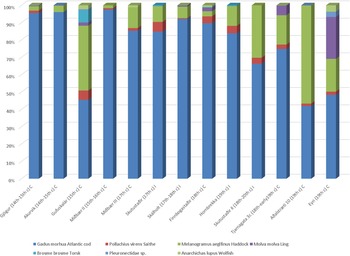
While cod is still dominant through the eighteenth century, other gadids reappear in the archaeological record in the early modern period. Finally, in the latest sites, haddock begins to make up a much more significant percentage of marine fish remains. This pattern can be seen more easily in Figure 5.
Percentage of gadid representation in the late medieval and early modern Icelandic archaeological sites. C, coastal; I, Inland.

In comparison to Akurvik, Gjögur, and Miðbær II, which exemplify the focus on cod that was the result of the medieval stockfish trade, the later coastal production sites all show an increase in gadid diversity. By the nineteenth century this diversity reveals a focus on haddock. What might have led to this change from the cod-centric production of the thirteenth to fifteenth centuries? To investigate what this diversity might have meant, we now turn to element distribution and butchery patterns.
Butchery patterns: household provisioning versus export production
In Icelandic zooarchaeology there is a well-established analytical method of using the percentage of cranial elements versus axial elements to determine whether a settlement was primarily a producer or a consumer of dried-fish products (with more cranial elements indicating a producer, as part of the production process involves the removal and disposal on-site of the head, whereas consumption sites contain more axial elements). As fishing communities tend to use part of their catch to provision themselves (often consuming the less marketable species and size ranges), tracking body-part representation is an important task for fisheries zooarchaeologists trying to assess relative patterns of local consumption and export production. One approach is examining the numbers of cleithrum, a bone that is part of the pectoral arch that travels with the processed fish body in both flat-dried klipfisk and stockfish preparations, versus the numbers of premaxilla, a bone in the skull of the fish that is left at the processing site, as the head is removed before drying. Each of these bones is relatively tough and of similar size, and both tend to survive attrition equally well (Butler and Chatters, Reference Butler and Chatters1994; Perdikaris, Reference Perdikaris1999; Moss, Reference Moss, Moss and Cannon2011; Smith et al., Reference Smith, Butler, Orwoll, Wilson-Skogen, Moss and Cannon2011). A simple ratio of cleithra to premaxillae is thus often a good proxy for understanding whether a fish is processed or consumed fresh and whether a site is involved in the production of dried gadid products or is primarily a consumer of such products.
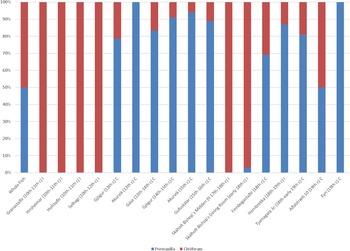
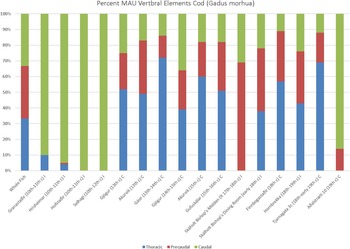
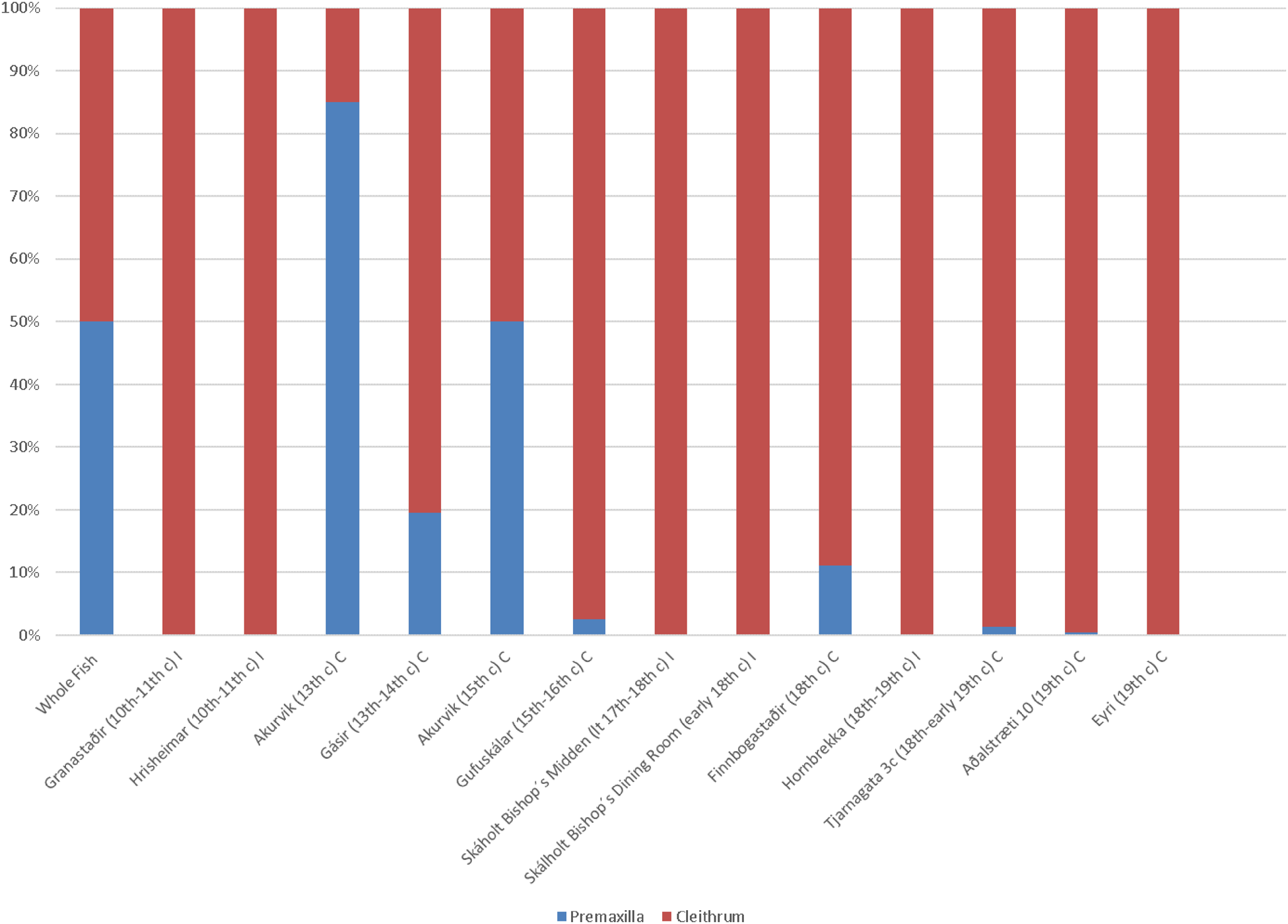
Figure 6 presents the premaxilla versus cleithrum data for cod for those sites. The early inland sites are completely dominated by cleithra, an indication of a processed and distributed dried-cod product being moved to the interior of Iceland from the earliest days of settlement. The coastal sites between the thirteenth and sixteenth centuries are all dominated by cod premaxillae, a pattern indicative of production sites (Gjögur in the West Fjords is a known “fishing farm,” while Akurvik is a set of small seasonally occupied fishing “booths” about 3 km away; Amundsen et al., Reference Amundsen, Perdikaris, McGovern, Krivogorskaya, Brown, Smiarowski, Storm, Modugno, Frik and Koczela2005). The Skálholt assemblages also show a clear signature of the consumption of headless processed codfish, though as will be discussed later, the pattern here does not only suggest the consumption of dried products. The eighteenth- to twentieth-century coastal and inland sites show a pattern in which there is less strict division in the distribution between the cranial and axial data, with more of the cod catch apparently being consumed on-site as part of household provisioning. This might be another indication of a somewhat less focused intensification around cod. Site-specific factors also may play a role in this use of cod for food or commerce, and we know from documentary accounts that fish heads were being transported inland for consumption in the early modern period (usually interpreted as a sign of poverty). The site of Eyri, which shows only the presence of cod premaxillae, suggests production of dried-cod products for export. Eyri was, we believe, producing dried cod for export without the presence of a growing population that required subsistence from all species present, which was the case for the contemporary sites of Aðalstræti and Tjarnagata in Reykjavík, as will be discussed later (Harrison et al., Reference Harrison, Roberts and Adderley2008). Examining the patterning in the codfish vertebral series (thoracic = upper body, precaudal = midbody, caudal = tail) provides another perspective on the distribution and consumption of cod in our sample of Icelandic sites (Fig. 7). Specifically, it can reveal what sorts of products were being produced: fresh fish, a flat-dried klipfisk product, or the dried in the round stockfish product.
Percentage of cod cleithrum versus premaxilla present in Icelandic archaeological sites. Note that the percentage for a whole fish would be 50/50%. C, coastal; I, Inland.

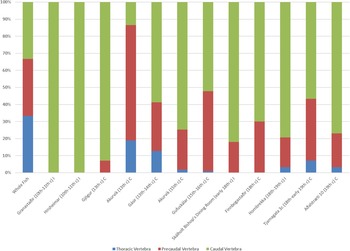
Comparison of cod vertebral series at the same Icelandic sites. Minimum animal units (MAU) is a measure of frequency of bone elements divided by their number in a whole skeleton. MAU measures how much of a carcass is represented in a collection (Lyman et al., Reference Lyman1994). %MAU normalizes for different element frequencies, so a whole fish (left) would display as equal bars. Disproportionately high MAU% of caudal (tail) vertebrae probably reflects consumption of a flat-dried product, while a more even distribution of caudal (tail), precaudal (lower body), and thoracic (upper body) vertebrae may reflect consumption of either whole fish (if cranial elements are also present) or of round-dried “stockfish” if heads are not present on-site. C, coastal; I, Inland.

Figure 7 presents the %MAU of the cod vertebrae recovered from these sites (MAU normalizes for different skeletal element frequency; a whole fish would display as equal bars). The inland Viking Age and early medieval sites (Granastaðir, Hrisheimar, Hofstaðir, Selhagi) all are dominated by caudal vertebrae, indicating regular consumption of a flat-dried product in which the upper vertebrae have been filleted out and discarded with the heads at the landing point. Both major phases at the later medieval fishing sites of Gjögur and Akurvik show a more even distribution of vertebrae, suggesting that cod may have been consumed as fresh fish or as a dried product at both sites, a pattern also evident at the trading site of Gásir in Eyjafjord. The inland site of Skálholt (the bishop's manor) may be a special case, as discussed later, and the other eighteenth- to nineteenth-century rural sites (Finnbogastaðir, Hornbrekka) have vertebral element profiles suggesting consumption of fresh cod or round-dried stockfish. The site of Aðalstræti 10 in Reykjavík reveals a cleithrum to premaxilla proportion that matches that of a fresh codfish, while the vertebral series suggests consumption of both fresh and flat-dried product. This assemblage was associated with a single household and has been interpreted as the product of domestic consumption by local factory workers (Harrison and Snæsdóttir, Reference Harrison and Snæsdóttir2013). The other major early urban archaeofauna from nearby Tjarnargata 3c also reflects some local consumption of fresh cod as well as production of dried cod for export. Previous research has argued that these sites in the developing center of early Reykjavík had two processes at work producing their assemblages: production and provisioning/consumption. As these two sites are located in the first urban center in Iceland, they were both located in a context that involved both large-scale fish processing and a level of consumer population density around early weaving mills that required more extensive provisioning of workers (Harrison and Snæsdóttir, Reference Harrison and Snæsdóttir2013).
The haddock cleithrum/premaxilla patterning (Fig. 8) provides some strong contrasts to the patterns reflected in the cod bones from the same sites. The early inland sites are all dominated by cleithra, indicating that haddock, like cod, were part of Viking Age household provisioning strategies that involved consumption of preserved marine gadid fish. The patterns at the nearby thirteenth-century sites of Gjögur (permanent fishing farm) and Akurvik (seasonal fishing station) show a strong contrast—the Gjögur farm was consuming headless haddock, while exporting cod bodies, while the Akurvik fishing station appears to have been exclusively exporting cod, while both consuming and exporting haddock. The fifteenth-century Akurvik assemblage also has haddock cleithrum/premaxilla percentages that are identical to those of a whole fish, while the cod percentages indicate a strong export signature. We argue here that this high medieval pattern reflects the continuation of a precommercial local consumption of haddock combined with a new focus on cod as an export commodity. The haddock vertebral series data (Fig. 9) amplify the patterns from the cleithrum/premaxilla comparisons.
Percentage of haddock cleithrum versus premaxilla present in Icelandic archaeological sites. Note that the percentage for a whole fish would be 50/50%. C, coastal; I, Inland.

The %MAU data for haddock from the same Icelandic sites. A whole fish (left) will display as equal bars, with a surplus of caudal (tail) vertebrae probably indicating consumption of a flat-dried product, and more even vertebral representation probably reflects consumption of a mix of fresh fish and round-dried stockfish. C, coastal; I, Inland.

The Viking Age inland sites (Granastaðir, Hrisheimar) are dominated by caudal vertebrae, again suggesting that haddock, like cod, reached these farms as a flat-dried product (Fig. 8). The coastal fishing farm at Gjögur was consuming haddock as a flat-dried product, but the very different pattern at the nearby fishing station of Akurvik suggests consumption of haddock as whole fresh fish by the seasonal fishing crews. Late medieval and early modern sites (Gufuskálar, Skálholt, Finnbogastaðir, Hornbrekka, Tjarnargata 3c, Aðalstræti) show vertebral series patterns that suggest consumption of haddock as a round-dried stockfish product, as does the premaxilla versus cleithrum figure for Eyri, where only cleithra are present (Fig. 9).
THE ANOMALIES—WEALTH AND CONNECTIVITY
Three sites stand out as anomalous in these data sets. These are the sites of Gásir, Gufuskálar, and Skáholt. Each represents a very different relationship between marine fish and specific economic and social conditions relative to the other late medieval and early modern sites. Gásir was a medieval seasonal trading site on the coast of Eyjafjord in northern Iceland. It was provisioned from the surrounding region and thus had a very different zooarchaeological signature than a typical Icelandic farm or fishing station. For further discussion of Gásir and its exceptional character in the context of current Icelandic archaeology, please consult Harrison, (Reference Harrison2013, Reference Harrison, Harrison and Maher2014a, Reference Harrison2014b).
As mentioned previously, Gufuskálar was a dedicated fishing station. To date, it is the largest example of this type of settlement to be excavated in Iceland, and its assemblage, in terms of both organic and inorganic artifacts, is exceptional in the Icelandic context. The bulk of data from this site, whose excavated assemblage is still being analyzed, comes from the fifteenth century. The stratigraphy is made up of bands of sand interspersed with thick bands (in some cases as thick as 40 cm for one context) of cultural material. Gufuskálar's assemblage is very different in character from more typical farm and fishing farm sites from either medieval or early modern Iceland. In contrast to many Icelandic archaeological sites, whose terrestrial fauna are often dominated by a milk and wool production signature (dominated by both very young and older sheep and cattle) the terrestrial mammal remains at Gufuskálar show high proportions of prime meat-age animals, most likely brought in from surrounding farms (Feeley, Reference Feeley2018). Gufuskálar's inorganic artifacts are also seen in much higher numbers than is typical for Iceland at this time, and include unusual items like finger rings, rosary beads, lead seals, and large knives, as well as high volumes of simple redware pottery not usually recovered from Icelandic sites. All of this indicates a level of wealth and connectivity to wider Atlantic trade networks than was standard for many premodern Icelandic settlements.
The much greater diversity in the gadid and non-gadid species from Gufuskálar relative to other sites parallels this. While the analysis of the Gufuskálar assemblage is still ongoing, there are some emerging possibilities as to the identity of this site. It might have been a relatively short-lived dedicated fishing village of a type not familiar to Icelandic archaeology. There is also the possibility that the site was inhabited by a mix of Icelanders and foreigners, English fisherfolk being a prime candidate for this position. Regardless, this site shows many traits in its material culture and faunal assemblage that place it outside our standard types of Icelandic archaeological sites (Pálsdottir and Sveinbjarnarson, Reference Palsdottir and Sveinbjarnarson2011; Feeley, Reference Feeley2018).
The Skálholt assemblage offers a possible parallel to Gufuskálar, though not specifically in its marine fish patterns. Skálholt was the headquarters for the bishops of southern Iceland (Catholic and then Lutheran). Its ability to provision itself from a wide variety of sources is clearly apparent in its zooarchaeological assemblage (Hambrecht, Reference Hambrecht2011, Reference Hambrecht2012). A possible further indication of this wealth is in the butchery patterns. The Skálholt data have been divided into two contexts in Figs. 6 and 7. The late seventeenth-century to eighteenth-century data come from a midden likely associated with the farm's butcher and food storage areas, with additional inputs from domestic waste disposal (Hambrecht, Reference Hambrecht2012). The eighteenth-century data come from deposits on the floor of what was most likely the bishop's dining room. The difference between the two is instructive. The midden contains no cleithra, though it does have a significant but small number of other cranial elements within it. The dining room context contains a small but significant number of premaxillae and a much larger percentage of total cranial elements. The presence of cranial bones outside a dried-fish production site in Iceland has two possible origins. The first is that some of the inhabitants of Skálholt, and perhaps the bishop himself, were consuming dried codfish heads, a practice that is well known. The other is that some inhabitants of Skálholt, and perhaps the bishop, were consuming fresh cod transported to the site from the coast. The consumption of dried cod heads could be a sign of economic stress and/or a position on the lower rungs of the social ladder. This sort of assumption must be treated with caution (perhaps some of the bishops enjoyed dried cod heads), but as a rule it can be accepted. Given the status and wealth of this site, as well as the rest of its zooarchaeological assemblage, which clearly indicates this elite position, we argue that it is more accurate to view these data as a reflection of the transport of fresh marine fish inland, which we argue was a relatively expensive, uncommon, and high-status form of provisioning (Hambrecht, Reference Hambrecht2011).
These anomalous sites can be explained through differential access to wealth and the broader access to larger Atlantic trade systems. They do not, we feel, problematize the observations made about the data. They do, however, offer an interesting example of the influence of wealth and connectivity in the relationship between Icelanders and their maritime hinterland. Each of these sites was wealthier than standard Icelandic sites of their times as measured by both zooarchaeological and material culture measures. Each also existed within periods of hazardous climates in the form of cold, increased sea ice, and storminess. Yet they seemed to have weathered these hazards well, likely because of their higher level of connectedness to global trade networks and social, political, and economic power.
DISCUSSION
The Landnám period sites yielded relatively terrestrial-heavy faunal assemblages; yet from the medieval period through the nineteenth century, the percentage of marine fish increases. Specifically, in the medieval period the growth in marine fish is characterized by high percentages of cod. This was a product of integration with long-range commodity-based trade networks focused on stockfish. In the early modern period the patterns shift, possibly because of a fishing strategy that is more opportunistic and less commodity based. Greater inter-gadid diversity appears, primarily in the form of a rise in the number of haddock. It is possible that this pattern is a response to hazardous terrestrial climate conditions in the early modern period in Iceland that diminished terrestrial productivity. A broadening of the spectrum of marine fish taken may have been a tool in offsetting diminishing terrestrial yields.
How do these patterns correlate to the periods of increased sea ice and storminess? The first period of potential climate disturbance in the high medieval period (late twelfth and early thirteenth centuries) shows no change in the zooarchaeological pattern. The signs of the intensification born out of an engagement with the medieval trade in dried cod predates the period of greatest sea ice and the onset of increased storminess. It is important to note that this pattern continues unchanged through the fourteenth century.
While climate variables cannot directly explain the zooarchaeological patterns, political and economic variables do offer an explanation. The transition from artisanal Viking Age patterns to commercialization ca. 1250–1350 took place during a period of intense local competition. Chieftains needed to generate funds to compete militarily and through the display and distribution of imported goods. Engagement with wider northern European markets was one potential avenue for the generation of the resources needed for political competition. The climate was becoming generally more hazardous in this period, but wider market and social factors drove the intensification process forward (Perdikaris and McGovern, Reference Perdikaris, McGovern, Thurston and Fisher2007; Vésteinsson et al., Reference Vésteinsson, Church, Dugmore, McGovern and Newton2014). While fishermen presumably faced increased hazards, the elites who controlled production and trade saw too many economic advantages to disengage. If climate was a factor in fishing patterns, for example, creating a need to offset diminishing terrestrial yields, then it was an indirect influence that worked against any movement toward disengagement from either subsistence or commodity-based fishing.
Fifteenth-century storminess was accompanied by additional travails, including the Black Plague and an influx of foreign fishermen (mainly English) in large well-armed ships. The Icelandic/Danish elites felt pressure to maintain control of labor and fishing profits and feared a loss of social power and their monopoly on trade goods (Gunnarsson, Reference Gunnarsson1983; Eggertsson, Reference Eggertsson1998). Hazardous weather (in the form of increasing storminess beginning around 1425) probably continued to wreck ships and kill sailors, negatively impacting local fishermen. However, the growing European markets continued to fuel demand for Icelandic stockfish, and the larger ships of the foreign fishermen were able to meet that demand despite increasing storminess. Climate impacts in this case were mediated by technology (i.e., bigger ships and better navigation), external market pressures, and social power dynamics.
There are changes in the zooarchaeological pattern during the second period of climate disturbance, the late seventeenth and nineteenth centuries. Whereas the reappearance of some inter-gadid diversity in the zooarchaeological assemblages in the early modern period could be a response to increasingly hazardous conditions offshore, what must again be considered is the larger economic/trade context. This period not only saw increased sea ice and storminess but also the appearance of smallpox in the early eighteenth century, colder conditions, and the disastrous eruption of the volcano Laki at the end of the century (Hambrecht, Reference Hambrecht2012; Ogilvie and Jonsson, Reference Ogilvie and Jonsson2001). All these variables subjected Icelandic society to heavy strain. The changes in provisioning in the early modern Icelandic zooarchaeological data could reflect increasing use of fish to compensate for farming shortfalls. As stockfish was the main export, perhaps more haddock on archaeological sites indicates greater use of fish products for the internal Icelandic diet, but not necessarily a decline in cod fishing for external trade. In this scenario, increasing sea ice and storms create hardship, unpredictability, and heavy periodic loss of life, but do not derail the strong maritime orientation of Iceland. As farming productivity dropped, the sea remained the main arena for intensification of resource extraction despite the growing human cost.
The early modern data could also suggest a decrease in market pressure on Icelandic marine systems. There are many possible reasons for this. The Danish monopoly on Icelandic trade is often argued to have been a stagnating influence on Icelandic society and its economy (Gunnarsson, Reference Gunnarsson1983; Eggertsson, Reference Eggertsson1996). There are scholars who argue that Icelandic elites deemphasized fishing as a main source of income and trade in the later medieval and early modern periods due to social pressures centered on a perceived need to control labor (Eggertsson Reference Eggertsson1998). At times these pressures might have been all too real, especially during periods of famine and plague in the seventeenth and eighteenth centuries. These social, economic and demographic phenomena could have led to a weakening of focus on stockfish through a lessening of participation in the trade and thus be reflected in the zooarchaeological record by an increased presence of haddock. Another variable could be the opening of the North American fishing grounds. The Newfoundland Banks were a source of competition for the Icelandic fishing industry, and the appearance of such a highly productive fishery could have depressed demand for Icelandic stockfish on world markets (Jones, Reference Jones, Reid and Ashcroft2000; Pope, Reference Pope2004; Wubs-Mrozewicz, Reference Wubs-Mrozewicz, Sicking and Abreu-Ferrera2008). Finally, changes in marine ecology during the early modern period, due to falling water temperatures, might have impacted Icelandic cod populations (Ólafsdóttir et al., Reference Ólafsdóttir, Westfall, Edvardsson and Pálsson2014).
The dynamics between changing climates and fishing patterns in Iceland shed light on the relationships between society, climate, and natural resources. These data reveal no direct correlation between changing zooarchaeological patterns and the main periods of sea ice and storminess in the medieval period and a possible correlation in the early modern period. The changes seen in marine zooarchaeological assemblages in the early modern period could be explained through the influence of markets and trade networks and possibly social pressure. This suggests a complex relationship between changing climates and fishing patterns in Icelandic history. The influences and impacts of the climate relative to marine resources were mediated by social, political, economic, and even technological variables.
This initial overview suggests the importance of looking across time periods to assess potential pattern shifts and begin assessing the relative impacts of local and regional climate change, Icelandic demographic patterns, changing social control pressures, and the changing impacts of external market forces and foreign fishermen and traders. One clear result of this is to highlight the need for a more interdisciplinary perspective to this question grounded in the idea of historical ecology and human ecodynamics (Fitzhugh et al., Reference Fitzhugh, Butler, Bovy and Etnier2019). To investigate, for example, the question of what variables were behind the change in zooarchaeological marine fish patterns in the early modern period, more historical, biological, and oceanographic data need to be integrated in with the zooarchaeological data. Input from historians, paleoclimate experts, paleoecologists, and oceanographers, as well as geneticists and molecular biologists, is necessary to investigate the social, climatic, and biological aspects of the relationships between fish, climate, and humans through time. Investigating the place of changing climates in human/maritime resource dynamics through Icelandic and North Atlantic history is a complex job. Yet the body of available data is growing, as are the potentials for interdisciplinary approaches to the problem.
FUTURE DIRECTIONS
Icelandic zooarchaeology has produced a large collection of well-dated and very well preserved fish remains from the earliest days of Icelandic settlement (late ninth century AD) down to the twentieth century. These collections are increasing as the analysis of important sites continues and plans for more excavations progress (Harrison, Reference Harrison, Harrison and Maher2014a; Feeley Reference Feeley2018). While much can be done with basic NISP-based zooarchaeological analysis, as can be seen in this article, there are several other productive analytical paths available to deepen our understanding of this exceptional archive of human maritime relations over the last millennium in the North Atlantic.
Size reconstruction using specific elements (premaxilla and vomer) and estimated age at death studies (using the atlas, the first bone in the vertebral column) are continuing and will be available for many of the newer assemblages discussed in this article, such as the data from Gufuskálar, Skutustadir, and Skálholt. These methods have assisted in the identification of the development of the stockfish trade in Iceland but will supply powerful demographic and paleoecological data on historic cod fisheries dating to the medieval and early modern periods. The combination of size reconstruction with age of death will also be a valuable source of cod paleodemographic data. A DNA analysis of cod remains from Icelandic archaeological sites is already taking place and promises to refine our understanding of cod population structures and the influence of both human and climate impacts on these populations (Ólafsdóttir et al., Reference Ólafsdóttir, Westfall, Edvardsson and Pálsson2014). The use of such paleodemographic analyses on fish populations can potentially give us significant insight on the way in which fish populations react in the face of a variety of climate and human pressures. With such analyses we might then be able to approach the impact of these same dynamics on human society with more nuance and precision. Scaling paleoclimate data to the temporal and geographical scale of the human experience is also, of course, an important way forward. While this is being done in the terrestrial arena, attempting to link high-resolution paleoclimate data to marine archaeological and historical data at a regional or even household scale could prove fruitful in the future.
This article offers up new data and synthesizes older data that have not been presented together before. More sites are being excavated and more material is currently under analysis, such as at Siglunes in Siglufjörður (Harrison, Reference Harrison, Harrison and Maher2014a) and Skagafjörður (Bolender et al., Reference Bolender, Steinberg and Damiata2011; Steinberg et al., Reference Steinberg, Bolender and Damiata2016) and in the Þistilfjörður region, where ongoing research is being undertaken by Dr. James Woollett of Laval University and his students. These new data, coupled with both established and new types of analysis, promise to further develop and refine this story.
ACKNOWLEDGMENTS
The authors wish to express their gratitude to all the people who assisted in the excavation and analysis of the material discussed. We especially want to acknowledge Fornleifastofnun Islands (Institute for Archaeology, Iceland), whose collaboration and leadership made this work possible. We are also grateful for the support and patience shown by the local communities and landowners of all the sites discussed. Support for this research was generously provided by a variety of funding agencies, including Rannsóknamiðstöð Íslands (RANNÍS—the Icelandic Center for Research), Fornleifasjóður, the Leverhulme Trust, the National Geographic Society, the American–Scandinavian Foundation, and the U.S. National Science Foundation, both the Archaeology and Arctic Social Science Programs (grant nos. 0732327, 1140106, 1119354, 1203823, 1203268, 1202692, 1249313, 0527732, 0638897, 0629500, 0947862, 1446308). The authors would also like to thank the anonymous reviewers for their very constructive feedback.