Introduction
Several decades after the end of the Khmer Rouge (KR) regime, some Cambodians are still struggling with its aftermaths. Memories of the regime, feelings of hatred towards the perpetrators, and an inability to forgive still affect those who lived under the KR and some of the next generation. The Extraordinary Chambers in the Courts of Cambodia (ECCC) was established in 2006 to address the violence of the KR. Its mandate is to bring to justice those who were responsible for human rights abuses committed during the regime. For the government of Cambodia and Cambodians, the ECCC is also intended as a means to pursue national reconciliation.Footnote 1
Promoting reconciliation is a common goal of transitional justice processes, as stated in the mandates of truth commissions, reparation programmes and trials in multiple countries. Reconciliation is generally accepted as both a goal that post-conflict societies strive to meet and a process they must undergo in order to prevent the recurrence of violence.Footnote 2 Despite much discussion, however, there is a large degree of variation in how reconciliation is understood in measurable and operational terms.Footnote 3
Reducing feelings of hatred and vengefulness toward other groups is seen by individuals and communities as an important aspect of violence prevention.Footnote 4 Forgiveness as part of reconciliation is commonly seen as antithetical to revenge, and leaders have frequently attempted to foster forgiveness after atrocities. In 1998, following amnesty deals and massive defections of KR guerrillas, Cambodian premier Hun Sen invited Nuon Chea and Khieu Samphan,Footnote 5 top KR leaders, to the Cambodian capital, Phnom Penh. During a press conference, Khieu Samphan stated that people should “let bygones be bygones” and “forget the past”, while Hun Sen said “the KR leaders should not be welcomed with guns, bullets, prison or handcuffs, but a bunch of flowers for the spirit of national reconciliation”.Footnote 6 Hun Sen further stated: “We should dig a hole and bury the past and look ahead to the 21st century with a clean slate.”Footnote 7 Efforts to promote forgiveness have been criticized, however, for pressuring victims to suppress their natural feelings of anger, with potentially harmful psychological consequences and the broader effect of downplaying the violence itself.Footnote 8 Arguably, such efforts have also been unsuccessful. Cambodia has not seen a return to mass violence, but as discussed in greater detail further in this paper, suppressing the past has prevented affected individuals and communities from processing and understanding what happened under the KR in order to achieve reconciliation.Footnote 9 By the late 1990s, the movement for an international tribunal to try senior KR leaders was growing, culminating in the opening of the ECCC in 2006.Footnote 10
In addition to their potential role in reconciliation, trial processes such as the ECCC are said to play an important role in shaping memory in post-conflict societies.Footnote 11 Law and legal processes have an implicit level of authority because they are empowered to differentiate between victims and perpetrators. At the same time they have inevitable limits, leaving out what has been described as a “counter-archive”, which contains the unwritten stories and events that never come to light.Footnote 12 Truth-telling processes have been praised for their role in illuminating past abuses and for uncovering the fate of people who went through the violence. Yet they too have been described as producing “amnesia”, a loss of partial or total memory, due to having limited mandates that can lead them to formalize a particular version of the truth.Footnote 13
The way in which the memory of the past emerges is critical and influences individual and national narratives. At the individual level, memories after war or violence are inherently connected to trauma and personal stories.Footnote 14 Memory, knowledge of the past and the sharing of stories are inextricably linked. Knowledge can refer to absolute truth or facts (content knowledge), or can be defined as an “individual's personal stock of information, skills, experiences, beliefs and memories”.Footnote 15 Memory is central to both understandings of knowledge: it encompasses both what a person knows and what they believe to be true.Footnote 16 Through the sharing of stories, individual memories lead to the creation of collective memory and the emergence of “memory narratives”.Footnote 17 While collective memory can emerge organically, historical narratives are often produced, or controlled, as a means to record a particular viewpoint on war or violence during a political transition.Footnote 18 A new government might support a certain narrative as a way to de-legitimize the previous regime or the opposing warring parties, and narratives that are politicized and consciously promoted can become “hegemonic”, dominant and exclusionary of alternative experiences of the violence.Footnote 19
During the KR regime, harsh policies applied across the country, but their implementation varied among regionsFootnote 20 and among groups.Footnote 21 With the creation of the ECCC, non-governmental organizations and the Court held outreach sessions to talk about the past and explain the ECCC's role and developments related to it. During those sessions, participants often described harm and suffering that they experienced during the KR regime. Despite people's diverse experiences, it seems there was little space for participants to express a different narrative. To conform and to be accepted, everyone had to have experienced hunger, suffering and harm.Footnote 22
This article examines the role and importance of the ECCC in shaping the dynamics of memory and knowledge, hatred and revenge, and forgiveness among Cambodians. It begins by presenting the Cambodian context and the methodology; then, using both quantitative and qualitative data gathered by the authors between 2008 and 2014, it addresses the possible effects of the ECCC, firstly on the relative silence surrounding the KR regime, and secondly on the lingering desire for revenge and on attitudes about forgiveness.Footnote 23 In exploring these questions in the context of Cambodia, the authors identify ways in which the memory of the past affects the present-day reality of communities that were affected by war.
The authors hope that this research will contribute to the understanding of how memory and narratives are created after mass violence, how transitional justice mechanisms affect these processes, and how memory interacts with other factors to influence the possibility of reconciliation. Responses to these questions are critical to sustaining peace in countries that are emerging from violent conflicts and engaging in transitional justice efforts.
Memory of the Khmer Rouge regime
For almost four decades, Cambodian society has struggled with the government's efforts to frame an unforgettable past under Democratic Kampuchea, also known as the KR regime, between 1975 and 1979. The regime saw approximately one quarter of its population killed (2 million out of a total population of 7.5 million) and the systematic persecution of elites, minority ethnic groups and eventually party members.Footnote 24
After the KR were removed from power, the newly established government sought first to create its own narrative and then to bury the past, in part because of its own links to the KR.Footnote 25 The efforts to impose a collective memory narrative co-existed with civil society efforts to preserve and document the past, and with transnational efforts to hold those responsible accountable for the violence.Footnote 26 Some memorial sites have acquired international renown, such as the prison facility at Tuol Sleng, also known as S-21, and the nearby killing fields of Choeung Ek, where several thousands prisoners from S-21 were executed and buried.Footnote 27 These sites exist within a broader landscape including dams, bridges and roads where people died during the KR and that still function today.Footnote 28 Further, people frequently told their stories within their families or communities, but the official record of the history of that period still overlooks many experiences of violence at the time.
Accounts of the creation and functioning of collective memory in Cambodia since the fall of the KR are in many ways emblematic of the dynamics of memory after violence. After the fall of the KR in 1979, the new government of the People's Republic of Kampuchea (PRK) prioritized building a certain narrative of the KR period that aimed to legitimize its own standing as the force that liberated Cambodia from a genocidal regime.Footnote 29 In 1979, the government organized the People's Revolutionary Tribunal, resulting in the condemnation of the KR regime and death sentences in absentia for Pol Pot and Ieng Sary.Footnote 30 The government arrested and executed thousands, with few ever appearing in court in judicial processes against former KR cadres. At the same time, the government urged local communities across the country to discuss the KR experience and promoted memorials and ceremonies to honour the dead.Footnote 31 Those initiatives helped to pacify the country, but many activists and scholars have questioned the due process of the trialsFootnote 32 and the impact of the different non-judicial initiatives. Observers noted that these processes provided only very limited information about the past to the population and failed to encourage real dialogue among Cambodians.Footnote 33
The KR violence was pervasive, and many Cambodians were forced to commit violations to save themselves. People could be simultaneously victims, perpetrators and bystanders. Some could be members of the KR, but not perpetrators of violence. The lack of official acknowledgement and exploration of these multiple roles is said to have hindered reconciliation on many levels: victims may be unwilling to accept former KR members in their communities, and former KR members may be perceived as perpetrators regardless of the level of responsibility they had for the violence.Footnote 34
The KR continued to be an opposition political and military force in Cambodia until 1999, when the last armed forces surrendered. They were weakened, in part, by the granting of amnesties for acts they had committed during 1975–79, including for high-level KR officials. The movement for an international tribunal to try senior KR leaders was growing. After almost a decade of negotiations, the ECCC was finally established in 2006.Footnote 35 Some have questioned whether the ECCC itself promoted a narrow narrative of justice and reconciliation, being confined by its temporal mandate, which covers only the period of KR rule, and by its singular focus on senior leaders and those most responsible for violations.Footnote 36 It is commonly accepted, however, that the tribunal and the civil society movement which surrounded it maintained a level of public dialogue about the era – an initiative that was not always supported by the country's political leadership.Footnote 37 Generally, individuals in Cambodia have memories of the KR years either from their own experience or from stories told by others.
Cambodia has not seen a return to mass violence, but feelings of anger and revenge persist, hindering national reconciliation.Footnote 38 In a 2011 study, Laura McGrew found that Cambodians had reached a state of “shallow coexistence”, but they remain far from the trust and interdependence that characterize a cohesive society.Footnote 39 Among the victims McGrew interviewed, some had begun to accept perpetrators into the community, but those seen as responsible for the more serious violations were less likely to be accepted.Footnote 40 Those seen as committing violations to save themselves, or out of ignorance, were accepted more compared to those who had not shown remorse or atoned in any way.Footnote 41 In cases where perpetrators continued to hold political power, victims reported living in a state of continued fear.Footnote 42 Burca Munyas’ study found that among families that discuss the KR period openly, young people reported feelings of anger, vengeance and fear that a similar era could recur.Footnote 43
The context of Cambodia, where a court was set up three decades after the events that it focuses on, is particularly appropriate for examining the effects of trials on memories and forgiveness as it avoids some of the tumultuous time in the direct aftermath of the conflict.Footnote 44
Methods and data sources
This article uses multiple datasets from surveys and mixed-methods research conducted by the authors between 2008 and 2014 with the general population (nationwide surveys), as well as interviews conducted with civil parties (CPs) engaged in legal proceedings against KR leaders at the ECCC.Footnote 45
The goal of the population studies was to assess the population's knowledge, perceptions and attitudes toward the ECCC and social reconstruction, as well as to examine changes in those key factors over a two-year period. Interviews were conducted in 2008 and 2010, and each survey was answered by a total of 1,000 randomly selected adult Cambodians. As a sampling frame, the team used the Cambodia General Population Census 2008's database, prepared by the National Institute of Statistics at the Ministry of Planning. Thereafter, a four-stage cluster sampling strategyFootnote 46 was then designed to ensure that results would be representative of this population. Interviewers used a structured questionnaire that was similar for both surveys. The two surveys included nine topics: (1) demographics; (2) needs and priorities; (3) justice and the rule of law; (4) the KR regime; (5) the ECCC's outreach efforts; (6) knowledge and perceptions of, and attitudes towards, the ECCC; (7) establishment of a historical record, truth-telling and reparations; (8) exposure to violence; and (9) mental health. The survey included several sets of questions aimed at understanding how much knowledge of the period of violence respondents had, particularly young people who did not experience it themselves, and how that knowledge was transmitted between people and across generations.Footnote 47 In 2010, questions related to the first case at the ECCC and the participation of victims in the legal proceedings as a CP were also added.Footnote 48 The instrument was first developed in English, and then translated into Khmer.Footnote 49 Consultations with local experts and pre-testing with sixty-seven randomly selected respondents in non-study sites ensured that the instrument was easily understandable to respondents.
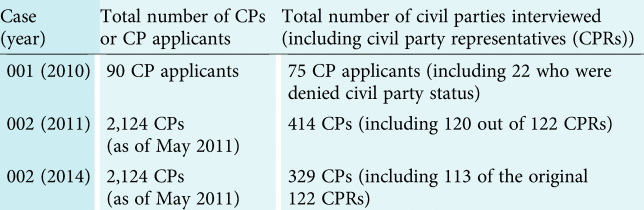
In addition, the authors conducted three waves of interviews with civil parties to cases before the ECCC.Footnote 50 The objectives of those studies were to monitor and assess the CPs’ participation process at the ECCC and in the programme led by the Cambodian Human Rights and Development Association (Association pour les Droits de l'Homme et le Développement au Cambodge, ADHOC), which assisted nearly half of the CPs accepted in Case 002 before the ECCC. The studies also gathered CPs’ opinions of the broader transitional justice efforts in the country. Table 1 shows the amount of CPs interviewed by the authors in Cases 001 and 002 before the ECCC.
Civil parties and civil party representatives interviewed

The first wave of interviews was conducted around December 2010 at the conclusion of the trial of Kaing Guek Eav, alias Duch (Case 001). The second wave was carried out in 2011, prior to the substantive trial of Nuon Chea and Khieu Samphan in Case 002,Footnote 51 and the third wave was conducted in January 2014 following the substantive trial and before the judgment in Case 002/01.Footnote 52
The structured questionnaires for the CP studies were similar to those of the population-based surveys, with emphasis on the participation process at the ECCC, including but not limited to the CP application process, legal representation, participation in the trial, and specific questions related to the ADHOC scheme where applicable.
While the studies were conducted as rigorously as possible, some limitations must be acknowledged. First, the instruments contained questions related to events that took place over thirty years previously. For respondents, the passage of time could have resulted in recall errors or created certain biases. Moreover, because views and attitudes are influenced by local and contemporaneous events, the data are only a snapshot of views as they were at the time of the survey. Several survey questions were designed to test the validity of responses. Finally, while the questions were finalized following piloting, respondents were free to interpret them according to their own understandings of the terms used. Careful choice of phrasing and translation and in-depth consultations with local experts about terminology reduced the risk of misinterpretation of the questions.
Some of the most notable results relate to people's knowledge of the KR, their willingness to talk about the KR era, their interest in knowing the truth about the period, and their feelings about the possibility of reconciliation. To explore these results further, the authors undertook a new literature review to identify some of the key issues surrounding memory and transitional justice globally, and new analyses to identify insights on how memory intersects with reconciliation after violence. The new analyses focused on a set of variables related to memory and reconciliation, in order to understand the relationships between them.
Breaking the silence?
Transitional justice mechanisms may, arguably, contribute to breaking the silence that surrounds serious crimes and abuses committed during conflicts. This silence surrounding often critical events obviously hinders the emergence of a complete narrative and collective memory. A legitimate question, however, is how much of that silence really exists – in other words, was there a silence to break in Cambodia?Footnote 53
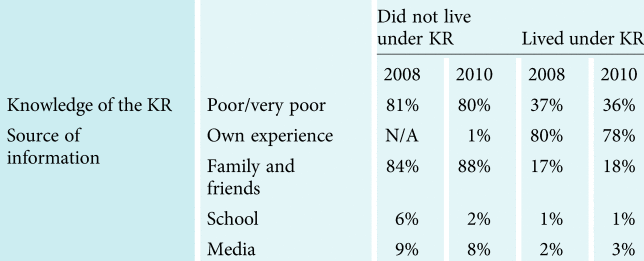
According to the 2008 and 2010 surveys, self-reported knowledge of the KR era (see Table 2) was particularly low among younger respondents who did not live under the KR.Footnote 54 Around 80% of them, as well as one third of those who lived under the KR, described their knowledge of that period as poor or very poor in both 2008 and 2010. This might seem surprising, but it can be explained by the regime's secrecy at the time and by people having little contact with their wider surroundings outside their immediate environment.
Knowledge about the Khmer Rouge regime*

* This question was not asked to the CPs since the focus in their case was solely on their experience as CPs.
The main source of information about the KR period for about 80% of the people who lived under the KR was their own experience, while family and friends were the main source for more than 80% of younger respondents. Very few respondents said they heard about the KR era in school or from the media, although both school and media were slightly more common sources for the younger generation. These results are not surprising – the media covered stories of the KR era at the time of the ECCC, but rarely before that. Furthermore, information through the media was often difficult to access or even unavailable for people with low literacy or living in rural areas.Footnote 55 The school system was almost non-existent during the 1980s, as schools were being rebuilt and teachers trained,Footnote 56 and the rudimentary history of the KR era introduced in the 1980s was eliminated from the school curriculum in 1993 and reintroduced only in 2010.Footnote 57
Along with lack of knowledge, there is some reluctance to speak about the era (see Table 3). About 40% of those who experienced the KR first-hand rarely or never speak about it; among those who did not live under the KR, this figure rises to around three out of four. This may be part of a broader tendency to avoid speaking about, and hence remembering, past violence. In psychology, avoidance of painful memories is a common coping and survival mechanism.Footnote 58 In surveys conducted by the Transcultural Psychosocial Organization Cambodia (TPO Cambodia) in 2015 and 2016, young people said that their parents do not talk about the KR because it is too painful, because it reminds them what happened to family members, or because they do not want to say what they themselves did during that time.Footnote 59 Based on interviews with youth, Munyas described many inconsistencies in the stories told by Cambodians who lived under the KR to their children. Some parents were too traumatized or too focused on their day-to-day struggles to discuss old traumas.Footnote 60 Former KR members may also have hidden their true identities or their involvement during the regime once the regime fell, fearing they could be brought before the ECCC or ostracized by their community.Footnote 61
Talking about the Khmer Rouge

Both surveys also indicate strongly that respondents’ priorities were the economy, jobs and poverty reduction (83% and 98% in 2008 and 2010 respectively); infrastructure (48% and 50% in 2008 and 2010 respectively); and services such as health and food. It is understandable that people with these priorities might not take the time to speak or inquire much about an era that is thirty years in the past. Previous studies found that, faced with poverty, displaced Cambodians prioritized daily tasks and survival over dealing with the past.Footnote 62 It is worth noting that CPs and civil party representatives (CPRs) were far more likely to talk often about the KR – as CPs, they were regularly involved in activities and receiving information related to the ECCC process.Footnote 63
This does not mean, however, that the general population in Cambodia lacks interest in the KR period: among those who did not live under the KR, 85% in both 2008 and 2010 wanted to know more, as did a large majority of those who lived under the KR (74% in 2008 and 67% in 2010). Given the lack of knowledge and tendency not to speak about the KR era, particularly among the younger generation, the authors will now look at attitudes toward truth-telling and historical exploration of the period of violence. This is particularly relevant since Cambodia's official policies promoted a narrow narrative about the regime, and there may still be a need to foster a broader dialogue.
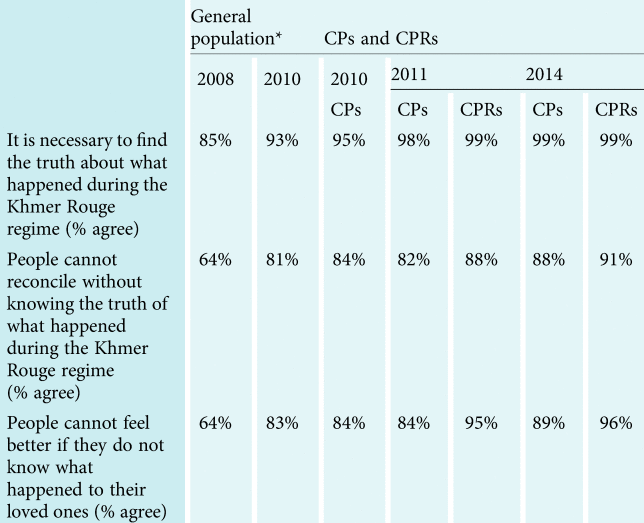
The survey data show clearly that attitudes toward truth and memory changed considerably from 2008 to 2010 (see Table 4), the period when the ECCC trials started and were accompanied by extensive civil society work. The changes from the first to the second survey are notable when considering attitudes toward pursuing the truth. In 2010, almost 10% more respondents believed in the necessity of finding out the truth. The proportion of respondents who believed that people cannot reconcile without knowing the truth increased from 64% in 2008 to 81% in 2010. Moreover, far more respondents in 2010 believed that people cannot feel better if they do not know what happened to their loved ones: 83% compared to 64% in 2008. This suggests that during the period when the first ECCC trial took place, Cambodians felt a change in their environment toward a greater possibility of openness. At the most basic level, the trial yielded details about the KR period that were previously unknown to many people. By giving a platform to at least some victims, the trial may have kindled a sense that it is possible to speak about the past and that this can be done safely. The increased coverage of the KR period in the media and more attention to it through civil society activities likely added to the effect.Footnote 64 More than half (61%) of respondents in the 2008 survey had been forcibly separated from family members, so it is likely that for many Cambodians, the pursuit of truth is about acquiring more information on the fate of their loved ones as much as it is about creating a historical record.
Attitudes toward the truth and the historical record of the KR era

* Responses among those members of the general population who lived under the KR and those who did not were similar on these questions, and this distinction is therefore not presented in the table.
Participation in the trial proceedings as a CP, as well as NGO activities, might have triggered greater interest in knowing the truth. In 2011 and 2014, nearly 100% of CPs and CPRs in Case 002 stated that it was important to find the truth, with the clear majority stating that people could not reconcile without the truth or that people could not feel better if they do not know what happened to their loved ones.
These respondents’ status as CPs could explain the difference between their responses and those of the general population. Because of their status and the support provided to help them with the proceedings, CPs had more opportunities than the general population to learn about the KR. They were supported by several NGOs, had legal representation and were in contact with the Victims Support Section responsible for facilitating victims’ participation at the ECCC. CPs had opportunities to meet as a group, to ask questions about the ECCC, and to talk about and reflect on their experience during the regime. Additionally, through the ADHOC scheme, CPRs received several trainings and were key actors in providing information to the CPs. CPRs and CPs had a favourable environment for talking about the ECCC and the KR regime.Footnote 65
Indeed, the discourse around the KR regime's atrocities has profoundly changed since the ECCC was established. The education system is starting to integrate the history of the KR in its curriculum: in 2017, eight focus groups at four universities in Phnom Penh indicated that family remained the main source of information about the KR, but schools now follow closely.Footnote 66 The ECCC has growing archives describing what happened during the regime and has implemented several projects that provide more detailed information about the KR.Footnote 67 Civil society continues to lead the way with projects informing and fostering dialogue about the KR era, or providing avenues to understand the past.Footnote 68 These efforts aim to fulfil the victims’ and their families’ desire to understand what happened during the KR regime, and offer an opportunity to process it through public and interpersonal conversations.Footnote 69
Revenge or forgiveness?
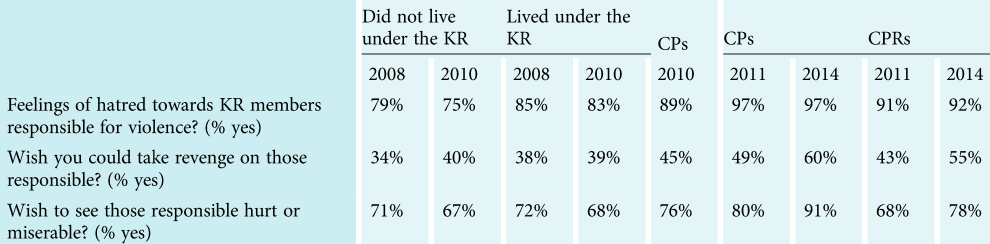
Reconciliation is a key objective of the ECCC: it is explicitly mentioned in the United Nations–Cambodia Agreement on the creation of the tribunal and in the ECCC's Internal Rules.Footnote 70 However, the value of trials and collective memory for reconciliation is debated. David Rieff, for example, argues for the value of forgetting rather than engaging in mechanisms to establish the truth and/or collective memories.Footnote 71 Reconciliation, however, is a complex process that evolves over time and operates at several levels.Footnote 72 Among the Cambodian adult population, the definition of reconciliation has evolved. In the 2008 survey, a majority of the population defined reconciliation as the absence of violence and conflict (56%). In the 2010 survey, Cambodians characterized it as unity and living together (54%), communicating and understanding each other (38%), and gentleness (compassion) (27%). About 8% defined reconciliation as forgiveness and about 5% defined it as “no revenge”. Only 15% mentioned reconciliation as the absence of violence and conflict, indicating a more positive conception of reconciliation. During the same period, however, respondents reported very little change in the level of comfort they felt interacting with former KR members in various social settings.Footnote 73 The authors therefore examined variables related to various aspects of reconciliation, notably feelings of hatred and desire for revenge. At the time of the surveys, feelings of hatred were still strongly present among Cambodians (see Table 5), reflecting in part the successive governments’ own narrative of hatred toward the KR regime. More than 80% of respondents in both population surveys reported that they still felt hatred towards those responsible for KR violence. Slightly more than one third expressed a desire for revenge, and the majority would wish to see those responsible hurt or miserable. There are small differences between the 2008 and 2010 surveys. Among those who did not live under the KR, the proportion of respondents who wished they could take revenge on those responsible for what happened during the KR regime slightly increased (40% in 2010 compared to 34% in 2008). On the other hand, the proportion of respondents who wanted to see those responsible hurt or miserable reduced slightly. This trend is true for both groups, among those who did not live during the regime (67% in 2010 compared to 71% in 2008) and those who experienced the regime (68% in 2010 compared to 72% in 2008).
Feelings of hatred and revenge

CPs and CPRs expressed hatred and desire for revenge at similar rates, with a notable increase from 2011 to 2014 in the proportion of CPs and CPRs wanting to seek revenge and wishing to see those responsible hurt or miserable. It is possible that the ECCC trials might have triggered memories and increased knowledge of what happened during the regime, therefore increasing desire for revenge. This would also explain why the effect is more pronounced among CPs and CPRs than in the general population, as they were more invested in the trials.Footnote 74 In addition, the survey questions did not distinguish between perpetrators with different levels of responsibility. It is possible that the trials may have highlighted these distinctions and caused more feelings of vengeance toward those with more responsibility.
In both 2008 and 2010, 40% to 50% of respondents said they were uncomfortable with a range of social situations involving former KR members (living in the same community, living as household members, having a child marry a former KR member, living as a close neighbour, etc). Notably, only half of respondents would be willing to talk openly in a public setting such as a court or a public hearing about what they or their family had experienced. This may be indicative of the overall reluctance to speak about the KR period and may also point to deeper fears about speaking out, given the prevalence of feelings of hatred and interest in revenge.
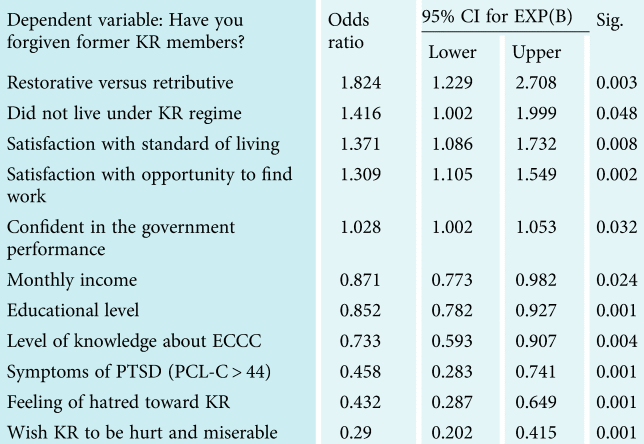
To more closely analyze the complex dynamics mediating memory, hatred, revenge and forgiveness, the authors conducted a logistic regression analysis for a range of variables that were hypothesized as influencing one outcome variable: having forgiven former members of the KR or not. Although the ECCC's primary purpose was to try senior leaders of the KR, forgiveness was widely cited by respondents to the surveys as a desirable outcome of holding the trials, and as a component of reconciliation.Footnote 75 Approximately one third of the total respondents in both general population surveys said they had forgiven the former KR. This analysis sheds light on the dynamics of forgiveness by showing which factors contribute to it. The final regression yielded the odds ratioFootnote 76 for the association of twelve separate variables with having forgiven the KR for the atrocities they caused. One of the twelve variables was composed of different forms of accountability that respondents mentioned as being most suitable for dealing with the KR era: truth-telling and reparations, which are categorized as “restorative”, and trials and other forms of punishment (including killing) which are categorized as “retributive”. The combined variable is referred to as “restorative versus retributive” in the model shown in Table 6. The authors also included several variables that point to respondents’ economic status: satisfaction with standard of living and opportunity to find work, monthly income, and education level. These were included to understand how economic factors influence individuals’ ability to feel conciliatory toward past abusers. Levels of knowledge about the KR and about the ECCC were included to assess the influence of memory (manifested by knowledge) and exposure to the main transitional justice mechanism of the time. Knowledge of the KR was highly correlated with living under the regime and thus was not included in the final regression. Three variables were included as indicative of reconciliation at the individual level: continued presence of post-traumatic stress disorder (PTSD) symptoms, having feelings of hatred toward the KR, and wanting to see them hurt or miserable.
Logistic regression of variables associated with having forgiven former KR members*

* This table presents an advanced analysis of survey data gathered in 2008 and published in 2009. See P. N. Pham et al., So We Will Never Forget, above note 23.
Table 6 presents the results with odds ratios, which demonstrate the likelihood (in terms of odds) that someone has forgiven the KR regime for each predictor variable. An odds ratio greater than 1 means increased likelihood of forgiveness given the status of the predictor variable, and an odds ratio of less than 1 means a decreased likelihood of forgiveness. For example, respondents who are in favour of restorative justice are 1.8 times more likely to have forgiven former KR members than those who preferred retributive justice. Overall, Table 6 tells us that four of the variables were associated with a greater tendency toward forgiveness. Those variables are: (1) did not live under the KR regime, (2) satisfaction with standard of living, (3) satisfaction with opportunity to find work, and (4) preference for restorative justice measures.
Respondents who did not live under the KR were more likely to report that they have forgiven the KR. This is to some degree intuitive – the younger generations forgive more easily because they did not experience the regime directly, and their knowledge and memory of the regime were indirectly acquired through their family, school or environment. Munyas’ study on understandings of the KR era among Cambodian youth found that there has been some inter-generational transmission of trauma, anger and vengefulness, but that some youth either disbelieve their parents’ stories or are more concerned with their daily priorities and challenges.Footnote 77
In addition, those who were generally satisfied with their economic status – as indicated by their standard of living and ability to find work – were also more likely to have forgiven. However, those with higher monthly incomes were less willing to forgive. This shows a difference between actual economic status (as measured by wealth) and satisfaction, which may be influenced by a perceived improvement in economic conditions. The results point toward a need for more holistic or transformative transitional justice processes, as proposed by Hamber and others, which address not only the “justice” aspect of the transition but also people's socioeconomic environments.Footnote 78 Examples of more holistic approaches are rare in practice, as most transitional countries implement some accountability measures without a comprehensive process and without concrete links to the country's broader economic development. Implementing a more transformative approach to transitional justice is also complicated because it involves addressing not only the impact of the conflict but also the structural context that enabled the conflict to occur.
The analysis also shows that higher education levels and more knowledge of the ECCC are less associated with tending to forgive. As previously noted, CPs and CPRs, who had more interaction with the ECCC, also had more feelings of hatred and revenge. This suggests that people who knew more about the ECCC as a justice mechanism were less willing to accept and forgive the abuses. CPs and CPRs are excluded from the regression model, but less than 10% of them said they had forgiven the KR's “top” leaders. The process to become a CP meant that the CPs were more likely to be invested in the trials and had more access to information on the ECCC. It is possible that other members of the population who experienced direct harm, notably people with higher education who were especially targeted by the KR,Footnote 79 were also more motivated to seek information about the ECCC. Based on other research on victims of mass violence, including in Cambodia, one of the strongest demands from victims is to know what happened and why.Footnote 80 Victims may have seen the ECCC as an important way to gain information and insights on the past.
In terms of the intersection between memory, justice and reconciliation, perhaps the most notable result is that those who expressed a preference for restorative measures – reparations and truth-seeking – were almost twice as likely to have forgiven the KR than those with a preference for retributive measures. The association of a preference for reparations and truth-seeking with forgiveness in many ways corroborates theories of forgiveness in the Cambodian context. Thirty years after the KR regime, those who experienced less violence, who had less contact with perpetrators or who still tended to support the KR on some level may have more easily come to terms with their experiences. They might view reparations and truth-seeking as more appropriate responses to events thirty years in the past. Cambodian culture and Buddhist beliefs also have a role: in Cambodian Buddhism, forgiveness can coexist with a desire for revenge or an understanding of justice that involves misfortune either in this life or the next befalling those who commit wrongful acts. Respondents may have forgiven while at the same time believing that justice will be done for the perpetrators, just not necessarily through the mechanism of trials.Footnote 81 Further analysis supports this view. Among those who reported having forgiven the KR, two thirds also reported still harbouring feelings of hatred (67%), and almost half wished to see the KR hurt and miserable (49%), but only a small number (15%) said they would seek revenge if they could.
What distinguishes trials from other forms of accountability is that they will single out individual perpetrators to potentially be punished if found guilty. The analysis shows that the respondents who supported the possibility of individual punishment were less likely to have forgiven the KR. Looking at the variables that were associated with less willingness to forgive provides further insight on this result. Those who were most likely to have feelings of hatred and wishing to see the KR hurt or miserable were the least likely to have forgiven the KR. Again, this may be explained either by the intensity of their exposure to violence under the regime or aspects of their lives since the KR was in power, such as poverty, ill health or ongoing interaction with perpetrators. This interpretation is supported by the finding that those with higher symptoms of PTSD were considerably less likely to have forgiven the KR.
Conclusion
This article has sought to shed light on the dynamics of memory, transitional justice and reconciliation in Cambodia thirty years after the end of the KR era. Memories of violence are inherently personal and individual. They are the legacy of individual experiences of and responses to trauma, but they are also moulded by prevailing policy environments which seek to shape communal memory and produce narratives that serve political purposes, and are influenced by the socioeconomic and environmental contexts which survivors inhabit. The results of the studies illustrate how the ECCC, as the major development in transitional justice in Cambodia in recent decades, has changed the environment surrounding memory. The data suggest that the ECCC created or brought back demand for truth – respondents felt strongly about the need for truth, that the truth will help people reconcile and that finding out the truth about their loved ones would help people to feel better. This may be driven by the large numbers of those who lost loved ones during that period and never learned of their fate, but it also reflects the lack of public education in school curricula and the officially promoted lack of transparency about the KR period that prevailed until recently.
At the time of the second survey in 2010, the possibility of greater demand for truth did not seem to have translated into more willingness to talk about the regime, especially among the older generation. This may point to an element of fear, anxiety or lack of interest in speaking out, which are important aspects of creating communal memory. For example, in a two-year TPO Cambodia project aiming at improving relationships between former KR members and victims, those identified as former KR were reluctant to talk or reveal their past, expressing concerns associated with safety and security.Footnote 82 This has practical consequences for efforts to shape communal memory and establish historical records as it necessitates special protections for victims who testify publicly. On the other hand, participating in a process, whether a legal one such as the ECCC, or one supported by NGOs, can provide a “safe” environment and the necessary platform so that people feel free to express themselves and to shape a different narrative.Footnote 83
Another notable change was that the desire for revenge increased from 2008 to 2010, particularly among CPs – those most closely involved in the trials. Through its legal processes and other activities that it inspired, the ECCC provided new details about the violence which may have caused feelings of vengeance. The authors’ analysis suggests that, at least in Cambodia, a preference for restorative justice through reparations and truth-seeking is strongly associated with forgiveness. This could be due to the passage of time since the violence took place or due to the different roles people played and their exposure to the violence. Religious beliefs that forgiveness can coexist with feelings of hatred and wishing harm to come to the wrongdoers are also relevant. Respondents with higher levels of PTSD are notably less likely to forgive, suggesting that their stronger, more traumatizing memories, or perhaps their ongoing experiences of violence, fear or deprivation in their everyday lives, are inhibiting their ability to accept coexistence with former KR members. Those satisfied with their economic status are more likely to forgive. The elements presented above point to the interrelation between individual survivors and the environment in which they live: conditions of daily life play a vital role in healing and should be an integral part of any transitional process.
In practical terms, the data suggest that the ECCC and the civil society movement associated with it may have had some positive outcomes in addressing the legacies of mass atrocities caused by the KR in Cambodia, even several decades later. The ECCC created a possibility of open dialogue where very little existed before. It also established a criminal justice mechanism to administer some form of punishment, which was the preferred way of achieving justice for those who had not forgiven the KR. These include people showing symptoms of PTSD and other mental health issues, those with higher incomes and education levels, and those who still hold stronger feelings of hatred. While forgiveness might be desirable as an indication that society is moving toward reconciliation, it cannot be forced on those whose residual trauma or anger have not been addressed through other means, such as trials and psychological counselling.Footnote 84
This analysis also points to the need to address underlying tensions in a post-conflict society caused by lasting memories of a conflict or a period of violence. A population can be pressured to accept a particular collective narrative by its government, but sentiments of hatred and anger at the individual level are not so easily erased. Overall, the results point to the importance of truth-seeking efforts and more open, transparent dialogue about the past that welcomes multiple viewpoints. Civil society has greatly contributed to these efforts, and the ECCC has created an opportunity, if not a momentum, for such a dialogue. In recent years, for example, Women's Hearings related to gender-based violence during the KR regime have been held, and the Documentation Centre of Cambodia (DC-Cam) has released a history textbook entitled A History of Democratic Kampuchea (1975–1979) which is now used in schools to educate pupils about the KR regime.Footnote 85 These developments cannot be directly attributed to the ECCC, but the existence of the Court may have shaped an environment favourable to their initiation.
As the ECCC draws closer to its end, many organizations have continued to work with Cambodians across the country. These projects target young people and the elderly in both urban and rural settings, aiming to promote healing through education, memorialization, mental well-being or empowerment. Addressing similar themes, in its judgment in Case 002/01 against Nuon Chea and Khieu Samphan, the Trial Chamber endorsed twelve of the fourteen projects requested by the co-lead lawyers representing the CPs at trial.Footnote 86 Those projects, some already implemented, also work toward fostering the healing process in Cambodia. Mental health support projects such as testimonial therapy and self-help groups might be especially important for decreasing PTSD among survivors.
Opening dialogue about the past is not easy. Cambodians’ reluctance to speak about the past, especially publicly, means that ways to operate around such reluctance must be found, for example by relying on private rather than public testimonies or by creating a safe environment for people to speak. Despite the strong support for learning the truth, the authors are not aware of any official, governmental truth-seeking effort in Cambodia since the time the surveys were conducted. Official acknowledgement remains important in both practical and symbolic ways. It is essential that the government provide support for steps such as rendering public the information gathered through the ECCC after its closing. Greater transparency and more commitment to an accurate historical record would provide victims with a sense of recognition and acknowledgement that has to date been absent.
On 16 November 2018, the ECCC's Trial Chambers convicted and sentenced Nuon Chea and Khieu Samphan to life in prison for war crimes, crimes against humanity and genocide against the Vietnamese (both accused) and the Chams (Nuon Chea).Footnote 87 Although appeals are likely, the judgment is the culmination of the last of the cases of former KR leaders at the ECCC.Footnote 88 It is also the first time a leader has been officially found guilty of the crime of genocide, even though genocide as a descriptor has long been part of the Cambodian narrative of the violence.Footnote 89 For some, the judgment was considered “historic”.Footnote 90 For others, it changed nothing: as one victim said, “I won't ever have peace”.Footnote 91 People interviewed in the media expressed varying degrees of satisfaction, with no indication as yet of how the decision will advance forgiveness or reconciliation, if at all.Footnote 92
In closing, this article points to several lessons that can be learned from the Cambodian transitional justice case by researchers and practitioners. Firstly, judicial measures like the ECCC create an opportunity to open a broader dialogue about past violations. Secondly, transitional justice measures such as truth-telling, trials and memorial projects need to provide an accessible and safe environment for people to speak openly about their experiences. Lastly, analyses of the role of forgiveness in transitional justice need to take a more nuanced perspective of how the concept operates among individuals and communities differently impacted by violence. These data suggest that forgiveness is neither synonymous with nor a precondition to reconciliation. It is a personal process. The anticipated end of the work of the ECCC and the fifty-year anniversary of the end of the brutal Khmer Rouge regime will bring another opportunity for Cambodians to reflect and provide the young population with lessons learned from the past. As this research shows, that is still very much needed.