Adolescent depression is a common and debilitating mental disorder that negatively affects academic functioning, interpersonal relationships, and physical health outcomes (Birmaher et al., Reference Birmaher, Ryan, Williamson, Brent, Kaufman and Dahl1996; Weisz, McCarty, & Valeri, Reference Weisz, McCarty and Valeri2006). Depression is among the leading causes of worldwide disability (Lopez & Murray, Reference Lopez and Murray1998), and youth with major depression are at significant risk for later poor physical health (e.g., chronic medical conditions), high medical costs and health care utilization, work impairment (e.g., decreased work productivity and neglected household responsibilities), and suicidal behaviors (Keenan-Miller, Hammen, & Brennan, Reference Keenan-Miller, Hammen and Brennan2007). Suicide is a particularly insidious problem among depressed adolescents (Bridge, Goldstein, & Brent, Reference Bridge, Goldstein and Brent2006), given that it constitutes the third leading cause of death among adolescents, with as many as 19% of depressed youth having reported frequent suicidal ideation in population-based samples (Grunbaum et al., Reference Grunbaum, Kann, Kinchen, Ross, Hawkins and Lowry2004).
Despite its prevalence and clinical significance, integrative models on the etiology of depression, including gene–environment interplay, have only recently emerged. Genetic influences on depression are suggested by evidence that first-degree relatives of individuals with major depressive disorder were two to three times more likely to develop depression than were nondepressed controls (Levinson, Reference Levinson2006); in addition, biological relatives of adoptees had higher rates of major depressive disorder than did adoptive relatives (Wender et al., Reference Wender, Kety, Rosenthal and Schulsinger1986). Genetic influences account for 40% to 50% of the variability in the etiology of depression (Levinson, Reference Levinson2006), and genetic association studies have focused on loci that regulate serotonin availability given its salience to theories of mood regulation (Stockmeier, Reference Stockmeier2003). The serotonin transporter linked promoter region gene (5-HTTLPR; solute carrier family C6, member 4 [SLC6A4]) is a compelling candidate for depression because it affects the site of pharmacological action for the treatment of depression (Whittington et al., Reference Whittington, Kendall, Fonagy, Cottrell, Cotgrove and Boddington2004). The human 5-HTTLPR gene is located on chromosome 17q12 and consists of a 44 base pair (bp) insertion/deletion polymorphism in the promoter region, resulting in short and long alleles (Heils et al., Reference Heils, Teufel, Petri, Stöber, Riederer and Bengel1996). Promoter region variants are specifically involved in regulating serotonin binding in the brain in postmortem brain samples of depressed individuals (Mann et al., Reference Mann, Huang, Underwood, Kassir, Oppenheim and Kelly2000). Compared to the long allele, the short allele is associated with reduced transcriptional efficiency, expression, and function of the serotonin transporter (Lesch & Schmitt, Reference Lesch and Schmitt2002). Evidence from neuroimaging studies and postmortem brain tissues similarly suggests significant associations among variants in the promoter region, serotonin regulation, and depression (Stockmeier, Reference Stockmeier2003). 5-HTTLPR variation also affects the stress response and reactivity of the amygdala, a subcortical structure rich in serotonin and critical to emotion regulation and fear processes (LeDoux, Reference LeDoux2000). Furthermore, a meta-analysis of 15 studies of depressed patients revealed that the short allele in the promoter region predicted poorer response to antidepressant medication compared to long allele homozygotes and also contributed to differences in rates of remission in depression (Serretti, Kato, De Ronchi, & Kinoshita, Reference Serretti, Kato, De Ronchi and Kinoshita2006). Consistent with this model of disrupted neurotransmission, the short allele has been implicated in the pathogenesis of depression and suicide behavior, particularly in the presence of stressful life events (Caspi et al., Reference Caspi, Sugden, Moffitt, Taylor, Craig and Harrington2003; Eley et al., Reference Eley, Sugden, Corsico, Gregory, Sham and McGuffin2004; Mann et al., Reference Mann, Huang, Underwood, Kassir, Oppenheim and Kelly2000; Zammit & Owen, Reference Zammit and Owen2006) through potential gene–environment interaction (G × E; Moffitt, Reference Moffitt2005).
The majority of research on environmental stress and depression has focused on interpersonal conflicts (e.g., dissolution of romantic relationship or ending friendships), academic or work problems, and family conflict (Daley et al., Reference Daley, Hammen, Burge, Davila, Paley and Lindberg1997; Hammen, Reference Hammen2005). Family-related stress may be relevant to depression in G × E given that ongoing poor family support, lack of closeness, poor communication, and family discord reliably predict youth depression (Côté et al., Reference Côté, Boivin, Liu, Nagin, Zoccolillo and Tremblay2009). Depressed adults also retrospectively recalled more abuse during childhood and adolescence, family conflict, rejection, and poor communication, as well as less warmth and support than normal controls (Birmaher et al., Reference Birmaher, Ryan, Williamson, Brent, Kaufman and Dahl1996; Sheeber, Hops, Alpert, Davis, & Andrews, Reference Sheeber, Hops, Alpert, Davis and Andrews1997). Relatedly, adolescents who completed suicide were more likely to experience parent–child discord, physical abuse, and high familial instability compared to matched controls (Brent et al., Reference Brent, Perper, Moritz, Liotus, Schweers and Balach1994). Furthermore, in a randomized control trial of 66 depressed and suicidal adolescents, a family-based intervention (i.e., attachment-based family therapy) that enhanced the quality of the parent–child relationship and reduced family conflict significantly reduced adolescent depression symptoms and suicidal ideation (Diamond et al., Reference Diamond, Wintersteen, Brown, Diamond, Gallop and Shelef2010), suggesting a potentially important role for family support in depression. Although there is replicated evidence that poor family support predicts adolescent depression and suicidality, null associations have also been reported. In one recent study, peer support, but not family support, robustly predicted adolescent depression symptoms among 90 adolescents who experienced trauma (Shahar, Cohen, Grogan, Barile, & Henrich, Reference Shahar, Cohen, Grogan, Barile and Henrich2009). Girls who were exposed to maternal depression during infancy were more likely to have high externalizing symptoms in kindergarten compared to boys (Essex, Klein, Miech, & Smider, Reference Essex, Klein, Miech and Smider2001), suggesting potential sex differences in the manifestation of psychopathology at a very young age in response to family factors (i.e., maternal psychopathology). With rare exceptions, however, most studies of family-related stress on adolescent depression have not accounted for potential sex differences, including differences in the type, frequency, and response to family- and peer-related social support (Rueger, Malecki, & Demaray, Reference Rueger, Malecki and Demaray2008).
It is well known that depression affects adolescent girls more often than boys (Cyranowski, Frank, Young, & Shear, Reference Cyranowski, Frank, Young and Shear2000) and that exposure to family-related stress may contribute to sex differences in adolescent depression (Brown & Harris, Reference Brown and Harris2008; Caspi, Hariri, Holmes, Uher, & Moffitt, Reference Caspi, Hariri, Holmes, Uher and Moffitt2010). In an 11-year longitudinal study of 550 rural adolescents, the number of stressful life events during adolescence varied drastically as a function of age and sex. Although girls and boys did not differ in the number of stressful life events during early adolescence (age 12–13) and young adulthood (age 22–23), by midadolescence girls experienced significantly more negative stressful life events than did boys, including family conflict and interpersonal problems (Ge, Nutsuaki, & Conger, Reference Ge, Natsuaki and Conger2006). Similarly, in a longitudinal study of 2,127 youth, depression among adolescent girls of depressed parents was more strongly related to interpersonal stressful life events than it was for adolescent boys (Bouma, Ormel, Verhulst, & Oldehinkel, Reference Bouma, Ormel, Verhulst and Oldehinkel2008). However, the association of family support and conflict with depression was comparable in adolescent boys and girls in another study (Sheeber et al., Reference Sheeber, Hops, Alpert, Davis and Andrews1997). These studies suggest that the association of family factors and adolescent depression may be moderated by sex, although few studies have explicitly tested models of G × E involving family support and measured genotype (i.e., 5-HTTLPR) in the prediction of adolescent depression and suicide risk.
Beyond their association with depression, family support and parenting behavior more broadly influence biological processes in offspring, a key consideration in selecting viable environmental risk factors in G × E research (Moffitt, Reference Moffitt2005). Adults who experienced harsh, chaotic, and high-conflict family environments exhibited less amygdala reactivity to emotional stimuli (i.e., angry and threatening faces) than did controls from nonrisky families (i.e., high warmth and closeness, and a well-organized and managed household; Taylor et al., Reference Taylor, Way, Welch, Hilmert, Lehman and Eisenberger2006). Abnormal amygdala reactivity to emotion-laden stimuli and difficulties with threat detection and emotion regulation (Hariri et al., Reference Hariri, Mattay, Tessitore, Kolachana, Fera and Goldman2002) are positively associated with psychopathology, including depression (Dannlowski et al., Reference Dannlowski, Ohrmann, Bauer, Deckert, Hohoff and Kugel2007). Maternal aggression moderated the influence of amygdala size and depression symptoms in Australian youth, such that boys (but not girls) with a larger right amygdala reported fewer depression symptoms in the context of low levels of maternal aggression (Yap et al., Reference Yap, Whittle, Yucel, Sheeber, Pantelis and Simmons2008). Poor family support also negatively affects the hypothalamic–pituitary–adrenocortical axis, a key limbic structure that regulates stress reactivity (Miller, Chen, & Zhou, Reference Miller, Chen and Zhou2007). Finally, there is recent evidence that early family adversity during childhood (e.g., financial stress or social adversity) and perinatal stressors (e.g., smoking during pregnancy) prospectively predicted lower serotonin synthesis capacity in the brain and increased the vulnerability of experiencing a psychiatric disorder at age 27 (Booij et al., Reference Booij, Benkelfat, Leyton, Vitaro, Gravel and Lévesque2012). Although this study featured a small (n = 26) and healthy adult all-male sample, the findings provide strong evidence that variations in parenting may have direct and enduring effects on offspring neurochemistry, including serotonin regulation. Thus, there is critical evidence that family factors represent biologically plausible constructs for G × E in the study of adolescent depression.
Most G × E studies have focused on environmental adversity per se (e.g., maltreatment or poor social support) given the primacy of diathesis–stress conceptualizations in psychopathology. Exposure to maltreatment (i.e., violence between parents, physical abuse, and psychological abuse) interacted with 5-HTTLPR to predict depression in a large sample of adolescent girls, such that maltreatment predicted depression only for girls with the short–short (SS) genotype (Åslund et al., Reference Åslund, Leppert, Comasco, Nordquist, Oreland and Nilsson2009). Far less is known about environmental enrichment, such as positive family support, warmth, low family conflict, and positive parent–child communication, in the context of G × E for depression and suicide. Positive family conditions may interact with genotype in ways that are consistent with “differential susceptibility” (Belsky & Pluess, Reference Belsky and Pluess2009), whereby the same genotype may simultaneously increase sensitivity to environmental enrichment and adversity. Serotonin metabolism, in particular, may regulate neural plasticity, such that higher serotonin levels may increase not only vulnerability to depression but also greater likelihood of recovery from depression (Branchi, Reference Branchi2011). In one study, high-quality social support moderated the association of 5-HTTLPR and depression among maltreated children, such that children with the SS genotype without positive support had the highest depression relative to nonmaltreated SS genotype children (Kaufman et al., Reference Kaufman, Yang, Douglas-Palumberi, Houshyar, Lipschitz and Krystal2004). However, the same maltreated children with the SS genotype who received high-quality social support had significantly less depression relative to maltreated children with the short–long (SL) and long–long (LL) genotypes. Similarly, adult individuals with the SS genotype had significantly more depressive symptomatology if they experienced severe emotional abuse, physical abuse, and/or poor quality parenting (i.e., frequent parental fighting or lack of warmth) during childhood compared to individuals without this genotype (Taylor et al., Reference Taylor, Way, Welch, Hilmert, Lehman and Eisenberger2006). However, individuals with the SS genotype also had the fewest depression symptoms if they reported a supportive early environment (Taylor et al., Reference Taylor, Way, Welch, Hilmert, Lehman and Eisenberger2006). Similar patterns were demonstrated in youth within the context of cognitive vulnerability and maternal warmth, such that children with negative inferential styles and the low-activity 5-HTTLPR genotype (two copies of the short allele or a long allele with a G variant [LG]) had the highest depression symptoms when their mothers were harsh and critical, but the same children with positive inferential styles exhibited the fewest depressive symptoms at low levels of maternal criticism (Gibb, Uhrlass, Grassia, Benas, & McGeary, Reference Gibb, Uhrlass, Grassia, Benas and McGeary2009). Empirical tests of differential susceptibility within the context of G × E are in their infancy, with few studies having explicitly tested positive and negative environmental conditions. These investigations suggest important implications for intervention, including targeted populations and interventions that focus on environmental change and enrichment (Belsky, Bakermans-Kranenburg, & van IJzendoorn, Reference Belsky, Bakermans-Kranenburg and van IJzendoorn2007).
Despite the plausibility of biological interaction, few studies have investigated interplay between positive and negative family factors with the 5-HTTLPR genotype for adolescent depression and suicide. The use of prospective longitudinal designs is also rare in such studies, despite their value in minimizing recall biases and ruling out reverse causation (Lahey et al., Reference Lahey, Rathouz, Lee, Chronis-Tuscano, Pelham and Waldman2011). Using a longitudinal, population-based study of adolescents and young adults, we tested the association of family support, 5-HTTLPR, and their interaction with self-reported depression symptoms and suicide risk using data from the National Longitudinal Study of Adolescent Health (Add Health). Based on previous research and theory (Belsky & Pluess, Reference Belsky and Pluess2009; Kaufman et al., Reference Kaufman, Yang, Douglas-Palumberi, Houshyar, Lipschitz and Krystal2004; Pluess, Belsky, Way, & Taylor, Reference Pluess, Belsky, Way and Taylor2010), we hypothesized that (a) high levels of family support would predict fewer depression symptoms and reduce the risk for suicide, and (b) carriers of the short allele would exhibit the most depression symptoms and the highest risk for suicide at low levels of family support, but concurrently, that they would report the fewest depression symptoms and have a lower risk of suicide with high family support relative to long allele homozygotes.
Method
Participants
We used data from Add Health (Harris, Reference Harris2008), which ascertained a stratified random sample of youth across 132 middle schools and high schools in 80 different communities, including urban, suburban, and rural, across the United States. Schools were stratified by region, ethnicity, size, and school type (i.e., parochial, private, or public). In-school questionnaires were administered to 90,000 students, which ascertained information on social, emotional, and health functioning. Additional information was obtained from a subsample of these adolescents through in-home interviews. A total of 20,745 youth and their caregivers participated in the comprehensive in-home interviews at Wave I. Respondents were queried on issues pertaining to family support, engagement in risky behaviors (e.g., sexual behavior, rule breaking, or substance use), and their present health, mood, and emotional functioning. At Wave I (1994–1996), youth were between the ages of 12 and 20 (M age = 15.22, SD = 1.65).
Wave II interviews were conducted 1–1.5 years after Wave I (1995–1996; 71% response rate) with the same adolescents (N = 14,738, M age = 16.21, SD = 1.65). The attrition rate from Wave I to II was heavily influenced by graduation (high school graduates were not followed for the second interview; Harris, Reference Harris2008). Most of the interview questions were retained from Wave I, given that the participants were still adolescents. Wave III included 15,197 young adults that were interviewed 6–7 years after Wave I, between 2001 and 2002 (73% response rate). Interview questions were changed in order to include more age-appropriate questions (e.g., marriage, children, and employment history). Most of the respondents at Wave III were young adults (M age = 21.96, SD = 1.78). The rate of attrition over the 7-year period was comparable to attrition rates in other longitudinal studies among young adults (approximately 32% attrition; Young, Powers, & Bell, Reference Young, Powers and Bell2006).
DNA was obtained from a subsample of youth at Wave III, consisting of individuals with varying degrees of genetic relatedness, including monozygotic and dizygotic twins, full siblings, half-siblings, and unrelated siblings raised in the same household. These individuals were identified through the in-school questionnaire administered at Wave I. The purpose of DNA collection was to allow behavioral genetic studies “to move beyond variance decomposition … to testing specific hypotheses about the influence of individual genes and their expression in the context of environmental circumstances” (Harris, Reference Harris2008). The overall genetic subsample (i.e., participants with DNA) consisted of 2,558 individuals (48% male): from this group, we excluded 937 non-White participants due to concerns over racial–ethnic substructure potentially influencing the genetic association findings (e.g., genotype distributions were significantly and nonrandomly associated with racial–ethnic group status). We then excluded another 591 youth who reported living in single-caregiver households in order to avoid confounds secondary to differences in family structure (Cumsille & Epstein, Reference Cumsille and Epstein1994). After these exclusions, our final sample included a total of 1,030 Caucasian adolescents (56% boys; n = 572) with DNA, family support, and depression data. The average age of our final sample was 15.5 years (SD = 1.7) and it was 56% male (n = 572). Compared to the overall sample from Add Health (with and without genetic data), the final sample was slightly older (t = −7.14, df = 11,611, p < 001), but it did not differ in sex composition (χ2 = 1.32, df = 1, p = .25). The final sample differed significantly from the original sample across all three waves on depression (Wave I: t = 4.18, df = 15,091, p < 001; Wave II: t = 4.73, df = 11,580, p < 001; Wave III: t = 3.71, df = 15,082, p < 001) and family support (Wave I: t = −3.53, df = 10,249, p < 001; Wave II: t = −3.67, df = 8,004, p < 001; Wave III: t = −2.87, df = 4,238, p < 001), such that the final sample had lower depression and higher family support scores compared to the original sample. Suicidal risk did not differ between the racial–ethnic groups at Wave I (χ2 = 2.84, df = 1, p = .09) but differed at Wave II (χ2 = 6.64, df = 1, p < 05). Thus, the final sample was not representative of the overall Add Health sample.
Depression
At Waves I and II, depression symptoms were assessed using an abbreviated 17-item version of the Center for Epidemiologic Studies Depression Scale (CES-D; Radloff, Reference Radloff1977). At Wave III, only 8 CES-D items were used to measure depression symptoms. To allow for longitudinal tests of G × E for depression, we analyzed the same 8 CES-D items that were gathered across all three waves. Respondents provided ordinal responses ranging from 0 (never or barely) to 3 (most or all of the time) on items related to the four-factor structure of the CES-D (Shafer, Reference Shafer2006): somatic complaints (“bothered by things” or “can't keep mind on tasks”), depressive affect (“felt depressed,” “unable to shake off the blues,” or “felt like life has been a failure”), positive affect (“you felt as good as others” or “enjoyed life”), and interpersonal problems (“you feel disliked by people”). Two items corresponding to positive affect were reverse scored. We calculated total CES-D scores, which represented the sum of the 8 items and ranged from 0 (no depressive symptoms) to 24 (most frequent/severe depressive symptoms). The internal consistency from Waves I, II, and III was 0.86, 0.87, and 0.80, respectively.
Suicide
Suicidal ideation and attempts were ascertained from an in-home structured interview at Waves I and II (suicide was not assessed at Wave III) based on two items from the Youth Risk Behaviors Survey (Kann, Reference Kann2001). Respondents were asked “During the past 12 months, did you ever seriously think about committing suicide?” Respondents replied “yes” or “no.” If respondents answered “yes,” they were then asked “During the past 12 months, how many times did you actually attempt suicide?” For this question, respondents could answer none, one time, two or three times, four or five times, or six or more times. Fourteen percent and 12% of adolescents positively endorsed suicidal ideation at Waves I and II, respectively. Among individuals who positively endorsed suicidal ideation, 17% and 19% also attempted suicide once at Waves I and II, respectively. Ten percent (Wave I) and 11% (Wave II) attempted suicide more than once in the past year. These estimates are similar to previous epidemiologic studies of depression and suicide in adolescents (Lewinsohn, Rohde, & Seeley, Reference Lewinsohn, Rohde and Seeley1996). Based on previous studies (Lewinsohn, Rohde, & Seeley, Reference Lewinsohn, Rohde and Seeley1996), we created a single variable of suicide at Waves I and II where 0 = no attempts/suicidal ideation only and 1 = one or more suicide attempts.
Family support
Family support was assessed from an in-home structured interview at Waves I, II, and III. Thirteen items ascertained the youth's perceived familial support, including parental closeness, quality of communication, connectedness, and feeling loved and wanted by family members. Respondents rated their perceived level of parent and family support on an ordinal scale from 1 (not at all) to 5 (very much). Items included “How close do you feel to your mother/father?” and “How much do you think she/he cares about you?” This scale has been used in previous studies of parenting and familial support (Borowsky, Ireland, & Resnick, Reference Borowsky, Ireland and Resnick2001; Resnick et al., Reference Resnick, Bearman, Blum, Bauman, Harris and Jones1997). In the current sample, the scale demonstrated good internal consistency (0.83, 0.81, and 0.81 for Waves I, II, and III, respectively). Furthermore, we established strong evidence of convergent validity against parent ratings of family support (e.g., “How often do you get along with your son/daughter?) and discriminant validity against adolescent ratings of neighborhood/community factors (e.g., “Do you feel safe in your neighborhood?”). Results from principle components analysis are available upon request. Scores on each item were summed and then standardized using z scores.
Genotyping
Genomic DNA was isolated from buccal cells using standard methods. The primer sequences were forward, 5′-GGCGTTGCCGCTCTGAATGC-3′ (fluorescently labeled), and reverse, 5′-46 GAGGGACTGAGCTGGACAACCAC-3.′ These primer sequences yield products of 484 or 528 bp (Heils et al., Reference Heils, Teufel, Petri, Stöber, Riederer and Bengel1996). The long variant (528 bp) has approximately three times the basal activity of the shorter promoter (484 bp) with the deletion (Lesch et al., Reference Lesch, Bengel, Heils, Sabol, Greenberg and Petri1996). Although the short allele confers vulnerability to depression in response to stress, the literature differs with respect to the number of short alleles needed to confer this risk (Uher et al., Reference Uher, Caspi, Houts, Sugden, Williams and Poulton2011). In other words, it is unclear if the effect of the short allele follows an additive, dominant, and recessive genetic model. We followed recommendations and tested and reported the results for all three separate genetic models (Uher & McGuffin, Reference Uher and McGuffin2010). 5-HTTLPR genotypes followed the following distributions: SS (n = 196) 19%, SL (n = 515) 50%, and LL (n = 319) 31%. These distributions did not deviate from Hardy–Weinberg equilibrium, χ2 (1) = 0.73, p = .39.
Statistical analysis
We examined the association of family support, 5-HTTLPR genotype, and their interaction with depression symptoms at Waves I, II, and III using generalized estimating equations (GEE) specifying Poisson distributions and an autoregressive correlation structure. GEE is an extension of the general linear model to longitudinal data using quasilikelihood estimation (Zeger, Liang, & Albert, Reference Zeger, Liang and Albert1988), which estimates change over time at the population level rather than at the individual or cluster-specific level. We then examined suicidality longitudinally by using GEE specifying binomial distributions and an autoregressive correlation structure. Adolescent age was covaried in each model, given the relatively wide age range in our sample (i.e., 12–20 at Wave I). Sampling weights were included in all analyses to take account of clustering within schools and oversampling, although they did not correct for design effects or unequal selection probability. Missing data was excluded via listwise deletion. A sensitivity analysis (i.e., multiple imputation) yielded a pattern of results that were entirely consistent with the results using listwise deletion (data available upon request).
Results
Demographics
Youth genotypes were unrelated to sex, χ2 (1) = 0.90, p = .34, and family support (β = −0.01, SE = 0.03, p = .69), thereby minimizing the possibility that a gene–environment correlation confounded our tests/interpretation of G × E.
Depression
Dominant genetic model (SS/SL vs. LL)
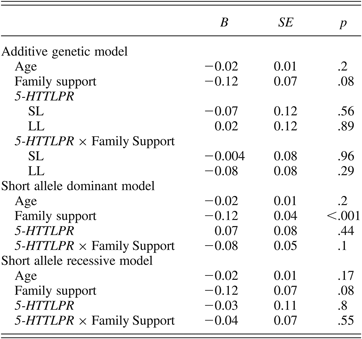
We tested the interaction for 5-HTTLPR and family support (controlling for age) with total depression symptoms for girls and boys separately, given that both constructs are known to vary by sex (Brown & Harris, Reference Brown and Harris2008). This was modeled using GEE, and we further specified Poisson distributions and an autoregressive correlation structure. Given that the interpretation of main effects is complicated in models that include higher order terms (i.e., interactions), we first examined the main effects of genotype and family support without their interaction in the model, followed by a fully saturated model with the main effects and interaction included (Table 1 shows the fully saturated model for girls). For the main effects model, among girls, high family support inversely predicted depression (β = −0.15, SE = 0.03, p < 01), but genotype was unrelated to depression (β = 0.10, SE = 0.08, p = .23). In the fully saturated model (with main effects and their interaction), the 5-HTTLPR × Family Support interaction was marginally significant (β = −0.09, SE = 0.05, p = .08; see Figure 1) with an improved model fit versus the main effects only model (Wald χ2 = 52.51, df = 3, p < 001). Family support inversely predicted depression symptoms in girls with the SS and SL genotypes (β = −0.12, SE = 0.03, p < 01) as well as in girls with the LL genotype (β = −0.19, SE = 0.04, p < 001). Based on established standards for evaluating differential susceptibility (Belsky et al., Reference Belsky, Bakermans-Kranenburg and van IJzendoorn2007), we further probed this interaction by testing the change in depression (ΔY) between genotypes at different levels of family support (ΔX; i.e., z = −3, −2, . . . , 2, 3), ranging from low to high levels of the family environment. Significant differences in depression levels were only detected between 5-HTTLPR genotypes at z = −3 (ΔY/ΔX = 2.78, SE = 1.16, p < 05) and z = −2 (ΔY/ΔX = 1.76, SE = 0.73, p < 05), such that family support inversely predicted depression symptoms among girls with the LL genotype but not among girls with the SS and SL genotypes.
(Color online) The Center for Epidemiologic Studies Depression Scale (CES-D) total scores and the interaction between the serotonin transporter linked promoter region gene (dominant model) and family support for girls. SS/SL, short–short/short–long alleles (bottom line in graph); LL, long–long allele (top line in graph).

Generalized estimating equations analyses of the interaction of 5-HTTLPR and family support for CES-D total scores in girls (n = 458)
Note: 5-HTTLPR, serotonin transporter linked promoter region; CES-D, Center for Epidemiological Studies Depression Scale; SL, short–long allele; LL, long–long allele.
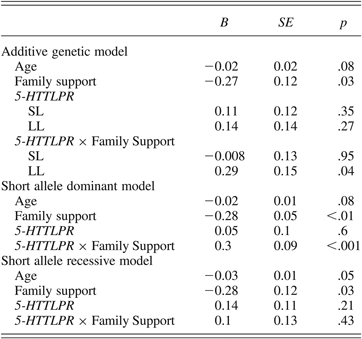
Among boys (Table 2), family support (β = −0.19, SE = 0.05, p < 001), but not genotype (β = 0.03, SE = 0.10, p = .74), negatively predicted depression in the main effects model. When the Family Support × Genotype interaction was included, the model fit improved significantly compared to the main effects only model (Wald χ2 = 29.48, df = 3, p < 0001); a significant interaction effect emerged (β = 0.31, SE = 0.09, p < 01) where family support inversely predicted depression symptoms among boys with the SS or SL genotype (β = −0.26, SE = 0.05, p < 001) but not for boys with the LL genotype (β = 0.06, SE = 0.08, p = .48; see Figure 2). Significant differences in depression were detected at z = −3 (ΔY/ΔX = −4.77, SE = 1.80, p < 01) and z = −2 (ΔY/ΔX = −2.67, SE = 1.15, p < 05), indicating that at the lowest level of family support, boys with the SS/SL genotype had significantly more depression than did boys with the LL genotype. However, as family support increased (e.g., z = 1, z = 2, and z = 3; ΔY/ΔX = 1.42, SE = 0.41, p < 01, ΔY/ΔX = 2.31, SE = 0.67, p < 01, and ΔY/ΔX = 3.05, SE = 1.03, p < 01, respectively), boys with the SS/SL genotype had significantly less depression than did boys with the LL genotype. These preliminary findings suggest differential susceptibility such that boys with at least one copy of the short allele of 5-HTTLPR were more susceptible to depression symptoms at low levels of family support but also showed the lowest levels of depression at high levels of family support relative to the LL genotype group.
(Color online) The Center for Epidemiologic Studies Depression Scale (CES-D) total scores and the interaction between the serotonin transporter linked promoter region gene (dominant model) and family support for boys. SS/SL, short–short/short–long alleles (top line in graph); LL, long–long allele (bottom line in graph).
Generalized estimating equations analyses: Interaction of 5-HTTLPR and family support for CES-D total scores in boys (n = 572)
Note: 5-HTTLPR, serotonin transporter linked promoter region; CES-D, Center for Epidemiological Studies Depression Scale; SL, short–long allele; LL, long–long allele.
Additive model (SS vs. SL vs. LL)
As we did for the dominant model above, we first conducted a GEE model, controlling for age, with only the main effects among girls (Table 1). Family support was inversely related to depression symptoms (β = −0.16, SE = 0.03, p < 0001), but 5-HTTLPR genotypes were not (SL vs. SS: β = −0.07, SE = 0.12, p = .54; LL vs. SS: β = 0.03, SE = 0.12, p = .79; SL vs. LL: β = 0.10, SE = 0.09, p = .23). In the fully saturated model (Wald χ2 = 56.20, df = 6, p < 0001), all 5-HTTLPR × Family Support interactions were unrelated to depression for the genotype comparisons (SL vs. SS: β = −0.004, SE = 0.08, p = .96; LL vs. SS: β = −0.08, SE = 0.08, p = .29; SL vs. LL: β = −0.08, SE = 0.05, p = .15). Unlike the original results based on the dominant model (SS/SL vs. LL), which detected a marginally significant Genotype × Family Support interaction, the same interaction was not significant in the additive models for girls.
In boys (Table 2), once again controlling for age, in the main effects model, family support was inversely associated with depression symptoms (β = −0.19, SE = 0.04, p < 001), but there was no effect for 5-HTTLPR genotypes (SL vs. SS: β = 0.12, SE = 0.12, p = .32; LL vs. SS: β = 0.14, SE = 0.12, p = .26; SL vs. LL: β = 0.01, SE = 0.11, p = .89). In the fully saturated model (Wald χ2 = 32.41, df = 6, p < 0001), the 5-HTTLPR × Family Support interaction was significant for the LL versus the SS group (β = −0.29, SE = 0.14, p < 05) and versus the SL group (β = 0.30, SE = 0.09, p < 001) but not for SL versus the SS group (β = −0.008, SE = 0.14, p = .95). In the post hoc tests, family support was inversely associated with depression symptoms in the SS (β = −0.28, SE = 0.11, p < 01) and the SL groups (β = −0.28, SE = 0.06, p < 001) but not in the LL group (β = 0.01, SE = 0.07, p = .88). The results are consistent with our results in the dominant-genetic model, such that adolescent boys with either the SS or the SL genotype were more sensitive to family support than were boys with the LL genotype.
Recessive model (SS vs. SL/LL)
We first analyzed main effects for 5-HTTLPR and family support for depression symptoms in girls, controlling for age (Table 1). In the main effects model, family support was inversely associated with depression symptoms, whereas 5-HTTLPR was not (β = −0.16, SE = 0.03, p < 001, and β = −0.03, SE = 0.11, p = .81, respectively). Finally, in the fully saturated model (Wald χ2 = 43.12, df = 4, p < 001), the interaction between 5-HTTLPR and family support was not significant (β = −0.04, SE = 0.07, p = .55). We then adopted parallel analytic strategies for depression symptoms in boys (Table 2). There was an inverse association between family support (β = −0.18, SE = 0.04, p < 001) but not for 5-HTTLPR (β = 0.13, SE = 0.11, p = .25) in predicting depression symptoms. In the fully saturated model (Wald χ2 = 20.25, df = 4, p < 001), there was no significant interaction between 5-HTTLPR and family support (β = 0.10, SE = 0.13, p = .43) for depression symptoms.
Suicide
Dominant model
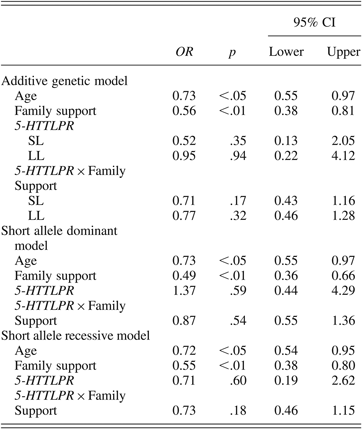
We employed GEE specifying a binomial distribution and autoregressive correlation structure to assess the interaction of 5-HTTLPR and family support on suicidal risk, controlling for age. In girls (Table 3), there was a main effect for family support, such that high family support significantly reduced the odds of a suicide attempt by 43% (p < 001) with a 95% confidence interval (CI; 0.28, 0.65). There was no main effect for 5-HTTLPR (odds ratio [OR] = 1.49, 95% CI = 0.54, 4.09; p = .44), nor was there a significant 5-HTTLPR × Family Support interaction for suicide attempts (OR = 1.06, 95% CI = 0.49, 2.26; p = .89; model fit: Wald χ2 = 30.12, df = 4, p < 001).
Interaction of 5-HTTLPR and family support for suicide risk in girls (n = 231)
Note: 5-HTTLPR, serotonin transporter linked promoter region; OR, odds ratio; SL, short–long allele; LL, long–long allele.
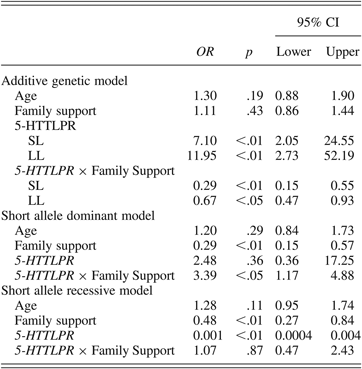
In boys (Table 4), high family support significantly reduced the risk of a suicide attempt by 39% (p < 001) with a 95% CI (0.23, 0.67), although there was no main effect for 5-HTTLPR (OR = 1.53, 95% CI = 0.28, 8.45; p = .36). In the fully saturated model (Wald χ2 = 56.20, df = 6, p < 001), the 5-HTTLPR × Family Support interaction was significant (OR = 2.56, 95% CI = 1.07, 6.09; p < 05; see Figure 3). Specifically, high family support significantly reduced the odds of a suicide attempt by 27% (p < 01) with a 95% CI (0.12, 0.62) among youth with the SS and the SL genotypes but not among youth with the LL genotype (OR = 0.76, 95% CI = 0.52, 1.10; p = .15). To assess for differential susceptibility, we tested the prospective change in the odds for a suicide attempt (ΔY) between genotypes at different levels of family support (ΔX; i.e., z = −3, –2, . . . , 2, 3). A significant difference in the odds for a suicide attempt was only detected at z = −4 (ΔY/ΔX = −0.40, SE = 0.20, p < 05) and –3 (ΔY/ΔX = –0.20, SE = 0.08, p < 05), suggesting that boys with the SS/SL genotype were significantly more at risk for suicidal behavior at only very low-quality family support (vs. boys with the LL genotype); thus, there was no evidence for differential susceptibility for Family Support × 5-HTTLPR for suicide risk.
(Color online) Probability of suicide attempt serotonin transporter linked promoter region gene (dominant model) and family support among boys. SS/SL, short–short/short–long alleles (top line in graph); LL, long–long allele (bottom line in graph).
Interaction of 5-HTTLPR and family support for suicide risk in boys (n = 296)
Note: 5-HTTLPR, serotonin transporter linked promoter region; OR, odds ratio; SL, short–long allele; LL, long–long allele.
Additive model
We then examined the same models using the additive approach for suicide risk in girls, also controlling for age (Table 3). The main effects model was significant for family support (OR = 0.48, p < 001, 95% CI = 0.35, 0.67) but not for genotype (OR = 0.78, p = .76, 95% CI = 0.18, 3.55) in predicting suicide risk. The interaction models (Wald χ2 = 58.98, df = 6, p < 0001) were similarly nonsignificant for each genotype group comparison (SS vs. SL: OR = 0.52, p = .17, 95% CI = 0.43, 1.16; SS vs. LL: OR = 0.77, p = .32, 95% CI = 0.46, 1.28; SL vs. LL: OR = 1.23, p = .45, 95% CI = 0.72, 2.10).
In the main effects model for boys, family support was negatively associated with suicide risk (OR = 0.48, p < 001, 95% CI = 0.31, 0.73), but 5-HTTLPR genotypes were not (OR = 1.68, p = .29, 95% CI = 0.64, 4.43). In the fully saturated model (Table 3; Wald χ2 = 120.57, df = 6, p < 0001), the interaction between 5-HTTLPR and family support was significant (SS vs. SL: OR = 0.004, p < 001, 95% CI = 0.001, 0.009; SS vs. LL: OR = 0.001, p < 001, 95% CI = 0.0002, 0.004; SL vs. LL: OR = 2.52, p < 001, 95% CI = 2.04, 3.13). In the post hoc analyses, the association between 5-HTTLPR and suicide risk was only significant for boys with the SS and the SL genotypes (OR = 0.04, p < 001, 95% CI = 0.01, 0.16, and OR = 0.32, p < 001, 95% CI = 0.17, 0.58, respectively) but not for boys with the LL genotype (OR = 0.77, p = .15, 95% CI = 0.54, 1.10). Once again, these results support a dominant model of genetic influence for 5-HTTLPR.
Recessive model
Finally, we assessed suicide risk as a function of 5-HTTLPR genotype and family support in adolescents using a recessive genetic model, controlling for age. For girls (Table 3), we only detected a main effect for family support (OR = 0.48, p < 001, 95% CI = 0.33, 0.66) but not for 5-HTTLPR (OR = 1.08 p = .91, 95% CI = 0.27, 4.27). Furthermore, the 5-HTTLPR × Family Support interaction was not significant (OR = 0.73, p = .18, 95% CI = 0.46, 1.15) in the fully saturated model (Wald χ2 = 36.86, df = 4, p < 0001). In boys (Table 4), family support and 5-HTTLPR genotype each significantly predicted suicide risk (OR = 0.48, p < 05, 95% CI = 0.27, 0.84, and OR = 0.003, p < 001, 95% CI = 0.001, 0.007, respectively) in the main effects model. However, in the fully saturated model (Wald χ2 = 263.92, df = 4, p < 0001), the interaction between 5-HTTLPR and family support was unrelated to suicide risk (OR = 1.07, p = .87, 95% CI = 0.47, 2.43).
Discussion
Few studies have investigated the interaction of family factors and youth 5-HTTLPR genotype with depression symptoms and related phenotypes. In addition, relatively little is known about the interactive effects of 5-HTTLPR with a wide range (i.e., low to high quality) of family support (e.g., cohesion, communication, and warmth) for psychopathology, given that most G × E studies have focused on environmental adversity (and typically categorical measures). We examined the interactive effects of 5-HTTLPR and variation in family support for depression symptoms and suicide risk in a population-based longitudinal study of adolescents and young adults. As expected, high-quality family support inversely predicted depression symptoms and suicidal risk, independent of sex. We also detected a significant interaction between 5-HTTLPR and family support for depression symptoms and suicidal risk, but this was only among boys. Boys with at least one copy of the short allele had more depression symptoms and were more likely to have attempted suicide under conditions of poor family support. However, boys with the same genotype also had the least depression symptoms (but not lower suicide risk) with high family support. There was also a marginally significant interaction between 5-HTTLPR and family support for depression symptoms (but not suicide risk) for girls, such that girls with the LL genotype had more depression symptoms relative to girls with the SS/SL genotype at only the lowest levels of family support.
As expected, family support was robustly associated with depression symptoms and suicide risk, independent of sex, age, and 5-7TTLPR genotype. This association is consistent with previous studies (Kaufman et al., Reference Kaufman, Yang, Douglas-Palumberi, Houshyar, Lipschitz and Krystal2004; Pluess et al., Reference Pluess, Belsky, Way and Taylor2010) where poor family support prospectively predicted adolescent depression and suicidal behavior across multiple cultural contexts (Harris & Molock, Reference Harris and Molock2000; Lee, Wong, Chow, & McBride Chang, Reference Lee, Wong, Chow and McBride Chang2006) and in older populations (Duberstein, Conwell, Conner, Eberly, & Caine, Reference Duberstein, Conwell, Conner, Eberly and Caine2004). Consistent with our hypothesis, high-quality family support negatively predicted depression symptoms and significantly reduced the risk of suicidality in girls and boys, suggesting that dimensions of family support, such as cohesion, communication, warmth, and closeness, are critical to the development of depression and may protect against other risk factors for depression and suicide, including stressful life events (e.g., work and academic stress) and genetic liability. Although adolescence is marked by increased independence and autonomy (Silverberg & Steinberg, Reference Silverberg and Steinberg1987), family support continues to play a central role in adolescent development (Matlin, Molock, & Tebes, Reference Matlin, Molock and Tebes2011) by promoting individual coping strategies and increasing self-efficacy in adolescents (Harris & Molock, Reference Harris and Molock2000). In a large community sample of adolescents, less supportive and more conflictual family environments prospectively predicted greater depression symptoms over a 1-year period, but family support 1 year later was not impacted by adolescent depression at baseline (Sheeber et al., Reference Sheeber, Hops, Alpert, Davis and Andrews1997), suggesting that family support is a relatively stable environmental factor that is independent of familial disruptions that may be caused by adolescent depression. However, the severity of depression and the timing of the depression onset may have had an important (unmeasured) impact on family support, thus necessitating developmental models that extend before adolescence. However, these findings still reinforce the importance of integrating family-based interventions, given the primacy of family influences on adolescent depression and suicide (David-Ferdon & Kaslow, Reference David-Ferdon and Kaslow2008).
Our findings also support the prevailing G × E literature that environmental adversity increased the risk of depression symptoms and suicide risk specifically among individuals carrying the short allele (Caspi et al., Reference Caspi, Sugden, Moffitt, Taylor, Craig and Harrington2003; Eley et al., Reference Eley, Sugden, Corsico, Gregory, Sham and McGuffin2004; Mann et al., Reference Mann, Huang, Underwood, Kassir, Oppenheim and Kelly2000; Zammit & Owen, Reference Zammit and Owen2006). However, in our study, boys with the short allele also had the fewest depression symptoms when they experienced high-quality family support. Thus, in the case of depression, the short allele not only increased sensitivity to poor-quality environmental conditions (Caspi et al., Reference Caspi, Hariri, Holmes, Uher and Moffitt2010) but also concurrently increased sensitivity to high-quality environmental conditions, which is consistent with differential susceptibility theory (Belsky & Pluess, Reference Belsky and Pluess2009; Kaufman et al., Reference Kaufman, Yang, Douglas-Palumberi, Houshyar, Lipschitz and Krystal2004; Pluess et al., Reference Pluess, Belsky, Way and Taylor2010). Biologically, the rate of neurotransmitter binding and subcortical reactivity may be contingent upon the salience of the event (i.e., highly positive or negative stimuli; Holroyd & Coles, Reference Holroyd and Coles2002). Specifically, the 5-HTTLPR genotype may affect the speed of the amygdala in response to different environmental stimuli. Short allele carriers exhibited faster amygdala reactivity than did long allele homozygotes, particularly when the stimulus indicates some form of physiological or emotional threat (Furman, Hamilton, Joorman, & Gotlib, Reference Furman, Hamilton, Joormann and Gotlib2011). Furthermore, emerging research from human (Garavan, Pendergrass, Ross, Stein, & Risinger Reference Garavan, Pendergrass, Ross, Stein and Risinger2001; Hamann & Mao, Reference Hamann and Mao2002) and nonhuman primates (Paton, Belova, Morrison, & Salzman, Reference Paton, Belova, Morrison and Salzman2006) suggests that the role of the amygdala extends beyond processing negative and fearful stimuli to positive stimuli as well. Using functional magnetic resonance imaging with healthy female adults, the amygdala was equally activated in response to pictures with positive (e.g., erotic scenes and adventurous sports) and negative (e.g., violence scenes and mutilations) valence (Garavan et al., Reference Garavan, Pendergrass, Ross, Stein and Risinger2001). Similarly, dopamine neurons exhibited the highest firing rate prior to a salient reward, but the firing rate fell below baseline in anticipation of a harsh punishment (Mirenowicz & Schultz, Reference Mirenowicz and Schultz1996). Taken together with the present results, 5-HTTLPR may neurobiologically interact with negative and positive environmental factors by altering serotonergic binding within subcortical structures, including the amygdala. However, other polymorphisms are likely to influence serotonin transporter transcription (Ansorge, Zhou, Lira, Hen, & Gingrich, Reference Ansorge, Zhou, Lira, Hen and Gingrich2004), as well as the influence of other variants in linkage disequilibrium.
There was, however, a marginally significant interaction between genotype and family support for depression symptoms in girls (no interaction was detected for suicide risk in girls). Previous research suggests that adolescent girls not only experience significantly more interpersonal stress but also are more anxious and depressed, and are thus more vulnerable to interpersonal stressors than are boys (Rudolph & Hammen, Reference Rudolph and Hammen1999; Shih, Eberhart, Hammen, & Brennan, Reference Shih, Eberhart, Hammen and Brennan2006). Furthermore, some studies of depression have found that genetic moderation involving the 5-HTTLPR locus and environmental stress were specific to females (Hammen, Brennan, Keenan Miller, Hazel, & Najman, Reference Hammen, Brennan, Keenan Miller, Hazel and Najman2010; Eley et al., Reference Eley, Sugden, Corsico, Gregory, Sham and McGuffin2004). However, our findings provide evidence that boys and girls may be equally susceptible to poor family support in the context of the 5-HTTLPR genotype and depression symptoms, although boys with the SS/SL genotype were more susceptible to poor family support (compared to LL genotype boys) whereas girls with the LL genotype were relatively more vulnerable to poor family support (compared to SS/SL genotype girls). There may be important sex differences in serotonin functioning among depressed individuals. Depressed women exhibited significantly reduced serotonin availability and reuptake in the diencephalon compared to depressed men, suggesting that disruptions in serotonin functioning may be sex specific (Staley et al., Reference Staley, Sanacora, Tamagnan, Maciejewski, Malison and Berman2006). There is also emerging evidence of genuine “allele flips,” where associations for the same disease occur at opposite alleles of the same biallelic locus (Clarke & Cardon, Reference Clarke and Cardon2010), which may be more likely to occur in epistatic or G × E models. We emphasize that the interaction between 5-HTTLPR genotype and family support was marginally significant for girls and that simple effects for 5-HTTLPR genotypes and depression in our post hoc models were both significant. Future studies should examine sex differences in G × E involving this locus.
Furthermore, evidence of differential susceptibility was detected among boys for depression symptoms (and not suicide risk), but none was detected among girls for either depression symptoms or suicide risk. Specifically, boys with the SS/SL genotypes had the fewest depression symptoms relative to boys with the LL genotype under conditions of positive family support. Evidence from animal studies demonstrated that chronic stress negatively affected mood and cognition (e.g., impaired memory and increased anxiety) in young male rats, but it enhanced cognitive abilities in female rats (Luine, Beck, Bowman, Franfurt, & Maclusky, Reference Luine, Beck, Bowman, Frankfurt and Maclusky2007). Conversely, acute stress enhanced learning and memory in male adult rats, but it impaired these cognitive functions in adult female rats (Shors, Reference Shors2004). Humans also demonstrate divergent patterns of stress response. Men who were experimentally exposed to chronic stress had significantly higher blood pressure and epinephrine levels relative to females who were chronically stressed in the laboratory (Matthews, Gump, & Owens, Reference Matthews, Gump and Owens2001). Shih et al. (Reference Shih, Eberhart, Hammen and Brennan2006) showed that although 15-year-old boys experienced significantly higher chronic stress than did girls, girls had more depression in response to chronic stress than did boys. Sex differences in response to chronic environmental adversity may be augmented by genetic factors, such that the short allele may confer additional sensitivity to these factors in boys but not in girls. More studies that explicitly assess chronic versus acute stress in adolescents are clearly needed.
Several study limitations are noteworthy. First, shared method variance may be salient given that adolescents self-reported their depression symptoms and suicide, as well as the quality of their family support. In particular, self-reported ratings by depressed adolescents may have been influenced by mood, psychopathology, or inaccurate recall (Mannuzza, Klein, Klein, Bessler, & Shrout, Reference Mannuzza, Klein, Klein, Bessler and Shrout2002). Second, the present findings may have poor generalizability given that the genetic subsample only included twins and siblings who differed from the original Add Health sample on depression, family support, and suicide behavior. Furthermore, we restricted our analyses to Caucasians. Our decision to focus on Caucasians was dictated by the nonrandom distribution of 5-HTTLPR alleles by race and ethnicity (Gelernter, Cubells, Kidd, Pakstis, & Kidd, Reference Gelernter, Cubells, Kidd, Pakstis and Kidd1999). The applicability of this finding to other racial–ethnic groups represents an important direction for future research. Next, the present findings apply to a nonclinical, population-based sample of adolescents rather than a clinical-referred population who present with more severe depressive symptomatology. Among youth in the Add Health sample, 9% of adolescents met the cutoff score on the full-itemed CES-D for “moderate/severe” depression (i.e., CES-D ≥ 24) and 30% endorsed “moderate” depression (i.e., CES-D ≥ 16), suggesting that depressive symptomatology is relatively prevalent among this age group. Nonetheless, the interactive effects of family support and 5-HTTLPR genotype for depression and suicidality require replication among treatment-seeking individuals because poor family support may have more dramatic effects among adolescent youth with more severe depressive symptoms. Third, given that individuals cannot have fewer than zero suicide attempts, there may have been “floor” effects that may have precluded the study of differential susceptibility per se. However, we believe that this study was still sensitive to differential susceptibility because suicidal risk, rather than discrete instances (i.e., counts), of suicidal behavior were tested. Recent calls have been made for measuring human functioning along a continuum ranging from dysfunction to competence (Belsky & Pluess, Reference Belsky and Pluess2009) to avoid ceiling and floor effects when interrogating differential susceptibility. Fourth, we acknowledge the possibility of other single nucleotide polymorphisms, such as a variable number of tandem repeats polymorphisms in functional intron 2, that may affect the structure or function of the transporter protein (Murphy & Lesch, Reference Murphy and Lesch2008). Future studies should prioritize examining a wider range of polymorphisms in regions that are proximal to the gene of interest, because certain polymorphisms may act as enhancers or silencers (i.e., epistasis) to other nearby polymorphisms (Serretti et al., Reference Serretti, Kato, De Ronchi and Kinoshita2006). Triallelic variants of 5-HTTLPR were not genotyped in Add Health (i.e., short, long, or LG). Given that the LG allele is believed to suppress 5-HTT transcription in a manner similar to the short allele (Hu et al., Reference Hu, Lipsky, Zhu, Akhtar, Taubman and Greenberg2006), this may have important implications for our findings. Namely, the effect sizes for the short allele may have been stronger had we also created a group that included LG carriers. Fifth, our measure of family support only included adolescents who lived with both parents. Although family composition predicts emotional and behavior problems in children and adolescents (Collishaw, Maughan, Goodman, & Pickles, Reference Collishaw, Maughan, Goodman and Pickles2004), we prioritized homogeneity within our sample by focusing only on adolescents with variation on the same environmental stimulus (i.e., negative or positive family support). Controlling for mother-only versus father-only effects would have increased our sample size, but it also would have potentially created a different environmental factor that may have unintentionally affected the outcomes (Collishaw et al., Reference Collishaw, Maughan, Goodman and Pickles2004). Although the issue of family composition is beyond the scope of this investigation, future studies will benefit from testing the relative contribution from each parent and whether G × E effects differ in single-parent households versus nuclear family households.
The present study makes several contributions to the literature. The interactive effects family support and 5-HTTLPR add to the mounting literature that their covariation may affect depression symptoms and suicide risk, especially among individuals with the short allele. Our detection of differential susceptibility at this locus also represents an innovative finding where adolescent boys with at least one copy of the short allele not only expressed the most depression symptoms at low levels of family support but also had the fewest symptoms at high levels of family support, relative to boys with the more transcriptionally active long allele. Taken together with the emerging evidence that 5-HTTLPR functionality and amygdala reactivity is influenced by the full range of environmental exposure, future G × E studies must rigorously examine the full range of environmental influences (i.e., positive and negative aspects) and utilize observational methods, experimental procedures, or ecologically rigorous measures (e.g., documented maltreatment history). Methodologically, our findings revealed natural variation in youth depression symptoms, family processes, and gene expression using a longitudinal design. Given that the impact of depression and family influences fluctuate during adolescence and early adulthood (Sheeber, Hops, & Davis, Reference Sheeber, Hops and Davis2001), developmentally sensitive designs for G × E are especially crucial. In addition, most studies of psychopathology have focused on extreme levels of risk and outcome, which can exaggerate effect sizes and neglect individuals who are exposed to more typical levels of environmental variation. Our study improves on these limitations using a population-based sample of adolescents and examining family environmental factors from the positive to and negative end of the spectrum. We conclude by emphasizing that a unique contribution afforded by genetically sensitive designs is that they simultaneously incorporate careful measurement of biologically plausible environmental conditions. In light of our findings in support of differential susceptibility, future investigations may identify genetic subpopulations, or at-risk populations, which are most likely to benefit from intervention (Jaffee & Price, Reference Jaffee and Price2007).