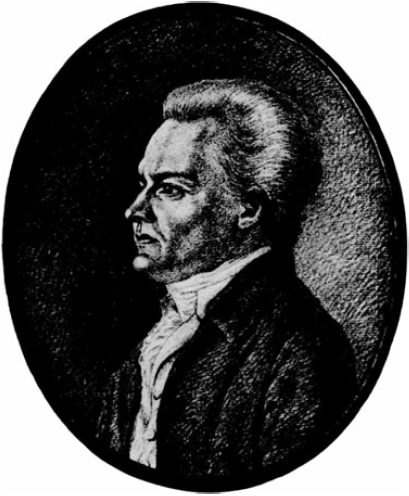
On 2 April 1786, Francisco de Miranda (figure 1), a Venezuelan Creole celebrated as the ‘Precursor’ of Latin American independence, entered the port of Ragusa (today Dubrovnik, Croatia) after a rough voyage along the Adriatic coast. Miranda’s transatlantic odyssey had begun five years earlier, when he was banished from Spanish America for participating in a Jamaican–Cuban smuggling cartel at the height of the American War of Independence. The Venezuelan Creole chose to turn his political exile into an opportunity for extensive travels in North America and Europe, where he sought to enlist support for his deepening confrontation with Spain.Footnote 1 After traversing the newly emancipated United States in late 1783 and 1784, where he met several US revolutionary war heroes, Miranda spent the next year touring the Dutch Republic, various German principalities, Austria, and Italy. Over the course of 1786, he travelled to different parts of the Ottoman empire before boarding a ship to Kherson at the mouth of the Dnieper river on his way to the Russian capital of Saint Petersburg.
Francisco de Miranda, c. 1788. Source: Francisco de Miranda, Archivo del general Miranda, vol. 2: Viajes. Diarios, 1785–1787 (Caracas: Editorial Suramérica, 1929).

With his arrival in Ragusa, Miranda became one of the first Creoles (descendants of Europeans born in the Americas) to ever visit the Balkan peninsula. Usually considered peripheral to his subsequent revolutionary activity, this trip to the Balkans, Anatolia, and Novorossiya has not received careful attention from Western historians. In their emphasis on Miranda’s participation in three major Atlantic revolutionary theatres (the United States, France, and Venezuela), biographers choose either to neglect Miranda’s Balkan episode or to sandwich it between ostensibly more important travels to North America, western Europe, and Russia.Footnote 2 Concomitantly, Miranda’s Balkan encounters are absent from analyses of his gradual evolution as a Creole revolutionary from the 1780s to the early 1800s.Footnote 3 Most Atlantic-centred biographies depict him as a secular revolutionary with a fully formed anti-imperial agenda at the outbreak of the American Revolution. In this interpretation, Miranda’s later explorations of south-eastern Europe do not represent particularly meaningful political contributions to his revolutionary career; they are merely waystations on a journey from one Atlantic revolutionary battlefield – North America in the early 1780s – to another – France in the early 1790s, where Miranda led the unsuccessful siege of Maastricht in the French revolutionary campaign of 1792–93. Nor do Miranda’s Balkan crossings inform the interpretation of his final revolutionary activities, his unsuccessful attempt to emancipate Venezuela with the help of British and North American liaisons in 1806, his failed project to do so in 1808, and his participation in the First Republic of Venezuela in 1811–12, for which he acquired the epithet of the ‘Precursor’ of Latin American independence.
Resisting the tendency to read Miranda as an exclusively ‘Atlantic’ agent, this article explores his political interactions in south-eastern Europe to argue that his Balkan trip played a formative role in his emergence as a revolutionary. This example also pushes back against a recurrent tendency of Atlantic historiography to marginalize revolutionary developments in south-eastern Europe.Footnote 4 Foregrounding Miranda’s Balkan encounters in 1786 alters our perception of his emergence as a revolutionary agent in three important ways. First, it was during his trip to the Balkans that Miranda articulated his most vehement criticism of ‘imperial despotism’ as a set of oppressive policies which imposed heavy taxation on local populations, limited the movement of locals and foreigners, and institutionalized a system of ethnic and/or religious discrimination.Footnote 5 Though he voiced his first critique of imperial despotism during the American Revolution, he did not specify what he meant by this concept, nor did he elaborate on its importance within his revolutionary ideology. While his North American interlocutors implicated Miranda in a ploy to overthrow Spanish ‘despotism’ in the Americas, the Creole left no evidence of his intentions to do so, either in his personal diary or in his epistolary correspondence. In fact, during a secret interaction with the French consul-general in Philadelphia, Miranda seemed to suggest various strategies for preventing a colonial insurgency, in a careful move to appease his antagonists.
Not until visiting the Balkans and interacting with a set of local and foreign agents did Miranda leave unequivocal first-hand evidence of formulating a sustained programmatic critique of imperial despotism, a critique which informed his ultimate break with Spain in 1787–88 and, in important ways, prefigured his subsequent revolutionary activism. Echoing widespread grievances of Balkan notables and foreign consuls, his condemnation of the heavy Ottoman tax impositions and of how Ottoman authorities treated non-Muslims adumbrated programmatic points he articulated in his later opposition to Spanish ‘despotism’ and imperial decadence in the Americas, notably during his failed 1806 expedition to Venezuela.Footnote 6 Unlike other Creole revolutionaries deploying the discourse of despotism in their anti-imperial struggles, Miranda’s critique of despotic rule stemmed to a significant degree from his actual experiences with Ottoman and Russian authorities in the late 1780s.Footnote 7 During his Balkan trip, Miranda encountered various autochthonous and religious models for resisting Ottoman rule, which formed intriguing antecedents to his later plans to introduce indigenous political elements in an emancipated Venezuelan republic.
This article’s second intervention is to regard Miranda’s resistance to the notion of imperial despotism not as a fixed ideological commitment but as an evolving process significantly shaped by his consular and diplomatic communications. Before his trip to the Balkans, Miranda avoided leaving evidence of his critique of Spanish imperialism, possibly for fear of being surveilled or apprehended by Spanish diplomats, or in the hope of remedying his relationship with Spain. Only after reaching south-eastern Europe, a region where Spain lacked consular or diplomatic representatives, did he incontrovertibly express his programmatic resistance to the set of imperial practices he called ‘despotism’.
Miranda’s political activities in the Balkans defied the traditional image of an Atlantic revolutionary, a Habermasian agent utilizing the power of print to incite revolutionary action.Footnote 8 Miranda’s interactions in this region were politically significant – for both the Creole and his interlocutors – not because he disseminated political pamphlets, newspapers, and broadsheets but for the very opposite reason: his highly personalized, indeed institutionalized, use of secrecy in consular communications. Miranda strategically used secrecy, especially with the widespread European consular staff across the Ottoman Balkans, to mediate critique of imperial impositions, discriminating quarantines, and arbitrary discrimination against foreigners or local Christians.
As Miranda lacked the linguistic capacity to communicate with local populations or the Ottoman authorities, European consuls and local notables acted as his intermediaries, influencing his travel arrangements and informing his ideas. According to his diary, almost every contact or interaction he had in the Balkans occurred in the presence, with the mediation, or under the protection of European consuls, foreign officials with particularly wide-ranging privileges at the Ottoman Porte.Footnote 9 Owing to their hybrid nature as quasi-diplomatic officials, civil servants, and foreign spies, consuls (the representatives of merchants and citizens of one state in other nations) played a complex role throughout Miranda’s trans-Atlantic exile. While his journeys in North America and western Europe confronted the Creole with hostile consuls surveilling his actions, his trip across the Ottoman empire exposed him to a different consular institution which derived its authority from ancient popular memory and a religiously informed emancipatory agenda. With their spread across the Ottoman empire in the late eighteenth century, foreign consulates had begun to act as protectors of local Christian populations as well as their own national merchants, enabling European centres to extend their imperial reach.
In the Balkans, consular institutions became crucial political vectors in Miranda’s travels. Consuls guided and protected Miranda on his way into, out of, and across imperial spaces, and helped shape his political vocabulary and public perception as a revolutionary.Footnote 10 The Balkan consuls’ highly politicized interactions with Miranda demonstrate that the common emphasis on print and ‘legacies’ of revolutionary movements in North America and western Europe fails to account for what made his south-eastern explorations significant. Instead, by interrogating Miranda’s Balkan encounters through a consular lens from the trans-Atlantic south-east, the article uncovers the neglected importance of common institutional forces that helped internationalize incipient projects for revolutionizing the Balkans and Latin America in the first decades of the Age of Revolution.Footnote 11
It is the third major intervention of this article to regard the Balkans not as a space ‘in between’ Miranda’s Atlantic activism and his explorations of the Russian empire, but as an important region whose consuls, officials, and locals informed his resistance against imperial despotism, his growing involvement with the Russian empire, and his ultimate break with Spain. Shedding more light on Miranda’s journey to the Balkans will contextualize his gradual emergence as an anti-imperial agent at what many considered the European periphery, prior to his break with Spain and his direct involvement in revolutionary action in France and South America. Miranda’s emergence as a south-eastern revolutionary helps to place interactions between two regions traditionally conceived of as separate ‘peripheries’ at the heart of a more integrated analysis of the global Age of Revolution.Footnote 12 By charting how notions of imperial despotism came to animate revolutionary activism in South America and south-eastern Europe – whether during actual transatlantic crossings, via the circulation of rumours, or with the dissemination of print – historians can begin to account for why these two distant regions simultaneously became the hotbeds of revolutionary movements seeking to topple centuries-old imperial systems in the early nineteenth century.
To examine Miranda’s Balkan explorations as an inflection point in his revolutionary career, the article begins with the prelude to his Balkan explorations, his tour of North America, to show his initial inexperience in negotiating his resistance to imperial ‘despotism’ with foreign consuls. It then examines his trip to the Balkans before showing how that trip enables historians to reconsider the place of the Balkans in Miranda’s biography, as well as in the history of the global Age of Revolution. Drawing on new evidence from Spanish consular archives, the article’s conclusion suggests that Miranda’s landmark 1806 expedition to Venezuela bore striking parallels to his earlier explorations of the Balkans and the United States, even though he failed to fully capitalize on the structural similarities between these distant revolutionary spaces. In sum, situating Miranda’s forgotten Balkan explorations in the context of his revolutionary career reminds historians that the Age of Revolution involved connections not just across the Atlantic, but also into south-eastern Europe and the Ottoman empire. Finally, Miranda’s Balkan journeys remind historians to pay attention to institutions of people, as well as print, as channels of revolutionary change. Consular communications were particularly important (if poorly understood) institutional catalysts for mobilizing revolutionary ferment across the Atlantic divide in an age of revolution.Footnote 13
The prelude: Miranda’s first consular encounters
To grasp the political stakes of Francisco de Miranda’s encounter with the Balkans, it is instructive to consider the wider political and diplomatic context that brought the Creole to the difficult – and reluctant – decision to embark on his 1786 voyage to Ragusa. As early as 1781–82, Miranda was a military officer fighting on the side of Spain in the US Revolutionary War; yet Spanish authorities charged him with smuggling Jamaican goods and disobeying military orders. After the termination of wartime hostilities, Miranda embarked upon the first part of his decades-long exile from Spanish America, which saw him touring the recently emancipated United States in 1783–84 in an attempt to enlist allies or find intermediaries in his confrontation with Spain.
While scholars relying on later accounts by US revolutionary leaders have come to regard Miranda’s North American explorations as the first act in the career of a fully formed Atlantic revolutionary, Miranda’s diary, epistolary correspondence, and later writings challenge such an interpretation.Footnote 14 Though his North American interlocutors implicated him in multiple plots to overthrow Spanish ‘despotism’, his diary contains no information about similar proceedings. Only once does it register his attitude toward despotism, in a rather abstract reference to ‘the advantages of a free government, in comparison with any other despotism’.Footnote 15 Miranda’s initial reluctance to refer to despotism in his diary reveals his careful attitude toward the Spanish empire because mediation with the Spanish authorities did not yet seem out of reach.
Perhaps the best evidence for Miranda’s initial ambivalence to publicly profess his antipathy toward Spanish imperial rule comes from his exchange with the French consul-general in Philadelphia, François Barbé-Marbois. Given France’s alliance with Spain and the United States during the American Revolution, Miranda’s attempt to enlist Barbé-Marbois as his intermediary testifies to the Creole’s early interest in utilizing diplomatic and consular networks to further his political ambitions.Footnote 16 Unlike the public office of a diplomat, the office of the consul – a modern surveillance agent operating at a non-diplomatic level – provided the perfect avenue for an exile seeking to enlist potential allies in a loosely defined political project. The lack of diplomatic precedents for foreign representatives in the recently emancipated United States allowed Miranda to subvert diplomatic protocol by corresponding with the powerful consul without the knowledge of the French minister. In contrast to the French ambassador, Anne-Cézar de la Luzerne, ‘a man of enlightenment, generosity, and mild manners, but weak and without an ability for his office’, Miranda described Consul Barbé-Marbois as a powerful information-broker and ‘the mentor who manages everything’.Footnote 17
Lacking any experience in consular affairs, Miranda attempted to use this unclear diplomatic hierarchy to his own advantage during a private meeting with Barbé-Marbois. According to Barbé-Marbois’s memoirs, published more than four decades after their encounter, Miranda presented an extensive account of his fallout with Spain during their rendezvous in Philadelphia: ‘Our American kingdoms will soon experience a revolution similar to the one which you have witnessed here’, the Creole predicted. ‘A wise and prudent government might moderate its violence or delay its effects. But such warnings only offend ministers. They have a great aversion for all wisdom except their own, and they always make those advisers, who are too well informed for them, feel their anger.’ This was Miranda’s suggestive nod to the consul-general to work together without the involvement of Luzerne, keeping their correspondence secret. Far from plotting an insurrection, Barbé-Marbois believed that Miranda wished to enlist his support in mediating with recalcitrant Spanish officials whose discriminatory policies risked stirring indigenous discontent. ‘I have told them that the rising of the Mexican Indians in 1778 was a warning of the highest importance’, Miranda reportedly told the consul. ‘I have spoken of admitting foreigners into all our colonies. From the manner in which this proposal was received, I have thought it prudent to fly, as if I had been guilty of a crime.’Footnote 18
Miranda wished to circumvent the French minister, whose official diplomatic character would inevitably expose the Creole’s intentions to hostile Spanish officials. Certainly, he used the interview with the consul not just to test the reach and scope of foreign consular networks but also to articulate his nascent discontent with Spanish rule. At this early point in his exile, Miranda was already learning how to present different political projects to different interlocutors; he was still far from the committed revolutionary who fought French and Spanish monarchists in the 1790s and 1800s. Instead of preparing a revolution in Spanish America, as Miranda’s US interlocutors interpreted his words and actions, Barbé-Marbois depicted the Creole as actively trying to prevent an impending indigenous insurgency by introducing imperial reforms such as legalizing the immigration of foreigners. In his later reflections on the subject, Barbé-Marbois in fact sympathized with Miranda’s opposition to the Spanish diplomatic corps, stressing the need for reforming the Spanish system of ‘absolute despotism’ to avoid ‘a general insurrection of the aborigines, and even of the colonists’.Footnote 19
Despite the seeming ideological agreement between the consul and the exile, Barbé-Marbois could not prevent this information from circulating to the French minister, ultimately compromising the Creole. Appalled by Barbé-Marbois’s inability to keep their conversation secret, Miranda described his adversary as an ‘idiot’ whose ‘talents and abilities were completely underwhelming’. His changing attitude toward Barbé-Marbois was understandable for, as he explained in his diary, the consul’s ‘thousand gossips and political plots’ made Miranda’s stay in the United States unfeasible. The French consul’s surveillance threatened to expose or exaggerate Miranda’s plans to overthrow Spanish American rule. Barbé-Marbois’s ‘plots and snarls’ jeopardized Miranda’s further explorations in North America, precipitating the Creole’s decision to board a ship to England.Footnote 20
In the hope of enlisting the French consul as an intermediary in his confrontation with Spanish authorities, Miranda exposed his apprehensions about the Spanish colonial system to foreign surveillance and public dissemination. His misjudgement in his first consular encounter cost him dearly: it would be two decades before he could return to the continent to prepare his 1806 expedition to emancipate Venezuela. Even though Miranda’s first consular encounter failed, however, this diplomatic debacle provided his first insights into how consular services worked.
After his interaction with Barbé-Marbois, Miranda would not only increase his understanding of how diplomatic and consular networks functioned, but also use them to further his travel arrangements, social acquaintances, and political goals. Immediately after his arrival in Britain, he enlisted the assistance of a US diplomat, who helped him evade the surveillance of his Bourbon antagonists.Footnote 21 Owing to the extensive Bourbon consular and diplomatic networks across western Europe, Miranda was unable to fully escape the scrutiny of his adversaries as he boarded a ship to the Dutch Republic, whereafter he travelled to Prussia, Westphalia, Saxony, and Austria before spending several months in the Apennines. As long as he remained in these countries, he could not be certain whether foreign consuls could obtain an order for his apprehension. Nowhere was this threat greater than in the Italian peninsula, a haven for exiled Spanish American Jesuits holding a grudge against Madrid, and also a region featuring an especially dense Spanish consular network.Footnote 22 Remaining vigilant about a hostile consular intervention, Miranda nonetheless noted the receipt of a list of exiled Jesuits in his diary containing, among others, the name of the Peruvian Creole Juan Pablo Viscardo y Guzmán, whose private Letter to the Spanish Americans Miranda would print and disseminate in his failed expedition to Venezuela in 1806.Footnote 23
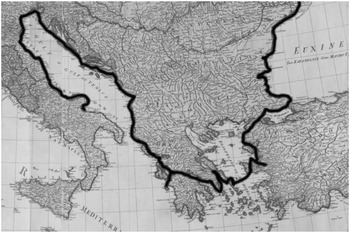
In contrast to his sojourns in the United States and western Europe, Miranda’s next destination, the Balkans, provided a region in which the Creole exile did not have to fear the constant surveillance of the Spanish consular staff, and where he could witness consulship’s potential to channel local discontent against imperial rule. While preparing for his journey in the port of Barletta, near the birthplace of modern consular institutions, Miranda recorded reading some recent works on the Balkans, akin to many learned travellers at the time.Footnote 24 The biased French works influenced him: shortly after reading François de Tott’s book on oriental tyrannies, he wrote of how the ‘despotism [of the Apulian governor] has never ceased to maltreat and oppress this poor people’.Footnote 25 This was among Miranda’s earliest references to despotism in his diaries following the aforementioned conversation in Philadelphia and a remark he had made about the Venetian government as ‘a despotism disguised in a Wig and black robe’.Footnote 26 Even though despotism had only tangentially surfaced in his diary during his American trip, the concept began to permeate his writings as he prepared to visit the Balkans, the door to the Orient that fascinated many Western readers in the Age of Revolution (see figure 2).
Miranda’s trip to south-east Europe. Source: William Faden, Map of the Mediterranean Sea with the Adjacent Regions and Seas in Europe, Asia and Africa (1785).

Miranda’s Balkan connection: oriental despotism and the articulation of anti-imperial critique
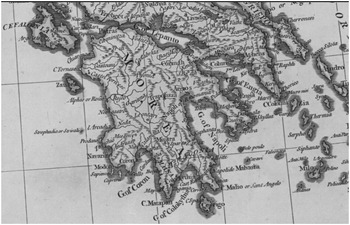
Because Miranda did not know any of the local languages spoken in these westernmost reaches of the Ottoman empire, he depended almost entirely on foreign consuls’ services. In Ragusa, the Russian vice-consul showed him the town’s major historic sites and satisfied his penchant for ancient history. Several days later, Miranda befriended Christopher Basich, the Ragusan consul to Morea (the Peloponnese), who took him on a trip to Zante (Zakynthos) and Patras on the Peloponnesian peninsula (figure 3). There, he met the resident Dutch and Russian consuls, Giorgio Paul and Christophoros Comnenos, ‘a merchant … of Greek origin, and who has served a long time in Russia, a man of instruction, travelling and the world’.Footnote 27
Morea (Peloponnese) with Patras, Zakynthos (Zante), Corinth, and Athens. Source: Faden, Map of the Mediterranean Sea.

While northern and western European consuls had resided in Greece for several centuries, the predominance of Russian consuls in this region was a new development.Footnote 28 Through the Treaty of Küçük Kaynarca (today Kaynardzha, Bulgaria) in 1774, the Russian empire acquired the right to appoint its consuls throughout the Ottoman domains.Footnote 29 Russian officials quickly appointed consuls to the Balkans as well as various islands in the Mediterranean and the Adriatic.Footnote 30 As the first Orthodox consuls in the Ottoman empire, these imperial agents used Russia’s naval and military might, as well its religious affiliation with Balkan Christians, to acquire the role of multinational protectors of Orthodox Christianity at the Porte.Footnote 31 Unlike other imperial powers, Russia emphasized its religious links to Balkan Christians over national affiliation, thereby co-opting local people to act as its consular agents. Over the next century, these multi-ethnic Orthodox consulates under Russian tutelage would come to play a crucial role in the successive independence struggles of Serbia, Greece, Romania, and Bulgaria against the Ottoman empire.Footnote 32
As a result of these Russian innovations of consulship, Miranda encountered a different political constellation from that in western Europe. Although he failed to fully grasp these local political intricacies, his diaries did register Russia’s increasingly dominant consular presence in the Balkans. In fact, the very trajectory of his trip from Ragusa through Greece and the Aegean to Anatolia and thence to Novorossiya shows how an expanding modern Russian consular network was already shaping foreign perspectives on south-east Europe. The Balkans became the first region that brought Miranda into the orbit of the Russian empire, which would later come to play an important role in his final break with Spain.
From acquainting the Creole with local notables to mediating with the Ottoman authorities and accompanying him on his trips to ancient monuments, consuls acted as Miranda’s protectors against the dispositions of Ottoman officials. Rather than being confined to the world of high diplomacy, consuls’ middling position enabled them to introduce Miranda to local elites, who represented a curious amalgam of French, British, and local Christian merchants. Linked by marriage and interest, these commercial elites recruited Miranda in their struggle against political authorities such as the Venetian nobles who held a loosening control over local politics in Ragusa and the adjacent Ionian islands.Footnote 33
The resistance of these mercantile circles to foreign dominion clearly resonated with the expulsed Creole. After leaving Dubrovnik, Miranda reported that the local Ottoman authorities at Zakynthos would not let a new consul disembark ‘as he came from Ragusa’, prompting the consul to seek refuge in the house of a Venetian noble. Navigating a complex relationship with the Porte, the consuls of the maritime republic used their affiliations with Venice to exert pressure on the Ottoman authorities. The same port authorities in Zakynthos who denied the Ragusan consul entry into the town, and who quarantined Miranda ‘as if infected with the plague’, apparently allowed the sailors of quarantined ships to ‘go on land to do their business’, eliciting Miranda’s comment: ‘You can see what a burlesque this health board is!’ He concluded:
But this should come as no surprise to those who know that this State is governed by miserable, vicious, and vain Venetians who leave the Senate [the local municipal body] so as not to die from hunger, bringing with them all the vices, which they compound to those of the already extremely corrupt State; I have never seen more presumptuous and vain devils than the Jews of the board of health here, when they sit pro tribunale on that miserable bank.Footnote 34
Regarding the health boards as corrupt foreign bodies instituted to oppress local merchants, Miranda employed the religiously and ethnically charged language of anti-Semitism to accentuate his critique of these ‘despotic’ establishments. In his first observations from the region, he had already linked his critique of imperial impositions with a discriminating attitude toward an ethnic and religious minority, despite the fact that Jewish populations suffered strong quarantine regulations, and often became the scapegoats for epidemic outbreaks among the Christian population.
Miranda’s criticism of the Venetian elites in Ionia and Dalmatia, including his anti-Semitic comment, marks both a departure from the more xenophilic attitude in his conversation with Barbé-Marbois, and an antecedent to his later attacks on the privileges enjoyed by peninsular Spaniards in the Americas.Footnote 35 Even though Miranda still considered himself a Spanish subject,Footnote 36 his resentment against imperial impositions, especially taxation and ethnic or religious discrimination, increased the further he travelled into the eastern parts of Europe. In Ragusa, he observed that
this republic pays to the Great Signor 28,000 coins, which tribute, if considered as an equivalent to the privileges it enjoys in the Turkish ports, is more of a commercial stipulation than anything else. The amount of its mercantile voyages does not even reach 200 and with all this they live comfortably and luxuriously amid these rocks. Here, the advantages of a republican government, however bad it may be, can be seen.Footnote 37
In Patras, too, Miranda observed the ‘decadence of that city’, whose Turkish governor and Greek primados ‘distributed among the peoples of their nation the respective quota of the payment of contributions frequently imposed to the Town (Pueblo) by the Court in Constantinople’. He reported a similar decline in Corinth, a town that had witnessed a major ‘revolution in 1770’ following the arrival of a Russian admiral. Within a decade, Ottoman mismanagement and suppression of local autonomy had decimated the population and its economy.Footnote 38
As a Spanish American Creole who had faced Spain’s imposing colonial regulations known as the Bourbon reforms – a set of policies that aimed to extract greater taxes and exert stronger metropolitan control over Creoles – Miranda empathized with local merchants and consuls chafing under Ottoman regulations and discriminatory imperial policies. His encounter with the Ottoman Balkans reinforced his resentment of heavy taxes levied by an imperial sovereign, while his trip to the vibrant maritime republic of Ragusa strengthened his belief in the superiority of republican institutions over a monarchy. The burdensome Ottoman tax impositions provoked Miranda’s criticism of foreign imperial rule and crystallized his defence of republican self-government, a conviction which would gradually culminate in his support of Spanish American republicanism. While he had made similar observations in the United States, he had not related them to the presence of a foreign imperial overlord, as the United States had just won their independence from Britain. In the Balkans, the imperial presence of the ‘decadent’ Ottomans alongside the practice of local self-governance linked Miranda’s critique of imperial impositions and regulations with his emphasis on the superiority of republican institutions.
The Creole also critiqued Ottoman authorities’ double standard when treating Muslim and Orthodox populations. While most of his biographers have pointed to Miranda’s secular outlook as a static component of his revolutionary activism, his explorations of the Balkans suggest otherwise.Footnote 39 Religion, too, shaped his gradually evolving language of anti-imperial critique, and not necessarily just as a foil for his secular ideology. Certainly, Miranda found plenty of occasions – especially in the Balkans – to criticize religion as an agent of ‘imperial despotism’, as a force actively oppressing local populations. In the town of Corinth, for example, he complained of ‘a Crazy Turk who makes noise all day in the street with a Tambourine’. The local authorities, he continued, ‘let these people do whatever they want because of their religion, and if someone wants to do to them even the most negligible [thing], they would suffer badly’. On his way from Corinth to Athens, Miranda boarded a Greek barge with ‘various poor people’, but it was one mendicant Turk travelling with his family that ‘really annoyed’ him and his companions. ‘[T]his rascal, however, (only due to being Turkish) purported to fully command the voyage’, triggering Miranda’s condemnation of inherited privilege and ethnic discrimination.Footnote 40 In the company of local Orthodox notables and foreign consuls, Miranda came to share their resentment at how religion trumped ethnic and class distinctions in the Ottoman empire.
Miranda’s diary suggests that, rather than being a merely secular observer of how religion informed political choices and opportunities in the Balkans, the Creole actively interacted and identified with the set of Christian consuls acting as his protectors. While Christian consuls’ distancing from Muslims precipitated Miranda’s increasingly hostile attitudes toward non-Christians, their active participation in Orthodox communal life helped involve him more directly with local religious politics. One of the consuls’ most strikingly political appearances in Miranda’s diary had nothing to do with their mediation with Ottoman authorities but in fact took place during a wedding procession in the Peloponnesian town of Patras:
The day before the Betrothal, the bride went to the local bathhouse with a great company of women to wash her well, then a great cavalcade to drive the groom (who lives 24 miles from here) to the City and throughout, music in the house of the bride; until the day of the Betrothal when all the Consuls and persons of distinction were invited to attend to the performance.Footnote 41
Unlike the Americas, where the memory of consulship had been absent from political discourse prior to the American Revolution, the distinguished part that consuls played in the Patras wedding procession shows that these officials had already become established components of the local community.Footnote 42 Furthermore, the consciously political act of assembling the corps consulaire in one place and for a specific occasion elided the significant differences between the various imperial powers, projecting their combined authority as an important legitimating element in the protection of Christian populations in a region marked by religious tension and inter-imperial rivalry.Footnote 43
A highlight of Miranda’s trip to the Balkans, the Patras wedding ceremony featuring consuls at the heart of the local community was a distinct sociopolitical phenomenon. In their role as protectors of the local Christian community, consuls acted as potent agents who transformed local sociability into political action and articulated a form of autonomy that explicitly excluded the imperial state. This, in turn, made their anti-despotic rhetoric even more palatable to Miranda, whose diary illustrated his growing immersion in consular networks and their institutional imaginaries. Having introduced Miranda to the everyday dynamics of Balkan sociability, consuls and local mercantile elites continued to guide the traveller through the sea- and landscapes of the Peloponnese and the adjacent islands. In the following days, the resident Dutch consul and a handful of local Greek merchants accompanied Miranda on a trip to Athens. The Creole marvelled at the ancient Greek ruins as a French merchant began ‘speaking a lot about antiquity, giving way to the imagination on all of the most interesting events in Greek history’. Overlooking the ruins of Themistocles and Kimon from the French consular house, it was easy for Miranda to experience a transcendent link between the past and the present, a link strategically politicized by Balkan Christians in their incipient revolutionary projects. In a period when Balkan Christian elites began to express great interest in reviving the ancient polities they had once established, the presence of foreign consuls provided them with the means to (re-)write their own history.Footnote 44
If anything, Miranda’s experiences with the French consulate in Athens and the wedding procession in Patras suggest that the dynamics of consular agency defy current explanations of anti-imperial political mobilization, which tend to underplay the importance of inter-imperial diplomatic and consular networks compared to the emergence of national print culture and the dissemination of new Western political ideas to global peripheries. Yet, as Miranda experienced at first hand, the power of the consulate in pre-revolutionary Ragusa and Morea lay not in its novelty but precisely in its evocation of an imagined past. Consuls claimed the consular institution as one ‘forever’ present in local life to contest the power of a foreign imperial elite that dominated Peloponnesian politics. Balkan merchants had, for seemingly immemorial time, organized themselves along familial links with ‘consuls’ presiding as corporate heads.Footnote 45 As members of the collective political body, consuls challenged the nature of the foreign political power ruling Peloponnesians and Ragusans from afar, in a mode of critique echoing Miranda’s indignation at Spanish discrimination against Creoles. In the company of these foreign and native consuls as well as their mercantile partners, local Christians began wondering why Ragusa, a thriving maritime republic, had become the retirement home for venal Venetian nobles, and why the Peloponnese, the site of ancient Greek greatness, had become the hospital for ailing foreigners and corrupt imperial officials. Sharpened by the presence of foreign consuls amid autochthonous Balkan communities, these questions on the nature of political authority permeated the writings of the visiting Creole. Far from complying with Atlantic modes of governance, these local forms of political mobilization showcased the ancient roots of autochthonous politics, a political element that Miranda had not expanded upon in his previous explorations. His first comprehensive plan for a new South American government, composed in 1790, featured similar autochthonous elements (an Inca ruler and cacique deputies) at the heart of a republican government blending ancient and modern institutions.Footnote 46
During Miranda’s Balkan tour, the consuls’ protection constantly distanced and alienated him from the Muslim population, fuelling his critique of imperial despotism. During his subsequent journeys to the Aegean, Anatolia, and Constantinople, Miranda became increasingly critical of their religious biases, as he distanced himself from the Balkan consulates.Footnote 47 If the Creole initially regarded consular protection as a mitigation of imperial excesses, he also came to appreciate that consulship itself entailed a higher inter-ethnic distancing across the empire. On 19 July 1786, as Miranda passed the island of Mykonos, he contrasted the Ottomans’ discriminatory attitudes toward western Europeans with their equitable treatment of people of colour: ‘it is worth noting the equality with which this nation admits and treats blacks, at the same time they despise and cannot suffer the Franks!’Footnote 48 During his sojourn in Constantinople following his departure from Greece, Miranda complained that ‘Nobody wanted to get close to me tonight, because I had been aboard the Turkish War Ships and this is the reason why many travelling here return without seeing the interior of Constantinople, nor deal with the Turks.’ He continued, ‘There are even people, to my knowledge, that have lived for more than fourteen years here and have never set foot in Constantinople.’Footnote 49 Tasked with overseeing naval quarantines, equipped with corporate immunities at the Porte, and invested in the imperial protection of their subjects in the Ottoman empire, the European officials with whom Miranda interacted distanced themselves from the South American as they likely feared he might be carrying a contagious disease contracted during his interactions on board the Turkish vessels.Footnote 50
Nowhere was this peculiar distancing between European officials and local Muslims more prominent than in the Ottoman capital. Miranda wrote:
I was surprised at the beginning to see the little or no knowledge of the City that the people and in particular the Dragomans [diplomatic secretaries] have, who are the universal guides … from which it follows that almost all the travellers … take a Dragoman as a Mentor, believing they know the Government or the Nation, as if one could give what one doesn’t have.Footnote 51
Accustomed to consuls’ wide-ranging privileges in the Ottoman empire, Miranda was struck at just how different and distant the behaviour of European dragomans in Constantinople seemed by comparison.Footnote 52 Stationed in the imperial capital, the European officials represented an altogether peculiar group to Miranda, whose previous interactions with consuls in the Balkans had suggested a more intimate, if far from unproblematic, involvement of consuls in inter-confessional and inter-imperial affairs.
Rather than marking a radical break in his political exile, Miranda’s subsequent trip to Russia built on his previous experiences in the Balkans. A Russian consular passport from Constantinople enabled him to navigate the highly delicate Russian–Ottoman borderlands, while a consular letter of introduction shortened his quarantine at the Russian port of Kherson and enabled him to expand his network of acquaintances in the new imperial periphery of Novorossiya.Footnote 53 Relying on information from his foreign acquaintances, Miranda deplored the relocation of Tatars, Greeks, and Armenians from this region as examples of ‘oriental despotism’.Footnote 54 During his stay at Kherson, Miranda also found an unlikely ally in his opposition to imperial despotism in the Orthodox archbishop Eugenios Voulgaris, a progenitor of the Greek struggle for independence from the Ottoman empire.Footnote 55 Despite his great aversion to religious authority, the Creole described Voulgaris as a man of ‘most amicable character’ whose ‘neat and venerable tonsure … and beard gave his bust a perfect Greek air’. In Voulgaris’s image, Miranda ‘thought to have seen the exact original marble that the illustrious ancient artists have given us of that same nation’. Though Miranda did not expand on the nature of their relationship, he did note his reception of two of Voulgaris’s writings (Abregé cronologique des Peuples qui ont habité les bords de la Mer Noire and Réflexions sur l’état critique actuel de la puissance ottomane), which argued for foreign support of Greek independence from the Ottomans. He also praised Voulgaris’s Réflexions sur l’état critique actuel de la puissance ottomane (1774) as a work ‘written with much taste and knowledge’.Footnote 56
Having become the main theme of Miranda’s interactions in the Ottoman empire, imperial despotism also informed his exploration of Russia as he travelled from Kherson to Kiev on his way to Saint Petersburg. When he reached the Russian imperial capital, he deployed his aversion to oriental despotism in order to convince the resident Spanish officials that he was not communicating any revolutionary ideas to the Russian court. Amid rumours that the Creole was about to use Russian diplomatic support to reach Spanish America by way of the Bering Strait and revolutionize the continent, his attempt to distance himself from Russia failed to convince his Spanish adversaries. Nevertheless, even after Miranda failed to appease Spain, he still used the services of the Russian consular and diplomatic services in northern Europe, skilfully evading the expansive Spanish consular reach across the region.Footnote 57 Reflecting on his entire south-eastern journey from Ragusa to Constantinople, and thence to Saint Petersburg and Paris, Miranda later confessed that the Russian consular and diplomatic protection he had come to enjoy during his travels had been the only reason why he returned to western Europe alive and well.Footnote 58
But in the high summer of 1786, as he was taking a last look at the Sea of Marmara at the intersection of the Balkans and Anatolia, Miranda could not predict the outcome of his growing involvement with Russian consuls, or grasp the wider significance of his journey to south-east Europe. From the imposing tower of Leander overlooking the town of Scutari (Üsküdar), he beheld the surrounding ‘Castles they call Hissar, where [the Ottoman authorities] usually decapitate the Victims of Despotism, whose execution they announce by a cannon shot amid the silence of the night’, powerfully invoking the discourse of oriental despotism as the capstone of his preceding encounters.Footnote 59 Twenty years later, as he prepared to embark upon a much-anticipated revolutionary expedition to his homeland, Miranda chose an ominous name for the flagship that aimed to end Spanish despotism in the Americas: Leander.Footnote 60
Reconsidering south-east Europe in the Age of Revolution
Occurring three years before the French Revolution, Miranda’s remarks on affairs in the Balkans complicate both contemporary analyses of his emergence as a revolutionary leader and broader Northern and Western conceptual frameworks governing historical interpretations of the Age of Revolution. Several significant aspects of his Balkan trip do not fit current accounts of revolutionary activism around 1800. In his numerous encounters with Ragusan, Ionian, and Peloponnesian elites, some of whom would later play important roles in the Greek and Serbian wars of independence, Miranda made scant references to ‘print culture’, the supposed universal catalyst of revolutionary thought and action.Footnote 61 His experiences demonstrate the shortcomings of a Habermasian approach which imbued broadsheets, pamphlets, or newspapers with an agential power to effect revolutionary change, but missed persistent interpersonal modes of mobilizing revolutionary energies.Footnote 62 Miranda’s interactions with local elites revolved around letter writing and oral communication rather than published books. In mediating between distant consulates, the Creole acted as a conscious political agent who directly influenced imperial communications rather than passively consuming print materials that shaped his revolutionary worldview. If we take the example of the precursor of Latin American independence, we can conclude that US, British, or French print materials hardly influenced any of Miranda’s interactions in south-east Europe. When these powers became occasionally significant for the Creole, it was not as ideological progenitors but rather as the strategic resources through which he could articulate his growing critique of imperial systems.
Equally prominent, and equally absent from current historical accounts of Miranda as a revolutionary agent, was the strategic role of consular infrastructures which dramatically influenced his ability to travel, gain new political allies (or enemies), and form his ideas of republicanism, religion, empire, and revolution. Judging by his private correspondence and extensive diary notes, the multinational consular corps in the Balkans mediated his numerous encounters with an imperial rule undergirded by religious excess, burdensome tax impositions, and arbitrary power. Although Miranda missed some of the underlying dynamics behind the consular interactions he witnessed across south-east Europe, he did experience consulship as an institution enabling individuals to act beyond the reach of (their) imperial overlords. Certainly, he realized that the public support of local anti-imperial aspirations was not what distinguished a good consul. Revolutionary publicity was perhaps a winning strategy in the Americas, where the reach of European metropoles was always an ocean away, but it was a much more dangerous proposition in the Balkans, where contiguity to the metropole meant the possibility of swift and potentially devastating repercussions for the local populace. It was much safer to use the institutional infrastructure of a rival empire against an imperial overlord than to waste precious lives and resources in a doomed anti-imperial uprising.Footnote 63
Miranda’s diaries only hinted at how Balkan consulates were remaking a distant periphery into a major centre for negotiating the parameters of imperial sovereignty and national identity in the last decades of the eighteenth century. At a time when western European and North American elites were considering rendering consulship a secular appendage to the nation-state, Russian officials and Balkan Christian elites became particularly invested in emphasizing the institution’s religious underpinnings, its intimate relationship to the historical formation of the modern state, and its implicit potency to embody national memory and transcend secular time. Impressed by the omnipresence and seeming omnipotence of these consuls among Balkan Christians, Miranda naturally followed the consular trail that linked his travels across south-east Europe and beckoned him to the Russian–Ottoman borderlands. Consulates acted as vital nodes in Miranda’s journey into, and out of, the south-east, mediating almost every action and informing the development of his critique of imperial despotism, a major aspect of his later revolutionary activism.
Rather than being a set of marginal acquaintances in the making of an Atlantic revolutionary, the consular networks across south-east Europe played a crucial role in ensuring Miranda’s subsistence and facilitating his communications, travels, ideological commitments, and political career. Like other Creoles, Miranda did not initially cast his struggle as an anti-colonial confrontation with the metropole, and in fact continued to date his break with the Spanish empire much later than his English, US, Russian, or French co-conspirators did.Footnote 64 Having experienced the far-reaching power of consulates as modern surveillance agencies, he became adept in using these institutions to obtain passports, expand his network of acquaintances, and enlist their protection against potential imperial excesses.Footnote 65 In the company of foreign consuls and men like the Greek cleric Voulgaris, the Creole relied on oral interactions and epistolary correspondence to communicate discontent with imperial rule. Given the lingering strength of old, seemingly decadent empires, it was much safer to exploit their imperial rivalries from the outside and use consular immunity and secrecy to propagate anti-imperial sentiment.Footnote 66
In addition, Miranda’s experiences with foreign consular networks in the United States and south-east Europe taught him how to create secret networks to advance his anti-imperial propaganda. After the initial diplomatic blunders with the Jamaican smuggling cartel and the French consul-general in the United States, he used his growing diplomatic connections to evade Spanish surveillance and navigate what he came to perceive as a despotic imperial regime whose decadent symptoms resembled those of the Spanish empire itself.Footnote 67 In the 1790s, Miranda built on these experiences by erecting a secret network which combined the features of a colonial cartel, a Masonic lodge, and a consular system. This organization had its parallels in the early nineteenth-century Balkan revolutionary movements and served as the vehicle through which the Creole sought to undermine Spanish rule in the Americas.
Far from being a tangential episode in the Age of Revolution, Miranda’s trip to the Balkans thus formed a significant chapter in the political and diplomatic career of the progenitor of Latin American independence. The Balkans gave a concrete shape and dimension to the kind of ‘decadent’ and ‘despotic’ imperial rule that Miranda made it his mission to overthrow from 1790 onward. During his Balkan explorations, he became increasingly drawn to the idea of travelling further across the Ottoman empire and acquainting himself with its ‘despotic’ Russian rival to the north. Miranda’s growing network of Russian consuls and diplomats strained his relationship with Spanish officials, who suspected his complicity in Russian plans to revolutionize Spanish America via the Pacific Northwest. By the coming of the French Revolution, Miranda’s trip across eastern Europe had made him not only one of the most notorious exiled Creoles but also the figurehead for revolutionizing Spanish America.Footnote 68
The Balkans were not just Miranda’s gate to Russia, but a peculiar space where consular networks operated quite differently from both the North Atlantic powers and Russia itself, which was trying to standardize and ‘Europeanize’ its state agencies.Footnote 69 Throughout his explorations of south-east Europe, Miranda witnessed how these foreign consular networks carved out an independent political space for locals and foreigners to negotiate their relationship with the Ottoman empire. Against the imperial officials engaged in collecting taxes, imposing quarantines, or discriminating against religious or ethnic groups, the presence of consuls itself suggested the viability of an internal anti-imperial critique which acted as an everyday catalyst for local political mobilization. This was certainly a valuable impression for someone negotiating a comprehensive critique of imperial rule.
Conclusion
When studying the global Age of Revolution, Miranda’s meanderings across south-east Europe present a crucial inflection point in his career as a trans-Atlantic revolutionary, most significantly in his deployment of consular and diplomatic connections and in his articulation of anti-imperial critique ‘from the south-east’. His Balkan explorations formed part of his first decade in exile, the 1780s, a decade of exploration, of attempts to mediate with Spain, of expanding diplomatic and consular networks, of increasingly public resentment of imperial ‘despotism’, and of preparation for his revolutionary activism in France and Spanish America.Footnote 70 Over the 1790s, as he joined the French revolutionary armies, Miranda continued to rely on diplomatic and consular connections in his confrontation with ‘despotic’ counter-revolutionary governments, while cultivating an image of a trans-Atlantic traveller whose personal familiarity with ‘oriental despotism’ lent his critique of empire special credibility.Footnote 71 The critique of ‘oriental despotism’ and the strategic approach to consulship that Miranda developed during his Balkan tour also informed his revolutionary activism in Latin America, most notably his 1806 expedition to liberate Venezuela.
Miranda’s first expedition to emancipate his homeland represented a landmark event in the Age of Revolution, which scholars have hitherto examined in an exclusively Atlantic framework. During this expedition, he distributed print copies of Viscardo y Guzmán’s Letter to the Spanish Americans – a manuscript Miranda had discovered in Guzmán’s archives – which talked extensively about the necessity of overthrowing Spanish despotism in South America, ensuring equal treatment of Creoles, abandoning imperial taxes, and strengthening local governance. Despite Miranda’s dissemination of revolutionary print propaganda upon his arrival at the Venezuelan town of Coro, he failed to elicit broad support among the local population. Given widespread illiteracy, the force of religious tradition, and persisting structures of imperial governance, Miranda’s approach seemed misplaced in a region so different from North America and England and so much more similar to the political dynamics prevalent across eastern Europe.
Once we look past this dogmatic emphasis on print, however, we can see that Miranda’s failure began before he even sailed to South America. As he sought to enlist support for his Venezuelan expedition among New York merchants, smiths, and federal officials, the Spanish consul in New York, Thomas Stoughton, began closely monitoring his activities.Footnote 72 Stoughton tracked down the amount of gunpowder, guns, uniforms, saddles, pikes, and cannons supplied to the Creole and the people involved in his plot. By the time that Miranda arrived on the Spanish Main, Stoughton’s consular reports had already mobilized imperial counter-insurgency, stripping the Leander of its strategic momentum and paving the way to its doom.Footnote 73
Miranda both remembered and forgot his experiences in the Balkans. Under the influence of his English and US peers, he overestimated the revolutionary power of print and underestimated the secret surveilling power of the consul, a power he had witnessed at first hand throughout his North American and eastern European travels.Footnote 74 Though he took precautionary measures to shield himself and his co-conspirators from the consul’s surveillance, effectively self-quarantining on board the Leander, he had no way of knowing that the Spanish consular service could swiftly communicate his plan to the colonial dependencies across the Americas.Footnote 75 Miranda had been able to outpace the slow rate of Spanish consular communications in the 1780s, but by the early 1800s the capacity of these consular networks to disseminate information was no match for the ageing Creole. Even with the power of the printing press and fiery revolutionary pamphlets in hand, he failed to outsmart the discerning eyes and gossiping pens of the consuls, who continued to watch over him as he criss-crossed the Atlantic in an age of revolution, warfare, and imperial retrenchment. Unlike the 1780s and 1790s, however, Miranda could not count on foreign consuls to promote his revolutionary conspiracy and protect his freedom of movement, for the Spanish empire, unlike the Ottoman, refused to acknowledge consuls in its subordinated provinces.Footnote 76
A high point in Miranda’s revolutionary career, the Leander expedition suggested that the limitations that the Creole had first faced during his exile in North America were still firmly in place twenty years later. Although he seemed to have forgotten some of the lessons of his earliest trans-Atlantic experiences, the act of naming his flagship after the eponymous tower in the Bosporus suggests that this was not exactly the case. The naming of the Leander powerfully recalled the legacy of Miranda’s Balkan encounters at a turning point of his revolutionary career, just as he was about to undertake the emancipation of Venezuela. The Balkans had taught him how to navigate diplomatic and consular networks in negotiating his commitment to ending ‘imperial despotism’. This was a pertinent lesson in Miranda’s self-imposed isolation on board the Leander, an experience which likely recalled his long quarantines in the Ottoman and Russian empires. In his explorations of south-east Europe, Miranda had also witnessed local elites’ mode of critiquing and resisting imperial rule, and, though he did not expand on their significance in 1806, these Balkan critiques of despotism resonated with the materials he had discovered in Viscardo y Guzmán’s diplomatic archives and carried with him in print across the Atlantic.
Even as the Venezuelan Creole became increasingly drawn into the world of Atlantic politics, the legacy of the Balkans, a legacy of consular secrecy and practices of imperial ‘despotism’, continued to beckon. By the 1800s, this legacy seemed of little relevance as Miranda, catering to a Western audience, assumed the public image of an Atlantic revolutionary with a lifelong commitment to defeating Spanish imperialists. However, his diary notes from the 1780s belie this mischaracterization as they reveal a complex figure expressing a variety of attitudes towards imperial rule in the Americas and south-east Europe.
Re-evaluating this evidence, we cannot think about Miranda’s trajectory as a revolutionary activist in an exclusively Atlantic frame. The ease with which he inserted himself into Balkan politics and with which he recruited new allies in his struggle against imperial ‘despotism’ suggests the limits of a western European or Atlantic-centred approach to understanding the trans-regional and global dynamics of the Age of Revolution. If Miranda’s explorations show us anything, it is that institutionalized practices of consular secrecy and notions of decadent despotism enabled people from distant regions without pre-existing political, diplomatic, or interpersonal connections to communicate a common type of imperial critique. This revolutionary mobilization, Miranda’s diary suggests, was not confined to social elites either; it resonated with local agents in peripheral places with limited access to print materials. Understanding the mechanisms which enabled this critique of imperial despotism to criss-cross the revolutionary Atlantic can open new venues for further research into the political geography of revolutionary ferment. The fact that the major figure of Latin American independence has so far been exclusively read outside the Balkans is both a reminder of the persistence of current paradigms and a first step toward a historical reorganization of the political space of revolution.
Simeon Andonov Simeonov is a PhD candidate at Brown University. His dissertation, entitled ‘Empire of Consuls: Consulship, Sovereignty, and Empire in the Revolutionary Atlantic (1778–1848)’, explores how Atlantic consuls negotiated an international consensus on citizenship and human rights, how they shaped ideas of national sovereignty, and how they developed new practices of empire- and nation-building in the Age of Revolution. His work blends theorists of state-building with Atlantic histories of slavery and abolition and approaches to ‘new’ diplomatic history to portray the creation of the modern nation-state as a process shaped as much by ‘external’ as by ‘internal’ institutions.