INTRODUCTION
The interpretation of archaeological findings is based on knowledge and inference of events as well as the construction of the temporal sequence in which the events may have occurred. Mexican archaeology has made these associations since the end of the 19th century with the help of documentary information, stratigraphy, and ceramic typology. The association of ceramic types coincides with the so-called stratigraphic revolution within the history of Mexican archaeology. Thanks to typological and stratigraphic studies, Mexican archaeology began the establishment of relative chronologies that were paradigmatic during the 20th century.
During the mid-20th century, Mexican archaeology was in full growth. It was a period in which great discoveries were made, consolidating the relative chronology based on typological studies of ceramics. At that time, the radiocarbon (14C) absolute dating method began its development, thanks to the work of Willard F. Libby.
In Mexico, in the area of the physical sciences, basic and applied research with ion beams emerged in 1953 at the Instituto de Física of the Universidad Nacional Autónoma de México (IFUNAM), with the acquisition of a Van de Graaff accelerator, AN2000 of 2 MV, by High Voltage ECO. Shortly thereafter, in the mid-1950s, Augusto Moreno, who had worked with Willard F. Libby on the instrumentation of the proportional gas meter, set up the first 14C laboratory at IFUNAM. However, it did not achieve the expected results and disappeared soon after.
It was not until 1981 that the Instituto Nacional de Antropología e Historia (INAH) launched the first 14C liquid scintillation counting (LSC) laboratory in Mexico. Later, in 2004, the Instituto de Investigaciones Antropológicas of UNAM launched the Laboratorio Universitario de Radiocarbono (LUR), also dedicated to 14C dating with LSC. In the same year, some experiments to test the possibility of performing 14C analysis by AMS in Mexico were carried out using an isotopic separator coupled to a Pelletron 9DSH based on a 3 MV accelerator (NEC). These tests were overseen by Dr. Douglas J. Donahue of the University of Arizona, a pioneer in the use of AMS for dating with 14C (Morales Reference Morales2005). Finally, in 2013, the LEMA AMS facility was established at the Instituto de Física of UNAM (Solís et al. Reference Solís, Chávez-Lomelí, Ortiz, Huerta, Andrade and Barrios2014). Its mission is to carry out and support archaeological, geological, physical, chemical, and environmental research through 14C, 10Be, 26Al, 129I, and Pu analysis. For quality assurance of 14C dating, LEMA was granted ISO 9001:2015 testing certification by the International Management and Evaluation Society (SIGE) for the years 2017–2020.
In the area of archaeology, LEMA began joint research with the INAH to carry out interdisciplinary studies on some of the main Mexican archaeological zones. Mexico has more than 50,000 registered archaeological sites. Their temporality varies from those where the presence of the first humans in America has been evidenced, passing through the Mesoamerican cultures until Spanish colonization, and later the independent period. Climates associated with these expansive areas range from arid (northwest) in which samples are well preserved, to very wet tropical (southeast) with acidic soils in which organic materials are easily degraded.
METHODOLOGY
The LEMA AMS system is based on a 1.0 MV Tandetron from High Voltage Engineering Europa. The accelerator is coupled to two mass spectrometers, which separate the different isotopes, which in the case of carbon are 12C, 13C, and 14C.
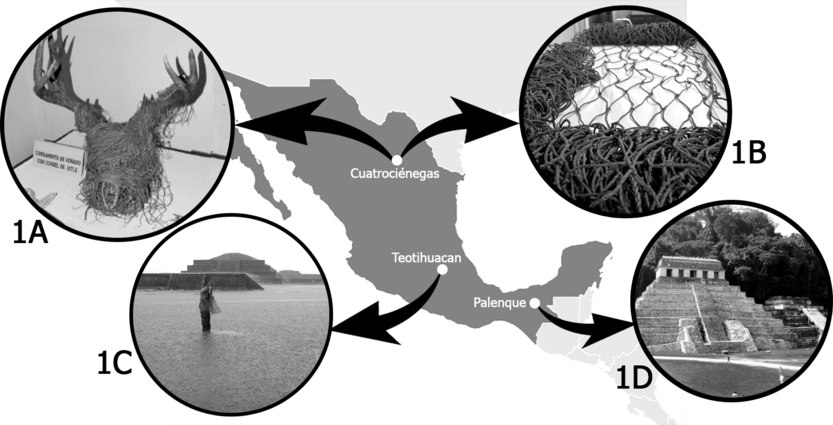
The archaeological sites selected for this study belong to three regions separated geographically and with very contrasting environmental conditions: (1) Cuatrociénegas, an arid area in the northern Chihuahua desert, whose materials were obtained from a cave; (2) Teotihuacan, probably Mesoamerica’s best-known archaeological site, located in an area with a temperate climate; and (3) Palenque, in the southern Chiapas State, characterized for being a warm and humid tropical area. The local conditions in which the materials are located make each of them unique since the preservation of these is strongly influenced by local environment. The locations of the three sites are shown in Figure 1.
Map showing the study sites of Cuatrociénegas, Teotihuacan, and Palenque. 1A: a deer antler headdress made of fibers from lechuguilla, a local agave; 1B: a net used to capture deer, made of lechuguilla fibers; 1C: the Ciudadela flooded; 1D: the Palenque archaeological site.

Materials from Cuatrociénegas belong to a ritual offering found inside a cave, probably left there in thanks for the abundant deer hunting. All materials are made of fibers from lechuguilla (Agave lechuguilla). They are part of a collection of Casa de la Cultura de Cuatrociénegas. Samples were cleaned with ultrapure water followed by a Soxhlet cleaning with hexane, 2-propanol and ethanol to remove the exogenous organic contaminants. Then a chemical treatment was used for cellulose extraction as described by Němec et al. (Reference Němec, Wacker, Hajdas and Gäggeler2010).
Bone samples taken from Teotihuacan, as well as a canine jaw and turtle carapace taken from Palenque, were processed to extract collagen, using a modified procedure of Longin (Longin Reference Longin1971; Solís et al. Reference Solís, Pérez-Andrade, Rodríguez-Ceja, Solís-Meza, Méndez, Chávez-Lomelí, Martínez-Carrillo and Mondragón2017) that included ultrafiltration to preserve only the collagen fibers greater than 30 KD. For bone samples from Teotihuacan, collagen yield was greater than 1% (weight), C/N of 2.9–3.5 and carbon content (>30% weight). This indicates a good collagen preservation and likely low levels of contamination. Human bone samples from Palenque showed high C/N values (up to 8), and very low ultra filtered collagen was recovered. Therefore, for these samples, the obtained dates correspond to the total collagen fraction that is obtained with the collagen fibers >30 KD added to the < 30 KD fibers (Solís et al. Reference Solís, Pérez-Andrade, Rodríguez-Ceja, Solís-Meza, Méndez, Chávez-Lomelí, Martínez-Carrillo and Mondragón2017).
Clean samples were processed in automated graphitization equipment (AGE III) in order to transform carbon into CO2 and then in pure graphite, that was measured in the AMS system (Solis et al. Reference Solís, Chávez-Lomelí, Ortiz, Huerta, Andrade and Barrios2014). Conventional ages were corrected for the variations of 14C in the atmosphere through time, using the OxCal v4.2.4 program (Bronk Ramsey Reference Bronk Ramsey2009, Reference Bronk Ramsey2017) and the IntCal13 calibration curve (Reimer et al. Reference Reimer, Bard, Bayliss, Beck, Blackwell, Ramsey, Grootes, Guilderson, Haflidason and Hajdas2013). Calibrated ages (BC-AD) were obtained with confidence limits of 68% (1 σ) and 95% (2 σ).
EXAMPLES
Cuatrociénegas: In Search of the First Settlements in Northern Desert of Mexico
Considered one of the centers of Arido-American culture, Cuatrociénegas is probably where the first settlers could have arrived to Mexico from the north. Local archaeological evidence of hunting and fishing indicates that the permanent abundance of freshwater encouraged human habitation several millennia ago. Previous studies report for Arido-America, various stone objects and others made with local plants, with 14C ages as old as 8000 BC (Taylor Reference Taylor1956). Human groups that left evidence of temporary occupation in Cuatrociénegas range from hunter-gatherers, the oldest, to nomadic groups at the time of the Spanish conquest. Nomads did not develop an advanced culture, nevertheless, their objects and utensils revealed the use of careful manufacturing techniques with local materials. However, no transition objects have been found, suggesting the use of previously acquired skills and techniques. It is presumed that these groups crossed the desert coming from the northeast of America. In order to complement the occupational sequence of the site, we present some AMS 14C dating of notable archeological objects from the Cave of the Antlers in the Cuatrociénegas Valley. These objects were made with plants collected most likely from the area (Figure 1).
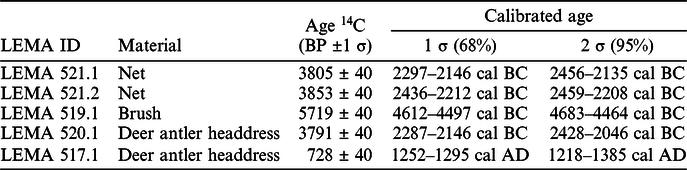
Dating results (Table 1) indicate that the Antlers-Cave recorded seasonal activities or occupations over a long period. The oldest sample has a calendar age of 4683–4464 cal BC with 95% confidence, while the most recent is between 1218 cal AD and 1385 cal AD with 95% confidence: a period of approximately 6000 years. The remarkable state of conservation of objects made with vegetable fibers is explained by the conditions of darkness, stable temperature, and very low humidity in which the objects were buried in the cave.
14C dating results for the samples from the Cave of the Antlers at Cuatrociénegas: net used to capture deer, two deer antler headdresses, and bristles that came from a paint brush, probably used for the paintings found in the cave.

Ciudadela in Teotihuacan: A Representation of the Creation Myth
Located 50 km NE of Mexico City, Teotihuacan is considered the largest urban center in Mesoamerica (close to 20 km2) in the Classical Mesoamerican period (1st–6th century AD) (Figure 1). This ancient city’s main monuments are the Sun’s Pyramid, the Moon’s Pyramid, and the La Ciudadela Complex (Spanish citadel). La Ciudadela of Teotihuacan is one of the most impressive architectural complexes. Located at the center of the site, its architecture includes the Feathered Serpent’s temple, an intermediate platform, and the Altars’ building among other notable buildings in a square of about 16,000 m2. In 2003, research and conservation work began on the Ciudadela architectural complex, which had been damaged by the 2002 floods. The excavations showed that in this complex, there was a previous sanctuary, the Pre-Ciudadela (Figure 1).
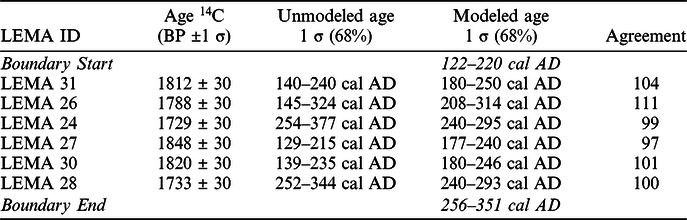
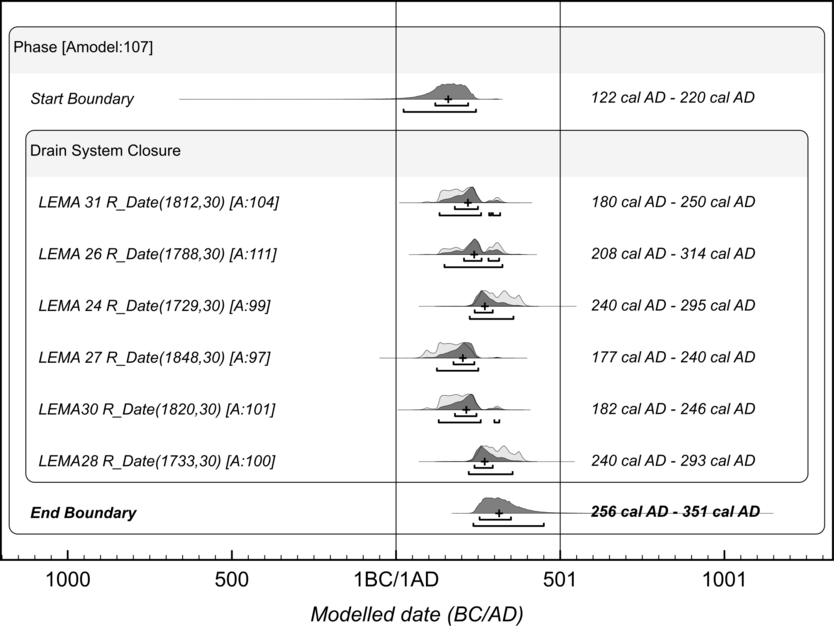
The terrain inspection resulted in the discovery of a Tunnel under the Feathered Serpent’s temple and the drain system of that complex (Gómez Chávez Reference Gómez Chávez and Rob2017). Such a drain system had been symbolically sealed by the ancient Teotihuacan people. The seals consisted of nine bodies dismembered in human sacrifices. The 14C data from six of the skeletons found in the archaeological excavations served to define an age interval of the construction of the drain system. A Bayesian model was constructed with OxCal through overlapping phase, considering the sealing of the drain as a single phase. The start and end boundaries from the obtained intervals are shown in Table 2. The modeled dates locate the closing time between 256–351 cal AD with 68% confidence (Table 2 and Figure 2).
14C dates of selected bones, unmodelled and modelled timespans calculated from the 14C dates of six bones recovered from the Pre-Ciudadela drain.

Bayesian age model of bones found at the drainage at Ciudadela, through overlapping phase made with OxCal 4.3.2 (Bronk Ramsey Reference Bronk Ramsey2009) using the IntCal13 athmospheric curve (Reimer et al. Reference Reimer, Bard, Bayliss, Beck, Blackwell, Ramsey, Grootes, Guilderson, Haflidason and Hajdas2013). Modeled output estimates the probable time interval (with 65% confidence) for the closing of the remodeling of Ciudadela Complex (Gazzola Reference Gazzola and Rob2017). Numbers next to the labels indicate the calculated agreement index A.

Gómez Chávez and Gazzola (Reference Gómez Chávez and Gazzola2015) consider that the sealing of the drain of the Ciudadela was made to make the great Plaza a large mirror of water, as a representation of the primordial sea, in the middle of which is the first mountain symbol of fertility, renewal, and abundance: the Feathered Serpent’s temple, which would emerge from the primordial sea. The Pre-Ciudadela complex was demolished by the Teotihuacans themselves, after sealing the drain, to give rise to the new Ciudadela complex as we know it, built on the remains of the Pre-Ciudadela (Gómez Chávez and Gazzola Reference Gómez Chávez and Gazzola2015). According to archaeological observations, this occurred between 200 and 300 AD, a slightly older interval relative to that obtained with 14C dating the Bayesian model with 1 σ (256–351 cal AD) and 2 σ (325–452 cal AD). The 2 σ covers a period of more than a hundred years, although with greater probability, according to Chávez and Gazzola’s hypothesis, both results can be considered reliable.
Palenque: The Earliest Date and Other Early Archaeological Data
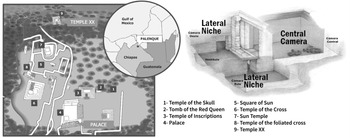
The Palenque archaeological site, located in the middle of the jungle of Chiapas State in the south of Mexico, is one of the most emblematic sites of the Mayan culture (Figure 1). The site was occupied during the Mesoamerican Classic period, between the 5th and 9th centuries. From 2012 to 2016, the Palenque Archeological Project directed by the Instituto Nacional de Antropología e Historia (PAP-INAH), sponsored the analysis of artifacts and skeletal remains from two contexts of the old City of Palenque (Figure 3, left): (1) the funerary complex (a vaulted tomb with painted walls) of a substructure of the Temple XX, and (2) a stratigraphic column excavated from the house F from the Palace (Balcells et al. Reference Balcells, Solís and Rodríguez-Ceja2019).
(Left) Palenque settings with the study area and the excavated sites. Insert: Map of the region showing Palenque location (right), the funerary complex of Temple XX (Balcells et al. Reference Balcells, Solís and Rodríguez-Ceja2019).

The objective of this study was to establish the absolute temporal chronology of these two structures and to compare them to other funerary complexes previously excavated that belong to the Late Classic period (600–900 AD).
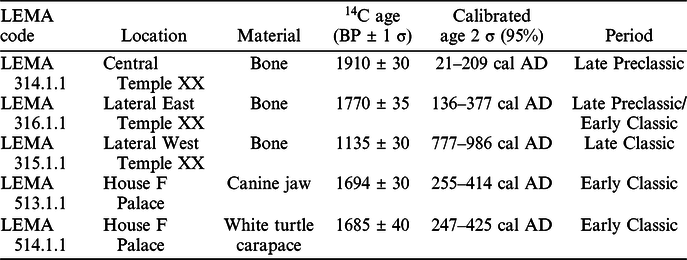
The tomb of the funerary complex of the Temple XX (Figure 3, right), is composed of a central chamber and two lateral niches. Bone samples were taken from the three places. Other objects found on the floor of the temple included ceramic vessels and non-articulated lithic artifacts, characteristic of mortuary trousseau that once formed one or more bracelets, necklaces, breastplates, diadems, waist masks, and headdresses. The Palace (House F) is one of the most complex structures at the spatial and temporal levels of the site (Figure 3). Along 3 m of excavation, different floors and architectural elements of the several stages of the building were recognized. The quantity and diversity of ceramic materials found were plentiful. Examples are dishes and pots that were used in food consumption or storage. A fragment of white turtle carapace and canine jaw with cutting tracks were chosen for 14C dating. Results obtained for material recovered in the two sites are shown in Table 3.
14C dating results of samples from Palenque archaeological site.

The AMS 14C dating of material recovered from the central chamber of the substructure of The Temple XX, refer to the Late Preclassic (300 BC–250 AD) and Early Classic period (250 AD–500 AD) and correspond to the earliest dates within the history of the site and region: the foundation of Palenque. The 14C dating of samples recovered from The Palace (House F) refer to the Early Classic period (250 AD–500 AD) and correspond to the emergence of Palenque as the most powerful Maya City in the region. The oldest date obtained in this study is earlier than the date reported previously as the oldest one for Palenque (Tomb 3 of the XVIII temple), whose buried remains were dated by Couoh and Cuevas (Reference Couoh Hernández and Cuevas García2015) at 250 AD–420 AD (1696 ± 30 BP).
CONCLUSION
Radiocarbon’s history in Mexico is described since the installation of the first radiometric laboratories, at the INAH and UNAM, until the establishment of AMS at LEMA, UNAM. Currently, measurement of other cosmogenic isotopes such as 10Be, 26Al, 129I, and Pu is also possible.
Given the rich cultural heritage in Mexico, the main activities at LEMA are focused on 14C dating. With this new tool, the Mexican archaeological community has better access to the 14C dating of organic archaeological samples with AMS. Some of the first hunter-gatherer groups living in Mexico entered through the desert in the north of the country. These groups left little evidence of their passage through the area, so the date when the first migrations occurred is unknown. This facility has contributed to the search for evidence that allows knowing the date of the early occupation of little-studied archaeological sites such as Cuatrociénegas, Coahuila.
It has also been possible to continue with chronological studies at other sites that have been excavated for decades, such as Teotihuacán and Palenque, where essential discoveries that contribute to accomplishing our knowledge of Mexico’s pre-Columbian past are found continuously.
ACKNOWLEDGMENTS
The authors are grateful to Arcadio Huerta Hernández for operation of the accelerator; to Sergio Martínez González for technical support; to Adriana Baca Barreno, director of Casa de la Cultura de Cuatrociénegas, Coahuila, for the aid granted. This work has been partially financed by DGAPA UNAM-IG100619 project, and CONACyT 299073 project.