INTRODUCTION
Parents in bilingual ethnic minority families have the opportunity to expose their children to two languages: the language of their country of origin, the ‘ethnic language’, and the language of the country in which they live, the ‘host language’. Stronger maintenance of the ethnic language at the expense of the host language reflects a stronger ethnic identity (Extra & Yagmur, Reference Extra and Yagmur2010; Oh & Fuligni, Reference Oh and Fuligni2010) and enables children to communicate with family members who do not speak the host language. The host language becomes increasingly important once children enter formal education in general, and formal reading education in particular (Uccelli & Páez, Reference Uccelli and Páez2007). Families with a higher socioeconomic status (SES) engage their children more often in home literacy activities (Kalia & Reese, Reference Kalia and Reese2009; Hindman & Morrison, Reference Hindman and Morrison2012) and are more likely to use the host language (Arriagada, Reference Arriagada2005; Dixon, Wu & Daraghmeh, Reference Dixon, Wu and Daraghmeh2012). Language input in turn can positively influence the children's vocabulary levels within the language in which the input is provided (Quiroz, Snow & Zhao, Reference Quiroz, Snow and Zhao2010; Mancilla-Martinez & Lesaux, Reference Mancilla-Martinez and Lesaux2011; Hoff, Core, Place, Rumiche, Señor & Parra, Reference Hoff, Core, Place, Rumiche, Señor and Parra2012) and also across languages (Roberts, Reference Roberts2008). To date, studies on the relation between SES, home language input, and vocabulary have been conducted in a variety of multilingual samples (Arriagada, Reference Arriagada2005; Kalia & Reese, Reference Kalia and Reese2009; Quiroz et al., Reference Quiroz, Snow and Zhao2010; Mancilla-Martinez & Lesaux, Reference Mancilla-Martinez and Lesaux2011; Dixon et al., Reference Dixon, Wu and Daraghmeh2012; Hoff et al., Reference Hoff, Core, Place, Rumiche, Señor and Parra2012). However, none of these specifically focused on the role of reading input in the relation between SES, language input, and vocabulary in bilingual children who are about to make the transition to formal reading education. In the current study, we examine the influence of SES on maternal language use, home reading input, and children's vocabulary outcomes, both within and across languages, in a sample of families with a Turkish background and their six-year-old children in the Netherlands.
Children tend to have a larger vocabulary if they receive more learning stimulation in general (Bradley, Corwyn, Burchinal, McAdoo & García Coll, Reference Bradley, Corwyn, Burchinal, McAdoo and García Coll2001) and reading stimulation in particular (Bus, Van IJzendoorn & Pellegrini, Reference Bus, Van IJzendoorn and Pellegrini1995; Hood, Conlon & Andrews, Reference Hood, Conlon and Andrews2008). Reading input at home can also positively influence children's emergent literacy skills (Bus et al., Reference Bus, Van IJzendoorn and Pellegrini1995). Children from families with a higher SES are often raised in more stimulating home environments, with more reading activities and books available (Guo & Harris, Reference Guo and Harris2000; Bradley, Corwyn, McAdoo & García Coll, Reference Bradley, Corwyn, McAdoo and García Coll2001; Korat, Klein & Segal-Drori, Reference Korat, Klein and Segal-Drori2007; Crosnoe, Leventhal, Wirth, Pierce, Pianta & NICHD Early Child Care Research Network, Reference Crosnoe, Leventhal, Wirth, Pierce and Pianta2010; Hindman & Morrison, Reference Hindman and Morrison2012), and show higher language proficiency (Hoff, Reference Hoff2006). This pattern can be explained by processes described in the Family Stress Model and the Family Investment Model (Conger & Donnellan, Reference Conger and Donnellan2007). The Family Stress Model proposes that families with a lower SES often have to deal with multiple stressors as a consequence of economic hardship. The Family Investment Model proposes that families with a lower SES have fewer economic and educational resources available than families with a higher SES. Due to the multiple stressors and fewer resources, these families are less likely to engage in shared book-reading activities (Hoff, Reference Hoff2003; Dixon et al., Reference Dixon, Wu and Daraghmeh2012). In previous research, evidence has been found for a mediating effect of language input in the relation between SES and children's cognitive outcomes, including vocabulary (Guo & Harris, Reference Guo and Harris2000; Hoff, Reference Hoff2003; Mistry, Biesanz, Chien, Howes & Benner, Reference Mistry, Biesanz, Chien, Howes and Benner2008; Kloosterman, Notten, Tolsma & Kraaykamp, Reference Kloosterman, Notten, Tolsma and Kraaykamp2011).
Children in bilingual families generally receive less exposure to one particular language than children from monolingual families, because their parents need to divide language input between two languages (Hoff et al., Reference Hoff, Core, Place, Rumiche, Señor and Parra2012). Bilingual children usually show higher vocabulary scores in the language that they are exposed to most frequently (Quiroz et al., Reference Quiroz, Snow and Zhao2010; Mancilla-Martinez & Lesaux, Reference Mancilla-Martinez and Lesaux2011; Hoff et al., Reference Hoff, Core, Place, Rumiche, Señor and Parra2012). A positive influence of reading stimulation on vocabulary in both the ethnic and the host language has also been found for bilingual children (Kalia & Reese, Reference Kalia and Reese2009; Quiroz et al., Reference Quiroz, Snow and Zhao2010). Storybook reading in the home is effective for promoting host language vocabulary acquisition, independent of the language in which the reading takes place, and the availability of books in the host language is related to vocabulary in that language (Roberts, Reference Roberts2008). Similar to findings in monolingual samples, bilingual families with a higher SES engage their children in more reading activities (Kalia & Reese, Reference Kalia and Reese2009).
Not only the frequency of reading activities but also the language that is used for these activities in bilingual families can be related to SES. Low-SES ethnic minority parents are likely to be less proficient in the host language as a result of their lower educational level, which in turn restricts their access to higher-level jobs in the host country (Dixon et al., Reference Dixon, Wu and Daraghmeh2012). Because of their lower host language proficiency and the larger likelihood of living in neighborhoods with more non-Western immigrants where use of the host language is often not required, low-SES ethnic minority families tend to use their ethnic language more than high-SES ethnic minority families (Arriagada, Reference Arriagada2005). However, because high-SES parents tend to provide more language input overall, their children may be stimulated in the ethnic language more often than children from low-SES families (Arriagada, Reference Arriagada2005). Thus, two processes operate in opposite directions in creating SES-related differences in ethnic language use, whereas for host language use the difference between low- and high-SES families are more straightforward. As is the case for language input, effects of SES on language outcomes can also differ for the host and the ethnic language. In previous research involving Spanish–English bilingual children a significant effect of maternal education was found for vocabulary in the host, but not in the ethnic, language (Quiroz et al., Reference Quiroz, Snow and Zhao2010).
In addition to the influence of SES, and language and reading input on language proficiency, it has been suggested that input and proficiency in the host and the ethnic language can positively influence each other. Evidence for such a cross-language effect has been found in several previous studies with bilingual children (Yeung, Marsh & Suliman, Reference Yeung, Marsh and Suliman2000; Verhoeven, Reference Verhoeven2007; Mancilla-Martinez & Lesaux, Reference Mancilla-Martinez and Lesaux2011). However, in some studies this cross-language effect was restricted to higher-level skills, such as complex syntax, and was not found for specific language elements, such as vocabulary (Verhoeven, Reference Verhoeven1994; Uccelli & Páez, Reference Uccelli and Páez2007). The difference between the skill levels might be explained by the fact that higher-level skills are more dependent on underlying individual differences that are independent of the language that is used, such as cognition, while development of the more specific language elements depends more on aspects that are characteristic of a particular language and is therefore less likely to be transferred from one language to the other (Cummins, Reference Cummins and Bialystok1991).
The Turkish population is the largest ethnic minority in the Netherlands and a relatively large part of this group (more than 10%) consists of children younger than seven years (Central Bureau of Statistics, 2010). In the Netherlands, the ethnic Turkish are over-represented in the lower socio-economic classes. In this ethnic minority, first- and second-generation immigrants have been found to identify themselves more with their own ethnic culture than with their host culture (Phinney, Horenczyk, Liebkind & Vedder, Reference Phinney, Horenczyk, Liebkind and Vedder2001). Turkish ethnic minorities are mostly in contact with persons with a similar ethnic background and generally marry within their own ethnic group, and about 30 to 40% of first-generation and 10 to 20% of second-generation Turkish immigrants never even have contact with people from the Dutch majority in their leisure time (SCP, Reference Gijsberts and Dagevos2009, Reference Gijsberts, Huijnk and Dagevos2011). It is thus not surprising that both the Dutch majority group as well as Turkish ethnic minorities themselves judge Turkish ethnic minorities as culturally different from the Dutch majority group (Verkuyten, Hagendoorn & Masson, Reference Verkuyten, Hagendoorn and Masson1996). The Turkish language is perceived as a core cultural value even after the first immigrant generation (Extra & Yagmur, Reference Extra and Yagmur2010). The language use pattern in Turkish families is generally characterized by Turkish dominance with a change towards more use of Dutch that starts when children enter childcare or preschool (Leseman, Reference Leseman2000; Prevoo, Mesman, Van IJzendoorn & Pieper, Reference Prevoo, Mesman, Van IJzendoorn and Pieper2011). Dutch primary schools do not provide education in Turkish, and many schools even apply a rule stating that the children should speak Dutch with each other when at school (NVLF, 2006).
For Turkish–Dutch bilingual children research results on the relations between SES, language and reading input and vocabulary are ambiguous. In one study with Turkish–Dutch three-year-old children, a positive relation between literacy activities in the home and children's cognitive development, including Turkish vocabulary, was found (Leseman & Van den Boom, Reference Leseman and Van den Boom1999), whereas in another no relation between reading input and vocabulary in either the ethnic or the host language was found for Turkish–Dutch children of the same age as in the other study (Scheele, Leseman & Mayo, Reference Scheele, Leseman and Mayo2010). In a study investigating the language environment and proficiency of Turkish–Dutch children, no relation between SES and language input or vocabulary in either language was found (Scheele et al., Reference Scheele, Leseman and Mayo2010). Evidence for cross-language transfer from ethnic to host language has been found in a previous study with Turkish–Dutch children (Scheele et al., Reference Scheele, Leseman and Mayo2010).
In our study we focus on the language and reading input and vocabulary in both ethnic and host language of six-year-old children with a Turkish background who are about to make the transition to formal reading education in the Netherlands. The language proficiency level with which a child enters formal reading education is important for the development of reading skills (Roth, Speece & Cooper, Reference Roth, Speece and Cooper2002; Lonigan, Schatschneider & Westberg, Reference Lonigan, Schatschneider and Westberg2008; Davison, Hammer & Lawrence, Reference Davison, Hammer and Lawrence2011). For bilingual children it is not only their overall language proficiency, including vocabulary, that is important in this phase of their educational career, but more specifically their proficiency in the language in which they learn to read (Bialystok, Reference Bialystok, Bhatia and Ritchie2004). If children enter formal reading education with a host language vocabulary level that is too low, they will certainly encounter difficulties in learning to read (Uccelli & Páez, Reference Uccelli and Páez2007). Furthermore, insight into the home literacy environment and language proficiency in both languages of bilingual children who are about to make a major educational transition can yield important information for the improvement of children's language and literacy development in such a vital phase of their school career.
In this study, we examine to what extent the relation between SES and vocabulary in both ethnic and host language of six-year-old Turkish–Dutch children is mediated by the language and reading input in either language. We hypothesize that family SES and home language and reading input will be positively related to children's Dutch and Turkish vocabulary. More specifically, we expect SES to predict maternal language use, which predicts home reading input in a particular language, which in turn predicts vocabulary in that language. In examining a possible cross-language effect, we take an exploratory approach, because previous research findings are too ambiguous to allow a firm hypothesis.
METHOD
Participants and procedure
Data for the current study were collected from ethnic Turkish mothers in the Netherlands with their five- or six-year-old children, who were about to make the transition to formal reading education. The sample consisted of 111 ethnic Turkish mothers and their children. These mothers were recruited from the municipal registers of several cities and towns in the western and middle region of the Netherlands. To make sure that all mothers in our sample had at least part of their education in the Netherlands, we selected second-generation Turkish immigrant mothers who were born in the Netherlands (with at least one of their parents born in Turkey), or first-generation Turkish immigrant mothers who moved to the Netherlands before the age of eleven, and who had children who were in the second year of Dutch primary school – which corresponds to the kindergarten year in the US – at the time of the home visit (age 5;5–6;10). Furthermore, if the child's father had a background other than Turkish, the family was excluded. Fathers could be either first- or second-generation Turkish immigrants and there was no restriction regarding the age of arrival in the Netherlands for fathers.
In total, 639 families were reached of whom 113 (18%) agreed to participate. Two respondents had to be excluded from this study because Kurdish was spoken at home. A subgroup of mothers that did not want to participate (N=153) provided some general information about their families by filling out a form. These families did not differ significantly from the participating families in age of father (p=·38), mother (p=·11), and child (p=·36), child's gender (p=·13), total number of children in the family (p=·81), birth rank of the participating child (p=·18), country of birth of mother (p=·79) and father (p=·86), mother's marital status (p=·68), and child's family status (p=·75).
The participating parents completed questionnaires and mother and child participated in a two-hour home visit including a mother interview, child testing, and video observation. The children had a mean age of 6;1 (SD=3·7 months) at the time of the home visit. Forty-one percent of the sample consisted of boys. The mothers had a mean age of 33;1 (SD=4;3). Thirty-three percent of the mothers and 84% of the fathers were born in Turkey. The mothers who were born in Turkey migrated to the Netherlands at a mean age of 5;7 (SD=3;10), whereas fathers who were born in Turkey migrated to the Netherlands at a mean age of 19;8 (SD=8;9). Most children lived in two-parent families with both their biological parents (91%). The majority of the children had one sibling (58%), 11% had no siblings, and 31% had two or more siblings. Fifty-six percent of the children were the first-born child in their family.
Almost half of the mothers (49%) reported speaking an equal amount of Dutch and Turkish with their child, 42% mostly or only Dutch, and 9% reported speaking mostly or only Turkish to their child. In contrast, most mothers (41%) reported speaking mostly Turkish with their partner, and only 10% of the mothers reported speaking mostly or only Dutch with their partner. Of the sixty-six fathers who filled out the father questionnaire, 35% reported speaking an equal amount of Dutch and Turkish with their child, 18% mostly Dutch, and 47% reported speaking mostly or only Turkish to their child. In the families where both fathers and mothers filled out the questionnaires, fathers reported speaking significantly more Turkish to their child than mothers did (t(64)=7·13, p<·001). Most mothers reported that they could speak and read Dutch (89% speaking; 94% reading) and Turkish (75% speaking; 76% reading) very well. Most fathers who filled out the father questionnaire also reported that they could speak (86%) and read (83%) Turkish very well. Almost half of the fathers reported that they could speak (42%) and read (49%) Dutch very well.
Measures
Questionnaires were available in the Dutch and the Turkish language. All questionnaires in this study were translated from Dutch into Turkish and back-translated in order to ensure correct wording in the Turkish language. Most mothers (91%) chose to complete the Dutch version of the questionnaire. This may be explained by the fact that all second-generation Turkish mothers have attended school in the Netherlands, and are thus more used to written communication in Dutch, even though they may prefer Turkish for spoken communication (Yaman, Mesman, Van IJzendoorn & Bakermans-Kranenburg, Reference Yaman, Mesman, Van IJzendoorn and Bakermans-Kranenburg2010).
Socioeconomic status (SES)
Family SES was based on the family's annual gross income and the highest completed educational level of both parents. The annual gross income was measured on a 7-point scale (1=no income; 2=less than €10,000; 3=€10,000–20,000; 4=€20,000–30,000; 5=€30,000–40,000; 6=€40,000–50,000; 7=more than €50,000). Parents' highest completed education was also measured on a 7-point scale (1=no qualification; 2=primary education; 3=lower vocational education; 4=intermediate vocational education; 5=secondary education; 6=higher vocational education; 7=university-level degree). Because factor analysis showed that maternal and paternal educational levels and annual family gross income loaded on a single factor (loadings of ·83, ·79, and ·81 respectively), SES was computed as the mean of the standardized values of the income and education variables. If one or two of the SES variables were missing, the values of the missing variables were computed based on a regression equation that included the available values as predictors of the missing value, before computing the SES variable. For two families only the father's education was missing. Four families had missing values for both father's education and annual income. For twenty-one families, annual income was missing while education levels were available, in most cases because mothers found their family income too confidential to report.
Relative maternal ethnic language use
Mothers reported on a 5-point scale (1=only Dutch; 2=more Dutch than Turkish; 3=equal amount of Dutch and Turkish; 4=more Turkish than Dutch; 5=only Turkish) how often they used the ethnic relative to the host language when speaking with their child.
Reading input
Reading by mother and father, and the availability of children's books in the home, were taken as indicators of the reading input the child received. Questions were taken from the questionnaire ‘Watching television, reading and computers at home’ from the Study of Early Child Care and Youth Development (SECCYD) of the National Institute of Child Health and Human Development (NICHD). Translation into Dutch and back-translation to English were used to ensure correct wording in Dutch of the original English questions. Turkish mothers were asked to indicate on a 5-point scale (0=never; 1=once per month or less; 2=once per week; 3=several times per week; 4=every day) how often they themselves and their partners read to the target child. When mothers referred to their partner this was always the child's father, because all children in our sample who lived in a two-parent household lived with both biological parents. The availability of children's books was measured on a 4-point scale (0=none; 1=less than 10; 2=10–30; 3=30 or more). Mothers were asked to indicate which language was used for reading by both parents and what the language was of the available children's books on the same 5-point scale that was used for relative maternal ethnic language use, ranging from ‘only Dutch’ to ‘only Turkish’.
In order to get separate reading input scores for the ethnic and the host language a score of 1 was given if the target language was always used, 0·75 if the target language was mostly used, 0·50 if both languages were used equally, 0·25 if the other language was used more often than the target language, and a score of 0 was given if the target language was never used for the particular indicator, in accordance with the calculation used by Scheele, Leseman, and Mayo (Reference Scheele, Leseman and Mayo2010). These scores for language use in each of the languages were then multiplied with the frequencies of the three indicators, yielding scores ranging from 0 to 4 for reading by both parents and a score ranging from 0 to 3 for the availability of children's books.
As a result of the multiplication, gaps between possible scores are larger as the frequency becomes higher. To prevent these gaps in the distribution that might cause problems for structural equation modeling, the reading input scores were grouped into four categories (0=no input; 1=low input; 2=medium input; 3=high input). Categorical regression analysis (Meulman & Heiser, Reference Meulman and Heiser1999) with relevant correlates of reading input (language use, SES, vocabulary) on a numerical measurement level was used to determine which scores could be taken together into one category. Categorical regression is comparable to linear regression analysis with transformed variables (for instance, log transformations); the main difference is that, according to criteria controlled by the researcher, the method finds the transformation that best represents the relation between predictors and response. The scores that were shown to represent the same values in the transformation plots were grouped together. Based on these analyses all reading input scores between 0·25 and 1 were taken together in the low input category, 1·5 to 2 in the medium input category, and input scores between 2·25 and 4 constituted the high input category. For the availability of children's books this category division, based on categorical regression analyses, was 0·25–0·75, 1–1·5, and 2–3. Scores of 0 on any of the reading input variables were not recoded, in order to keep the distinction between no reading input and some input. It should be noted that the categorical regression analyses also confirmed that different scores on the two components of reading input that lead to the same outcome (e.g., a score of 2 could be based on 2*1 or 4*0·5) could fall into the same reading input category, because each possible combination was given a different value in the analysis but combinations that lead to the same outcome still appeared at the same level in the transformation plots. Because the scores for both languages were based on multiplication of the same raw variables, input sources in each of the languages were interrelated: r=−0·29, p=·005 for reading by mother; r=0·32, p=·002 for reading by father; r=−0·39, p<·001 for availability of children's books. Interestingly fathers' reading in the two languages was positively correlated, which may be due to the low overall frequency of their reading. However, if they read they tend to do so in both languages.
Dutch vocabulary
To measure Dutch expressive vocabulary, the Expressive One Word Picture Vocabulary Test (EOWPVT; Brownell, Reference Brownell2000) was translated into Dutch. In this test, a picture is shown and after a prompting question from the researcher the child has to name the picture in one word. All test administrations were audio-recorded to be able to decide on the scoring afterwards in case of ambiguous answers. Based on pilot assessments of the Dutch translation of this test, the decision was made to replace the map of the United States with a map of the Netherlands and to delete items 118 (reel), 146 (prescription), and 160 (monocular) for which no appropriate Dutch translation was available. Item-response analyses showed that this Dutch version of the test captured basically the same increase in difficulty level that is present in the original English version. The split-half (odd/even) sample reliability was >·99.
Turkish vocabulary
Because bilingual children have been shown to have difficulties accessing their productive vocabulary in their ethnic language in the circumstance of immersion in the host language (Gibson, Oller, Jarmulowicz & Ethington, Reference Gibson, Oller, Jarmulowicz and Ethington2012), a receptive vocabulary measure was most appropriate for the Turkish language. To measure Turkish receptive vocabulary, the Peabody Picture Vocabulary Test (PPVT; Dunn & Dunn, Reference Dunn and Dunn2007) was translated into Turkish (Glück, Reference Glück2009). In this test, four pictures are shown and the child is asked to select the picture that matches a spoken word. Because not all research assistants administering the child tests spoke the Turkish language, the Turkish pronunciation was recorded beforehand and children heard the Turkish word as soon as the four pictures that they could choose from were shown on the computer screen. If necessary, the child could ask the assistant to play the recorded word one more time. Item-response analyses showed that, despite some variance in difference levels within sets, the increasing difficulty level from one set to the other that is present in the original English version was captured in this translation. The split-half (odd/even) sample reliability was ·98.
Analyses
First, correlations were computed to explore the relations between SES, maternal language use, and reading input in Dutch and Turkish, and children's vocabulary scores in each of the languages. Structural equation modeling (SEM) with EQS 6.1 (Bentler, Reference Bentler2001) was used to test the hypothesized mediations. The chi-square goodness of fit test, the Bentler–Bonnett normed fit index (NFI), comparative fit index (CFI), and root mean square error of approximation (RMSEA) were used to evaluate the model fit. Model fit was considered to be satisfactory when the chi-square statistic was not significant at p<·05, fit indices (NFI and CFI) >·95, and RMSEA <·10 (Schermelleh-Engel, Moosbrugger & Müller, Reference Schermelleh-Engel, Moosbrugger and Müller2003). Issues of missing data in the SEM analyses were dealt with by using Full-Information Maximum Likelihood (FIML) estimation procedures. Outliers were winsorized to be equal to the next highest value of the particular variable (Dixon, Reference Dixon1960).
RESULTS
Descriptives
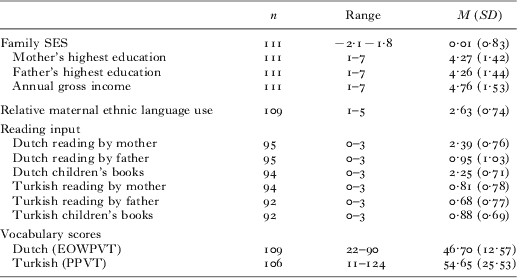
Descriptive statistics of the main variables are reported in Table 1. The results show that mothers spoke on average somewhat more Dutch than Turkish to their children, as is shown by the mean which is below the scale midpoint. Also, children in our sample received significantly more Dutch reading input as compared to Turkish reading input by their mothers (t(95)=12·47, p<·001), fathers (t(94)=2·41, p=·02), and through the availability of children's books (t(92)=11·28, p<·001). Reading by fathers provided least input in both languages. This is caused by the low overall frequency of reading by fathers, who on average read about once a month (M=1·33, SD=1·25), which is included in the computation of the input in each of the languages. Despite the low means for the Turkish variables, the entire range of possible reading input scores was present in our sample. There were no differences between first or second immigrant generation mothers in language use with their child (t(106)=−0·82, p=·42), nor were there any differences in Dutch reading input between first- and second-generation mothers (t(92)=−0·04, p=·97) or fathers (t(87)=−0·81, p=·42). For Turkish reading input, there were no differences between first- and second-generation mothers (t(92)=0·43, p=·67), but there was a difference for fathers. First-generation fathers provided significantly more Turkish reading input to their children than second-generation fathers (t(28·20)=2·20, p=·04). However, in families with fathers born in Turkey there was no difference in the availability of children's books in Dutch (t(87)=−0·13, p=·90) or Turkish (t(87)=0·59, p=·56) as compared to families with fathers born in the Netherlands. There were no differences between boys and girls in any of the reading input sources or vocabulary scores in the ethnic or host language (0·13 <| t | <1·57, p>·05).
Descriptive statistics of reading input, vocabulary and SES
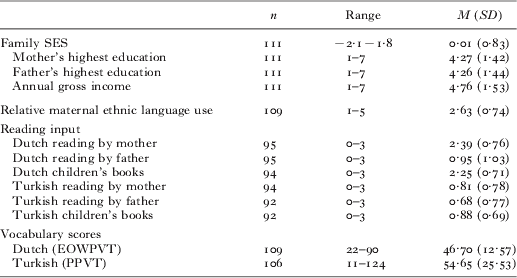
note: Relative maternal ethnic language use ranges from 1=only Dutch, to 5=only Turkish.
Associations between main variables
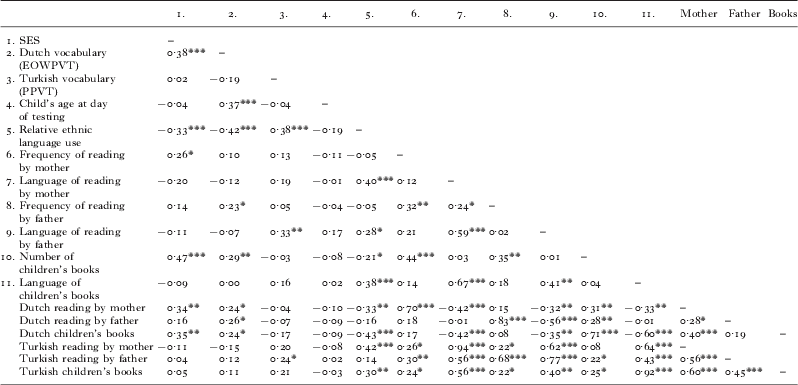
Before analyzing the proposed models, the correlations between SES, maternal language use, reading input, vocabulary scores, and the child's age were explored (see Table 2). SES showed a significant positive correlation with Dutch reading by mother and availability of Dutch children's books, as well as with the Dutch expressive vocabulary scores, and a significant negative correlation with relative maternal ethnic language use. There were no significant correlations between SES and any of the Turkish input variables or Turkish vocabulary. SES was also positively related to the overall frequency of reading by mother and the overall number of children's books available in the home, but not to the language that was used for these reading activities.
Correlations among SES, reading input, vocabulary and child's age
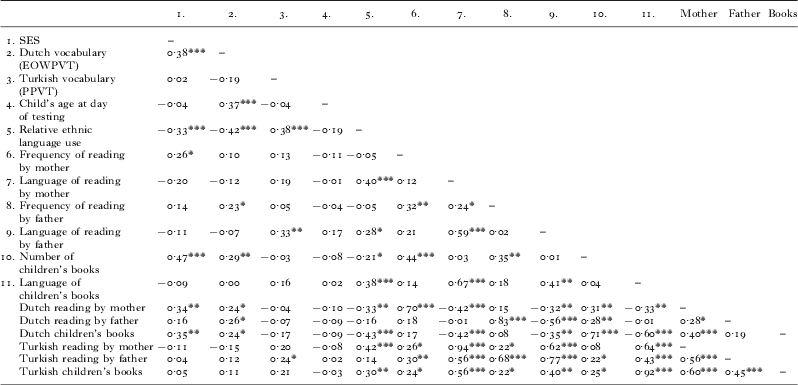
notes: Because reading input in each of the languages is based on a reverse coding of the same variable, for the reading input variables only correlations within languages, not between languages, are presented in the last three columns of the table.
Relative maternal ethnic language use ranges from 1=only Dutch, to 5=only Turkish.
* p<·05, **p<·01, *** p<·001.
The input variables were almost all significantly and positively inter-correlated within the languages. Relative maternal ethnic language use was positively related to Turkish vocabulary and negatively to Dutch vocabulary, meaning that children's Turkish vocabulary was generally higher and their Dutch vocabulary lower when their mothers spoke relatively more Turkish to them. All Dutch reading input variables showed significant positive correlations with Dutch expressive vocabulary, meaning that more reading input was related to higher Dutch vocabulary scores. For Turkish, only reading by father showed a significant positive correlation with Turkish receptive vocabulary, while the other correlations were not significant (·05<p<·06). No significant cross-language correlations were present. However, the negative correlation between Dutch and Turkish vocabulary (r=−0·19, p=·06) indicated a trend towards competition between the languages.
Dutch vocabulary was significantly correlated with the child's age at the day of testing. Because translated versions of both vocabulary tests were used, no norm scores for vocabulary were available and raw scores had to be used. To control for a possible age effect on vocabulary outcomes, the residual scores, obtained after a regression analysis with age as predictor and vocabulary as outcome variable, will be used in further analyses for both the EOWPVT and the PPVT.
Structural equation models
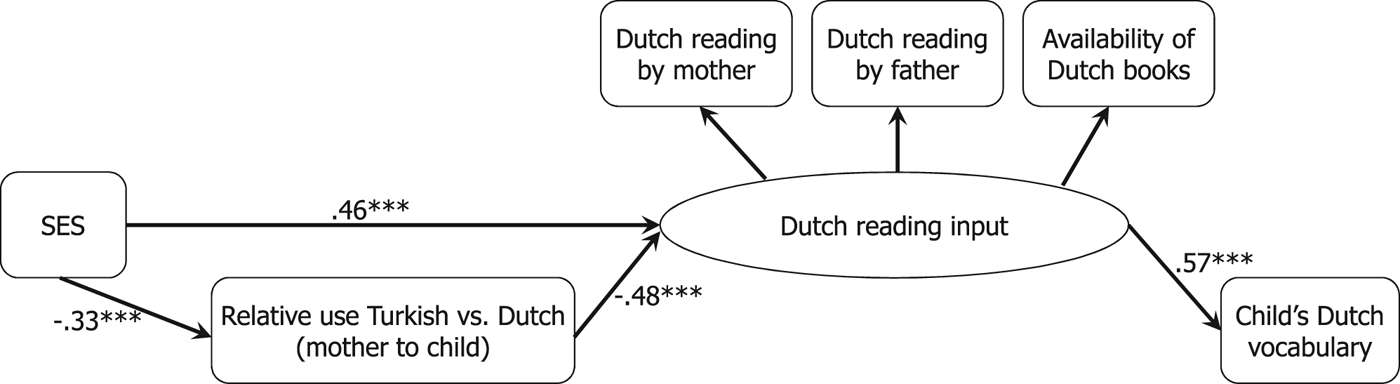
To examine the relations between SES, maternal language, and reading input and vocabulary, a structural equation model with SES, maternal language use, a latent factor representing reading input (indicated by reading by mother, reading by father, and availability of children's books), and vocabulary was tested in EQS for each of the languages. Because we expected the indicators of reading input to contribute equally to this construct, the coefficients for the (unstandardized) paths connecting the indicators with the factor were fixed to 1 for all indicators of the latent variable.
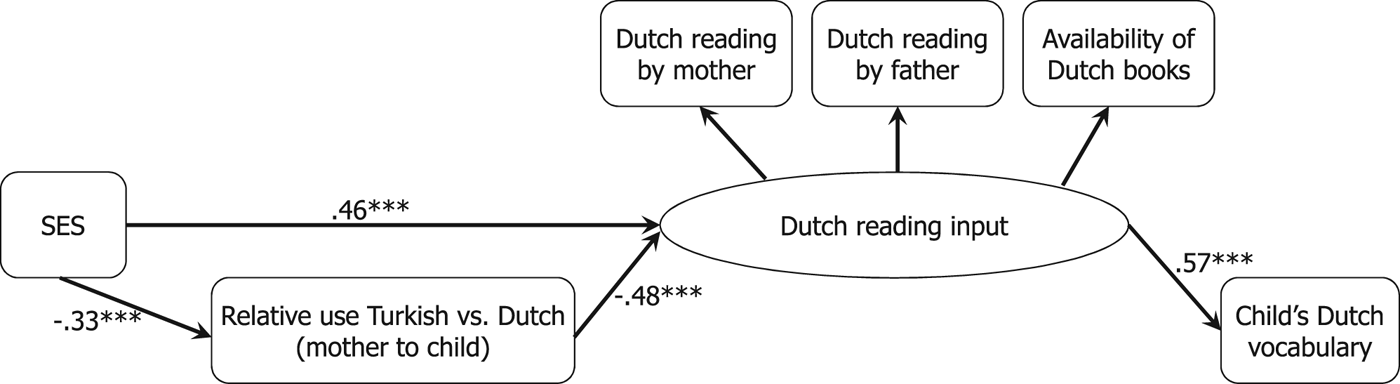
A model with paths from SES to all other variables, from maternal language use to reading input, and from all other variables to Dutch vocabulary fit the data (χ 2(6, N=111)=6·26, p=·39, NFI=1·00, CFI=1·00, RMSEA=·07). However, in this model none of the paths leading to Dutch vocabulary were significant. Therefore, based on the Lagrange Multiplier test, the paths from SES to Dutch vocabulary and from maternal language use to Dutch vocabulary were removed. This led to the final model presented in Figure 1, which fit the data well (χ 2(11, N=111)=9·33, p=·59, NFI=1·00, CFI=1·00, RMSEA=·04).
Structural equation models on the relation between SES, maternal language use, Dutch reading input, and vocabulary (***=p<·001).
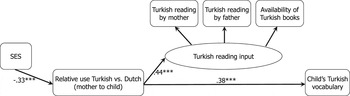
For the model with Turkish reading input and vocabulary the same steps were followed. A model with paths from SES to all other variables and from all other variables to Turkish vocabulary did not fit the data well (χ 2(6, N=111)=10·29, p=·11, NFI=1·00, CFI=1·00, RMSEA=·11). The Lagrange Multiplier and Wald tests were used to determine what would be the most parsimonious model with the best fit. The relation between the latent variable Turkish reading input and Turkish vocabulary, which was tested with SEM, was significant (β=·29, p<·05), but the path from reading input to vocabulary was removed in the final model. The paths from SES to reading input and vocabulary were also removed in the final model. Furthermore, the loadings of Turkish reading input by father and the availability of Turkish children's books were no longer restricted to be fixed on 1. The standardized loadings of the indicators of the latent variable were ·94 for Turkish reading by mother, ·59 for Turkish reading by father, and ·65 for the availability of Turkish children's books. The final model is presented in Figure 2 (χ 2(10, N=111)=13·81, p=·18, NFI=1·00, CFI=1·00, RMSEA=·08).
Structural equation models on the relation between SES, maternal language use, Turkish reading input, and vocabulary (***=p<·001).

DISCUSSION
The results of the current study showed that mothers in families with a higher SES spoke more Dutch than Turkish to their child, that these families provided more Dutch reading input and that their children had a larger Dutch vocabulary. Maternal language use partially mediated the effect of the families' SES on Dutch reading input, which was in turn related to Dutch vocabulary. Maternal language use also mediated the effect of SES on Turkish reading input. Children had a larger Turkish vocabulary if mothers spoke more Turkish compared to Dutch with them.
The mediating role of host language reading input in the positive relation between SES and maternal language use and host language vocabulary was in line with our expectations. Previous research has shown a positive relation between home stimulation and cognitive outcomes for Turkish–Dutch children (Leseman & Van den Boom, Reference Leseman and Van den Boom1999). We replicated this finding in an older age group and specifically for reading input. However, our results are not in line with studies showing only a marginal relation or no relation at all between reading input and vocabulary (Scheele et al., Reference Scheele, Leseman and Mayo2010; Hindman & Morrison, Reference Hindman and Morrison2012). Although one of these studies was conducted in a Turkish–Dutch sample as well (Scheele et al., Reference Scheele, Leseman and Mayo2010), it should be noted that children in that study were younger and constituted a specific bilingual group receiving most of their input in their ethnic language.
The positive relation between relative maternal ethnic language use and Turkish vocabulary is in line with previous research in which the relative amount of input in a certain language was found to be related to the children's language outcomes (Quiroz et al., Reference Quiroz, Snow and Zhao2010; Mancilla-Martinez & Lesaux, Reference Mancilla-Martinez and Lesaux2011; Hoff et al., Reference Hoff, Core, Place, Rumiche, Señor and Parra2012). The finding that there was no relation between SES and Turkish vocabulary is consistent with previous research in which a relation between maternal education and language proficiency was found for the host language only (Quiroz et al., Reference Quiroz, Snow and Zhao2010). There were only very few respondents reporting high Turkish reading input. Concurrently, only very few respondents reported low Dutch reading input. This was in line with the average relative ethnic language use that mothers reported, which also showed more use of Dutch than Turkish. Across all three sources of reading input (reading by mother, reading by father, and availability of children's books) Dutch was the language that was used most. Fathers who were born in Turkey were found to read more to their children in Turkish. This is in line with the previous finding that first-generation immigrants are more likely to use their ethnic language than second-generation immigrants (Hakuta & D'Andrea, Reference Hakuta and D'Andrea1992). The majority of fathers in our sample were born in Turkey and moved to the Netherlands at an older age than the mothers did. The Turkish mothers in this study are more used to written communication in Dutch, because they received most of their education in the Netherlands (Yaman et al., Reference Yaman, Mesman, Van IJzendoorn and Bakermans-Kranenburg2010). It is possible that Dutch reading materials are more easily accessible or were promoted more as compared to Turkish ones, or that children invite more reading input in Dutch because this is the language that they use at school. The limited use of Turkish in general and for reading in particular can also be a result of an ongoing decrease in ethnic language use and increase in host language use, that starts with increased host language input in toddlerhood (Prevoo et al., Reference Prevoo, Mesman, Van IJzendoorn and Pieper2011). Previous research has shown that the acceptance of the maintenance of the ethnic language in Dutch society is limited, even if people show a good host language proficiency in addition to the ethnic language maintenance (Vedder & Virta, Reference Vedder and Virta2005). If this low acceptance is clearly apparent within the community, parents across SES groups might prioritize host language development in their children above ethnic language development and therefore provide more input in Dutch than Turkish.
The processes underlying the effect of SES on Dutch language and reading input have been described in the Family Investment Model or the Family Stress Model (Conger & Donnellan, Reference Conger and Donnellan2007). The Family Investment Model focuses on economic and educational resources. Although the economic resources are the same for both languages within families, the educational resources may vary for the two languages. All mothers in our sample had most of their education in their host country, the Netherlands. Higher educated mothers will have had more exposure to the host language during their educational career. Differences in SES thus partly reflect differences in the extent to which mothers have been exposed to Dutch at school. For the ethnic language the differences in maternal language might not be so strongly related to SES, because this language was learned from other sources than school. For fathers this pattern is less clear, because it depends on the country where the father received most or all of his education whether a higher educational level is related to better proficiency in the host or the ethnic language. Also, higher educated parents might value host language development more, because they know how important it is from their own experience with the Dutch educational system, and therefore choose to stimulate the host language more. The Family Investment Model applies to our findings, albeit only regarding the investment of educational resources. The Family Stress Model focuses on the stress that parents experience as a result of economic hardship. In this study family stress was not measured, so firm conclusions on the applicability of the Family Stress Model cannot be drawn. However, multiple stressors experienced by low-SES parents may keep them from investing in balancing the use of two languages and lead to the decision to use their mother tongue only. It should be noted that causal conclusions about the relation between SES, maternal language use, reading input, and vocabulary cannot be drawn in our study, due to the cross-sectional design. It is possible that children with a higher vocabulary invite more input in a certain language or more reading input from their parents, instead of the other way around. However, that would not explain the relation between SES and Dutch vocabulary and between maternal language use and reading input.
In our correlational analyses we found that SES correlated positively with overall frequency of reading by mother and the overall number of children's books in the home, which is in line with previous research (Leseman & Van den Boom, Reference Leseman and Van den Boom1999; Kalia & Reese, Reference Kalia and Reese2009; Hindman & Morrison, Reference Hindman and Morrison2012). Conversely, we found that SES did not correlate significantly with the relative use of the ethnic language for any of the reading activities. Turkish vocabulary correlated positively with the language of reading by father. In other words, if fathers used more Turkish than Dutch for reading at home, the child's Turkish vocabulary was generally higher, regardless of the amount of reading with the father. Dutch vocabulary, on the other hand, correlated positively with overall frequency of reading by father and the overall number of children's books. In a previous study, the effect of SES was even found to change direction once the language context in the home was added (Arriagada, Reference Arriagada2005). As suggested in this previous study, we found that high-SES parents provide more overall reading input. We did not find, however, that low-SES parents use the ethnic language more for reading. Apparently, the choice to use the ethnic language for reading is influenced by factors other than SES.
Other explanations for differences between Turkish–Dutch families in Turkish reading input could be investigated further in future research. The birth order of the child could matter. Previous research in families with at least one first-generation immigrant parent has shown that the oldest child is more likely to speak the ethnic language than a later-born child (Stevens & Ishizawa, Reference Stevens and Ishizawa2007; Obied, Reference Obied2009). Another interesting focus could be a comparison of those who were exposed to two languages from birth (i.e., simultaneous second-language learners) versus those who were first exposed to the host language when they started (pre-)school (i.e., sequential second-language learners). Previous research has shown that mothers of simultaneous second-language learners engaged more often in language stimulating activities than mothers of sequential second-language learners (Hammer, Miccio & Wagstaff, Reference Hammer, Miccio and Wagstaff2003).
The observed trend towards competition between the host and the ethnic language that we found is contrary to previous studies, both in Turkish–Dutch samples and other bilingual samples, in which a positive relation between input or vocabulary in one language and vocabulary in the other language was found (Roberts, Reference Roberts2008; Scheele et al., Reference Scheele, Leseman and Mayo2010). Because what we found is only a trend, no firm conclusions can be based upon this finding. Some previous studies did not find a cross-language effect for vocabulary (Verhoeven, Reference Verhoeven1994; Uccelli & Páez, Reference Uccelli and Páez2007). Although vocabulary has been shown to be dependent on language proficiency (Zareva, Schwanenflugel & Nikolova, Reference Zareva, Schwanenflugel and Nikolova2005), it might be that measuring vocabulary only is too specific, because vocabulary is less indicative of a general underlying proficiency and more dependent on language-specific factors (Cummins, Reference Cummins and Bialystok1991) and on the presence of a particular word in the input environment of the child. Future research could take into account more aspects of language proficiency in addition to vocabulary to get a clearer picture of the influence that the ethnic and the host language might have on each other and the influence that language and reading input have on these aspects. It is also possible that the positive effect of the ethnic on the host language only becomes visible at a later age (Yeung et al., Reference Yeung, Marsh and Suliman2000).
The current study has some limitations. First, despite all the effort that was put into the recruitment of families for this study, the response rate was low. We did not only send letters in both Dutch and Turkish and brochures containing culturally adapted pictures, but also tried to personally contact the families. These are all important aspects in the recruitment of ethnic minority respondents (Yancey, Ortega & Kumanyika, Reference Yancey, Ortega and Kumanyika2006). It should be noted that, paradoxically, more effort to reach possible participants could lead to a lower response rate. When eligible participants who are hard to reach refuse participation, the response rate is negatively affected, whereas with less recruitment effort, these potential participants would have remained unreached. Second, the tests that were used to measure Dutch and Turkish vocabulary did not provide norms for monolingual or bilingual children for the languages in which we used them and measured only one language modality for each language, expressive or receptive spoken language respectively. However, even if we had measured both languages with the same measures, they would not have been comparable (Hulstijn, Reference Hulstijn2012). Previous research has shown that book reading is more strongly related to expressive than to receptive language skills (Mol, Bus, de Jong & Smeets, Reference Mol, Bus, de Jong and Smeets2008). This may explain why we found a pathway from reading input to Dutch but not to Turkish vocabulary. However, the receptive–expressive gap that is often present in bilingual children's vocabulary has been shown to be larger for the ethnic language (Gibson et al., Reference Gibson, Oller, Jarmulowicz and Ethington2012), making a receptive measure for the ethnic language a better indicator of the children's total vocabulary in that language. We did control for the child's age at the day of testing in analyses in which the test scores were used. A final limitation is that we did not take into account any language or reading input by other persons than the mother or father and that we did not measure the quality of the reading input in addition to the quantity of the input. It is possible that children are being read to by other persons in the home. Turkish–Dutch mothers tend to interact differently with their child during shared book reading as compared to native Dutch mothers (Bus, Leseman & Keultjes, Reference Bus, Leseman and Keultjes2000). It is known that rich explanations during shared reading activities have a positive influence on the words that the child learns from this activity (Collins, Reference Collins2010) and that mother's reading ability mediates the relation between SES and children's achievement (Sastry & Pebley, Reference Sastry and Pebley2010). Still, none of the above would explain why SES is unrelated to Turkish vocabulary.
Our findings provide insight into the differences in language and reading input at home and how these relate to host and ethnic language proficiency of the children. When children are about to make the transition to formal reading education, the language in which children learn to read is important for the reading education to succeed (Bialystok, Reference Bialystok, Bhatia and Ritchie2004). If children's vocabulary level in the host language is too low, they will encounter difficulties in learning to read (Uccelli & Páez, Reference Uccelli and Páez2007). Across SES groups, advising parents to read with their children can have a positive effect for the host as well as the ethnic language, given the positive correlations between reading input and vocabulary within each of the languages. In light of the children's transition to formal reading education, extra attention should be paid to children from low-SES families, because the generally limited reading input in the host language that they are exposed to at home can put them at risk for slower host language vocabulary development and as a result also endanger their reading development.