Introduction
The public discourse on COVID-19 and mental health has generally emphasised its profound negative effects. Numerous studies have described initial, small negative effects on mental health outcomes occurring with pandemic restrictions globally (Patel et al., Reference Patel, Robertson, Kwong, Griffith, Willan, Green and Katikireddi2022; Robinson, Sutin, Daly, & Jones, Reference Robinson, Sutin, Daly and Jones2022), with longer-term studies only starting to emerge. However, it has become clear that COVID-19 has not had an equal impact across the population. Patterns of exacerbating inequalities have been described for both physical and mental health outcomes (Perry, Aronson, & Pescosolido, Reference Perry, Aronson and Pescosolido2021). Further evidence for the non-uniformity of effects comes from studies demonstrating that a sizeable minority actually reported improved mental health and well-being during lockdown (Soneson et al., Reference Soneson, Puntis, Chapman, Mansfield, Jones and Fazel2022).
From the outset of the pandemic in March 2020, there has been an acknowledgement that specific demographic groups will be vulnerable to more negative mental health outcomes, considering long-standing social and health inequalities (O'Connor et al., Reference O'Connor, Hotopf, Worthman, Perry, Tracey, Wessely and Holmes2020). Research during the initial months of COVID-19 has highlighted a set of consistent predictors of poorer mental health, even if findings from large-scale studies have not always shown negative overall outcomes (e.g. Kwong et al., Reference Kwong, Pearson, Adams, Northstone, Tilling, Smith and Zammit2021; Pan et al., Reference Pan, Kok, Eikelenboom, Horsfall, Jörg, Luteijn and Penninx2021; Pierce et al., Reference Pierce, McManus, Hope, Hotopf, Ford, Hatch and Wessely2021; van der Velden, Contino, Das, van Loon, & Bosmans, Reference van der Velden, Contino, Das, van Loon and Bosmans2020; Young et al., Reference Young, Purves, Hübel, Davies, Thompson, Bristow and Breen2022). The predictors of poorer mental health outcomes include having a prior mental health diagnosis, being in a younger age category (16–25 years), being a woman, a student or being unemployed, as well as being from minoritised ethnic communities (Elmer, Mepham, & Stadtfeld, Reference Elmer, Mepham and Stadtfeld2020; Hawes, Szenczy, Klein, Hajcak, & Nelson, Reference Hawes, Szenczy, Klein, Hajcak and Nelson2021; Kwong et al., Reference Kwong, Pearson, Adams, Northstone, Tilling, Smith and Zammit2021; Li, Cao, Leung, & Mak, Reference Li, Cao, Leung and Mak2020; Meda et al., Reference Meda, Pardini, Slongo, Bodini, Zordan, Rigobello and Novara2021; Saraswathi et al., Reference Saraswathi, Saikarthik, Senthil Kumar, Madhan Srinivasan, Ardhanaari and Gunapriya2020; Young et al., Reference Young, Purves, Hübel, Davies, Thompson, Bristow and Breen2022).
After an initial wave of studies providing early insights into population-level averages for mental health outcomes, several studies have begun to examine within-population variation. Trajectory-based analyses of longitudinal data offer a promising approach for investigating discrete patterns of changes in mental health over time (see online Supplementary Table 1 for a summary of UK-based studies). Data from the COVID-19 Social Study has been a dominant contributor to knowledge, with studies examining loneliness (Bu, Steptoe, & Fancourt, Reference Bu, Steptoe and Fancourt2021), depression and anxiety (Fancourt, Steptoe, & Bu, Reference Fancourt, Steptoe and Bu2021; Fluharty, Bu, Steptoe, & Fancourt, Reference Fluharty, Bu, Steptoe and Fancourt2021; Saunders, Buckman, Fonagy, & Fancourt, Reference Saunders, Buckman, Fonagy and Fancourt2021), depression specifically (Iob, Frank, Steptoe, & Fancourt, Reference Iob, Frank, Steptoe and Fancourt2020) and depression and anxiety in key workers (Bu et al., Reference Bu, Steptoe and Fancourt2021). Focusing on the first 6 months of the pandemic, these investigations have reported that most participants fell into a category characterised by low symptoms, that is, good mental health outcomes, throughout the study period.
For those not in the majority category, with ‘low and stable’ symptoms, several patterns of symptom change over time have been described. These include adults with ‘stable and moderate’ symptoms of anxiety (13.8%) and depression (16.8%) and severe symptoms worsening over time (~6%). Smaller numbers of participants had higher symptoms of depression or anxiety during lockdowns that reduced as lockdown restrictions were eased (~4%) or anxiety symptom-specific initial worsening of symptoms that rapidly improved over time (~3%) (Saunders et al., Reference Saunders, Buckman, Fonagy and Fancourt2021). In one of the most methodologically robust trajectory-focused studies to date, using probability sampling, most individuals again had consistently good or very good mental health (76.8%; April to October 2020; Pierce et al., Reference Pierce, McManus, Hope, Hotopf, Ford, Hatch and Wessely2021). Other patterns identified included a recovering group (12.0%) showing an initial worsening of mental health, with a return to pre-pandemic levels by October 2020. A second group showed initial worsening with a gradual decline over time (7.0%) and a third group, an initial and sustained worsening (4.1%).
After the first 6 months of the pandemic, a second wave of COVID-19 cases in Autumn 2020 led to a reimposition of restrictions across the UK. The impact of the second set of national restrictions that came into force in November 2020 has not yet been fully described (some recent publications include Daly & Robinson, Reference Daly and Robinson2022; Ellwardt & Präg, Reference Ellwardt and Präg2021; Gao, Davillas, & Jones, Reference Gao, Davillas and Jones2022; Wetherall et al., Reference Wetherall, Cleare, McClelland, Melson, Niedzwiedz, O'Carroll and O'Connor2022), and a limited number of studies have examined symptoms trajectories into 2021 (e.g. Bu et al., Reference Bu, Steptoe and Fancourt2021; Ellwardt & Präg, Reference Ellwardt and Präg2021). Our longitudinal study, covering the period after the first lockdown and beyond the second, has three main aims:
1. We assess patterns of change in mental health over the first 12 months of the pandemic. Given the pronounced declines in mental health at the beginning of the pandemic in a considerable minority of individuals, we expect that reintroduction of restrictions following a second wave of COVID-19 will also represent a pivotal point. We therefore test piecewise trajectory models, informed by lockdown and restriction timelines in the UK, using 12 months of longitudinal data collected as part of the Repeated Assessments of Mental Health in Pandemics (RAMP) and COVID-19 Psychiatry and Neurological Genetics (COPING) studies.
2. We examine anhedonia symptom changes because the majority of studies have focused on depression, anxiety and to a lesser extent, loneliness. Anhedonia, the loss of pleasure or interest in activities, is theorised as a transdiagnostic factor for psychopathology (Guineau et al., Reference Guineau, Ikani, Rinck, Collard, van Eijndhoven, Tendolkar and Vrijsen2022), and potentially impacted by the opportunity to engage in rewarding activities (Skumlien et al., Reference Skumlien, Mokrysz, Freeman, Wall, Bloomfield, Lees and Coughlan2022) but has received little attention in the COVID-19 mental health literature.
3. We assess whether predictors of short-term changes in mental health identified in this sample (Young et al., Reference Young, Purves, Hübel, Davies, Thompson, Bristow and Breen2022) were also associated with longer-term changes in symptoms of depression, anxiety and anhedonia.
Methods
Sample
Data were collected from 34 465 adults (aged 16+ years; UK residents) between April 2020 and April 2021 as part of the RAMP and COPING studies (for further details, see Young et al., Reference Young, Purves, Hübel, Davies, Thompson, Bristow and Breen2022). RAMP recruited via social media advertising and word-of-mouth. COPING recruited from existing participant cohorts via the National Institute for Health and Care Research BioResource (NBR), approximately half of whom (n = 12 718) were from the Genetic Links to Anxiety and Depression (GLAD) Study (Davies et al., Reference Davies, Kalsi, Armour, Jones, McIntosh, Smith and Ashford2019). Of the total sample, 71% were women (RAMP 78%, COPING 68%), and 88% of the sample were froma white ethnic background (RAMP, 94%, COPING, 86%).
Participants were recruited on a rolling basis from April to September 2020. Once recruited into the study, participants received invitations to complete follow-up questionnaires every 2 weeks between 21 April 2020 and 18 July 2020, and monthly thereafter. Baseline measures were completed by 34 465 (RAMP = 8651; COPING = 25 814) participants, with a maximum of 25 501 and minimum of 17 511 for any one follow-up. Table 1 provides the number of participants who completed each follow-up for the RAMP and COPING samples, and represents the maximum sample size included in the present analyses. All participants provided online consent. Ethical approval for the RAMP study was granted by the Psychiatry, Nursing and Midwifery Research Ethics Committee at King's College London (HR-19/20-18157), and for the COPING study by the NHS Health Research Authority, South West – Central Bristol Research Ethics Committee (20/SW/0078).
Summary of follow-up data collection

RAMP, Repeated Assessment of Mental Health in Pandemics; COPING, COVID-19 Psychiatry Neurological Genetics.
Note: Numbers presented here are the maximum available sample. Missing data due to participant non-response to specific questionnaires mean that there will be some discrepancies between the numbers reported in this table and in the analyses.
Measures
All questionnaires were administered online via Qualtrics (Qualtrics, Provo, UT). For baseline assessments, study information, consent and questionnaires were accessed via a link either on the RAMP website or in an email invitation for COPING. For follow-up assessments, participants were emailed, or text messaged a link to invite them to complete a new questionnaire. For the full list of measures collected during the study see the RAMP Open Science Framework repository (https://osf.io/7p2ek/). Further details of the RAMP and COPING study procedures are available elsewhere (Young et al., Reference Young, Purves, Hübel, Davies, Thompson, Bristow and Breen2022).
Symptoms of depression were measured at each time point using the Patient Health Questionnaire 9-item depression module (PHQ-9) (Kroenke, Spitzer, & Williams, Reference Kroenke, Spitzer and Williams2001). The PHQ-9 is a brief self-report measure of symptoms of major depressive disorder. Possible scores for the PHQ-9 range between 0 and 27, with scores ⩾5 indicating mild symptoms of depression, ⩾10 indicating moderate symptoms of depression, ⩾15 indicating moderately severe symptoms of depression and ⩾20 indicating severe symptoms of depression. Internal consistency of the PHQ-9 in the current sample was excellent (ɑ = 0.94).
Symptoms of anxiety were measured at every time point using the Generalised Anxiety Disorder seven-item scale (GAD-7) (Spitzer, Kroenke, Williams, & Löwe, Reference Spitzer, Kroenke, Williams and Löwe2006). The GAD-7 is a brief self-report scale designed to identify probable cases of generalised anxiety disorder, but with high sensitivity for the three most common anxiety disorders seen clinically (generalised anxiety disorder, panic disorder, social anxiety disorder) (Kroenke, Spitzer, Williams, Monahan, & Löwe, Reference Kroenke, Spitzer, Williams, Monahan and Löwe2007). Possible scores for the GAD-7 range between 0 and 21, with scores of ⩾5 indicating mild symptoms of anxiety, ⩾10 indicating moderate symptoms of anxiety and ⩾15 indicating severe symptoms of anxiety. Internal consistency of the GAD-7 in the current sample was excellent (ɑ = 0.93).
Symptoms of anhedonia were measured using the short adaptation of the Mood and Anxiety Symptoms Questionnaire (MASQ-D30) anhedonic depression subscale (Wardenaar et al., Reference Wardenaar, van Veen, Giltay, de Beurs, Penninx and Zitman2010). The MASQ anhedonic depression (MASQ-AD) scale was designed to measure symptoms of low positive affect and anhedonia, thought to differentiate depression from anxiety as per the tripartite model (Clark & Watson, Reference Clark and Watson1991). Both the original and adapted short version of the scale have good psychometric propertiesand are moderately specific to depression (Kendall et al., Reference Kendall, Zinbarg, Bobova, Mineka, Revelle, Prenoveau and Craske2015; Wardenaar et al., Reference Wardenaar, van Veen, Giltay, de Beurs, Penninx and Zitman2010; Watson et al., Reference Watson, Clark, Weber, Assenheimer, Strauss and McCormick1995). The scale consists of 10 items and possible scores range between 0 and 40, with 0 indicating low experiences of positive affect, indicating high anhedonia, whilst scores of 40 indicate high experiences of positive affect, and low anhedonia. For comparability with the GAD-7 and PHQ-9, the MASQ-AD was reverse-scored, such that higher scores indicate higher anhedonia. Internal consistency of the MASQ-AD in the current sample was excellent (ɑ = 0.93).
Statistical analyses
All data cleaning and analysis scripts are available at: https://github.com/RAMP-COPING/Symptom_trajectories_COVID19. Patterns of missingness and skewness of data in outcome variables were examined and missing data were dealt with using Full Information Maximum Likelihood, implemented with the ‘MLR’ option in Mplus, with robust standard errors for continuous data. Individuals who missed more than two items for each outcome scale were excluded for that time point. Where two or fewer items were missing, total scores were imputed using an individual's average score for all non-missing items for that time point. All individuals with at least one time point with non-missing data were included in the models. Missing data in the predictors were dealt with using multiple imputation. We analysed trajectory models using the total sample, combining RAMP and COPING cohorts, for several reasons. First, the two cohorts were recruited via similar mechanisms, and responded to identical survey schedules. Second, we explicitly model the effects of prior diagnoses and demographic variables in our analysis of factors predicting trajectory group membership. Third, our previous analyses of baseline data indicated that there were comparable predictors of symptoms in the two cohorts (Young et al., Reference Young, Purves, Hübel, Davies, Thompson, Bristow and Breen2022). Finally, combining the two cohorts maximises statistical power and we did not have any hypotheses about between-cohort differences.
Trajectory modelling
First, latent growth curve modelling (LGCM) was used to identify 12-month trajectories of symptoms of depression, anxiety and anhedonia [MPlus version 8 (Muthén & Muthen, Reference Muthén and Muthen2017); aims 1, 2]. Three different trajectory types (linear, quadratic and piecewise) were assessed for best fit for the data (see preregistration). For the piecewise models, we used England's lockdown dates, because of the geographical location of most of our sample, and the fact that variations in dates across the rest of the UK were minor. We defined four pieces: (i) the first lockdown from 23 March 2020 until 23 June 2020 (slope includes the baseline assessment of 7 April 2020, and our follow-up on 16 June 2020), (ii) summer easing of restrictions from 23 June 2020 until 31 October 2020 (slope includes 30 June 2020 to 20 October 2020), (iii) second lockdown from 31 October 2020 until 8 March 2021 (slope includes 17 November 2020 until 9 February 2021) and (iv) spring easing of restrictions from 8 March 2021 until the end of the current study period, 6 April 2021 (slope includes 9 March 2021 to 6 April 2021). Models were run both with and without pairwise correlations between the residuals of contiguous time points to assess which gave the better model fit. The trajectory type with the best fit was carried forward.
Growth mixture modelling (GMM) was then used to decompose the group trajectory with the best fit into distinct, heterogeneous trajectory subgroups (or ‘classes’). Each class is defined by an average trajectory, but individual trajectories within a class can deviate from the average (with the degree of deviation indicated by a variance statistic). This approach determines whether data are better explained by multiple average trajectories, rather than one single trajectory, indicating the likely presence of subgroups (Muthén et al., Reference Muthén, Brown, Masyn, Jo, Khoo, Yang and Liao2002).
Models using increasing numbers of classes (minimum two, maximum seven) were assessed for fit against the observed data. Model fit decisions were based primarily on the Bayesian information criterion (BIC), as recommended for GMM analyses (Nylund, Asparouhov, & Muthén, Reference Nylund, Asparouhov and Muthén2007; Van De Schoot, Sijbrandij, Winter, Depaoli, & Vermunt, Reference Van De Schoot, Sijbrandij, Winter, Depaoli and Vermunt2017). Model fitting was halted prior to reaching seven classes if either: (i) fit indices deteriorated with addition of a class; (ii) the model no longer converged due to complexity; or (iii) a model included a class containing <1% of the total sample [to ensure models were stable and clinically meaningful (Jung & Wickrama, Reference Jung and Wickrama2008)]. Where results were ambiguous, scree plots of BIC values were used to determine the inflection point (Petras & Masyn, Reference Petras, Masyn, Piquero and Weisburd2010), additional fit indices were globally compared and model parsimony was examined. More parsimonious models with higher entropy and better fit statistics on the greatest number of indices were favoured (see online Supplementary Table S6 for details and online Supplementary Fig. S2 for a decision tree).
GMM was conducted to identify the optimal number of classes of trajectories for each outcome variable. Across all models, increasing the number of classes led to reductions in BIC, so this criterion was not the sole focus of model selection. We pre-specified that models producing classes with <1% of the total sample would be discarded: the MASQ-AD 6 and 7 class solutions were discarded on this basis (see online Supplementary Materials). Model selection was then based on visual inspection of scree plots of BIC values, selecting the model that fell at the inflection point (Petras & Masyn, Reference Petras, Masyn, Piquero and Weisburd2010). Across all outcome variables, inflection points were observed at the four-class solution (i.e. the slope of change in BIC from class 3 to class 4 was steeper than the slope of change from class 4 to class 5; see online Supplementary Fig. S3). Guidelines recommend selecting either the model at the inflection point (four-class), or immediately after the inflection point (five-class) (Van De Schoot et al., Reference Van De Schoot, Sijbrandij, Winter, Depaoli and Vermunt2017). For the sake of parsimony, four-class models were favoured over five-class models.
Predictors of symptom trajectories
Predictors were selected based on factors shown to impact short-term changes in mental health in prior analyses within the RAMP and COPING cohorts (Young et al., Reference Young, Purves, Hübel, Davies, Thompson, Bristow and Breen2022). We assessed whether these factors were also related to longer-term (12 months, aim 3) changes in depression and anxiety symptoms. The factors tested were: age, gender, ethnicity, employment status, and prior mental health diagnoses. We collapsed or excluded demographic subcategories, where appropriate, for categories with 20 participants or fewer (e.g. collapsing age categories). Multinomial logistic regressions (R version 4.1.2) were used to examine the association between predictor variables and ‘most likely class membership’ (highest posterior probability), extracted from the best-fitting GMMs.
Results
Participants
Table 1 presents the sample sizes at each time point and Table 2 presents participant demographics at baseline. Mean symptom scores and standard deviations (s.d.) are presented for each time point in online Supplementary Table S6 across the full sample (RAMP and COPING). Data distributions were examined for normality, and test results are available in online Supplementary Table S7.
Summary of sociodemographic and mental health-related variables (including data from all individuals who reported answers for least one predictor variable, at minimum one time point)

Note: All questions were optional, which resulted in varying quantities of missing data for variables such as ethnicity and employment. Change in employment was not included as a baseline measure, explaining the relatively high quantity of missing data.
Trajectory modelling: LGCM and GMM
For each outcome measure, PHQ-9, GAD-7 and MASQ-AD, the best-fit models were piecewise, based on dates of English national lockdowns, with pairwise correlations between residuals of contiguous time points (Table 3, aims 1 and 2). The proportion of the total sample included in the LGCM solutions is presented in online Supplementary Table S8.
Fit statistics for the 7 class models assessed

AIC, Akaike information criterion; BIC, Bayesian information criterion; Δ BIC, change (dela) in BIC from the preceding model; aBIC, adjusted Bayesian information criterion; LL, Loglikelihood.
Models in bold are those selected for subsequent analyses.
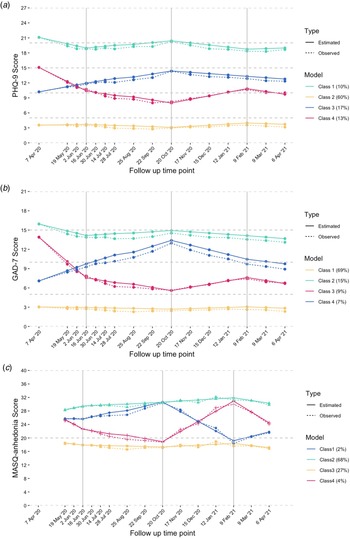
For the PHQ-9, four classes of trajectories were identified (Fig. 1a). Most participants reported low and stable symptoms (60%, class 2, n = 25 364), while 10% had high and stable symptoms (class 1, n = 4341). The high and stable symptom group's scores fell at the border of moderate-severe (15–19) to severe scores (20–27) throughout. Seventeen per cent showed initially moderate symptoms, which then increased in their symptom trajectory until October 2020, then decreased (class 3, n = 6977). A fourth group (13%) had moderately severe baseline symptoms (15), which decreased until October (mild range), then increasing until February 2021, then decreasing again (class 4, n = 5324).
Trajectory plots for optimal class number solutions: (a) depression symptoms (PHQ-9) model with four-class solution, (b) anxiety symptoms (GAD-7) model with four-class solution, (c) anhedonia symptoms (MASQ-AD) model with four-class solution (reverse-coded, higher scores indicate higher anhedonia). The first time point for data collection for the MASQ-AD was in May 2020. The follow-up time points were more frequent between May and July 2020, and less frequent from August 2020 to April 2021. Grey dashed lines indicate standardised cut-off thresholds across for the PHQ-9 and GAD-7, and the midpoint and maximum scores for the MASQ-AD. Vertical lines indicate timepoints selected for piecewise models.

For the GAD-7, we identified four classes of trajectories comparable to that for the PHQ-9 (Fig. 1b). Again, most participants reported low and stable symptoms (69%, class 1, n = 28 640), and 15% reported high stable symptoms (class 2, n = 6064), at around the cut-off for severe anxiety symptoms (⩾15). Smaller proportions than that seen for PHQ-9 symptoms fell into the time-varying classes. Seven per cent showed mild baseline symptoms (above 5), with an increasing trajectory until October 2020, followed by decreasing symptoms (class 4, n = 2887). Nine per cent showed high initial symptoms in the severe range (⩾15), and a decreasing pattern until October, then increasing until February 2021, then decreasing again trajectory (class 3, n = 3854).
For the MASQ-AD (aim 2), we also identified four classes of trajectories: a high stable class (class 2, n = 22 299, 68%), a low stable class (class 3, n = 8764, 27%), and two smaller classes, comprising 4 and 2% of participants (Fig. 1c). The two smaller classes started with high symptoms. One class initially decreased until October 2020, then showed a later increase until February 2021, followed by another decrease (class 4, n = 1237, 4%). The other class initially increased until October 2020, then showed a decrease until February, followed by another small increase (class 1, n = 592, 2%).
Predicting class membership
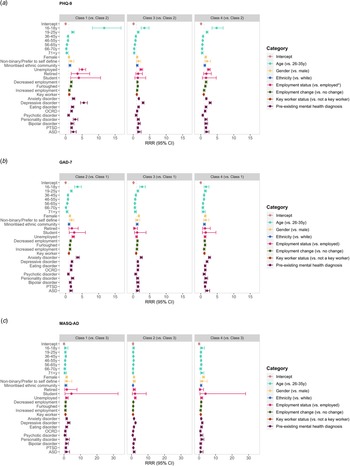
Figure 2 and online Supplementary Tables S9–S11 present the results of the multinomial logistic regression models used to examine predictors of class membership (aim 3). For each model, the ‘low and stable’ symptom class was used as the reference category. For both the anxiety and depression ‘high and stable symptom groups’, membership was predicted by younger age (16–25 years, relative to the reference category 25–36 years), unemployment (relative to being employed) and non-binary or self-defining gender (relative to male gender). Having a self-reported previous mental health diagnosis was also a significant predictor of high symptom group membership for all diagnoses included in the models, except for a psychotic disorder diagnosis. For depression (PHQ-9) particularly, the strongest predictors of being in the consistent high symptom group were younger age (16–18 years), being unemployed or prior history of a depressive disorder. These three predictors were also associated with membership of the other time-varying classes (i.e. the classes showing both improved symptoms with societal re-opening, and worsening symptoms). There were several differences between predictors of group membership for consistent high symptoms of depression and anxiety. For example, female gender was a predictor of anxiety, but not depression symptoms and being retired was a predictor of depression but not anxiety symptoms (see online Supplementary materials for further discussion).
Forest plots for showing results of multiple regression analyses: (a) depression symptoms (PHQ-9), (b) anxiety symptoms (GAD-7), (c) anhedonia (MASQ-AD). Grey dashed line indicates relative risk ratio (RRR) = 1.

For the MASQ-AD trajectories, the largest category of participants reported high and stable experiences of anhedonia, the opposite to PHQ-9 and GAQ-7 scores. Female participants were less likely to be in the low stable anhedonia symptom class (class 2) compared to male participants, and they were more likely to be in one of the time-varying smaller classes. As for depression and anxiety classes, an unemployed status (relative to employed) was a predictor of membership of the high and stable class. Finally, for prior mental health diagnoses, the most consistent effects were related to previous depression and anxiety diagnoses. Previous diagnoses of depression or anxiety were predictors of membership of all three of the moderate or high anhedonia symptom classes. The effects were strongest for a previous diagnosis of depression, across all three classes.
Discussion
This study examined mental health trajectories in a large sample of UK participants across the first year of the COVID-19 pandemic. We found that the majority of participants had low and stable symptoms of depression or anxiety across the first year of the pandemic (60%, 69% respectively), and a minority had high and stable symptoms (10%, 15%). For the time-varying trajectory groups, we found a subgroup of participants who showed improving symptoms until the period of the second national lockdown, and then a worsening pattern of symptoms again. We view this as a group negatively impacted by the lockdowns. An opposite pattern also emerged: those who showed worsening of depression and anxiety symptoms as the re-opening of society occurred at the end of the first lockdown, and an improvement in symptoms with a second lockdown (aim 1). Our trajectory groups for anhedonia provided the most unexpected pattern, with most of the sample reporting stable low positive affect (i.e. high anhedonia) throughout the 12-month period (aim 2).
For depression and anxiety symptom trajectories, we confirm earlier findings indicating the importance of demographic factors associated with existing social and health inequalities, such as employment status and having a prior mental health diagnosis (aim 3). Being younger in age, reporting a previous diagnosis, non-binary or self-defined gender, and an unemployed or a student status were all significantly associated with falling into the high stable symptom groups for depression and anxiety. Our findings of age effects, prior mental health diagnoses and employment are consistent with factors reported for the earlier time periods of the pandemic (e.g. Pierce et al., Reference Pierce, Hope, Ford, Hatch, Hotopf, John and Abel2020, Reference Pierce, McManus, Hope, Hotopf, Ford, Hatch and Wessely2021; Saunders et al., Reference Saunders, Buckman, Fonagy and Fancourt2021; Young et al., Reference Young, Purves, Hübel, Davies, Thompson, Bristow and Breen2022). Female gender predicted membership of the high and stable anxiety group, but not the high and stable depression group, in line with our earlier report (Young et al., Reference Young, Purves, Hübel, Davies, Thompson, Bristow and Breen2022). Other work has also reported complex gender-related effects, with women being both overrepresented in the ‘deteriorating’ mental health trajectory group, and also the ‘recovered’ group (Pierce et al., Reference Pierce, McManus, Hope, Hotopf, Ford, Hatch and Wessely2021). Some comparable effects were demonstrated in the anhedonia symptom trajectories, with women, unemployed individuals and those with specific prior mental health diagnoses more likely to be in the high stable symptom trajectory.
By explicitly considering UK lockdown timelines in our analyses, we identified participants who responded in divergent ways to the initial lifting and re-imposition of restrictions. A sizable proportion of participants seemed to fare better in terms of their anxiety and depression symptoms shortly after the start of the lockdown (first measurement point), showing a worsening pattern of symptoms as restrictions were lifted, and improving again with the second lockdown. Described in a youth sample as a group ‘happier during lockdown’ (Sonenson et al., Reference Soneson, Puntis, Chapman, Mansfield, Jones and Fazel2022), we speculate that these participants may have benefited from the reduced commitments inherent in lockdown restrictions. For example, being away from challenging work environments, or social activities that cause distress, could be beneficial for some adults. The other time-varying group, discussed more prominently in the literature as a recovery group (e.g. Fancourt et al., Reference Fancourt, Steptoe and Bu2021), comprises the participants falling into a ‘less happy during lockdown’ pattern. Symptoms reported by this group improved as restrictions were eased, until the second national lockdown, and then worsened again. By including data over a 12-month period, and including the second wave of COVID-19, we were able to examine the extended effects of more than one period of restrictions. Our study contributes to the understanding of mental health during the pandemic by demonstrating the variability of adults' responses to pandemic restrictions, whereby patterns are not just in the direction of recovery.
Anhedonia: low positive affect throughout the 12-month period
For the MASQ-AD scores, the picture was complex and counterintuitive. Only small numbers of participants (6%) had time-varying trajectories, and unexpectedly, most participants (68%) indicated low positive affect (i.e. high anhedonia). Participants' scores on the PHQ-9 and the MASQ-AD were strongly positively correlated (online Supplementary Fig. S1), as would be predicted from models of depression [e.g. the tripartite model (Clark & Watson, Reference Clark and Watson1991)]. However, while only a minority of participants fell into clinical symptom ranges indicating depression or anxiety, the majority of participants were in the high stable group for anhedonia. In interpreting our participants' MASQ-AD scores, we note that our participants' mean values are higher than other UK participant samples including ‘healthy controls’ and unselected community (e.g. Gagne, Zika, Dayan, & Bishop, Reference Gagne, Zika, Dayan and Bishop2020) or university samples (Burr, Javiad, Jell, Werner-Seidler, & Dunn, Reference Burr, Javiad, Jell, Werner-Seidler and Dunn2017).
There are several possible interpretations of our relatively high MASQ-AD scores. First, the extended reduction in opportunities to engage in rewarding activities such as work or social activities may have altered our sample's experiences of daily positive affect. The MASQ-AD scores reported here may reflect a COVID-19-related dampening of joyful experiences in participants' day-to-day lives, even in the absence of clinical levels of depression or anxiety symptoms. However, the absence of a pre-pandemic measure of anhedonia means that we cannot exclude the possibility that our participants were high on state or trait anhedonia before April 2020. Furthermore, there is evidence for a substantial trait variance component for the MASQ-AD (Kendall et al., Reference Kendall, Zinbarg, Bobova, Mineka, Revelle, Prenoveau and Craske2015), and participants' stable scores do not show evidence of recovery with the lifting of restrictions.
A second interpretation of our high MASQ-AD scores is related to potential cross-cultural variations in responses to the scale itself. The original MASQ-AD was developed in the US (Clark & Watson, Reference Clark and Watson1991), and much of the subsequent psychometric evaluation work has been carried out with US samples (e.g. Bredemeier et al., Reference Bredemeier, Spielberg, Silton, Berenbaum, Heller and Miller2010; Talkovsky & Norton, Reference Talkovsky and Norton2015). We considered the acceptability of items such as ‘Felt like I accomplished a lot’, with the response ‘Extremely’ for a UK sample, but we could not find any published comparisons examining representative data from the US and the UK. For our overall interpretation of the MASQ-AD findings, and potential pandemic-related effects on anhedonia, we found primarily cross-sectional studies (e.g. Cheung et al., Reference Cheung, Jin, Lam, Su, Hall and Xiang2021; Landaeta-Díaz, González-Medina, & Agüero, Reference Landaeta-Díaz, González-Medina and Agüero2021; Wellan, Daniels, & Walter, Reference Wellan, Daniels and Walter2021), or small-scale studies (n = 80; Fried, Papanikolaou, & Epskamp, Reference Fried, Papanikolaou and Epskamp2022; n = 87; Wieman et al., Reference Wieman, Arditte Hall, MacDonald, Gallagher, Suvak, Rando and Liverant2022) of university samples. With the limited available evidence against which to compare our sample's MASQ-AD scores, we suggest the most plausible explanations are related to trait characteristics of our sample or a measurement issue.
Limitations
Our study used convenience sampling, and our cohort had an over-representation of women, those with high education levels, and individuals of white ethnicity, issues that have been widely discussed as impacting COVID mental health studies (e.g. Pierce et al., Reference Pierce, Hope, Ford, Hatch, Hotopf, John and Abel2020). We carried out surveys online and relied on self-report measures of diagnostic history, and our samples had an over-representation of adults with a prior mental health diagnosis. We did not adjust for seasonal variation in population mental health (de Graaf, van Dorsselaer, ten Have, Schoemaker, & Vollebergh, Reference de Graaf, van Dorsselaer, ten Have, Schoemaker and Vollebergh2005), although others have estimated that the effects of seasonal variation are unlikely to account for changes in population mental health during the pandemic (Daly, Sutin, & Robinson, Reference Daly, Sutin and Robinson2020). Another factor we did not adjust for was regional variation, whereby there were both local lockdowns in response to geographically constrained COVID-19 case spikes, and also minor differences in the timing of lockdowns in Northern Ireland, Wales, England and Scotland.
Conclusion
Numerous rapid surveys from the initial months of the COVID-19 lockdown suggested that mental health symptoms of individuals in the UK declined initially but recovered quickly thereafter. Our findings, extending beyond the initial months of the pandemic and including measurement points until April 2021, showed that for the majority, symptoms of depression and anxiety were low and stable throughout the 12-month period. For a minority of participants, trajectories of symptoms diverged from the majority group, with some showing improvements in symptoms as the pandemic progressed, whereas others showed the opposite pattern of marked symptom increases until the second national lockdown. We also highlight several sociodemographic characteristics associated with the ‘poorer’ symptom trajectories, such as being a student, being retired and having a previous mental health diagnosis.
Supplementary material
The supplementary material for this article can be found at https://doi.org/10.1017/S0033291722003828
Financial support
The RAMP study was supported in part by the King's Together Multi and Interdisciplinary Research Scheme (Rapid COVID-19 call, Round 1; Round 2). KSY was supported by MQ; Transforming Mental Health (MQF20/24). TCE and GB are part funded by a program grant from the UK Medical Research Council (MR/V012878/1). CEP is funded by a grant from the Carlsberg Foundation (Semper Ardens: Accelerate CF19-0715).