INTRODUCTION
Family-centered care was defined in the 1970s, as “care as an innovative approach to the planning, delivery, and evaluation of healthcare that is grounded in mutually beneficial partnerships among healthcare providers, patients, and families” (Cypress, Reference Cypress2011). The core concepts of a family-centered approach include honoring the patient and family perspectives and choices, incorporating the patient's and family's cultural and spiritual background into the delivery of care, engagement and support in the decision-making process, and sharing complete and unbiased information.
Patients admitted to an ICU are often unable to communicate effectively due to illness, mechanical ventilation, altered mental state, and sedation. As a result, much of the interaction with the care team, including provision of history and shared decision making, is managed by family members (Hickey, Reference Hickey1990; Johnson et al., Reference Johnson, Wilson and Cavanaugh1998; Heyland et al., Reference Heyland, Rocker and Dodek2002; Fumis et al., Reference Fumis, Nishimoto and Deheinzelin2008). However, healthcare team communication with the family in ICUs can be logistically difficult due to the high-acuity environment and the large, complex team of providers. Families are often dissatisfied with the communication with providers, especially in the end-of-life context (Hanson et al., Reference Hanson, Danis and Garrett1997; Baker et al., Reference Baker, Wu and Teno2000), and families of ICU patients often experience anxiety, depression, and posttraumatic stress disorder (Azoulay et al., Reference Azoulay, Pochard and Kentish-Barnes2005; McAdam et al., Reference McAdam, Dracup and White2010; Pochard et al., Reference Pochard, Azoulay and Chevret2001; Reference Pochard, Darmon and Fassier2005).
There is a growing consensus regarding best practices for palliative care for critically ill patients that includes recommendations for family communication. In 2008, a consensus panel of experts proposed 18 quality measures to assess the end-of-life care provided in an ICU (Mularski et al., Reference Mularski, Curtis and Billings2006). They addressed the domains of patient- and family-centered decision making, communication with the team and the patient's family, continuity of care, emotional and practical support for patient and family, symptom management, and comfort care. A multidisciplinary family conference is the core component of recommended family communication. Family conferences have been associated with decreased ICU length of stay and improved ratings for quality of dying by family members (Lilly Reference Lilly, de Meo and Sonna2000). Despite the publication of these best practices and improved outcomes, reliable delivery of these components to ICU patients has been variable.
Clinical reengineering using electronic checklists, discrete data capture, and clinical decision support via an electronic health record (EHR) has been employed to promote higher reliability in the care process (Haynes et al., Reference Haynes, Weiser and Berry2009; Hales & Pronovost, Reference Hales and Pronovost2006; Bright et al. Reference Bright, Wong and Dhurjati2012). The present paper evaluates implementation of a Family Communication Pathway intervention in an ICU with the help of embedded EHR tools to promote the reliability of best practices, including the occurrence of a multidisciplinary family conference.
METHODS
Study Setting
Our study was conducted at the Geisinger Medical Center (GMC), a large tertiary/quaternary care hospital within the Geisinger Health System in rural Pennsylvania. GMC has 42 critical care beds staffed by 21 (12.0 FTE) attending physicians, 110 critical care nurses, 1 social worker, and 1 case manager. The Geisinger Health System provides care for more than 2.6 million residents throughout 44 counties in central and northeastern Pennsylvania, and has designed new models and methods for reliable care delivery by leveraging both health information technology and workflow redesign (Paulus et al., Reference Paulus, Davis and Steele2008; Berry et al., Reference Berry, Laam and Wary2011; Weber et al., Reference Weber, Bloom and Pierdon2008; Wood et al., Reference Wood, Chu and Manney2012).
Development and Implementation of Family Communication Pathway
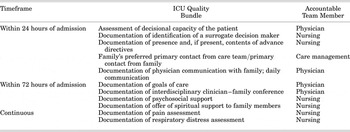
Beginning in June of 2011, a multidisciplinary team focused on best practices in the GMC ICU. This team consisted of critical care physicians, neurosurgeons, critical care nursing, care management, and health information technology staff. Over a series of 6 hour-length meetings, the team reviewed national consensus guidelines and selected 10 care process elements to be incorporated into the Family Communication Pathway intervention (Table 1). Each care process element was assigned an accountable care team member and a time period for completion.
Care processes in the ICU quality bundle

Once the Family Communication Pathway care elements and accountability were established, existing electronic health records (EHRs) or paper-based workflows were reviewed. Three hour-long health information technology design sessions were conducted to develop an integrated EHR workflow that captured all data elements as part of the clinical documentation process. All workflows designed to capture data were augmented with decision support (e.g., EHR-based alerts) to enhance reliability. An EHR-based Family Communication Pathway dashboard displaying the status of all care elements was also implemented.
All patients admitted to neurosurgery or having a neurosurgery consultation were included in the Family Communication Pathway pilot population (approximately one patient per day). Training materials were generated and disseminated to all critical care providers, neurosurgeons, social workers, and care managers, and presentations were made to critical care staff over three separate 20-minute educational sessions. One-on-one support was available to providers and nurses during the first two months following implementation. Reports regarding compliance with the Family Communication Pathway documentation were provided on a monthly basis to ICU leadership, physicians, nursing staff, and care management.
The core component of the Family Communication Pathway was the performance of a multidisciplinary family conference within 72 hours of admission to the ICU. The content of the family meeting was not proscribed or measured, but rather decided by the critical care team to perform, with specific roles and tasks assigned to care team members (e.g., the ICU social worker facilitated the family meeting; physicians provided prognostic information to the family). The multidisciplinary family meeting was to be repeated every week.
Evaluation Methods
We utilized a quasiexperimental design to measure the impact of the Family Communication Pathway intervention on family satisfaction. The Geisinger Institutional Review Board (IRB) approved the study under expedited status. We chose the FSICU–24 questionnaire, a validated 24-item instrument for assessing family satisfaction in an ICU, which yields an overall satisfaction score (FS–Total), and two subscales: satisfaction in the area of decision-making (FS–DM) and satisfaction with the care provided (FS–Care) (Heyland et al., Reference Heyland, Rocker and Dodek2002; Wall et al., Reference Wall, Engelberg and Downey2007). To the standard questionnaire we added an additional item asking if a multidisciplinary family conference was held during their loved one's hospital stay.
Surveys were sent to the next of kin (NOK) of patients aged 18 and above admitted to the GMC ICU and receiving ICU level of care who had been discharged between January and March of 2012. Patients with a research opt-out indicator were excluded, as were patients who lacked NOK information in their EHRs. Using these criteria, eligible patients and NOK contact information were identified by querying our clinical data warehouse, which stores all the clinical information from the EHRs. For patients with multiple contacts, the next of kin listed as the primary contact in the EHR were utilized for study purposes.
A modified Dillman method (Machlis & Dillman, Reference Machlis and Dillman1990) was employed to survey the NOK, whose addresses were obtained through the EHRs. An initial notification letter addressed from the study's principal investigator and the director of critical care medicine was sent between 2 and 6 weeks following the patient's discharge, along with the questionnaire and a one-dollar bill aimed at increasing response rate. The letter included an explanation of the study, explicitly stating that the care received by their family member would not be affected by the decision to participate in the study, and provided a toll-free number that patients could call to opt out. After three weeks, a reminder letter and a second copy of the questionnaire were sent to the next of kin who had not returned the questionnaire or opted out. This mailing was followed up three days later with a call from a study team member to verify that the packet had been received and confirm whether the NOK was interested in participating. Consent was implied for those who returned a questionnaire, and thank-you letters were sent to all NOK participants.
Implementation of the Family Communication Pathway intervention began in April of 2012. To achieve higher levels of reliability and consistency of the intervention, a six-month implementation period was sustained before follow-up evaluation was conducted. Patients were discharged between October of 2012 and May of 2013 and surveyed using the same inclusion criteria and methodology as the baseline population.
Analyses
Analyses were performed with survey, clinical, and demographic data extracted from Geisinger's EHRs. A chi-square test or Fisher's exact test was utilized to compare the pre- and post-Family Communication Pathway intervention survey results, as appropriate. All were two-sided tests, and a p value <0.05 was considered significant. All analyses were performed using SAS v9.2 software (SAS Institute Inc., Cary, North Carolina).
RESULTS
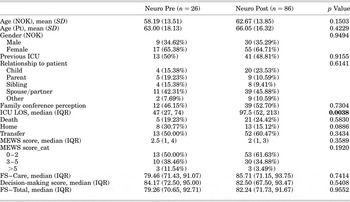
For the eligible pre-intervention population, 278 questionnaires were mailed, of which 8 NOK chose to opt out, 1 was removed due to bad address information, and 149 responded, representing a 53% response rate. For the post-intervention population, 771 surveys were mailed, 21 NOK chose to opt out, 8 were returned due to a wrong address, and 363 responded, which represented a 47% response rate. In the post-intervention population, 86 were neurosurgical patients who were eligible to receive the Family Communication Pathway intervention, and these survey results were compared to the 26 who were neurosurgical patients in the baseline population. Univariate analysis of the characteristics and demographics of the neurosurgical patients and their families in the baseline and post-implementation populations showed no significant differences except for ICU length of stay (Table 2).
Characteristics of eligible pre- and post-intervention populations

Note. Numbers in columns do not add up to the total number in each group due to missing values. NOK = next of kin; ICU = intensive care unit; LOS = length of stay; MEWS = modified early warning score; IQR = interquartile range.
The percentage of families in the pilot population who self-reported the occurrence of a family conference was 46.5% before the intervention; this improved minimally to 52.5% following the intervention (p = 0.565) (Table 3). There was no statistically significant difference noted in family satisfaction as determined by FSICU–24 scores, including the Care and Decision Making constructs.
Family satisfaction scores for pre- and post-intervention population

IQR = interquartile range.
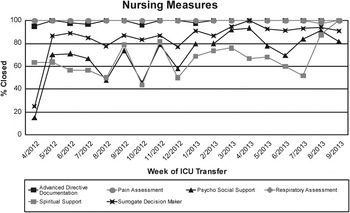
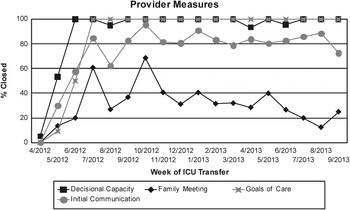
Staff compliance with the intervention process measures following implementation was also examined through reports on completion of the electronic checklist. Overall, the nursing measures (Figure 1) had higher rates of compliance compared to physician process measures (Figure 2). Among the nursing measures, pain and respiratory assessments were completed for all patients. Identification of a surrogate decision maker and documentation of the existence of an advanced directive were completed for most of the patients. Documentation of an offer of psychosocial and spiritual support was the process with the least compliance and showed only minimal improvement despite multiple efforts at reeducating the staff. Compliance with physician measures was very low in the beginning but gradually improved with ongoing support and education. Compliance with documentation of a multidisciplinary conference remained at around 50% and did not show much improvement throughout the intervention.
Care gaps closed by nursing measures.

Care gaps closed by provider measures.

DISCUSSION
Improving communication with families is an important component of high-quality intensive care. We evaluated the impact on family satisfaction of an intervention to increase compliance with national expert recommendations on family communication and end-of-life care in neurosurgical patients admitted to the ICU. Despite the consensus from ICU clinical leadership and end users on the importance of the measures, the use of EHR-based reliability tools, and a lengthy implementation period, the intervention did not achieve a statistically significant increase in the proportion of family members who clearly perceived and reported the occurrence of a family conference or a perception that care processes were delivered (no change in percentage of patients reporting a family conference), nor was a statistically significant increase in family satisfaction achieved.
A study conducted by Lily and colleagues evaluated an intensive communication pathway that required a multidisciplinary family conference within 72 hours of admission to the ICU and noted that intensive communication reduced the length of stay (Lilly et al., Reference Lilly, Sonna and Haley2003). However, family satisfaction as an endpoint was not measured. As far as we know, our study is the only Family Communication Pathway intervention in an ICU that looked at family satisfaction as a primary endpoint. It is interesting to note that, even in the Lily et al. study the rate of occurrence of family conferences was quite low (48% pre- and 69% post-intervention).
In another study evaluating a multicenter study of patients who died at 10 ICUs in the northwestern United States, the occurrence of family conferences as documented in medical charts was noted to be associated with a higher quality of death as rated by family members (Glavan et al., Reference Glavan, Engelberg and Downey2008). In our study, which looked at both the survivors and nonsurvivors of an ICU stay, we noted that that there was no significant difference in family satisfaction between patients who had interventions that included a family conference.
One factor that may have contributed to the lack of impact of an intervention on family satisfaction was that the reliability of actual performance of the agreed-upon best practices was less than 100%. For example, use of EHR-based tools for documentation of a family conference by physicians increased over the intervention period but was often inconsistent. Overall compliance with the Family Communication Pathway tended to be high among nursing staff and lower for physicians, despite the addition of EHR reminders, one-on-one training, and periodic feedback to physicians and critical care leadership. Family self-report of the occurrence of a family conference during ICU stays, as collected through the questionnaire, did not improve, providing additional confirmation of poor intervention uptake. This can be attributed to a number of factors, including: (1) inadequate critical care professional staffing to meet the demand, (2) a lack of social worker support to organize family conferences and liaison with families, and (3) inability of critical care medicine and neurosurgery to consistently coordinate family communications across the continuum of care.
Another factor is that, while the Family Communication Pathway intervention attempted to ensure reliable provision of a checklist of care-process elements, it did not attempt to prescribe the content or format of the multidisciplinary family meeting. Despite increased structured documentation of family meetings over the course of the implementation period, next of kin may have had a different perception of “family conference” as compared to provider perceptions. Since we did not measure or assess what occurred in the family conferences documented by physicians, it may be that there is substantial variation between providers and patients in terms of understanding what constitutes a family conference.
The use of structured electronic tools and reminders to increase the reliability of communications with families may have shortcomings. The use of “checkboxes” may not be an accurate reflection as to whether a family conference, with high-quality communication, was indeed held. The components of high-quality communication with families in an ICU—providing more time for families to speak during the conference, holding empathic conversations, employing shared decision making, use of brochures (Lautrette, Reference Lautrette, Darmon and Megarbane2007), and addressing spiritual needs—may be additional skills that need to be imparted to healthcare providers with further training.
It is known that family meetings improve family well-being. However, this may in fact result from the process of engaging families specifically in the decision-making process. If scheduling a multidisciplinary family conference is not feasible given the coordination of numerous already-busy providers and members of the healthcare team, other means of family engagement should be explored and their impact studied.