

As archaeologists, many of us take pride in our ability to borrow tools, methods, and theories from other disciplines and apply them to our work. As Nilsson Stutz (Reference Nilsson Stutz2018:49) notes, interdisciplinarity is “in our bones”—to the point that we archaeologists are placed in natural science, social science, or the humanities, and we often cross those boundaries depending on our needs. Interdisciplinarity also takes us into a variety of sectors: academia, museums, government, and cultural resource management (CRM), to name a few. It seems impossible there are still disciplines available for us to mine. However, as we begin to reflect on our disciplinary culture and make calls for safer, more inclusive, more effective, and more meaningful workplaces, I would like to argue that business-focused scholarship on leadership and management may serve as a place for us to look for resources and research to improve our discipline.
The purpose of this article is to provide examples of ways that I have applied leadership and management strategies pulled from this scholarship to academic and museum settings, the places where I have the most experience leading archaeology teams. The intention is to provide examples of what some of this literature looks like and show how I have applied some of the strategies. This article is not arguing for the adoption of these specific approaches across the board, given that each workplace is different and has its own challenges. My purpose is to suggest that when faced with management and leadership decisions, a body of scholarship exists to turn to for ideas. I also want to acknowledge that many archaeologists, particularly in CRM and government, may already be familiar with this scholarship and these approaches. My hope is to encourage more archaeologists to engage with it.
Typically, this literature is designed for people running and managing businesses, with research questions related to improving efficiency, quality control, and workplace happiness and retention, and to maximizing return on investment. The scholarship is long-standing and plentiful. The Harvard Business Review, for example, began as an academic magazine designed to bridge management theory and practice in 1922. Journal of Management, started in 1975, publishes monthly, whereas Leadership Quarterly, founded in 1990, now publishes bimonthly. Coupled with increasing numbers of business colleges and leadership programs emerging at universities, it is evident that this is an abundant area of scholarship.
In this article, I will reflect on three areas I have found particularly useful: developing a values-based culture, adopting coaching-based leadership, and adopting project management methodologies. After introducing each concept and its supporting literature, I will provide examples of how I have applied these approaches during my time as the assistant director for archaeology at James Madison’s Montpelier and director of the Cultural Heritage and Archaeology Research Group (CHARG) at Wake Forest University (WFU).
A Values-Based Culture
Recently, archaeologists have conducted several studies about the culture of the discipline. Our colleagues have called for a more inclusive and compassionate culture that embodies ethical care and that is free from the harassment and discrimination that archaeologists have identified (Voss Reference Voss2021a, Reference Voss2021b). Making the necessary changes will require leaders of archaeological organizations to think critically and intentionally about how to address cultural issues within their institutions. Although this includes addressing organizational policies, it also means developing an aspirational mindset to think about and encourage the type of organizational culture within which archaeologists and their teams want to work.
Scholars in leadership and management have studied how organizational culture affects outcomes and what best practices are used to build successful cultures. Many researchers have concluded that successful organizations are defined by their ability to articulate their values and live them out through their actions. This scholarship began to take hold in the 1980s with the work of Schein (Reference Schein1985). Later work studied the effectiveness of values on outcomes: Kotter and Heskett (Reference Kotter and Heskett1992) demonstrated that values-driven work cultures outperformed others, and Anderson (Reference Anderson1997) argued that organizations should have explicit value statements and use them to guide their decision-making.
At James Madison’s Montpelier, we decided to build a values-based organization because we were lucky enough to have hired a team that had organically built a culture we wanted to preserve. We ran a workshop with the team, where we distilled our culture into a set of values. These were Professionalism, Mutual Respect, Learning, Publicly Focused, Transparency and Open Communication, Choose Positivity, and Family. I drafted a booklet to accompany these values, explaining in more detail what they meant, giving examples of them in practice and providing resources for new staff to learn more (Brock Reference Brock2017). These values have been revisited annually, not only to hold each other accountable but to revise, add, or remove values that needed adjusting. Since its original drafting, the team has added Accountability, removed Choose Positivity, and changed Family to Community.
The values have repeatedly demonstrated their utility. This ranged from visually projecting Professionalism by ordering “Staff Archaeologist” uniform shirts to developing anti-racist policies and practices stemming from our value of Mutual Respect (Minkoff et al. Reference Minkoff, Brock, Reeves and Westmont2022). The values changed our interview practices, moving us away from questions about experience to questions about value fit. It influenced our project management practices, leading us to adopt a more democratic and accountable system that prioritized open communication and transparency. Most importantly, it gave us a shared language so that we could hold each other accountable to the type of culture we wanted. Overall, becoming a values-based organization improved our ability to do archaeology in meaningful, ethical ways.
CHARG was also designed with a specific mission and set of values. With a particular emphasis on collaborations outside of the university and the use of digital tools, our values focus on developing a Community of Practice (Watrall Reference Watrall2019; Wegner and Snyder Reference Wegner and Snyder2000) around Public Collaboration, Learning by Doing, Learning Together, Equity and Justice, and Mutual Respect (Brock Reference Brock2021). These values set the expectation for students and staff who work within the group, as well as a promise to our community partners. These values were inspired not only by my personal approach to archaeology but also to align with WFU’s motto Pro Humanitate, or For Humanity, and its strategic framework, which prioritizes building Communities of Learning, Inquiry, and Partnerships (Wake Forest University (2023). Aligning with the university’s values has allowed CHARG to effectively communicate our value to the institution. Our values also help us focus on what projects we will take on and how we approach those projects.
From Managing to Coaching
Although developing a values-based culture can provide parameters within which an organization can function, leaders must still work with their employees to ensure that the values are upheld while the work itself gets done. This calls for day-to-day engagement with staff on an individual basis to ensure quality performance, handle interpersonal issues, and set goals in career development and training. The scholarship on management and leadership has focused on a variety of approaches to carry out this work, and a coaching-focused model has emerged as one alternative to traditional approaches. This approach has been popularized by individuals such as Cy Wakeman (Reference Wakeman2017) and Michael Bungay Stanier (Reference Bungay Stanier2016), who both encourage leaders to empower their employees to take responsibility for their thinking and actions, to engage with their emotions and assumptions, and to support the creation of paths that benefit both the individual and collective. This is a shift from a more traditional approach, in which leaders and managers are responsible for solving problems on behalf of the team. This is not only heavily burdensome but also relieves staff of accountability and disempowers them from contributing.
Wakeman (Reference Wakeman2017) argues that leaders must develop cognitive discipline by understanding and regulating their emotions so they can learn to distinguish between reality and story. This skill set allows leaders to help their teams move through challenges and develop both a sense of personal accountability and a capacity for constructive response without blame or victimhood. Bungay Stanier (Reference Bungay Stanier2016) argues that leaders must cultivate restraint and curiosity. Instead of providing more solutions, they should ask better questions, helping their team build (1) skills in independent thinking and problem-solving and (2) the confidence to act. Although they have different emphases, collectively these approaches focus on leaders developing a coaching mindset that empowers their team members to address issues and problems on their own.
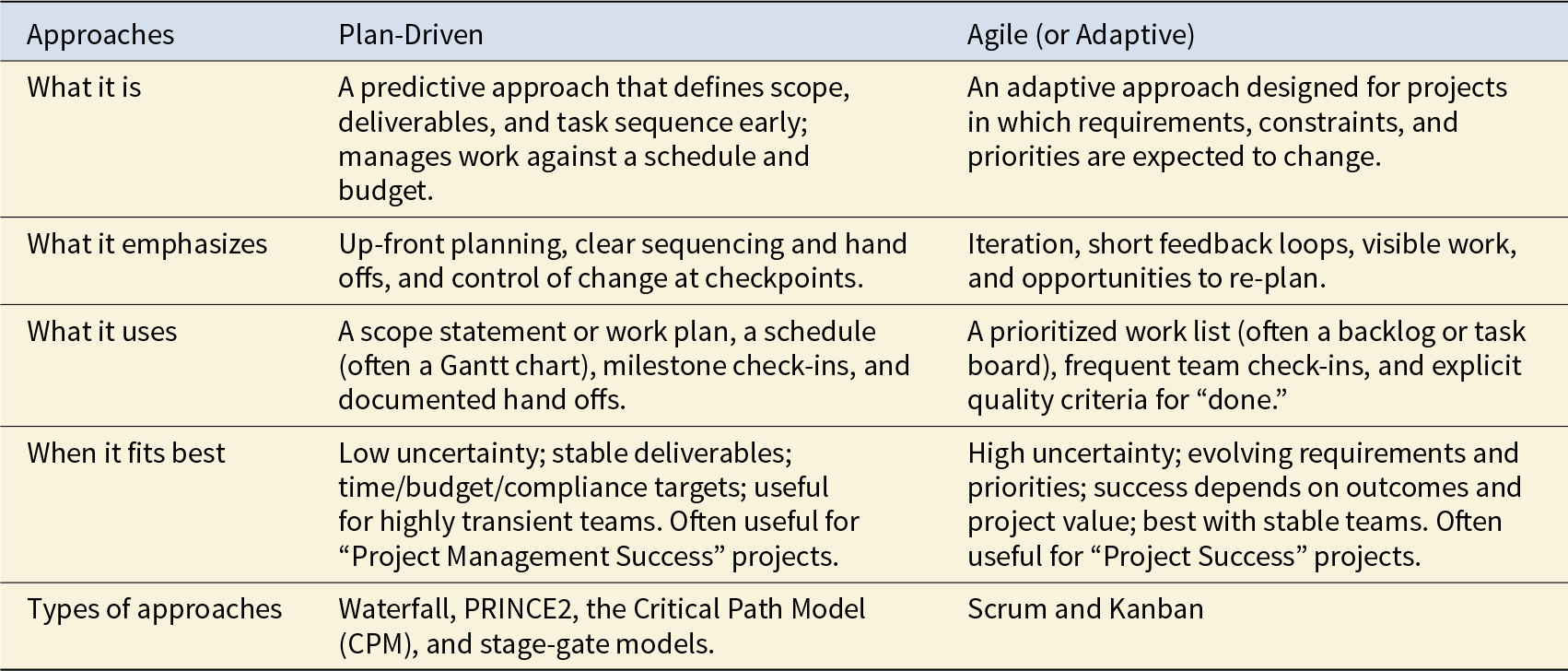
Comparison of Plan-Driven versus Agile or Adaptive Approaches to Project Management.

Adopting a coaching-oriented approach at Montpelier required me to confront how my own practices—particularly my impulse to try to solve problems and absorb others’ frustrations—were disempowering my staff and reducing the team’s effectiveness. One-on-one meetings were frequently sites of emotional offloading and competing narratives, putting me in the position of addressing dissatisfied staff rather than building accountability. Engaging with Wakeman and Bungay Stanier helped reframe this dynamic. Drawing on Bungay Stanier (Reference Bungay Stanier2016), I began treating these meetings as opportunities to coach through a process of inquiry. I used his seven coaching questions to shift the focus from fielding complaints that I had to solve to working with staff to develop their own solutions, to identify next steps, and to articulate what they needed from me to support their plan. This model empowered staff to act and reduced my role to one of support.
Wakeman’s (Reference Wakeman2017) reality-based framework also helped me see how unexamined assumptions and emotionally charged narratives were sustaining conflict and resistance to change. Using his approach to examine stories to sort reality from assumption helped reduce defensiveness and moved us toward solutions. Wakeman’s concept of bounded choice when facing resistance to change was extremely helpful. This meant providing staff who were resisting change with one of two commitments: (1) to help them develop a plan that will get them on board with the change or (2) to support their transition to a new role elsewhere, instead of their staying and resisting. It became a tool that honored the individual’s agency to make a choice while also affirming the commitments that the rest of the team had already made to the change by not modifying it. It catered to the willing while providing supportive on- or off-ramps for the unwilling.
At both Montpelier and CHARG, a coaching model has become central to thinking about leadership as a developmental practice rather than a strictly managerial role. This reorientation supports my efforts to provide mentorship focused on professional identify formation, skill acquisition, and network building. At CHARG, where many of my students are pursuing career paths unrelated to archaeology, a coaching mindset has allowed me to identify and foster their interests so that they can still make meaningful contributions to our projects while fulfilling their career goals. This approach has broadened the reach of our program, allowing us to work with 36 student researchers and interns in our first four years (Brock Reference Brock2025).
Project Management
As noted earlier, archaeological work takes place in many different institutional and regulatory contexts, and they each have separate measures of success and are accountable to different stakeholders. Determining how to manage archaeological projects—which include large teams and lots of details, and which are inherently unpredictable because we are studying the unknown—is a critical part of effective archaeological practice. A poorly managed project could result in missing a deadline, going over budget, alienating staff, or upsetting key stakeholders. Fortunately, there is a great deal of scholarship that examines the design, implementation, and success of different project management methodologies (PMMs).
PMMs are often grouped into either plan-driven or Agile approaches (see Table 1). Plan-driven (or predictive) approaches emphasize up-front definition of scope, sequence, and deliverables, and they manage work through a structured, sequential plan. In contrast, Agile (or adaptive) approaches assume that uncertainty and change are likely, so they emphasize iterative planning, short cycles of work, frequent feedback, and ongoing adjustment (Beck et al. Reference Beck, Beedle, van Bennekum, Cockburn, Cunningham, Fowler and Grenning2001).
Although some organizations adopt a single method, the scholarship increasingly emphasizes that there is no one-size-fits-all approach. Instead, approaches should be chosen and adapted to meet the project’s overall goals, level of uncertainty, and team structure (Loch et al. Reference Loch, Jiang and Si2025; Mirzaei et al. Reference Mirzaei, Mabin and Zwikael2024). This may mean selecting different approaches for different projects or developing a hybrid system that chooses the most effective approach for different components of a project.
Loch and colleagues (Reference Loch, Jiang and Si2025) argue that different project management approaches are better suited for projects that have high or low levels of complexity and uncertainty. Plan-driven approaches are better suited for projects in which task complexity and uncertainty are low, reducing the likelihood that the project scope, budget, and timeline will be disrupted by unforeseen events. Archaeologically, this may be reflected by a standard Phase I shovel-test-pit survey or the processing and cataloging of excavated artifacts—projects that have clear objectives, methods, and low levels of uncertainty. Agile approaches, however, are better suited for projects with high levels of task uncertainty due to risk, unforeseen events, or knowledge gaps. A Phase III excavation, for example, may have higher level of uncertainty given that it is not evident precisely what kinds of stratigraphy, features, or artifact concentrations might be uncovered. The ability to be reflexive and adaptable can be critical in these situations.
Mirzaei et alia (Reference Mirzaei, Mabin and Zwikael2024) note that project objectives should also be considered, and their research suggests that projects typically prioritize either “Project Management Success” or “Project Success.” Project Management Success means that the project was managed effectively in relation to its plan and constraints: on time, on budget, and to the expected scope. This could mean that a project may have produced exactly what was asked for but did not end up meeting the underlying need of the project. These projects are often managed through plan-driven approaches. For archaeology, this kind of goal would relate to projects whose the primary obligation is reliability. Such an outcome may be necessary in a salvage archaeology project or repatriation effort, or in many contract archaeology projects.
“Project Success” means that the project achieved the value it intended, and that the outcome was both useful for decision-making and meaningful to stakeholders. This means that budget, timeline, and scope might change during the project to achieve the highest value. Agile approaches are often more effective for achieving these outcomes given that they are iterative and feedback intensive. Archaeologically, projects whose primary obligation is outcome usefulness are typically designed for Project Success. Such a project might be a community-engaged excavation, a public interpretation project, or a research-driven field project where results inform new questions and methods.
Mirzaei and coauthors (Reference Mirzaei, Mabin and Zwikael2024) also argue that the composition and stability of the project team can determine PMMs. In stable teams—where the same group works together over an extended period—Agile practices are often easier to sustain because coordination can rely on continuity, shared context, and routines such as short planning cycles, a maintained backlog, and regular check-ins. Over time, these practices build trust, “team memory,” and a shared understanding of priorities and quality standards. In archaeology, this may align with a museum or CRM firm with a consistent staff that works on projects together long enough for iterative planning and feedback to accumulate meaningfully. In contrast, transient teams—in which individuals move in and out of projects due to short-term need, specialized skill sets, or scheduling—often require more explicit coordination mechanisms. This increases the value of clear schedules, task sequencing, and well-defined expectations for deliverables, which are characteristics of plan-driven approaches. In archaeology, this may describe a university lab, where students drop in and out depending on class schedules, or situations in which volunteers are heavily depended on as part of the team.
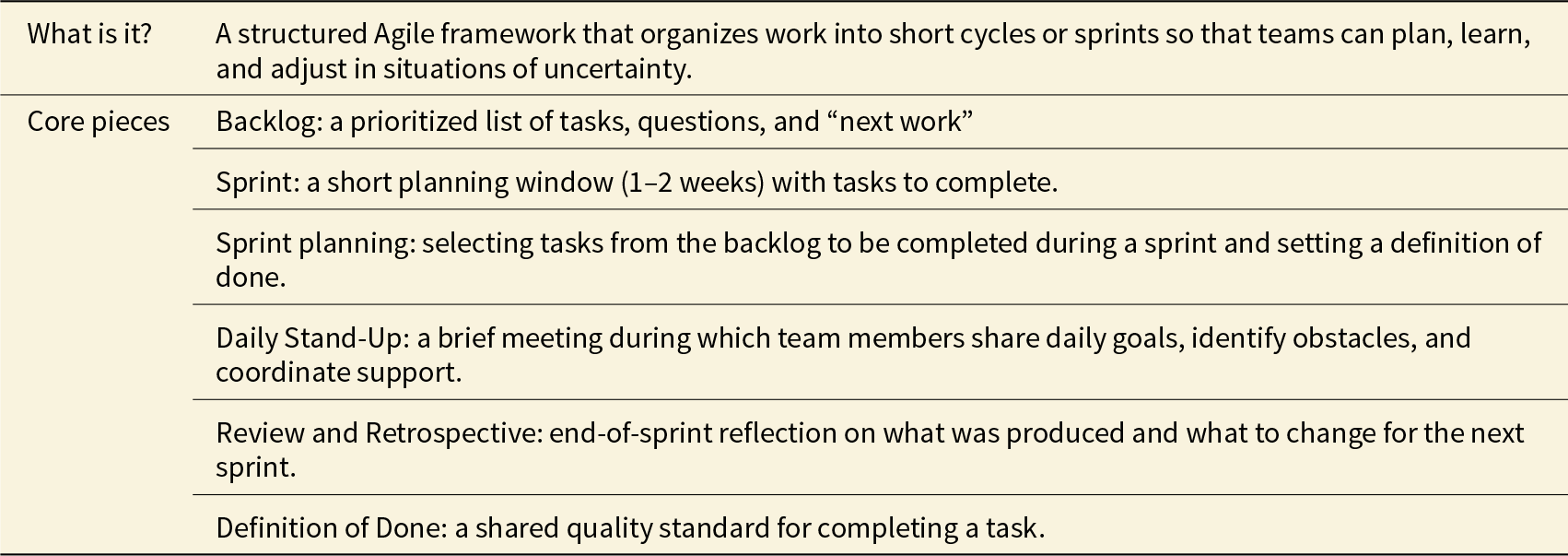
At my museum, we adopted elements from an Agile methodology called Scrum (see Table 2).
Description and Core Elements of Scrum.

Table 2 Long description
Comparison across two columns, Plan Driven and Agile or Adaptive, for what each approach is, what it emphasizes, what it uses, when it fits best, and types of approaches. For what it is, Plan Driven is predictive, defining scope, deliverables, and task sequence early and managing against schedule and budget, while Agile or Adaptive is designed for projects where requirements, constraints, and priorities are expected to change. For what it emphasizes, Plan Driven focuses on up front planning, clear sequencing and hand offs, and control of change at checkpoints, while Agile or Adaptive focuses on iteration, short feedback loops, visible work, and opportunities to re plan. For what it uses, Plan Driven lists a scope statement or work plan, a schedule often a Gantt chart, milestone check ins, and documented hand offs, while Agile or Adaptive lists a prioritized work list often a backlog or task board, frequent team check ins, and explicit quality criteria for, done. For when it fits best, Plan Driven lists low uncertainty, stable deliverables, time, budget, and compliance targets, usefulness for highly transient teams, and often useful for, Project Management Success, projects, while Agile or Adaptive lists high uncertainty, evolving requirements and priorities, success depending on outcomes and project value, best with stable teams, and often useful for, Project Success, projects. For types of approaches, Plan Driven lists Waterfall, PRINCE2, the Critical Path Model, CPM, and stage gate models, while Agile or Adaptive lists Scrum and Kanban.
Note: Description built from work by Takeuchi and Nonaka (Reference Takeuchi and Nonaka1986), Schwaber (Reference Schwaber1997), Sutherland (Reference Sutherland2014), and Schwaber and Sutherland (Reference Schwaber and Sutherland2020).
Scrum is one of the most widely used Agile project-management systems and is structured around the principles of transparency, inspection, and adaptation. Several elements of Scrum were helpful in our fieldwork. Although our projects were often yearlong, and we followed consistent excavation methodologies that were plan-driven, excavations themselves were inherently complex and uncertain. Our research questions were also always mission driven, responsive to descendant community partners, and focused on public education and interpretation—meaning that our objectives were Project Success-oriented. And finally, we had a stable team of full-time staff members, creating an ideal context for an Agile approach. We particularly emphasized Scrum’s methods of working in two-week sprints, using a task backlog, having a daily stand-up, and having a set definition of “done.” The system addressed several issues surrounding task management, accountability, and scope creep. Having a system that could catch new information and tasks through the backlog ensured that the team could focus on the objectives of the sprint while remaining confident that new information would be addressed at the next sprint planning meeting. These meetings, which included the entire team, provided opportunities for collaborative problem-solving and opened opportunities for the team to communicate about leadership obstacles, challenges, and solutions. This helped set more realistic expectations and allowed us to pivot if something unexpected or unique was uncovered. Similarly, the daily stand-up allowed the entire team to communicate about challenges so that they could support each other and built accountability through goal setting. Although there was initial resistance to the stand-up, which was perceived as another meeting or a means of micromanaging, it quickly became evident that the staff appreciated knowing what their colleagues and supervisors were working on and what the objectives were for the day. Having an agreed-upon definition of “done” for tasks, such as unit or level excavation, ensured that there were no loose ends in our paperwork. Overall, Scrum helped us significantly in streamlining our research process, democratizing the project planning process, and allowing us to quickly and thoughtfully respond to the variety of changes that an archaeology site typically brings.
Adopting Scrum for my research group has been more challenging, and reviewing the literature on PMMs has revealed why. Although our project goals are mission driven, responsive to community partners, and oriented toward student learning—ideal conditions for an Agile approach—our day-to-day work is comparatively predictable (e.g., cemetery documentation, GIS, and collections tasks, not excavation), and our staffing model is highly transient. Students work intermittently around course schedules, often work remotely, and may only be part of the team for one or two semesters. They also lack the experience or expertise to provide feedback on the work during sprint planning meetings or to contribute to a backlog. These conditions have made it difficult to sustain the shared team context that Scrum assumes, such as consistent sprint planning meetings, daily stand-ups, and shared ownership of a backlog. Although the work is still guided by a Project Success objective of providing a product of value to our community partners, it is evident that the day-to-day management of a transient team will require a more plan-driven approach. At the time of writing, I am thinking about how to implement a new approach, but this mismatch between methodology and team structure is an important lesson in how to evaluate “fit” before adopting a PMM, or in being willing to adjust and adapt when a methodology is not working.
Conclusion
Archaeologists are well versed in borrowing theories, tools, and methods from other disciplines and incorporating them into our workflows. This article argues that we need to be thinking intentionally about our leadership and management practices and that other disciplines offer potential solutions to our challenges. The topics of values-based culture, coaching-oriented leadership, and project management methodologies are only a glimpse of the wide array of topics in leadership and management scholarship. For example, I have found tremendous support in public archaeology through my background and training in sales, and I have effectively implemented social media initiatives for archaeology by studying scholarship on marketing by changing the measurement of success from looking for a financial return on investment to a focus on engagement and learning outcomes. Business scholarship has tremendous value that could be applied to our discipline.
The intent of this article is to demonstrate how I used this scholarship to address leadership and management challenges. Although it may have also introduced new approaches, its intent is not to advocate for their adoption: it was to show that there is a wealth of resources available that is applicable and could improve our archaeological work and workplaces. These practices are not about how to best excavate or process artifacts; they are about building an overall system that lets these methods happen effectively and efficiently—and within a framework that builds healthy, productive, and meaningful cultures. Using this literature can provide archaeologists with an intentional approach to leadership and management. Such an approach considers strategy and process thoughtfully, and relies on scholarship and evidence-based approaches. As a result, leaders, managers, and staff will have better experiences at work, create better outcomes for community stakeholders, take better care of archaeological resources, and conduct more meaningful research.
Acknowledgments
I am extremely grateful to my colleagues at the Montpelier Foundation, particularly Matthew Reeves and Mary Furlong Minkoff, for letting me experiment and try new approaches during our time leading the Montpelier Archaeology Department. I would also like to thank the many archaeology staff and students who have worked with me over the years for their feedback, participation, and willingness to engage in the various strategies and approaches discussed in this article.
Funding Statement
This work received no specific grant funding from any funding agency or from commercial or not-for-profit sectors.
Data Availability Statement
No original data were used.
Competing Interests
The author declares none.

 Open access

