1. Introduction
Most of the state-owned forest enterprises (SOFEs) in northeast China (Heilongjiang and Jilin Provinces and Inner Mongolia Autonomous Region) were established in the early 1950s, shortly after the People's Republic of China was founded. Initially, the primary task of the SOFEs was logging (SFA, 1987). In the 1950s and 1960s, the SOFEs produced large quantities of timber, which were much needed in the construction and development of the Chinese economy, but devoted little effort to forest regeneration and management. As a result, large harvested areas were not replanted. Although investment in afforestation and silviculture has increased gradually since the late 1960s, it did not keep up with the extensive harvesting. In the late 1970s, the so-called ‘double crises’ began to emerge in the SOFEs, characterized by the rapid depletion of forests suitable for harvesting and the increasing difficulties for the SOFEs to generate sufficient income to cover necessary expenditures (Zhang, Reference Zhang1998).
Since the late 1970s, a number of policy adjustments have been made to alleviate the pressure on the SOFEs. In 1978, a reform gave the SOFE managers more leeway to make decisions and increased their share of the profits (Zhang, Reference Zhang1998), but the supervising authorities still kept them under tight control – all management plans of the SOFEs had to be approved, and their achievements were assessed, by these authorities.
In 1988 the supervising authorities started to implement a ‘management-responsibility contract system’ to help reduce some of the operating costs of the SOFEs, but it unfortunately also increased the exploitation of forests in the region (Cao, Reference Cao2000). The reforms since 1992 have focused on introducing market mechanisms to the management of state-owned forests. One of the strategies was to create market-oriented ‘modern forest enterprises’. To this end, four large-scale forest companies were established in northeast China and Inner Mongolia between 1992 and 1996.
For a long time after the reforms started in the late 1970s, the SOFEs were obligated to sell part of their timber to the state at prices predetermined by the government. In 1986 and 1990, the government adjusted its purchase prices for timber and increased the share of timber that the SOFEs were allowed to sell at market prices. Moreover, the tax burden of the SOFEs had declined since the 1980s. However, the effects of the taxation relief were partly offset by the continuously increasing fees that the SOFEs had to pay (Jiang, Reference Jiang2006).
It is worth mentioning that the Natural Forest Protection Program (NFPP), one of the key national forestry programs, has had a considerable impact on the SOFEs in northeast China. The NFPP was started in 1998 and has substantially reduced the amount of forestland managed for timber production. On the other hand, in the course of implementing the NFPP, the government significantly increased its financial support to the SOFEs and initiated several reforms to increase the efficiency of forest resource management and protection by the SOFEs (SFA, 2010).
The forest coverage of the land area managed by the SOFEs increased from 79 per cent in 1980 to 90 per cent in 2008. However, the proportion of forests managed for timber production fell from 92 per cent in 1980 to 33 per cent in 2008 (see table A1 in online appendix A, available at http://journals.cambridge.org/EDE). The most significant reduction in the share of timber production forests occurred after the implementation of the NFPP. Furthermore, the growing stock of timber in mature forests decreased from 71 per cent of the total timber stock in the timber production forests in 1980 to 20 per cent in 2008 (see online appendix, table A2). A significant reduction of the amount of timber in mature forests that could be harvested severely affected the sustainability of forest management. Despite this, timber production remained the main source of income for the SOFEs. In 2004, even though the harvest level was too high (relative to the available resource), about one-third of the SOFEs lost money.
A fundamental cause of the resource and economic crises facing the SOFEs is the extensive harvesting and inadequate investment in regeneration and forest management since the 1950s. To reverse this unsustainable situation with appropriate reforms, we need to analyze the factors that affect the SOFE's timber harvest and investment behavior. When SOFE managers make decisions, they need to consider both their own interests and the targets assigned to them by the supervising authorities. At present, they sign annual contracts with the supervising authorities, which specify both economic and forest resource targets. Obviously, one year is much too short, relative to the production cycle of timber, to allow SOFE leaders to make reasonable long-term sustainable management plans. The annual assessment of the SOFEs, financial subsidies and various regulations are the main instruments used by the forestry authorities to control and manage the SOFEs. It seems clear that the supervising authorities would strive to maximize social welfare and adopt policies and assessment criteria that sufficiently spur SOFE leaders to manage their forests sustainably. However, serious information asymmetry exists between the SOFEs and the supervising authorities, partly due to the large area managed by each SOFE (Xu et al., Reference Xu, Ran and Wei2004). This information asymmetry leads forestry authorities to focus more on the short-term economic performance of the SOFEs, which is easier to evaluate and is more closely related to the forestry authorities' self-interests. Consequently, the SOFEs often have to sacrifice safeguarding forest resources because sale of timber is the main source of income in pursuing profit targets.
There is a large body of literature on the reform of state-owned forest management in China. Most of the previous studies focused on describing the problems of state-owned forest management and/or on suggesting solutions to these problems. To give a few examples, upon a review of the management of state-owned forest in the USA, England and Canada, Chen (Reference Chen2007) proposed ‘five reforms and five complementary reforms’ of key state-owned forest areas in China. Wu (Reference Wu2009) discussed the necessity and objectives of reforming state-owned forest management and suggested ‘a thought for further reform and development of state-owned forest areas’. Zhang (Reference Zhang2009) identified three relatively successful models of state-owned forest management and, based on an examination of these models, proposed a number of efforts to build a new system of state-owned forest management. Wang and Gu (Reference Wang and Gu2010) discussed the problems in the ongoing reform in state-owned forest management and proposed that the reform
should be guided and controlled by the central government, local governments may take part in the reform actively, and central and local governments undertake the reform costs together, a forest resource administration system directly managed by the central government should be founded, and the relationship of forests management institutions and enterprises can be coordinated gradually. (Wang and Gu, Reference Wang and Gu2010)
In fact numerous suggestions on the reform of state-owned forests in China have been forwarded in the literature. How the suggested reforms would affect the management and utilization of the state-owned forests remains to be assessed.
The purpose of this paper is to examine the factors influencing the timber harvest, forest management investment and the forest resource change of SOFEs. First, we developed a behavioral model of the SOFEs and used the model to analyze the qualitative effects of the relevant market, resource and policy variables on the timber harvest and forest management investment decisions, as well as the effects on the development of forest resources, of the SOFEs. Next, we assessed the quantitative effects of these variables by estimating an econometric model using data pertaining to 75 SOFEs in northeast China during 1980–2004. Through the analyses we obtained two sets of results that confirm each other. These results provide an important basis for the choice of policy measures aimed at promoting sustainable management of state-owned forests in China.
2. Theoretical analysis of the behavior of state-owned forest enterprises
Timber harvest and forest management decisions at the SOFE level are made annually. Based on a review of the contracts signed between SOFE leaderships and their supervising authorities, we found that the decision makers at SOFEs typically are concerned with two attributes of the outcome of their decisions: the financial result in the current year and the state of the forest at the end of the year. The financial result of a SOFE is determined by the profits of timber production and forest management, the profits of non-forestry activities (including subsidies from the government) and the SOFE's fixed costs (expenditures for retirement pensions and benefits to employees and their family members, such as medical care, education, etc.). In the following analysis, the SOFE's fixed costs are treated as an exogenous variable because the SOFEs have limited means of controlling these costs. In order to focus on decisions concerning timber harvest and forest management, the profits of non-forestry activities are assumed to be exogenously given as well. The state of the forest is described by the growing stock of timber.
Forestry profits refer to the revenue of timber harvest net of the harvest cost and costs of forest management activities. We assume that forest regeneration takes place immediately after an area of forest is harvested. Thus, regeneration cost is modeled as a function of the harvested volume. The cost of all other forest management activities is represented by a separate decision variable. The preferences of the decision maker are described using a Cobb–Douglas utility function (Max and Lehman, Reference Max and Lehman1988). The decision problem is modeled as:
 $$\mathop{\max}\limits_{h\comma I} \quad U\lpar \pi\comma \; Q_1\rpar = [ \pi_f \lpar h\comma \; I\rpar + \pi_n - \bar{c}\rsqb ^{\alpha_1}[ Q_1 \lpar h\comma \; I\rpar \rsqb ^{\alpha_2}\comma \; $$
subject to:
 $$\pi_f \lpar h\comma \; I\rpar = ph - C\lpar r_h\comma \; h\rpar - I $$
 $$Q_1 \lpar h\comma \; I\rpar = g\lpar Q_0 - h\rpar S\lpar r_m\comma \; I\rpar $$
 $$0 \le h \le Q_0 $$
 $$I \ge 0 $$
where α1 and α2 are utility function coefficients, which represent the relative importance of financial result and change of forest resource for the SOFE, is forestry profit, h is the volume of timber to be harvested, p is timber price, I is the investment in forest management activities (excluding harvest and regeneration costs), is non-forestry income,
 $\bar{c}$
is fixed costs, C(r
h
, h) is the sum of harvest and regeneration costs, Q
0 is the growing stock of timber at the beginning of the year, Q
1 is the growing stock of timber at the end of the year, g(Q
0 − h) is the potential timber growth, S(r
m
, I) is the share of realized timber growth, r
h
represents the productivity of timber harvest and regeneration efforts, and r
m
the productivity of forest management efforts.
Large portions of the forests in northeast China are middle-aged or young stands. The SOFEs in this region own very little old-growth forests. Timber harvest commonly starts in the oldest and most easily accessible stands, where trees are larger and the stocking level is higher than in younger stands. As the harvest volume increases, younger and younger stands are harvested, implying that both the marginal harvest cost and the marginal regeneration cost associated with each harvested cubic meter of timber increase with the harvest volume. In the profit function (1b), we capture these effects by assuming that C(r h , h) is an increasing and strictly convex function of the harvest volume h, namely, C h (r h , h) > 0 and C hh (r h , h) > 0.
The productivity of timber harvest and regeneration efforts r h is included in the cost function C(r h , h) to reflect the effect of rationalization of timber harvest and regeneration operations on the cost of these activities. This variable is defined in such a way that, given an arbitrary harvest volume, a larger value of r h leads to a lower harvest and regeneration cost, i.e., C r h (r h , h) < 0. Furthermore, we assume that the economic gain (in terms of cost reduction) of rationalization increases as the harvest level increases, which means that C hr h (r h , h) < 0.
When modeling the growing stock of timber at the end of the year, we assume that timber harvesting takes place at the beginning of the year. The growth function g(Q 0 − h) tells us how large a growing timber stock of (Q 0 − h) will become in one year, when it is managed ideally and there is no damage or loss due to, for example, wildfire or pest outbreak. In other words, g(Q 0 − h) is the maximum stock we will have one year later, given a current timber stock (Q 0 − h). We assume that g(Q 0 − h) is an increasing and concave function of (Q 0 − h), namely g′(Q 0 − h) > 0 and g″ (Q 0 − h) < 0. The function S(r m , I) refers to the percentage of the potential growth that is actually realized. Presumably, a larger investment leads to more intensive management of the existing stands, which in turn will result in a higher rate of realization of the potential growth. Moreover, the marginal effect of increasing management intensity on timber growth usually becomes smaller when the management intensity grows higher. Based on these arguments, we assume the following properties of the function S(r m , I): S I (r m , I) > 0 and S I I(r m , I) < 0.
In the same way as we modeled the effect of rationalization on harvest and regeneration cost, we include a variable r m in the function S(r m , I) to describe the growth effect of rationalization of the management of existing stands. We assume that S r m (r m , I) > 0 and S I r m (r m , I) < 0. That is, rationalization of the management of existing stands will increase the growth of the stands but the marginal effect is decreasing as the investment increases.
Substituting equations (1b) and (1c) into the objective function (1a), and assuming that an interior optimal solution exists, the decision model (1a) – (1e) can be analyzed as an unconstrained optimization problem. At the optimum, the partial derivatives of the objective function with respect to the decision variables should be equal to zero. That is,
 $$\displaystyle{\partial U\lpar \pi\comma \; Q_1\rpar \over\partial h} = \displaystyle{\partial U\lpar \pi\comma \; Q_1\rpar \over \partial \pi} \displaystyle{\partial \pi \lpar h\comma \; I\rpar \over \partial h} + \displaystyle{\partial U\lpar \pi\comma \; Q_1\rpar \over \partial Q_1} \displaystyle{\partial Q_1 \lpar h\comma \; I\rpar \over \partial h} = 0$$
and
 $$\displaystyle{\partial U\lpar \pi\comma \; Q_1\rpar \over \partial I} = \displaystyle{\partial U\lpar \pi\comma \; Q_1\rpar \over \partial \pi} \displaystyle{\partial \pi \lpar h\comma \; I\rpar \over \partial I} + \displaystyle{\partial U\lpar \pi\comma \; Q_1\rpar \over \partial Q_1} \displaystyle{\partial Q_1 \lpar h\comma \; I\rpar \over \partial I} = 0.$$
Expanding the partial derivatives, and after some simplifications, the first-order conditions for the optimal solution can be expressed as:
 $$g\lpar Q_0 - h\rpar S_I \lpar r_m\comma \; I\rpar [ p - C_h \lpar r_h\comma \; h\rpar \rsqb - g^{\prime}\lpar Q_0 - h\rpar S\lpar r_m\comma \; I\rpar = 0$$
 $$\alpha_1 S\lpar r_m\comma \; I\rpar - \alpha_2 [ ph - C\lpar r_c\comma \; h\rpar - I + \pi_n - \bar{c}\rsqb S_I \lpar r_m\comma \; I\rpar = 0.$$
Equation (2a) implies that if the optimal harvest volume is greater than zero, then the marginal profit of harvesting is greater than zero, i.e., [p − C
h
(r
h
, h)] > 0. Similarly, equation (2b) shows that if the investment in forest management I is greater than zero, then
 $[ \pi_{f} + \pi_{n} - \bar{c}\rsqb \gt 0$
.
We conducted comparative statics analysis by taking the total derivatives of ∂ U(π, Q 1)/∂ h and ∂ U(π, Q 1)/∂ I, respectively, and then equating both the total derivatives to zero. It is straightforward to show that d(∂ U(π, Q 1)/∂ h) = 0 is equivalent to the total derivative of the left-hand-side of equation (2a) equaling zero. Similarly, d(∂ U(π, Q 1)/∂ I) = 0 is equivalent to the total derivative of the left-hand side of equation (2b) equaling zero. Taking the total derivatives of equations (2a) and (2b) yields the following equations:
 $$\eqalign{Adh + BdI &= \lcub g^{\prime \prime}\lpar \rpar S\lpar \rpar -g^{\prime}\lpar \rpar S_I\lpar \rpar [ p - C_h\lpar \rpar \rsqb \rcub dQ_0 + g\lpar \rpar S_I \lpar \rpar C_{h_{r_h}} \lpar \rpar dr_h \cr &\quad + S_{Ir_m} \lpar \rpar \lcub g^{\prime}\lpar \rpar - g\lpar \rpar [ p - C_h \lpar \rpar \rsqb \rcub dr_m - g\lpar \rpar S_I \lpar \rpar dp }$$
and
 $$\eqalign{Cdh + DdI &= -S\lpar \rpar d\alpha_1 + \lpar \pi_f + \pi_n - \bar{c}\rpar S_I \lpar \rpar d\alpha_2 + \alpha_2 S_I \lpar \rpar hdp \cr &\quad + \alpha_2 S_I \lpar \rpar d\pi_n - \alpha_2 S_I \lpar \rpar d\bar{c} - \alpha_2 S_I \lpar \rpar C_{r_h} \lpar \rpar dr_h \cr &\quad + \lcub \alpha_2 \lpar \pi_f + \pi_n - \bar{c}\rpar S_{Ir_m} \lpar \rpar - \alpha_1 S_{r_m} \lpar \rpar \rcub dr_m }$$
where:
 $$\eqalign{A & = g^{\prime \prime}\lpar \rpar S\lpar \rpar - g^{\prime}\lpar \rpar S_{I}\lpar \rpar [ p - C_{h}\lpar \rpar \rsqb - g\lpar \rpar C_{hh}\lpar \rpar \lt 0 \cr B & = g\lpar \rpar S_{II} \lpar \rpar [ p - C_h\lpar \rpar \rsqb - g^{\prime}\lpar \rpar S_I \lpar \rpar \lt 0 \cr C & = -\alpha_2 S_I \lpar \rpar [ p - C_h\lpar \rpar \rsqb \lt 0 \cr D &= \lpar \alpha_1 + \alpha_2\rpar S_I \lpar \rpar - \alpha_2 \lpar \pi_f + \pi_n - \bar{c}\rpar S_{II}\lpar \rpar \gt 0.}$$
The signs of A, B, C and D are determined by the properties of the functions g(Q
0 − h), S(r
m
, I) and C(r
h
, h), and the fact that [p − C
h
(r
h
, h)] > 0 and
 $[ \pi_{f} + \pi_{n} - \bar{c}\rsqb \gt 0$
. Equations (3a) and (3b) enable us to examine the effects of changing each parameter
 $\lpar \alpha_{1}\comma \; \alpha_{2}\comma \; \pi_{n}\comma \; \bar{c}\comma \; p\comma \; Q_{0}\comma \; r_{h}\comma \; r_{m}\rpar $
on the optimal harvest volume h and forest management investment I. Consider, for example, the change of α1, keeping all the other parameters unchanged. That is, dα1 > 0 and
 $d\alpha_{2} = d\pi_{n} = d\bar{c} = dp = dQ_{0} = dr_{h} = dr_{m} = 0$
. Equations (3a) and (3b) reduce to:
 $$Adh + BdI = 0 \hbox{ and } Cdh + DdI = -S\lpar \rpar d\alpha_1.$$
Solving these two equations yields:
 $$\eqalign{\displaystyle{\partial h \over \partial \alpha_1} &= s\displaystyle{-BS\lpar r_m\comma \; I\rpar \over BC - DA} \gt 0 \cr \displaystyle{\partial I \over \partial \alpha_1} & = \displaystyle{AS\lpar r_m\comma \; I\rpar \over CB - AD} \lt 0.}$$
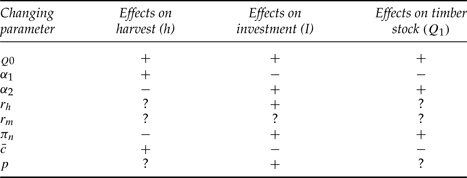
In a similar way, we can examine the effects of the other parameters on timber harvest, on forest management investment and on the growing stock of timber at the end of the year (see online appendix B). The results of the comparative statics analysis are summarized in table 1. Based on the results of the theoretical analysis, we can draw the following conclusions.
-
• An increase in the initial growing stock of timber causes a SOFE to increase both its timber harvest and investment in forest management. The net effect of these changes on the growing stock of timber at the end of the year is positive.
-
• If the supervising authority increases its emphasis on the financial result of the SOFEs in their annual evaluation, the SOFEs will increase timber harvest and reduce investment in forest management. Accordingly, the growing stock of timber at the end of the year will be smaller. If the supervising authority places a greater weight on forest resource development, the SOFEs will decrease timber harvest and increase investment in forest management, which will result in a larger growing stock of timber at the end of the year.
-
• Reforms that efficiently reduce the harvest and regeneration costs will spur the SOFEs to invest more in forest management. The effects of such reforms on timber harvest and on the development of forest resources are undetermined.
-
• The impact of reforms intended to increase the productivity of forest management efforts on timber harvest, investment and the development of forest resources are undetermined.
-
• An increase in non-forestry income will reduce timber harvest and increase investment in forest management. This will result in a larger growing stock of timber at the end of the year. In contrast, an increase in fixed costs will increase timber harvest and reduce investment in forest management, and thus result in a smaller growing stock of timber at the end of the year.
-
• Following an increase in timber price, the SOFEs will increase investment in forest management, but the impacts on timber harvest and on the development of forest resources are ambiguous.
Our model resembles the two-period timber harvest model that has frequently been applied in forest economics literature to examine the optimal harvest decision of a private forest owner (Johansson and Löfgren, Reference Johansson and Löfgren1982; Max and Lehman, Reference Max and Lehman1988; Amacher et al., Reference Amacher, Ollikainen and Koskela2009: 78–110; Barua et al., Reference Barua, Kuuluvainen, Laturi and Uusivuori2010). The financial result
 $[ \pi_{f} \lpar h\comma \; I\rpar + \pi_{n} - \bar{c}\rsqb $
in our model corresponds to the consumption of the forest owner during the first period in the two-period model. The growing stock of timber Q
1 (h, I) corresponds to the consumption in the second period. The timber price in our model can be interpreted as the relative price of timber in the first period (assuming that timber price in the second period is 1). The difference between non-forest income and fixed cost,
 $[ \pi_{n} - \bar{c}\rsqb $
, corresponds to the forest owner's wealth (excluding the forest). Investment in forest management corresponds to the saving in period 1 in the two-period model, although the marginal rate of return of the investment is decreasing whereas in the two-period model the marginal rate of return of saving is constant. The fraction (α2/α1) corresponds to the utility discounting factor in the two-period model. Unlike the two-period model, however, our model does not include the possibility of borrowing/saving in a capital market.Footnote
1
Summary of the results of comparative statics analysis

Given the relationship between our model and the two-period harvest model, one would expect that the effects of the initial growing stock of timber, timber price, etc. on optimal timber harvest and investment in forest management of a SOFE are similar to the effect of their corresponding variables on the optimal harvest and saving in the first period in the two-period model. This is indeed the case, with the exception that the effect of timber price on harvest is ambiguous in our model, whereas in the two-period model an increase (decrease) in the relative price always leads to a larger (smaller) harvest in the first period. The reason for this difference is that in our model investment in forest management is the only way for the SOFE to save the harvest income in the current period for future consumption. If the optimal harvest level is high, an increase in timber price can lead to a significant increase in the optimal consumption in the next period, which cannot be achieved by increasing the investment in forest management alone. In such a case, it is necessary to reduce the harvest level following an increase in timber price.
There is no counterpart in the two-period model for the parameters representing the productivity of timber harvest and regeneration efforts r h and rationalization of the management of existing stands r m . An increase in the productivity of timber harvest and regeneration efforts leads to a lower cost of timber harvest and regeneration, and thus would affect the optimal harvest and investment in forest management in the same way as an increase in timber price. Rationalization of the management of existing stands by assumption increases the actual growth rate of the forest. Intuitively, an increase in forest growth will enable the SOFE to increase its consumption in both the current and the future periods. Because of the absence of capital market in our model, the SOFE needs to increase the harvest or decrease the investment in forest management in order to increase the consumption in the first period. An increase in the harvest income also makes it possible to increase the investment in forest management. On the other hand, an increase in the growth rate of the forest which is not harvested would make it more profitable to leave a larger growing stock of timber for the future period (and thus a lower harvest in the current period). Because of these opposite effects, rationalization of the management of existing stands may cause the optimal harvest and investment in forest management either to increase or decrease.
3. Empirical model specification
Based on the results of the theoretical analysis, the econometric models are specified as:
 $$\eqalign{\ln h_{it} &= \beta_0^1 + \beta_1^1 \ln Q_{it}^0 +\beta_2^1 \ln A_{it}^n + \beta_3^1 \ln S_{it} + \beta_4^1 T_{it} +\beta_5^1 \ln p_{it} \cr &\quad + \beta_6^1 r_{hit} + \beta_7^1 r_{mit} + \beta_8^1 \alpha_{2it} + \beta_9^1 y + u_{it} \cr \ln I_{it} &= \beta_0^2 + \beta_1^2 \ln Q_{it}^0 + \beta_2^2 \ln A_{it}^{n} + \beta_3^2 \ln S_{it} + \beta_4^2 T_{it} + \beta_{5}^{2} \ln p_{it} \cr &\quad + \beta_{6}^{2}r_{hit} + \beta_{7}^{2}r_{mit} + \beta_{8}^{2}\alpha_{2it} + \beta_{9}^{2}y + v_{it} \cr \ln Q_{it}^{1} &= \beta_{0}^{3} + \beta_{1}^{3} \ln Q_{it}^{0} + \beta_{2}^{3} \ln A_{it}^{n} + \beta_{3}^{3} \ln S_{it} + \beta_{4}^{3}T_{it} + \beta_{5}^{3} \ln p_{it} \cr &\quad + \beta_{6}^{3}r_{hit} + \beta_{7}^{3}r_{mit} + \beta_{8}^{3}\alpha_{2it} + \beta_{9}^{3}y + w_{it}}$$
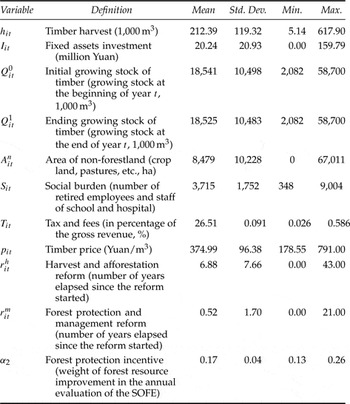
where β i j (i = 0…9, j = 1, 2, 3) are coefficients; u it , v it , and w it are random error terms; and y is time. Definitions of the other variables are presented in table 2.
Definitions of variables and descriptive statistics (number of observations: 1,850)

In the survey data, investment in forest management activities is included in the fixed assets investment. Therefore, we use the fixed assets investment of the SOFEs as a proxy of investment in forest management.
In the theoretical analysis, we assumed that the SOFE decision makers maximize their utility, which is a function of current profits and the growing stock of timber at the end of each year. In reality, the leadership of each SOFE is responsible to its supervising authority, which evaluates the SOFE's performance using a multitude of criteria, including ‘profit’ and ‘administration fee’ paid to the supervising authority, the turnover growth rate, increment of payments to employees, compliment of forest harvest quota, reforestation area, occurrence of severe forest fires and so on. We grouped these criteria into two categories: profit and the improvement of forest resources. The variable ‘incentive for forest protection’ refers to the weight a supervising authority assigned in the annual evaluation to how well a SOFE improves forest resources. According to the result of our theoretical analysis, an increase in the ‘incentive for forest protection’ should reduce the timber harvest and increase the investment in forest protection and management, and thus increase the growing stock of timber at the end of the year.
Non-forest land is the sum of crop land, pastures, and land used for miscellaneous purposes. This variable is used as a proxy for the non-forestry income of the SOFEs. According to Xu et al. (Reference Xu, Jiang and Ji2006), the management and utilization of non-timber products by the SOFEs promoted the development of this tertiary industry and increased the income of the SOFEs and their employees. Furthermore, the management and utilization of non-timber resources created jobs and reduced the degree of dependence on forest resources. The most important non-timber resource utilizations are crop growing, livestock farming and collecting and processing non-timber forest products (such as mushrooms, fungi, herbs and wild vegetables). Therefore, the area of non-forestland provides a reasonable indication of the scale of the non-timber resource utilization.
In the empirical analysis, we used two variables to describe the fixed costs of the SOFEs. The variable ‘tax and fees’ refers to the sum of the taxes and fees a SOFE pays in one year in proportion to the gross revenue of the SOFE. The second variable, ‘social burden’, refers to the number of retired workers and school and hospital staff hired by each SOFE. The variable ‘harvest and afforestation reform’ refers to the number of years elapsed since a SOFE reformed the organization and implementation of its harvest and afforestation activities. Similarly, the variable ‘forest protection and management reform’ refers to the number of years elapsed since a SOFE reformed the organization and implementation of forest protection and management activities. These reforms are important means for the SOFEs to increase the productivity of timber harvest and afforestation, as well as forest protection efforts. Observations of the changes in efficiency resulting from the reforms are not available, however. Presumably, it takes time to achieve the maximum effects of the reforms. We use the time elapsed since a SOFE started the reforms as a proxy for the extent of rationalization of afforestation and forest protection activities.
4. Data
There are in total 75 SOFEs in the study area (Heilongjiang and Jilin Provinces and the Inner Mongolia Autonomous Region), all of which were included in the analysis.Footnote 2 We estimated the empirical models using data for the period 1980–2004. The data on forest resources, area of non-forestland, social burden, timber harvest, tax and fees, timber price and fixed-assets investment during that period were provided by the State Forestry Agency and the three provincial forestry authorities. The data on harvest and afforestation reform, forest protection and management reform were collected through a survey conducted from June to October 2005. The questionnaire was distributed to the SOFEs and was collected on site. Information about forest protection incentive was retrieved from documents provided by the SOFEs. Descriptive statistics of the data are presented in table 2.
For all 75 SOFEs, the total forestland area increased steadily from 1980 to 2004, while the growing stock of timber stayed relatively stable. There are, however, significant differences among the SOFEs in different provinces (see figures A1 and A2 in online appendix A). On average, the SOFEs in Inner Mongolia achieved the most significant increase in both forestland area and the growing stock of timber. Changes in the average forestland area and the growing stock of timber in Jilin Province were small. For the SOFEs in Heilongjiang Province, the area of forested land increased by about 20 per cent, with the major part of the increase occurring in the 1990s; the growing stock of timber decreased by more than 20 per cent between 1980 and 1989, and has been stable thereafter. The average timber stock per hectare was relatively stable in Jilin Province and Inner Mongolia (about 130 m3/ha). For the 40 SOFEs in Heilongjiang Province, the average timber stock per hectare decreased significantly between 1980 and 2004.
The timber harvest of the 75 SOFEs included in this study has decreased dramatically since the mid-1980s (see figure A3 in online appendix A). The average annual harvest volume of the SOFEs in Inner Mongolia decreased from 315,000 m3 in 1986 to 145,000 m3 in 2004. In Heilongjiang Province, the average harvest volume of the SOFEs dropped from 296,000 m3 in 1986 to 96,000 m3 in 2004. The average harvest volume of the SOFEs in Jilin Province decreased from about 297,000 m3 in 1986 to 116,000 m3 in 2004. The primary reasons for the reduction in timber harvest during this time period were the shift of focus in the national forest policy from timber production to nature conservation and environmental protection, and the lack of mature forests caused by decades of unsustainable forest management.
The fixed assets investment in the three provinces increased slightly between 1980 and 1998 (figure A4 in online appendix A). After the NFPP was launched in 1998, fixed assets investment increased rapidly for a few years, but quickly fell back to the 1998 level by 2004. On average, the fixed assets investment per hectare of forestland was much higher in Jilin than in Heilongjiang and Inner Mongolia, which may have contributed to the relatively high growing stock of timber per hectare in Jilin Province.
The average area of non-forestland of the SOFEs in Jilin Province decreased steadily in the 1990s before stabilizing in the early 2000s (figure A5 in online appendix A). For the SOFEs in Heilongjiang and Inner Mongolia, the average area of non-forestland started to increase in the late 1990s, after a significant decrease in the late 1980s. The changes in the area of non-forestland of the SOFEs were to a large extent the result of changes in policy concerning the management and utilization of non-timber resources.
Since the late 1990s, the SOFEs significantly reduced the number of employees through a so-called ‘reallocation’ of surplus staff. At the same time, the number of retired workers increased significantly. Figure A6 in online appendix A shows a clear trend where the number of pensioners and school and hospital staff increased in the 75 SOFEs. The timber prices were adjusted, using the producer price index for forest products, to the 2004 price level. The data show that timber prices increased significantly between 1980 and 2004.
5. Estimation results
We have a panel data set, which can be analyzed using three types of models: pooled regression models, random effects regression models and fixed effects regression models. In our analysis, we first compared the pooled regression model and random effects regression model using the F-test. The result showed that the random effects model was superior to the pooled model. Next, we used the Hausman test to compare the random effects model with fixed effect model, and found that the fixed effects model was more effective. Finally, we conducted a Breusch–Pagan Lagrange multiplier test to the fixed effect model and found that we could not reject the correlation assumption among the sample cross-section. Therefore, we estimated the models with the feasible generalized least squares considering the correlation.
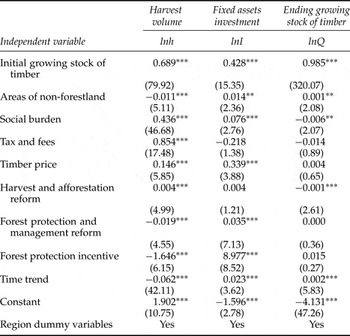
Because the generalized least squares estimation controlling the heteroskedasticity and correlation requires balanced data, we removed one of the SOFEs in Jilin Province, which was established in 1990, and estimated the models using 1,850 observations.Footnote 3 In order to solve the endogeneity problem, we lagged the independent variables, so the actual number of observations used in the model estimation was 1,776. The estimation results are presented in table 3.
Estimation results

Notes: *Indicates significant at 10% level; **indicates significant at 5% level; ***indicates significant at 1% level. Z value is in parentheses.
The estimation results strongly support the results of the theoretical analysis. The empirical results show that an increase in the weight assigned to forest resource improvement by the supervising authorities will reduce timber harvest and increase the investment in forest protection and management of the SOFE, as the theoretical analysis suggested. The estimation also shows that the effects on both the harvest volume and the investment are large. If the weight of forest resource improvement increases by 1 per cent in a contract signed by the supervising authorities and the SOFE, the harvest volume will on average decrease by 0.28 per cent, and the investment will increase by 1.53 per cent. Increasing the weight of forest resource improvement has a positive effect on the change in the growing stock of timber over time, but the effect is not statistically significant.
The forest protection and management reform had a positive impact on investment, but a negative influence on the harvest volume. Both effects are statistically significant at the 1 per cent level. The reform also had a positive effect on the change in the growing stock of timber, but the effect is statistically insignificant. The result suggests that the reform focusing on the implementation of forest protection activities started to show effects on the harvest and investment rather quickly, but it will take longer before we can observe any significant impact of the reform on the development of forest resources over time.
The afforestation reform had a positive impact on the harvest volume and a negative impact on the change in the growing stock of timber. This reform had a positive, but statistically insignificant, effect on the fixed assets investment. The result indicates that the afforestation reform can effectively reduce regeneration costs. All other things being the same, the reduction in regeneration costs increases the profits from harvesting and regenerating the forest, and therefore causes the harvest level to increase. Intuitively, the afforestation reform should lead to more forests being successfully established, which would have a positive effect on the development of the growing stock of timber.
In this study, we regressed the growing stock of timber at the end of each year against the growing stock of timber at the beginning of the year, in addition to the other explanatory variables. This means that, in our model, forests established in previous years do not affect the growing stock of timber at the end of the current year. These forests are accounted for in the growing stock of timber at the beginning of the year. Because the growing stock of timber in the newly established forests is very low, the positive effect of the regeneration reform on the growing stock of timber is negligible. Therefore, in our model, the afforestation reform affects the growing stock of timber mainly through its effects on harvest, which explains the negative effect of the reform on the development of the growing stock of timber.
An increase in the social burden of a SOFE will increase its harvest volume and have a negative effect on the development of the forest resources. In relation to the theoretical model, an increase in the social burden corresponds to an increase in the fixed costs of the SOFE. Thus, with respect to the effect on timber harvest and the development of forest resources, the empirical result is consistent with the result of the theoretical analysis. What may appear surprising is the positive effect of the social burden on the fixed assets investment. This positive effect is probably due to the fact that the fixed assets investment included those investments aimed at providing social services, whereas the theoretical model examined the effect on investment in forest protection and management. If the social burden increased by 10 per cent, the harvest volume would increase by 4.36 per cent; at the same time, the investment would increase by 0.76 per cent. The effect on the forest resources stock is small.
As expected, an increase in the tax and fees will significantly increase the harvest volume. At the same time, it will affect the investment and the development of the forest resource negatively, although the effects were statistically not significant. The estimated parameters show that a 10 per cent increase in the tax and fees will cause an 8.54 per cent increase in harvest volume.
An increase in the area of non-forestland would cause the harvest volume to decrease, but had a positive effect on the investment and on the development of the forest resources. Since a larger area of non-forestland implies a higher non-forestry income, this result is consistent with our theoretical result. The effects of the area of non-forestland are small, however. Following a 10 per cent increase in the area of non-forestland, the harvest volume would decrease by 0.11 per cent, the fixed assets investment would increase by 0.14 per cent, and the growing stock of timber at the end of the year would increase by only 0.01 per cent.
Increases in timber price had positive effects on the harvest volume and the fixed assets investment. The estimation result showed that if the timber price rose by 10 per cent, the harvest volume would increase by 1.46 per cent and the fixed assets investment would increase by 3.39 per cent. An increase in timber price would affect the development of the forest resources positively, but the effect is statistically not significant.
The growing stock of timber has significant and positive effects on the harvest volume and the fixed assets investment, as well as on the development of the forest resources. If the growing stock of timber at the beginning of a year increases by 10 per cent, the harvest volume and the fixed assets investment in the same year would increase by 6.89 per cent and 4.28 per cent, respectively, and the growing stock of timber at the end of the year would increase by 9.85 per cent.
6. Conclusions
An important conclusion we can draw from the results of this study is that a number of policy measures can effectively change the managerial behavior, as well as the development of forest resources, of the SOFEs. Specifically, the supervising authorities exercise considerable influence on the harvest and investment decisions of SOFEs by how they weight specific elements in the annual SOFE evaluations. By assigning a greater weight to forest resource improvement, the supervising authorities could induce the SOFEs to significantly reduce the harvest level and increase investment in forest management. Likewise, reduction of taxes and fees, as well as policy measures that reduce the social burden of the SOFEs, could significantly reduce the harvest level. These measures would have positive effects on the development of the forest resources.
A second conclusion we can draw from this study is that the reforms within the SOFEs have had relatively small effects on harvest and investment decisions and on the development of the forest resources. The reforms have been aimed at increasing the productivity of timber harvest and forest management (including afforestation and forest protection) efforts. When carrying out these reforms, the SOFEs were not able to make any significant adjustment in the number of employees or the level of social services they provide. The potential of rationalization through such reforms is therefore limited.
A third conclusion is that the strategy of promoting non-timber resource businesses (such as crop growing, livestock farming, etc.) has had a positive effect on the development of the forest resources, although the effect has been small thus far.
A limitation of the study is that we did not explicitly model the intertemporal aspects of the decision problem of the SOFEs. Intuitively, the decision maker would consider several years ahead when determining the timber harvest level and the investment in forest management in each year. The timber harvest and forest management investment in each year affect the state of the forests at the end of the year which, in turn, would affect the performance of a SOFE in the following years. As the latter effects were ignored in our analysis, we may have overestimated the impacts of the influencing variables on timber harvest and at the same time underestimated their impacts on forest management investment.
The conclusions are based on the result of an aggregate analysis of all 75 SOFEs in Heilongjiang and Jilin Provinces and the Inner Mongolia Autonomous Region, and may not be representative of each of these areas individually. Another caveat of the analysis is the fact that the data period ends in 2004. China is a fast-changing nation, and our conclusions may appear dated. However, most SOFEs in China are still highly dependent on forestry income, and mature forests available for harvesting remain scarce at present. The results of this study can contribute to the continuing reform of SOFEs.
The main policy implication of the results from this study is that, in order to achieve sustainable management of the state-owned forests, it is necessary to substantially reduce the dependence of the SOFEs on forestry income and set forest resource improvements as the primary management objective of the SOFEs in the near future. The lack of mature forests is the fundamental cause of the problems facing the SOFEs. The only viable option for resolving the economic and resource crises facing the SOFEs is to reduce their dependence on forestry income, so that they could prioritize the improvements of forest resources. Reforms within the framework of the present organization of SOFEs, such as rationalization of forest regeneration and management activities and promotion of non-timber resource businesses, have been inadequate for reducing the dependence of the SOFEs on forestry income. Emphasizing forest resource improvement in the annual evaluation of the performance of the SOFEs may be insufficient for reducing timber harvest and increasing investment in forest management as long as the SOFEs are to a large extent dependent on forestry income. Policy makers need to consider a broader set of measures to reduce the SOFEs' motivations for pursuing income from forest management in the short run.
Supplementary materials and methods
The supplementary material referred to in this paper can be found online at journals.cambridge.org/EDE/.