Spain occupies a prominent position in the teaching of comparative politics. It is a paradigmatic example of a successful transition to and consolidation of democracy, as well as an intriguing study in constitutional development, federalism, and a host of other topics. I have found that it is particularly useful when discussing electoral systems and representation.
Spain's representational structure compares to those in other federally organized nations such as Canada and the United States, and to supranational structures such as the European Union. In all cases, the respective nations' legislative bodies are organized by province or state (or in the European Parliament, by member nation). As a result, the institutional design that guarantees a threshold of representation to all members in the federal systems also ensures that voting power is not apportioned evenly by population. This creates the possibility that the electoral system will “manufacture” a majority government (see, e.g., Amy 2002).
A manufactured majority occurs when a government that has a majority of the legislative seats does not have the support of a majority of the electorate. Under such circumstances, the possibility of what Richard Katz called a “perverse” electoral outcome arises: one party has a majority of the legislative seats, although a different party obtained more popular votes. (An example would be the 1951 British election, which gave the Conservatives a 26 seat majority over Labour, although Labour won about 230,000 more votes.) Thus, in a perverse election, the government represents fewer people than at least one of the opposition parties (see Katz 2006).
Manufactured majorities and perverse electoral outcomes can result from the idiosyncrasies of the formulae by which votes are translated into seats (see, generally, Farrell 2001). Scholars note that while Spain employs proportional representation to elect members of the Congress of Deputies (Congreso), the manner in which the electoral system is structured detracts from its capacity to produce a truly representative legislature. Scholars such as Hopkin (2006) note that the d'Hondt electoral formula, in conjunction with the relatively small size of Spain's multimember electoral districts, works to produce less than proportional outcomes.
This propensity is amplified by the extent to which the states or provinces in a federal system are not represented in proportion to their populations. The most controversial example in recent memory of a majority manufactured by a federal system is, perhaps, the American presidential election of 2000 in which George W. Bush was elected president by virtue of his winning a majority of the Electoral College vote. But, he actually lost the popular vote to Albert Gore. The purpose of this essay is to discuss the impact of Spain's federal structure on its electoral system. The constitutional commitment to provincial representation in the Congreso, coupled with the correspondingly uneven apportionment of voting power among the 50 provinces, lays the seeds for non-majoritarian governments.
In this respect, the Spanish constitutional system manifests an important, enduring tension between two key aspects of democratic theory. On the one hand we wish to promote majority rule. On the other, we also want to protect minorities of all types—religious, racial, ethnic, or geographic. This issue animated the American constitutional debates and was an important, controversial issue in the European constitutional debates at the beginning of this decade.1
Spain and Poland had protested the possibility of changing the allocation of voting power under the new constitution. Under the Nice Treaty, Spain and Poland had almost as much voting power as Germany even though they had significantly smaller populations. Under the proposed European Constitution, their voting power would have been more proportional to their populations. See, e.g., “Poland Threatens Veto in EU Row.” Available at: http://news.bbc.co.uk/2/hi/europe/3308917.stm.
Background: Spain's Electoral System
Critics suggest that Spain's electoral system suffers because it minimizes voter choice. Spain uses a closed party list system to elect the Congreso. With this system, voters may choose only among political parties—not particular candidates. In each province, voters may choose and vote for one party list. Votes for parties are translated into legislative seats using the d'Hondt allocation formula.
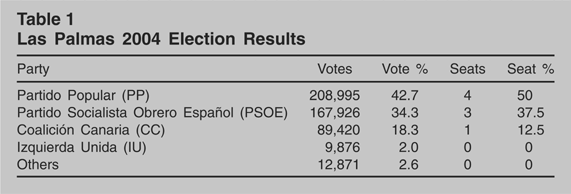
The d'Hondt formula allocates seats according to what is known as a “highest average” formula. Thus, in the 2004 election, the results in the city of Las Palmas were as shown in Table 1.2
Spanish electoral and population data are drawn from Alvarez Rivera (http://electionresources.org/es/index_es.html), Instituto Nacional de Estadistica (2001), and “Provinces of Spain” (www.statoids.com/ues.html).
Las Palmas 2004 Election Results

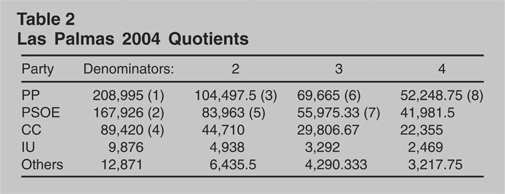
The d'Hondt formula divides the party vote totals by a series of denominators to produce a table of quotients (also known as “highest averages”). In the case of Las Palmas in 2004, the quotients are shown in Table 2.
Las Palmas 2004 Quotients

Las Palmas has eight seats in the Congreso. The seats were allocated sequentially to the party with the highest average in the table of quotients. Thus, the PP received the first seat because its vote total (i.e., its total vote divided by denominator 1) was the highest average in the table. The second seat went to the PSOE (167,926). The third seat went to the PP (104,497.5) and so forth. The order in which the seats were allocated is indicated parenthetically in the table.
Elections to the 350 member Congreso are organized provincially. Critics note that the decision to use the provinces as the principal unit of representation and electoral aggregation ensured a significant overrepresentation of rural and less-populated provinces because each province is guaranteed two seats in the Congreso. The average number of seats per province is seven. Scholars of electoral systems note that this is a relatively small number of seats per constituency.3
Scholars debate the impact of constituency size on representation—especially of smaller parties. As a rule, the larger the number of seats (the district magnitude), the more opportunities there are for smaller parties to gain representation. Of course, critics acknowledge that in larger districts, the connection between representatives and their constituents is attenuated. How best to balance such concerns remains a matter of debate. Nonetheless, scholars generally acknowledge that the relatively small size of Spain's electoral districts does disadvantage smaller parties. See generally Farrell 2001; Gallagher and Mitchell 2006.
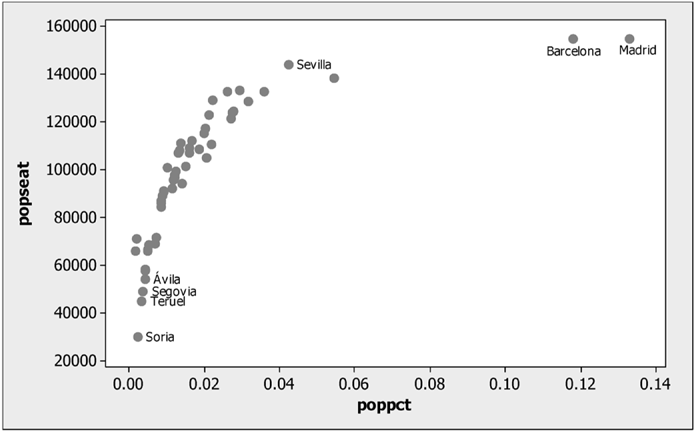
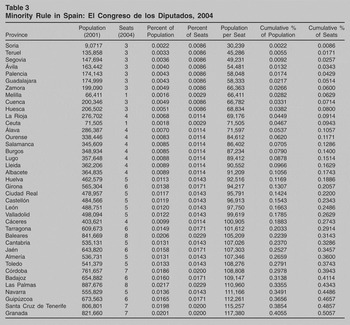
Jonathan Hopkin notes that this apportionment scheme, coupled with the party list system and the d'Hondt electoral formula, favors larger political parties with nationwide appeal. As a result, the electoral system has diminished the number of effective political parties contesting elections (Hopkin 2006, 382) and makes it easier for larger parties to govern without seeking coalition partners (Gallagher, Laver and Mair 2006, 369). The result of this malapportionment (or, less pejoratively, uneven distribution of voting power in the Spanish Congreso) is a proliferation of provinces comprised of “cheap seats” (see, e.g., Campbell 1996), that is, provinces where the number of votes necessary to win a seat in the Congreso is much smaller than it is in others (see Figure 1; Table 3).

Voting Power in the Spanish Congreso (2004)
Note: “poppct” = percentage of national population in a particular province; “popseat” = number of residents per seat in the Congreso
Minority Rule in Spain: El Congreso de los Diputados, 2004

Figure 1 demonstrates the vast difference in voting power in Spain. Deputies in the largest provinces (or, in this case, the cities of Madrid and Barcelona) must garner more than 150,000 votes to win a seat in the Congreso, while those running in Soria and Teruel need to garner only some 31,000 or 45,000, respectively. The larger provinces are correspondingly underrepresented.
This creates an incentive to spend one's campaign resources efficiently. Were a party to target the provinces with the “cheapest seats” it would be possible to garner 50.57% of the Congreso seats from provinces that comprise only 40.55% of the Spanish population (see Table 3).
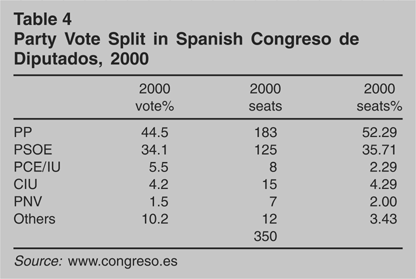
Granted, there is no reason to assume that overrepresented provinces would share a common partisan disposition. Nonetheless, the use of provinces as the basic unit of electoral organization ensures that this sort of systemic disparity in voting power will endure and it creates the possibility that a political party may win a majority of the Congreso without winning a majority of the vote. Ironically, this happened in 2000 (the same year it happened in the United States) when the PP won a 183 seat majority with the support of less than a majority of the voters (see Table 4).
Party Vote Split in Spanish Congreso de Diputados, 2000

Thus, in a year when the United States was preoccupied with the Electoral College's manufacture of George W. Bush's majority, the Spanish electoral system manufactured an equally unrepresentative government.
Criticism and Comparative Perspective
Depending on the theory of democracy to which one subscribes, these results may or may not be upsetting. Some scholars and jurists (such as the American Supreme Court) have advocated strict adherence to a one person, one vote principle.4
See, e.g., the American Supreme Court decision, Baker v. Carr, 369 U.S. 186 (1962).
See, e.g., the Canadian Court decision, in Ref. Re: Provincial Electoral Boundaries (Sask.) (1991) 2 S. C. R. 158.
The United States
The organization of the Electoral College in the United States, like the bicameral organization of the Congress, derives from the compromises achieved during the debates about the federal constitution. The so-called “New Jersey Compromise” created a legislative process that, in the words of James Madison, ensures that all legislation would have the support of a majority of the people (in the House of Representatives) and a majority of the States (in the Senate).6
The apportionment of the House of Representatives is conducted by the Bureau of the Census. It is essentially a “highest average” formula that compares to the d'Hondt method of proportional representation. For information on the formula and method of apportionment see: “Congressional Apportionment: How It's Calculated.” Available at: www.census.gov/population/www/censusdata/apportionment/calculated.html.
While contemporary critics (see Amy 2002; Hill 2002) contend that the system has a built-in propensity for manufacturing majorities, it was clear at least from the compromises in the federal conventions at the time of founding, that the Congress and the Electoral College were designed to protect minority interests (which, in this case, were the interests of the smaller states).
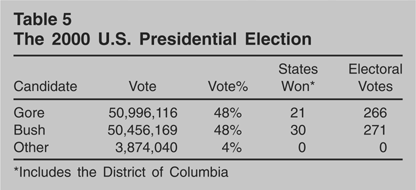
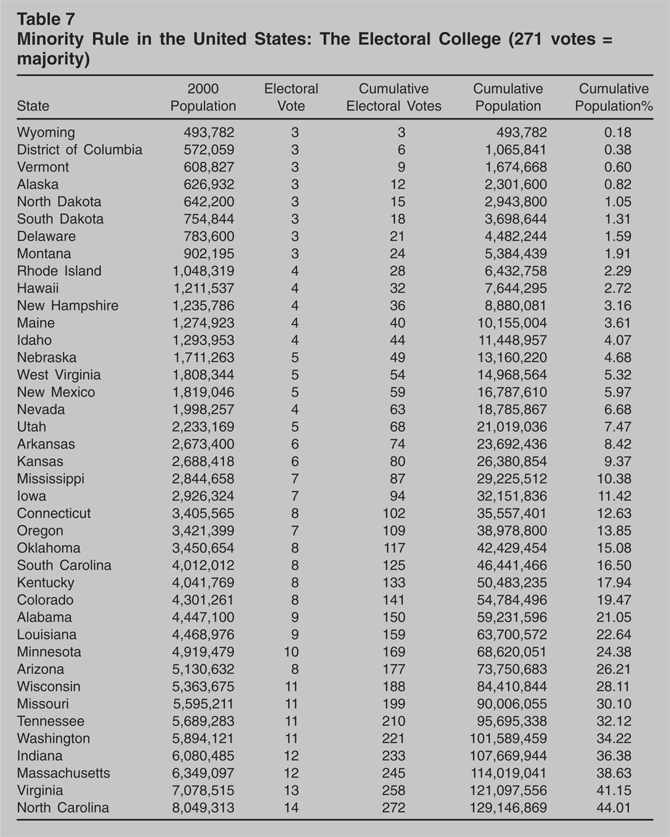
Nonetheless, the method by which congressional representation is apportioned among the states (and, by extension, the Electoral College) ensures that smaller states retain a disproportional impact in elections and the legislative process. This was demonstrated in the presidential election of 2000. George W. Bush won the election with a majority vote in the Electoral College despite finishing behind Albert Gore by some 540,000 popular votes (see Table 5).
The 2000 U.S. Presidential Election

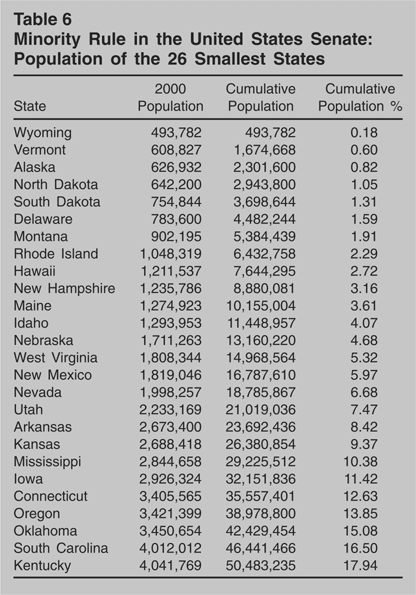
In the United States, it is possible to assemble a majority of the Electoral College votes by winning states that account only for 44% of the population. This formula for minority rule is actually exacerbated (actually, it is fostered) in the United States Senate. To pass legislation in the 100-member Senate, it is necessary to gain the votes of at least 51 senators. Since two senators are elected from each state, we can regard the Senate as being comprised of 50 two-seat, state constituencies. Were one to assemble a coalition of senators from the least populated states (beginning with Wyoming), it would represent only 17.94% of the population.7
Here, I assemble a majority of 52 senators (not 51) to simplify the process of building a coalition state-by-state. To assemble a 51 senator majority, I would need to split one state. Either way, the example holds. A 51 senator majority would represent an even smaller fraction of the population.

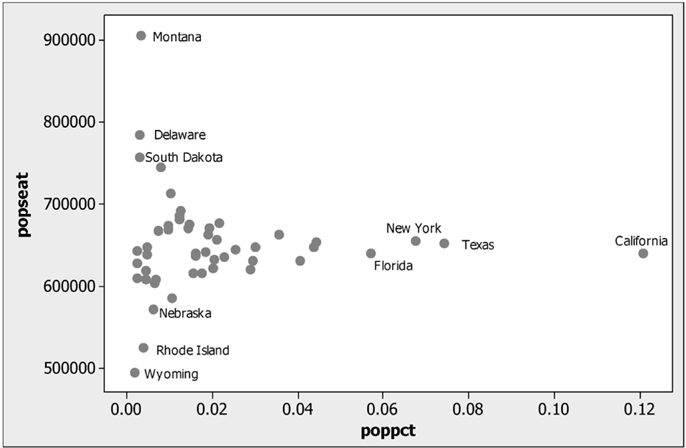
Uneven Voting Power in the United States Congress—2000 Census
Source: www.census.gov
Minority Rule in the United States Senate: Population of the 26 Smallest States

Minority Rule in the United States: The Electoral College (271 votes = majority)

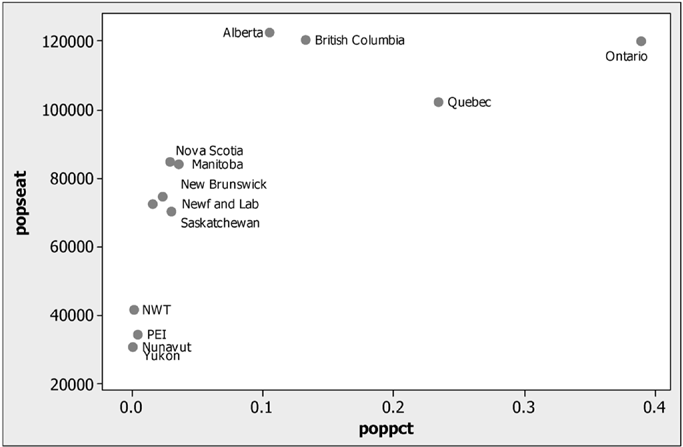
Figure 3 demonstrates that Canada exhibits a similar pattern of uneven allocation of political power.8
For an explanation of the process by which seats in the House of Commons are allocated among the Canadian provinces, see: www.elections.ca/scripts/fedrep/federal_e/RED/representation_e.htm.
There are many scholarly articles and books on the distribution process in Canada (see, e.g., Courtney 2001). For a good overview of the process, see the information available at Elections Canada, see: www.elections.ca/content.asp?section=cir&document=index&dir=red&lang=e&textonly=false.

Uneven Voting Power in the Canadian Parliament (2006)
Source: electionscanada.ca
Implications and Utility for Teaching Comparative Politics
Insofar as Spain has been hailed as a paradigmatic example of a successful transition from authoritarian to democratic government, it certainly can stand alone as a focus of comparative political study. But, when contrasted with longstanding democracies such as the United States and Canada, Spain also provides a useful basis for comparative study of parliamentary versus presidential systems of government, representation theory, federalism, electoral systems, majority rule, minority rights, and constitutional design.
While the Spanish electoral system is designed to ensure more proportional outcomes than the single-member district plurality system used in Canada and the United States, the manner in which voting power is allocated among the Spanish provinces demonstrates that the founders of the modern Spanish state were as fearful of unchecked majorities as were their eighteenth century counterparts in the United States. Accordingly, Spain's electoral system protects the less populated provinces by overrepresenting them in the Congreso in the same way that the American apportionment formula and Electoral College overrepresent smaller states.
This is not to argue that the twentieth century thinking that underpinned the design of the Spanish constitutional system in 1978 compares to the eighteenth century foundation of the American Constitution or the evolution of thought across the nineteenth and twentieth centuries that led to the patriation of the Canadian Constitution. Nonetheless, the three systems share a federal structure and electoral system that manifest clear constitutional choices to protect the rights and interests of smaller political entities at the expense of equality of individual voting power and at the risk of manufactured government majorities. Thus, while the Spanish electoral system may not enhance legislative diversity as much as advocates of proportional representation would hope, the limits on the system's proportionality and its capacity to manufacture a majority government represent nothing short of the smooth working of constitutional system designed to check majority rule.