Introduction
Recent studies in Denmark, The Netherlands, North America and Sweden indicate that the prevalence of bovine perinatal mortality is increasing, particularly in Holstein primiparae (Harbers et al., Reference Harbers, Segeren and de Jong2000; Meyer et al., Reference Meyer, Berger, Koehler, Thompson and Sattler2001; Steinbock et al., Reference Steinbock, Nasholm, Berglund, Johansson and Philipsson2003; Hansen et al., Reference Hansen, Misztal, Lund, Pedersen and Christensen2004). Currently, the prevalence of bovine perinatal mortality in cows and heifers varies between 2% and 10% across dairy industries internationally (Table 1). While the case definition of perinatal mortality varies between studies, it generally refers to calf mortality at full-term, up to 48 h after calving.
Prevalence of perinatal calf mortality in dairy heifers and cows internationally

aCows only, bnot recorded.
High stillbirth rates and under-reporting of losses around calving are areas of real societal welfare concern (Garry, Reference Garry2004). The majority of perinatal mortality occurs within 1 h of calving (75%) with the remainder occurring either pre partum (10%) or post partum (15%) (Mee, Reference Mee2004). Traditionally, over 50% of this mortality has been directly attributed to dystocia (Collery et al., Reference Collery, Bradley, Fagan, Jones, Redehan and Weavers1996; Mee, Reference Mee1999). Other significant risk factors, which have been associated with bovine perinatal mortality include age at first calving (Ettema and Santos, Reference Ettema and Santos2004), primiparity (Pryce et al., Reference Pryce, Harris, Sim and McPherson2006), twinning (Silva del Rio et al., Reference Silva del Rio, Stewart, Rapnicki, Chang and Fricke2007), foetal gender (Steinbock et al., Reference Steinbock, Nasholm, Berglund, Johansson and Philipsson2003), gestation length (Meyer et al., Reference Meyer, Berger, Koehler, Thompson and Sattler2001) and season of calving (McGuirk et al., Reference McGuirk, Going and Gilmour1999). However, there is now some evidence to suggest that an increasing proportion of perinatal mortality occurs at unassisted calvings (idiopathic stillbirth or weak calf syndrome) where placental dysfunction and low birth weight may be causative factors (Berglund et al., Reference Berglund, Steinbock and Elvander2003; Kornmatitsuk et al., Reference Kornmatitsuk, Dahl, Ropstad, Beckers, Gustafsson and Kindahl2004; Sorge, 2005). This raises the questions as to whether the risk factors conventionally associated with perinatal mortality may be of greater or lesser importance now and whether these differ in pasture-based systems.
Towards this end, a European working group has been established to coordinate research into bovine stillbirth (Mee, Reference Mee2006), part of which involves establishing current national statistics. Many of the recently published studies on bovine perinatal mortality (Harbers et al., Reference Harbers, Segeren and de Jong2000; Meyer et al., Reference Meyer, Berger, Koehler, Thompson and Sattler2001; Jamrozik et al., Reference Jamrozik, Fatehi, Kistemaker and Schaeffer2005; Lombard et al., Reference Lombard, Garry, Tomlinson and Garber2007) have been conducted in confinement systems where nutrition, housing, genetics, disease risk and stock management are quite unlike the pasture-based management systems operating in, for example, Ireland. The most recent studies on the prevalence of, and the risk factors associated with, perinatal mortality in Irish dairy herds were regional studies conducted over 10 years ago (Crosse and Soede, Reference Crosse and Soede1988; Mee, Reference Mee1999).
The objectives of this study were to benchmark the national prevalence of perinatal mortality in heifers and cows on commercial dairy farms in Ireland and to determine the current significance of putative exposures and attributes in pasture-based management systems.
Material and methods
Data edits
Data on calf, sire and dam identification number, as well as calving date, day of the week, gender of the calf, degree of calving assistance, occurrence of perinatal mortality (recorded as calf dead at birth or within 24 h), age of dam, parity of the dam, and breed of the dam and service sire, were extracted from the Irish Cattle Breeding Federation (ICBF) database for the years 2002 to 2005, inclusive. In total, 3 562 644 records were available for inclusion in the analysis of which 2 152 245 had records on calf condition at birth. Records coded as abortions as well as records on cows of unrecorded parity or parities greater than 10 (n = 220.569) were removed. Subsequently, calvings with more than two calves born (n = 3.565 records) were removed. Following these edits, animals recorded as having calved for the first time less than 660 days of age (n = 7.693) or whose age at calving was more than 2 years from the median within parity (n = 215.787) were discarded. Births from dams that were less than 50% Holstein or Friesian (n = 311 699) were deleted; 1 392 932 records remained. Only records with a known service sire and where the dam was mated to an artificial insemination (AI) sire whose main breed component (i.e. >50% their genes) was Angus, Belgian Blue, Charolais, Hereford, Holstein/Friesian, Limousin or Simmental were retained and each breed was coded separately; 564 176 records remained; predicted transmitting ability (PTA) of the service sire for perinatal mortality was obtained from the August 2006 genetic evaluations. Only service sires with a PTA reliability of greater than 70% for direct perinatal mortality were retained; 304 531 records remained.
In Ireland, calving assistance is scored on a scale of 1 to 4 as follows: 1 = no assistance/unobserved; 2 = slight assistance; 3 = severe assistance; and 4 = veterinary assistance (including caesarean). A total of 151 924 records of perinatal mortality did not have information on calving assistance; hence, in order to facilitate the inclusion of these records in a multiple regression model, records with missing information for calving assistance score were allocated a separate code. Furthermore, herd-years with less than 20 calving records were removed and the prevalence of perinatal mortality was calculated. A total of 182 026 records of full-term calvings from ⩾50% Holstein-Friesian dams of known parity served by AI sires of seven breeds in herds of 20 or more calvings per year were available for inclusion in the analysis of factors affecting perinatal mortality.
Perinatal mortality in the previous calving, within dam, was also retained. Dams with no previous information on perinatal mortality (e.g. first parity animals) were coded separately to facilitate their inclusion in the multiple regression analysis. Parity number was recoded into five classes: 1, 2, 3, 4–6 and 7–10. Parity number of the dam in the present study was parity of the cow the day after she calved. Therefore, the calf of a first parity animal represents the calf born following a mating of a nulliparous heifer. Herd-year size was calculated as the number of calvings per herd-year and was divided into three categories: small (20 to 39 calvings), medium (40 to 59 calvings) and large (more than 59 calvings).
Statistical analysis
The logit of the probability of a perinatal mortality was modelled using generalised estimating equations (GEE) in PROC GENMOD (SAS, 2006) assuming a binomial distribution. Herd-year was included as a repeated effect with an exchangeable correlation structure assumed among records within herd-year. The following independent variables were tested, using backward elimination, for inclusion in the model: year of birth, month of birth, day of week of birth, herd size, single or twin birth (one record), calving assistance score, age at calving nested within parity, perinatal mortality in previous calving within dam, gender of the calf, service sire breed and service sire PTA for direct perinatal mortality. Age at calving nested within parity and service sire PTA for direct perinatal mortality were both treated as continuous variables, and non-linear associations were tested for significance in the multiple regression model by categorising the continuous variable into a number of categories and evaluating the relationship. Referent levels of the class variables were singleton birth, male calves, no stillbirth in the previous calving, first parity dams, no assistance at calving, calving month of December and calving year of 2005. No confounding existed between variables. Significance of main effects was declared at P < 0.05 based on the GEE score statistic. Interactions among variables that were biologically meaningful were also tested for significance in the model where significance was declared at P < 0.001 based on the GEE score statistic; a stricter level of significance was used to avoid Type I errors due to multiple testing.
Results
Prevalences
The percentage of the data from parities 1, 2, 3, 4–6 and 7–10 was 20%, 22%, 17%, 31% and 10%, respectively. Each year was equally represented within the dataset with 24%, 26%, 27% and 23% of the data from the years 2002, 2003, 2004 and 2005, respectively. The majority (86%) of the AI sires included in the analysis was Holstein-Friesian and the majority of calvings (81%) occurred in the months January to April (‘spring-calving’), inclusive. The frequency of records within the herd-size categories of small, medium and large was 62%, 25% and 13%, respectively. In herds with 20 or more calvings, 46% had no perinatal mortality and in the remainder the herd prevalence of perinatal mortality varied between 1% and 25% with 14 herd-years having a prevalence of >25%. Median herd prevalence was 2.5%. The standard deviation of sire PTA for direct perinatal mortality was 0.94.
The prevalence of perinatal mortality in this dataset was 4.29% (7.73% in primiparae and 3.46% in pluriparae). Twin calving occurred in 2.72% of calvings. The percentage of calvings scored as no assistance/unobserved, slight assistance, severe assistance and veterinary assistance (including caesarean) was 57.38%, 19.2%, 3.69% and 2.23%, respectively; 17.51% of records had no information on calving assistance. A secondary sex ratio of 51 : 49 in favour of males was observed in the dataset.
Risk factors
Significant (P < 0.001) factors included in the multiple regression analysis of perinatal mortality were year of birth, month of birth, calf gender, degree of assistance at calving, whether it was a twin birth or single birth, dam parity, dam age at calving nested within parity, whether the dam had a perinatal mortality in the previous calving or not and service sire PTA for direct perinatal mortality. Interactions were evident between parity and a quadratic regression on age at calving, relative to the median within parity, between parity and degree of calving assistance and between parity and multiple births. The intercept of the multiple regression model was −3.26 (s.e. = 0.175). Breed of sire, day of the week of calving or herd size were not significant in the multiple regression model.
Time
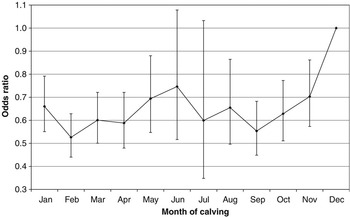
Although only across 4-years data, the likelihood of perinatal mortality increased, across all animals, over time with the odds ratio of a perinatal mortality relative to the year 2005 being 0.85 (95% confidence interval (CI): 0.77 to 0.95), 0.78 (95% CI: 0.70 to 0.86) and 0.93 (95% CI: 0.85 to 1.03) in 2002, 2003 and 2004, respectively. When restricted to only primiparae, there was no significant difference in perinatal mortality across the 4 years. The odds of perinatal mortality across different months of the year are illustrated in Figure 1. Perinatal mortality tended to be greatest in June and in winter (November to January).
Odds ratios of perinatal mortality (95% CIs included as error bars) in each month of calving (December was the referent month).

Calving assistance and parity
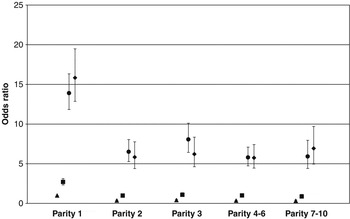
The effect of degree of calving assistance on the odds of a perinatal mortality differed by parity and is illustrated in Figure 2. Across the different degrees of calving assistance the odds of a perinatal mortality were consistently greater in first parity animals. Furthermore, the effect of calving assistance on prevalence of perinatal mortality was greater in primiparous animals. The likelihood of perinatal mortality was lower in parities 2 through 6 for veterinary-assisted calvings compared with severe assistance calvings (excluding veterinary assistance), although this difference was not significant. For a singleton male calf born without assistance, to a cow of median age, to a sire of zero genetic merit for perinatal mortality, calving in March 2005, the predicted probability of a perinatal mortality was 2.5%, 1.3%, 1.4%, 1.3% and 1.2% in parity 1, 2, 3, 4 to 6 and 7 to 10, respectively; the respective predicted probabilities increased to 26.2%, 13.6%, 14.0%, 13.1% and 14.7% when severe assistance (excluding veterinary assistance) was required at calving and all other variables remaining unchanged.
Effect of the interaction between parity and degree of calving assistance (no assistance = triangle, slight assistance = square, severe assistance = circle and veterinary assistance = diamond) on the odds ratios of perinatal mortality (parity one without assistance was the referent group). Ninety-five percent CIs are included as vertical bars.

Foetal gender, previous calving history and sire PTA for direct perinatal mortality
The odds of perinatal mortality were 1.12-times (95% CI: 1.06 to 1.17) greater for male calves than for female calves. However, the odds increased to 1.29 (95% CI: 1.23 to 1.36) when calving assistance was removed from the multiple regression model. Dams that had perinatal mortality had a 4.21-times (95% CI: 3.79 to 4.68) greater odds of perinatal mortality in the following calving. The logit of the probability of perinatal mortality increased by 0.099 (s.e. = 0.0141) per unit increase in PTA for direct perinatal mortality.
Twin calving
The odds of at least one perinatal mortality in a twin birth were 13.36-times (95% CI: 11.03 to 16.21), 9.60-times (95% CI: 8.10 to 11.38), 7.44-times (95% CI: 6.12 to 9.04), 5.70-times (95% CI: 4.96 to 6.56) and 5.95-times (95% CI: 4.77 to 7.44) that for a single birth for parity 1, 2, 3, 4 to 6 and 7 to 10, respectively. The respective odds increased to 14.24, 10.36, 8.32, 6.71 and 7.33 following the removal of degree of calving assistance from the multiple regression model.
Age at calving
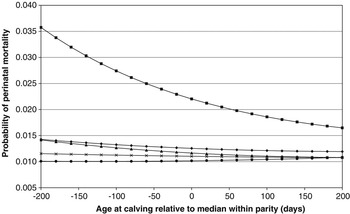
The predicted probability of perinatal mortality for different ages at calving, relative to the median age within parity, for the different parities, is illustrated in Figure 3. The effect of age at calving was greatest in primiparae with the probability of perinatal mortality increasing at an increasing rate as animals calved at a younger age relative to the median age at first calving, which was 759 days in this study. The effect of age at calving on the prevalence of perinatal mortality was minimal in pluriparae.
Predicted probability of perinatal mortality for a singleton, male calf, born to a cow of parity 1 (▪), 2 (▴), 3(⧫), 4 to 6 (●) and 7 to 10 (×) with zero genetic merit for direct perinatal mortality and no previous history of perinatal mortality, calving between −200 and +200 days relative to the median age within parity, in March 2005.

Discussion
The prevalence of bovine perinatal mortality reported here for Holstein-Friesian heifers and cows (4.3%) in pasture-based dairy herds is similar to that recently reported for Holstein-Friesians in other pasture-based dairy industries worldwide, and lower than that reported in confinement systems (Table 1). This reflects differences in management, genetics, nutrition and environment between these systems. Lower perinatal mortality rates of dairy cows have generally only been achieved in non-Holstein cattle populations, such as the Norwegian Red, Swedish Red and in Jerseys and their crosses (Table 1). Given that the data analysed were edited, one might query how representative the results reported are of the national database. In order to address this query, the unedited ICBF database figures were extracted for comparison. These showed that the perinatal mortality rate varied between 4.3% in 2002 and 3.5% in 2005, figures very similar to those reported for the edited dataset. The fact that 46% of herds had no recorded perinatal mortality raises the question as to whether such losses were accurately recorded in these herds. However, only 41% to 48% of herds, by year, with no perinatal mortality in one year had no perinatal mortality in another year. When the data were examined for herds with records in all 4 years, only 2% had no perinatal mortality recorded for any of these years; these were all small herds, ranging in size from 22 to 57 cows. Data from the international literature indicate that the dairy herd-level prevalence of perinatal calf mortality is positively skewed and can vary between 0% and 31% (Fourichon et al., Reference Fourichon, Beaudeau, Bareille and Seegers2001). Where dairy herd-level perinatal mortality rate is cited, all large-scale studies refer to herds with no recorded perinatal mortality (Drew, Reference Drew1986; Streit and Ernst, Reference Streit and Ernst1992; Fourichon et al., Reference Fourichon, Beaudeau, Bareille and Seegers2001; Ansari-Lari, Reference Ansari-Lari2007) unless smaller herds are edited from the dataset (McClintock, 2004; Silva del Rio et al., Reference Silva del Rio, Stewart, Rapnicki, Chang and Fricke2007). However, the authors could only find one study where the percentage of dairy herds with no recorded calf mortality was presented (50% of 104 herds of 23 to 154 cows, with an average calf mortality rate of 3.7%, had no recorded calf mortality; Waltner-Toews et al., Reference Waltner-Toews, Martin, Meek and McMillan1986).
The prevalence of twin calvings reported here (2.7%) is consistent with the last Irish survey on dairy cow twinning (2.5%) (Mee, Reference Mee1991) but lower than that reported recently in US dairy herds (4.8%; Silva del Rio et al., Reference Silva del Rio, Stewart, Rapnicki, Chang and Fricke2007). The temporal trend of increasing perinatal mortality detected here, albeit over a short period, reflects international trends amongst Holsteins (Meyer et al., Reference Meyer, Berger, Koehler, Thompson and Sattler2001; Steinbock et al., Reference Steinbock, Nasholm, Berglund, Johansson and Philipsson2003; Hansen et al., Reference Hansen, Misztal, Lund, Pedersen and Christensen2004). This may, in part, be attributed to the increasing proportion of Holstein-Friesian genes (‘holsteinisation’) or the influence of widely used Holstein-Friesian sires in the Irish dairy cow population.
The higher odds of perinatal mortality in the winter months in this study are in agreement with the results of McGuirk et al. (Reference McGuirk, Going and Gilmour1999), Harbers et al. (Reference Harbers, Segeren and de Jong2000), Johanson et al. (Reference Johanson, Berger, Kirkpatrick and Dentine2001) and Silva del Rio et al. (Reference Silva del Rio, Stewart, Rapnicki, Chang and Fricke2007) but are in contrast to the results of Meyer et al. (Reference Meyer, Berger, Koehler, Thompson and Sattler2001), McClintock (2004) and Ansari-Lari (Reference Ansari-Lari2007). Colder weather is associated with increased gestation length, higher calf birth weight and dystocia (Colburn et al., Reference Colburn, Deutscher, Nielsen and Adams1997; McGuirk et al., Reference McGuirk, Going and Gilmour1999), all contributory factors to perinatal mortality. In Ireland the onset of colder weather in winter coincides with the last trimester of gestation when the majority of foetal growth occurs. A peak in perinatal mortality occurred in June (albeit with a large CI), which was also reported by Auran (Reference Auran1972), Philipsson (Reference Philipsson1976) and Simensen (Reference Simensen1982). Though this has been attributed to the stress of turnout to pasture in these northern latitude countries, turnout in Ireland occurs in February or March. Here, increased risk of perinatal mortality in June is probably due to pregnant cows getting overfat on lush spring grass and lack of calving supervision with small numbers of late-calving cows per herd at pasture.
Perinatal mortality did not differ between days of the week, a finding in agreement with that of Silva del Rio et al. (Reference Silva del Rio, Stewart, Rapnicki, Chang and Fricke2007). However, Szenci and Kiss (Reference Szenci and Kiss1982) found inadequate attendance at calving (at night, on Sundays and bank holidays) can account for a significant increase in stillbirth incidence.
Calving assistance, which was both a significant risk factor for perinatal mortality and occurred in a high percentage of calvings, has a high impact on overall perinatal mortality. The odds ratios found here are within the wide range (2.7 to 14.6) reported for the effects of calving assistance on perinatal mortality in dairy herds (Chassagne et al., Reference Chassagne, Barnouin and Chacornac1999; Johanson and Berger Reference Johanson and Berger2003; Berry et al., Reference Berry, Lee, Macdonald and Roche2007). While dystocia is often listed as the most significant risk factor for perinatal mortality, the results of the present study and of others (McGuirk et al., Reference McGuirk, Going and Gilmour1999; Meyer et al., Reference Meyer, Berger, Koehler, Thompson and Sattler2001; Sorge, 2005) show that even slight calving assistance is associated with increased risk of perinatal mortality. This suggests a perinatal mortality aetiology unrelated to dystocial trauma, possibly poor foetal viability, placental dysfunction or prolonged duration of calving.
The likelihood of perinatal mortality was approximately 3-times as high in primiparae compared with pluriparae, a finding similar to the range (1.5 to 2.6) reported previously (Szenci and Kiss, Reference Szenci and Kiss1982; Steinbock et al., Reference Steinbock, Nasholm, Berglund, Johansson and Philipsson2003; Berry et al., Reference Berry, Lee, Macdonald and Roche2007), indicating that perinatal mortality is a different trait in younger and older cows. While most of this differential is attributable to the significant interaction between parity and calving assistance rate shown here, recent research in sheep has shown that first parity animals had smaller and less efficient placentas resulting in less viable lambs than those of older sheep (Dwyer et al., Reference Dwyer, Calvert, Farish, Donbavand and Pickup2005). A tendency for increased risk of perinatal mortality in mature cows (>6th parity), as reported by Simensen (Reference Simensen1982), McGuirk et al. (Reference McGuirk, Going and Gilmour1999) and McClintock (2004) was not found here.
In contrast to the results from the present study, which showed a 12% greater odds of perinatal mortality in male calves, Meyer et al. (Reference Meyer, Berger, Koehler, Thompson and Sattler2001) detected a 12% greater odds of perinatal mortality in female calves, in pluriparae. In addition, Szenci and Kiss (Reference Szenci and Kiss1982), Ansari-Lari (Reference Ansari-Lari2007) and Berry et al. (Reference Berry, Lee, Macdonald and Roche2007) did not detect significant differences in perinatal mortality rate between calf sexes, for certain breeds. These differences may be partially attributable to the inclusion of dystocia in their models, which may have masked some of the effect of calf gender on perinatal mortality given the increased probability of dystocia in male calves (Chassagne et al., Reference Chassagne, Barnouin and Chacornac1999; Berry et al., Reference Berry, Lee, Macdonald and Roche2007; Lombard et al., Reference Lombard, Garry, Tomlinson and Garber2007). However, after adjusting for degree of calving assistance in our multiple regression model, calf gender still significantly affected perinatal mortality. This indicates that male calves have poorer viability at birth than females, independent of the effects of dystocia. This could possibly be due to the heavier weight of male calves resulting in prolonged calving.
In the present study, whether the dam had a perinatal mortality in the previous calving or not significantly influenced the risk of perinatal mortality. This indicates a strong influence of the cow effect on calf viability at birth in the Irish Holstein-Friesian population and suggests a repeatability of perinatal mortality within dam. A small but real tendency to repeat prior calving assistance score has been shown, but not prior calf viability at birth (Thompson and Rege, Reference Thompson and Rege1984). For example, repeatability rates for gestation length (17%), prenatal growth rate (15%), birth weight (16%) and dystocia are low (6% to 14%), but that of calf viability at birth is even lower (2%) (Thompson and Rege, Reference Thompson and Rege1984; Klassen et al., Reference Klassen, Cue and Hayes1990; Casanova et al., Reference Casanova, Garcia, Magofke, Gonzalez and Martinez1999).
The range in odds ratios for twinning-associated perinatal mortality reported here (5.70 to 13.36) includes the odds ratio of 11.9 reported by Berry et al. (Reference Berry, Lee, Macdonald and Roche2007) in pasture-based New Zealand dairy cows. Nonetheless, given its low, but increasing (Silva del Rio et al., Reference Silva del Rio, Stewart, Rapnicki, Chang and Fricke2007), prevalence, the impact of twinning on overall perinatal mortality rate is low, except in individual herds where twinning rates are high. Increased perinatal mortality in biparous cows has been significantly associated with foetal laterality (Echternkamp et al., Reference Echternkamp, Cushman and Allan2006) and with increased malpresentation and calving assistance (Mee, Reference Mee1991).
In this study, where median age at first calving was 27.1 lunar months, the probability of perinatal mortality increased at an increasing rate as primiparae calved at a younger age, with a minimal effect in pluriparae. These trends were also observed by Steinbock et al. (Reference Steinbock, Nasholm, Berglund, Johansson and Philipsson2003), but were more pronounced for males due to their heavier birth weight and greater risk of dystocia. However, while Ettema and Santos (Reference Ettema and Santos2004) reported a significantly higher perinatal mortality rate in primiparae less than 25 months at calving, dystocia rates did not differ. They suggested the highest economic return would come from calving heifers at 23 to 24.5 months of age, which is lower than the average in US dairy herds (25.4 months) (BAMN, 2007). Simerl et al. (Reference Simerl, Wilcox, Thatcher and Martin1991) found no significant effect of age at first calving on perinatal mortality rate, but found higher dystocia rates in young and old heifers, possibly due to immaturity and relative oversize and fat deposition in the maternal pelvis, respectively. The target age and percentage of mature body weight at first calving is 24 months or 85% to 90% and 22 months or 82% in Ireland (Mee, 2008) and in the USA (BAMN, 2007), respectively.
Breed of service sire did not significantly affect the likelihood of perinatal mortality in the present study. This is because genetic merit for direct perinatal mortality in Ireland is predicted using an across-breed genetic evaluation and therefore all PTAs across breeds are comparable. Hence, the service sire breed effect is included in the PTA for mortality, which was included in the multiple regression model. The positive coefficient of service sire PTA for direct perinatal mortality in the model agrees with expectations that increased calf mortality is expected when sires with inferior genetic merit for perinatal calf mortality (positive PTA in Ireland) are mated to cows.
The only herd-level risk factor examined, herd size, did not significantly affect the prevalence of perinatal mortality. Though a significant variation in perinatal mortality rate has been reported between herds both here and in the literature (0% to 31%; Streit and Ernst, Reference Streit and Ernst1992; Fourichon et al., Reference Fourichon, Beaudeau, Bareille and Seegers2001; McClintock, 2004), this has not been attributed to herd size (Szenci and Kiss, Reference Szenci and Kiss1982; Fourichon et al., Reference Fourichon, Beaudeau, Bareille and Seegers2001; Ansari-Lari, Reference Ansari-Lari2007). Silva del Rio et al. (Reference Silva del Rio, Stewart, Rapnicki, Chang and Fricke2007) cautioned against interpreting a causal relationship between increased herd size and perinatal mortality, suggesting that factors such as accuracy of recording and herd expansion may influence this relationship. The skewed distribution of herd perinatal mortality rates reported here demonstrates that while many herds do not experience losses, the majority of herds experience some loss and a very small proportion of herds have very high perinatal mortality rates. Factor analysis showed that while herds with a lower than average mean lactation number and those calving in the late summer and autumn had higher calf mortality on Irish dairy farms, this was not influenced by herd size (Fahey et al., Reference Fahey, O’Sullivan, Crilly and Mee2002). Similarly, while Fourichon et al. (Reference Fourichon, Beaudeau, Bareille and Seegers2001) identified clusters of herds with a high prevalence of peri partum disorders, this was not influenced by herd size. Drew (Reference Drew1986) concluded that differences in stillbirth rate between herds were primarily due to the herdsman’s ability to calve heifers with large calves.
In conclusion, these results indicate that although the prevalence of perinatal mortality in the Irish dairy cow population has increased, the prevalence is similar to that in other pasture-based dairy systems worldwide. The putative risk factors traditionally associated with perinatal mortality were also associated with perinatal mortality in these commercial dairy herds. The practical implication of these results is that as many of the significant risk factors are largely not under management control (year of calving, month of calving, twin calving, primiparity, previous perinatal mortality and foetal gender) herd owners must focus on the significant key determinants largely under their control (age at first calving, sire genetic merit for direct perinatal mortality and both the extent of calving supervision and the degree of calving assistance), to reduce the prevalence of perinatal mortality and improve perinatal welfare. For example, herd owners can ensure that heifers achieve target body condition score (2.75 to 3.0; 0 to 5 scale) and body weight (540 to 570 kg or 85% to 90% of mature body weight) when calving at 2 years of age (Mee, 2008), which will reduce the risk of stillbirth caused by the over condition and deposition of excessive fat in the pelvis (Drew, Reference Drew1986, Chassagne et al., Reference Chassagne, Barnouin and Chacornac1999). Veterinary practitioners and agricultural and breeding advisors must play a proactive role in educating herd owners on how to address these modifiable risk factors on an individual herd basis.