Introduction
The mode of corallite increase is an important character in the recognition and taxonomic assignment of Paleozoic corals (Scrutton, Reference Scrutton1997; Lee and Elias, Reference Lee and Elias2000, Reference Lee and Elias2004; Lee et al., Reference Lee, Jun, Bae, Elias, Hubmann and Piller2007; Elias et al., Reference Elias, Lee and Woo2008). Information regarding increase, however, is strikingly insufficient for the majority of genera, due to a lack of detailed studies (Pandolfi, Reference Pandolfi1989). Tabulate corals are characterized by lateral increase (offset arises from side of parent corallite) and by coenenchymal increase (offset arises from coenenchyme between corallites), which occurs mainly in heliolitids (Scrutton, Reference Scrutton1997, Reference Scrutton1998). Axial increase (longitudinal fission of corallite) has also been reported in addition to lateral increase in some early tabulate genera (Lee and Elias, Reference Lee and Elias1991, Reference Lee and Elias2000, Reference Lee and Elias2004; Bae et al., Reference Bae, Lee and Elias2006, Reference Bae, Lee and Elias2008, Reference Bae, Elias and Lee2013; Lee et al., Reference Lee, Jun, Bae, Elias, Hubmann and Piller2007). In rugose corals, the other main Paleozoic group, multiple parricidal modes of increase (offsets replace parent corallite), including uncommon peripheral and rare axial types, are considered to be unique (Scrutton, Reference Scrutton1997, Reference Scrutton1998). However, lateral increase is also typical in rugosans (Fedorowski and Jull, Reference Fedorowski and Jull1976).
Agetolites Sokolov, Reference Sokolov1955 is a problematic genus of Late Ordovician cerioid corals, reported mainly from central Asia, China, and Australia (Sun et al., Reference Sun, Elias, Choh, Lee, Wang and Lee2016). It possesses features of both tabulate and rugose corals, but has generally been considered to be a tabulate or allied with tabulates, due to the presence of numerous and large mural pores (Sokolov, Reference Sokolov1955; Lin, Reference Lin1960; Yu and Zhang, Reference Yu, Zhang, Yu, Wu, Zhao and Zhang1963; Kim, Reference Kim1966; Lin and Chow, Reference Lin and Chow1977; Hill, Reference Hill and Teichert1981; Lin et al., Reference Lin, Qiu and Xu1984; Lin and Huang, Reference Lin and Huang1986; Scrutton, Reference Scrutton1997; Sun et al., Reference Sun, Elias, Choh, Lee, Wang and Lee2016). An affinity with rugosans has also been proposed, based mainly on septal patterns and other morphological characteristics, such as an axial structure of septal lobes or a columella (Kim, Reference Kim and Sokolov1974; Xu et al., Reference Xu, Elias and Lee1999). A recent study (Sun et al., Reference Sun, Lee and Wang2014), however, revealed that the septal pattern in Agetolites from the Xiazhen Formation at Zhuzhai, South China, is highly variable and the rugosan pattern of septal insertion in this genus as claimed by Kim (Reference Kim and Sokolov1974) was not supported.
Xu et al. (Reference Xu, Elias and Lee1999) briefly reported that mural pores are associated with corallite increase in Agetolites. No subsequent investigation, however, has yet been conducted to consider that observation. Our principal objectives in the present study are to examine the issues of corallite increase and mural pores in species of Agetolites from the Xiazhen Formation at Zhuzhai, to compare the findings in detail with other Ordovician corals, and to consider the paleobiologic, taxonomic, and phylogenetic implications.
Materials and methods
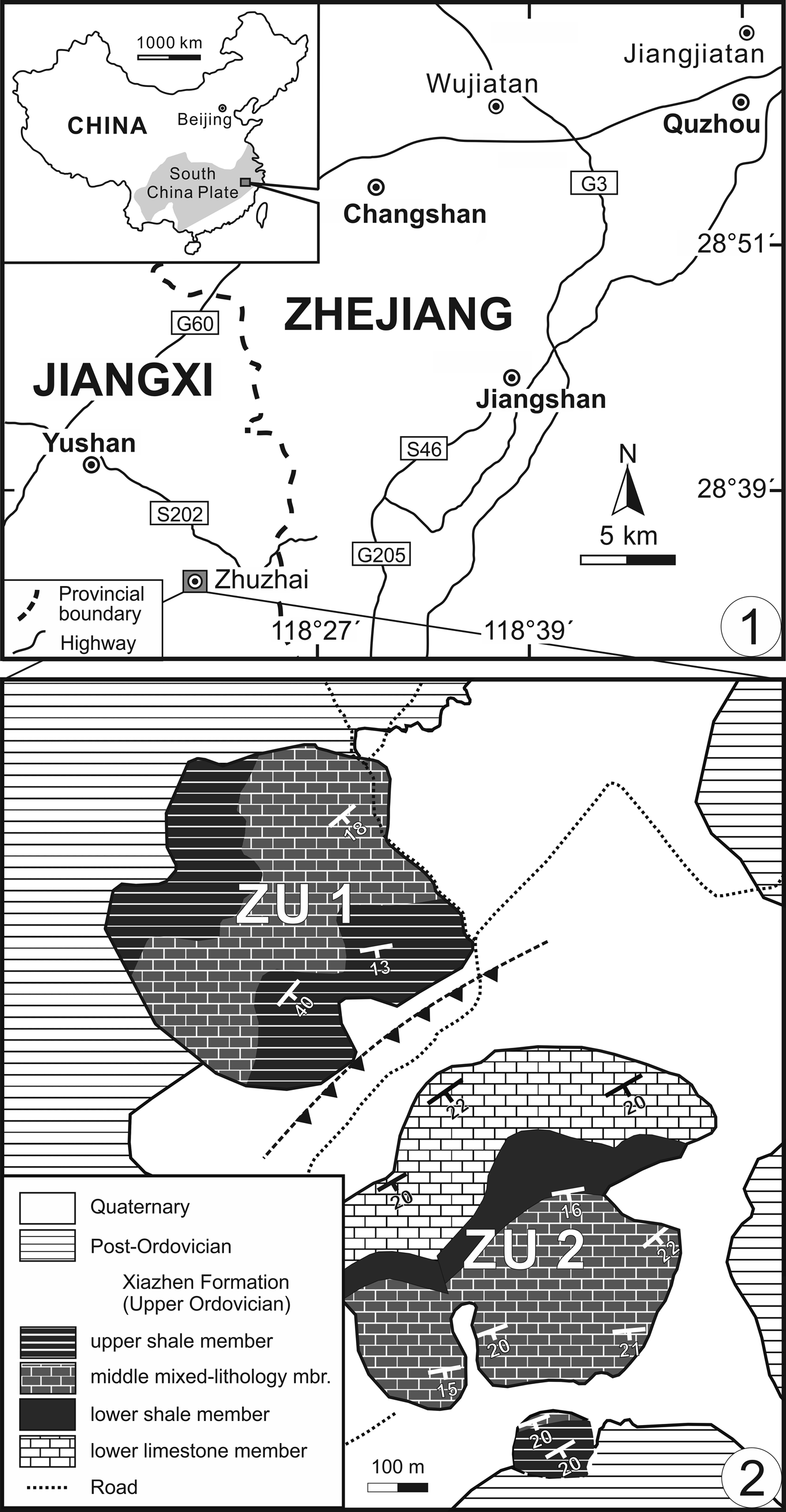
Agetolites is the most abundant genus of colonial corals in the Upper Ordovician Xiazhen Formation at Zhuzhai, Jiangxi Province, in the southern end of the JCY (Jiangshan-Changshan-Yushan) triangle region, South China (Fig. 1.1, 1.2). This formation is a mixed carbonate-siliciclastic, fossil-rich deposit containing abundant stromatoporoids, corals, brachiopods, bryozoans, algae, sponges, and trilobites (Chen et al., Reference Chen, Rong, Qiu, Han, Li and Li1987; Bian and Zhou, Reference Bian and Zhou1990; Zhang et al., Reference Zhang, Chen, Yu, Goldman and Liu2007; Kwon et al., Reference Kwon, Park, Choh, Lee and Lee2012; Lee et al., Reference Lee, Park, Woo, Kwon, Lee, Guan, Sun, Lee, Liang, Liu, Rhee, Choh, Kim and Lee2012, Reference Lee, Elias, Choh and Lee2016; Lee, Reference Lee2013; Liang et al., Reference Liang, Elias, Choh, Lee and Lee2016; Sun et al., Reference Sun, Elias, Choh, Lee, Wang and Lee2016; Park et al., Reference Park, Lee, Hong, Choh, Lee and Lee2017; Zhang et al., Reference Zhang, Xia, Taylor, Liang and Ma2018). The formation is considered to have been deposited in back-reef to marginal platform environments (Lee et al., Reference Lee, Park, Woo, Kwon, Lee, Guan, Sun, Lee, Liang, Liu, Rhee, Choh, Kim and Lee2012) of a shallow epicontinental sea fringing the north-northwestern Cathaysian Oldland of South China (Li et al., Reference Li, Kershaw and Mu2004).
(1) Map of the study area in southeastern China and location of South China Plate (shaded). (2) Simplified geological map of the Xiazhen Formation at Zhuzhai (modified after Lee et al., Reference Lee, Park, Woo, Kwon, Lee, Guan, Sun, Lee, Liang, Liu, Rhee, Choh, Kim and Lee2012). ZU 1 and ZU 2 refer to the stratigraphic columns in Figure 2.

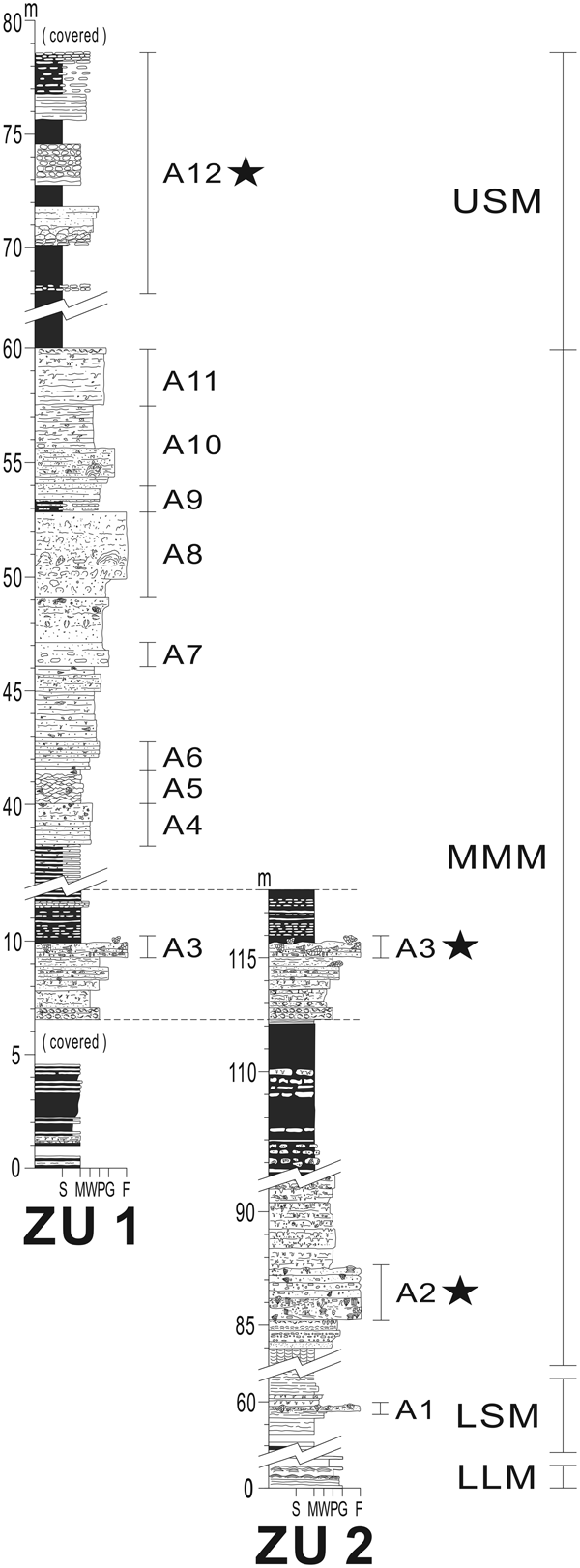
Stratigraphic columns showing relevant portions of the Upper Ordovician Xiazhen Formation at sub-sections ZU 1 and ZU 2, Zhuzhai, South China (modified after Lee et al., Reference Lee, Park, Woo, Kwon, Lee, Guan, Sun, Lee, Liang, Liu, Rhee, Choh, Kim and Lee2012; for complete columns and correlation, see Lee et al., Reference Lee, Park, Woo, Kwon, Lee, Guan, Sun, Lee, Liang, Liu, Rhee, Choh, Kim and Lee2012, figs. 4, 8). Specimens examined in this study were collected from intervals A12 at ZU1, and A2 and A3 at ZU 2 (stars). LLM, lower limestone member; LSM, lower shale member; MMM, middle mixed-lithology member; USM, upper shale member. S, shale; M, mudstone; W, wackestone; P, packstone; G, grainstone; F, floatstone.

The Xiazhen Formation at Zhuzhai was recently measured and described in detail by Lee et al. (Reference Lee, Park, Woo, Kwon, Lee, Guan, Sun, Lee, Liang, Liu, Rhee, Choh, Kim and Lee2012), based on the integration of lithological and paleontological data; we follow their interpretations and stratigraphic revisions. They compared data from the three exposures (designated as subsections ZU 1, ZU 2, and ZU 3, separated by Quaternary deposits) and demonstrated that stratigraphic intervals of the various subsections overlap (Lee et al., Reference Lee, Park, Woo, Kwon, Lee, Guan, Sun, Lee, Liang, Liu, Rhee, Choh, Kim and Lee2012, figs. 3, 4). The Xiazhen Formation is ~190 m thick. Four informal members are recognized: the lower limestone member, lower shale member, middle mixed-lithology member, and upper shale member (Lee et al., Reference Lee, Park, Woo, Kwon, Lee, Guan, Sun, Lee, Liang, Liu, Rhee, Choh, Kim and Lee2012). Fossils such as conodonts, which have well-constrained biostratigraphic utility, have not been reported from the Xiazhen Formation. However, based on corals and a proposed correlation with the Changwu Formation (Zhang et al., Reference Zhang, Chen, Yu, Goldman and Liu2007), and the recent discovery of the graptolite Anticostia uniformis (Mu and Lin in Mu et al., Reference Mu, Li, Ge, Chen, Lin and Ni1993) in the upper part of the Xiazhen Formation (Chen et al., Reference Chen, Kim, Choh, Lee and Chen2016), the age of the formation is estimated to be late Katian to possibly Hirnantian.
In a recent study, five species of Agetolites were recognized among specimens collected from 12 coral-bearing intervals at two measured sections of the Xiazhen Formation (Lee et al., Reference Lee, Park, Woo, Kwon, Lee, Guan, Sun, Lee, Liang, Liu, Rhee, Choh, Kim and Lee2012; Sun et al., Reference Sun, Elias, Choh, Lee, Wang and Lee2016; A1–A12 in Fig. 2). For the present paper, 12 exceptionally well-preserved specimens representing three species were selected from three of those intervals (A2, A3, and A12 in Fig. 2): A. waicunensis (Lin and Chow, Reference Lin and Chow1977), A. maxima (Lin and Chow, Reference Lin and Chow1977), and A. yushanensis Lin, Reference Lin1960 (Table 1). The selected specimens allow the types of corallite increase to be documented and evaluated.
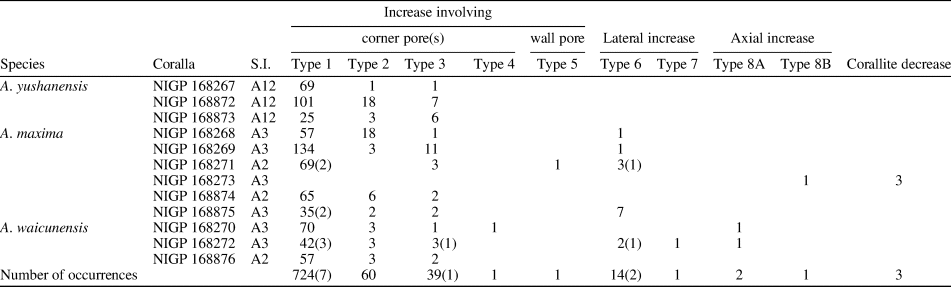
Number of occurrences of each type of corallite increase and corallite decrease in three species of Agetolites, as observed in transverse serial peels of 12 coralla from three stratigraphic intervals (S.I.) in the Xiazhen Formation (Upper Ordovician), Zhuzhai, Jiangxi, China (Fig. 1). Numbers in parentheses indicate attempts at offsetting that failed to yield a corallite.

More than 2000 transverse serial peels were prepared from the 12 coralla. All peels are oriented perpendicular to the central growth axis and spaced as little as 0.05 mm apart, with up to 403 sections per corallum. In addition, 115 transverse and six longitudinal thin sections were prepared to compare skeletal development and general morphology of the coralla. All transverse sections illustrated herein are oriented as they appear looking down from the top of the corallum toward the bottom.
Repository and institutional abbreviation
Selected peels of the 12 studied specimens, including all figured peels, are deposited in the Palaeontological Collections, Nanjing Institute of Geology and Palaeontology (NIGP), Chinese Academy of Sciences, Nanjing, China.
Types of corallite increase
The coralla of Agetolites are cerioid, composed of prismatic corallites with well-developed septa that commonly alternate in length (Sun et al., Reference Sun, Elias, Choh, Lee, Wang and Lee2016, fig. 4). Mural pores are abundant, usually connecting three corallites and rarely two, four, and even five corallites. Tabulae are mostly complete and flat, with a few concave or slightly convex, but some are incomplete or irregular.
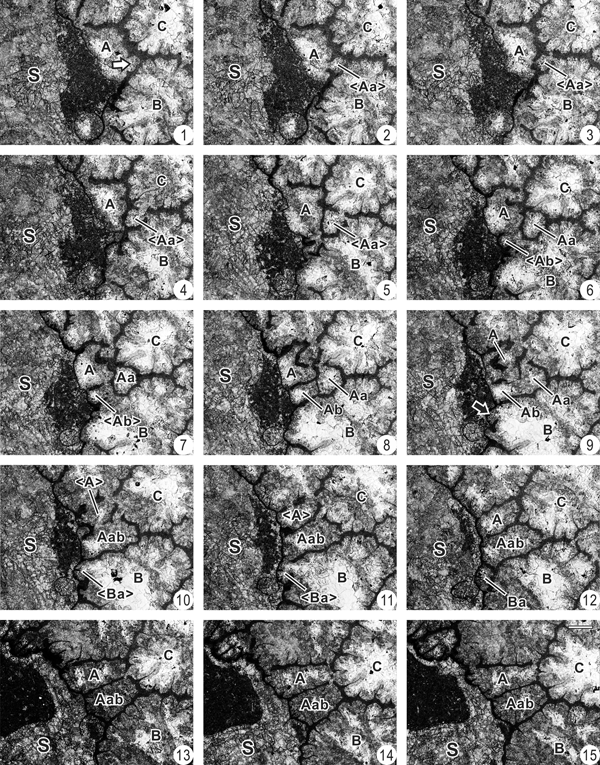
Three modes of corallite increase, represented by a total of eight distinct types of increase, are recognized in this study of Agetolites and are described in detail below. Increase involving the development of an offset from a connective mural pore is by far the most common mode, occurring in all examined species. Five types are distinguished. Types 1 to 4 are associated with corner pores, whereas Type 5 involves a wall pore. In all five types of increase involving connective mural pores, the offset developed without a clear relationship to a particular parent corallite. The processes of increase in which offsets arose from mural pores were almost always successful in yielding corallites (Table 1).
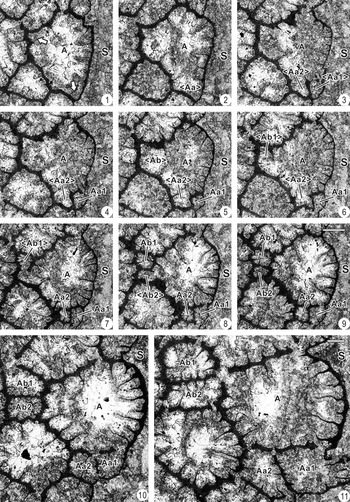
Lateral increase is a nonparricidal process (the parent corallite survives), by which an offset arises from the side of a particular parent (Scrutton, Reference Scrutton1998; Lee and Elias, Reference Lee and Elias2000). This mode of increase is relatively uncommon in Agetolites, but is a typical feature in corallites along the boundaries of intergrowths with the stromatoporoid Clathrodictyon Nicholson and Murie, Reference Nicholson and Murie1878. Two types of lateral increase, identified as Types 6 and 7, are recognized in this study.
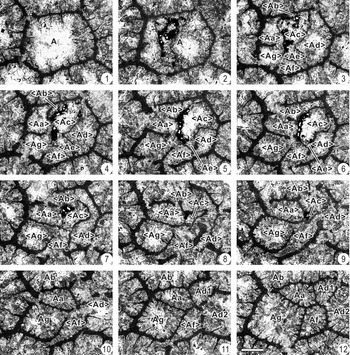
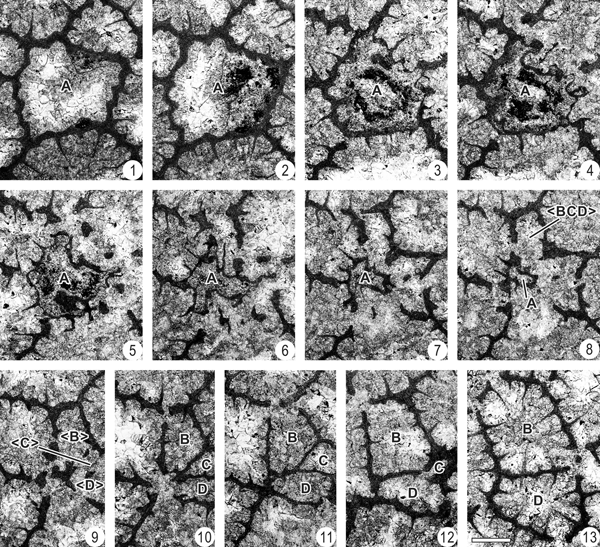
The axial mode of increase, which involves longitudinal fission of a corallite (Lee and Elias, Reference Lee and Elias2000), is rare in Agetolites. It occurs in association with rejuvenation of a damaged corallite (Type 8A) or regeneration following termination of a corallite (Type 8B).
Type 1 increase
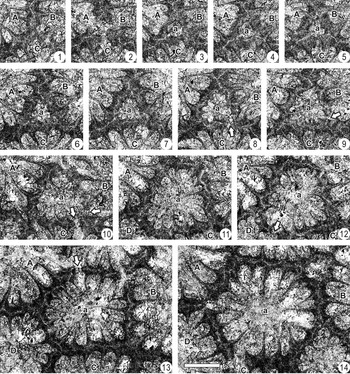
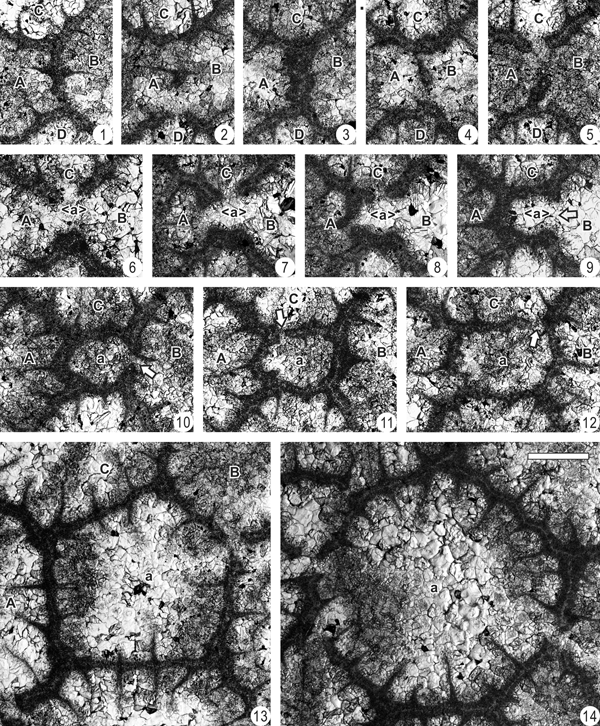
The process began when walls opened to form a connective pore at a junction of usually three corallites (Fig. 3.1, 3.2) to rarely as many as five adjacent corallites. The walls usually became thickened prior to and during formation of the offset (Fig. 3.2, 3.3). As the offsetting procedure was underway, dividing walls developed one by one or nearly simultaneously to enclose the offset, which was round or rarely triangular to rectangular in shape, and completely separated it from the adjacent corallites (Fig. 3.3). The offset then expanded in size (Fig. 3.4–3.7). As growth continued, several small pores appeared in the dividing walls between the offset and adjacent corallites (arrows in Fig. 3.8–3.10, 3.12, 3.13). ‘Adult’ corallite size and polygonality (typically six to eight sides) were attained ~4.1–15.5 mm above the initial development of the offset (Fig. 3.14). Type 1 is by far the most common form of corallite increase in coralla representing the three species of Agetolites (Table 1). It occurred ubiquitously throughout colony growth, and was almost always successful in yielding a new corallite.
Transverse serial peels illustrating Type 1 increase involving connective corner pore. (1, 2) Opening in walls resulted in formation of a connective pore at junction of three corallites (A–C); (3) closure of walls yielded an offset (a); (4–7) expansion of offset (a); (8–10) further expansion of offset (a) and appearance of pores between offset and adjacent corallites (C, arrow in 8; B, arrow in 9; B and C, arrows in 10); (11–14), growth to attain ‘adult’ corallite size and polygonality (a; arrow in 12 points to pore connection with corallite D): figured peels spaced 0.78, 0.05, 0.05, 0.05, 0.10, 0.15, 0.40, 0.25, 0.74, 0.73, 0.20, 1.77, 2.56 mm apart, respectively; scale bar for 1–14 (shown in 14) = 1 mm. Agetolites yushanensis, NIGP 168267, Xiazhen Formation (Upper Ordovician), Zhuzhai, Jiangxi, China.

Type 2 increase
In this type of increase, pores appeared at both ends of a wall that extended between corners of two corallites (Fig. 4.1–4.4). A connective pore subsequently formed at one of the triple junctions (Fig. 4.5) and the remnant of the wall disappeared, leaving only the connective pore (Fig. 4.6). Further development, like that described for Type 1, involved the formation of dividing walls around the offset (Fig. 4.7–4.10), expansion of the offset with pore connections to adjacent corallites (Fig. 4.10–4.12), and growth to ‘adult’ corallite size and polygonality (Fig. 4.13, 4.14). The ‘adult’ stage was attained ~7.4–13.6 mm above the initial development of the offset. Type 2 corallite increase is less common than Type 1, but was recognized in all three species of Agetolites (Table 1). It successfully yielded a new corallite in all observed cases.
Transverse serial peels illustrating Type 2 increase involving connective corner pore. (1–4) Wall extending between corners of two corallites (C, D) developed pores temporarily connecting adjacent corallites (A, B); (5) connective pore appeared at junction of three corallites (A–C); (6, 7) remnant of wall between corallites A and B disappeared, leaving opening (<a>); (8, 9) closure of walls between opening (<a>) and corallites A and C, leaving opening with corallite B (arrow in 9); (10–12) as offset (a) expanded, opening between offset and corallite B (arrow in 10) closed and pores appeared between offset and corallite C (arrows in 11, 12); (13, 14) growth to attain ‘adult’ corallite size and polygonality (a): figured peels spaced 0.40, 0.40, 0.25, 0.15, 0.16, 0.09, 0.09, 0.12, 0.15, 0.15, 0.41, 5.61, 6.14 mm apart, respectively; scale bar for 1–14 (shown in 14) = 1 mm. Agetolites maxima, NIGP 168268, Xiazhen Formation (Upper Ordovician), Zhuzhai, Jiangxi, China.

Type 3 increase
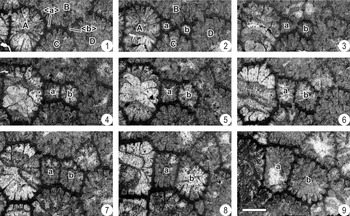
Two offsets developed nearly simultaneously at opposite ends of a wall that extended between corners of two corallites (Fig. 5.1). As dividing walls developed around the offsets, which were approximately equal in size and commonly round in shape, the offsets expanded at the expense of the wall between them and came into contact with one another (a and b in Fig. 5.2–5.4). Continued growth of both offsets yielded two ‘adult’ corallites (a and b in Fig. 5.5–5.9). ‘Adult’ size and polygonality were attained ~7.8–15.5 mm above the initial development of the offset. Type 3 increase is relatively uncommon, but occurs in all examined species of Agetolites (Table 1). This process of increase was almost always successful in yielding new corallites.
Transverse serial peels illustrating Type 3 increase involving connective corner pores. (1, 2) Pore at junction of corallites A–C (<a> in 1) gave rise to an offset (a in 2) and pore at junction of corallites B–D (<b> in 1) gave rise to another offset (b in 2), nearly simultaneously at opposite ends of wall extending between corners of corallites A and D; (3–9) the two offsets expanded into lateral contact and grew to attain ‘adult’ corallite size and polygonality (a, b): figured peels spaced 0.44, 0.42, 0.40, 0.40, 0.84, 0.40, 1.76, 1.89 mm apart, respectively; scale bar for 1–9 (shown in 9) = 2 mm. Agetolites maxima, NIGP 168269, Xiazhen Formation (Upper Ordovician), Zhuzhai, Jiangxi, China.

Type 4 increase
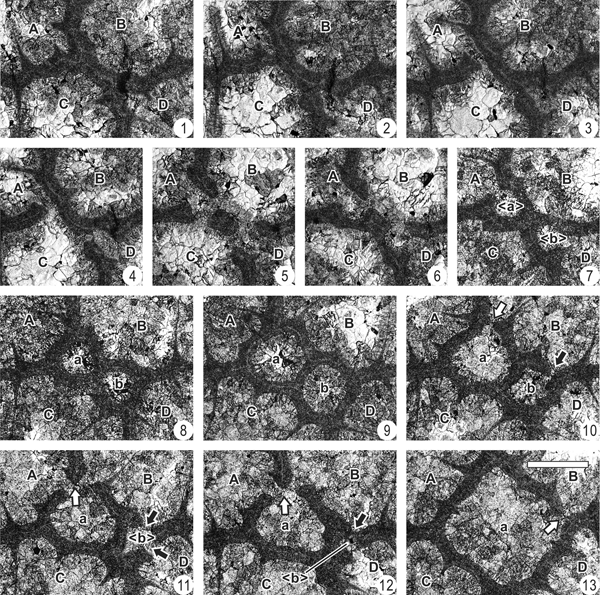
Type 4 increase is similar to Type 3, except that only one offset developed into a corallite while the other decreased in size at an early stage and disappeared. In this type of increase, two connective pores formed nearly simultaneously at opposite ends of a wall that extended between corners of two corallites (Fig. 6.1–6.5). Dividing walls developed to enclose the offsets, which expanded at the expense of the wall between them and became conjoined (Fig. 6.6–6.9). The two offsets were approximately equal in size and round in shape. While one offset continued to develop into a polygonal corallite of ‘adult’ size (a in Fig. 6.10–6.13), the other offset decreased in size and pores appeared in the wall separating it from adjacent corallites (b in Fig. 6.10–6.12), before the offset disappeared (Fig. 6.13). ‘Adult’ size of the corallite resulting from this type of increase was attained 10.1 mm above the initial development of the offset. Only a single case of Type 4 increase was recognized in A. waicunensis from stratigraphic interval A3 (Table 1).
Transverse serial peels illustrating Type 4 increase involving connective corner pores. (1–5) Walls between four corallites (A–D) opened, yielding connective corner pores at junctions of corallites A-C and B-D; (6–9) closure of walls around pores (6, <a> and <b> in 7) yielded two offsets that expanded into lateral contact (a and b in 8, 9); (10–13) one offset grew to attain ‘adult’ corallite size and polygonality (a; note pore connection with corallite B at white arrow in 10, and corallites A and B at white arrows in 11, 12, and corallite B at white arrow in 13), while the other offset decreased in size and disappeared (b in 10, <b> in 11, 12); note pore connection with corallite B at black arrow in 10–12, and corallite D at other black arrow in 11): figured peels spaced 0.25, 0.31, 0.05, 0.15, 0.15, 1.13, 0.39, 0.25, 0.12, 1.50, 2.20, 3.59 mm apart, respectively; scale bar for 1–13 (shown in 13) = 1 mm. Agetolites waicunensis, NIGP 168270, Xiazhen Formation (Upper Ordovician), Zhuzhai, Jiangxi, China.

Type 5 increase
This type of increase involved a wall pore. The process began where a wall became disconnected in the middle, resulting in a connective pore between two corallites (Fig. 7.1–7.3). Dividing walls eventually enclosed the offset, which was elliptical in shape, completely separating it from the adjacent corallites (a in Fig. 7.4–7.8). As the offset increased in size to become an ‘adult’ corallite, pores connected it with adjacent corallites (Fig. 7.9–7.15). The ‘adult’ stage was attained ~9.5 mm above the initial development of the offset. In general, wall pores are very rare in Agetolites of South China (Sun et al., Reference Sun, Elias, Choh, Lee, Wang and Lee2016), including those species formerly assigned to Agetolitella Kim, Reference Kim1962 (Lin and Chow, Reference Lin and Chow1977). In the case of the three species of Agetolites examined in the present study, Sun et al. (Reference Sun, Elias, Choh, Lee, Wang and Lee2016) reported that wall pores are absent in A. yushanensis, very rare in some coralla of A. waicunensis, and rare in some coralla of A. maxima. Corallite increase involving wall pores is evidently very rare because only a single occurrence was recognized in the present study in A. maxima from stratigraphic interval A2 (Table 1).
Transverse serial peels illustrating Type 5 increase involving connective wall pore. (1, 2) Wall between two corallites (A, B) opened in the middle, forming a connective wall pore (arrow in 2); (3–7) walls developed around the pore (<a> in 4–7); (8) closure of wall separated offset (a) from adjacent corallites; (9–13) pores connected offset (a) and adjacent corallites; (14, 15) offset grew to attain ‘adult’ corallite size and polygonality (a): figured peels spaced 0.97, 0.06, 0.07, 0.12, 0.06, 0.12, 0.13, 0.18, 0.20, 0.33, 0.49, 0.74, 0.50, 1.15 mm apart, respectively; scale bar for 1–15 (shown in 15) = 1 mm. Agetolites maxima, NIGP 168271, Xiazhen Formation (Upper Ordovician), Zhuzhai, Jiangxi, China.

Type 6 increase
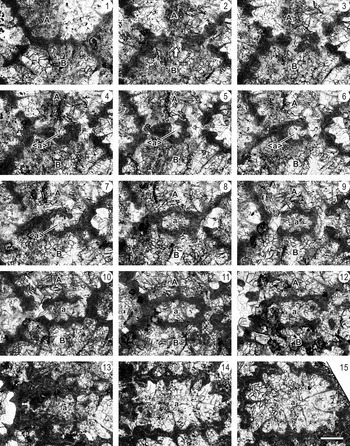
Type 6 lateral increase occurred only in corallites at corallum margins, in contact with skeletons of sessile organisms (usually stromatoporoids; in one case a cylindrical organism, possibly a solitary rugosan representing Tryplasma Lonsdale, Reference Lonsdale, Murchison, Verneuil and Keyserling1845) or with sediment (Fig. 8.1, 8.2). This type of increase always involved the production of ‘immature’ corallites. Unlike the previously described types of increase associated with mural pores, the offset began as a protuberance located in a corner of a juvenile parent corallite (Fig. 8.1). Temporary fusion between the offset and adjacent corallites (Fig. 8.3–8.5) was common before the offset became completely separated from the parent by closure of a dividing wall (Aa in Fig. 8.6). A second offset could develop similarly from a protuberance in another corner of the same juvenile parent corallite, and expand into contact with the first offset (Fig. 8.5–8.7, Ab in Fig. 8.8). In some cases, walls between the two offsets and parent opened temporarily, resulting in fusion of the parent and offsets (Fig. 8.9). A wall was then reestablished between the parent and offsets, but not between the two offsets, which remained fused to form an offset nearly equal in size to the parent (A and Aab in Fig. 8.10–8.15). During the offsetting process, the parent corallite typically decreased significantly in size, without developing septa (A in Fig. 8.7, 8.8).
Transverse serial peels illustrating Type 6 lateral increase and disappearance of an offset. (1) Corallites (A, B) at corallum margin in contact with stromatoporoid (S), sediment (dark color), and cylindrical organism (possibly Tryplasma); note protuberance in a corner of corallite A (arrow); (2, 3) two septa extended to partially enclose protuberance (<Aa>); (4, 5) pore connections appeared between <Aa> and corallites B and C; (6, 7) walls closed yielding lateral offset Aa, while protuberance <Ab> developed in another corner of corallite A; (8) walls closed, yielding lateral offset Ab; (9) the size of parent corallite A was reduced, the wall between Aa and Ab disappeared, and a protuberance developed in a corner of corallite B (arrow); (10–12) fusion of offsets Aa and Ab (see 9) and closure of surrounding wall formed corallite Aab, and protuberance <Ba> (in 10, 11) developed into lateral offset Ba (in 12); (13–15) offset Ba (see 12) eventually disappeared: figured peels spaced 0.06, 0.06, 0.12, 0.25, 0.13, 0.06, 0.12, 0.13, 0.12, 0.12, 0.25, 1.79, 0.13, 0.12 mm apart, respectively; scale bar for 1–15 (shown in 15) = 1 mm. Agetolites waicunensis, NIGP 168272, Xiazhen Formation (Upper Ordovician), Zhuzhai, Jiangxi, China.

The corallites involved in Type 6 increase were relatively small and distorted, and had thin, crenulate walls (Fig. 8.1–8.15). In some cases, an offset at the corallum margin failed to expand and gradually disappeared, possibly due to crowding by an adjacent stromatoporoid (Ba in Fig. 8.10–8.12, Fig. 8.13–8.15). Most of the offsets, however, successfully developed into new corallites, but ‘adult’ size and polygonality were not attained, resulting in the production of ‘immature’ corallites (Aab in Fig. 8.11–8.15). Type 6 lateral increase is uncommon, but has been recognized in two species, A. waicunensis and A. maxima (Table 1).
Type 7 increase
This type of lateral increase involved the production of a pair of corallites. In a parent corallite contiguous to a stromatoporoid (A in Fig. 9.1), two offsets developed side-by-side from a relatively large corner protuberance that is >1.0 mm wide (Aa in Fig. 9.2). As the offsets became separated from the parent, the dividing walls seem to have originated from septa of the parent corallite, one after another within a short vertical distance of ~0.5 mm, isolating the two offsets of approximately equal size and shape (Aa1 and Aa2 in Fig. 9.3–9.7). The same process also occurred on another side of the parent corallite (Ab in Fig. 9.5, Ab1 in Fig. 9.6, 9.7, Ab1 and Ab2 in Fig. 9.8, 9.9). In both events, the entire process leading to the formation of a pair of offsets was completed within a vertical distance of 0.8 mm. The offsets subsequently expanded and developed into ‘adult’ corallites, which were relatively small and distorted, and had thin, crenulate walls (Aa1 and Aa2 in Fig. 9.8–9.11, Ab1 and Ab2 in Fig. 9.10, 9.11). This is the only known example of Type 7 increase, which occurs in A. waicunensis from stratigraphic interval A3 (Table 1).
Transverse serial peels illustrating Type 7 lateral increase. (1) Corallites at corallum margin are contiguous with stromatoporoid (S), note two protuberances in corallite A (arrows); (2) large protuberance <Aa> formed on one side of parent corallite A; (3–9) wall divided protuberance in half (<Aa1> and <Aa2> in 3) and closure of walls yielded lateral offsets Aa1 (in 4–9) and Aa2 (in 7–9) beside one another; (2–5) large protuberance <Ab> formed on another side of parent corallite A; (6–9) dividing walls in protuberance developed around <Ab1> (in 6, 7) and < Ab2> (in 8) and closed to form lateral offsets Ab1 (in 8, 9) and Ab2 (in 9) beside one another; (10, 11) corallite A and the four offsets grew larger: figured peels spaced 0.61, 0.49, 0.06, 0.13, 0.19, 0.24, 0.13, 0.12, 1.26, 1.73 mm apart, respectively; scale bars for 1–9 (shown in 9) and 10, 11 (shown in 11) = 1 mm. Agetolites waicunensis, NIGP 168272, Xiazhen Formation (Upper Ordovician), Zhuzhai, Jiangxi, China.

Type 8 increase
Axial increase took place during rejuvenation of a damaged corallite (Type 8A) or during regeneration following the termination of a damaged corallite (Type 8B). In the case of Type 8A increase, damage was recorded by the entry of sediment into a corallite (Fig. 10.1, 10.2). Initially, the dividing walls that developed within the axial area of the damaged parent were typically relatively thin and crenulate (Fig. 10.2). They subsequently lengthened to join the corallite wall, and together with the extension of septa from the parent's wall, separated multiple offsets from one another by walls that divided the parent corallite radially (Aa to Ag in Fig. 10.3–10.6). Some offsets were terminated at an early stage (Ae in Fig. 10.3–10.7, Ac in Fig. 10.7–10.10) or divided axially into two (Ad in Fig. 10.10, Ad1 and Ad2 in Fig. 10.11). As a result of this parricidal process, the damaged parent corallite was replaced by up to six corallites of similar or differing sizes (Fig. 10.12). The entire process to attain corallites of ‘adult’ size and polygonality was accomplished within a vertical distance of ~2.4–5.4 mm. Type 8A increase appears to be rare; only two cases have been observed in A. waicunensis from stratigraphic interval A3 (Table 1).
Transverse serial peels illustrating Type 8A axial increase. (1, 2) Damage to corallite A indicated by entry of sediment; (3–6) rejuvenation involving axial increase subdivided corallite into seven offsets (<Aa > to <Ag>); (7–9) disappearance of offset < Ae>left six offsets (<Aa> to <Ad>, <Af>, <Ag>); (10) disappearance of offset <Ac > and further development of some walls left two offsets (<Ad>, <Af>) and three corallites (Aa, Ab, Ag); (11) offset <Ad> (see 10) divided axially to yield two corallites (Ad1, Ad2); (12) final result was six corallites (Aa, Ab, Ad1, Ad2, Af, Ag): figured peels spaced 0.68, 0.25, 0.13, 0.37, 0.12, 0.25, 0.24, 0.13, 0.26, 0.25, 0.85 mm apart, respectively; scale bar for 1–12 (shown in 12) = 1 mm. Agetolites waicunensis, NIGP 168272, Xiazhen Formation (Upper Ordovician), Zhuzhai, Jiangxi, China.

A decrease in the number of corallites was rare within coralla of Agetolites. Only three examples have been observed in one corallum of A. maxima from stratigraphic interval A3 (Table 1). Corallite decrease involved the termination of a normal corallite (A in Fig. 11.1). Prior to termination, evidence of damage was recorded by the entry of sediment into the corallite (A in Fig. 11.2–11.5). The corallite contracted and its walls became thin and crenulated, as adjacent corallites expanded (A in Fig. 11.2–11.8). The damaged corallite finally disappeared (Fig. 11.9). In one case, the area was restored by regeneration involving the formation of corallites by Type 8B axial increase (B, C, and D in Fig. 11.9–11.11). The dividing walls began as thin, irregular structures on the axial part of a tabula, and progressively thickened and extended to the periphery of the parent (Fig. 11.9, 11.10). One of the resulting corallites decreased in size (C in Fig. 11.11, 11.12) and disappeared (Fig. 11.13), while the other two attained ‘adult’ size and polygonality (B and D in Fig. 11.13). The entire process of Type 8B increase was completed within a vertical distance of 5.1 mm.
Transverse serial peels illustrating Type 8B axial increase. (1–9) Termination of corallite A indicated by entry of sediment and disappearance of corallite, accompanied by regeneration involving axial increase (<BCD> in 8), yielding three offsets (<D > in 9); (10–13) two of the resulting corallites (B, D) grew and attained ‘adult’ size and polygonality, while the third (C) decreased in size and disappeared: figured peels spaced 0.35, 1.02, 0.10, 0.15, 0.15, 0.10, 0.11, 0.15, 0.48, 0.69, 1.74, 2.21 mm apart, respectively; scale bar for 1–13 (shown in 13) = 1 mm. Agetolites maxima, NIGP 168273, Xiazhen Formation (Upper Ordovician), Zhuzhai, Jiangxi, China.

Discussion
Eight types of corallite increase, identified as Types 1 to 8, are recognized in 12 studied coralla of Agetolites (Table 1). Overall, the vast majority of occurrences of increase involve the development of offsets from mural pores located at corners connecting usually three to rarely five corallites (Types 1–4). Those types of increase are considered to be a characteristic feature in Agetolites. They differ, however, from the typical processes of lateral increase in favositid tabulates, in most cases in the Ordovician tabulate Lichenaria Winchell and Schuchert, Reference Winchell, Schuchert, Lesquereux, Woodward, Thomas, Schuchert, Ulrich and Winchell1895, and in the Ordovician cerioid rugosan Favistina Flower, Reference Flower1961, where the offset began as a protuberance located in a corner of a recognizable particular parent corallite (Fedorowski and Jull, Reference Fedorowski and Jull1976; Scrutton, Reference Scrutton1998; Lee and Elias, Reference Lee and Elias2000; Elias et al., Reference Elias, Lee and Woo2008). Stel (Reference Stel1979) considered serial sectioning at a spacing of 0.1 mm or less to be necessary in order to verify the presence or absence of a basal connection between the parent and offset. In the present study of Agetolites, even though transverse serial peels are spaced as little as 0.05 mm apart, we are still unable to confirm that Types 1–4 are forms of lateral increase involving a basal connection to a particular parent.
Type 1 increase, in which a single connective corner pore appeared and developed into an offset, is by far the most common form of increase in all examined species of Agetolites: A. waicunensis, A. maxima, and A. yushanensis. It is comparable only to type 6 lateral increase described from Lichenaria globularis Bassler, Reference Bassler1932 and L. grandis Bassler, Reference Bassler1932 (Elias et al., Reference Elias, Lee and Woo2008), especially those cases of type 6 without a clear relationship to a particular parent corallite. The formation of pores in the wall between the developing offset and adjacent corallites in Type 1 increase is similar to type 4 lateral increase in L. globularis and L. grandis (Elias et al., Reference Elias, Lee and Woo2008).
In Type 2 increase, pores initially appeared at both ends of a wall extending between two corners, followed by a connective pore at the triple junction at only one end of the wall. The wall subsequently disappeared as the connective pore developed into an offset. This type of increase is less common than Type 1, but has been recognized in all examined species of Agetolites. Type 2 increase is unknown in other colonial corals.
Type 3 increase, where two offsets arose nearly simultaneously at opposite ends of a wall extending between two corners, occurred in all examined species of Agetolites, but is less common than Type 2. It is similar to some cases of type 3 lateral increase documented in Lichenaria globularis, in which a wall initially separated the facing corners of two parent corallites (Elias et al., Reference Elias, Lee and Woo2008, fig. 6).
The single occurrence of Type 4 increase in A. waicunensis is similar to Type 3, but one offset decreased in size and disappeared at an early stage while the other offset expanded and developed into an ‘adult’ corallite. Disappearance of offsets at an early stage may also have occurred during Type 6 lateral increase and Type 8A axial increase. Aborted increase is also known from the Ordovician tabulate Saffordophyllum newcombae Flower, Reference Flower1961, but differs in that it involved retraction of the dividing wall between a lateral offset and parent corallite at an early stage of development (Lee and Elias, Reference Lee and Elias2000, fig. 9).
Type 5 increase involved the development of an offset from a wall pore. It is evidently rare in Agetolites of South China—only a single case has been recognized in A. maxima. This type of increase is unknown in other colonial corals.
Lateral increase in Agetolites is considered to have been a method for rapidly generating corallites at the corallum margin, usually in contact with a stromatoporoid. Type 6 lateral increase is uncommon in A. waicunensis and A. maxima. Two offsets, which developed nearly simultaneously from separate protuberances of one ‘juvenile’ parent corallite, became conjoined and through fusion yielded a single corallite that did not attain ‘adult’ size. Such development of conjoined offsets one after another from a single ‘juvenile’ parent is unknown in other colonial corals, although two examples have certain similarities. In some cases of type 2 lateral increase in Lichenaria globularis, two offsets developed simultaneously from a ‘juvenile’ parent corallite, but they were located on opposite sides of the parent and remained separated (Elias et al., Reference Elias, Lee and Woo2008, fig. 4). In Saffordophyllum newcombae, lateral increase involved the formation of a dividing wall separating the offset from the parent corallite, followed by a second dividing wall that doubled the size of the offset, followed by retraction of the first wall. However, that process occurred in a single protuberance of the parent (Lee and Elias, Reference Lee and Elias2000, fig. 10.7–10.12). In one variation of lateral increase in Favistina stellata (Hall, Reference Hall1847), two offsets in contact with one another formed simultaneously (Fedorowski and Jull, Reference Fedorowski and Jull1976, B1–B4 in fig. 5) or one after another in separate corners of a single parent corallite (Fedorowski and Jull, Reference Fedorowski and Jull1976, pl. 10, fig. 2a–2k). However, both of the offsets were retained.
Type 7 lateral increase is known from a single occurrence in Agetolites waicunensis. Side-by-side offsets developed one after another in each of two separate, relatively large protuberances of a single parent corallite. The corallites resulting from these offsets attained ‘adult’ size. This process, which rapidly generated multiple new corallites, is unknown in other tabulates. However, there is some similarity to one of the two types of increase in Foerstephyllum halli (Nicholson, Reference Nicholson1879), in which only one offset developed in each of two separate, relatively large protuberances from a single parent corallite (Jull, Reference Jull1976, B1–B12 in fig. 1). In the early development of the offsets in F. halli, some septa from the parent were usually retained, whereas in A. waicunensis there seem to be no parental septa. Foerstephyllum Bassler, Reference Bassler1941 is a problematic Ordovician coral that lacks mural pores and has short septa. It has been referred to both tabulates and rugosans, although a tabulate affinity seems more likely (Jull, Reference Jull1976; Scrutton, Reference Scrutton1997).
Axial increase took place during rejuvenation of a damaged corallite (Type 8A, rare in Agetolites waicunensis) or during regeneration following termination of a corallite (Type 8B, rare in A. maxima). Damage or termination of corallites was marked by the entry of sediment. In Agetolites of the Xiazhen Formation, such features were confined to small areas of the corallum, involving just a single corallite. The rarity of this type of increase may reflect the depositional environment of the Xiazhen Formation, in which storm-generated events have not been reported. In the Selkirk Member of the Ordovician Red River Formation in Manitoba, Canada, where corals were commonly subjected to influxes of sediment as a result of storms, axial increase was involved in restoration of relatively large areas of the corallum in the cerioid tabulates Saffordophyllum newcombae (Lee and Elias, Reference Lee and Elias2000; Lee et al., Reference Lee, Jun, Bae, Elias, Hubmann and Piller2007) and Trabeculites maculatus Flower, Reference Flower1961 (Lee and Elias, Reference Lee and Elias2004; Lee et al., Reference Lee, Jun, Bae, Elias, Hubmann and Piller2007). In the same unit, axial increase during restoration also occurred in the cateniform tabulates Manipora amicarum Sinclair, Reference Sinclair1955 and Manipora sp. A (Lee et al., Reference Lee, Jun, Bae, Elias, Hubmann and Piller2007; Bae et al., Reference Bae, Lee and Elias2008), and Catenipora rubra Sinclair and Bolton in Sinclair, Reference Sinclair1955 (Lee and Elias, Reference Lee and Elias1991; Lee et al., Reference Lee, Jun, Bae, Elias, Hubmann and Piller2007). Recovery of the corallum by axial increase in those four genera is fundamentally the same as in Agetolites, although the process was apparently slower in Agetolites (over a vertical distance of 2.4–5.4 mm) than in other genera (vertical distance of 1.0 to 2.6 mm; Lee et al., Reference Lee, Jun, Bae, Elias, Hubmann and Piller2007).
Interpretation of the level of colony integration for fossil corals, which refers to the evolutionary loss of individuality within colonies (Coates and Oliver, Reference Coates, Oliver, Boardman, Cheetham and Oliver1973; Oliver and Coates, Reference Oliver, Coates, Boardman, Cheetham and Rowell1987), is complicated and not always possible (Elias et al., Reference Elias, Lee and Woo2008). In Agetolites, the common wall between corallites has a median suture (e.g., Sun et al., Reference Sun, Elias, Choh, Lee, Wang and Lee2016, fig. 4A, B), suggesting back-to-back epithecae of adjacent corallites (Flower, Reference Flower1961). From such a structure, it is inferred that the polyps were separated and soft-tissue continuity between polyps above the skeleton was minimal, indicating a low level of integration (Scrutton, Reference Scrutton1998; Elias et al., Reference Elias, Lee and Woo2008). This contrasts with Saffordophyllum newcombae (Lee and Elias, Reference Lee and Elias2000) and species of Lichenaria (Elias et al., Reference Elias, Lee and Woo2008), where corallites are separated by continuously fused common walls lacking back-to-back epithecae, indicating a higher level of integration. In Trabeculites maculatus, the discontinuous mid-wall planes suggest an intermediate level of integration (Lee and Elias, Reference Lee and Elias2004).
Although wall structure itself indicates a relatively low level of integration for Agetolites, numerous and large connective mural pores were ubiquitously developed throughout the corallum. Furthermore, such pores were involved in the most common mode of corallite increase, in which an offset originated without a clear relationship to a particular parent. These characteristics indicate that connection of soft parts and probably confluence of body cavities among polyps occurred during colony growth, suggesting a higher level of integration. Sparse connective mural pores also formed in Saffordophyllum newcombae, and temporary corallite fusion occurred in S. newcombae and Trabeculites maculatus, although it was uncommon (Lee and Elias, Reference Lee and Elias2000, Reference Lee and Elias2004).
The most common mode of corallite increase in Agetolites involved the transformation of connective mural pores into offsets (Types 1–5). Pores also appeared during the development of offsets in the other modes of increase, including lateral (Types 6 and 7) and axial (Type 8). Increase involving mural pores contributed to expansion within the corallum, lateral increase contributed to growth at the corallum margin (generally in contact with stromatoporoids), and axial increase resulted in rejuvenation of a damaged corallite or regeneration following termination of a corallite. It therefore seems that pores were associated throughout astogeny with growth, maintenance, and recovery of the colony as a whole.
Taxonomic implication
The origination of offsets from well-developed connective mural pores is characteristic of the Ordovician cerioid coral Agetolites. This mode of corallite increase is fundamentally different from that of colonial rugose corals, which all lack mural pores (Hill, Reference Hill and Teichert1981; Scrutton, Reference Scrutton1997). Some rugosans are characterized by unique multiple parricidal modes of increase, including peripheral and axial types (Scrutton, Reference Scrutton1998). The axial type is a normal form of corallite increase in some rugosans. In Agetolites, axial increase is rare and is associated only with rejuvenation of a damaged corallite or regeneration following termination of a corallite. Lateral increase is the usual way in which corallites were added in most colonial rugosan taxa (Fedorowski and Jull, Reference Fedorowski and Jull1976). In Agetolites, lateral increase is uncommon and confined to corallum margins. However, certain aspects of the process of lateral increase in Agetolites are comparable to features in the Ordovician cerioid rugosan Favistina.
In corals considered to be tabulates (Scrutton, Reference Scrutton1997, fig. 3), the lateral mode of corallite increase is typical for non-coenenchymal taxa (Scrutton, Reference Scrutton1998). The characteristic mode of increase in Agetolites, involving a connective mural pore and occurring without an identifiable parent corallite, differs from such tabulates, although there are certain similarities with some types of lateral increase in the Ordovician cerioid genus Lichenaria. Despite the regularly arranged connective mural pores in cerioid favositid tabulates, the involvement of these pores in corallite increase was apparently extremely rare and in such cases a parent corallite can be identified (Schouppé and Oekentorp, Reference Schouppé and Oekentorp1974; Plusquellec, Reference Plusquellec, Jell and Pickett1989; Elias et al., Reference Elias, Lee and Woo2008). Lateral increase occurs in Agetolites, but is uncommon. Certain aspects of lateral increase in Agetolites are comparable to features of lateral increase in some Ordovician cerioid corals, including the tabulates Lichenaria and Saffordophyllum Bassler, Reference Bassler1950, and the probable tabulate Foerstephyllum. The axial mode of increase is rare in Agetolites. The process is fundamentally the same as in Ordovician tabulates representing the cerioid genera Saffordophyllum and Trabeculites Flower, Reference Flower1961, and the cateniform genera Manipora Sinclair, Reference Sinclair1955 and Catenipora Lamarck, Reference Lamarck1816.
The characteristic mode of corallite increase found in Agetolites, involving the development of offsets from connective mural pores, together with the variable patterns of septal insertion reported previously (Sun et al., Reference Sun, Lee and Wang2014), indicate that this genus is not a rugose coral. Leleshus (Reference Leleshus1963) suggested a close phylogenetic relation between Agetolites and the favositid tabulate Paleofavosites Twenhofel, Reference Twenhofel1914. Hill (Reference Hill and Teichert1981) and Lin et al. (Reference Lin, Tchi, Jin, Li and Yan1988) recognized the family Agetolitidae Kim, Reference Kim1962 within the order Favositida Wedekind, Reference Wedekind1937. Based on the present study of the modes of corallite increase, a close affinity of Agetolites to typical favositids seems unlikely. The Ordovician aseptate genus Lichenaria, considered a representative of the most primitive stock of tabulate corals (Elias et al., Reference Elias, Lee and Woo2008), shows the closest similarities with the characteristic mode of increase in Agetolites. In addition, certain aspects of the uncommon lateral and rare axial modes of increase in Agetolites are comparable to features in Ordovician tabulates representing Lichenaria, the septate genera Saffordophyllum and Trabeculites, and Manipora and Catenipora, which have septal spines. The paleobiologic and morphologic features of Agetolites are consistent with a tabulate affinity, but the relation of this genus to other tabulates remains unresolved.
Conclusions
Three major modes of corallite increase, represented by a total of eight distinct types of increase, are identified in three species of Agetolites from the Upper Ordovician Xiazhen Formation in South China. By far the most common mode involves the origination of an offset from a connective mural pore, without a recognizable relationship to a particular parent corallite. This mode of increase includes Types 1 to 4, associated with corner pores, and Type 5 at a wall pore. The lateral mode of increase, represented by Types 6 and 7, is relatively uncommon. It occurs at the corallum margin, usually along the boundary of intergrowths with stromatoporoids. The axial mode of increase is rare; types 8A and 8B are associated with rejuvenation of a damaged corallite and regeneration following termination of a corallite, respectively. The distinctive mode of corallite increase in Agetolites, involving a connective mural pore and occurring without a recognizable parent corallite, supports the interpretation that this genus is not a rugosan or a typical favositid tabulate. Rugose corals lack mural pores, and the parent corallite can be recognized in favositids. The closest similarities with types of increase in Agetolites are found in the Ordovician genus Lichenaria, considered a representative of the most primitive stock of tabulate corals. Some aspects of lateral and axial increase in Agetolites resemble features in a few more genera of Ordovician tabulates, further supporting a tabulate affinity. However, the phylogenetic relation of Agetolites to those and other tabulate genera is unresolved.
Acknowledgments
This study is a contribution to IGCP 653 project titled ‘The onset of the Great Ordovician Biodiversification Event.’ We sincerely thank the farmers of Zhuzhai village for their assistance in fieldwork, and colleagues at Nanjing Institute of Geology and Palaeontology for shipping the specimens. This work was supported by a grant from the 2018 Research Fund of Andong National University. We are grateful to G. Wang and G. Young for providing helpful comments in their reviews of the manuscript.