Introduction
Necrotising otitis externa is a rare infective condition that elicits interest because of its rising incidence,Reference Linton and Stapleton1 burden on our health servicesReference Godbehere, Hutson and Watson2 and its potentially fatal complications.Reference Stern Shavit, Soudry, Hamzany and Nageris3 No universally recognised diagnostic criteria for necrotising otitis externa exist,Reference Stapleton and Watson4 and there is no level 1, 2 or 3 evidence for its diagnosis, investigation, management or monitoring.Reference Stapleton and Watson4 Necrotising otitis externa tends to present at a late stage of the diseaseReference Stern Shavit, Soudry, Hamzany and Nageris3 and can have a profound negative impact on patients’ quality of life.Reference Owen, Abrar and Stapleton5
Clinical features of necrotising otitis externa include pain, discharge and granulation tissue arising from the ear canal floor.Reference Cohen and Friedman6 The condition presents almost exclusively in immunocompromised patients, classically in older adult diabetic patients, and it is increasingly recognised in patients with other forms of immunocompromisation.Reference Long, Koyfman and Long7
The first necrotising otitis externa case series was described in 1968 by ChandlerReference Chandler8 and noted 13 cases over a 10-year period in Florida, USA, identifying that 92 per cent of patients were diabetic, with an average age of 73 years. Chandler points out that: ‘the skin of the external auditory canal is normally strongly resistant to infection… [necrotising otitis externa] occurs as a result of excess local moisture and the introduction of pathogenic bacteria into the ear, usually with some trauma to macerated receptive epithelium’.
The presence of granulation tissue in necrotising otitis externa represents epidermal compromise of the ear canal skin. Granulation tissue does not develop in the presence of an intact epidermis. It arises from activated fibroblasts in the dermal layer of the skinReference Arif, Attiogbe and Moulin9 and requires epidermal compromise for its formation. This epidermal compromise offers a potential route for pathogens to enter the infratemporal fossa via the fissures of SantoriniReference van der Meer, van Tilburg, Mitea and Postma10 and create disease progression from simple otitis externa to necrotising otitis externa in the immunocompromised patient.
The concept of local risk factors for necrotising otitis externa, alongside systemic risk factors, has previously been postulated by Guevara et al.,Reference Guevara, Mahdyoun, Pulcini, Raffaelli, Gahide and Castillo11 who noted incidences of ear canal trauma and prolonged moisture exposure among their cohort of 22 patients with necrotising otitis externa. Hutson et al. Reference Hutson and Watson12 also postulate the role of local risk factors in susceptible individuals.
The ‘epidemiological triad’ is a historic approach to infectious disease control that considers the role of host, agent and environment (Figure 1). Considering necrotising otitis externa in terms of this model introduces two questions: could the aetiology of necrotising otitis externa involve a triad of host (immunocompromised individual), agent (micro-organism) and environment (epidermal compromise)? And might acknowledgement of this triad in public health, primary care and secondary care facilitate prevention and earlier recognition of necrotising otitis externa, improve outcomes for patients and reduce the impact that necrotising otitis externa has on our patients and health services?
The ‘epidemiological triad’ for infectious disease.

We hypothesised that epidermal compromise is a key feature in necrotising otitis externa pathogenesis, forming an aetiological triad along with infection and immunosuppression. We propose that protection of epidermal integrity must be an important feature of primary ear care in older adult, diabetic and immunocompromised patients.
Materials and methods
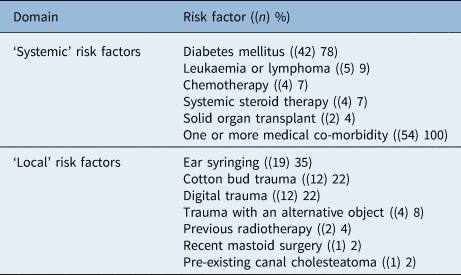
A structured history was taken from 54 patients diagnosed with necrotising otitis externa clinically and radiologically, between August 2017 and August 2022, as part of their routine clinical care. The structured history included questions aiming to capture relevant potential risk factors for the development of necrotising otitis externa. These risk factors were derived from existing published literature and are detailed and referenced in Table 1.
Structured history for potential necrotising otitis externa risk factors

Patients were asked about the temporal relationship between potential epidermal compromise events and the onset of severe pain, which indicates the spread of infection from the ear canal to deeper tissues. Primary care records were also reviewed to identify risk factors for necrotising otitis externa that may not have been disclosed during history-taking. A Charlson Comorbidity IndexReference Charlson, Carrozzino, Guidi and Patierno13 was calculated from patient demographic data and medical history. Necrotising otitis externa diagnosis was based on characteristic clinical findings (severe pain, ear discharge, granulation tissue),Reference Cohen and Friedman6 positive computed tomography and magnetic resonance imaging scans, and histopathology that was negative for malignancy. Treatment protocols and outcomes are not addressed in this manuscript, which focuses only on risk factor analysis.
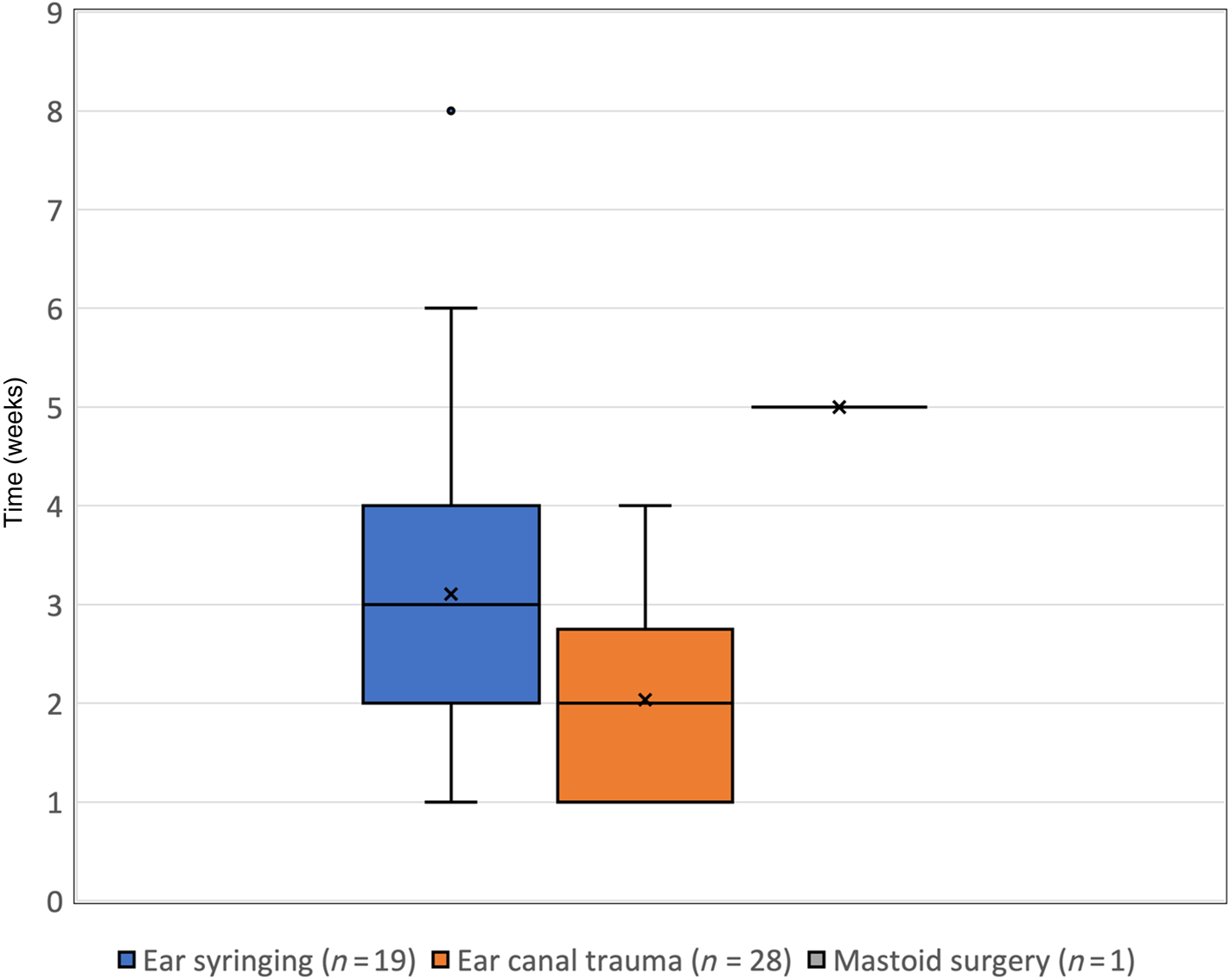
All data were stored in a secure database and analysed in September 2022. As this was a simple case series, it was not deemed appropriate for statistical analyses to be performed, and this manuscript therefore presents only observations and trends. A box and whisker plot (Figure 2) is used to show the temporal relationship between incidents of potential epidermal compromise and onset of severe pain.
Box and whisker plot showing the temporal relationship between incidents of potential epidermal compromise and onset of severe pain (weeks post-incident).

Results
A total of 54 patients were included, with a mean age of 77 years (range, 50–95 years) and a male:female ratio of 2.9:1. Their mean Charlson Comorbidity Index score was 5, indicating a 21 per cent estimated 10-year survival and a high prevalence of co-morbid systemic disease. A total of 52 patients (96 per cent) had positive microbiological culture, with P aeruginosa detected in 92 per cent of culture-positive cases. Two patients had inconclusive microbiological culture in a context of a clinical necrotising otitis externa diagnosis, which responded to empiric antimicrobial therapy. A total of 51 patients (94 per cent) had a history of immunosuppression, including 41 patients (78 per cent) with diabetes. Some patients had more than one cause of immunosuppression (Table 2). All had at least one medical co-morbidity.

A total of 51 patients (94 per cent) had a clear history of epidermal compromise preceding onset of severe pain, including 19 who had ear syringing (35 per cent), and 28 who had direct self-inflicted trauma (denoted by the appearance of blood) to the ear canal in the weeks preceding the onset of severe pain, including cotton bud trauma (22 per cent), digital trauma (22 per cent) and trauma from an alternative object (8 per cent), Additionally, two patients had undergone previous radiotherapy to the temporal bone (4 per cent), one had undergone recent mastoid surgery (2 per cent) and one had a pre-existing canal cholesteatoma (2 per cent). The temporal relationship between epidermal compromise events and the onset of severe pain, which indicates the spread of infection from the ear canal to deeper tissues, is shown in Figure 2. The mean time lag from ear syringing to severe pain onset was 3.1 weeks (range, 1–8 weeks) and from ear canal trauma to severe pain onset was 2 weeks (range, 1–4 weeks).
Discussion
Using a structured clinical history based on recognised risk factors for necrotising otitis externa in existing published literature, this paper explored important clinical information that may not have been disclosed through open-ended history taking. This is a well-documented phenomenon; the value of both open and closed questions has been explored in other domains.14,Reference Stapleton and Mills15
The clinical information disclosed using a structured history in this cohort of patients with confirmed necrotising otitis externa demonstrated a 94 per cent incidence of recognised epidermal compromise in the weeks preceding the onset of severe pain, which denotes the spread of infection to deeper tissues beyond the ear canal. Epidermal compromise has previously been identified as a local risk factor for necrotising otitis externa, and must, by definition, be present for the development of granulation tissue in the external auditory canal; this is a finding that is required for confirmed cases of necrotising otitis externa. However, epidermal compromise has never been previously recognised in the literature as a potentially modifiable risk factor in necrotising otitis externa.
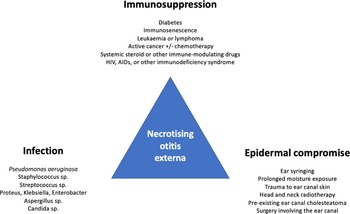
We therefore propose an aetiological triad for necrotising otitis externa: immunosuppression, infection and epidermal compromise (Figure 3), and hypothesise that the development of necrotising otitis externa requires a host (immunocompromised individual), agent (infective micro-organism) and environment (epidermal compromise). When considering necrotising otitis externa with this model, we can address potentially modifiable risk factors and take action in public health, primary and secondary care settings to prevent necrotising otitis externa and to recognise it in its early stages. This makes it more likely to be treatable, with a lower incidence of co-morbiditiesReference Stern Shavit, Soudry, Hamzany and Nageris3 and a lesser burden on health services.Reference Godbehere, Hutson and Watson2 Case series of necrotising otitis externa have been published for over 40 years with a conclusion stating that the clinical progression of necrotising otitis externa at the time of diagnosis correlated with prognosis, necessitating early recognition, treatment and prevention to improve outcomes.Reference Doroghazi, Nadol, Hyslop, Baker and Axelrod16 However, published literature focuses repetitively on proposed algorithms and treatment pathways that start at the time of necrotising otitis externa diagnosis, often when the disease is already advanced. There is therefore an urgent need to identify potentially modifiable risk factors for necrotising otitis externa.
Proposed aetiological triad for necrotising otitis externa. HIV = human immunodeficiency virus; AIDS = acquired immunodeficiency syndrome; +/- = with or without

The patient cohort described in this paper is similar to other recent published cohorts in terms of age, gender, microbiological culture, co-morbid status and diabetic prevalence. It is therefore conceivable that its conclusions can be more widely applied.
Advanced age, diabetes and immunosuppression are accepted and well-documented risk factors for necrotising otitis externa, and it is therefore to be expected that published cohorts would include data on these. Epidermal compromise is a risk factor which, while clearly documented by ChandlerReference Chandler8 in his 1968 series of patients with necrotising otitis externa, has been relatively neglected in subsequent published work. Epidermal compromise does, however, make occasional appearances in the world literature. Radiotherapy, pre-existing canal cholesteatoma (benign necrotising otitis externa) and surgery involving the ear canal in susceptible individuals are sparsely documented in the literatureReference Hutson and Watson12.Reference Peled, Parra, El-saied, Kraus and Kaplan17,Reference Stern Shavit, Bernstine, Sopov, Nageris and Hilly18 as risk factors for necrotising otitis externa. There are three further epidermal compromise scenarios presented in the literature: prolonged exposure to moisture, ear canal trauma and ear syringing.
Guevara et al. Reference Guevara, Mahdyoun, Pulcini, Raffaelli, Gahide and Castillo11 describe ‘climate and local predisposing factors’ in their cohort of 22 patients, noting that 95 per cent of their necrotising otitis externa patients (in the South of France) presented between April and September and that 38 per cent had recent prolonged water exposure in the form of spa therapy and diving. Yang et al. Reference Yang, Xirasagar, Cheng, Wu, Kao and Shia19 also proposed that necrotising otitis externa is more common in warm, humid climates. Chandler's original and subsequent case series were based in Florida, which has a warm, humid climate.Reference Chandler8,Reference Chandler20,Reference Chandler, Grobman, Quencer and Serafini21
Ear canal trauma is proposed as a risk factor for necrotising otitis externa in three published studies. Hutson et al. Reference Hutson and Watson12 comment that one patient in their series of 16 patients with necrotising otitis externa, sustained ear canal trauma as a result of excessive cleaning prior to their diagnosis, and they propose ear canal trauma in a susceptible population as a risk factor for necrotising otitis externa. Guevara et al. Reference Guevara, Mahdyoun, Pulcini, Raffaelli, Gahide and Castillo11 identified 3 patients with ear canal trauma preceding the onset of necrotising otitis externa in their series of 22 patients. A recent reportReference Bigdeli, Jabbour, Noor, Bradshaw, North and Singh22 describes two patients who developed necrotising otitis externa on the background of an impacted cotton bud in the ear canal.
Hutson and WatsonReference Hutson and Watson12 identified 3 patients within their case series of 16 patients with ear syringing as a predisposing factor for necrotising otitis externa, advising ‘caution around aural cleaning (syringing) in high-risk patients’. Two case reports published over 30 years ago, also postulate the theory of necrotising otitis externa triggered by ear syringing.Reference Rubin, Yu, Kamerer and Wagener23,Reference Zikk, Rapoport and Himelfarb24
An important observation from a case series of 21 patients published in 1981Reference Doroghazi, Nadol, Hyslop, Baker and Axelrod16 addresses the wider impact of diabetes, proposing that diabetic microangiopathy of the skin and temporal bone results in poor local perfusion and creates an environment well suited for invasion by Pseudomonas aeruginosa. Diabetes could therefore be considered both a systemic and a local risk factor for necrotising otitis externa.
In our cohort of patients with necrotising otitis externa, 51 patients (94 per cent) had a clear history of epidermal compromise preceding onset of severe pain. This is a higher incidence than identified in other published cohorts, and this is likely because of the use of a structured clinical history, which facilitates disclosure of information that patients may not have considered relevant.
Nineteen patients in our cohort (35 per cent) gave a history of ear syringing prior to their diagnosis of necrotising otitis externa. The mean time lag from ear syringing to severe pain onset (denoting the spread of infection from the ear canal to deeper tissues) was 3.1 weeks (range, 1–8 weeks) as seen in Figure 2. The one patient with an 8-week time lag between ear syringing and necrotising otitis externa onset was an outlier; most patients had a time lag of between 2–4 weeks. There were no patients who found it difficult to report the time lag between ear syringing and the onset of severe pain; most gave a very clear history of seeking ear syringing because of their ear(s) feeling itchy or blocked, and their ear(s) subsequently ‘not being right’ leading up to the onset of severe pain. It is not possible to retrospectively ascertain whether the onset of necrotising otitis externa in susceptible patients following ear syringing was a result of the introduction of infective micro-organisms, direct trauma to the epithelium of the ear canal, or epithelial maceration and breakdown because of prolonged moisture exposure. The clinical history and time lag in these patients would favour epithelial maceration and breakdown because of prolonged moisture exposure following ear syringing in a susceptible patient; however, the reality may well be a combination of factors. The history of aural itch and/or blockage that led patients to seek ear syringing might reflect a pre-existing otitis externa, exacerbated by ear syringing that ultimately led to compromise of their epithelial integrity.
A total of 28 patients in our cohort (52 per cent) reported direct self-inflicted trauma (denoted by the appearance of blood) to the ear canal in the weeks preceding the onset of severe pain. Similar to the patients seeking ear syringing, these patients gave a history of a persistent feeling of itch, which led them to instrument their own ear canal to relieve the itch, using cotton buds (22 per cent), fingers (22 per cent) and or alternative objects (8 per cent). The alternative objects included paperclips, a hairgrip and a carpentry nail. The mean time lag from ear canal trauma to severe pain onset was two weeks (range, 1–4 weeks) as seen in Figure 2. The shorter time lag in patients sustaining direct canal trauma compared with ear syringing could be because of two reasons; either a faster progression to necrotising otitis externa because of direct epithelial trauma (rather than maceration and breakdown due to prolonged moisture exposure) or the presence of granulation tissue (which bled when traumatised), although the latter seems less likely as severe pain had not yet set in at the time of ear canal trauma.
• Necrotising otitis externa is a serious infective condition of the outer ear that has a high mortality; risk factors include advanced age, diabetes and immunosuppression
• Presence of granulation tissue in the ear is a classic feature, and this denotes epidermal compromise, which can be a modifiable risk factor
• Epidermal compromise can be caused by ear syringing, ear canal trauma or prolonged exposure to moisture
• Epidermal compromise can also be caused by previous radiotherapy, previous surgery or pre-existing ear canal cholesteatoma
• This study proposed an aetiological triad for necrotising otitis externa: immunosuppression, infection and epidermal compromise
• By addressing modifiable risk factors in the public health, primary and secondary care settings, the incidence, severity and burden of necrotising otitis externa could be significantly reduced
It is clear from the histories given by patients who sought ear syringing and those who traumatised their own ear canals, that these patients experienced aural itch and/or fullness in the weeks immediately prior to the onset of necrotising otitis externa, indicating simple otitis externa, which may have been amenable to topical treatment.
Four patients in our cohort had pre-existing epidermal compromise as a risk factor for developing necrotising otitis externa; two had undergone previous radiotherapy of their ipsilateral temporal bone (4 per cent), one susceptible patient had undergone ipsilateral mastoid surgery five weeks prior to the onset of necrotising otitis externa (2 per cent) and one patient had pre-existing ipsilateral ear canal cholesteatoma (2 per cent).
Although these findings offer an insight into necrotising otitis externa risk factors and disease progression, they do not explain why, in most patients with necrotising otitis externa, granulation tissue forms on the floor of the ear canal, at the osseocartilaginous junction, adjacent to the fissures of Santorini, which act as a conduit for infection to enter the infratemporal fossa. This phenomenon has not been fully explained in any previous publication. In our cohort, all patients other than the post-surgical patient demonstrated a classical clinical picture of disease progression (i.e. granulation tissue on the ear canal floor and spread of infection via the infratemporal fossa). Although it seems feasible that the patients whose epidermal compromise was caused by prolonged moisture exposure may have experienced skin breakdown in this area, it is less likely that every patient who self-traumatised their ear canal caused trauma to this specific area. It is more likely that the thin skin overlying the osseocartilaginous junction of the ear canal is more susceptible to trauma, or that trauma to this specific area led to the development of necrotising otitis externa. It is also feasible that a combination of pre-existing infection and moisture had already begun to affect epidermal integrity in this region.
This patient cohort study has many limitations. History-taking relies on patient reporting of disease course and specific events, which cannot always be verified and may not be accurate. Patients in this cohort were not routinely tested for autoimmune conditions or immunodeficiency syndrome, so the data of this study relies on the accuracy of patients’ clinical history and primary care records. There is also a risk of assuming causation when, in the absence of a control group or a randomised trial, it is not possible to confidently attribute causation, only to observe patterns and trends.
This study serves to highlight the benefit of structured history-taking, to record information that may not be considered relevant by patients. This study also serves to highlight the role of epidermal compromise, not only as a risk factor for necrotising otitis externa, but potentially as an essential component of an aetiological triad, which highlights potential modifiable risk factors for necrotising otitis externa.
Necrotising otitis externa is a serious infective condition, yet all protocols and algorithms for its management begin at diagnosis. The identification of modifiable risk factors suggests that outcomes could be improved, and the burden of care reduced, if necrotising otitis externa is prevented, or recognised sooner. The clinical relevance of epidermal compromise as a modifiable risk factor for necrotising otitis externa is clear. Older adult, diabetic and immunocompromised patients should receive meticulous ear care, at home, in the community and in healthcare settings. These susceptible populations should never undergo ear syringing and should avoid ear canal trauma and prolonged exposure to moisture. This requires education at a public health level and of primary care providers.
Conclusion
Necrotising otitis externa is a serious infective condition, which has a high rate of mortality and co-morbidities. This paper explores the role of epidermal compromise as a potentially modifiable risk factor for necrotising otitis externa, which has not previously been addressed in the world literature.
Considering the aetiology of necrotising otitis externa in the form of a triad, immunosuppression, infection and epidermal compromise, we can approach necrotising otitis externa in terms of preventative medicine. Older adult, diabetic and immunocompromised patients are susceptible populations. Through education at a public health and primary care level, it may be possible to improve outcomes, and to reduce the incidence and the disease burden of necrotising otitis externa, by preventing, or recognising epidermal compromise of the ear canal in these patients. This will involve meticulous ear care for susceptible populations, who should never undergo ear syringing and should avoid ear canal trauma and prolonged exposure to moisture.
Acknowledgements
This research was supported by the National Institute for Health Research Manchester Biomedical Research Centre.
Data availability statement
The data are not publicly available due to confidentiality restrictions.
Competing interests
None declared