Introduction
Reconstructing paleodiversity dynamics of Eocene tropical radiolarians is primarily hampered by our incomplete taxonomic knowledge of these organisms. Indeed, despite being studied for nearly two centuries (Ehrenberg, Reference Ehrenberg1839), we are still far from having fully documented and described all of the species preserved in the Eocene fossil record. The first major contribution to the taxonomy of Eocene radiolarians is attributed to Ehrenberg (Reference Ehrenberg1874), who described 265 new species from middle Eocene to lower Oligocene pelagic sequences that crop out today on the Barbados Island (Saunders et al., Reference Saunders, Bernoulli, Mueller-Merz, Oberhaensli, Perch-Nielsen, Riedel, Sanfilippo and Torrini1984; Ogane et al., Reference Ogane, Suzuki, Aita, Sakai, Lazarus, Tanimura, Tanimura and Aita2009), 85 of which were subsequently illustrated in Ehrenberg (Reference Ehrenberg1876). In his famous monograph, Haeckel (Reference Haeckel1887) also introduced ~200 middle Eocene radiolarian species from Barbados onshore samples, including illustrations for only half of them. In addition to this body of taxonomic work, several authors sporadically published new species and genera throughout the late nineteenth century (Bury, Reference Bury1862; Bütschli, Reference Bütschli1882a, Reference Bütschli and Bronnb; Carter, Reference Carter1893, Reference Carter1895, Reference Carter1896a, Reference Carterb, Reference Carterc, Reference Carterd, Reference Cartere; Sutton, Reference Sutton1896a, Reference Suttonb, Reference Suttonc, Reference Suttond). However, numerous species described in these early radiolarian studies have not been reported since, and there are still many uncertainties about their stratigraphic range, their biogeographic distribution, and the precise extent of their intraspecific variation (Ogane et al., Reference Ogane, Suzuki, Aita, Sakai, Lazarus, Tanimura, Tanimura and Aita2009).
Although little taxonomic progress was achieved on tropical Eocene radiolarians during the first half of the twentieth century (e.g., Brandt, Reference Brandt and Wetzel1935), two important publications by Clark and Campbell (Reference Clark and Campbell1942, Reference Clark and Campbell1945) that marked this period were devoted to the study of middle–late Eocene radiolarian faunas from three Californian shale formations, and resulted in the description of 157 new species (Blueford, Reference Blueford1988). The subsequent advent of scientific ocean drilling during the 1960s and 1970s marked a turning point in the history of Cenozoic radiolarian taxonomy. The increase of deep-sea sediment recovery allowed extensive studies of radiolarian assemblages across the world, and renewed interest in describing radiolarian diversity (e.g., Riedel and Sanfilippo, Reference Riedel, Sanfilippo, Bader, Gerard, Benson, Bolli, Hay, Rothwell, Ruef, Riedel and Sayles1970, Reference Riedel, Sanfilippo, Winterer, Riedel, Brönnimann, Gealy, Heath, Kroenke, Martini, Moberly, Resig and Worsley1971, Reference Riedel and Sanfilippo1978; Petrushevskaya and Kozlova, Reference Petrushevskaya, Kozlova, Hayes, Pimm, Beckmann, Benson, Berger, Roth, Supko and von Rad1972; Foreman, Reference Foreman, Worzel, Bryant, Beall, Capo, Dickinson, Foreman, Laury, McNeely and Smith1973; Sanfilippo and Riedel, Reference Sanfilippo, Riedel, Worzel, Bryant, Beall, Capo, Dickinson, Foreman, Laury, McNeely and Smith1973). The primary goal of these studies was biostratigraphy, and thus they were usually focused on a limited number of stratigraphically useful species that are often abundant in the Eocene fossil record. As a consequence, many rare morphotypes of no biostratigraphic value, or those belonging to morphologically complex taxa, remained undescribed and were neglected in most taxonomic surveys. Concurrently with this biostratigraphic work, some nassellarian families have also been the subjects of more detailed and exhaustive taxonomic investigations, leading to the establishment of several evolutionary lineages (e.g., Nigrini, Reference Nigrini1977; Sanfilippo and Riedel, Reference Sanfilippo and Riedel1982, Reference Sanfilippo and Riedel1992; Sanfilippo and Caulet, Reference Sanfilippo and Caulet1998).
In an effort to improve the taxonomic resolution of tropical Eocene radiolarians, 15 new nassellarian species belonging to 11 genera and seven families are described and illustrated from the upper middle Eocene sequences drilled at Ocean Drilling Program Site 1260 (Leg 207; western Atlantic Ocean). Among the undescribed morphotypes encountered in this material, we chose to describe the most abundant and morphologically distinct, to best circumscribe the morphological diversity of each new species. As a consequence, some potentially new species only represented by one or a few isolated specimens were excluded from this analysis. Information is also provided for the stratigraphic range of each new species, as well as the orbitally tuned ages for the first and last occurrences of most of them. Relationships to previously described species are also suggested. Finally, three species described in early radiolarian studies and rarely reported since are illustrated and discussed.
Materials and methods
Materials
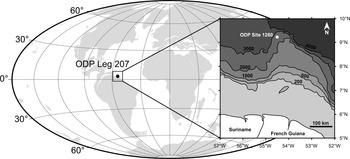
All samples investigated in this study came from ODP Leg 207, Site 1260 (9°16′N, 54°32′W) located on the northwestern slope of Demerara Rise, a continental shelf off Surinam and French Guiana (Fig. 1). The site is situated between 9°N and 10°N latitude today, but according to paleomagnetic data, its position during the middle Eocene is estimated at paleolatitude ~1°N (Suganuma and Ogg, Reference Suganuma, Ogg, Mosher, Erbacher, Malone, Berti and Bice2006). Two holes (1260A and 1260B) recovered Paleogene sediments at a water depth of 2549 meters below sea floor (mbsf), enabling the study of an expanded and almost continuous sedimentary sequence extending from the lower Albian to the middle Eocene (Shipboard Scientific Party, Reference Erbacher, Mosher, Malone, Berti and Bice2004). The middle Eocene interval of ODP Site 1260 is composed of greenish white foraminifer-nannofossil chalk with abundant, well-preserved radiolarians and diatoms (Shipboard Scientific Party, Reference Erbacher, Mosher, Malone, Berti and Bice2004; Danelian et al., Reference Danelian, Le Callonec, Erbacher, Mosher and Malone2005, Reference Danelian, Saint Martin and Blanc-Valleron2007; Renaudie et al., Reference Renaudie, Danelian, Saint-Martin, Le Callonec and Tribovillard2010). In this study, we focused on the richest radiolarian interval; a 91.72 m thick sequence ranging from 43.77–39.83 Ma that corresponds to the late middle Eocene (middle Lutetian to middle Bartonian). Fifty-five samples were selected from 10 cores (15R to 6R) from Hole 1260A, resulting in an average inter-sample spacing of ~1.67 m and a mean age resolution of ca. 71,600 years.
Middle Eocene (ca. 40 Ma) paleogeographic map showing the location of Demerara Rise (ODP Leg 207) in the western equatorial Atlantic Ocean. The square shows the detailed location of ODP Site 1260 on a modern bathymetric map (modified after Wang et al., Reference Wang, Reinhard, Planavsky, Owens, Lyons and Johnson2016). Paleogeographic reconstruction drawn after ODSN Plate Tectonic Reconstruction Service (http://www.odsn.de/odsn/services/paleomap/paleomap.html).

A well-defined cyclostratigraphic framework was developed for ODP Site 1260 using X-ray fluorescence core scanning (Westerhold and Röhl, Reference Westerhold and Röhl2013). Astrochronological calibration, which is available throughout the sequence every 2 cm of sediment, allowed each sample to be dated with a high accuracy. Whenever there was absence of calibration for parts of Hole 1260A, the absolute ages of these samples were estimated based on the tuned ages provided for samples at the same depth located in Hole 1260B.
Methods
Samples were processed following the protocol outlined in Sanfilippo et al. (Reference Sanfilippo, Westberg-Smith, Riedel, Bolli, Saunders and Perch-Nielsen1985). First, 1–2 cm2 of untreated sediments were placed in a beaker and soaked in ~10% hydrogen peroxide (H2O2) and ~30% hydrochloric acid (HCl) to remove organic matter and carbonate fraction, respectively. The resulting residues were subsequently washed through a 45 μm sieve to eliminate clay, small diatom frustules, and radiolarian fragments. We chose this relatively fine mesh to improve the recovery of smaller radiolarian species that may be lost by the use of larger mesh. Then, 1–4 slides were prepared for each sample by using a few mg of cleaned residues, evenly scattered on a coverslip according to the preparation method described by Witkowski et al. (Reference Witkowski, Bohaty, McCartney and Harwood2012). When dry, the coverslips were mounted on standard glass slides using Norland Optical Adhesive 61 (refractive index 1.56).
All slides were examined systematically for radiolarians using a Zeiss Axio Imager.A2 as a transmitted light microscope, fitted with a Zeiss AxioCam ERc5s digital camera. For each illustrated specimen, a series of 5–10 pictures captured at different focal distances were z-stacked using Helicon Focus v.7.6.6 (HeliconSoft) to create a composite picture entirely in focus.
In the following section, dimensions are based on a maximum number of specimens observed at different depths in the sedimentary sequence, in order to represent the intraspecific variation throughout the stratigraphic range of the species. Measurements were directly made on specimen pictures using the image processing and analysis software ImageJ (Schneider et al., Reference Schneider, Rasband and Eliceiri2012).
The radiolarian biozonation applied herein is the one introduced by Riedel and Sanfilippo (Reference Riedel, Sanfilippo, Bader, Gerard, Benson, Bolli, Hay, Rothwell, Ruef, Riedel and Sayles1970, Reference Riedel, Sanfilippo, Winterer, Riedel, Brönnimann, Gealy, Heath, Kroenke, Martini, Moberly, Resig and Worsley1971, Reference Riedel and Sanfilippo1978) and Sanfilippo et al. (Reference Sanfilippo, Westberg-Smith, Riedel, Bolli, Saunders and Perch-Nielsen1985), and recently refined by Meunier and Danelian (Reference Meunier and Danelian2022), with the introduction of some subzones. Stratigraphic occurrences of species are shown in Figure 2 (see also Supplement Data 1 for the occurrence of each studied species per sample) and related bioevents are summarized in Table 1, with their tuned age at ODP Site 1260.
Range chart of 19 selected radiolarian species from the middle Eocene of ODP Site 1260 (Demerara Rise, western equatorial Atlantic). Geomagnetic timescale after calibration of Suganuma and Ogg (Reference Suganuma, Ogg, Mosher, Erbacher, Malone, Berti and Bice2006); radiolarian biozonations after Meunier and Danelian (Reference Meunier and Danelian2022).

Summary of first occurrences (FO) and last occurrences (LO) at ODP Site 1260, drilled on Demerara Rise in the western equatorial Atlantic. The estimated tuned age and revised meters composite depth (rmcd) are after Westerhold and Röhl (Reference Westerhold and Röhl2013).

Repository and institutional abbreviation
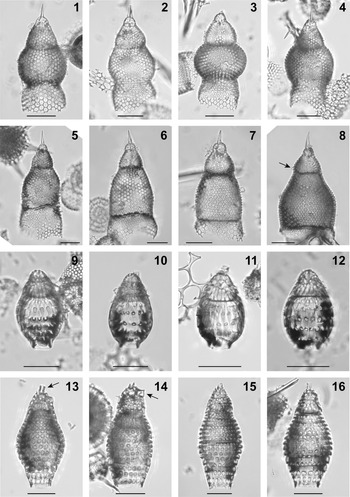
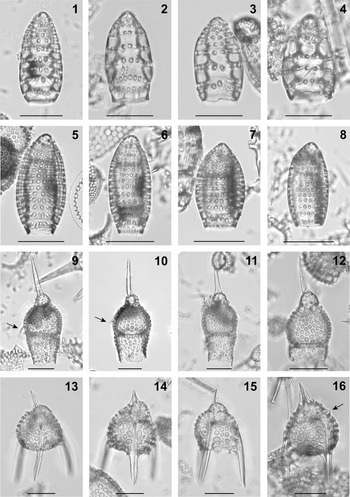
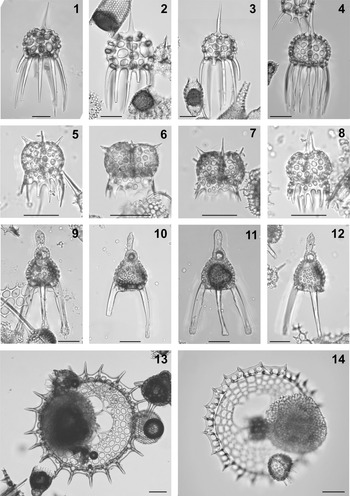
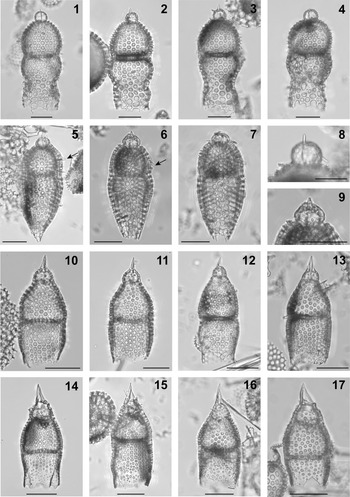
All holotypes and figured specimens (Figs. 3–7) are housed at the public paleontological collection of the University of Lille (USTL), France. Specimens are located according to hole number, core number, section number, interval depth, and England finder coordinates.
Composite light micrographs of new radiolarian species from ODP Site 1260 (Demerara Rise, western equatorial Atlantic). (1–4) Cymaetron? dilatatus n. sp.: (1) holotype, ODP 1260A-9R-4W, 55–57 cm, USTL 3483-1, V46/2; (2) ODP 1260A-9R-4W, 55–57 cm, USTL 3481-1, H41/3; (3) ODP 1260A-9R-3W, 55–57 cm, USTL 3479-1, T47/1 (mirrored); (4) ODP 1260A-9R-4W, 55–57 cm, USTL 3481-2, J37/2. (5–8) Eucyrtidium levisaltatrix n. sp.: (5) holotype, ODP 1260A-9R-4W, 55–57 cm, USTL 3482-1, J52/2; (6) ODP 1260A-9R-4W, 55–57 cm, USTL 3484-1, V45/2; (7) ODP 1260A-9R-3W, 55–57 cm, USTL 3478-1, E48/4; (8) specimen showing thoracic wing (arrow), ODP 1260A-8R-3W, 54–56 cm, USTL 3462-3, Z63/4 (mirrored). (9–12) Dictyoprora curta (Clark and Campbell): (9) ODP 1260A-14R-1W, 55–57 cm, USTL 3530-1, J40/1; (10) ODP 1260A-6R-3W, 55–57 cm, USTL 3424-1, H60/4; (11) ODP 1260A-9R-1W, 55–57 cm, USTL 2848-1, C46/2; (12) ODP 1260A-9R-1W, 55–57 cm, USTL 3473-1, L48/1. (13–16) Spirocyrtis? renaudiei n. sp.: (13) holotype, showing apical tube (arrow), ODP 1260A-8R-3W, 54–56 cm, USTL 3462-1, Q53/1 (mirrored); (14) specimen showing ventral tube (arrow), ODP 1260A-8R-3W, 54–56 cm, USTL 3462-2, L48/1 (mirrored); (15) ODP 1260A-7R-6W, 54–56 cm, USTL 3454-1, X45/2; (16) ODP 1260A-7R-6W, 54–56 cm, USTL 3454-2, R43/2. All scale bars equal 50 μm.

Composite light micrographs of radiolarian species from ODP Site 1260 (Demerara Rise, western equatorial Atlantic). (1–4) Siphocampe pachyderma (Ehrenberg): (1) ODP 1260A-9R-3W, 55–57 cm, USTL 3477-3, V50/3; (2) ODP 1260A-12R-6W, 55–57 cm, USTL 3519-1, F39/4; (3) ODP 1260A-11R-7W, 55–57 cm, USTL 3506-1, M43/3; (4) ODP 1260A-12R-4W, 55–57 cm, USTL 3514-1, S45/4. (5–8) Siphocampe pollen n. sp.: (5) holotype, ODP 1260A-13R-4W, 55–56 cm, USTL 2854-1, X67/4; (6) ODP 1260A-14R-1W, 55–57 cm, USTL 3530-3, N41/3; (7) ODP 1260A-10R-6W, 55–57 cm, USTL 3498-1, L52/2; (8) ODP 1260A-14R-1W, 55–57 cm, USTL 3531-1, W56/1. (9–12) Pterocyrtidium eep n. sp.: (9) holotype, showing thoracic wing (arrow), ODP 1260A-12R-CC, 63–177 cm, USTL 3521-1, U59/2 (mirrored); (10) specimen showing thoracic wing (arrow), ODP 1260A-12R-1W, 55–57 cm, USTL 2851-5, L64/3 (mirrored); (11) ODP 1260A-12R-CC, 63–177 cm, USTL 3521-2, U53/3; (12) ODP 1260A-12R-CC, 63–177 cm, USTL 3520-1, H36/3 (mirrored). (13–16) Corythomelissa galea (Ehrenberg) n. comb.: (13) ODP 1260A-11R-3W, 55–57 cm, USTL 3502-1, W34/4 (mirrored); (14) ODP 1260A-11R-4W, 55–57 cm, USTL 3503-1, F36/3 (mirrored); (15) ODP 1260A-11R-4W, 55–57 cm, USTL 3503-2, X39/3 (mirrored); (16) specimen showing sagittal horn (arrow), ODP 1260A-12R-CC, 63–177 cm, USTL 3520-2, X33/2 (mirrored). All scale bars equal 50 μm.

Composite light micrographs of radiolarian species from ODP Site 1260 (Demerara Rise, western equatorial Atlantic). (1–3) Petalospyris cometa n. sp.: (1) holotype, ODP 1260A-6R-2W, 55–57 cm, USTL 3421-1, W42/3; (2) ODP 1260A-6R-1W, 55–57 cm, USTL 2847-1, X45/1; (3) ODP 1260A-6R-1W, 55–57 cm, USTL 2847-2, D39/2. (4) Petalospyris argiscus Ehrenberg, Reference Ehrenberg1874: ODP 1260A-13R-4W, 55–56 cm, USTL 2854-4, M38/4. (5–7) Petalospyris castanea n. sp.: (5) holotype, ODP 1260A-9R-3W, 55–57 cm, USTL 3477-1, H33/3; (6) ODP 1260A-8R-2W, 54–56 cm, USTL 3461-1, R55/3; (7) ODP 1260A-9R-3W, 55–57 cm, USTL 3479-2, S42/1. (8) Petalospyris confluens Ehrenberg, Reference Ehrenberg1874: ODP 1260A-9R-3W, 55–57 cm, USTL 3478-3, U43/3. (9–12) Lychnocanium nimrodi n. sp.: (9) holotype, ODP 1260A-9R-4W, 55–57 cm, USTL 3483-2, L38/2; (10) ODP 1260A-9R-4W, 55–57 cm, USTL 3481-4, U38/3 (mirrored); (11) ODP 1260A-9R-4W, 55–57 cm, USTL 3484-2, L36/9; (12) ODP 1260A-9R-2W, 55–57 cm, USTL 3474-2, O38/3. (13, 14) Velicucullus armatus n. sp.: (13) holotype, ODP 1260A-14R-5W, 55–57 cm, USTL 3277-1, Q41/1; (14) ODP 1260A-13R-4W, 55–56 cm, USTL 2854-3, T61/3. All scale bars equal 50 μm.

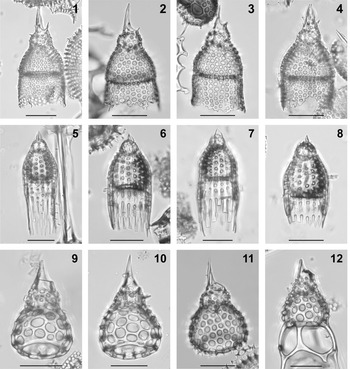
Composite light micrographs of new radiolarian species from ODP Site 1260 (Demerara Rise, western equatorial Atlantic). (1–4, 8) Aphetocyrtis zamenhofi n. sp.: (1) holotype, ODP 1260A-15R-2W, 55–57 cm, USTL 3543-1, Q37/4; (2) ODP 1260A-14R-CC, 63–117 cm, USTL 3540-1, P37/1; (3) ODP 1260A-15R-1W, 55–57 cm, USTL 3541-1, N47/2; (4) ODP 1260A-15R-1W, 55–57 cm, USTL 3541-2, Q54/1; (8) focus on the cephalis, ODP 1260A-15R-2W, 55–57 cm, USTL 3543-2. (5–7, 9) Aphetocyrtis? columboi n. sp.: (5) holotype, showing thoracic wing (arrow), ODP 1260A-6R-6W, 55–57 cm, USTL 3438-1, J31/1; (6) specimen showing thoracic wing (arrow), ODP 1260A-6R-6W, 55–57 cm, USTL 3438-2, G46/1; (7) ODP 1260A-6R-6W, 55–57 cm, USTL 3438-3, L38/3; (9) focus on the cephalis of the specimen illustrated as Figure 6.6. (10–13) Aphetocyrtis? spheniscus n. sp.: (10) holotype, ODP 1260A-12R-1W, 55–57 cm, USTL 2851-2, Y49/1; (11) ODP 1260A-9R-3W, 55–57 cm, USTL 3478-2, S52/4; (12) ODP 1260A-12R-1W, 55–57 cm, USTL 2851-3, G45/2 (mirrored); (13) ODP 1260A-12R-3W, 55–57 cm, USTL 3512-2, H58/1. (14–17) Albatrossidium regis n. sp.: (14) holotype, ODP 1260A-12R-1W, 55–57 cm, USTL 2851-1, Y54/2 (mirrored); (15) ODP 1260A-13R-5W, 54–56 cm, USTL 3525-1, W56/2 (mirrored); (16) ODP 1260A-14R-1W, 55–57 cm, USTL 3530-2, M38/1 (mirrored); (17) ODP 1260A-12R-5W, 55–57 cm, USTL 3516-1, N49/1 (mirrored). All scale bars equal 50 μm.

Composite light micrographs of radiolarian species from ODP Site 1260 (Demerara Rise, western equatorial Atlantic). (1–4) Albatrossidium annikasanfilippoae n. sp.: (1) holotype, ODP 1260A-12R-3W, 55–57 cm, USTL 3512-1, Y39/1; (2) ODP 1260A-13R-4W, 55–57 cm, USTL 2854-5, X67/4; (3) ODP 1260A-13R-4W, 55–57 cm, USTL 2854-2, O66/1; (4) ODP 1260A-9R-3W, 55–57 cm, USTL 3477-2, L56/3. (5–8) Phormocyrtis lazari n. sp.: (5) holotype, ODP 1260A-9R-2W, 55–57 cm, USTL 3474-1, T40/4; (6) ODP 1260A-9R-3W, 55–57 cm, USTL 3480-1, M35/1; (7) ODP 1260A-9R-4W, 55–57 cm, USTL 3482-2, W36/3; (8) ODP 1260A-9R-4W, 55–57 cm, USTL 3481-3, E38/3. (9–12) Podocyrtis (Lampterium) puellasinensis Ehrenberg, Reference Ehrenberg1874: (9) ODP 1260A-6R-2W, 55–57 cm, USTL 3420-1, U56/1; (10) ODP 1260A-9R-4W, 55–57 cm, USTL 3484-3, D47/3; (11) ODP 1260A-12R-1W, 55–57 cm, USTL 2851-4, C47/4 (mirrored). (12) Podocyrtis (Lampterium) goetheana (Haeckel, Reference Haeckel1887), focus on the cephalothorax, ODP 1260A-8R-2W, 54–56 cm, USTL 3461-2, S49/1 (mirrored). All scale bars equal 50 μm.

Systematic paleontology
The higher level classification adopted for this study is based on the most recent and comprehensive radiolarian classification provided by Suzuki et al. (Reference Suzuki, O'Dogherty, Caulet and Dumitrică2021). In the case of species already described, we used combinations derived from O'Dogherty et al. (Reference O'Dogherty, Caulet, Dumitrică and Suzuki2021).
The terminology used to designate different parts of the fundamental nassellarian spicule is based on Petrushevskaya (Reference Petrushevskaya, Petrushevskaya and Stepanjants1984). Features specific to the family Cephalospyrididae follow Goll (Reference Goll1968, p. 1413, text-figure 6) and features specific to the family Lophocyrtiidae follow Sanfilippo and Caulet (Reference Sanfilippo and Caulet1998, p. 6, text-figure 2).
Infrakingdom Rhizaria Cavalier-Smith, Reference Cavalier-Smith2002, emend. Cavalier-Smith (Reference Cavalier-Smith2003)
Phylum Retaria Cavalier-Smith, Reference Cavalier-Smith1999
Class Polycystinea Ehrenberg, Reference Ehrenberg1839
Order Nassellaria Ehrenberg, Reference Ehrenberg1876
Superfamily Eucyrtidioidea Ehrenberg, Reference Ehrenberg1846, emend. Suzuki et al. (Reference Suzuki, O'Dogherty, Caulet and Dumitrică2021)
Family Eucyrtidiidae Ehrenberg, Reference Ehrenberg1846, emend. Suzuki et al. (Reference Suzuki, O'Dogherty, Caulet and Dumitrică2021)
Genus Cymaetron Caulet, Reference Caulet, Barron, Larsen, Baldauf, Alibert and Berkowitz1991
Type species
Cymaetron sinolampas Caulet, Reference Caulet, Barron, Larsen, Baldauf, Alibert and Berkowitz1991, p. 536, pl. 4, figs. 10–12; by monotypy.
Cymaetron? dilatatus new species
Figure 3.1–3.4
Holotype
Figure 3.1; collection number USTL 3483-1; coordinates V46/2; sample ODP 1260A-9R-4W, 55–57 cm; upper part of the Podocyrtis (L.) mitra Zone, in the Podocyrtis (P.) apeza Subzone (late Lutetian, middle Eocene).
Diagnosis
Trisegmented eucyrtidiid with an abdomen constricted in two false segments.
Occurrence
This species occurs sporadically throughout the studied interval, from the upper part of the Podocyrtis (P.) ampla Zone, to the lower part of the Podocyrtis (L.) goetheana Zone.
Description
Shell trisegmented, smooth and robust, with the collar and lumbar strictures marked externally by a change in the shell contour. Cephalis proportionally small, globular, poreless or bearing a few small circular pores. Apical spine extending outward as a strong apical tribladed horn longer than the cephalis, and dorsal spine prolonged as thoracic rib on upper thorax. Thorax truncate conical to slightly inflated conical, with subcircular pores, hexagonally framed and quincuncially arranged. Abdomen conspicuously inflated in its proximal part, usually 1.5–2 times as wide as thorax, then subcylindrical to truncate conical. The two parts of the abdomen are not subdivided into segments by an inner ring. Abdominal pores subcircular, hexagonally framed, and quincuncially arranged, sometimes less regularly arranged in the most distal part of the segment. Aperture open wide. Abdominal termination invariably ragged along a pore row.
Etymology
The specific epithet refers to the expanded proximal part of the abdomen of the new species; dilatatus in Latin means ‘dilated, expanded.’ The specific epithet is to be treated as an adjective in the nominative singular.
Dimensions
Based on 10 specimens (mean): total length without the apical horn 145–188 μm (176), length of apical horn 18–31 μm (24), length of cephalothorax without the apical horn 45–66 μm (56), length of abdomen 51–155 μm (117), maximum breadth of abdomen 82–129 μm (95).
Remarks
Cymaetron? dilatatus n. sp. is tentatively assigned to the genus Cymaetron based on the characteristic undulated outline of the shell, which is constricted in false segments. However, the generic assignment is doubtful because the genus Cymaetron was originally described by Caulet (Reference Caulet, Barron, Larsen, Baldauf, Alibert and Berkowitz1991) as a two-segmented eucyrtidiid, while C.? dilatatus n. sp. clearly displays a trisegmented shell. In addition, C.? dilatatus n. sp. differs from C. sinolampas Caulet, Reference Caulet, Barron, Larsen, Baldauf, Alibert and Berkowitz1991, the only other species of the genus, by having only one abdominal constriction. Cymaetron? dilatatus n. sp. also is distinguished from all other eucyrtidiid species with open abdomen in not having post-abdominal segments. Finally, C.? dilatatus n. sp. superficially resembles Theocorys anaclasta Riedel and Sanfilippo, Reference Riedel, Sanfilippo, Bader, Gerard, Benson, Bolli, Hay, Rothwell, Ruef, Riedel and Sayles1970, from which it differs in having a much more elongated shell, a bladed apical horn, and smaller abdominal pores, which are regular in size.
Genus Eucyrtidium Ehrenberg, Reference Ehrenberg1846
Type species
Lithocampe acuminata Ehrenberg, Reference Ehrenberg1844a, p. 84 (unfigured); Ehrenberg, Reference Ehrenberg1854, pl. 22, fig. 27; subsequent designation by Frizzell and Middour (Reference Frizzell and Middour1951, p. 33).
Eucyrtidium levisaltatrix new species
Figure 3.5–3.8
Holotype
Figure 3.5; collection number USTL 3482-1; coordinates J52/2; sample ODP 1260A-9R-4W, 55–57 cm; upper part of the Podocyrtis (L.) mitra Zone, in the Podocyrtis (P.) apeza Subzone (late Lutetian, middle Eocene).
Diagnosis
Eucyrtidium species with an elongated abdomen, being the longer segment of the shell.
Occurrence
This short-lived species is relatively rare from the uppermost part of the Podocyrtis (L.) mitra Zone, to the lower part of the Podocyrtis (L.) chalara Zone.
Description
Shell multisegmented, conical-elongated, and thick-walled. Cephalis relatively small, globular, and sparsely pored, bearing a long conical apical horn. Collar stricture marked externally by a change in the shell contour. Thorax subspherical to campanulate, with circular pores quincuncially arranged. Dorsal spine of the initial spicule rarely protruding close to the thoracic stricture as a reduced, curved thoracic wing (Fig. 3.8). Abdomen subcylindrical to campanulate, being the longest segment. Abdominal pores circular, slightly bigger than thoracic ones, hexagonally framed, and longitudinally aligned. First post-abdominal segment proximally extended, with pores irregular in size and shape. Abdomen and first post-abdominal segment separated by a slight external constriction, and by a straight (Fig. 3.7) or wavy (Figs. 3.5, 3.6) internal ridge that appears externally as a thick obscure band. Distal part of the abdomen invariably ragged along a pore row.
Etymology
From the Latin levis, meaning ‘light, not heavy,’ and saltatrix, meaning ‘female dancer, dancing girl.’ The specific epithet is to be treated as a noun in the nominative singular standing in apposition to the generic name.
Dimensions
Based on six specimens (mean): total length without the apical horn 166–226 μm (194), length of apical horn 26–38 μm (30), length of cephalothorax 51–57 μm (55), length of abdomen 107–134 μm (119), maximum breadth of shell 101–127 μm (118).
Remarks
This distinctive species is differentiated from all other middle Eocene Eucyrtidium species by its long apical horn, its well-marked abdominal stricture, and by its more conical shape due to elongation of the abdomen in comparison with other segments of the shell. Moreover, unlike other large species of the genus Eucyrtidium, the shell of E. levisaltatrix n. sp. is usually broken at the first post-abdominal segment.
It is likely that the new species originated from a stock of late middle Eocene multisegmented Eucyrtidium by elongation of its abdomen. However, further phylogenetic affinities remain unclear because E. levisaltatrix n. sp. appears suddenly in the fossil record.
Superfamily Artostrobioidea Riedel, Reference Riedel and Harland1967
Family Artostrobiidae Riedel, Reference Riedel and Harland1967, sensu Sugiyama (Reference Sugiyama1998)
Genus Dictyoprora Haeckel, Reference Haeckel1887
Type species
Dictyocephalus amphora Haeckel, Reference Haeckel1887, p. 1305, pl. 62, fig. 4; subsequent designation by Campbell (Reference Campbell1953, p. 296).
Dictyoprora curta (Clark and Campbell, Reference Clark and Campbell1942)
Figure 3.9–3.12
- Reference Clark and Campbell1942
Dictyocephalus (Dictyoprora) pulcherrimus curtus Clark and Campbell, p. 79, pl. 8, figs. 3, 6, 7.
- Reference Foreman, Worzel, Bryant, Beall, Capo, Dickinson, Foreman, Laury, McNeely and Smith1973
Theocampe pirum (Ehrenberg); Foreman, p. 432, pl. 9, fig. 11 (part).
- Reference Nigrini, Sanfilippo, Moore, Wilson, Lyle and Firth2005
Dictyoprora spp.; Nigrini et al., pl. P6, fig. 13.
- Reference Funakawa, Nishi, Moore, Nigrini, Wilson, Lyle and Firth2006
Dictyoprora sp. A; Funakawa et al., p. 18, pl. P2, fig. 10a, b.
Holotype
Because no type was designated by Clark and Campbell (Reference Clark and Campbell1942) in their original publication, any of the three illustrated specimens (pl. 8, figs. 3, 6, 7) are candidate lectotypes; they are all housed at the University of California, Museum of Paleontology.
Occurrence
This species is found throughout the studied interval. It occurs sporadically from the Thyrsocyrtis (P.) triacantha Zone to the upper part of the Podocyrtis (L.) mitra Zone, and becomes more consistent and abundant from the upper part of the Podocyrtis (L.) mitra Zone to the Podocyrtis (L.) goetheana Zone.
Description
Ovoid shell made of three segments. Surface of the shell relatively smooth, but with fine surface sculpture on the abdomen. Cephalis hemispherical, unarmed, with scattered subcircular pores. Ventral pore large and circular, but no ventral tube develops. Collar stricture externally not defined in most of the observed specimens. Thorax truncate conical, with irregularly arranged circular pores. Lumbar stricture slightly expressed externally by a change in shell outline. Globular abdomen perforated by circular downward-directed pores arranged in 5–6 transverse rows. Each abdominal pore opens on a furrow dug within the wall thickness, which extends almost to the next pore row. Shell narrowing distally and ending in cylindrical poreless peristome with smooth margin.
Dimensions
Based on 15 specimens (mean): total length 89–108 μm (97), length of cephalothorax 29–38 μm (34), length of abdomen 56–72 μm (63).
Remarks
We have judged it appropriate to re-illustrate this species because it has been rarely reported since its original description by Clark and Campbell (Reference Clark and Campbell1942) from upper middle Eocene strata of Mont Diablo, California. Dictyoprora curta is distinguished from all other dictyoprorids by its small globular abdomen (maximum length of abdomen <80 μm). This species also differs from D. pirum (Ehrenberg, Reference Ehrenberg1874) and D. gibsoni (O'Connor, Reference O'Connor1994) by having more closely spaced rows of pores, a well-developed peristome, and a thick-walled shell rather than a thin hyaline shell. Dictyoprora curta differs from D. urceolus (Haeckel, Reference Haeckel1887) by its globular abdomen and its abdominal pores being downward directed, and differs from D. armadillo (Ehrenberg, Reference Ehrenberg1874) and D. ovata (Haeckel, Reference Haeckel1887) in lacking a cephalic horn and in having fewer than seven rows of abdominal pores. It is finally distinguished from D. mongolfieri (Ehrenberg, Reference Ehrenberg1854) by not having abdominal pores aligned longitudinally and from D. amphora (Haeckel, Reference Haeckel1887) by having abdominal pores that are uniform and aligned in transverse rows.
Genus Siphocampe Haeckel, Reference Haeckel1882
Type species
Siphocampe annulosa Haeckel, Reference Haeckel1887, p. 1500, pl. 79, fig. 10; subsequent designation by Strelkov and Lipman (Reference Strelkov, Lipman and Khabakov1959, p. 459).
Siphocampe pachyderma (Ehrenberg, Reference Ehrenberg1874)
Figure 4.1–4.4
- Reference Ehrenberg1874
Eucyrtidium pachyderma Ehrenberg, p. 231.
- Reference Ehrenberg1876
Eucyrtidium pachyderma; Ehrenberg, p. 72, pl. 11, fig. 21.
- Reference Bütschli and Bronn1882b
Lithomitra pachyderma; Bütschli, pl. 30, fig. 26.
- Reference Caulet, Barron, Larsen, Baldauf, Alibert and Berkowitz1991
Siphocampe pachyderma; Caulet, p. 539, pl. 3, fig. 12.
- Reference Ogane, Suzuki, Aita, Sakai, Lazarus, Tanimura, Tanimura and Aita2009
Eucyrtidium pachyderma; Ogane et al., pl. 21, fig. 1a–d.
Lectotype
No holotype was designated by Ehrenberg in the original description of the species. The specimen drawn by Ehrenberg (Reference Ehrenberg1876, pl. 11, fig. 21) was re-illustrated by Ogane et al. (Reference Ogane, Suzuki, Aita, Sakai, Lazarus, Tanimura, Tanimura and Aita2009, pl. 21, fig. 1a–d) during their reexamination of Ehrenberg's collection, which is kept in the Museum für Naturkunde, Humboldt University (Berlin, Germany), and subsequently designated as a lectotype by O'Dogherty et al. (Reference O'Dogherty, Caulet, Dumitrică and Suzuki2021, p. 976).
Diagnosis
Very thick-walled Siphocampe species, with an asymmetrically placed cephalis and widely spaced rows of abdominal pores.
Occurrence
The record of this species is punctuated throughout the studied interval, from the Thyrsocyrtis (P.) triacantha Zone to the Podocyrtis (L.) goetheana Zone.
Description
Three-segmented, small, spindle-shaped, and very thick-walled shell. Cephalis hemispherical to subspherical, asymmetrically placed, poreless or penetrated by a few subcircular pores. Ventral pore present, but ventral tube not developed. Absence of an apical horn. Collar and lumbar stricture indistinct in most of the observed specimens. Thorax trapezoidal, with 2–4 transverse rows of circular pores. Thoracic wall thickening distally. Abdomen elongated, subcylindrical to barrel-shaped, and very thick-walled, 2–3 times longer than the thorax. Abdominal pores small, circular, with tubular projections through the abdominal wall, arranged in 3–5 transverse rows of pores. Although the abdomen is smooth externally, internal indentations can be distinguished by transparency, the maximum thickness of the abdominal wall being reached between the rows of pores. Shell ending in a smooth poreless peristome.
Dimensions
Based on six specimens (mean): total length: 84–119 μm (99), maximum breadth 43–57 μm (51).
Remarks
Siphocampe pachyderma differs from all other species of the genus Siphocampe by its very thick-walled and almost hyaline shell, and from Plannapus aitai O'Connor, Reference O'Connor2000, in having a less-elongated shell, with fewer than 10 transverse rows of pores.
Siphocampe pollen new species
Figure 4.5–4.8
- Reference Chen, Hayes, Frakes, Barrett, Burns and Chen1975
Theocampe amphora group Chen, p. 456, pl. 2, fig. 2 (part).
Holotype
Figure 4.5; collection number USTL 2854-1; coordinates L48/1; sample 1260A-13R-4W, 55–56 cm; lowermost part of the Podocyrtis (L.) mitra Zone, in the Artostrobus quadriporus Subzone (late Lutetian, middle Eocene).
Diagnosis
Siphocampe species with a symmetrically placed cephalis and thick-walled abdomen with closely spaced transverse rows of pores.
Occurrence
Siphocampe pollen n. sp. is found in almost all the studied samples, from the lowermost part of the Podocyrtis (P.) ampla Zone, to the lower part of the Podocyrtis (L.) goetheana Zone.
Description
Shell of three segments, spindle-shaped, and smooth-surfaced. Cephalis hemispherical, asymmetrically placed, and partially embedded in the thorax. Absence of an apical horn. Ventral pore present, but ventral tube not developed. Cephalic pores subcircular, sparse, and irregularly arranged. Collar stricture slightly obscure externally, but not marked by a change in the shell contour. Thorax truncate conical with 5–6 closely spaced transverse rows of small subcircular to circular pores. Lumbar stricture usually obscure externally. Abdomen elongated, barrel-shaped, and thick-walled, about twice the length of the cephalothorax. Abdominal pores small, circular, cylindrical, arranged in 9–10 transverse rows. Distal part of the abdomen usually ragged (Fig. 4.6, 4.7), but on complete specimens the termination of the shell is a thin annular poreless peristome (Fig. 4.5).
Etymology
From the Latin pollen meaning ‘flour flower,’ for its resemblance to a pollen grain (i.e., the male reproductive particles produced by the anther lodges of flower stamens). The specific epithet is to be treated as a noun in the nominative singular standing in apposition to the generic name.
Dimensions
Based on 24 specimens (mean): total length 68–129 μm (91), maximum breadth 30–55 μm (45).
Remarks
The general form of the shell of Siphocampe pollen n. sp. resembles those of S. acephala (Ehrenberg, Reference Ehrenberg1874) and S. missilis O'Connor, Reference O'Connor1994. It differs from these species in having a thicker abdominal and thoracic wall, and 9–10 transverse rows of pores on the abdomen, instead of 4–8 rows for S. acephala and 8–17 rows for S. missilis. The new species also differs from S. acephala in having a spindle-shape rather than subcylindrical abdomen, and from S. missilis in having an asymmetrical cephalis. It differs from S. imbricata (Ehrenberg, Reference Ehrenberg1874), S. lineata (Ehrenberg, Reference Ehrenberg1839), and S. arachnea (Ehrenberg, Reference Ehrenberg1862) by the smaller length of its abdomen and in lacking abdominal indentations. The new species is distinguished from the co-occurring species S. pachyderma (Ehrenberg, Reference Ehrenberg1874) by having a thinner abdominal wall and closely spaced transverse rows of pores on the abdomen. Finally, S. pollen n. sp. differs from the enigmatic Plannapus? aitai O'Connor, Reference O'Connor2000, in having an asymmetrically placed cephalis that never bears an apical horn, and a trisegmented shell with thinner walls.
Siphocampe pollen n. sp. is probably related to S. acephala and S. pachyderma, which also have an asymmetrical cephalis. The characteristic thickness of the shell wall also suggests a close proximity between the S. pollen n. sp. and S. pachyderma.
Genus Spirocyrtis Haeckel, Reference Haeckel1882, emend. Nigrini (Reference Nigrini1977)
Type species
Spirocyrtis scalaris Haeckel, Reference Haeckel1887, p. 1509, pl. 76, fig. 14; subsequent designation by Campbell (Reference Campbell and Moore1954, p. D142).
Spirocyrtis? renaudiei new species
Figure 3.13–3.16
Holotype
Figure 3.13; collection number USTL 3462-1; coordinates Q53/1; sample ODP 1260A-8R-3W, 54–56 cm; Podocyrtis (L.) chalara Zone, in the Rhopalosyringium? biauritum Subzone (late Lutetian, middle Eocene).
Diagnosis
Artostrobiid with a multisegmented pupoid shell, a short truncated apical tube and a flared ventral tube.
Occurrence
From the uppermost part of the Podocyrtis (L.) mitra Zone, to the lowermost part of the Podocyrtis (L.) goetheana Zone.
Description
Shell pupoid to spindle-shaped, thick-walled, and multisegmented, fourth segment being the widest (rarely the third). Strictures usually indistinct or just slightly obscure externally. Cephalis truncate conical, with downward-directed subcircular pores, bearing a short truncated apical tube (Fig. 3.13) and a robust, distally flared ventral tube that opens almost at a right angle to the axis of the shell (Fig. 3.14). Thorax truncate conical, half the length of the cephalis, with 2–4 transverse rows of subcircular pores. Abdomen truncate conical or slightly campanulate, longer than thorax, bearing 3–5 transverse pore rows. First post-abdominal segment short, cylindrical and medially expanded, with its lower margin marked by a narrow hyaline band. Other post-abdominal segments short, truncate conical, wider proximally than distally. All post-abdominal segments with subcircular pores arranged in 1–3 transverse rows. Pores tend to be larger distally. Last segment terminating in narrow hyaline peristome (Fig. 2.1, 2.2), ragged in most of the observed specimens.
Etymology
This species is named after Dr. Johan Renaudie (Museum für Naturkunde, Humboldt-Universität, Berlin), in honor of his contribution to the study of Cenozoic radiolarians. The specific epithet is to be treated as a noun in the genitive case formed from a modern personal name.
Dimensions
Based on 20 specimens (mean): total length without the apical tube 173–216 μm (192), maximum breadth of shell 66–98 μm (89), length of apical tube 9–13 μm (10).
Remarks
Spirocyrtis? renaudiei n. sp. differs from all other Spirocyrtis species in having a pupoid rather than a conical shell. The new species is also distinguished from Botryostrobus grantmackiei (O'Connor, Reference O'Connor1997a) and B. hollisi (O'Connor, Reference O'Connor1997a) in having bigger pores arranged in more closely spaced transverse rows, and in not having post-abdominal indentations. Spirocyrtis? renaudiei n. sp. is distinguished from B. miralestensis (Campbell and Clark, Reference Campbell and Clark1944) and B. aquilonaris (Bailey, Reference Bailey1856) in being more elongated and in lacking a hyaline peristome, and from B. bramlettei (Campbell and Clark, Reference Campbell and Clark1944), B. auritus (Ehrenberg, Reference Ehrenberg1844a), and B. australis (Ehrenberg, Reference Ehrenberg1844b) in having less-rounded abdominal and post-abdominal segments, and in lacking hyaline bands between post-abdominal segments.
The generic assignment of S.? renaudiei n. sp. is uncertain because of its affinity to both Botryostrobus and Spirocyrtis. On the one hand, it appears to be close to the genus Botryostrobus by the general shape of its shell, which is characterized by a pupoid shape narrowing distally, and by the fact that the test is widest at or before the fifth segment (O'Connor, Reference O'Connor1997a). On the other hand, S.? renaudiei n. sp. differs from all Botryostrobus species in bearing a short apical tube and a distally flared ventral tube, which are two diagnostic characters of the genus Spirocyrtis (Nigrini, Reference Nigrini1977). The oldest known representatives of both genera have been found in upper Paleocene to lower Oligocene sequences: B. joides Petrushevskaya, Reference Petrushevskaya, Kennet, Houtz, Andrews, Edwards and Gostin1975 (upper Eocene–lower Oligocene), S.? hollisi Renaudie and Lazarus, Reference Renaudie and Lazarus2012 (upper Paleocene, see Hollis, Reference Hollis2002), S. greeni O'Connor, Reference O'Connor1999a (upper Eocene), and S. proboscis O'Connor, Reference O'Connor1994 (lower Oligocene). The middle Eocene S.? renaudiei n. sp. represents therefore one of the oldest species of the genus Spirocyrtis, and the mixture of features observed in this species may indicate that it is very close to the divergence between the genera Botryostrobus and Spirocyrtis.
Family Rhopalosyringiidae Empson-Morin, Reference Empson-Morin1981
Genus Pterocyrtidium Bütschli, Reference Bütschli1882a
Type species
Pterocanium barbadense Ehrenberg, Reference Ehrenberg1874, p. 254 (unfigured); Ehrenberg, Reference Ehrenberg1876, p. 82, pl. 17, fig. 6; subsequent designation by Petrushevskaya and Kozlova (Reference Petrushevskaya, Kozlova, Hayes, Pimm, Beckmann, Benson, Berger, Roth, Supko and von Rad1972, p. 552).
Pterocyrtidium eep new species
Figure 4.9–4.12
Holotype
Figure 4.9; collection number USTL 3521-1; coordinates U59/2; sample ODP 1260A-12R-CC, 63–177 cm; lower part of the Podocyrtis (L.) mitra Zone, in the Artostrobus quadriporus Subzone (Lutetian, middle Eocene).
Diagnosis
Pterocyrtidium species with a long apical horn, and a roundish thorax larger than the abdomen.
Occurrence
Rare, from the uppermost part of the Podocyrtis (P.) ampla Zone to the upper part of the Podocyrtis (L.) mitra Zone.
Description
Three-segmented, subcylindrical shell. Cephalis relatively small and globular, penetrated with a few subcircular pores and bearing a remarkably strong apical horn, usually three times as long as the cephalis height. Two dimples present at the base of the apical horn (Fig. 4.9). Collar stricture expressed externally as a constriction. Thorax roundish to inflated, penetrated by numerous subcircular pores quincuncially arranged and hexagonally framed. In some specimens, primary lateral spines growing out from the lower thorax as one or two sharply pointed lateral wings (Fig. 4.9, 4.10). Lumbar stricture marked by a change in the shell contour and a thick internal ridge. Abdominal pores subcircular and roughly aligned in longitudinal rows, and less numerous in the distal part of the abdomen. Aperture open and bordered by a hyaline band, or ragged along a pore row.
Etymology
The specific epithet is to be treated as an arbitrary combination of letters derived from the acronym used to designate the Evolution, Ecology, Paleontology (EEP) Laboratory of the University of Lille, as a token of gratitude for the assistance offered to the first author.
Dimensions
Based on five specimens (mean): total length without the apical horn 133–153 μm (138), length of apical horn 61–75 μm (70), length of cephalothorax without the apical horn 76–84 μm (79), length of abdomen 54–71 μm (58).
Remarks
Pterocyrtidium eep n. sp. is distinguished from P. barbadense (Ehrenberg, Reference Ehrenberg1874) and P. praebarbadense Kozlova, Reference Kozlova, Lyubinova and Myatlyuk1983, by its long sharply pointed apical horn, and from P. borisenkoi Nishimura, Reference Nishimura1992, by possessing a roundish thorax instead of a pyramidal thorax. The new species differs also from P. genrietta Nishimura, Reference Nishimura1992, by having a longer apical horn, and a thorax wider than the abdomen. Finally, P. eep n. sp. differs from P. zitteli Bütschli, Reference Bütschli and Bronn1882b, by having a simple, conical apical horn rather than a dichotomous, bladed apical horn, and by the absence of a ventral horn on the cephalis. Finally, the new species is distinguished from similarly shaped upper Paleogene pterocorythids in having an unilobed cephalis.
Superfamily Acanthodesmioidea Haeckel, Reference Haeckel1862
Family Cephalospyrididae Haeckel, Reference Haeckel1882
Genus Petalospyris Ehrenberg, Reference Ehrenberg1846
Type species
Petalospyris diaboliscus Ehrenberg, Reference Ehrenberg1847, p. 55, fig. 6; by monotypy.
Petalospyris cometa new species
Figure 5.1–5.3
Holotype
Figure 5.1; collection number USTL 3421-1; coordinates W42/3; sample ODP 1260A-6R-2W, 55–57 cm; lower part of the Podocyrtis (L.) goetheana Zone (early Bartonian, middle Eocene).
Diagnosis
Spyrid with a tuberculate shell, big cephalic pores, and nine conical feet.
Occurrence
Petalospyris cometa n. sp. appears in the lowermost part of the Podocyrtis (L.) goetheana Zone at ODP Site 1260.
Description
Lattice shell tuberculate, thick-walled, with slight external sagittal stricture, and not extending below the basal ring. Sagittal ring D-shaped. Apical horn robust, triangular, variable in length, generally less than half the height of the lattice shell. Cephalic pores subcircular to quadrate, unequal in size, and arranged in symmetry with respect to the sagittal stricture. Vertical pore present, showing a strong vertical spine. Presence of nine conical feet with pointed end, emerging directly from the basal ring. All feet well-individualized, straight or slightly divergent, with most of the curvature proximal.
Etymology
From the Latin cometa, meaning ‘comet.’ The specific epithet is to be treated as a noun in the nominative singular standing in apposition to the generic name.
Dimensions
Based on 15 specimens (mean): length of cephalis without the apical horn 74–100 μm (86), maximum breadth of cephalis 104–132 μm (118), length of apical horn 33–85 μm (62), length of lamellar feet 70–180 μm (129).
Remarks
Petalospyris cometa n. sp. differs from all Dorcadospyris species and from Dendrospyris stylophora (Ehrenberg, Reference Ehrenberg1874) in having nine lamellar feet emerging from the basal ring, instead of a reduced number of curved or straight feet that are round in cross section. Representatives of Petalospyris cometa n. sp. differ from those of P. confluens Ehrenberg, Reference Ehrenberg1874, in having bigger cephalic pores, and long and well-individualized lamellar feet (Fig. 5.8). Petalospyris cometa n. sp. differs from P. inferispina (Goll, Reference Goll1968), P. flabellum Ehrenberg, Reference Ehrenberg1874, P. platyacantha Ehrenberg, Reference Ehrenberg1974, and Elaphospyris? golli (Nishimura, Reference Nishimura1992) in having larger pores, a rougher surface, and an apical horn that is shorter than the lattice shell. Petalospyris cometa n. sp. also differs from P. diaboliscus Ehrenberg, Reference Ehrenberg1847, and P. castanea n. sp. by the absence of two lateral spines on the cephalis. Finally, P. cometa n. sp. is distinguished from P. argiscus Ehrenberg, Reference Ehrenberg1874 (Fig. 5.4), P. carinata Ehrenberg, Reference Ehrenberg1874, and P. eupetala Ehrenberg, Reference Ehrenberg1874, by having fewer than 10 pores on the circumference of the cephalis at its widest part, a robust apical horn that is shorter than the lattice shell, and by having a wide vertical pore.
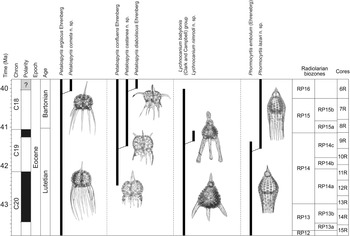
The origin of P. cometa n. sp. is to be found within a number of middle Eocene Petalospyris species displaying a pebbly surfaced cephalis and numerous teeth surrounding the cephalic aperture, introduced by Ehrenberg (Reference Ehrenberg1874) as distinct species: P. argiscus, P. carinata, and P. eupetala. Petalospyris argiscus is abundant throughout the studied interval, displaying a high intraspecific variability, both in the expression of the sagittal constriction and in the length and inclination of the lamellar teeth. At ODP Site 1260, we also observed specimens with proximally carinate lamellar teeth, especially in the Podocyrtis (L.) mitra Zone. All these different morphotypes do not form homogeneous groups that are distinct from typical P. argiscus (Fig. 5.4); we therefore chose to include them all under this species. Thus, because our enlarged concept of P. argiscus encompasses morphotypes previously assigned to P. eupetala and P. carinata, the latter are here considered as synonyms of P. argiscus. In this revised taxonomic framework, P. cometa n. sp. is regarded as an offshoot of P. argiscus (Fig. 8).
Stratigraphic ranges and evolutionary relationships to previously described species of four of the new species described at ODP Site 1260 (Demerara Rise, western equatorial Atlantic). Stratigraphic ranges of Petalospyris argiscus Ehrenberg, Reference Ehrenberg1874; Petalospyris confluens Ehrenberg, Reference Ehrenberg1874; Petalospyris diaboliscus Ehrenberg, Reference Ehrenberg1847; Lychnocanium babylonis (Clark and Campbell, Reference Clark and Campbell1942) group; and Phormocyrtis embolum (Ehrenberg, Reference Ehrenberg1874) at ODP Site 1260 after Meunier and Danelian (Reference Meunier and Danelian2022). Geomagnetic timescale after calibration of Suganuma and Ogg (Reference Suganuma, Ogg, Mosher, Erbacher, Malone, Berti and Bice2006); and radiolarian biozonations after Meunier and Danelian (Reference Meunier and Danelian2022).

Petalospyris castanea new species
Figure 5.5–5.7
Holotype
Figure 5.5; collection number USTL 3477-1; coordinates H33/3; sample ODP 1260A-9R-3W, 55–57 cm; upper part of the Podocyrtis (L.) mitra Zone, in the Podocyrtis (P.) apeza Subzone (late Lutetian, middle Eocene).
Diagnosis
Spyrid with two lateral spines on the cephalis and a latticed thorax terminating in long teeth.
Occurrence
This species occurs sporadically from the upper part of the Podocyrtis (L.) mitra Zone, until the end of the studied interval, which falls in the lowermost part of the Podocyrtis (L.) goetheana Zone.
Description
Shell dicyrtid, smooth, with a bilobed cephalis and a short latticed thorax. Cephalis globular, separated into two lobes by a weak sagittal constriction, bearing a short needle-like apical horn and two short lateral spines. Lateral spines developed directly from the latticed shell. Cephalic and thoracic pores subcircular, of different sizes, and randomly distributed. Thorax terminating in a ring of teeth as long as the thorax or a little longer (usually broken), pointing distally and slightly curved inward.
Etymology
From the Latin castanea, meaning ‘chestnut,’ for its resemblance to the fruit of the sweet chestnut tree. The specific epithet is to be treated as an adjective in the nominative singular.
Dimensions
Based on five specimens (mean): length of cephalis without the apical horn 33–45 μm (40), maximum breadth of cephalis 61–70 μm (65), maximum length of lamellar feet 26–64 μm (36).
Remarks
Petalospyris castanea n. sp. differs from most of the other species of the genus Petalospyris in having two lateral spines on the cephalis. Petalospyris castanea n. sp. resembles P. diaboliscus Ehrenberg, Reference Ehrenberg1847, from which it differs in having a latticed thorax, and shorter straight lateral spines on the cephalis. Finally, the new species is distinguished from P. tricornis (Haeckel, Reference Haeckel1887) in having a thorax shorter than the cephalis height, larger pores, and a smaller number of perioral teeth.
Petalospyris castanea n. sp. appears to have evolved from P. confluens in the upper part of the Podocyrtis (L.) mitra Zone, with which it co-occurred afterwards throughout the analyzed stratigraphic interval (Fig. 8). Petalospyris diaboliscus evolved from a stock of P. castanea n. sp. in the lower part of the Podocyrtis (L.) goetheana Zone. One of the major trends in this evolutionary lineage is the appearance and lengthening of the two lateral horns situated on the cephalis (which developed directly from the latticed shell), the resorption of the thoracic pores, and the lengthening of the perioral teeth. The origin of P. confluens remains obscure, and there are no known descendants of P. diaboliscus.
Superfamily Archipilioidea Haeckel, Reference Haeckel1882, sensu Sandin, Not, and Suzuki in Sandin et al. (Reference Sandin, Pillet, Biard, Poirier, Bigeard, Romac, Suzuki and Not2019)
Family Theophormididae Haeckel, Reference Haeckel1882, sensu Suzuki emend. Suzuki et al. (Reference Suzuki, O'Dogherty, Caulet and Dumitrică2021)
Genus Velicucullus Riedel and Campbell, Reference Riedel and Campbell1952
Type species
Soreuma (Soreumium?) magnificum Clark and Campbell, Reference Clark and Campbell1942, p. 51, pl. 4, fig. 15; by monotypy.
Velicucullus armatus new species
Figure 5.13, 5.14
Reference Sanfilippo, Riedel, Worzel, Bryant, Beall, Capo, Dickinson, Foreman, Laury, McNeely and Smith1973 Velicucullus sp. Sanfilippo and Riedel, p. 530, pl. 20, figs. 2, 3 (part).
Holotype
Figure 5.13; collection number USTL 3277-1; coordinates Q41/1; sample ODP 1260A-14R-5W, 55–57 cm; Podocyrtis (P.) ampla Zone, in the lower part of the Coccolarnacium periphaenoides Subzone (late Lutetian, middle Eocene).
Diagnosis
Velicucullus species with four collar pores subequal in size, and a thorax terminating in ~20 well-individualized radial spines.
Occurrence
This species occurs sporadically from the Thyrsocyrtis (P.) triacantha Zone, to the upper part of the Podocyrtis (L.) mitra Zone.
Description
Shell two-segmented, consisting of a large cephalis and a flat extended discoidal thorax. We found no specimens in our material that display an entire cephalis, thus, the anatomical details of the cephalis remain unknown. Basal ring composed of the dorsal spine, the ventral spine, and two primary lateral spines. The four rods intersect orthogonally at angles of 90°, delimiting four collar pores that are subequal in size. Thoracic pores subcircular to quadrangular, roughly aligned longitudinally and increasing in size toward the periphery. Distal margin of the thorax ending in a narrow hyaline band armed with ~20–25 radial spines each spaced by three or four pores and ventrally connected to the velum. Very reduced velum positioned under the most distal row of thoracic pores, not extending on the oral surface of the thorax (Fig. 5.14).
Etymology
From the Latin armatus, meaning ‘armed.’ The specific epithet is to be treated as an adjective in the nominative singular.
Dimensions
Based on the only two complete specimens found: shell diameter 251–293 μm.
Remarks
This species is represented in the fossil record of ODP Site 1260 by highly fragmented remains, including isolated portions of the thorax. However, the very characteristic shape of the distal margin of its thorax does not allow any confusion in its identification, even in the form of small fragments. Velicucullus armatus n. sp. differs from V. discoides (Ehrenberg, Reference Ehrenberg1874) and V. fragilis O'Connor, Reference O'Connor1999a, in having the distal margin of the thorax armed with radial spines. The new species differs also from V. magnificum (Clark and Campbell, Reference Clark and Campbell1942) by having bigger and fewer thoracic pores and well-individualized radial spines, and differs from V. palaeocenica in having collar pores equal in size and an almost flat thorax. Finally, V. armatus n. sp. co-occurs during its observed stratigraphic range with a gigantic unknown Velicucullus species. In our material, this species is always in the form of fragments, and therefore it could not be formally described. In addition to its larger size (>300 μm), this species does not appear to have radial spines, and has smaller and more numerous thoracic pores.
Superfamily Plagiacanthoidea Hertwig, Reference Hertwig1879
Family Pseudodictyophimidae Suzuki in Suzuki et al., Reference Suzuki, O'Dogherty, Caulet and Dumitrică2021
Genus Corythomelissa Campbell, Reference Campbell1951
Type species
Lithomelissa corythium Ehrenberg, Reference Ehrenberg1874, p. 240 (unfigured); Ehrenberg, Reference Ehrenberg1876, p. 78, pl. 3, fig. 12; subsequent designation by Campbell (Reference Campbell1951, p. 529).
Corythomelissa galea (Ehrenberg, Reference Ehrenberg1874) new combination
Figure 4.13–4.16
- Reference Ehrenberg1874
Halicalyptra Galea Ehrenberg, p. 234.
- Reference Ehrenberg1876
Halicalyptra Galea; Ehrenberg, p. 74, pl. 2, fig. 10.
- Reference Ogane, Suzuki, Aita, Sakai, Lazarus, Tanimura, Tanimura and Aita2009
Halicalyptra galea; Ogane et al., pl. 44, fig. 2a–g.
Holotype
No holotype was designated by Ehrenberg in the original description of the species. The specimen drawn by Ehrenberg (Reference Ehrenberg1876, pl. 2, fig. 10) and subsequently re-illustrated by Ogane et al. (2009, pl. 44, fig. 2a–g) during their reexamination of Ehrenberg's collection kept in Museum für Naturkunde, Humboldt University (Berlin, Germany), is a candidate lectotype.
Diagnosis
Corythomelissa species with a proportionally small cephalis bearing a strong apical horn and sometimes an inconspicuous ventral horn, a closed thorax, and three straight, downwardly directed feet.
Occurrence
Corythomelissa galea (Ehrenberg, Reference Ehrenberg1874) n. comb. has a discontinuous range at ODP Site 1260, extending from the upper part of the Podocyrtis (P.) ampla Zone, to the lower part of the Podocyrtis (L.) mitra Zone.
Description
Shell composed of two segments, globular, and thick-walled. Cephalis subspherical to hemispherical, partially embedded in the thorax, and penetrated by randomly distributed subcircular pores. Apical spine free in the cephalic cavity and extending outside as a stout, bladed apical horn. Ventral spine protruding as a small sagittal horn in some specimens (Fig. 4.16). Dorsal and primary lateral spines elongated as strong ribs or ridges on the thorax, and protruding as three straight bladed feet. Thorax usually closed distally, rounded and asymmetrical in lateral view due to development of the dorsal spine. Thoracic pores subcircular to elongated around the thoracic ribs, irregular in size, generally larger than cephalic ones.
Dimensions
Based on five specimens (mean): length of cephalothorax without the apical horn 82–105 μm (90), length of apical horn 21–35 μm (29), length of feet 53–86 μm (64).
Remarks
Corythomelissa galea (Ehrenberg, Reference Ehrenberg1874) n. comb. was assigned to the genus Corythomelissa on the basis of its closed thorax, its hemispherical cephalis bearing an apical and a ventral spine, and its dorsal and primary lateral spines prolonged as three straight, downwardly directed feet. The combination Phaenocalpis galea (Ehrenberg, Reference Ehrenberg1874), recently suggested by O'Dogherty et al. (Reference O'Dogherty, Caulet, Dumitrică and Suzuki2021), was not selected because the species belonging to the genus Phaenocalpis are all composed of a single segment. Corythomelissa galea (Ehrenberg, Reference Ehrenberg1874) n. comb differs from C. horrida (Petrushevskaya, Reference Petrushevskaya, Kennet, Houtz, Andrews, Edwards and Gostin1975) group, C. omoprominentia Funakawa, Reference Funakawa1995a, and C. spinosa Funakawa, Reference Funakawa1995a, in having a smooth-surfaced cephalis bearing shorter apical and ventral horns, and differs from C. pachyostraca Funakawa, Reference Funakawa1995a, in having a smaller cephalis with shorter apical and ventral horns, and a closed thorax. Among similar-looking Pseudodictyophimus species, C. galea (Ehrenberg, Reference Ehrenberg1874) n. comb. differs from Ps. bicornis (Ehrenberg, Reference Ehrenberg1874), Ps. leptoretis Funakawa, Reference Funakawa1995b, Ps. pyramidalis Funakawa, Reference Funakawa1995b, and Ps. tanythorax Funakawa, Reference Funakawa1994, in having a shorter ventral horn, three straight, downwardly directed feet, and a closed thorax. It is also distinguished from Ps.? sphaerothorax Funakawa, Reference Funakawa1995b, in having a smaller ventral horn and a proportionally larger thorax, and from Ps.? charlestonensis (Clark and Campbell, Reference Clark and Campbell1945) in having three straight feet, and a cephalis conspicuously embedded in the thorax. Finally, C. galea (Ehrenberg, Reference Ehrenberg1874) n. comb. differs from Spongomelissa cucumella Sanfilippo and Riedel, Reference Sanfilippo, Riedel, Worzel, Bryant, Beall, Capo, Dickinson, Foreman, Laury, McNeely and Smith1973, in having larger pores, a cephalis distinctly smaller than the thorax, and three longer feet.
Superfamily Lithochytridoidea Ehrenberg, Reference Ehrenberg1846
Family Lithochytrididae Ehrenberg, Reference Ehrenberg1846, sensu Suzuki in Matsuzaki et al. (Reference Matsuzaki, Suzuki and Nishi2015)
Genus Lychnocanium Ehrenberg, Reference Ehrenberg1846
Type species
Lychnocanium lucerna Ehrenberg, Reference Ehrenberg1847, p. 55, fig. 5; subsequent monotypy (O'Dogherty et al., Reference O'Dogherty, Caulet, Dumitrică and Suzuki2021).
Lychnocanium nimrodi new species
Figure 5.9–5.12
- Reference Sanfilippo, Westberg-Smith, Riedel, Bolli, Saunders and Perch-Nielsen1985
Sethochytris babylonis group; Sanfilippo et al., fig. 17.8a (part).
Holotype
Figure 5.9; collection number USTL 3483-2; coordinates L38/2; sample ODP 1260A-9R-4W, 55–57 cm; upper part of the Podocyrtis (L.) mitra Zone, in the Podocyrtis (P.) apeza Subzone (late Lutetian, middle Eocene).
Diagnosis
Lychnocanium species with a stout, distally dilated apical horn, and three long subparallel feet, rectangular in cross-section.
Occurrence
Lychnocanium nimrodi n. sp. ranges from the upper part of the Podocyrtis (L.) mitra Zone to the lowermost part of the Podocyrtis (L.) chalara Zone.
Description
Cephalis subspherical, thick-walled, and poreless. Apical horn longer than the cephalis, stout and distally dilated, with a hammered surface. Collar stricture well defined externally by a change in the shell contour. Thorax pyriform, with subcircular pores of different sizes, quincuncially or irregularly arranged. Three long and subparallel feet, rectangular in cross section and dilated at the end in heavily silicified specimens (Figs. 5.9, 5.11), emerging from the base of the thorax. Feet smooth-surfaced over a large part of their length, then rough-surfaced when they are dilated.
Etymology
Named after Nimrod, the ancient king of Babylon who commissioned the construction of the Tower of Babel. The specific epithet is to be treated as a noun in the genitive case formed from a personal name.
Dimensions
Based on 20 specimens (mean): length of cephalothorax without the apical horn 81–107 μm (91), length of apical horn 35–59 μm (46), length of feet 88–140 μm (117).
Remarks
Lychnocanium nimrodi n. sp. is undoubtedly related to the L. babylonis (Clark and Campbell, Reference Clark and Campbell1942) group. It is distinguished from all morphotypes grouped under this name in having a rounded thorax rather than a pyramidal thorax with sharp angles, and in having three long subparallel feet, rectangular in cross section and usually distally dilated. A distally dilated apical horn is also a characteristic feature of L. nimrodi n. sp.
This short-lived species is regarded as an offshoot from the L. babylonis group (Fig. 8).
Superfamily Pterocorythoidea Haeckel, Reference Haeckel1882, emend. Suzuki et al. (Reference Suzuki, O'Dogherty, Caulet and Dumitrică2021)
Family Lophocyrtiidae Sanfilippo and Caulet in De Wever et al., Reference De Wever, Dumitrică, Caulet, Nigrini and Caridroit2001
Genus Aphetocyrtis Sanfilippo and Caulet, Reference Sanfilippo and Caulet1998
Type species
Aphetocyrtis gnomabax Sanfilippo and Caulet, Reference Sanfilippo and Caulet1998, p. 16, pl. 7, fig. 10.
Aphetocyrtis zamenhofi new species
Figure 6.1–6.4, 6.8
- 2006
Lophocyrtis (Apoplanius) aspera (Ehrenberg); Funakawa et al., p. 25, pl. P7, figs. 5a, b (part).
Holotype
Figure 6.1; collection number USTL 3543-1; coordinates Q37/4; sample 1260A-15R-2W, 55–57 cm; lowermost part of the Podocyrtis (P.) ampla Zone, in the Dictyomitra amygdala Subzone (late Lutetian, middle Eocene).
Diagnosis
Aphetocyrtis species with an apical spine completely free in the cephalic cavity, an inflated hemispherical thorax, and an abdomen split in half by constriction.
Occurrence
From the beginning of the studied interval, which is situated in the Thyrsocyrtis (P.) triacantha Zone, to the upper part of the Podocyrtis (P.) ampla Zone.
Description
Three-segmented, thick-walled, and almost cylindrical shell. Cephalis proportionally small, spherical and globular, porous. Apical spine merge with the cephalic wall, protruding outside as a small simple apical horn. Collar constriction expressed externally by a sharp contour change that gives the impression that the cephalis is just resting on the thorax. Thorax inflated hemispherically, perforated by subcircular pores that are regular in size and shape, quincuncially arranged, and hexagonally framed by high and sharp ridges that give the thorax its thorny contour. Lumbar stricture marked by a thick internal ridge, which appears externally as an obscure band. Abdomen in the form of an hourglass, with an inflated proximal part followed by a constriction and then an enlargement of the shell. Abdominal pores subcircular to ovoid, unequal in size, randomly distributed or roughly aligned longitudinally. In the proximal part of the abdomen, pores separated by weak ridges, sometimes fused and arranged longitudinally according to the alignment of the pores. Abdominal termination lacks a peristome or terminal feet.
Etymology
Named after the Polish ophthalmologist Ludwik Lejzer Zamenhof, who is the creator of Esperanto, one of the most widely used constructed international auxiliary languages. The specific epithet is to be treated as a noun in the genitive case formed from a modern personal name.
Dimensions
Based on 30 specimens (mean): total length 120–258 μm (188), length of cephalothorax 61–107 μm (84), length of abdomen 59–157 μm (104).
Remarks
Aphetocyrtis zamenhofi n. sp. displays strong morphological similarities to early representatives of A. gnomabax Sanfilippo and Caulet, Reference Sanfilippo and Caulet1998, which can have a constricted abdomen (e.g., Sanfilippo and Caulet, Reference Sanfilippo and Caulet1998, pl. 2, figs. 14–17). However, A. zamenhofi n. sp. is distinguished from A. gnomabax by having an apical spine completely free in the cephalic cavity, a more globular cephalis that is well separated from the thorax, and an inflated hemispherical thorax rather than an inflated campanulate thorax. In addition to the organization of its initial spicule, A. zamenhofi n. sp. differs from the Southern Ocean species A. rossi Sanfilippo and Caulet, Reference Sanfilippo and Caulet1998, and A. catalexis Sanfilippo and Caulet, Reference Sanfilippo and Caulet1998, and from the tropical species A.? columboi n. sp. in having a constricted abdomen. The new species is separated from A.? bianulus (O'Connor, Reference O'Connor1997b) by its shorter abdomen with only one constriction. During a part of its range, A. zamenhofi n. sp. co-occurs with Lophocyrtis alauda (Ehrenberg, Reference Ehrenberg1874), which is easy to differentiate by its stronger apical horn and its subcylindrical abdomen perforated by pores that are regular in size and shape. Among the lophocyrtiids, Apoplanius klydus (Sanfilippo and Caulet, Reference Sanfilippo and Caulet1998) also has an undulating abdomen, but differs from A. zamenhofi n. sp. in having a spiny thorax, an apical spine partially included within the cephalis wall, and a stronger apical horn.
Under the original description of the genus Aphetocyrtis, Sanfilippo and Caulet (Reference Sanfilippo and Caulet1998) described three species (A. gnomabax, A. rossi, and A. catalexis), all of which were included in the A. gnomabax lineage. One of the major trends in this evolutionary lineage during the late Paleogene is the gradual inclusion of the apical spine in the cephalic wall. In A. gnomabax, the earliest morphospecies of this lineage, known during the earliest middle Eocene, the apical spine is loosely attached to the cephalic wall; the apical spine becomes completely included in the cephalic wall in the youngest Oligocene morphospecies A. rossi and A. catalexis. The apical spine of A. zamenhofi n. sp., which is completely merged in the cephalic wall (Fig. 6.8), prevents inclusion of this species in the A. gnomabax lineage. Therefore, A. zamenhofi n. sp. is not considered as a descendant of A. gnomabax, in spite of their great morphological similarity; it is likely part of another evolutionary lineage within the genus Aphetocyrtis. Documentation of A. zamenhofi n. sp. allows firm placement of the origin of the genus Aphetocyrtis in low latitudes in the middle Eocene, before its migration to high latitudes during the late Eocene (Sanfilippo and Caulet, Reference Sanfilippo and Caulet1998).
Aphetocyrtis? columboi new species
Figure 6.5–6.7, 6.9
Holotype
Figure 6.5; collection number USTL 3438-1; coordinates J31/1; sample ODP 1260A-6R-6W, 55–57 cm; lowermost part of the Podocyrtis (L.) goetheana Zone (early Bartonian, middle Eocene).
Diagnosis
Spindle-shaped shell with a tapered abdomen, terminating in a horn-like structure.
Occurrence
From the upper part of the Podocyrtis (L.) chalara Zone to the Podocyrtis (L.) goetheana Zone.
Description
Shell three-segmented, spindle-shaped, and thick-walled, with the collar and lumbar strictures expressed externally as a slight contour change. Cephalis spheroidal to flattened ovoid, partially embedded in the thorax, poreless or with a few small and irregularly distributed pores. Apical spine included in the cephalic wall, protruding externally as a reduced apical horn, shorter than the cephalis height. Mitral arches leave the apical spine in the middle of the cephalis, and diverge rapidly at a great angle. Thorax hemispherical to inflated campanulate, as wide as, or wider than, the abdomen, with subcircular pores quincuncially arranged. Dorsal and primary lateral spines prolonged in the thoracic wall as externally indistinct ribs, protruding outside the shell as three inconspicuous conical wings that usually are broken and difficult to see (Fig. 6.5). Abdomen inverted conical, with subcircular pores roughly arranged in longitudinal rows. Abdomen terminating in a horn-like structure, usually longer than the apical horn (Fig. 6.5), but ragged along a pore row in most of the observed specimens (Fig. 6.6, 6.7).
Etymology
Named after the iconic cigar smoker Lieutenant Columbo of the eponym American crime drama series Columbo, for the resemblance of this species to a cigar. The specific epithet is to be treated as a noun in the genitive case formed from a modern personal name.
Dimensions
Based on 11 specimens (mean): total length 191–207 μm (193), length of cephalothorax 71–84 μm (77), length of abdomen 101–121 μm (116).
Remarks
Aphetocyrtis? columboi n. sp. is tentatively assigned to the genus Aphetocyrtis because of the general morphology of its shell and the organization of its initial spicule. Its phylogenetic relationships with other members of the A. gnomabax lineage are difficult to determine for now; however, it can be noted that this new species has reached an advanced stage in the inclusion of the apical spine in the cephalic wall early in the history of the genus (Fig. 6.9). Aphetocyrtis? columboi n. sp. is distinguished from A. gnomabax Sanfilippo and Caulet, Reference Sanfilippo and Caulet1998, A. rossi Sanfilippo and Caulet, Reference Sanfilippo and Caulet1998, A. catalexis Sanfilippo and Caulet, Reference Sanfilippo and Caulet1998, and A. zamenhofi n. sp. by its tapered abdomen terminating in a horn-like structure and its thorax flanked by three small wings. This new species is morphologically close to A.? hamata (O'Connor, Reference O'Connor1999a), from which it differs in being larger and in having more regularly arranged abdominal pores. Aphetocyrtis? columboi n. sp. is also distinguished from Lophocyrtis versipellis (Ehrenberg, Reference Ehrenberg1874) by having a flattened ovoid cephalis and smaller abdominal pores. In general form, A.? columboi n. sp. is superficially similar to some species of the genus Glomaria, in particular the middle Miocene species G. thornburgi (Sanfilippo and Riedel, Reference Sanfilippo and Riedel1970) and G. baueri (Sanfilippo and Riedel, Reference Sanfilippo and Riedel1970). However, the thorax of A.? columboi n. sp. is not composed of a loose spongy meshwork, which differentiates it easily from all the species of the genus Glomaria.
The origin of A.? columboi n. sp. remains obscure; it is probably closely related to the late Eocene species A.? hamata (O'Connor, Reference O'Connor1999a), which was described from the Oamaru Diatomite.
Aphetocyrtis? spheniscus new species
Figure 6.10–6.13
Holotype
Figure 6.10; collection number USTL 2851-2; coordinates Y49/1; sample ODP 1260A-12R-1W, 55–57 cm; lower part of the Podocyrtis (L.) mitra Zone, in the Artostrobus quadriporus Subzone (late Lutetian, middle Eocene).
Diagnosis
Aphetocyrtis species with an elongated shell, a slight abdominal constriction, and an open aperture.
Occurrence
From the lowermost part of the Podocyrtis (P.) ampla Zone, to the lower part of the Podocyrtis (L.) chalara Zone.
Description
Shell of three segments, subcylindrical to fusiform, and thick-walled. Cephalis subspherical, perforated by few subcircular pores and bearing a strong bladed apical horn. Collar stricture expressed as a change in the shell contour. Thorax thick-walled, campanulate to truncated-conical, with circular pores quincuncially arranged. Thoracic stricture marked externally by a slight constriction of the shell, and lined by an internal ridge that appears externally as an obscure band. The pores on the thoracic stricture are slightly lengthened longitudinally. Abdomen subcylindrical, with circular pores longitudinally aligned, although pore alignment tends to be less regular in the distal part of the abdomen. Short longitudinal ridges sometimes separate rows of abdominal pores (Fig. 6.11). Aperture sometimes slightly constricted, and always ragged.
Etymology
From the Latin spheniscus, meaning ‘penguin,’ for its resemblance to the great penguins. The specific epithet is to be treated as a noun in the nominative singular standing in apposition to the generic name.
Dimensions
Based on 30 specimens (mean): total length 130–214 μm (159), length of apical horn 12–23 μm (15), length of cephalothorax 70–102 μm (80), length of abdomen 62–144 μm (80).
Remarks
Aphetocyrtis? spheniscus n. sp. is tentatively assigned to the genus Aphetocyrtis because of the absence of a ventral horn or of any external extensions related to the dorsal and the primary lateral spines, and because of its abdomen ending in a simple peristome. The new species is morphologically close to the specimen designated as holotype of the species A. catalexis Sanfilippo and Caulet, Reference Sanfilippo and Caulet1998 (pl. 7, fig. 14a, b), but it differs in having a truncate conical thorax rather than a hemispherical thorax, and less-marked abdominal and collar constrictions. Aphetocyrtis? spheniscus n. sp. also differs from A. saginata (Takemura and Ling, Reference Takemura and Ling1998) in having smaller thoracic and abdominal pores, as well as a less-pronounced constriction between the thorax and the abdomen. It differs from A. minuta (Takemura and Ling, Reference Takemura and Ling1998) and A. perforalvus (O'Connor, Reference O'Connor1997b) in being more elongated, with a truncate conical thorax rather than an hemispherical to spherical thorax, and in having a stronger apical horn, and from A. spongoconus (Kling, Reference Kling, Fischer, Heezen, Boyce, Bukry, Douglas, Garrison, Kling, Krasheninnikov, Lisitzin and Pimm1971) in having a latticed abdomen instead of a spongious abdomen. Aphetocyrtis? spheniscus n. sp. is also distinguished from Theocyrtis diabloensis Clark and Campbell, Reference Clark and Campbell1942, and T. robusta Clark and Campbell, Reference Clark and Campbell1942, in having a less-pronounced lumbar stricture and regularly arranged pores, and from T. kerguelensis Takemura and Ling, Reference Takemura and Ling1998, in having a shorter apical horn, and regular abdominal pores in size and shape. Finally, A.? spheniscus n. sp. can be distinguished from Paralampterium? robusta (Clark and Campbell, Reference Clark and Campbell1942) by its less-pronounced lumbar structure and its shorter apical horn, and from P.? scolopax (Ehrenberg, Reference Ehrenberg1874) by its shorter apical horn, its smaller thoracic and abdominal pores, and by the absence of well-differentiated longitudinal ridges separating the rows of abdominal pores.
Family Pterocorythidae Haeckel, Reference Haeckel1882
Genus Albatrossidium Sanfilippo and Riedel, Reference Sanfilippo and Riedel1992
Type species
Albatrossidium minzok Sanfilippo and Riedel, Reference Sanfilippo and Riedel1992, p. 16, pl. 2, fig. 7.
Albatrossidium regis new species
Figure 6.14–6.17
Holotype
Figure 6.14; collection number USTL 2851-1; coordinates Y54/2; sample 1260A-12R-1W, 55–57 cm; lower part of the Podocyrtis (L.) mitra Zone, in the Artostrobus quadriporus Subzone (late Lutetian, middle Eocene).
Diagnosis
Albatrossidium species with a cylindrical shell, a large triangular apical horn, and spaced, irregularly arranged pores in the distal part of the abdomen.
Occurrence
From the beginning of the studied interval, which is situated in the Thyrsocyrtis (P.) triacantha Zone, to the upper part of the Podocyrtis (L.) mitra Zone.
Description
Three-segmented, cylindrical, and thick-walled shell. Cephalis hemispherical and trilobate, bearing a strong pyramidal apical horn and sometimes a few small accessory spines on the rim of the cephalic hole. Cephalic pores subcircular, few in number, and randomly arranged. Inconspicuous collar stricture. Thorax subcylindrical to campanulate, with subcircular pores hexagonally framed and quincuncially arranged. The boundary between thorax and abdomen is marked by an internal ring, which appears externally as an obscure band. Abdomen cylindrical, with subcircular pores longitudinally aligned in the proximal part, then smaller, irregularly arranged, and more spaced. Abdomen terminating in an simple, almost hyaline peristome, or in three inconspicuous shovel-shaped feet.
Etymology
This species is named after the late radiolarian specialist Dr. William Rex Riedel, who actively participated in the renewal of radiolarian studies during the second part of the twentieth century. The specific epithet is to be treated as a noun in the genitive case formed from a personal name that is Latin.
Dimensions
Based on 14 specimens (mean): total length without the apical horn 76–167 μm (121), length of apical horn 26–38 μm (31), length of cephalothorax without the apical horn 62–93 μm (70), length of abdomen 39–85 μm (55).
Remarks
Albatrossidium regis n. sp. is distinguished from the holotype of A. minzok (Sanfilippo and Riedel, Reference Sanfilippo and Riedel1992, pl. 2, fig. 7) in having a large triangular apical horn and three shovel-shaped feet. The new species differs from A. cylindricum (Ehrenberg, Reference Ehrenberg1874) and A. tenellum (Foreman, Reference Foreman, Worzel, Bryant, Beall, Capo, Dickinson, Foreman, Laury, McNeely and Smith1973) in having a more elongated apical horn, usually flanked by a few accessory spines close to its base, and by the proportion of thoracic length to abdominal length: 1:1 to 1:1.5 in the former, while it is greater than 1:2 for the other two species mentioned. Finally, A. regis n. sp. differs from A. annikasanfilippoae n. sp. in being much more cylindrical, with a reduction in the number of pores in the distal part of the abdomen, in having smaller accessory spines, and in not having any perforation in the apical horn.
Albatrossidium minzok is considered to be the ancestral species of the genus (Sanfilippo and Riedel, Reference Sanfilippo and Riedel1992). Given its stratigraphic position (early Eocene to middle Eocene), this species represents a potential ancestor for the late middle Eocene species A. regis n. sp. However, the phylogenetic relationship between these two species could not be elucidated in this study due to the absence of A. minzok at ODP Site 1260. A few specimens with a large triangular apical horn and a long cylindrical abdomen perforated by regularly arranged pores were observed in the Podocyrtis (L.) goetheana Zone after the last occurrence of A. regis n. sp. These specimens correspond well to A. cylindricum as described by Ehrenberg (Reference Ehrenberg1874, p. 227) and illustrated by Ogane et al. (Reference Ogane, Suzuki, Aita, Sakai, Lazarus, Tanimura, Tanimura and Aita2009, pl. 84, figs. 5a–d, pl. 85, figs. 1a–d). Given their morphological resemblance to A. regis n. sp. and their stratigraphic position, these specimens may represent the descendants of A. regis n. sp.
Albatrossidium annikasanfilippoae new species
Figure 7.1–7.4
- Reference Sanfilippo and Riedel1992
Albatrossidium minzok Sanfilippo and Riedel, p. 18, pl. 1, fig. 18 (part).
Holotype
Figure 7.1; collection number USTL 3512-1; coordinates Y39/1; sample ODP 1260A-12R-3W, 55–57 cm; lower part of the Podocyrtis (L.) mitra Zone, in the Artostrobus quadriporus Subzone (late Lutetian, middle Eocene).
Diagnosis
Albatrossidium species with a large triangular and perforated apical horn, surrounded by several accessory spines.
Occurrence
From the lower part of the Podocyrtis (P.) ampla Zone, to the end of the studied interval, which is situated in the lower part of the Podocyrtis (L.) goetheana Zone.
Description
Three-segmented, smooth, and thick-walled shell. Cephalis trilobate, hemispherical, bearing a strong triangular apical horn and usually two or four accessory spines on the rim of the cephalic hole. Proximal half of the apical horn usually perforated by several subcircular pores. Cephalic pores subcircular and randomly arranged. Collar stricture expressed externally as a slight contour change. Thorax campanulate to inflated campanulate, with quincuncially arranged subcircular pores with polygonal pore-frames. Thorax and abdomen separated by an internal septa that is marked externally by a slight change in the shell contour. Abdomen subcylindrical, with subcircular pores roughly arranged in longitudinal rows. Abdominal termination undifferentiated, invariably ragged along a pore row.
Etymology
The species is dedicated to Dr. Annika Sanfilippo for her cornerstone work on Paleogene radiolarians. The specific epithet is to be treated as a noun in the genitive case formed from a modern personal name.
Dimensions
Based on 26 specimens (mean): total length without the apical horn 110–174 μm (126), length of apical horn 30–47 μm (39), length of cephalothorax without the apical horn 61–100 μm (77), length of abdomen 29–87 μm (49).
Remarks
Albatrossidium annikasanfilippoae n. sp. differs from the holotype of A. minzok (Sanfilippo and Riedel, Reference Sanfilippo and Riedel1992, pl. 2, fig. 7), A. cylindricum (Ehrenberg, Reference Ehrenberg1874), and A. tenellum (Foreman, Reference Foreman, Worzel, Bryant, Beall, Capo, Dickinson, Foreman, Laury, McNeely and Smith1973) in having a perforated apical horn surrounded by several accessory spines, and an abdomen shorter than the thorax. Albatrossidium annikasanfilippoae n. sp. differs from A. regis n. sp. as reported under A. regis n. sp.
Given that A. minzok is the earliest member of the genus Albatrossidium, known from the early Eocene to the middle Eocene (Sanfilippo and Riedel, Reference Sanfilippo and Riedel1992), it seems to be a possible ancestor of the late middle Eocene species A. annikasanfilippoae n. sp. However, A. minzok was not found at ODP Site 1260, and for this reason it is for the moment impossible to confirm this phylogenetic hypothesis. The cephalic hole observed in A. annikasanfilippoae n. sp. reminds us the open cephalis of Neogene and Quaternary species of the genus Lamprocyrtis (e.g., Sanfilippo and Riedel, Reference Sanfilippo and Riedel1992, pl. 4, figs. 7–9). However, the rest of the cephalis of Lamprocyrtis species differs in being longitudinally elongated and indistinctly trilobed. Although the two genera are related (Sanfilippo and Riedel, Reference Sanfilippo and Riedel1992), it is likely that this remarkable cephalic structure appeared twice independently.
Genus Phormocyrtis Haeckel, Reference Haeckel1887
Type species
Phormocyrtis longicornis Haeckel, Reference Haeckel1887, p. 1370, pl. 69, fig. 15; subsequent designation by Campbell (Reference Campbell and Moore1954, p. D134).
Phormocyrtis lazari new species
Figure 7.5–7.8
- Reference Riedel and Petterson1957
Phormocyrtis embolum; Riedel, p. 88, pl. 2, fig. 7 (part).
- Reference Petrushevskaya, Kozlova, Hayes, Pimm, Beckmann, Benson, Berger, Roth, Supko and von Rad1972
Phormocyrtis embolum group; Petrushevskaya and Kozlova, p. 537, pl. 22, figs. 8, 9.
- Reference Kruglikova and Zhuze1974
Phormocyrtis embolum; Kruglikova, fig. 3.10.
- Reference Chen, Hayes, Frakes, Barrett, Burns and Chen1975
Phormocyrtis proxima (?); Chen, p. 456, pl. 2, fig. 6.
- ?Reference Kozlova1999
Phormocyrtis embolum; Kozlova, p. 148, pl. 31, fig. 14.
- ?Reference Kozlova1999
Phormocyrtis sp. cf. P. embolum; Kozlova, pl. 35, fig. 16.
Holotype
Figure 7.5; collection number USTL 3474-1; coordinates T40/4; sample 1260A-9R-2W, 55–57 cm; uppermost part of the Podocyrtis (L.) mitra Zone, in the Podocyrtis (P.) apeza Subzone (late Lutetian, Middle Eocene).
Diagnosis
Phormocyrtis species with a subcylindrical hyaline abdomen terminated by lamellar feet.
Occurrence
From the upper part of the Podocyrtis (L.) mitra Zone, to the end of the studied interval, which is situated in the lower part of the Podocyrtis (L.) goetheana Zone.
Description
Shell three-segmented, smooth, and thick-walled, with the collar and lumbar strictures slightly expressed externally. Cephalis hemispherical, poreless or with a few small subcircular pores, bearing short conical horn, weakly bladed, at least in the proximal part. Thorax truncate conical to subcylindrical, with pores in longitudinal rows (6–7 in a row), separated by strong longitudinal ribs. The lower margin of the thorax marked by a well-defined internal septal band. Abdomen subcylindrical to truncate conical, hyaline or sparsely pored in its upper portion, then surrounded by ~20 lamellar feet pointing distally and variable in length (~0.5–2 times the length of the hyaline part). Abdominal pores, when present, subcircular or longitudinally elongated, and can be up to three times as long as the thoracic pores.
Etymology
This species is named in honor of Dr. David Lazarus (Museum für Naturkunde, Humboldt-Universität, Berlin) for his contribution to the study of Cenozoic radiolarians. The specific epithet is to be treated as a noun in the genitive case formed from a personal name that is Latin.
Dimensions
Based on 30 specimens (mean): total length without the apical horn 69–180 μm (129), length of apical horn (when present) 7–15 μm (12), length of cephalothorax without the apical horn 51–84 μm (72), length of the hyaline proximal part of the abdomen 18–40 μm (27), length of lamellar feet 6–68 μm (33).
Remarks
Phormocyrtis lazari n. sp. differs from P. embolum (Ehrenberg, Reference Ehrenberg1874), P. ligulata Clark and Campbell, Reference Clark and Campbell1942, and P. striata Brandt, Reference Brandt and Wetzel1935, by having a subcylindrical, sparsely pored abdomen terminated by lamellar feet, rather than an inverted truncate conical abdomen with numerous pores and a simple peristome. Phormocyrtis lazari n. sp. also differs from all P. striata subspecies by the presence of an internal septal band at the lower margin of the thorax. Phormocyrtis lazari n. sp. is distinguished from P. proxima Clark and Campbell, Reference Clark and Campbell1942, by having a nearly hyaline abdomen terminated by lamellar feet, and from P. alexandrae O'Connor, Reference O'Connor1997a, P.? cubense Riedel and Sanfilippo, Reference Riedel, Sanfilippo, Winterer, Riedel, Brönnimann, Gealy, Heath, Kroenke, Martini, Moberly, Resig and Worsley1971, and P. turgida (Krasheninnikov, Reference Krasheninnikov, Sazonov and Shchutskaya1960) in having no fourth segment.
Stratigraphic data collected at ODP Site 1260 suggest that P. lazari n. sp. is derived from P. embolum; the latter species disappeared shortly after the first occurrence of P. lazari n. sp. (Fig. 8). The two species share many morphological similarities: towards the end of its age range, P. embolum tends to become more cylindrical, with a subcylindrical to slightly tapered abdomen. This late morphotype of P. embolum corresponds well to the original description of P. proxima, and argues for the synonymization of these two species. Riedel (Reference Riedel and Petterson1957) had already suggested this, and extended it to specimens bearing an abdomen terminated by lamellar teeth, although the original description of P. proxima does not mention the presence of such perioral appendages. A few specimens exhibiting an intermediate morphology between P. embolum and P. lazari n. sp. also have been observed at ODP Site 1260, as well as in the Southern Ocean (Hollis et al., Reference Hollis, Pascher, Sanfilippo, Nishimura, Kamikuri and Shepherd2020, pl. 10, fig. 18). These specimens are characterized by a subcylindrical porous abdomen terminated by short lamellar teeth. Phormocyrtis ligulata is also probably related to these taxa. Unfortunately, this species was only reported from the Pacific Ocean (Clark and Campbell, Reference Clark and Campbell1942, 1945; Blueford, Reference Blueford1988) and from the Southern Ocean (O'Connor, Reference O'Connor1999b; Hollis et al., Reference Hollis, Pascher, Sanfilippo, Nishimura, Kamikuri and Shepherd2020), therefore we were unable to clarify its phylogenetic relationships with P. embolum and P. lazari n. sp.
Genus Podocyrtis Ehrenberg, Reference Ehrenberg1846
Type species
Podocyrtis papalis Ehrenberg, Reference Ehrenberg1847, p. 55, fig. 2; subsequent designation Campbell (Reference Campbell and Moore1954, p. D130).
Podocyrtis (Lampterium) puellasinensis Ehrenberg, Reference Ehrenberg1874
Figure 7.9–7.11
- Reference Ehrenberg1874
Podocyrtis Puella sinensis Ehrenberg, p. 252.
- Reference Ehrenberg1876
Podocyrtis Puella sinensis; Ehrenberg, p. 82, pl. 14, fig. 3.
- Reference Ogane, Suzuki, Aita, Sakai, Lazarus, Tanimura, Tanimura and Aita2009
Podocyrtis puella-sinensis; Ogane et al., pl. 48, figs. 9a–f.
Holotype
No holotype was designated by Ehrenberg (Reference Ehrenberg1874) in the original description of the species. The specimen drawn by Ehrenberg (Reference Ehrenberg1876, pl. 14, fig. 3) and subsequently re-illustrated by Ogane et al. (Reference Ogane, Suzuki, Aita, Sakai, Lazarus, Tanimura, Tanimura and Aita2009, pl. 48, fig. 9a–f) during their reexamination of Ehrenberg's collection kept in Museum für Naturkunde, Humboldt University (Berlin, Germany), is a candidate lectotype.
Diagnosis
Podocyrtis species with a two-segmented shell, and a well-defined cephalic hole delimited by a thick hyaline rim.
Occurrence
From the upper part of the Podocyrtis (P.) ampla Zone, to the end of the studied interval, which is situated in the lower part of the Podocyrtis (L.) goetheana Zone.
Description
Shell two-segmented and robust. Cephalis trilobed, with one large unpaired eucephalic lobe, and two small paired lobes dorsally positioned. Cephalic pores subcircular to quadrate, irregular in size, and randomly arranged. Apical horn long as the cephalis, triangular, with a large cephalic hole circumscribed by a thick hyaline rim. Thorax truncate conical to globular, perforated by subcircular pores of various size, usually hexagonally framed, and much larger than the cephalic ones. Thorax ending in a smooth hyaline peristome doubled by an internal septum, or more rarely ending in a crown of very short spines (Fig. 7.11).
Dimensions
Based on 18 specimens (mean): length of cephalothorax without the apical horn 65–90 μm (78), length of the apical horn 27–51 μm (41), maximum breadth of shell 66–92 μm (78).
Remarks
Podocyrtis (L.) puellasinensis Ehrenberg, Reference Ehrenberg1874 is distinguished from all other Podocyrtis species by its two-segmented shell and its well-developed cephalic hole.
We have chosen to leave P. (L.) puellasinensis in the genus Podocyrtis, although the absence of an abdominal segment in this species is in contradiction with the diagnosis of the genus (O'Dogherty et al., Reference O'Dogherty, Caulet, Dumitrică and Suzuki2021). This choice was motivated by the strong morphological similarities between P. (L.) puellasinensis and the cephalothorax of the later members of the subgenus Lampterium, such as P. (L.) chalara Riedel and Sanfilippo, Reference Riedel, Sanfilippo, Bader, Gerard, Benson, Bolli, Hay, Rothwell, Ruef, Riedel and Sayles1970, and P. (L.) goetheana (Haeckel, Reference Haeckel1887) (see Fig. 7.12 for comparison with a typical P. [Lampterium] cephalothorax). This resemblance is all the more unexpected because the first occurrence of P. (L.) puellasinensis is dated 43.36 Ma at ODP Site 1260, ca. 2.2 Ma earlier than the first occurrence of P. (L.) chalara (41.15 Ma; Meunier and Danelian, Reference Meunier and Danelian2022). It is therefore difficult to decipher the origin of P. (L.) puellasinensis. The best candidate seems to be P. (L.) sinuosa Ehrenberg, Reference Ehrenberg1874, although its thorax is more campanulate and penetrated by smaller pores. In this case, P. (L.) puellasinensis would be an offshoot of the lineage from P. (L.) sinuosa to P. (L.) mitra, and for this reason it is placed in the subgenus Lampterium. In their taxonomic review, O'Dogherty et al. (Reference O'Dogherty, Caulet, Dumitrică and Suzuki2021) recognized the subgenus Lampterium as a distinct genus, and suggested the following combinations: Lampterium chalara (Riedel and Sanfilippo, Reference Riedel, Sanfilippo, Bader, Gerard, Benson, Bolli, Hay, Rothwell, Ruef, Riedel and Sayles1970) and L. goetheana (Haeckel, Reference Haeckel1887). We do not share this view because the Lampterium evolutionary lineage that leads from P. (L.) acalles Sanfilippo and Riedel, Reference Sanfilippo and Riedel1992, to P. (L.) goetheana has been amply demonstrated (e.g., Riedel and Sanfilippo, Reference Riedel, Sanfilippo, Bader, Gerard, Benson, Bolli, Hay, Rothwell, Ruef, Riedel and Sayles1970; Sanfilippo and Riedel, Reference Sanfilippo and Riedel1992), and this taxonomic change would imply that the genus Podocyrtis is paraphyletic. An alternative hypothesis to explain the particular morphology of P. (L.) puellasinensis is that this species is the expression of an early stage in the development of the Podocyrtis shell (a neoteny).
Conclusions
Examination of middle Eocene sediment sequences from the equatorial Atlantic Ocean allowed the description of 15 new radiolarian species, and the re-illustration of four species rarely reported since their original description in early radiolarian studies. With the exception of a few sporadic species (Petalospyris castanea n. sp., Pterocyrtidium eep n. sp., Cymaetron? dilatatus n. sp., and Velicucullus armatus n. sp.), the taxa reported herein have a continuous range in the studied interval, and can therefore be included in future biostratigraphic studies. Although the studied interval is relatively limited and did not allow us to establish the total range of most of these species, 23 radiolarian bioevents are documented, including 14 first occurrences and nine last occurrences. Orbitally tuned ages are provided for these bioevents through direct calibration to the astronomical time scale, increasing the number of biostratigraphic tiepoints available for the equatorial Atlantic Ocean.
Several new species described herein display strong morphological similarities to previously described species, which enabled us to suggest phylogenetic hypotheses by integrating stratigraphic data. Despite being fragmentary, these observations are important in establishing new evolutionary lineages, and better understand nassellarian evolutionary dynamics. The documentation of new species has also improved our understanding of the origin of some genera. This is the case of the genus Aphetocyrtis, which is now clearly rooted in the tropical region with three new tropical species reported herein (A. zamenhofi n. sp., A.? columboi n. sp., and A.? spheniscus n. sp.). Similarly, documentation of Spirocyrtis? renaudiei n. sp., an Artostrobiid species with a mixture of characters found in the genera Botryostrobus and Spirocyrtis, allows us to place the divergence between these two genera shortly before the late middle Eocene. Finally, this study contributed to the addition of new species to the monotypic genera Albatrossidium and Cymaetron, which are poorly known and have been rarely reported since their original descriptions.
Acknowledgments
We thank the Ocean Drilling Program (ODP) for supplying the samples used in this study. Thanks also to J. Cuvelier for technical assistance. Constructive remarks by the two anonymous reviewers significantly improved the initial manuscript.
Declaration of competing interests
The authors declare none.
Data availability statement
Biostratigraphic data generated in this study are available in Supplementary Data 1, reposited in the Dryad Digital Repository: https://doi.org/10.5061/dryad.x3ffbg7nn.