INTRODUCTION
In his landmark book, Strategic Management: A Stakeholder Approach, Freeman (Reference Freeman1984) defined stakeholders as ‘any group or individual who can affect or is affected by the achievement of the firm's objectives’ (25). Stakeholders include shareholders, employees, consumers, investors, communities, regulators, suppliers, and the media, all entities who are involved in two-way relationships with firms (Parmar, Freeman, Harrison, Wicks, Purnell, & De Colle, Reference Parmar, Freeman, Harrison, Wicks, Purnell and De Colle2010). Stakeholder theory sees the relationship as relatively static (Freeman, Reference Freeman1984), but it fails to consider conditions that might alter the relationship and allow stakeholders to seize enough power to influence firms’ decisions (Frooman, Reference Frooman1999; Mitchell, Agle, & Wood, Reference Mitchell, Agle and Wood1997).
To fill this gap, we take a dynamic perspective for investigating changing stakeholder influences and firms’ subsequent responses. We identify the boundary conditions associated with changes in corporate-stakeholder relationships and reveal underlying mechanisms linking stakeholder influences to firm responses. Specifically, we investigate (1) conditions that might disrupt original corporate-stakeholder relationships and allow stakeholders to influence firms’ decision making as well as (2) managers’ responses by changing their priorities regarding stakeholders and reallocating firms’ resources.
Corporate social responsibility (CSR) practices have been associated with the priority managers give to competing stakeholder claims (Barnet, Reference Barnett2007; Mitchell et al., Reference Mitchell, Agle and Wood1997; Wood, Reference Wood1991). The suspension of CSR initiatives means that a company suspended its CSR practices when managers placed higher importance on shareholder demands and lower importance on other stakeholders such as employees, customers, governments, and communities. So CSR suspension reveals the conditions that allowed shareholders to seize enough power that they persuaded managers to suspend CSR to satisfy shareholders’ demands over other stakeholders’ interests. Therefore, it provides opportunities for us to investigate when stakeholders exert their influence on organizations and how organizations respond to such stakeholder influence.
Using qualitative procedures, we undertook a case study to explore the circumstances that prompted stakeholders to exert their influence on firms’ CSR. We examined a private insurance company pseudo-named China Insurance Company (CIC) and found that an economic downturn and adverse performance were precipitating events that enabled the shareholders to seize power and influence the firm's decisions. Furthermore, shareholders exerted their influence on managers by leveraging their shares to reconstruct the firm's ownership structure. In response, managers placed more value on shareholder demands and less on the needs of other stakeholders in a process of stakeholder rebalancing that included suspension of CSR ethical and discretionary investments. We further show that CSR suspension negatively affects corporate-stakeholder relations and ultimately threatens firms’ survival.
We make two important contributions through this study. First, we add a dynamic perspective to the static view of stakeholder-firm relationships. Second, we address the common but underexplored phenomenon of CSR suspension to provide a more comprehensive view showing how corporations that were once socially responsible may suspend their CSR initiatives and, as a result, negatively affect stakeholder relations and the likelihood of firm survival.
THEORETICAL BACKGROUND
After stakeholder theory was first introduced (Freeman, Reference Freeman1984), studies diverged into three streams (Frooman, Reference Frooman1999). One stream, attempting to identify stakeholders, asks Who are they? Another stream, focused on stakeholder ends or interests, asks What do they want? A third stream, addressing stakeholder means, asks How will they try to get it?
Who are they? A theory of stakeholder identification and salience (Mitchell et al., Reference Mitchell, Agle and Wood1997) suggests that managers identify stakeholders as being most salient depending on the shareholders’ power, urgency, and legitimacy. Stakeholder salience refers to ‘the degree to which managers give priority to competing stakeholder claims’ (Mitchell et al., Reference Mitchell, Agle and Wood1997: 854). Although controversy has surrounded the importance of legitimacy as a stakeholder attribute (Eesley & Lenox, Reference Eesley and Lenox2006; Neville, Bell, & Whitwell, Reference Neville, Bell and Whitwell2011), power and urgency have been widely acknowledged as two important stakeholder attributes. The three attributes are not fixed but instead vary or change across time or contexts (Magness, Reference Magness2008; Pfarrer, Decelles, Smith, & Taylor, Reference Pfarrer, Decelles, Smith and Taylor2008). However, no study has identified conditions that might change stakeholder attributes.
What do they want? Stakeholders have many interests that may oppose firms’ interests (Frederick, Post, & Davis, Reference Frederick, Post and Davis1992): economic vs. social interests, concrete vs. symbolic interests, and local vs. domestic vs. international interests (Wood, Reference Wood1994). To understand what stakeholders really want, it is essential to understand conflicts between stakeholders’ and firms’ interests (Frooman, Reference Frooman1999).
How will they try to get it? Because stakeholder actions partly determine firm actions, it is important to consider how stakeholders influence firms’ decision making and behavior. Prior studies on stakeholder influences have focused on stakeholders’ strategies for exerting influence or on the market reactions to those strategies. Hirchman (Reference Hirchman1970) was one of the first to identify that dissatisfied stakeholders can influence corporations by using ‘exit’ or ‘voice’ strategies. Theoretical approaches have identified other stakeholder strategies including shareholder resolutions (Davis & Thompson, Reference Davis and Thompson1994), boycotts (Paul & Lydenberg, Reference Paul and Lydenberg1992), and modified vendettas (Corlett, Reference Corlett1989). By applying resource dependence theory, Frooman (Reference Frooman1999) developed a conceptual typology of stakeholder influence strategies categorized as ‘usage, withholding, direct, and indirect’ strategies. He argued that stakeholder influence strategy depends on the resource dependency relationship between stakeholders and the firm: Are stakeholders dependent on the firm? Is the firm dependent on stakeholders? To determine market reactions to stakeholder strategies, empirical methods have been used to test letter-writing campaigns (Smith & Cooper-Martin, Reference Smith and Cooper-Martin1997), withholding and usage strategies (Sharma & Henriques, Reference Sharma and Henriques2005), and protests (King & Soule, Reference King and Soule2007).
Overall, prior research has addressed stakeholder identity, desires, and strategies for acquiring what they want but has not yet shown conditions that will enable stakeholders to more powerfully and successfully influence firms. As a new research focus, we adopt a dynamic perspective and propose that precipitating events, defined as ‘shocks’ (Fligstein, Reference Fligstein1990), ‘jolts’ (Meyer, Reference Meyer1982), ‘discontinuities’ (Lorange, Scott, & Ghoshal, Reference Lorange, Scott and Ghoshal1986), ‘disruptive’ or ‘punctuated’ events (Hoffman, Reference Hoffman1999; Tilcsik & Marquis, Reference Tilcsik and Marquis2013), or ‘turning points’ (Abbott, Reference Abbott1997), possibly offer stakeholders opportunities to protect their interests. Precipitating events have been widely recognized as the source of organizational and institutional change and industry evolution (Hoffman & Ocasio, Reference Hoffman and Ocasio2001; Holm, Reference Holm1995). Precipitating events – wide economic recessions, strikes, social upheavals, technological disruptions, competitive discontinuities, or regulatory changes – may disturb the socially constructed field-level consensus, erode existing organizational and institutional legitimacy, and directly challenge organizational survival (Child, Lua, & Tsai, Reference Child, Lua and Tsai2007; Greenwood, Suddaby, & Hinings, Reference Greenwood, Suddaby and Hinings2002; Tilcsik & Marquis, Reference Tilcsik and Marquis2013).
We bring to stakeholder theory the idea that precipitating events not only disrupt organizations but also disrupt relatively stable corporate-stakeholder relationships. Dissatisfied stakeholders see precipitating events as giving them opportunities to alter company directions by leveraging their resources to create an operational crisis (Frooman, Reference Frooman1999; Pfeffer & Salancik, Reference Pfeffer and Salancik1978). Secondary stakeholders who lack relevant control over firm resources (Clarkson, Reference Clarkson1995) might create a legitimacy crisis through collective action and public stakeholder discourse to crystallize their key demands, promote their views, shape opinions, and diffuse multiple constituencies (King, Reference King2008; Pfarrer et al., Reference Pfarrer, Decelles, Smith and Taylor2008).
Suspending CSR Initiatives in China
Despite much debate about corporate social responsibility as a concept, researchers are increasingly acknowledging that organizations must consider stakeholders’ expectations (Freeman, Reference Freeman1984) when they take responsibility for economic, legal, ethical, and discretionary actions for the public good (Carroll, Reference Carroll1979). Today, many corporations seriously try to define and integrate CSR into all aspects of their business (Zu & Song, Reference Zu and Song2008). However, corporations do not always maintain the same level of CSR engagement when circumstances change in dynamic environments (Aguinis & Glavas, Reference Aguinis and Glavas2012; Barnett, Reference Barnett2007). When corporations face adverse performance crises or wide economic recessions, many may reduce or suspend their CSR initiatives (Surroca, Tribo, & Waddock, Reference Surroca, Tribo and Waddock2010).
Although the Chinese government actively promotes CSR development, CSR in China is still in its infancy (Marquis & Qian, Reference Marquis and Qian2014). Civil societies and nongovernmental organizations are too weak to positively influence corporate CSR (Kojima, Choe, Ohtomo, & Tsujinaka, Reference Kojima, Choe, Ohtomo and Tsujinaka2012; Ma, Reference Ma2006). Formal regulations regarding consumer rights and labor protections and environmental conservation remain largely underdeveloped, inconsistent (Tan, Reference Tan2009), and poorly enforced (Child & Tsai, Reference Child and Tsai2005). Consumers in China are more price sensitive and show neither strong preference for socially responsible products nor aversion to unethically manufactured products (Cui, Liang, & Lu, Reference Cui, Liang and Lu2015). Therefore, under such conditions, many corporations have irregular and unsustainable CSR: they frequently suspend their CSR initiatives when situations become unfavorable (China CSR, Reference China2010; Lu, Reference Lu2009).
Declines in financial performance have been shown to cause companies to suspend their CSR activities (China CSR, Reference China2010; Lu, Reference Lu2009; Surroca et al., Reference Surroca, Tribo and Waddock2010). However, CSR suspension is a highly complex process involving changes in managers’ perceptions regarding stakeholder salience, firms’ CSR investment, and corporate stakeholders’ viewpoints. We need a comprehensive view to explore the processes that socially responsible firms might take in choosing to suspend their CSR initiatives and to determine how CSR suspension influences subsequent corporate-stakeholder relations.
METHOD
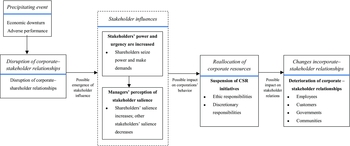
This study emerged from ongoing research during which we became aware that stakeholders can influence firms’ decision making and that the strategies they choose will affect their influence. However, we did not understand the conditions that might allow them to seize power. We undertook a longitudinal case study of CSR suspension to reveal its antecedents and consequences and to develop a dynamic model of stakeholder influence. This dynamic model (Figure 1) emerged from our case study, and it shows the following: (1) precipitating events provided conditions that made it possible for shareholders to seize power, (2) newly empowered stakeholders made urgent demands for changes, (3) managers rebalanced their priorities and reallocated corporate resources to meet those demands, and (4) corporate-stakeholder relationships achieved a new equilibrium. Below we discuss our data collection, analyses, and details of the dynamic model.
A general model of stakeholder influences, firm responses, and CSR suspension (Color online)

Data Collection
It is often desirable to choose a particular organization precisely because it allows one to gain certain insights that other organizations would not be able to provide (Siggelkow, Reference Siggelkow2007: 20). In this study, we examined CIC,Footnote [1] an unlisted private insurance company located in Shanghai. Founded in 1994, the company provides property, liability, marine, and casualty insurance. By the end of 2008, CIC had gained an excellent reputation because of its innovative products and remarkable CSR activities. However, starting in 2010, CIC largely suspended its CSR initiatives, posing an interesting question: Why would a socially responsible company suddenly suspend its CSR initiatives?
Our data came from CIC's headquarters and CIC's Sichuan Branch.Footnote [2] CIC's headquarters, where CSR activities are established, determines the depth and breadth of the branches’ CSR activities. Each branch is equally responsible for CSR implementation, so each branch was similarly affected by the CSR suspension. We chose to study the Sichuan Branch, because one of the authors worked there for many years and could help us acquire CIC's internal information, arrange interviews with former and current top and middle managers, and obtain the ‘negative’ data that are usually difficult for researchers to collect. We obtained data from primary sources of participant observation and interviews and secondary sources of archival data.
Participant observation
Participant observation is a form of ‘opportunistic ethnography’ (Reimer, Reference Reimer1977), a relatively rare methodology in management, but one that is well established in sociology (e.g., see Tracey, Phillips, & Jarvis, Reference Tracey, Phillips and Jarvis2011). The third author worked in CIC's Sichuan Branch as a vice general manager from March 2003 to July 2011. He witnessed firsthand the series of events that occurred when CIC suspended its CSR activities.
We began our formal data collection in March 2009 and finished in June 2011. The third author kept a diary for recording his general observations and feelings about company operations, changes of CSR initiatives, stakeholders’ reactions, the content of key meetings, and details of informal conversations with organizational members. During the data collection period, the other two authors regularly reviewed the diary and identified key questions for further data collection.
Interviews
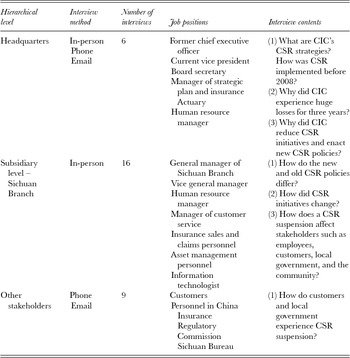
To get the full picture of CIC's CSR suspension, we conducted interviews with various stakeholders who were involved in the process of CSR suspension, in two waves (Van de Ven & Jing, Reference Van de Ven and Jing2012). The first wave occurred from June 2012 to March 2013. We interviewed 16 respondents at the Sichuan Branch including the general manager, vice general manager, human resources (HR) manager, customer service managers, and 11 personnel at different divisions. We interviewed 9 former and current customers and government officials mainly through phone and email. We asked respondents to describe the differences between the new and original CSR policies from headquarters, the suspension of CSR initiatives, and the experiences of stakeholders. During the second wave in September 2013, we conducted 6 interviews – a former CEO, the current vice president, the board secretary, an HR manager, a division manager of strategic planning, and an insurance actuary at CIC's headquarters. We asked respondents to describe the economic downturn and adverse performance that CIC faced, the shareholder efforts to seize power and their demands for change, and the managers’ perceptions regarding various stakeholders. Each interview lasted from 30 to 90 minutes and was tape-recorded and transcribed. As the research project progressed and the theory was refined, we conducted telephone and email follow-ups to gather missing information. Table 1 provides details about interviewees.
Interview details

Archival data
We had access to a range of CIC's internal documents dating from 2005 to 2011, including annual financial and CSR reports, the compensation incentive system for top management team and employees, strategic plans, internal communications records, public press articles, and other operational data. To enhance research reliability, these data were also triangulated with data drawn from the direct interviews.
Data Analysis
We conducted data analysis in three stages. In the first stage, we drew on the observational, interview, and archival data to build an ‘event history database’ (Garud & Rappa, Reference Garud and Rappa1994): before 2007, CIC focused on developing CSR initiatives; from 2007 to 2011, CIC suspended the CSR initiatives.
In the second stage, we focused on cross-stage analysis to examine stakeholder influences and management responses (Yin, Reference Yin1994). Specifically, we first identified the stakeholders who would affect or be affected by CSR suspension from each stage. Then we identified how precipitating events – economic downturn and adverse performance – provided opportunities for stakeholders to seize power and make demands. Third, we used a five-point scale (1 = lowest changes; 5 = highest changes) to measure how managers’ perceptions of stakeholder attributes (e.g., power and urgency) changed. Finally, we used a five-point scale (1 = least important; 5 = most important) to measure how shareholders, employees, customers, the government, and the community changed in the salience attributions. Four researchers discussed the coding principles. Then each researcher independently coded the case data on the constructs according to the coding scheme. Finally, coding results were compared across the four coders. If there were disagreements on a certain construct, the coders discussed their differences until they agreed on the scores for the constructs.
In the third stage, we used content analysis to identify how CSR initiatives were suspended and how CSR suspension influenced stakeholder relations. First, we identified initial concepts and grouped them into first-order categories through a process of open coding. This was essentially an inductive process, building on multiple sources of data and focusing on the CSR activities that were reduced or suspended and the stakeholder reactions. Then we used axial coding to search for and identify relationships between and among first-order concepts (Strauss & Corbin, Reference Strauss and Corbin1990). This allowed us to collapse our first-order categories into fewer second-order themes.
Finally, we ‘iterated between’ our data categories and theory (Eisenhardt, Reference Eisenhardt1989; Yin, Reference Yin1994) to answer our research questions, to search for anomalous results, and to discover how our findings contribute to extant theory. From the iterative cycle of dialogue between theory and data, the final theoretical model, shown in Figure 1, gradually emerged. We also asked the key interviewees (e.g., a former CEO) to review the model to ensure the authenticity of the story from their perspectives.
RESULTS OF CASE ANALYSIS
Generalizing from two stages in the CIC case, we developed a dynamic model of stakeholder influences and subsequent firm responses applied to the phenomenon of CSR suspension. First, we explain the precipitating event – economic downturn and adverse performance – that disrupted corporate-stakeholder relations. Second, we describe how shareholders took advantage of the precipitating event to influence the firm's CSR decision making. Then we provide evidence that the firm responded to shareholder influences by suspending CSR initiatives. Finally, we show that new corporate-stakeholder relations were formed.
Precipitating Event and the Disruption of Corporate-Stakeholder Relationships
Economic downturn and adverse performance
The 2008/2009 economic downturn and CIC's adverse performance were precipitating events that disrupted stakeholder relations. CIC was a small regional insurance company located in Shanghai. By 2007, CIC had grown to be a well-managed, modern, medium-sized national insurance company with a good reputation. It was profitable for 13 consecutive years until it began to fail from 2007 to 2009, because it had rapidly expanded into auto insurance and was suddenly faced with capital shortage. Furthermore, the worldwide financial crisis of 2008 and several natural disasters such as earthquakes and floods badly hurt Chinese economic development. The economic downturn directly depressed the Chinese insurance market and damaged the CIC's financial performance.
The Shanghai insurance industry experienced huge overall losses. The Shanghai Bureau of China Insurance Regulatory Commission provides 2008 insurance data showing that property insurance companies had to compensate claims for $3.75 trillion, 2.5 times more than 2007 claims. In such a dismal insurance market, CIC's insurance outlays increased, and insurance profitability sharply decreased. Also, the worldwide financial crisis caused investments to accrue huge losses. For example, in 2008 CIC had only $360 million in investment returns, compared with $2 billion in 2007. Thus, CIC's financial performance steadily deteriorated, with a total loss of $428.62 million from 2007 to 2009. Actually, performance loss is very common for Chinese insurance companies, especially under such poor conditions. However, for CIC, which had stayed profitable for 13 consecutive years, adverse performance represented a big precipitating event. The former CEO said:
Although I emphasized many times that the performance loss would be temporary and we were trying to improve conditions by optimizing our management, many people, including some top managers, shareholders, and employees, were shocked and confused about our future.
Disruption of corporate-stakeholder relationships
Before the precipitating events, CIC had maintained a very good relationship with stakeholders. Shareholders were satisfied with economic returns from a company that had managed to stay profitable for 13 consecutive years. Employees were satisfied with their competitive compensation, comprehensive training, and career development. Beginning in 2002, CIC sent at least 20 employees yearly to the United States for insurance training. At the same time, customers, government, and communities recognized CIC's philanthropy. However, the adverse performance shock disrupted the harmonious corporate-stakeholder relationships. Many employees, customers, and government agencies expressed concern about CIC's performance loss and future development. An HR manager in CIC's headquarters said that many employees, including some top managers, were worried about their career development in CIC, but they remained confident and wanted to help in reviving the company. Nevertheless, some shareholders expressed strong dissatisfaction over performance declines by selling their shares. A former shareholder noted:
After the performance loss in 2007, we invested more money into CIC and hoped it would turn from deficits to profit. However, performance continually deteriorated. We want short-term investment returns. We don't want to and can't wait for such a long time.
Overall, the precipitating event of economic downturn and consequent adverse performance disrupted the original relationships between CIC and its stakeholders. In particular, shareholders expressed the strongest dissatisfaction with their interests, which pushed them to try to exert their influence to change CIC's direction.
Stakeholder Influences
Shareholders seize power and rebuild CIC's ownership structure
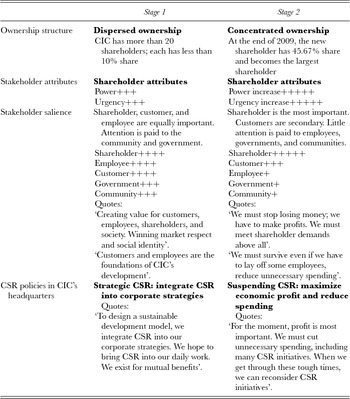
Before 2009, CIC's ownership structure was quite dispersed. As Table 2 shows, CIC had more than 20 shareholders but none owned more than 10% of the company. Therefore, the diffused stock ownership represented little power and offered little opportunity for any shareholder to influence CIC's decision making. However, the adverse performance led to strong shareholder dissatisfaction and prompted some small shareholders to sell their shares. Tianxin (TX), a large state-owned enterprise, expressed a desire to take over CIC. In December 2009, eight shareholders transferred half their shares to TX, which then became the largest CIC shareholder, with a 45.67% share. The concentrated ownership structure provided shareholders much more power to influence CIC's leadership.
Ownership structure, stakeholder salience, and CSR policies at Stages 1 and 2

Notes: We use + signs to represent the importance of stakeholder attributes and stakeholder salience. More + signs indicate a greater level of importance.
Shareholders demand profit maximization
The new power block of shareholders articulated, as soon and as clearly as possible, their demand that losses be turned into profits. At the beginning of 2010, they set a net profit goal of $150 million for the year and voiced their demands in general meetings of shareholders and in board meetings. The board of directors’ secretary said:
The new largest shareholders made it very clear that profit should be the most important focus. They demanded $150 million in profit for the year. It would be very difficult for CIC to make so much profit in such a short time.
Then the new shareholders shortened the performance evaluation period for top managers from every three years to once a year. More importantly, they abolished the original comprehensive performance evaluation system including profit rate, insurance business growth rate, insurance renewal rate, market share, new business development rate, customer satisfaction, and employee training. The new performance evaluation system kept only two indexes: profit rate and law-breaking rate. Under such conditions, CIC's managers felt powerful pressure from shareholders and felt a need to respond.
Organization Responses to Stakeholder Influences
Managers rebalance stakeholder salience
In response to shareholder claims for maximizing economic profit, CIC managers rebalanced their priorities regarding various stakeholders by giving the stronger shareholders more salience and undermining the salience of others. From the time CIC was first established, CIC managers wanted to consider all stakeholders’ interests in their efforts to remain sustainable. The former CEO often emphasized that customers and shareholders are equally important, because CIC wanted to create value for society and employees alike. Just as Table 2 shows, in stage 1, managers considered the interests of many stakeholders and gave the highest priority to shareholders, employees, and customers.
However, after the precipitating events, managers significantly changed their attitudes toward stakeholder importance. Table 2 shows that in stage 2, managers saw the shareholder block as having more power and urgency as compared with employees, customers, the government, and community stakeholders. Managers then adopted as their sole objective for 2010 the imperative to make $150 million profit to satisfy shareholder demands. Second, creating value for customers was no longer a company goal; customers were valued only for their ability to contribute to CIC profits. Third, managers significantly devalued the importance of employees, governments, and communities. At the time of our interview, more than one top manager lamented that they had to choose shareholders over other stakeholders, although the choice was not the best. A vice manager said:
Poor performance put a lot of pressure on new shareholders and the internal management team. We all knew that employees and customers are important, but we lacked choices at that time. If we couldn't satisfy shareholders’ needs, we couldn't do anything. So we had to reduce all unnecessary expenses.
Suspending CSR initiatives
By the end of 2008, CIC had established a complete social responsibility fulfillment system embracing economic, legal, ethical, and discretionary responsibilities. At stage 1, strategic CSR activities and CSR development were among its most important strategies. However, at stage 2, CIC regarded CSR as a cost to be abandoned.
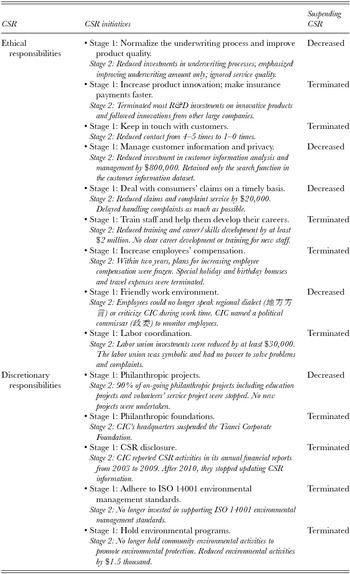
Specifically, as shareholders became more important and employees, customers, governments, and communities became less important, CIC suspended its ethical and discretionary responsibilities. Companies that are ethically responsible strive to do what is right and fair (Carroll, Reference Carroll1979), including honoring their responsibilities to employees and customers. As Table 3 shows, CIC suspended its employee responsibilities by no longer training staff members and nurturing their career development, no longer increasing employee compensation, no longer building a friendly work environment, and no longer coordinating with labor interests. CIC's Sichuan Branch cut at least $300,000 budgeted for employee training, in-service education, skills improvement, and career development and $5,000 for maintaining the labor union. Within two years, they froze increases in employee compensation and benefits. They prohibited employees from speaking regional dialects during work time. They even hired a ‘political commissar’ (政委) to investigate employees who criticized the company. Former and current employees said:
Detailed information of CSR suspension in CIC's Sichuan Branch

I think the company doesn't care about our needs any more. Everyone is stressed about improving work efficiency. I became very cautious about saying anything the company would not like because they might reduce my salary or transfer me to an unimportant job position.
As Table 3 shows, when CIC suspended its attention to customer responsibilities, it abandoned its practices of normalizing underwriting processes or improving product quality, innovating new products, striving to make insurance payments more timely, keeping in touch with customers, managing customer information and privacy, and addressing consumer complaints about products or services. CIC's Sichuan Branch significantly reduced its management of the underwriting process and focused on the underwriting numbers. Simultaneously, it substantially reduced its investments in managing customer information. It terminated its product innovation, customer service, and timely handling of customers’ complaints and fast payout responsibilities. A former customer said:
I used to trust CIC's product and service. I don't know why their services suddenly changed. I couldn't get my auto claim paid for three months. I called them again and again. They just told me to wait and then offered no further response.
Discretionary responsibilities refer to philanthropic contributions that companies choose in an effort to give back to society (Carroll, Reference Carroll1979). CIC was once known for discretionary philanthropic and environmental responsibilities, but as Table 3 shows, they ceased supporting philanthropic projects and foundations and stopped reporting CSR activities. CIC's Sichuan Branch, in particular, stopped 90% of ongoing philanthropic projects, including education and volunteer services. CIC's headquarters suspended the Tianci Corporate Foundation, founded in 2007. In addition, CIC's headquarters stopped disclosing its CSR, which it had been disclosing since 2003.
Table 3 also shows that CIC ceased honoring the ISO14001 environmental management standards and stopped holding community environmental activities to reduce their investment by $1,500. ISO14001 environmental management standards became symbolic only; staff members who had been responsible for implementing ISO14001 environmental management standards were transferred to insurance sales.
Stakeholder Responses to CSR Suspension
Employee and CIC relationships
At stage 1, CIC had very good employee relations. They provided competitive and fair compensation and benefits, comprehensive training and career development, and a pleasant work environment. CSR suspension largely undermined the relationship. First, middle- and lower-ranked staff members were deeply dissatisfied when pay increases were suspended. The unfriendly and stressful work environment exacerbated their disappointment. Two HR managers in CIC's headquarters said:
Based on my observations, many employees would like to share their happiness and sorrow with the company. However, they can't stand having low compensation while working in such a stressful environment. I am disappointed with what the company did to us. The most ridiculous is that we are not allowed to speak Shanghai dialect during our work time, even if our customers are Shanghai natives.
Second, employees lost confidence about their careers when CIC suspended employee training and career development. Many employees were angry when they were transferred from functional and technical departments to insurance sales. Some sought protection through legal avenues. Some expressed their anger through extreme behaviors such as laying siege to top managers’ offices. However, more people chose to leave the CIC. According to a former employee at CIC's Sichuan Branch:
I used to be an HR manager. However, they transferred me to sales. I don't want to stay in such a company. If they treat us well, I think many will stay and help the company recover from the financial crisis. The main reason I want to leave is that CIC is no longer a warm, friendly, and caring family.
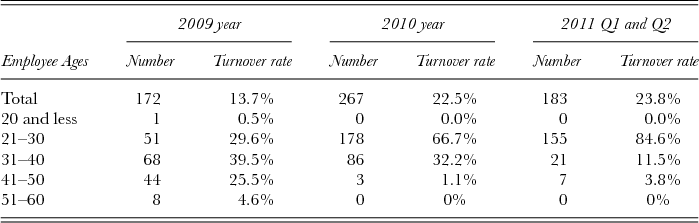
Table 4 shows that staff turnover greatly increased during 2010–2011. Young staff members or those with high positions were the majority of the departing talent. Overall, CSR suspension caused the relationship between employees and CIC to deteriorate.
Employee turnover in CIC's Sichuan Branch

Customer and CIC relationship
CSR suspension of customer responsibilities caused a sharp decrease in after-sales service and significantly damaged the relationship between customers and CIC. A manager from another insurance company said:
CIC used to be one of the most trustworthy insurance companies in China. Their former customers told me a lot about the reduced services. Customers are very sensitive to our products and services. If you don't treat them seriously and sincerely, they will leave you.
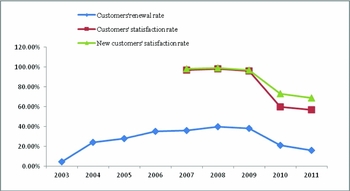
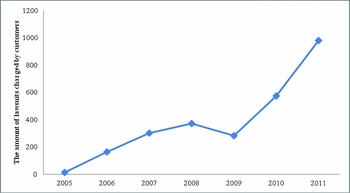
At CIC's Sichuan Branch, customers rigorously complained about their delayed insurance claims. The former customers we interviewed mentioned their dissatisfaction with CIC's delayed services. Figure 2 shows that customers’ satisfaction rates dropped dramatically during the period of CSR suspension. Second, when customers could not get timely and appropriate responses to their claims, they turned to litigation. Figure 3 shows that consumer lawsuits increased sharply, from 276 in 2009 to 1,086 in 2011. In 2010, CIC's Sichuan Branch paid $2.2 million in compensation. Many dissatisfied customers, no longer feeling loyal, left CIC. Figure 2 shows that from 2003 to 2008, the customer renewal rate rose steadily, from less than 5% to 40%. However, in 2010, the renewal rate abruptly dropped to 21%; in 2011, it dropped to 16%. Two former customers said:
Customers’ satisfaction and renewal rates in CIC's Sichuan Branch (Color online)

Customer lawsuits against CIC's Sichuan Branch (Color online)

I felt very angry with their payout service. When I bought their insurance product, they told me their product and services are the best. However, when I needed my payout, the attitude and service were terrible. I don't like this company and I have already bought a policy from another insurance company. I hate this company. I had to turn to litigation, and it took me three months to get my money back. They are liars.
Government and CIC relationship
CIC had been widely recognized and praised for its philanthropic activities. CIC maintained good relationships with local governments. Between 2003 and 2009, CIC had contracts for underwriting official government vehicles, the Xichang satellite launch, and property insurance for many large state-owned and state-holding enterprises. When CIC suspended its philanthropic responsibilities, the relationship chilled. Between 2010 and 2011, CIC was disqualified from bidding on major government projects and, in 2010, almost lost the most profitable underwriting of official government vehicles. The renewal rate for government policies declined more than 60%. According to a vice general manager in CIC's Sichuan Branch:
Suspending philanthropic projects is a bad idea that is destroying the good relationship between our company with local government. We have lost the qualification to bid for the underwriting of local government projects, and local government doesn't want to recommend projects for us.
Community and CIC relationship
Historically, CIC's Sichuan Branch had built a good relationship with local communities by sharing philanthropic and environmental activities with them. However, when CIC's Sichuan Branch suspended the activities, they distanced themselves from the local community. More importantly, CIC's Sichuan Branch lost its reputation, because its customers brought increasing numbers of lawsuits against CIC. A staff member in a community street office said:
CIC is losing its reputation in our community. When we refer customers to CIC, many complain a lot. CIC doesn't put much effort into building a long-term relationship with us and its customers. We work with many other insurance companies that hold environmental or insurance activities in our community.
In 2009, the neighborhood committees had recommended 416 customers to CIC, and 257 (62%) were successfully insured. However, in 2010, the community recommended 162 customers, and CIC enrolled only 52 (32%).
DISCUSSION
Our objective for this study is to identify conditions that might allow some stakeholders to gain power to influence firms’ decision making and to discover how firms respond to stakeholder demands. We analyze the case study of an insurance company, CIC, to show how shareholders influenced CIC to suspend its CSR. The observation allows us to generate a dynamic model of stakeholder influences and firm responses. The model shows that precipitating events disrupted the original corporate-stakeholder relations and gave shareholders the opportunity to seize power to alter the firm's CSR strategy. In response to shareholder pressure, managers rebalanced their direction so that they placed more value on shareholders and less value on other stakeholders. Focusing more on economic profit, they suspended their discretionary and ethical responsibilities. As a result, they negatively affected their relationships with other stakeholders such as employees, customers, the government, and the community. Our study provides compelling insights into the nature of stakeholder influences on organizations and on the novel phenomenon of CSR suspension in the Chinese context.
The Dynamic Model of Stakeholder Influences and Organization Responses
Prior studies on stakeholder theory view corporate-stakeholder relations as being relatively static (Freeman, Reference Freeman1984; Frooman, Reference Frooman1999), but a static view fails to fully explain dynamic changes in corporate-stakeholder relationships. Instead, we need to understand how corporate-stakeholder relations work and change over time (Parmar et al., Reference Parmar, Freeman, Harrison, Wicks, Purnell and De Colle2010). Thus, we use a case study to capture a dynamic narrative of how corporate-stakeholder relations changed and how a firm responded.
Shocks or jolts such as regulatory changes (e.g., Fligstein, Reference Fligstein1990), catastrophes (e.g., Hoffman, Reference Hoffman1999), punctuated events (Tilcsik & Marquis, Reference Tilcsik and Marquis2013), or other highly publicized dramatic events (e.g., Meyer, Reference Meyer1982) are known to disrupt socially constructed field-level consensus and, as a result, trigger organizational and institutional change. Our case study demonstrates that precipitating events did indeed disrupt the original corporate-stakeholder relationships and triggered stakeholders to change the company direction. Thus, we contribute to stakeholder theory by demonstrating precipitating events as the enabling conditions that might alter the corporate-stakeholder relationships.
While prior studies argued that stakeholders often find ways to adapt to influence firm behaviors (Eesley & Lenox, Reference Eesley and Lenox2006; Sharma & Henriques, Reference Sharma and Henriques2005), little attention is paid to exploring the process corporations might undertake to respond to stakeholder influences. We show that, in response to stakeholder influences, managers may rebalance their attitudes and priorities and then allocate resources to meet the demands of stakeholders who have the highest priorities. In the process, managers undermine the priorities of other stakeholders such as employees, customers, communities, and governments. Our CIC case study illustrates that managers responded to pressure from the stakeholders who had the greatest priority by suspending CSR investment. Therefore, we contribute to the study of stakeholder influence by identifying that stakeholder rebalancing is an important underlying mechanism between stakeholder influences and firm responsive behaviors.
Finally, we contribute to the current CSR research by exploring the antecedents and consequences of CSR suspension. Although prior studies have widely examined contextual and institutional drivers of CSR and CSR benefits (for a review, see Aguinis & Glavas, Reference Aguinis and Glavas2012; Liu, Guo, & Chi, Reference Liu, Guo and Chi2015), we add to the knowledge, explaining why socially responsible firms suspend CSR activities. We consider the influential role of stakeholders and propose a dynamic model of the antecedents and consequences of CSR suspension. Answering recent calls for focus on managerial perceptions of stakeholder salience as explanations for CSR practices (Chin, Hambrick, & Treviño, Reference Chin, Hambrick and Treviño2013), we demonstrate the importance of changed managerial perceptions of stakeholder prioritization in the process of suspending CSR activities. We also identify when and how shareholders powerfully influence or change managerial perceptions of stakeholder priority. We further demonstrate the negative consequences that CSR suspension might bring to the firm.
Limitations and Future Research Directions
This study has several limitations. First, we examined only one kind of precipitating event – adverse performance from an economic downturn. However, other external precipitating events or crises, such as social upheaval or regulatory changes, might explain why corporations suspend CSR initiatives. Future research examining other external shocks would further enrich our understanding of the novel phenomenon of CSR suspension. Second, we examined only shareholders – as one kind of stakeholder – to see how they took advantage of adverse performance. However, consumers, nongovernmental organizations, and social activists play active roles in the construction of CSR through social movements (King, Reference King2008; King & Soule, Reference King and Soule2007; McWilliams & Siegel, Reference King and Soule2001). For example, in this issue, Sun, Wang, Wang, & Yin (Reference Sun, Wang, Wang and Yin2015) find that local institutional infrastructures significantly affect corporate decisions to adopt CSR reporting. Future studies might use quantitative data to examine how local communities influence corporate decisions to suspend CSR. Also in this issue, Liu et al.'s (Reference Liu, Guo and Chi2015) meta-analytic study reports that in China, regulations, stakeholder norms, and the mindsets of top managers equally influence firms’ proactive environmental strategies, a form of CSR activities. Furthermore, Chinese firms use environmental strategies to improve both environmental and economic performance. Hence, when economic performance is under threat, firms abandon their CSR activities immediately, since they see a direct link between CSR activities and firm performance. Future research might study whether firms with stronger vs. weak managerial mindset might be more resistant to shareholder influence and less likely to suspend CSR commitment even when experiencing poor firm performance.
Managerial Implications
The stakeholder management approach suggests that corporations should address expectations and interests of a wide variety of stakeholders rather than narrowly focusing on creating shareholder value (Freeman, Reference Freeman1984). However, the approach provides little guidance to how managers should balance competing demands. We provide valuable empirical evidence that meeting one set of shareholders’ demands and ignoring other stakeholders’ needs or interests is risky. Managers cannot maximize returns to some at the expense of others. Instead, managers must balance competing claims and create a win-win situation for all stakeholders. For managers with limited resources, correctly identifying the organization's stakeholder set and accurately prioritizing stakeholder claims are keys to successful management. Inaccurate assessment of stakeholder claims can damage an organization's profitability and reputation and may even threaten a firm's survival.
CONCLUSION
Management scholars increasingly call for explorations of how stakeholders influence organizations’ decision making. Our real-life observations illustrate when stakeholders may exert their influence on organizations and how firms respond to stakeholder influences from a dynamic perspective. We hope our study stimulates more research into stakeholder influences on CSR decision making, in regard to construction and suspension. Overall, studies of stakeholder influence are important for both stakeholder theory and corporate social responsibility.