Introduction
Cadillo, also known as caesarweed, aramina, hibiscus burr, and jute africain (USDA 2018), is an annual herb in the Malvaceae family that behaves as a short-lived perennial under environmental conditions in Florida. Cadillo is originally from Asia, but it has spread throughout most tropical and subtropical regions of the world and is commonly found invading pastures, rangeland, poorly managed areas, and natural areas (Wang et al. Reference Wang, Ferrell, MacDonald and Sellers2009). Cadillo has the ability to grow over a wide range of altitudes and has been reported growing from near sea level to approximately 1,000 m above sea level (Awan et al. Reference Awan, Chauhan and Cruz2014). In addition, it thrives under a wide variety of soil types and can reach 3 m in height with woody stems at maturity (Francis Reference Francis2003). Moreover, cadillo can produce up to 600 seeds per plant per year, and seed is the primary means of spread (Harris and Brewah Reference Harris and Brewah1986). Dispersion is aided by livestock or humans because of the barbed trichomes on the fruit capsule that cling to fur or clothing.
According to the Florida Exotic Pest Plant Council, cadillo is listed as a Category I species on the list of nuisance plants, implying that this species is increasing in number and causing ecological harm (FLEPPC 2017). Fagundes (Reference Fagundes2002) stated that this species has been found to be aggressive in nature, commonly causing severe infestations when not managed. Furthermore, the University of Florida Institute of Food and Agricultural Sciences Assessment of non-native plants in Florida’s natural areas recommends against any agronomic use of this species throughout the entire state of Florida (UF/IFAS 2018).
Cadillo is frequently found infesting pastures of bahiagrass (Paspalum notatum Flueggé), the most widely used forage of cow/calf operations in Florida (Burton et al. Reference Burton, Gates and Gasho1997; Chambliss Reference Chambliss1996). Even though the impacts of cadillo interference on bahiagrass have not been identified, the presence of cadillo in bahiagrass pastures probably reduces both forage productivity and availability, as has been observed with dogfennel [Eupatorium capillifolium (Lam.) Small] (Dias et al. Reference Dias, Sellers, Ferrell, Silveira and Vendramini2018). This is especially relevant in that bahiagrass does not tolerate shading (Trenholm et al. Reference Trenholm, Unruh and Cisar2015). Because heavy infestations of cadillo have been observed to create a dense canopy and affect bahiagrass production (BA Sellers, unpublished data), control options for this species are necessary.
Previous research on cadillo control is limited. Cadillo has been grown in Sierra Leone as a fiber crop (Harris Reference Harris1981), and most of the research conducted on cadillo has focused on attempts to enhance plant growth rather than control it (Wang et al. Reference Wang, Ferrell, MacDonald and Sellers2009). Therefore, it is important to investigate the susceptibility of cadillo to different control management strategies, especially the use of herbicides.
Some of the herbicides most commonly used in permanent grass pasture systems in Florida include triclopyr, fluroxypyr, and aminopyralid (Abe et al. Reference Abe, Sellers, Ferrell, Leon and Odero2016; Sellers et al. Reference Sellers, Ferrell, MacDonald and Kline2009). These herbicides are classified as synthetic auxin herbicides and belong to the pyridine carboxylic acid family (Shaner Reference Shaner2014). Triclopyr has activity on broadleaf brush-type species such as blackberry (Rubus spp.) (Ferrell et al. Reference Ferrell, Sellers, MacDonald and Kline2009), dogfennel (MacDonald et al. Reference MacDonald, Brecke, Colvin and Shilling1994; Sellers et al. Reference Sellers, Ferrell, MacDonald and Kline2009), tropical soda apple (Solanum viarum Dunal) (Call et al. Reference Call, Coble and Perez-Fernandez2000), and southern waxmyrtle [Morella cerifera (L.) Small] (Kalmbacher et al. Reference Kalmbacher, Eger and Rowlandbamford1993). Aminopyralid (AMP) and fluroxypyr are used to control annual and perennial broadleaf weeds in permanent grass pastures, rangeland, and non-cropland areas (Shaner Reference Shaner2014). AMP is highly active on many invasive plant species such as Canada thistle [Cirsium arvense (L.) Scop.] (Enloe et al. Reference Enloe, Lym, Wilson, Westra, Nissen, Beck, Moechning, Peterson, Masters and Halstvedt2007), tropical soda apple (Ferrell et al. Reference Ferrell, Mullahey, Langeland and Kline2006), Russian knapweed [Rhaponticum repens (L.) Hidalgo] (Enloe et al. Reference Enloe, Kyser, Dewey, Peterson and DiTomaso2008), and largeleaf lantana (Lantana camara L.) (Ferrell et al. Reference Ferrell, Sellers and Jennings2012). In addition, fluroxypyr has been increasingly used in Florida because of its efficacy against dogfennel (MacDonald et al. Reference MacDonald, Brecke, Colvin and Shilling1994; Sellers et al. Reference Sellers, Ferrell, MacDonald and Kline2009), a very common broadleaf pasture weed in Florida (Sellers and Ferrell, Reference Sellers and Ferrell2016).
Given the need to identify effective chemical control options to reduce the spread of cadillo, the main objective of this research was to evaluate herbicides for effective POST control of cadillo in Florida pastures. We hypothesize that POST herbicides commonly used in Florida’s pastures and natural areas will effectively control cadillo.
Materials and Methods
An initial greenhouse screening experiment was conducted to evaluate the effectiveness of various POST herbicides, applied either alone or in mixtures to control cadillo. Results from the greenhouse experiment were used to refine the treatments included in the field study.
Greenhouse Screening Study
Cadillo seeds were collected from various locations at the University of Florida Institute of Food and Agricultural Sciences Range Cattle Research and Education Center (RCREC), near Ona, FL (27.39° N, 81.94° W, 29 m altitude), in 2014. Immediately after collection, seeds were separated from undesired materials and stored in paper bags in the shade. Seed coats were physically broken by rubbing seeds between two wood blocks lined with sandpaper before planting into 5- by 5-cm pots uniformly filled with commercial potting medium (Fafard Mixes for Professional Use, Conrad Fafard Inc., Agawan, MA) amended with 14-14-14 slow-release fertilizer (Osmocote Smart-Release Plant Food, Scotts-Sierra Horticultural Products Co., Marysville, OH). Two seedings were made on May 6 and June 10, 2015. Pots were thinned to one plant per pot at the one-leaf growth stage. Plants were supplied with adequate water and kept in greenhouse conditions at 30 C day/24 C night temperature. Artificial lighting was provided to ensure a 14-h photoperiod.
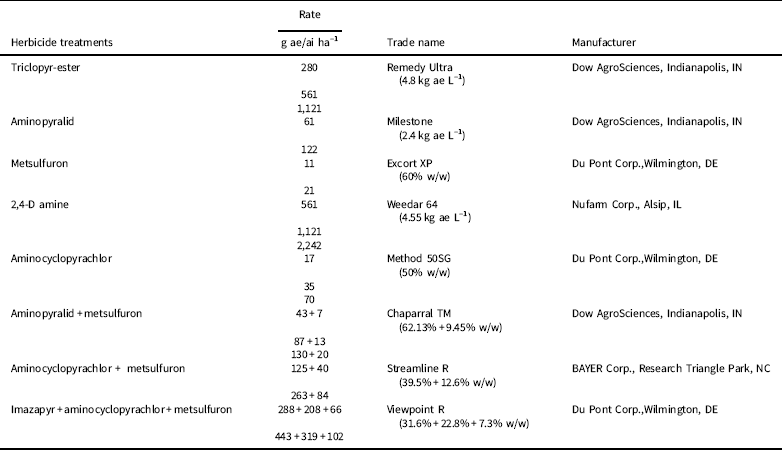
POST herbicide treatments were applied approximately 30 d after seeding with a compressed air–powered moving-nozzle spray chamber (Generation II Spray Booth, Devries Manufacturing Corp., Hollandale, MN) equipped with a Teejet 8001 EVS spray nozzle (Teejet Technologies Southeast, Tifton, GA) calibrated to deliver 187 L ha–1 at 172 kPa. A list of herbicide treatments and rates is provided in Table 1. All treatments included a nonionic surfactant (Activator 90®, Loveland Products Inc., Greeley, CO 80632) at 0.25% v/v. Cadillo plants were at the five- to nine-leaf growth stage at time of application. Plants were returned to the greenhouse following herbicide treatment and maintained as previously described.
Herbicide treatments used in the greenhouse experiment.

The experimental design was a randomized complete block design with six replications. Even though the experiment was conducted under controlled greenhouse conditions, plants were not uniformly sized; therefore, plants were blocked by size. A single pot served as the experimental unit. The cadillo control was visibly evaluated 14, 21, and 28 d after treatment (DAT). Visible comparisons of each treated pot to the nontreated control were made on a rating scale of 0 (no control) to 100% (complete absence of live cadillo leaves or stem) control. The cadillo control was also quantitatively assessed by clipping the aboveground biomass at the soil surface at 28 DAT, drying at 60 C for 72 h, and recording dry weights. Biomass data were converted into percent biomass reduction of the nontreated plants within each replication.
Field Study
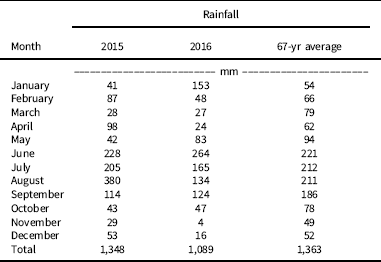
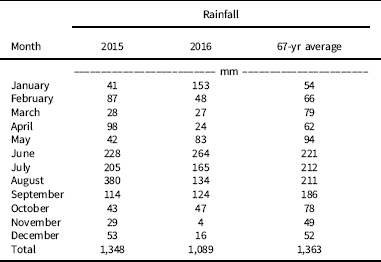
Based on the results from the greenhouse experiments, field experiments were conducted with selected treatments at the RCREC near Ona, FL, in 2015 and 2016 (27.38° N, 81.94° W, 29 m altitude). The experiments were conducted on a pine (Pinus elliotii Engelm.)–bahiagrass silvopasture, and different locations within the same silvopasture were used in 2015 and 2016. The predominant soil type at both locations consisted of Ona fine sand (sandy siliceous, hyperthermic Typic Alaquods); soil pH was 4.8 and organic matter was 3.43% before initiation of the study. Monthly rainfall and yearly totals of 2015 and 2016 were obtained from the weather station located at the research center and are presented in Table 2.
Monthly rainfall at the Range Cattle Research and Education Center (RCREC) near Ona, FL, in 2015 and 2016.
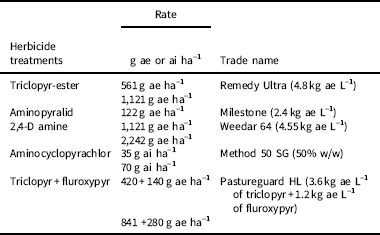
Herbicide treatments were applied July 30, 2015 and August 16, 2016 with a tractor-mounted, compressed-air broadcast sprayer equipped with a 3-m boom with 8 flat-fan nozzles calibrated to deliver 233 L ha−1. Plants were approximately 2 m tall at the time of application. Nonionic surfactant (Activator 90®, Loveland Products Inc., Greeley, CO 80632) was added to all treatments at 0.25% v/v. Treatments that contained metsulfuron were not included in the field experiments because of unacceptable injury to bahiagrass (Bunnell et al. Reference Bunnell, Baker, McCarty, Hall and Colvin2003). Herbicide treatments and rates are listed in Table 3. A premix of triclopyr+fluroxypyr was included, as it is one of the most popular treatments currently utilized in Florida pastures for dogfennel management (Sellers and Ferrell Reference Sellers and Ferrell2016).
Herbicide treatments used in field experiments.

The experimental design was a randomized complete block design with four replications. Experimental plots were 6 m wide by 15 m long, and each plot was sprayed with two passes of the tractor. Control of established cadillo plants in the field was visibly evaluated 15, 30, and 60 DAT. Visible evaluations were made as previously described in the greenhouse experiments.
Data Analysis
Data were subjected to ANOVA using the “aov()” function in R (R Development Core Team 2008) to test for experimental run and herbicide treatment effects in the greenhouse experiment, and for year and herbicide treatment effects in the field experiment. Treatments and interactions were considered significant when P≤0.05. If interactions were not significant, data were pooled across runs (greenhouse study) or years (field study). Normality, independence of errors, and homogeneity were visibly examined, and no transformations were necessary. Means were separated at P≤0.05 with Fisher’s protected LSD test where the ANOVA indicated that treatment effects were significant.
Results and Discussion
Greenhouse Screening Study
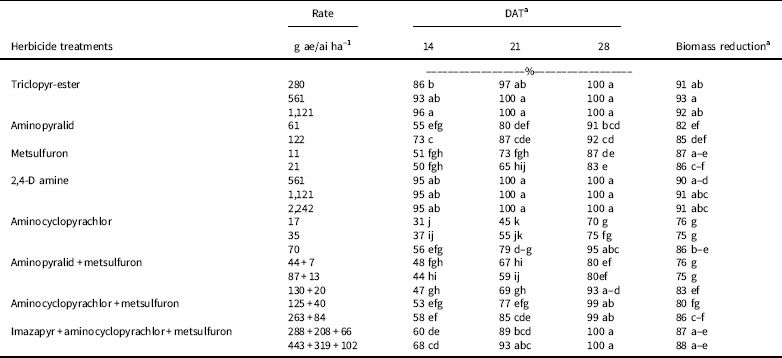
There was no experimental run–by–herbicide treatment interaction for cadillo visible percent control at any evaluation timings; therefore, data were pooled across experimental runs (Table 4). However, herbicide treatment was significant for cadillo visible control at 14 (P≤0.05; Table 4), 21 (P≤0.01; Table 4), and 28 DAT (P≤0.01; Table 4).
Visible estimates of cadillo control 14, 21, and 28 d after treatment (DAT) and dry biomass reduction 28 DAT following POST herbicide treatments under greenhouse conditions near Ona, FL, in 2015.

a Means within columns followed by the same letter are not significantly different according to Fisher’s protected LSD test at P ≤ 0.05. Means were averaged over experimental run and replicates.
Triclopyr applied at 561 and 1,121 g ha−1 and 2,4-D at 561, 1,121, and 2,242 g ha−1 provided >90% control 14 DAT (Table 4). Triclopyr at 280 g ha−1, AMP at 122 g ha−1, and the high and low rates of imazapyr (IMA)+aminocyclopyrachlor (ACP)+metsulfuron resulted in 86%, 73%, 68%, and 60% control, respectively. All other herbicide treatments provided <60% control. Cadillo control increased with all treatments from 14 to 21 DAT (Table 4). At 21 DAT, the most effective treatments were all rates of triclopyr and 2,4-D, as well as high rate of IMA+ACP+metsulfuron. Both rates of AMP and the high rate of ACP+metsulfuron, and low rate of IMA+ACP+metsulfuron resulted in similar control, ranging from 80% to 89%. All other herbicide treatments provided <80% control.
Visible estimates of control for most herbicide treatments continued to increase from 21 to 28 DAT. Triclopyr, 2,4-D, ACP at 70 g ha−1, AMP+metsulfuron at 130+20 g ha−1, ACP + metsulfuron, and IMA+ACP+metsulfuron all provided at least 93% control. AMP at 61 and 122 g ha−1 also provided effective control (>90% control); however, AMP performance at both rates was significantly lower than the previous herbicide treatments. Metsulfuron-alone treatments provided at least 83% control, whereas the two lower rates of AMP+metsulfuron provided 80% control. The low rate of ACP (17 g ha−1) provided only 70% control, which was not significantly different from ACP at 35 g ha−1 with 75% control.
Similar results were reflected in cadillo biomass reduction 28 DAT. There was no experimental run–by–herbicide treatment interaction, but the treatment effect was significant (P<0.001; Table 4). Although the only treatments that provided >90% biomass reduction 28 DAT were those that contained triclopyr and 2,4-D, most herbicide treatments reduced cadillo biomass by at least 80%. The exceptions were the middle and low rates of ACP and AMP+metsulfuron, which provided ≤76% biomass reduction.
Among all herbicide treatments used in the greenhouse study, metsulfuron and IMA are the only ones that are not synthetic auxin herbicides. Metsulfuron and IMA are acetolactate synthase–inhibitor herbicides (Shaner Reference Shaner2014) and therefore would add a different mode of action to the herbicide management program of cadillo, thus reducing the probability of resistance. However, the use of metsulfuron and IMA is limited on account of crop safety. Metsulfuron can be applied to bermudagrass [Cynodon dactylon (L.) Pers.] and limpograss [Hemarthria altissima (Poir.) Stapf & C.E. Hubbard] pastures in Florida (Abe et al. Reference Abe, Sellers, Ferrell, Leon and Odero2016; Lastinger et al. Reference Lastinger, Sellers, Ferrell, Vendramini and Silveira2016), but this herbicide cannot be applied to bahiagrass because of crop injury (Bunnell et al. Reference Bunnell, Baker, McCarty, Hall and Colvin2003). Furthermore, IMA can only be applied to dormant bahiagrass with <25% green foliage (Anonymous 2018). In summary, the greenhouse results suggested that control of cadillo can be effectively achieved by many different herbicides commonly used in permanent grass pastures and natural areas in Florida.
Field Study
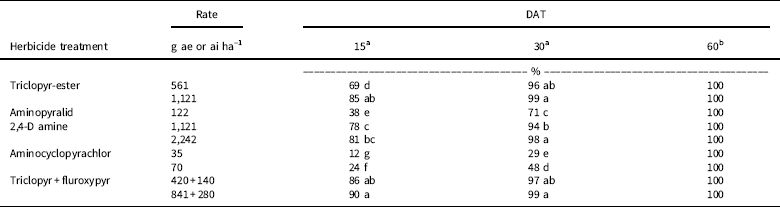
There was no year-by-herbicide treatment interaction for cadillo visible estimates of control at any of the evaluations; therefore, data were pooled across years. However, herbicide treatment was significant for cadillo visible control 15 DAT (P<0.01) and 30 DAT (P<0.01). At 15 DAT, triclopyr+fluroxypyr and triclopyr at 1,121 g ha−1 provided at least 85% control. The high rate of 2.4-D provided 78% control, whereas all other treatments provided <70% control (Table 5). Control with ACP and AMP was less than 25% at this rating date.
Visible estimates of field populations of cadillo control at 15, 30, and 60 d after treatment (DAT) with POST-applied herbicides near Ona, FL, in 2015 and 2016.

a Means within columns followed by the same letter are not significantly different according to Fisher’s protected LSD test at P ≤ 0.05. Means were averaged over years and replicates.
b At 60 DAT all treatments provided 100% of visible control; therefore, no statistical analysis was performed.
At 30 DAT, an overall increase in herbicide efficacy was observed for all herbicide treatments (Table 5), as was observed in the greenhouse study (Table 4). Despite the statistical differences, the premix of triclopyr+fluroxypyr, 2,4-D, and triclopyr resulted in at least 94% control. Conversely, AMP at 122 g ha−1 provided 71% control, and ACP at both rates resulted in 29% to 48% control.
All herbicide treatments provided 100% control 60 DAT (Table 5), suggesting that all herbicides utilized in this study can effectively control established cadillo plants under field conditions. The extended time period needed for complete control of perennial species with synthetic auxins has been reported in other research. Ferrell et al. (Reference Ferrell, Mullahey, Langeland and Kline2006), studying permanent grass pastures, suggested a similar trend, as AMP and triclopyr resulted in 72% and 93% control of tropical soda apple at 50 DAT, respectively. Conversely, by 150 DAT control was at least 82%, with no differences between the two treatments. Durham et al. (Reference Durham, Ferrell, Minogue, MacDonald and Sellers2016) reported mat lippia [Phyla nodiflora (L.) Greene] control with ACP increased over time. ACP and 2.4-D provided 71% and 86% control of 30 DAT, respectively, but by 150 DAT both provided >90% control. These data collectively imply that AMP and ACP might be slower in achieving satisfactory perennial weed control compared to the standard synthetic auxin herbicides triclopyr and 2,4-D.
Awan et al. (Reference Awan, Chauhan and Cruz2014) reported that 2,4-D-ester at 0.5 kg ha−1 provided 98% and 85% control of four- and six-leaf stage cadillo, respectively. In our greenhouse study, 2,4-D provided 100% control regardless of rate, yet we used 1,120 kg ha−1 of 2,4-D rate in our field study. Therefore, effective control of cadillo might also be achieved with lower rates of 2,4-D. Among all herbicides tested in the field experiments, AMP and ACP are the only ones with significant soil residual activity (Shaner Reference Shaner2014). AMP appeared to provide cadillo residual control 1 yr after treatment at the location treated in 2015, but not at the location treated in 2016 (data not shown). Therefore, future research assessing the ability of these two and other compounds in providing long-term cadillo residual control in a wider range of soil types and environmental conditions is necessary and would benefit the overall cadillo management program.
Mowing or chopping are the most commonly employed weed control strategies in permanent pastures systems in Florida (Crawford et al. Reference Crawford, Kirby, Prevatt, Sellers, Silveira, Stice and Wiggins2011), and we estimate that only 10% of pastures are treated on an annual basis. Although mechanical control methods have the potential to be effective weed control practices when properly adopted, they tend to only suppress or retard regrowth of perennial species, especially when used as the sole management practice. These studies show that cadillo is susceptible to many common herbicides already available for weed control in permanent grass pastures and natural areas in Florida, suggesting that effective control of cadillo can be obtained through traditional herbicide management programs. Therefore, pastures should be scouted and cadillo infestations properly managed before infestation levels affect forage production.
Acknowledgements
No conflicts of interest have been declared. This research received no specific grant from any funding agency, commercial, or not-for-profit sectors.