When I began my research on Leonard Bernstein's affiliation with Brandeis University, it did not seem to fit neatly within the other projects undertaken in our “Bernstein's Boston” seminar, which focused on Bernstein's childhood and early adulthood in Boston during the 1920s, 1930s, and early 1940s. Bernstein began teaching at Brandeis in 1951, eight years after his conducting premiere with the New York Philharmonic catapulted him to stardom and away from Boston for good. He did not live in Boston when he taught at Brandeis—he commuted from his home in New York (and elsewhere). Could Bernstein's affiliation with Brandeis truly be considered part of an official “Bernstein's Boston”?
In the spirit of this seminar, the principal sources for my research were rooted locally, drawing mainly on the archives at Brandeis University and interviews both within and outside the classroom.Footnote 1 After spending time with these materials, I have come to believe that Bernstein's time at Brandeis is, indeed, directly related to his early years in Boston. I became increasingly intrigued by the question of why Bernstein chose to spend his time in Waltham. By the early 1950s Bernstein had achieved international celebrity and was busy with multiple conducting and composition projects. Why did he commit to teaching at Brandeis and continue to support the school until the end of his life? One could certainly point to Bernstein's lifelong interest in teaching, as demonstrated by his years at Tanglewood, as well as his Young People's Concerts and Omnibus television series and, later, his Norton lectures at Harvard. But why did he choose to teach at Brandeis, rather than a more established university, or one closer to his home in New York? Bernstein's commitment to Brandeis can be understood as a manifestation of his ongoing connection and sense of duty to the Boston Jewish community of his youth, and to his father. This article provides a brief history of Bernstein's activities at Brandeis, but its focus is on the ways in which Bernstein's affiliation with the university can be understood as an expression of his ties to his Jewish roots in Boston, as well as to the Jewish immigrant experience of his parents and his parents’ generation.
Bernstein at Brandeis: An Overview
Brandeis is a Jewish-sponsored, nonsectarian university, founded on the site of a former medical and veterinary school in Waltham in 1948.Footnote 2 The music program began in 1949 as part of the School of Creative Arts, with harpsichordist and musicologist Erwin Bodky as its sole faculty member.Footnote 3 In 1950 Brandeis hired Irving Fine, who left a position at Harvard to join its faculty.Footnote 4 Fine soon lured many prominent American composers to campus as guest lecturers and jointly taught a course on twentieth-century music with Aaron Copland.Footnote 5 In 1951 the university became a four-year school, and Brandeis President Abram Sachar suggested to Fine that they “dare a quantum coup” to ask Leonard Bernstein to serve on the faculty.Footnote 6 Sachar described his trip to Tanglewood with donor Adolph Ullman for a meeting with Bernstein, writing that he “made an unabashedly sentimental appeal. I emphasized to Bernstein what Brandeis meant as a symbol, how important it was for us to fulfill highest expectations in the areas we had charted as unique for our concentration, and that he would be making a pivotal contribution if he joined the music faculty in our beginning years.”Footnote 7 Their sales pitch was successful, and Bernstein's connection with Brandeis thus began in the spring of 1951, when he taught a course in modern music.Footnote 8 President Sachar described this course as a “tour de force” that Bernstein would later draw upon for his Omnibus television lectures.Footnote 9
The following summer Bernstein directed Brandeis's first Creative Arts Festival, which coincided with the university's first commencement ceremonies in June 1952.Footnote 10 The ambitious festival featured high-profile premieres of Bernstein's opera Trouble in Tahiti and Marc Blitzstein's adaptation of the Weill-Brecht Threepenny Opera; symposia on topics such as “the present state of creative arts” and the crisis of “intellectualization” in contemporary jazz; poetry readings; art film screenings; a jazz concert featuring Miles Davis, John Mehegan, Lenny Tristano, and others; a dance concert of works choreographed by Merce Cunningham, including Stravinsky's Les Noces; and a symphony concert in memory of Serge Koussevitzky (who had died in 1951), with members of the Boston Symphony Orchestra under Bernstein's direction playing works by Benjamin Britten, Aaron Copland, Irving Fine, William Schuman, and Ben Weber.Footnote 11 Modeling itself on elite arts festivals such as those in the Berkshires, Aspen, and Salzburg, festival planners hired professional performers rather than students.Footnote 12 Bernstein biographer Humphrey Burton noted that the first festival was pronounced a success by the press and that “Bernstein had given Brandeis University a national profile.”Footnote 13 And not just any profile, because the festival left Bernstein's unique imprint on the creative arts at Brandeis. As Carol Oja notes, Bernstein “ambitiously challenged traditional cultural hierarchies” in the festival program by treating jazz as a serious art form and presenting theatrical works that blurred the divide between opera and musical theater.Footnote 14 Although there was a distinct focus on the new, with programming skewed toward contemporary American composers and symposia that explored the relevance of the arts in present-day society, Bernstein was also mindful of tradition, paying tribute to Boston's (and his own) classical music roots by dedicating the symphony concert to the memory of his mentor Koussevitzky.Footnote 15
During the following academic year, Bernstein taught two courses: one on the modern symphony in the fall of 1952, and another on modern opera in the spring of 1953.Footnote 16 Judith Cohen, a member of the Brandeis class of 1954 who was enrolled in the opera course, noted in an interview that Bernstein would fly into Boston from New York once a week to teach, and that “he was always in hurry, always rushing.”Footnote 17 She went on to describe the scene when Bernstein came to Ford Hall, which was the main academic building at the time:Footnote 18
Upstairs in Ford Hall there was a fairly large, open room, and this was the place where the piano was. And of course, no elevator or anything like that at the time. . . . But everyone knew Bernstein was on campus when he would come. So there were 109 people in my [graduating] class, and everyone was there, plus the two other classes. So the place was mobbed. . . . He had to pretty much fight his way up the stairwell, up to the top floor of this building. Of course, everybody parted when they realized who it was. And he'd come running down the corridor. Not walking, running. And he would throw off his coat—his topcoat, and then his sport coat, and he'd undo his tie. And he'd take two hands and ruffle up his hair, pull out the piano bench, and he would sit down, and he would play. . . . I mean, this was a theater performance, and I'm sure he must have known that he had several hundred kids right there in the palm of his hand. There wasn't a peep in the class. I mean, somebody could be stepping on your toe, it was so crowded, and nobody would make a sound.Footnote 19
Cohen's description of an overflowing classroom captivated by Bernstein's “performance” conveys the electric effect of his presence on campus. Her memory is corroborated by Irving Fine, who said that when Bernstein lectured, “singing practically all the roles” for his opera course, “the hall would be jammed with students enrolled in the course, other students, faculty members, everyone who could possibly squeeze in. It was always a brilliant performance.”Footnote 20
The next summer, in 1953, Bernstein directed the second Creative Arts Festival, which was scaled back in scope and budget from its inaugural year.Footnote 21 The theme was “The Comic Spirit,” and as was true in the first festival, Bernstein's predilection for blurring lines between high and low culture was in evidence. The program included a panel on comedic techniques moderated by the radio star Fred Allen and author S. J. Perelman, as well as a performance of Morton Gould's Concerto for Tap Dancer with Broadway dancer Danny Daniels; the American premiere of Poulenc's comic opera Les Mamelles de Tiréseas; and a reading of a new comedy by Louis Kronenberger entitled “The International Set,” featuring Bernstein's wife, Felicia Montealegre.Footnote 22
The choice of comedy as the festival's theme is interesting in light of the central role of humor in Bernstein's life, beginning in childhood.Footnote 23 As his brother Burton Bernstein commented in an interview: “When I think of Lenny, and youth, and Boston and its environments, what comes to mind more than anything else to me, is humor, laughter, jokes. And I can't emphasize this enough. That was so important to Lenny in his life. Humor, it was as important as notes and words were to him.”Footnote 24 A prime example of the prominent role of humor in Bernstein's youth is his invention of “Rybernian,” a language and culture based largely on the accents and malapropisms of anyone who “talked funny”—often immigrants such as his father and his friends, and later even Bernstein's mentor Koussevitzky.Footnote 25 On some level Rybernian can be understood as a way of using humor to deal with more serious issues of alienation and isolation that go along with the immigrant experience. With the 1953 festival, Bernstein showed a similar interest in turning to humor to deal with difficult times—in this case, in response to a general climate of fear and suspicion as manifested in McCarthyism and the Red Scare. Bernstein was listed in the 1950 tract Red Channels and briefly had his passport suspended, but he was never called to appear at a House Committee on Un-American Activities or McCarthy hearing in the Senate.Footnote 26 However, many of his friends and colleagues were subpoenaed during this time, and Humphrey Burton links Bernstein's “deflated mood” that summer to choreographer Jerome Robbins's HUAC testimony in which he named names, which took place on 5 May 1953.Footnote 27 As Bernstein wrote in the festival program:
I sometimes think that Man's capacity for laughter is nobler than his divine gift of suffering. Laughing cleanses a man: it restores his sanity, and balances his sense of values. Now in a time of caution and fear, in an atmosphere turgid with non-direction and non-expressivity, let us laugh and let laugh, lighten the air we breathe, and feel clean.Footnote 28
After that summer Bernstein asked to be relieved of his teaching duties, writing to President Sachar,
It has finally dawned on me that I have been dancing at far too many weddings (please translate). I have always faced a rather severe problem in trying to balance the creative and performing sides of my life—either of which should properly be a full-time matter. . . . But I have learned that putting one foot, however tentatively, into the academic world constitutes a real plunge. I love to teach; and therefore I agreed to try a one-semester plan last year, experimentally. I cannot carry that experiment forward next year, since the other active ogres have caught up with me.Footnote 29
Bernstein also withdrew from his role as director of the festival, noting with admiration the audacity of their scope, as well as the toll they had taken on him:
My two experiences with the Festival have been rewarding, if difficult in the extreme. It is almost mad of Brandeis to have attempted them, given a new school with all its problems and so small a staff. (To say nothing of so small a budget.) We have pulled them off, though, somehow, and to the great glory of the school. Even this last festival, which you seem a bit unenthusiastic about, made a deep impression on the most hardened sophisticates. But it has been done largely through shnorring [begging], and I can schnorr no more. I think that that cost me more years of my life than any other activity I can remember.Footnote 30
After a year's leave, however, Bernstein was lured back to Brandeis in the fall of 1954, when he taught a composition workshop to a select group of students, using his own process of writing Candide as a teaching tool by asking students to tackle the same compositional problems he faced in adapting Molière's play as a musical work.Footnote 31 Although Bernstein found the idea of this course to be “terribly exciting,” and Jack Gottlieb, a student in the course, described it as “immensely stimulating,” it was to be Bernstein's last at Brandeis.Footnote 32 After spending several semesters on a leave of absence, Bernstein officially stepped down as a faculty member in 1956, rejecting a plan by which he would have led composition “clinics” throughout the year.Footnote 33 Bernstein obviously felt that he could not give as much time to Brandeis as was needed. He protested to Sachar that the number of course meetings they had previously agreed upon
seems to me both too small properly to serve the students and too large for my schedule to contain. This creates a situation in which I can only feel guilty about accepting a salary, in addition to the guilt I feel toward my other commitments from which I am stealing time, energy and concentration in order to perform an academic duty which is itself unrewarding. In other words, it is unfair both to Brandeis and to me.Footnote 34
Sachar grudgingly accepted Bernstein's resignation from the faculty, and wrote earnestly, “I want to thank you most heartily for the identification which we have had. I do not think that you yourself will ever know what it has meant to a young University which has been obliged, because it is so late in its arrival in the academic world, to telescope decades of development into a few short years.”Footnote 35 In response, Bernstein effused:
Thank you and bless you. You are a great and good man, and what is more, an understanding one. I feel ten years younger since your letter, infinitely less guilty, and twice as fond of Brandeis. Let it be understood that I do not want in any way to break the relationship, which is dear to me. Anything I can do for Brandeis which is in my power to do will always give me pleasure and satisfaction. Don't hesitate to call on me.Footnote 36
Indeed, Bernstein remained active as a fundraiser for the university, and his affiliation and support continued throughout his life.Footnote 37
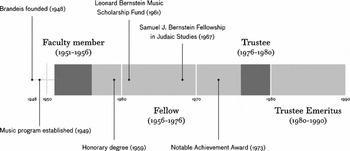
Thus Bernstein served as a Brandeis faculty member from 1951 to 1956, a Fellow from 1956 to 1976, a Trustee from 1976 to 1980, and a Trustee Emeritus from 1980 until his death in 1990 (Fig. 1).Footnote 38 He was awarded an honorary doctorate in 1959 and the university's Notable Achievement Award in 1973. In addition to his fundraising activities on behalf of the university, Bernstein himself was a generous donor, establishing the Leonard Bernstein Music Scholarship Fund in 1961 and a one-time graduate fellowship in Judaic Studies in 1967 (which I will discuss further below). Bernstein's lifelong commitment to Brandeis is indisputable, and the evidence has led me to believe that it stems from a sense of pride in his Jewish identity, as well as a deep sense of duty and obligation to Boston's Jewish community and, more specifically, to his father.
Timeline of Bernstein's association with Brandeis. Graphic courtesy of Benjamin Shaykin.

Bernstein, Boston, and Jewish Identity
The influence of Judaism on Bernstein, manifested in works such as his Symphony No. 1 (Jeremiah), Symphony No. 3 (Kaddish), and the ballet suite Dybbuk, has been well documented by scholars.Footnote 39 His Jewish identity—which he never hid or shied away from at the height of his celebrity—is certainly an important part of Bernstein's image as a public figure. Indeed, Sachar hints that it was this pride in his Jewish heritage that led him to agree to join the Brandeis faculty, as he describes in his memoir about the school's founding:
At that time, I did not know what has since been confirmed. It seems that Koussevitzky, himself a Russian-born Jew who had encountered difficulties in his own early career, had often urged Bernstein to Anglicize his name. Bernstein steadfastly refused. He would make it as Bernstein or not at all. Perhaps it was this quality of unintimidated pride, as well as some of the glittering unrealities I put to him, that helped to bring about his decision.Footnote 40
Such pride in his Jewish identity was surely a factor in his decision to join the Brandeis faculty. However, the fact that Brandeis was based in the Boston area, supported by Boston Jews, was likely an important aspect as well. Bernstein retained a strong connection to Congregation Mishkan Tefila, the conservative synagogue to which his family belonged in Roxbury.Footnote 41 The music director, Professor Solomon Braslavsky, was a Russian émigré educated in Vienna, and he brought to Roxbury the grand tradition of liturgical music from the famous Viennese temples, with organ accompaniment and full choral settings.Footnote 42 Bernstein counted Braslavsky as one of his earliest mentors, who first introduced him to European art music and inspired him to draw on Jewish music in his own compositions. As he wrote to the elderly Braslavsky in 1973, “I think of you very often, and never forget the tremendous influence you and your music made on me when I was a youngster. I am always grateful and remember you tenderly.”Footnote 43 Bernstein returned to the synagogue of his youth for major rites of passage in his adult life, including his marriage to Felicia Montealegre and the bar mitzvah of his son Alexander.Footnote 44 His roots in Jewish Boston ran deep and were not severed even after he moved to New York.
The secular orientation of Brandeis was another factor that likely appealed to Bernstein, who was not a strictly observant Jew but who strongly identified with Jewish culture and traditions. As Sachar described Brandeis's conception, “The model was to be not the Yeshiva or Catholic University of America or Baylor, but rather Harvard or Princeton or Swarthmore.”Footnote 45 Brandeis, in this view, represented American Judaism's chance to join the long history of religious denominations that had established secular colleges in the United States; it was less about establishing a specifically Jewish university than about what Sachar calls “pride of sponsorship, the comfort of playing host, the satisfaction of fulfilling a religious mission in modern, practical terms of service to the common good.”Footnote 46 It was about acceptance and assimilation, of Jews becoming a part of the fabric of American life: “the ultimate synthesis, in short, of American and Jew.”Footnote 47 This theme resonates with the Bernstein family's upward mobility during Leonard's childhood, from increasingly spacious apartments in the Jewish neighborhoods of Mattapan and Roxbury to a stately brick home in Newton. In the 1930s Newton was “both genteel and Gentile,” a place for newly successful Jews to escape from Boston's inner-city Jewish neighborhoods in pursuit of a universal American dream.Footnote 48 Just as the Bernsteins established their “Americanness” by living comfortably next to their Christian neighbors, Brandeis was attempting to show that Judaism was as much a part of American public life in the mid-twentieth century as those Christian denominations that had founded secular colleges in centuries past.
On a broader level, the founding of Brandeis fits in with what Jonathan Sarna has called a “new era in American Judaism” that took hold in the postwar United States.Footnote 49 During this period Jews made inroads into many facets of mainstream American culture, with the first Jewish Miss America (Bess Myerson) and the first Jewish baseball star (Hank Greenberg) both being crowned as heroes in 1945.Footnote 50 Certainly the ambitious scope of Brandeis's first Creative Arts Festival can be understood within the context of this new era of Jewish aspiration and acceptance. Sarna points out that such achievements were important symbols of “affirmation” in the wake of the Nazis’ decimation of European Jewry, which shifted the center of Jewish culture from Europe to the United States.Footnote 51 Rabbi Israel Goldstein, an early leader in the creation of Brandeis, framed the university's future in terms of this new sense of obligation, concluding his 1951 memoir on Brandeis's founding with these words:
The barbaric decimations which have ravaged Jewish communities in Europe during the black Hitler decade, and the blight now withering Jewish cultural and spiritual self-expression in totalitarian regimes on that continent, challenge American Jewry to become, next to Israel, the chief saving remnant in the realm of Jewish spirit, intellect, and culture.Footnote 52
Rabbi Goldstein viewed Brandeis and Israel as fulfilling parallel roles in preserving Jewish culture, and indeed, Zionism is another interesting lens through which to view Bernstein's relationship with Brandeis. Although not an explicitly Zionist endeavor, Brandeis was founded in the same year as the state of Israel and named after prominent Zionist and former Supreme Court justice Louis Brandeis. The university also became a center for American Zionist thought as many prominent pro-Israel intellectuals joined the faculty during its early years.Footnote 53 Although the Jewish community was by no means united in support of Zionism, Mishkan Tefila—which exerted such a strong influence on Bernstein's musical development—had been a “Zionist pulpit” since the early part of the twentieth century.Footnote 54
For his part, Bernstein demonstrated a lifelong commitment to Israel; after his first trip in 1947 to conduct the Palestine Symphony Orchestra in Tel Aviv, he served as founding musical advisor to the Israel Philharmonic Orchestra in 1948 and returned throughout his career.Footnote 55 A letter that Bernstein wrote to Sachar from Tel Aviv in 1953 demonstrates that Bernstein felt a connection between his associations with Brandeis and Israel:
Writing you from here seems utterly natural, and the only logical substitution for talking to you in Waltham. It is as always a great joy to be here: I delight in the land and its people, and feel the problems as deeply as any Sabra. I'm sure you understand the extraordinary at-homeness I feel here.Footnote 56
Bernstein seems to have felt a strong pull from this sense of “at-homeness” that Israel presented for Jews accustomed to alienation in their home countries. That being in Israel was “the only logical substitution” for being at Brandeis hints that such a feeling of belonging was likely another important reason behind Bernstein's affiliation with Brandeis.
The issue of anti-Semitism may also have been a key factor. Many of the early supporters of the idea of a Jewish-sponsored college such as Brandeis hoped that it would serve as an antidote to the widespread discrimination against Jewish students and scholars at universities throughout the United States.Footnote 57 Beginning in the 1920s a number of leading private colleges restricted their admissions policies to address the so-called Jewish problem, in which an increasing number of Jews of Eastern European descent were being admitted to institutions that had long been the exclusive domain of elite Anglo-Saxon men.Footnote 58 Indeed, when Bernstein was admitted to Harvard in 1935, the university employed a quota system that limited the number of Jews admitted each year.Footnote 59 Once on campus, a number of clubs and activities remained closed to Jewish students like Bernstein, including the Crimson, the Lampoon, and others.Footnote 60 Brandeis eventually moved away from an explicit mission to combat anti-Semitic quotas,Footnote 61 but its mere presence in Harvard's backyard may have served, for Bernstein, as an inspiring rejoinder to this kind of institutional discrimination.
The Ties That Bind: Bernstein's Family Connection
In addition to issues of Jewish identity, an equally important factor in understanding Bernstein's affiliation with Brandeis is the university's close linkage to the immigrant generation of his parents, Sam and Jennie Bernstein. The founding trustees of Brandeis were mostly successful immigrant businessmen who had settled in the Boston area; only three were college educated. As Sachar describes this group:
America had been good to them, immigrants or the sons of immigrants, and because they remembered the restrictions and humiliations of their people in eastern Europe, they could not take for granted what they had been free to achieve in their adopted land. The Lowells, the Cabots, the Eliots, the Coolidges, the Saltonstalls—they were secure in their status; there was no call upon them to demonstrate gratitude. But an Abraham Shapiro, whose accent was pure Slobodka, felt impelled to express appreciation for the freedom and dignity of American life.Footnote 62
This description aptly characterizes Sam Bernstein, who fled the Russian Ukraine on his own as a teenager and arrived in the United States in 1908.Footnote 63 He had worked his way up from cleaning fish at the Fulton Fish Market in New York, to sweeping hair at his uncle's barbershop in Connecticut, to stocking shelves at a beauty supply store in Boston, to owning his own beauty supply business: the Samuel Bernstein Hair Company.Footnote 64
Although he received no formal education after the age of sixteen, Sam Bernstein had a deep and lifelong interest in Jewish scholarship and theology; he was the son of a scholar-rabbi and attended yeshiva before emigrating to the United States.Footnote 65 Burton Bernstein notes that Sam proudly traced their family heritage to a line of scholar-rabbis that began in sixteenth-century Prussia and Poland.Footnote 66 In a high school essay entitled “Father's Books,” Leonard wrote that his father's “life's text-book is the TALMUD. It has been so from his earliest childhood, and he has known no other teacher.”Footnote 67 Throughout the essay the word “Talmud” appears in all capital letters. Although it is possible that this capitalization was merely meant to denote a foreign word, it underscores for readers the Talmud's almost domineering presence in the Bernstein household. Leonard wrote that for his father, the Talmud was a
guide to moral and social ethics. If he is called upon to speak, his discourse invariably begins with a quotation from the TALMUD. Nor does he omit it from casual conversation. It is his unfailing source of reference. He lives according to its principles, and it hurts him to see that others do not.Footnote 68
Perhaps these transgressing “others” included Leonard himself, whose passion for music and disinclination to join the family business were a source of tension between father and son during these years.Footnote 69 Leonard received a thoroughly secular education at Boston Latin School and Harvard and did not share Sam's devotion to Talmudic study (although he did attend Hebrew school at Mishkan Tefila). Yet as an adult he chose to honor his father through a gift to Brandeis and its contributions to Jewish scholarship—the Samuel J. Bernstein Fellowship in Judaic Studies, established in 1967 on the occasion of Sam's seventy-fifth birthday.Footnote 70 Through this gift, Bernstein was able to fulfill a sense of duty to his father, and, perhaps, to pay homage to his own family's long line of Talmudic scholars.
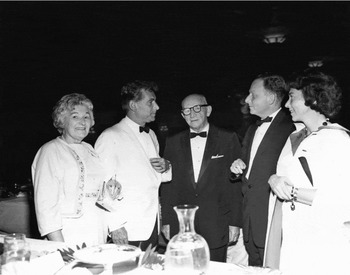
A photograph in the Brandeis archives illustrates the family ties between the Bernsteins and Brandeis (Fig. 2). The caption on the back reads, “June 10, 1961, Address for 10th Annual Banquet for Fellows; Mother and father of Leonard Bernstein and Irving and Verna Fine (Bernstein in white jacket, center).” Although the caption indicates that Leonard is in the center of the photo, it is actually Sam Bernstein who stands center stage; both he and Jennie Bernstein look at the camera, flanking their son with pride. The values embodied by Brandeis are those on which both parents and son could agree: a love of learning (despite the parents’ lack of a formal education), a pride in their Jewish heritage, and a desire to embrace and be embraced by American culture.
Address for Tenth Annual Banquet for Fellows, 10 June 1961. Left to right: Jennie Resnick Bernstein (Leonard's mother), Leonard Bernstein, Samuel Bernstein (Leonard's father), Irving Fine, and Verna Fine. Brandeis University photographer (name unknown). Office of Communications, Department of Media Relations, Folder 46, Robert D. Farber Archives and Special Collections Department, Brandeis University. Courtesy of the Robert D. Farber Archives and Special Collections Department, Brandeis University.

When Sam Bernstein died, President Sachar wrote to Leonard, one of many heartfelt letters they exchanged over the years. The second paragraph of Sachar's letter is worth quoting at length:
Your Father and I did not meet very often, perhaps four or five times. We needed neither meetings nor speech for our hearts to commune for I know that incredible immigrant generation; my parents were part of it. They came to this country with two hands and a determined will, little else. They had no time for self-pity; they remembered the bread of affliction and they had no quarrel with early poverty if it did not restrict opportunity. They did not demand reparations. They just dug in and carved out lives for themselves and their families. Above all, they were tenacious when it came to educating their children, so that the youngsters could fit creatively into the new world. Your Father worked hard for everything that came to him and he spiced adversity and frustration with a sublime sense of humor that places experience in perspective. I never saw this better manifested than the night he stood in for you at our annual Associates function. He completely captivated the huge audience with his dry, Talmudic wit, and his endearing self-deprecation. Yet, there was a serious undertone to what he said and the audience responded with love and tears because they so identified with him.Footnote 71
Sachar's poignant tribute to Sam Bernstein is a testament to the importance of Brandeis for Sam and his generation of Jewish immigrants. The fact that it was Sam who stood in for Leonard at a Brandeis function, rather than a comparable celebrity, serves as further evidence that family and community ties were at the root of Leonard's connection with Brandeis.
Obviously, there were a number of motivating factors behind Bernstein's decision to affiliate with Brandeis, beyond what I have discussed in this article. Throughout his career Bernstein showed a love and a true gift for teaching, as demonstrated by his Young People's Concerts, Omnibus television programs, and the Norton lectures he gave at Harvard in 1971. Bernstein was certainly not alone among his peers in American music in lending his support to Brandeis in its early years, including his close friends Irving Fine, Aaron Copland, and Marc Blitzstein. It is impossible to completely untangle the complex motivations that led Bernstein to support Brandeis so actively over the years. However, his longtime association with this Jewish-sponsored institution allowed him to honor a sense of both pride and obligation toward the Boston Jewish community—and to the immigrant generation of his parents—long after he had ostensibly left his hometown for good.