Numerous alien species of Indo-Pacific origin have been introduced to the Mediterranean via the Suez Canal since its opening in 1869. These species, named lessepsian migrants, have made a significant impact on the ecosystem in the eastern Mediterranean and more than 60 fish species from the Red Sea have been encountered in the Mediterranean since the beginning of the invasion (CIESM, 2008). In the Adriatic, 11 lessepsian migrants have been recorded so far. Except for the first records, no additional records of any lessepsian migrants have been reported for the Adriatic until now.
The bluespotted cornetfish Fistularia commersonii (Rüppel, 1835) is a reef-associated species of minor commercial fisheries importance. It is widely distributed in the Indo-Pacific and eastern central Pacific (Froese & Pauly, 2003). In the Mediterranean, the presence of this species was documented for the first time in Israel in 2000 (Golani, Reference Golani2000).
The aim of this paper is to present a new additional record of the ‘lessepsian sprinter’ (Karachle et al., Reference Karachle, Triantaphyllidis and Stergiou2004), the bluespotted cornetfish Fistularia commersonii, as a possible indicator of the spreading of this species in the Adriatic. Morphometric features of the Adriatic specimen are also presented.
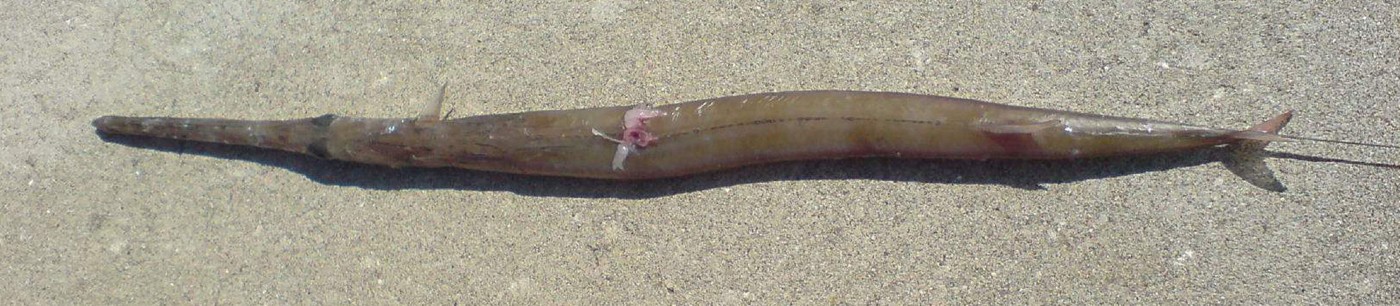
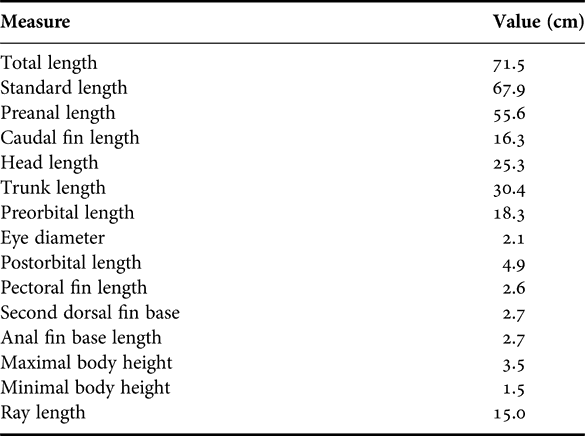
On 19 December 2007, a 715 mm total length (TL) specimen (Figure 1) of the bluespotted cornetfish, F. commersonii, was found washed up on the shore of Bar (Montenegro, southern Adriatic 42°04′N 19°05′E) probably as a consequence of an evident injury. The specimen weighed 350 grams. Examination of the stomach showed no traces of any food items and the gonads were inconspicuous which suggests that this specimen was immature. The morphometric characteristics of the specimen are presented in Table 1. The specimen had typical diagnostic features of the species such as: 15 dorsal, 14 anal, 14 pectoral and six pelvic fin rays; no elongated body plates along the dorsal midline or in front and behind the dorsal fin (Golani, Reference Golani2000). This record represents the third record of F. commersonii in the Adriatic Sea. In the summer of 2006, two specimens of F. commersonii were recorded in the waters off Tricase Porto (south-western Adriatic, Italy, TL = 1020 mm) and off Sveti Andrija (south-eastern Adriatic, Croatia, TL = 1150 mm), respectively (Dulčić et al., Reference Dulčić, Scordella and Guidetti2008).
Fistularia commersonii, 715 mm TL, Montenegrin coast of the Adriatic Sea.

Morphometric measurements of Fistularia commersonii from the Adriatic Sea.

The invasion and spreading of the bluespotted cornetfish Fistularia commersonii (Fistularidae) has been particulary intense in the Mediterranean. After a population explosion along the coast of Israel it subsequently spread westward and reached the shores of southern Italy (Azzurro et al., Reference Azzurro, Pizzicori and Andaloro2004) and the Tunisian coast (Charfi-Cheikhrouha, Reference Charfi-Cheikhrouha2004) eventually invading the western Mediterranean basin at Sardinia Island (Pais et al., 2006). In 2007 it was recorded in large numbers from Latium waters in the central Tyrrhenian Sea suggesting the establishment of a self-sustained population in the western Mediterranean basin (Psomadakis et al., Reference Psomadakis, Scacco, Consalvo, Bottaro, Leone and Vacchi2008). Fistularia commersonii has a high rate of northward expansion (Karachle et al., Reference Karachle, Triantaphyllidis and Stergiou2004). In 2001 this species appeared in the waters of Rhodes Island in considerable abundance (Corsini et al., Reference Corsini, Kondilatos and Economidis2002) and subsequent records followed from the Anatolian coast, Turkey (Bilencenoglu et al., Reference Bilecenoglu, Taskavak and Kunt2002) and Aegean Sea (Karachle et al., Reference Karachle, Triantaphyllidis and Stergiou2004). Its spreading is characterized by very short intervals between new records, followed by rapidly increasing abundance at the invaded areas, therefore it could be considered as one of the most successful among lessepsian migrants (Karachle et al., Reference Karachle, Triantaphyllidis and Stergiou2004). Furthermore, records from the Adriatic Sea represent the northernmost records of F. commersonii in the Mediterranean Sea.
The record presented in this paper, along with the two previous records, could suggest that F. commersonii has continued to spread through the Adriatic Sea. Kalogirou et al. (Reference Kalogirou, Corsini, Kondilatos and Wennhage2007) found that the most abundant prey by weight of F. commersoni in the Mediterranean were Spicara smaris, Boops boops and Mullidae spp. Since these species are of great importance to local fisheries and considering the fast spreading rate of F. commersonii followed by its rapidly increasing abundance, its potential negative effects on the local fish communities should be emphasized.
ACKNOWLEDGEMENTS
The authors express thanks to Slavko Petrovic for providing the specimen for examination and Ismet Alkovic for taking photographs of the specimen.